Disclosure: airfryerkitchensupply.com is reader-supported. When you buy through links on our site, we may earn an affiliate commission at no extra cost to you.
Where to buy
Every model in this guide to the best built vertical propane smokers was verified as a current Amazon listing before inclusion. Propane smokers are revised quietly and sold under similar names across years, so use the links below to check the current price on Amazon and confirm the exact model before ordering.
Quick links to the picks in this guide: Pit Boss 3-Series Propane Gas Vertical Smoker; Masterbuilt 40-inch ThermoTemp Propane Smoker (MB20051316); Masterbuilt MPS 230S Propane Smoker, 30-inch; Dyna-Glo DGY784BDP 36-inch Vertical LP Gas Smoker; Masterbuilt GS30D Propane 2-Door Smoker; Pit Boss 3-Series Gas Vertical Smoker, Red Hammertone (10773).
The case for the best built vertical propane smokers starts with the format’s honest virtues: a tall cabinet that stacks a lot of food over a small patio footprint, a gas burner that lights in seconds and holds temperature without electricity or fire-tending, and construction simple enough that a well-built one lasts for many years. Propane is the overlooked middle fuel of smoking — steadier than charcoal, independent of the power outlet that electric cabinets need, and cheaper to run than pellets for most households.
Because the machines are simple, build quality is the whole game. What separates the picks below from the thin, leaky cabinets that give the format a mixed name is door construction and sealing, burner quality, rack and frame solidity, and temperature control you can trust across a six-hour cook. All six were verified as current listings, and each review is candid about where its maker spent money and where the owner should expect to add a gasket or a better thermometer.
Expect the truth about the category, too: this is a shrinking niche. The big brands now pour their energy into electric and pellet models, so the propane cabinet market is a handful of proven designs rather than a flood of new ones. That makes choosing well easier — the survivors below have survived for reasons.
In this guide
Quick Picks
Pit Boss 3-Series Propane Gas Vertical Smoker — Best Overall. The most complete propane cabinet in the current market: 983 square inches across 4 racks, a stated 100°F to 300°F range that reaches lower than rivals — interesting for jerky and sausage — an HVR controller, and a proper wood chip tray. The modern standard for the format. Check price on Amazon.
Masterbuilt 40-inch ThermoTemp Propane Smoker (MB20051316) — Best Thermostat Control. The propane cabinet that behaves like an oven: Masterbuilt’s ThermoTemp system uses a thermostat to hold your set temperature, rather than a manual valve you babysit, across a big 40-inch, 960 sq in cabinet. The thinking propane buyer’s pick. Check price on Amazon.
Masterbuilt MPS 230S Propane Smoker, 30-inch — Best Value. The straightforward value pick of the format: a 30-inch Masterbuilt propane cabinet with the brand’s standard layout, at the gentlest price among the major-brand models here. No thermostat, no app — just a proven cabinet that smokes dinner. Check the current price on Amazon. Check price on Amazon.
Dyna-Glo DGY784BDP 36-inch Vertical LP Gas Smoker — Best Wide-Door Design. A 36-inch LP cabinet from Dyna-Glo, a brand that has kept faith with gas smokers while others wandered off to pellets. Generous vertical capacity, powder-coat finish, and the straightforward burner-and-cabinet design the format’s loyalists prefer. Check price on Amazon.
Masterbuilt GS30D Propane 2-Door Smoker — Best Two-Door Design. The clever ergonomic answer to the cabinet’s oldest flaw: two doors, so adding chips or water through the lower door does not dump the cooking chamber’s heat. A design idea so sensible that its scarcity in the current market is the surprise. Check price on Amazon.
Pit Boss 3-Series Gas Vertical Smoker, Red Hammertone (10773) — Best Finish and Style. The 3-Series gas cabinet wearing Pit Boss’s red hammertone finish — the same practical vertical platform as its black sibling, in a finish that hides wear gracefully and looks like equipment rather than an appliance. For the patio where the smoker is seen, not stored. Check price on Amazon.
How These Picks Were Chosen
Picks were verified through Amazon’s catalog data, with each model’s stated capacity, rack count, and temperature range taken from the manufacturer’s listing. They were judged on cabinet and door build, burner and control quality, usable capacity, and the ownership record of the design — in a mature, slow-changing category, a model’s years in production are genuine evidence. Two-door and thermostat-controlled designs were credited for solving real problems: heat loss at reload, and temperature drift.
Prices are not printed; check the current price on Amazon, and remember to budget for a tank, a cover, and — for most models — a roll of gasket tape in the same purchase.
A word about the category’s maturity, because it shaped this list’s confidence: propane cabinets change slowly, so the designs here have accumulated years of owner evidence rather than months of launch reviews. Where a model has been in production a long time, that record was treated as data — thousands of winters, tank changes, and holiday turkeys survived. Newer entrants were required to show a specification advantage, not merely a newer badge, to displace them, and exactly one — the range-leading Pit Boss — did. That is how a mature category should be bought: incumbents by default, challengers by proof.
The 6 Best Built Vertical Propane Smokers

Pit Boss 3-Series Propane Gas Vertical Smoker — Best Overall
Pit Boss is one of the few major brands still investing in propane cabinets, and the 3-Series shows it. The capacity is generous without being cavernous, the four racks are arranged for real loads, and the temperature range deserves attention: a floor around 100°F opens gentle work — drying jerky, finishing sausage — that cabinets starting at 200°F simply cannot do, while the 300°F ceiling covers poultry crisping better than most.
It suits the propane buyer who wants the current, supported model rather than a legacy design: families, jerky makers, and anyone whose patio lacks a convenient outlet. It does not suit the cold-smoking purist — 100°F is low, but it is not cold smoking — nor the charcoal devotee.
Strengths
- Widest stated temperature range in the roundup, reaching genuinely low
- 983 sq in across 4 racks is well-matched to family and batch cooking
- Current model from a major brand — parts and support exist
Trade-offs
- Door sealing still benefits from owner gasket care, as with the class
- Propane consumption on long cooks means keeping a spare tank habit
- Cabinet thermometer should be verified against a probe, as on all smokers
| Cooking space | 983 sq in, 4 racks |
| Temperature range | 100°F to 300°F |
| Control | HVR controller |
| Fuel system | Wood chip tray |
What earns this model the top spot is completeness: no single specification is missing. Capacity, range, racks, chip system, brand support — the checklist a propane buyer writes is the checklist this smoker satisfies, which cannot be said of rivals that beat it in one column and forfeit another. In a niche category, the complete product from the committed brand is the rational default.
Buy it as the format’s current standard. Check the current price on Amazon, and add the gasket and a second tank to the plan from day one.
The low end of its range deserves a second look from a specific reader: the home sausage maker. Sausage smoking is a staircase — drying, then smoking at gradually rising temperatures, finishing at a safe heat — and a cabinet that works honestly from around 100°F climbs that staircase without the ice baths and door-cracking improvisations that higher-floor cabinets demand. Jerky makers will recognize the same virtue. A specification that looks like a footnote is, for two entire branches of the craft, the headline — and it is why this model leads a roundup it might otherwise merely join.
Its range also future-proofs the purchase: the cook who buys it for ribs discovers jerky by autumn and sausage by winter, without a second machine. Few specifications repay their owner in new hobbies; a 100°F floor is one of them.
Best for: most propane buyers — families, jerky and sausage makers / Not suited for: cold smokers or charcoal purists
Check on Amazon — check the current price on Amazon before you decide, because configurations and included accessories change.

Masterbuilt 40-inch ThermoTemp Propane Smoker (MB20051316) — Best Thermostat Control
Most propane smokers are a burner and a knob, and their temperatures drift with weather, tank pressure, and time. The ThermoTemp design closes that loop with a thermostat: set the temperature, and the burner modulates to hold it. For long cooks — a brisket through a windy afternoon — that is the difference between propane’s convenience and propane’s reputation, and it is why this model has a devoted following.
It suits the cook who chose propane precisely to avoid tending, and wants the promise kept, at family-and-crowd capacity. It does not suit the minimalist who prefers a valve and a gauge; the thermostat is a component, and components can eventually need service.
Strengths
- Thermostat control holds temperature like an oven — unique in this class
- 960 sq in 40-inch cabinet handles whole birds and big batches
- Set-and-forget character makes propane’s convenience real
Trade-offs
- Thermostat system adds a serviceable component manual models lack
- Analog-era presentation; no app, no digital display
- Large cabinet is more than small households need
| Cooking space | 960 sq in |
| Control | ThermoTemp thermostat control |
| Size | 40-inch cabinet |
Judge this smoker on the problem it solves. Propane’s knock has never been flavor or capacity — it is drift, the slow wander that turns a 225°F plan into a 190°F or 260°F reality. A thermostat is the direct, engineered answer, and Masterbuilt remains the brand that bothered to build it into a cabinet at this size and price class.
If your cooks are long and your attention is elsewhere, this is your propane smoker. Check the current price on Amazon; it prices as the premium Masterbuilt, and the thermostat is what the premium is for.
Thermostat control changes the cook’s job in a way worth picturing: instead of visiting the smoker every half hour to nudge a valve against the weather, you visit to add chips, check the food, and enjoy the process. For the host cooking a brisket through a party, or the parent smoking through a Saturday of obligations, that is not a convenience — it is the difference between smoking and not smoking. Technologies should be judged by the cooks they make possible, and by that standard the ThermoTemp earns its premium in a single holiday weekend.
Verify the thermostat against a probe on your first cooks and note any consistent offset in your notebook; a known, steady offset is no obstacle at all, and this cabinet’s steadiness is the entire point of owning it.
Best for: long cooks where temperature must hold without tending / Not suited for: minimalists who prefer a simple manual valve
Check on Amazon — check the current price on Amazon before you decide, because configurations and included accessories change.

Masterbuilt MPS 230S Propane Smoker, 30-inch — Best Value
The MPS 230S is the propane smoker as commodity done right: a sensibly sized 30-inch cabinet from the category’s biggest name, with the expected racks, chip tray, and water pan arrangement, sold at a price that makes it the format’s natural first purchase. It asks the owner to manage temperature at the valve like propane smokers always have, and rewards that small attention with entirely respectable results.
It suits first-time propane buyers and smaller households who want the fuel’s convenience without the ThermoTemp premium. It does not suit the set-and-forget cook — that is the model above — nor crowd-scale cooking.
Strengths
- Major-brand cabinet at the format’s friendliest serious price
- 30-inch size suits most families without heating a cavern
- Simple manual system — nothing electronic to fail
Trade-offs
- Manual valve control means temperature drift is the cook’s problem
- Door seal improves with owner-added gasket, as class-wide
- Fewer refinements than the ThermoTemp and Pit Boss models
| Size | 30-inch cabinet |
| Fuel | Propane |
| Brand line | Masterbuilt MPS series |
Value picks earn their place by having no disqualifying flaw, and the 230S’s record is exactly that: a known design, from a known maker, at a known-good price, with weaknesses — drift, sealing — that are the class’s weaknesses rather than its own. An owner who adds a gasket and learns the valve gets most of the propane experience for the least money in this guide.
It is the right first propane smoker and a perfectly rational only propane smoker. Confirm the current model when you check the current price on Amazon, as Masterbuilt’s naming across years is genuinely confusing.
Its simplicity has a second dividend: diagnosability. When a manual propane smoker misbehaves, the fault tree is short — gas supply, burner cleanliness, valve, vent — and every branch can be checked by the owner with basic tools in minutes. Owners keep these cabinets for years partly because there is so little that can strand them. In an era of smokers that fail by software, a machine whose entire intelligence is a valve and your judgment is not primitive; it is resilient, and resilience is a build quality this guide is explicitly about.
A wind screen and a consistent parking spot will do more for this smoker’s temperature manners than any modification — propane cabinets are honest machines that simply ask for honest conditions.
Best for: first-time propane buyers and smaller households / Not suited for: set-and-forget cooks or crowd feeders
Check on Amazon — check the current price on Amazon before you decide, because configurations and included accessories change.
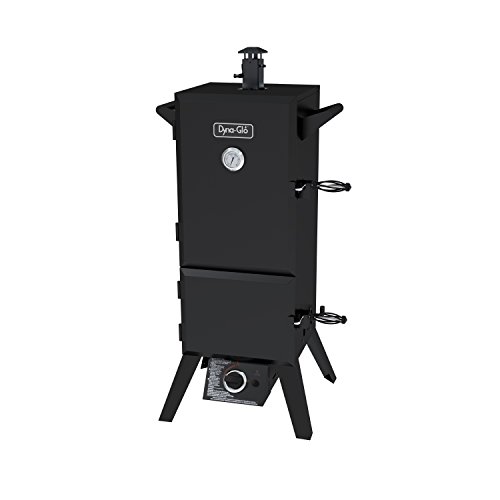
Dyna-Glo DGY784BDP 36-inch Vertical LP Gas Smoker — Best Wide-Door Design
Dyna-Glo’s propane cabinets have a quiet following among cooks who value access: a tall cabinet you can actually load, racks that take real food, and a burner system with no electronics between you and the fire. The 36-inch size splits the difference between the 30-inch value models and the 40-inch crowd machines, which for many households is exactly the right split.
It suits the propane loyalist who wants capacity and simplicity from a gas-specialist brand. It does not suit the buyer who wants thermostat control or the newest features; Dyna-Glo’s proposition is proven design, not novelty.
Strengths
- Gas-specialist brand with a long propane cabinet record
- 36-inch capacity is the class’s useful middle size
- Simple, serviceable design with no electronics to fail
Trade-offs
- Manual temperature management, with the class’s usual drift
- Finish and sealing benefit from owner care and gasket work
- Feature set is traditional — no probes, apps, or thermostats
| Size | 36-inch vertical |
| Finish | Black powder coat |
| Fuel | LP gas |
There is a case that Dyna-Glo understands this format’s users better than the giants do: people who keep a propane cabinet for a decade, cook on it monthly, and want parts and predictability rather than model-year excitement. The DGY784BDP is that philosophy in steel — unglamorous, correctly sized, and built to be maintained rather than replaced.
Choose it if you are replacing a beloved old gas cabinet or buying the format for the long term. Check the current price on Amazon; it typically sits in the honest middle of the category.
A word for the cabinet’s proportions, because 36 inches is the size cooks land on after owning both neighbors. The 30-inch class makes whole birds and long racks a negotiation; the 40-inch class heats a great deal of empty air for Tuesday’s chicken. Thirty-six inches of vertical cabinet is where family-scale and event-scale overlap — big enough for the holiday, sane enough for the weeknight. Dyna-Glo’s long run with this size suggests the market agrees, and the cooks who replace a worn cabinet with the same size again are the strongest evidence in this entire category.
Keep a spare regulator and hose on the shelf if this is your only smoker; they are inexpensive, they are the parts weather and time actually consume, and having them turns a ruined Saturday into a fifteen-minute repair.
Best for: propane loyalists wanting proven, serviceable design / Not suited for: feature seekers wanting thermostats or connectivity
Check on Amazon — check the current price on Amazon before you decide, because configurations and included accessories change.

Masterbuilt GS30D Propane 2-Door Smoker — Best Two-Door Design
Every cabinet smoker owner knows the moment: the chips are spent, the water pan is low, and opening the one big door costs you the temperature you spent an hour building. The GS30D’s two-door layout separates the fire and chip zone from the food chamber, so service happens below while the cook continues above. It is the kind of improvement that sounds minor in a listing and feels major at hour four of a brisket.
It suits long-cook cooks — brisket, shoulders, big sausage sessions — who reload chips and water often. It does not suit the buyer who wants the largest capacity or a thermostat; this model’s virtue is its doors, not its size or electronics.
Strengths
- Two-door layout preserves chamber heat during chip and water service
- Proven Masterbuilt design with a long production history
- Right-sized cabinet for most households
Trade-offs
- Two doors mean two seals to maintain and gasket
- Manual temperature control, with class-typical drift
- An older design in a market that increasingly ignores propane
| Design | Two-door cabinet |
| Size | 30-inch class |
| Fuel | Propane |
Design ideas should be judged by the problem they retire, and heat loss at reload is a real, recurring cost in cabinet smoking — measured in recovery time, fuel, and temperature spikes on the food. The GS30D retires it with sheet metal and hinges rather than electronics, which is why owners who have cooked on one tend to evangelize the layout.
If your smoking style involves long cooks and frequent chip service, the doors are worth choosing a smoker for. Check the current price on Amazon — as a legacy design, its pricing can be surprisingly gentle.
The two-door idea has one more beneficiary nobody mentions: the water pan. In single-door cabinets, the pan — buried at the bottom, under the food — is effectively unserviceable mid-cook, so it runs dry in the long cooks that need it most. The GS30D’s lower door makes the pan a living part of the system again: checkable, refillable, working for the whole cook. Humidity control across ten hours, rather than across the first three, is a quiet quality difference you can taste in the bark and the yield of everything the cabinet produces.
Label your chip rhythm in the notebook — how long a tray lasts at your usual temperatures — and the two-door advantage compounds: service becomes a scheduled, thirty-second errand instead of an investigation.
Best for: long-cook cooks who reload chips and water often / Not suited for: buyers wanting maximum capacity or thermostat control
Check on Amazon — check the current price on Amazon before you decide, because configurations and included accessories change.
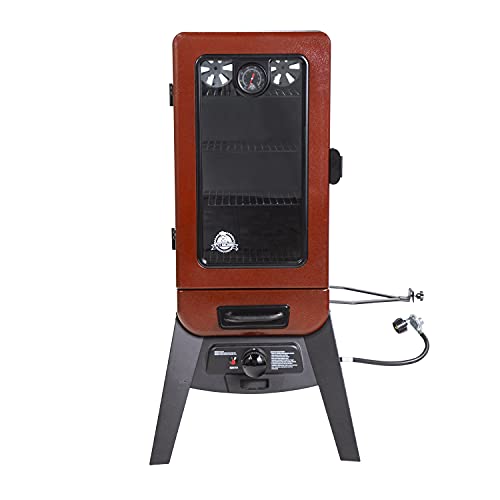
Pit Boss 3-Series Gas Vertical Smoker, Red Hammertone (10773) — Best Finish and Style
Finish is not vanity on outdoor equipment; it is corrosion strategy and pride of ownership in one coat. Hammertone finishes are the traditional choice on workshop machinery because the textured surface hides scratches, shrugs off minor dings, and ages without looking tired — and on a propane cabinet that lives outside year-round, those are working virtues. Underneath, this is the same 3-Series gas platform as the roundup’s overall pick, with the same rack-and-cabinet practicality.
It suits the buyer who wants the Pit Boss platform and a patio with a point of view. It does not suit the bargain hunter, since finish variants rarely carry the deepest discounts — compare both 3-Series listings before deciding what the color is worth to you.
Strengths
- Hammertone finish hides wear and ages gracefully outdoors
- Same proven 3-Series gas cabinet platform as the overall pick
- Distinctive equipment look rather than appliance styling
Trade-offs
- Finish variants can price above the standard black model
- Same class-wide notes: gasket care and a probe thermometer advised
- Color is a commitment — it will be red for a decade
| Series | Pit Boss 3-Series |
| Finish | Red Hammertone |
| Model | 10773 |
Treat this pick as the overall winner in a different coat, and the decision becomes refreshingly simple: if the red hammertone makes you happy every time you cross the patio, it will also make you maintain the smoker better, cover it more faithfully, and keep it longer — which is to say, the finish is a durability feature operating through the owner. Equipment people have always known this; it is why good tools look like something.
Compare the two 3-Series listings when you check the current price on Amazon, and buy the one you will enjoy looking at for ten years.
Hammertone’s practical virtues compound outdoors in a specific way: the textured finish does not show the fine scratching that glossy black accumulates from covers, brushes, and patio life, so the smoker’s tenth year looks much like its second. For equipment that lives in view — and a cabinet this size always lives in view — that graceful aging protects both your satisfaction and the machine’s resale dignity. It is the same reason workshop machinery has worn this finish for a century, and it suits a smoker exactly as well as it suits a lathe.
Photograph it new. A decade from now, beside a machine that still looks like equipment rather than archaeology, that photo will make the case for buying finishes properly better than this review can.
Best for: buyers who want the 3-Series platform with lasting style / Not suited for: pure bargain hunters indifferent to finish
Check on Amazon — check the current price on Amazon before you decide, because configurations and included accessories change.
Comparison Table
| Pick | Badge | Key spec | Best for |
|---|---|---|---|
| Pit Boss 3-Series Propane Gas Vertical Smoker | Best Overall | 983 sq in, 4 racks, 100–300°F range | most propane buyers — families, jerky and sausage makers |
| Masterbuilt 40-inch ThermoTemp Propane Smoker (MB20051316) | Best Thermostat Control | 960 sq in with thermostat-controlled burner | long cooks where temperature must hold without tending |
| Masterbuilt MPS 230S Propane Smoker, 30-inch | Best Value | 30-inch propane cabinet, the value standard | first-time propane buyers and smaller households |
| Dyna-Glo DGY784BDP 36-inch Vertical LP Gas Smoker | Best Wide-Door Design | 36-inch LP cabinet with wide access | propane loyalists wanting proven, serviceable design |
| Masterbuilt GS30D Propane 2-Door Smoker | Best Two-Door Design | Two-door design separates fire access from food | long-cook cooks who reload chips and water often |
| Pit Boss 3-Series Gas Vertical Smoker, Red Hammertone (10773) | Best Finish and Style | 3-Series gas cabinet in red hammertone finish | buyers who want the 3-Series platform with lasting style |
How to Choose a Vertical Propane Smoker
Decide your relationship with temperature control first, because it splits the category. Manual-valve smokers — most of this list — are simple, cheap, and honest, but they drift with weather and tank state, and the cook is the thermostat. The ThermoTemp model closes that loop mechanically. If your cooks are long and your attention is divided, the thermostat is worth its premium; if you cook attentively and mostly for a few hours, a manual cabinet plus a good probe thermometer serves perfectly well.
Second, think in doors. A separate lower door for chips and water preserves the cook every time you service the fire, and tall cabinets benefit most. Third, size by racks and realistic loads rather than headline area, and prefer models whose makers still support the line — in a niche category, a living brand is a feature. Finally, plan the whole purchase: tank, regulator condition, cover, gasket tape, and a reliable probe thermometer are part of owning any of these machines well.
Propane vs Electric vs Pellet Cabinets: An Honest Comparison
Propane’s case is independence and response: no outlet needed, instant ignition, fast recovery after door openings, and running costs that undercut pellets for most users. Its costs are drift (unless you buy the thermostat model), tank management, and a category the industry is slowly deprioritizing. Electric cabinets hold temperature best and cost least to run, but need power at the patio and produce the mildest smoke. Pellet machines automate everything and cost the most to buy and feed.
For a cabin, a tailgate property, a rental with a dubious outdoor outlet, or a household that simply likes fire it can see and adjust, propane remains the rational fuel — which is why these six cabinets, mature designs all, continue to earn their patios. Choose the fuel by your site and habits, then choose the build quality within it; this guide exists because the second choice matters as much as the first.
Reading a Propane Smoker’s Specification Like an Owner
Three numbers decide a propane cabinet’s character, and all three are routinely misread. Capacity should be counted in racks and realistic loads — a turkey’s height, a brisket’s length — not in the largest square-inch figure the listing can construct. Temperature range should be read at both ends: the floor decides whether jerky and sausage are citizens or guests, and the ceiling decides whether poultry skin ever crisps. And the control type — manual valve or thermostat — decides who holds the temperature at hour six: you, or the machine.
Apply those readings to this roundup and the picks sort themselves, which is the point of a guide: the Pit Boss leads on range, the ThermoTemp on control, the Masterbuilt and Dyna-Glo value models on honest manual simplicity. A buyer who reads specifications this way will never be surprised by their smoker, and surprise — in a gas appliance bought for a decade — is the one feature nobody wants.
Tank, Regulator, and Hose: The Supporting Cast That Decides Reliability
Most propane smoker ‘failures’ are not in the smoker. A regulator that has tripped its safety flow limiter delivers a lazy flame and a cabinet that will not reach temperature; a perished hose leaks the gas your burner needed; an nearly-empty tank loses pressure as it cools mid-cook. The fixes are correspondingly unglamorous: learn your regulator’s reset procedure, inspect and replace hoses on schedule rather than on failure, and keep the two-tank rotation so supply is never the variable.
Build this supporting cast into the purchase, as the guide above advises, and the cabinet itself — any of the six here — will show you its true reliability. Owners who blame a smoker for its regulator’s behavior replace good machines; owners who learn the system keep one machine happily for a decade. The difference is fifteen minutes of reading, once.
Altitude, Wind, and Cold: Running a Propane Cabinet in Real Weather
Propane cabinets are weather instruments whether they like it or not, and three conditions deserve a plan. Wind is the chief thief: it strips heat from the cabinet’s walls and worries the burner flame, so a sheltered siting — a corner, a fence line, never an enclosed space — is worth more than any accessory. Cold is the slow tax: longer preheats, faster tank pressure drop, and cooks that stretch; a full tank and patience answer it. Altitude thins the air and the flame’s vigor with it, asking for slightly different valve habits that a few documented cooks will teach you.
The common thread is the notebook this guide keeps recommending. A propane cabinet in known weather, with known settings, is a predictable machine; the cooks who call the format unreliable are usually cooking in unrecorded weather with unrecorded valves. Record three cooks in each season and your cabinet becomes a year-round instrument — which, given that propane needs no outlet and fears no power cut, makes it the most dependable winter smoker on many properties.
How to Use a Vertical Propane Smoker Safely and Well
Propane smoking is simple, but it is still fire in a box fed by a gas bottle. This routine covers setup, the cook, and shutdown for any model in this roundup.
- Site the smoker outdoors on a level, non-combustible surface, clear of walls, eaves, and dry vegetation, and check the tank, hose, and regulator connections with soapy water — bubbles mean a leak to fix before any flame.
- Fit gasket tape to the door if your model lacks a seal, fill the water pan, and load the chip tray with dry chips or chunks. Preheat with the door closed until the cabinet stabilizes at your target, verified by a probe thermometer at rack level rather than the door gauge alone.
- Load food quickly, spacing pieces for airflow, and close the door. Note the valve setting, the weather, and the time — propane cabinets are consistent enough that your notes become a reliable personal manual within a few cooks.
- Manage temperature in small valve adjustments, waiting several minutes between changes. Chasing the needle with big turns is the beginner’s error that manufactures the drift this format is blamed for.
- Service chips and water through the lower door if your model has one; if not, work fast and accept the brief dip. Add food-safe smoke wood little and often rather than in one bitter cloud.
- At the end, close the tank valve first and let the burner consume the line gas, then shut the burner control. Once cool, empty the chip tray and drip components, wipe the door seal, and cover the smoker with the tank stored upright and outdoors.
That shutdown order — tank valve first — is the safety habit that matters most, and it costs nothing. Build it into muscle memory along with the soapy-water leak check at every tank change, and propane becomes what it should be: the least dramatic fuel in smoking.
Common Buying Mistakes
Trusting the door thermometer. Cabinet door gauges are approximate and age badly. A probe thermometer at rack level is the difference between cooking at the temperature you chose and cooking at the temperature you were told. Every model in this roundup deserves one.
Chasing temperature with the valve. Propane cabinets respond over minutes, not seconds. Big, impatient adjustments create the oscillation beginners blame on the smoker. Small turns, patient waits, and a notebook cure it.
Skipping the leak check. A soapy-water test at every tank change takes one minute and is the entire safety case for gas smoking. Hoses perish and connections loosen in storage; check them like it matters, because it does.
Running one tank with no spare. A brisket at hour seven is the worst moment to discover an empty bottle. The two-tank rotation — one on the smoker, one full in reserve — is the format’s oldest wisdom for a reason.
Neglecting the water pan and drip tray. An empty water pan removes your temperature buffer and dries the cabinet’s air; a full drip tray of old grease flavors food and courts flare-ups. Both are two-minute jobs that decide whether the next cook tastes clean.
Storing the smoker with the tank connected and the cover trapping moisture. A covered cabinet in a humid climate can become a rust incubator if it goes under the cover damp and stays there. Air the cabinet after wet-weather cooks, store the tank upright and outdoors per its own rules, and check under the cover monthly in the rainy season. The cabinet’s steel is only half its corrosion defense; the owner’s storage habits are the other half, and they cost nothing but attention.
Final Recommendation
The Pit Boss 3-Series propane model is the default recommendation: the most complete current cabinet in the format. Choose the Masterbuilt ThermoTemp instead if unattended temperature holding is your priority, the MPS 230S if value leads, the Dyna-Glo for proven gas-specialist simplicity, the GS30D if you reload chips through long cooks, and the red hammertone 3-Series if you want the winner’s platform with a finish that ages as gracefully as the machine.
Check the current price on Amazon for your pick, confirm the exact model — propane naming is a maze — and put the gasket, cover, spare tank, and probe thermometer in the same plan. That complete purchase, not the cabinet alone, is what a well-built propane setup actually is.
One last piece of timing advice: propane cabinets, as a mature category, are discounted less theatrically than pellet grills, but end-of-season clearances are real, and a cabinet bought in autumn seasons itself beautifully through the winter cooks that propane handles so well. If your purchase can wait for such a window, the savings belong in the supporting cast — the second tank, the quality cover, the probe thermometer — where they will serve you for the cabinet’s whole life. Buy the machine once, equip it properly once, and let the next decade be about cooking.
Revisit the shortlist: Pit Boss 3-Series Propane Gas Vertical Smoker; Masterbuilt 40-inch ThermoTemp Propane Smoker (MB20051316); Masterbuilt MPS 230S Propane Smoker, 30-inch; Dyna-Glo DGY784BDP 36-inch Vertical LP Gas Smoker; Masterbuilt GS30D Propane 2-Door Smoker; Pit Boss 3-Series Gas Vertical Smoker, Red Hammertone (10773).
Keep reading in this series: Best Built Vertical Smokers; Best Box Smokers; Best Built Bbq Smokers; Best Built Pellet Smokers; Best Bullet Smokers.
Frequently Asked Questions
Are propane smokers good for beginners?
Yes — they light instantly, need no electricity, and hold temperature more forgivingly than charcoal, while teaching real fire and smoke judgment. A manual model plus a probe thermometer is a complete, inexpensive education; the thermostat model is even easier for long cooks.
How long does a propane tank last in a smoker?
A long time — cabinet burners are small, and a standard tank typically covers many long cooks. Exact life depends on temperature, weather, and cabinet size, which is why the standing advice is a two-tank rotation: one in use, one full in reserve, swapped without drama.
Can a propane smoker reach low enough temperatures for jerky?
Some can. The Pit Boss 3-Series in this guide states a range beginning around 100°F, which suits jerky and sausage finishing. Models with higher minimums can still make jerky with door and vent management, but the low-range models do it properly and safely with less fuss.
Propane or electric cabinet — which should I choose?
Choose propane for outlet independence, fast heat recovery, and a slightly more assertive smoke; choose electric for the steadiest temperatures and lowest running cost where power is convenient. Both formats appear across this series of guides, and the honest answer is that your patio’s power situation often decides correctly for you.
Do propane smokers need a water pan?
In this format, effectively yes. The water pan buffers temperature swings, adds humidity that helps smoke adhere and bark form, and catches drips. Running dry is a technique for specific results, not a default — keep it filled for ordinary cooks.
Is a two-door propane smoker worth it?
For long cooks with frequent chip and water service, yes: the separate lower door preserves the chamber’s heat and smoke at every reload, which compounds over a ten-hour cook. For short cooks, the advantage shrinks and a single-door value model makes more sense.
Why is my propane smoker not getting hot enough?
Work the supporting cast first: confirm the tank is full and fully open, reset the regulator (close everything, disconnect, wait, reconnect, and open the tank valve slowly), and check the burner ports for spider webs or rust, which are classic seasonal blockages. If those are clear, inspect the hose for damage. The cabinet itself is the last suspect, not the first.
Can I convert a propane smoker to natural gas?
Not safely as a casual project. Gas appliances are jetted and rated for a specific fuel and pressure, and conversions belong to qualified technicians using manufacturer-approved kits where they exist. If your home has natural gas and you want its convenience, shop for a model built for it rather than adapting a propane cabinet.

