Disclosure: airfryerkitchensupply.com is reader-supported. When you buy through links on our site, we may earn an affiliate commission at no extra cost to you.
Where to buy
Every smoker in this guide to the best built bbq smokers was verified as a current Amazon listing before inclusion. Steel smokers are sold in several configurations and model years, so use the links below to check the current price on Amazon and confirm the exact model and included accessories before ordering.
Quick links to the picks in this guide: Oklahoma Joe’s Highland Offset Smoker; Oklahoma Joe’s Highland Reverse Flow Offset Smoker; Dyna-Glo Wide Body Vertical Offset Charcoal Smoker (DGO1890BDC-D); Oklahoma Joe’s Bandera Smoker and Grill; Char-Griller Smokin’ Pro Charcoal Grill and Offset Smoker; Royal Gourmet CC1830W Charcoal Grill with Offset Smoker.
Search for the best built bbq smokers and you are really asking a durability question: which smokers are put together well enough to hold heat, resist rust, and still be cooking in ten years? Construction is the specification that decides all the others, because a smoker with thin steel, leaky doors, and wandering welds cannot hold temperature no matter how good its thermometer looks, and a well-built one makes an average cook look skilled by simply doing the same thing every hour of every cook.
This roundup judges the mainstream steel market on build: steel weight and rigidity, door fit, weld and fastener quality, firebox design, and the honest compromises each maker chose at its price point. It concentrates on the offset and vertical-offset designs that dominate serious backyard barbecue, because that is where build quality varies most and matters most. All six picks are current, verified listings, and each review says plainly where its maker spent money and where it saved.
One truth up front: at these prices, no smoker is a welded custom pit, and none should be judged as one. The question is which factory builds behave best — sealing well, drafting cleanly, and aging gracefully — and the six below are the strongest answers in the current market.
In this guide
Quick Picks
Oklahoma Joe’s Highland Offset Smoker — Best Overall. The benchmark mid-market offset: 900 square inches of cooking area, a proper side firebox, and the heaviest-feeling construction in its price class. If you want one well-built offset that teaches real fire craft and lasts, this is the default recommendation. Check price on Amazon.
Oklahoma Joe’s Highland Reverse Flow Offset Smoker — Best Reverse Flow. The Highland’s smarter sibling: a reverse-flow baffle routes heat and smoke under and across the chamber before exiting, evening out the hot spot every traditional offset has, across a larger 1,093 square inches. For the cook who wants offset flavor with fewer compromises. Check price on Amazon.
Dyna-Glo Wide Body Vertical Offset Charcoal Smoker (DGO1890BDC-D) — Best Vertical Offset. A vertical cabinet married to a side firebox: the offset’s smoke path with a cabinet’s stacking capacity and small footprint. The wide-body format fits whole racks and big cuts that narrow verticals force you to cut down. A clever, well-executed hybrid. Check price on Amazon.
Oklahoma Joe’s Bandera Smoker and Grill — Best Classic Vertical Offset. The design that invented its category: a tall vertical smoking cabinet beside an offset firebox, with a grill on top of the firebox for good measure. Decades in production, beloved by a loyal owner base, and still a genuinely well-thought-out build. Check price on Amazon.
Char-Griller Smokin’ Pro Charcoal Grill and Offset Smoker — Best Budget Offset. The gateway offset: a full-size charcoal grill with a side firebox, dual damper control, and 1,130 square inches of total cooking space, at the friendliest price in this roundup. Its steel is lighter than the leaders — and its value is exactly why generations of pitmasters started here. Check price on Amazon.
Royal Gourmet CC1830W Charcoal Grill with Offset Smoker — Best Value Combo. A barrel grill and offset smoker combo that adds the things cooks actually touch — a front shelf, a wooden side table, tool hooks, and adjustable fire grates — across 783 square inches. Thoughtful ergonomics at a value price, for the grill-first cook who also smokes. Check price on Amazon.
How These Picks Were Chosen
Picks were verified through Amazon’s catalog data and assessed on build criteria that predict real performance: cooking-chamber and firebox construction, door and lid sealing, grate quality and adjustability, damper precision, mobility hardware, and the availability of the gaskets, covers, and mods that owners use to finish what the factory started. A smoker that needs a gasket kit is not disqualified — in this class most do — but one whose basic structure is flimsy is, however famous its badge.
Prices are not printed, because they move and because build value only makes sense against a current number: check the current price on Amazon for each model, and judge the steel you get for it.
A note on what was deliberately not rewarded: novelty. This category’s makers periodically announce redesigned smokers with new vents, new shelves, and new names, and most of those redesigns are styling exercises over unchanged structures. The picks above are the designs that have survived contact with thousands of owners and come out with their reputations enhanced — in the Bandera’s case, across decades. In a purchase meant to last ten years, a five-year production record is not a lack of innovation; it is the strongest specification on the page.
The 6 Best Built BBQ Smokers

Oklahoma Joe’s Highland Offset Smoker — Best Overall
The Highland is the smoker this category is measured against, and the reason is tactile: lift the lid, swing the firebox door, roll it across the patio, and everything feels a grade sturdier than the price suggests. The chamber holds 900 square inches of grates, the firebox is sized for real splits and charcoal beds, and the whole unit drafts the way an offset should once you learn its intake.
It suits the buyer who wants genuine offset barbecue — wood and charcoal, fire-tending included — in a factory build that will not embarrass the craft. It does not suit anyone wanting push-button convenience; an offset is a commitment, and this one rewards it honestly.
Strengths
- Sturdiest build feel in its class — doors, hinges, and wheels all inspire confidence
- 900 sq in chamber handles briskets and multi-rack rib cooks properly
- Huge owner community means every gasket, baffle, and tuning-plate question is already answered
Trade-offs
- Like most factory offsets, it seals better with an inexpensive gasket added by the owner
- Offset cooking demands fire management every 30–45 minutes — no exceptions
- Heavy; choose its home before assembly, not after
| Cooking area | 900 sq in |
| Type | Offset charcoal smoker and grill |
| Fuel | Charcoal and wood |
Build quality in an offset shows up as temperature behavior: the Highland’s chamber holds a steadier line than thinner rivals because its steel and fit waste less heat, and its firebox gives you the coal-bed control that separates barbecue from burnt offerings. It is also the rare factory smoker whose aftermarket is an asset — tuning plates, stack extensions, and gasket kits exist because the base unit is worth improving.
For the money the market currently asks, this is the best-built starting point in traditional barbecue. Check the current price on Amazon, and budget for a gasket and a good cover in the same order.
A note on learning curve, honestly: your first three cooks on any offset are tuition. The Highland’s virtue is that it makes the tuition cheap — its firebox takes a proper coal bed, its dampers respond predictably, and the enormous owner literature means every mistake you make has a named fix written by someone who made it first. By the fourth cook, most owners are producing barbecue they are proud to serve, and by the tenth they understand fire in a way no appliance can teach. That education is included in the price, and it never expires.
Its firebox size is the quiet headline: it accepts real splits and builds the deep coal bed that makes offset cooking stable rather than frantic. Many new owners discover that this, more than the chamber, is what they paid for.
Best for: aspiring offset cooks who want the class benchmark build / Not suited for: anyone seeking set-and-forget convenience
Check on Amazon — check the current price on Amazon before you decide, because configurations and included accessories change.

Oklahoma Joe’s Highland Reverse Flow Offset Smoker — Best Reverse Flow
Reverse flow is an engineering answer to the offset’s oldest flaw — the firebox end cooking hotter than the stack end. By forcing heat to travel the length of the chamber beneath a baffle before rising through the food and exiting, this design narrows the temperature gradient dramatically, and at 1,093 square inches it does so on a chamber big enough for the difference to matter across four racks of ribs.
It suits the detail-minded offset cook who loads the chamber full and wants the far rack to finish with the near one. It does not suit minimalists; the baffle system adds cleaning surface and the smoker asks the same fire-tending as any offset.
Strengths
- Reverse-flow baffle delivers the most even chamber temperatures in this roundup
- 1,093 sq in is the largest cooking area among the offsets here
- Same sturdy Oklahoma Joe’s construction as the benchmark Highland
Trade-offs
- Baffle plates add cleaning work after fatty cooks
- Still an offset — fire management remains the cook’s job
- Even heat costs more than the traditional version
| Cooking area | 1,093 sq in |
| Type | Reverse flow offset |
| Fuel | Charcoal and wood |
What you are buying here is forgiveness. A traditional offset in skilled hands matches it; a reverse flow in ordinary hands beats the traditional offset in ordinary hands, because the design absorbs the small fire fluctuations that otherwise print themselves onto the food as uneven doneness. For cooks who fill the chamber — the whole point of a big offset — that evenness is worth more than any other single feature.
Choose it over the standard Highland if you cook full loads often, and choose the standard model if you cook small and enjoy managing zones. Check the current price on Amazon for both before deciding; the gap between them is the decision.
Reverse flow has one more subtle dividend: smoke residence. Because the smoke travels the chamber’s length twice — under the baffle, then back across the food — it spends more time with the meat than in a traditional offset of the same size, and cooks often report a deeper smoke presence at the same fuel and fire. Purists will note, correctly, that a master of the traditional offset can match anything; the reverse flow simply moves that result within reach of the rest of us, on a Tuesday, with a full chamber.
Give the baffle system a seasoning cook of its own before judging temperatures — the plates become part of the thermal system once coated and cured, and the evenness owners praise is the finished state, not the first fire’s.
Best for: offset cooks who load the chamber full and want even heat / Not suited for: small-batch cooks who enjoy managing hot zones
Check on Amazon — check the current price on Amazon before you decide, because configurations and included accessories change.
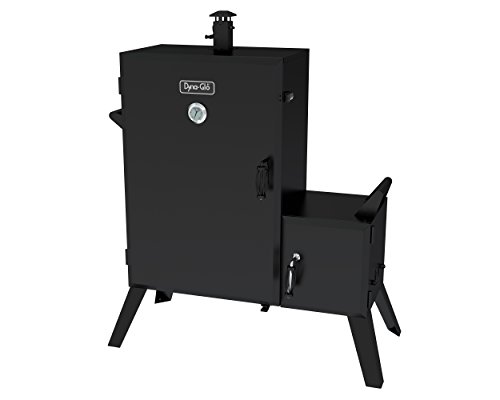
Dyna-Glo Wide Body Vertical Offset Charcoal Smoker (DGO1890BDC-D) — Best Vertical Offset
Vertical offsets solve the offset’s footprint problem. Instead of a long horizontal chamber, the cooking space stacks upward in a wide cabinet while the fire sits in a side box, sending heat and smoke up through the food. The wide-body design is the important detail: standard verticals are notoriously narrow, forcing rib racks to be halved and briskets to be squeezed; this one was drawn wider on purpose.
It suits the cook who wants offset flavor and cabinet capacity on a patio that cannot host a long horizontal pit. It does not suit the traditionalist who wants a horizontal chamber’s grilling surface and zone behavior.
Strengths
- Cabinet capacity on a compact footprint — the patio-friendly offset
- Wide body fits untrimmed racks and larger cuts
- Offset firebox keeps direct heat away from food for gentle, even smoking
Trade-offs
- Vertical cabinets leak heat at door seams without owner-added gasket care
- Temperature varies by rack height; rotation is part of the technique
- Less grilling versatility than a horizontal offset
| Type | Wide body vertical offset charcoal smoker |
| Firebox | Side offset firebox |
The build question for vertical offsets is the door: a tall, wide door is a big leak waiting to happen, and this model’s owners consistently treat gasket sealing as step one. Do that, and the design’s physics take over — rising heat, stacked capacity, and a fire you can tend without touching the food chamber. It is one of the most space-efficient ways to cook for a crowd with real wood smoke.
If your patio is small but your gatherings are not, this is the best-built answer in the roundup. Check the current price on Amazon, and order the gasket in the same box.
Loading strategy is where this design rewards thought: heavy, long-cooking cuts low in the cabinet where heat arrives first, quicker items above, and a rotation at the halfway point of long cooks. Owners who develop that choreography produce startling amounts of food from a two-foot square of patio — the vertical offset’s entire reason to exist. The wide body is what makes the choreography possible; in a narrow vertical, the menu itself is constrained before the fire is even lit, and no technique fixes geometry.
A chimney starter of charcoal plus small splits is this firebox’s favorite diet; feed it in that rhythm and the cabinet’s temperature story becomes remarkably calm for a charcoal machine of its capacity.
Best for: small patios that still need crowd capacity and offset flavor / Not suited for: cooks who want a horizontal chamber for grilling and zones
Check on Amazon — check the current price on Amazon before you decide, because configurations and included accessories change.
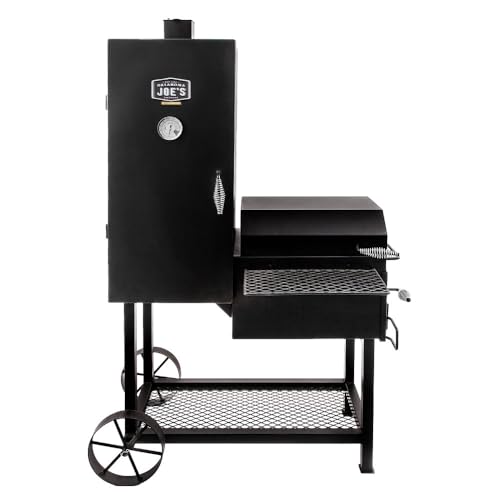
Oklahoma Joe’s Bandera Smoker and Grill — Best Classic Vertical Offset
The Bandera’s layout is a small masterpiece of barbecue ergonomics: firebox low on one side, tall cabinet above and beside it, and a grilling surface over the fire for searing and sides. Smoke and heat rise through the cabinet’s racks, giving the vertical format’s capacity with an offset’s clean fire, and the whole machine occupies the footprint of a modest grill.
It suits experienced cooks who appreciate the vertical-offset tradition and want the original rather than an interpretation. Newcomers should know it rewards skill: rack rotation, fire judgment, and door discipline are all on the cook.
Strengths
- Category-defining design refined over decades of production
- Cabinet capacity plus a firebox-top grill in one footprint
- Deep owner knowledge base for mods, gaskets, and technique
Trade-offs
- Vertical temperature gradients require rack rotation on long cooks
- Factory sealing benefits from owner gasket work, as with most of this class
- Its traditional design lacks modern conveniences some rivals add
| Type | Vertical offset smoker and grill |
| Fuel | Charcoal and wood |
Longevity is build evidence. A smoker design does not stay in production for decades, through multiple eras of the market, unless the underlying machine works and holds up. The Bandera’s continued presence — and the loyalty of owners who buy a second one — is the strongest testimony in this roundup to the difference between a design that was engineered and one that was merely styled.
Buy it if the vertical-offset tradition appeals and you cook with attention. Check the current price on Amazon; it typically sits as the considered, mid-tier choice rather than the budget one, which matches its build.
The Bandera also deserves credit as a teacher of vertical cooking specifically. Its cabinet makes the format’s lessons unavoidable and therefore quickly learned: rack gradients, drip logic, door discipline, fire sizing for a tall chamber. Owners who master a Bandera can cook on any vertical ever made, including the modern electric cabinets in this series, because the principles outlive the fuel. In that sense it is the traditional education of this entire category of smokers, still enrolling students after all these years.
The firebox-top grill is not a garnish: it is where appetizers, sauces, and the cook’s own lunch happen while the cabinet works. Owners who use it describe the Bandera as two appliances that share one fire, which is exactly what its designer intended.
Best for: experienced cooks who want the original vertical offset / Not suited for: beginners wanting a forgiving first smoker
Check on Amazon — check the current price on Amazon before you decide, because configurations and included accessories change.

Char-Griller Smokin’ Pro Charcoal Grill and Offset Smoker — Best Budget Offset
Honesty about this smoker is easy because its trade is explicit: Char-Griller spends less on steel thickness so it can charge less for a genuinely complete offset setup. You get the full experience — side firebox, dual dampers, a warming rack, and a grill that sears dinner when it is not smoking it — in a machine that asks the owner to add a gasket and accept a shorter cosmetic life in exchange for a much smaller bill.
It suits the beginner who wants to learn offset cooking before investing seriously, and the griller who wants smoking capability in the same machine. It does not suit the buyer shopping for a decade-long heirloom; that is the Highland’s brief.
Strengths
- Complete offset experience at the lowest price in this roundup
- Doubles as a full charcoal grill — two appliances in one footprint
- Dual damper control gives real fire-management learning
Trade-offs
- Lighter steel loses heat faster and needs more fuel and attention
- Paint and finish age faster than the premium builds
- Sealing and temperature stability are owner-improved, not factory-given
| Cooking area | 1,130 sq in total |
| Firebox | Side fire box |
| Controls | Dual damper control |
| Extras | Chrome-plated warming rack |
Judged as a teacher, the Smokin’ Pro may be the best value in offset barbecue: everything you learn on it — coal beds, damper work, smoke color — transfers intact to any better pit you buy later, and if the hobby does not take, you are out the least money. Judged as a build, it is the lightest here, and this review will not pretend otherwise.
That is a fair trade, openly made, and for the right buyer it is the smartest purchase on the page. Check the current price on Amazon; the gap to the Highland is the tuition decision.
Managing expectations on steel: a lighter offset asks for smaller, more frequent fire attention and rewards a wind-sheltered spot and a welding blanket’s improvisation in winter more than the heavy builds do. None of that prevents excellent barbecue — generations of evidence say otherwise — but it does mean the cook works a little harder for it. Read that as the honest exchange rate of the budget tier: money saved, attention spent. For learners, that attention is not even a cost; it is the curriculum, delivered at the right price.
A welding blanket over the chamber on cold, windy days is this model’s famous improvisation — it compensates for light steel with insulation you already own, and it genuinely works. Budget smokers reward ingenious owners.
Best for: beginners learning offset cooking on a budget / Not suited for: buyers wanting maximum steel and longevity
Check on Amazon — check the current price on Amazon before you decide, because configurations and included accessories change.

Royal Gourmet CC1830W Charcoal Grill with Offset Smoker — Best Value Combo
Royal Gourmet’s combo starts from a different assumption than the others here: that the machine will grill more often than it smokes, and should be a pleasure at both. The barrel chamber grills across 783 square inches with adjustable fire grates for heat control, the offset box handles the smoking sessions, and the shelf, table, and hooks solve the universal problem of where to put the tongs, the tray, and the drink.
It suits the backyard cook whose week is burgers and whose weekends occasionally become ribs. The committed smoker who rarely grills should buy a dedicated offset instead — the Highland’s chamber and firebox are built for that life.
Strengths
- Best work surfaces in the roundup — shelf, side table, and hooks included
- Adjustable fire grates give real grilling heat control
- Honest value pricing for a two-in-one machine
Trade-offs
- Offset box is sized for occasional smoking, not all-day brisket duty
- Build weight sits with the budget class, not the leaders
- Barrel shape offers less smoking capacity than its grill area suggests
| Cooking area | 783 sq in |
| Fire grates | Adjustable |
| Extras | Front shelf, hooks, wooden side table |
Combos earn suspicion from purists, and often deserve it — but this one is honest about its priorities and executes them well. The ergonomics are genuinely better than rivals at the price, and ergonomics are a build quality too: a grill you can work at comfortably is a grill that gets used, maintained, and kept. For grill-first households, that may matter more than chamber steel.
Choose it if your cooking ratio is mostly grilling with real smoking on the side. Check the current price on Amazon — it is typically the gentlest number in this guide.
The combo format has a hidden maintenance virtue: a machine that grills weekly gets looked at weekly. Ash gets emptied because tomorrow’s burgers need the grate; rust gets noticed while it is still a touch-up; the cover goes back on because the machine lives in the weekly routine. Dedicated smokers that sit for a month between cooks are the ones that deteriorate unnoticed. For the household whose rhythm is weeknight grilling with weekend smoking ambitions, this machine’s dual life may keep it healthier, longer, than a ‘better’ smoker used rarely.
Keep the wooden table oiled and the shelf clear, and this machine will organize your cooking the way a good bench organizes a workshop. Its ergonomics are a system; use the whole system and the value compounds.
Best for: grill-first households that also smoke regularly / Not suited for: dedicated smokers running long offset sessions weekly
Check on Amazon — check the current price on Amazon before you decide, because configurations and included accessories change.
Comparison Table
| Pick | Badge | Key spec | Best for |
|---|---|---|---|
| Oklahoma Joe’s Highland Offset Smoker | Best Overall | 900 sq in offset, the class benchmark build | aspiring offset cooks who want the class benchmark build |
| Oklahoma Joe’s Highland Reverse Flow Offset Smoker | Best Reverse Flow | 1,093 sq in reverse-flow offset for even heat | offset cooks who load the chamber full and want even heat |
| Dyna-Glo Wide Body Vertical Offset Charcoal Smoker (DGO1890BDC-D) | Best Vertical Offset | Wide-body vertical cabinet with offset firebox | small patios that still need crowd capacity and offset flavor |
| Oklahoma Joe’s Bandera Smoker and Grill | Best Classic Vertical Offset | The original vertical offset design, still in production | experienced cooks who want the original vertical offset |
| Char-Griller Smokin’ Pro Charcoal Grill and Offset Smoker | Best Budget Offset | 1,130 sq in grill-and-offset combo with side firebox | beginners learning offset cooking on a budget |
| Royal Gourmet CC1830W Charcoal Grill with Offset Smoker | Best Value Combo | 783 sq in barrel grill with offset smoker and work surfaces | grill-first households that also smoke regularly |
How to Choose a Well-Built BBQ Smoker
Judge build in the order the heat experiences it. First, the firebox: it lives the hardest life, cycling between ambient and fierce heat, so its steel, door fit, and ash management decide the smoker’s lifespan. Second, the chamber doors: every gap is a leak that costs fuel and stability, which is why owner-added gaskets are normal in this class and why hinge and latch quality matters more than paint. Third, the grates and dampers: you touch these every cook, and their precision is your temperature control. Cosmetics — badges, handles, shelf wood — come last, and the picks above were ordered by exactly this hierarchy.
Then match architecture to cooking style. Horizontal offsets give zones and grilling versatility; reverse flow buys evenness; vertical offsets buy capacity per square foot of patio. None is ‘best’ in the abstract — the best built smoker for a small patio is the Dyna-Glo or Bandera, and for a big deck with big loads, the reverse-flow Highland. Let your space and your typical load make the architecture decision, then let build quality choose within it.
Factory Offsets and the Mod Question: Gaskets, Baffles, and Honest Expectations
New offset owners are often startled to discover an entire aftermarket of gaskets, tuning plates, and stack extensions for brand-new smokers. This is not a scandal; it is the economics of the class. At factory prices, makers build a sound structure and leave the final sealing to the owner, because a roll of high-temperature gasket costs little and an hour of fitting it teaches you your smoker intimately. Budget for the gasket, a quality cover, and an accurate grate-level thermometer with any pick in this roundup, and the machine you end up with is meaningfully better than the one that left the factory.
What mods cannot fix is structure: a warped door, a firebox too small for a coal bed, or steel so thin it oil-cans in the heat. That is why this guide weights base construction over feature lists. Buy the soundest structure your budget allows, mod the sealing yourself, and you have the formula that experienced offset owners have used for decades.
Reading Steel: A Field Guide to Judging Smoker Construction in Person
If you can stand in front of a smoker before buying, your hands will tell you most of what this guide says in words. Rap the chamber wall: a dull thud suggests substance, a tinny ring suggests the opposite. Work the doors: they should swing true, latch positively, and show no daylight at the seams when closed. Lift a grate: it should have weight and sit flat without rocking. Turn the dampers: they should move in increments and stay where you leave them, because a damper that drifts is a temperature that drifts.
Then look at the firebox floor and door — the parts that will live hardest — and at the welds and fasteners inside, where finishing effort is invisible in photographs. Makers who finish the invisible parts well tend to have engineered the invisible behaviors well: draft, heat distribution, ash management. It is not a perfect test, but across the six picks here, hands and specifications agree remarkably often.
The First Year of Offset Ownership: What Actually Happens
Month one is learning: a seasoning burn, a forgiving pork shoulder, a notebook started, and probably one cook that teaches humility. Months two and three are the gasket weekend, the first brisket, and the discovery of your smoker’s favorite fire size — every offset has one, and finding it ends most temperature drama. By month six, the machine has a personality you can predict, the neighbors have opinions about your hobby, and the notebook has become the most valuable barbecue book you own.
The second half of the year is refinement: wood species by meat, a tuning plate or baffle experiment if your model invites one, and the first cook where you manage the fire by instinct while hosting actual guests. This arc is why the well-built picks matter — a flimsy smoker interrupts the arc with failures that are its fault, not yours, while a sound one lets every lesson be about cooking. Buy the structure that keeps the year about the food.
Wood Selection for Offsets: The Variable Nobody Can Sell You
A well-built offset reveals its quality through wood as much as steel, because the firebox is a wood-burning instrument and its fuel is half the recipe. Seasoned hardwood — split, dried, and sized to your firebox — burns to the clean, thin smoke that makes offset barbecue famous; green or wet wood makes the bitter, billowing kind that gives it a bad name in careless hands. Oak is the reliable backbone, hickory the assertive classic, fruitwoods the refinements, and mesquite the specialist’s spice, used briefly and deliberately.
Build quality enters here in a practical way: a firebox with room for a proper coal bed and splits of honest size lets you cook on coals and flame in the rhythm offsets reward, while a cramped box forces a charcoal-only compromise. Every pick in this roundup was assessed partly on that firebox generosity. Buy your wood before your second cook, stack it dry, and your smoker — whichever you chose — will taste like the upgrade you actually wanted.
How to Set Up and Season a New Offset Smoker
A factory offset becomes a good smoker in its first week, if you set it up deliberately. This sequence applies to every pick in this roundup.
- Assemble on the smoker’s permanent home. These machines are heavy and awkward; level the ground first, confirm the stack side has clearance, and check that doors swing fully before the first fire.
- Fit a high-temperature gasket around the cooking chamber and firebox doors before seasoning. The seal you create now is the single biggest performance upgrade available at this price, and it is far easier on clean metal.
- Wash the grates, then coat interior surfaces lightly with a high-heat cooking oil. This is the base of the seasoning layer that protects steel and steadies temperatures.
- Build a modest charcoal fire in the firebox and run the smoker at cooking temperature for several hours, letting smoke and heat cure the oil into a dark, hard finish. Resist cooking food during this burn — it is for the machine, not for dinner.
- During the seasoning burn, learn the dampers: find the intake and exhaust settings that hold your target temperature, and note how the chamber responds. This free practice is worth three ruined cooks.
- Finish with a cheap, forgiving first cook — chicken thighs or a pork shoulder — and a notebook. Write down fuel amounts, damper positions, and weather. Your smoker’s personal manual starts here, and no two are alike.
From then on, care is simple and decisive: empty ash after every cook (ash holds moisture and eats fireboxes), keep the smoker covered, touch up exterior rust early, and re-oil the interior after any deep clean. Well-built smokers die of neglected ash and weather far more often than of use — the picks above will outlast your interest if you do these small things.
Common Buying Mistakes
Judging build by features instead of steel. A smoker with a bottle opener, a logo plate, and paper-thin doors is a worse build than a plain one with real metal and tight hinges. Run your hands over the doors, firebox, and grates — build quality is tactile, and the reviews above tell you what your hands will find.
Skipping the gasket because the smoker is new. Factory offsets in this class are designed to be finished by the owner. Cooking for a year with a leaking door, then blaming the smoker’s temperature swings, is the most common and most avoidable disappointment in the category.
Buying capacity you will not use. A big chamber cooked half-empty wastes fuel and fights stability. Match the smoker to your typical load — the guide above sizes each pick honestly — and rent or borrow for the one giant cook a year.
Leaving ash in the firebox. Ash plus moisture becomes a corrosive paste that destroys fireboxes from the inside, on the best-built smoker as surely as the cheapest. Five minutes with a scoop after each cook is the highest-value maintenance in barbecue.
Expecting offset results with pellet effort. Every smoker in this roundup burns charcoal and wood and asks for fire management. That is the craft and the flavor. If your schedule cannot feed a fire every half hour or so, choose a different format from this series rather than resenting this one.
Final Recommendation
For most buyers, the standard Highland is the best built bbq smoker recommendation: the soundest structure in the class, the deepest owner knowledge, and a chamber that suits real cooking. Step up to the reverse-flow Highland if you cook full loads and want evenness engineered in; choose the Dyna-Glo or the Bandera if your patio demands vertical; and take the Char-Griller or Royal Gourmet honestly for what they are — lighter builds at lighter prices that still teach and feed well.
Whichever you choose, check the current price on Amazon, add the gasket and cover to the same order, and season it properly before the first brisket depends on it.
Revisit the shortlist: Oklahoma Joe’s Highland Offset Smoker; Oklahoma Joe’s Highland Reverse Flow Offset Smoker; Dyna-Glo Wide Body Vertical Offset Charcoal Smoker (DGO1890BDC-D); Oklahoma Joe’s Bandera Smoker and Grill; Char-Griller Smokin’ Pro Charcoal Grill and Offset Smoker; Royal Gourmet CC1830W Charcoal Grill with Offset Smoker.
Keep reading in this series: Best Box Smokers; Best Bullet Smokers; Best Built Vertical Smokers; Best Built Pellet Smokers; Best Built Vertical Propane Smokers.
Frequently Asked Questions
What makes a bbq smoker ‘well built’?
Steel weight and rigidity, tight-fitting doors and hinges, a properly sized firebox, precise dampers, and grates that sit flat and clean easily. In practice, a well-built smoker holds temperature with less fuel, leaks little smoke at the seams, and shows its quality in the firebox — the part that lives the hardest life.
Do I need to add a gasket to a new offset smoker?
In this price class, yes — plan on it. Factory offsets are built to a price and typically seal best after the owner fits high-temperature gasket tape to the chamber and firebox doors. It is inexpensive, takes under an hour, and is the largest single performance improvement available.
Offset or vertical offset — which is better built for a small patio?
Vertical offsets, like the Dyna-Glo wide body and the Bandera in this guide, stack capacity upward and fit patios a horizontal offset cannot. They trade away the horizontal chamber’s grilling surface and zones, and their tall doors need gasket care, but for small spaces they are the right architecture.
How long should a well-built smoker last?
With ash emptied after cooks, a cover in place, and rust touched up early, the heavier builds in this roundup should cook for many years — a decade of regular use is a reasonable expectation for the class leaders. Neglect, especially wet ash in the firebox, shortens any smoker’s life dramatically.
Is reverse flow worth the extra cost?
If you regularly fill the chamber, yes: the baffle system evens temperatures across the cooking space, so the far rack finishes with the near one. If you usually cook one or two items, a traditional offset’s hot zone is manageable and the savings are better spent on a cover, gasket, and good fuel.
Can these smokers also grill?
Most can — the Highland models grill in the firebox and chamber, the Char-Griller and Royal Gourmet are grill-first combos, and the Bandera grills over its firebox. Dedicated smoking sessions remain their strength, but weeknight grilling is a genuine secondary talent across this list.
Should I buy an offset or a pellet smoker?
Choose the offset if you want the deepest smoke flavor, the craft of fire management, and no dependence on electricity or electronics — and if your schedule can feed a fire roughly every half hour. Choose pellet if your cooks must run unattended. Many households end with both; the offset is usually the one they describe with pride.
How do I stop my offset from leaking smoke at the doors?
Fit high-temperature gasket tape to the door mating surfaces, check that hinges are snug and the latch pulls the door evenly, and accept a whisper of leakage as normal — a smoker is not a submarine. What matters is that the leaks are small enough that the dampers, not the seams, govern the fire.


