Disclosure: airfryerkitchensupply.com is reader-supported. When you buy through links on our site, we may earn an affiliate commission at no extra cost to you.
Where to buy
Yes, this guide is about books — the printed companions to a dehydrator — and every title below was verified through the site’s Amazon catalog data before earning its link. The shortlist favours books with real drying charts, temperatures, and times over recipe collections with pretty covers, because a dehydrator book lives or dies on whether you can trust it mid-batch. Check the current price on Amazon on each listing; book pricing and formats shift often.
- The Ultimate Dehydrator Cookbook (Globe Pequot Press) — Check the current price on Amazon
- The Beginner’s Guide to Dehydrating Food, 2nd Edition — Check the current price on Amazon
- The Home Food Dehydrator Cookbook: 100+ Easy Recipes for Beginners — Check the current price on Amazon
- The Ultimate Food Dehydrator Cookbook for Beginners — Check the current price on Amazon
- My Ultimate EXCALIBUR Food Dehydrator Recipe Book — Check the current price on Amazon
- COSORI Food Dehydrator Cookbook for Beginners — Check the current price on Amazon
Finding the best book for food dehydrators sounds simple until you open a few: the shelves are full of quickly assembled recipe collections that repeat the same fifty snacks with no drying science at all. The best book for food dehydrators does something harder — it teaches you times, temperatures, thickness, and storage well enough that you can dehydrate food that was never in the book, safely and well, and it gives you recipes worth the electricity while you learn.
This guide verifies six real titles and sorts them by the job each does best: the comprehensive reference, the beginner’s teaching guide, the brand-specific deep dives for Excalibur and Cosori owners, and the broad recipe collections for households that want ideas fast. Every pick is a real, listed book — no invented titles, no phantom editions.
In this guide
Quick Picks
Start with the Ultimate Dehydrator Cookbook if you want one reference that covers the whole craft; start with the Beginner’s Guide if you have never dried anything. Brand owners should look at their machine’s dedicated book further down the list.
- The Ultimate Dehydrator Cookbook (Globe Pequot Press) — Best Overall Reference: The long-standing reference from Globe Pequot Press — the one-book answer covering method, charts, and recipes across fruit, vegetables, meat, and more. Check the current price on Amazon.
- The Beginner’s Guide to Dehydrating Food, 2nd Edition — Best for Beginners: Workman Publishing’s teaching guide — how to preserve vegetables, fruits, meats, and herbs, written for someone running their first trays. Check the current price on Amazon.
- The Home Food Dehydrator Cookbook: 100+ Easy Recipes for Beginners — Best Recipe-First Starter: A beginner cookbook whose verified title promises complete drying time, temperature, and storage charts alongside its 100-plus recipes for fruit, vegetables, herbs, and jerky. Check the current price on Amazon.
- The Ultimate Food Dehydrator Cookbook for Beginners — Best Broad Beginner Coverage: A beginners’ cookbook spanning fruits, vegetables, meat, jerky, herbs, fruit leathers, powders, and snacks — with methods aimed at reliable results without guesswork. Check the current price on Amazon.
- My Ultimate EXCALIBUR Food Dehydrator Recipe Book — Best for Excalibur Owners: A brand-dedicated recipe book for Excalibur machines — 100 everyday recipes including jerky, tea, and potpourri — tuned to the big square-tray format. Check the current price on Amazon.
- COSORI Food Dehydrator Cookbook for Beginners — Best for Cosori Owners: A beginner cookbook written for Cosori dehydrator owners — easy, tested recipes for jerky, fruits, vegetables, herbs, and dog treats, in the Cosori Kitchen Series. Check the current price on Amazon.
How These Picks Were Chosen
Titles were verified one by one against live Amazon catalog data, matching each listing to the book described — title, scope, and publisher where the listing states it. Selection then judged what actually matters at the counter: whether the book gives drying times and temperatures you can rely on, whether it covers safety-critical topics like meat and jerky properly, whether storage guidance is included, and whether the recipes respect how people really use a dehydrator — garden gluts, lunchbox snacks, trail food, and pet treats included.
An honesty note: several dehydrator cookbooks in the wider market are thin, recycled compilations. The six below were chosen because their verified listings describe substantial, structured contents — charts, guides, and method — rather than a recipe count alone. Where a book is brand-specific, this guide says so plainly.
The 6 Best Books for Food Dehydrators: Cookbooks and Guides That Earn Their Shelf Space

The Ultimate Dehydrator Cookbook (Globe Pequot Press) — Best Overall Reference
If a dehydrator owner buys one book, this is the shape it should take: a comprehensive cookbook from an established publisher, Globe Pequot Press, whose verified listing carries the simple, confident title The Ultimate Dehydrator Cookbook. It has been the category’s reference point because it treats dehydrating as a craft with rules — preparation, thickness, temperature, doneness, storage — and then gives you the recipes to practise on.
Strengths
- A true reference: method and charts alongside recipes, so you can dry foods the book never mentions
- Established publisher and a long track record in the category
- Covers the full range — produce, jerky, snacks, and pantry staples
Trade-offs
- A big book; beginners may prefer a gentler teaching text first
- Generalist by design — no brand-specific settings for your exact machine
- Print-first reference style rather than a photo-heavy coffee-table book
| Specification | Detail |
|---|---|
| Title | Ultimate Dehydrator Cookbook |
| Publisher | Globe Pequot Press (per verified listing) |
| Scope | Comprehensive dehydrating reference and recipes |
The test of a reference book is the third year, not the first week: when a neighbour hands you a sack of pears or a hunting trip produces more meat than the freezer likes, this is the book you pull down to check a temperature and a time you can trust. Its charts-and-method structure is what separates it from the recipe-only crowd, and it is why experienced dehydrator owners keep recommending the same title.
Pair it with your machine’s manual for model-specific tray and airflow notes, and you have the complete system: the machine’s instructions for the hardware, this book for the food.
A word about how to read a reference like this: do not start at page one. Start at the chart for whatever is ripening on your counter today, run that batch, and read the surrounding method while the trays hum. Reference books reward use-driven reading — each batch teaches you which chapter you need next — and punish cover-to-cover intentions, which usually stall somewhere in the introduction. Kept beside the machine with a pencil in it, this is the rare cookbook that becomes genuinely personal within a season.
Best for: Owners who want one authoritative reference for the whole craft / Not suited for: Readers who want a slim, photo-led starter book only
Check on Amazon — check price on Amazon before ordering, and confirm the listing details match the verified model described here.
The Beginner’s Guide to Dehydrating Food, 2nd Edition — Best for Beginners
The Beginner’s Guide to Dehydrating Food does exactly what its verified title promises: it teaches how to preserve all your favourite vegetables, fruits, meats, and herbs, in a second edition from Workman Publishing. Where the reference above assumes you want depth, this book assumes you want confidence — what to buy, how to slice, what temperature, how to tell done, and how to store it so the work is not wasted.
Strengths
- Structured as teaching, not just recipes — ideal for a first season of drying
- Covers produce, meats, and herbs, so the whole garden and the jerky habit are both served
- A second edition from an established publisher, which means the content has been revised and kept current
Trade-offs
- Experienced dehydrators will outgrow parts of it within a season or two
- Less exhaustive as a long-term reference than the Ultimate above
- Recipe breadth is solid rather than encyclopaedic
| Specification | Detail |
|---|---|
| Title | The Beginner’s Guide to Dehydrating Food, 2nd Edition |
| Publisher | Workman Publishing (per verified listing) |
| Stated scope | Preserving vegetables, fruits, meats, and herbs |
Beginners do not fail at dehydrating because of recipes; they fail on judgement calls — how thick, how dry is dry, is this jerky safe, how long will this keep. A teaching guide that walks those calls explicitly is worth more in month one than three hundred recipes. This book’s virtue is that it leaves you able to improvise: after a season with it, the reference shelf makes sense, and so does your own notebook of what worked.
The herb coverage in a guide like this quietly pays for the book. Fresh herbs are the most perishable luxury in a kitchen — bought in bunches, used by the tablespoon, wilted by Friday. A beginner who learns to dry the surplus properly in their first month has already converted waste into a year of seasoning, and the confidence from that early, easy win carries them into the more demanding projects — the jerky, the leathers, the full garden glut — with momentum. Good teaching books sequence their wins exactly this way.
Best for: First-time dehydrator owners who want to learn the craft properly / Not suited for: Veteran preservers looking for an exhaustive reference
Check on Amazon — check price on Amazon before ordering, and confirm the listing details match the verified model described here.

The Home Food Dehydrator Cookbook: 100+ Easy Recipes for Beginners — Best Recipe-First Starter
Some cooks learn by doing, and this is their book: over a hundred easy recipes for beginners spanning fruit, vegetables, herbs, and jerky — and, crucially, the verified listing promises complete drying time, temperature, and storage charts to back the recipes up. That chart commitment is what lifts it above the recipe-only pack: every dish you make also teaches you the numbers behind it.
Strengths
- Recipe-led learning with the charts included, so doing and understanding grow together
- Broad coverage across the four categories beginners actually dry
- Storage charts included — the step most starter books skip
Trade-offs
- A beginner ceiling: advanced techniques are not its brief
- Newer title with a shorter track record than the established references
- Chart values should still be cross-checked against your machine’s manual
| Specification | Detail |
|---|---|
| Title | The Home Food Dehydrator Cookbook |
| Contents | 100+ easy dehydrator recipes for beginners (per verified listing) |
| Charts | Drying time, temperature, and storage charts (per verified listing) |
The smart way to use a book like this is to cook through it by category: a fruit week, a jerky weekend, an herb session when the garden bolts. By the end you have a pantry, a feel for your machine’s hot spots, and a personal sense of the times — which is the real curriculum. The charts then become your starting point for everything the book does not cover.
Keep this book’s charts honest by annotating them. Every machine runs a little hot or cool, every kitchen’s humidity differs, and the printed time for banana chips is a population average, not your result. A pencil note in the margin — your time, your thickness, your verdict — converts a generic chart into a calibrated instrument within a dozen batches. Booksellers call a book treated this way ‘used’; dehydrator owners should call it ‘finished’, because that is when it starts working at full value.
Best for: Hands-on beginners who learn by cooking rather than reading theory / Not suited for: Advanced preservers wanting deep technique
Check on Amazon — check price on Amazon before ordering, and confirm the listing details match the verified model described here.

The Ultimate Food Dehydrator Cookbook for Beginners — Best Broad Beginner Coverage
The verified title of this one is a table of contents in itself: fruits, vegetables, meat, jerky, herbs, fruit leathers, powders, and snacks, presented as a beginner’s route to reliable results with no guesswork. That breadth matters because a dehydrator’s second life is in exactly those extras — the leather that rescues soft fruit, the vegetable powder that disappears into soups, the herb harvest that becomes a year of seasoning.
Strengths
- Widest beginner scope in this guide, including leathers and powders
- Method framing aimed at repeatable results, not just inspiration
- Covers snacks and staples alike, matching how households really use the machine
Trade-offs
- Breadth over depth: specialists will want a dedicated reference alongside
- Beginner framing means advanced food-safety discussion is introductory
- Newer title; judge it by its charts and structure, which this guide did
| Specification | Detail |
|---|---|
| Title | The Ultimate Food Dehydrator Cookbook for Beginners |
| Stated scope | Fruits, vegetables, meat, jerky, herbs, fruit leathers, powders, snacks |
| Approach | Methods for reliable results (per verified listing) |
Choose this book if your dehydrator ambitions are wide from day one — if the garden, the orchard box, and the snack drawer are all calling. Its coverage of powders and leathers is the differentiator: those are the projects that turn a dehydrator from a jerky machine into a pantry system, and they are the ones beginners rarely find explained in one place.
The powders chapter, wherever it sits in this book’s running order, deserves an early visit rather than a late one. Dehydrated vegetable and fruit powders are the stealth ingredient of a preserving household: tomato powder deepens sauces in seconds, mushroom powder is umami on demand, and fruit powders turn plain yoghurt and oatmeal into something children request. They also rescue the imperfect batches — the over-dried, the uneven — by giving them a second, ground-down life. A beginner book that teaches powders is teaching resourcefulness, not just recipes.
Best for: Beginners with wide ambitions across snacks, leathers, powders, and staples / Not suited for: Single-purpose jerky makers who want one narrow book
Check on Amazon — check price on Amazon before ordering, and confirm the listing details match the verified model described here.
My Ultimate EXCALIBUR Food Dehydrator Recipe Book — Best for Excalibur Owners
Excalibur owners run a different machine — large square trays, serious capacity, a rear fan — and a dedicated book speaks its language. This verified title offers 100 delicious everyday recipes including jerky, tea, and potpourri, under a fruit-and-veggie-heaven banner. The inclusion of teas and potpourri is a tell: this book understands that a big dehydrator earns its counter space on more than snacks.
Strengths
- Written for the Excalibur format and capacity, so batch sizes make sense
- Everyday-recipe focus — food you will actually make weekly
- Range beyond food into teas and potpourri, using the machine’s full capacity creatively
Trade-offs
- Brand-specific: owners of round stacking machines get less from it
- Recipe-led rather than a teaching or reference text
- Excalibur’s capacity means its batches may overwhelm smaller kitchens’ storage
| Specification | Detail |
|---|---|
| Title | My Ultimate EXCALIBUR Food Dehydrator Recipe Book |
| Contents | 100 everyday recipes including jerky, tea and potpourri (per verified listing) |
| Audience | Excalibur dehydrator owners |
Brand books earn their place when the machine’s format changes the cooking — and with Excalibur’s trays it genuinely does, from how you lay out leathers to how a full load dries evenly. If you own the machine, a book that assumes it saves you the mental translation every generalist title demands. If you do not own one, the generalist picks above will serve you better.
Excalibur’s capacity changes the economics of drying in a way this book understands: a full load costs roughly the same electricity as a half load, so the machine rewards batch thinking — a tray of herbs riding along with the fruit, the dog treats filling the corner the leathers left. Recipes written for the format assume that abundance rather than apologising for it. Owners of the big square-tray machines who have been scaling up generalist recipes by guesswork will feel the difference on the first batch.
Best for: Excalibur owners who want recipes sized and written for their machine / Not suited for: Owners of other brands and readers wanting a method reference
Check on Amazon — check price on Amazon before ordering, and confirm the listing details match the verified model described here.
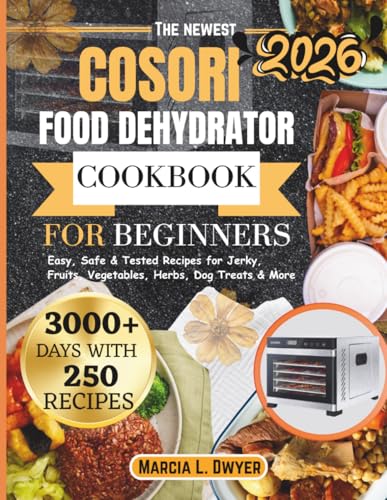
COSORI Food Dehydrator Cookbook for Beginners — Best for Cosori Owners
Cosori’s dehydrators are among the most common first machines, and this series title is written directly for their owners: easy, tested recipes for jerky, fruits, vegetables, herbs, and dog treats. The dog-treat inclusion is more significant than it looks — homemade pet treats are one of the top reasons households buy a dehydrator, and one of the least covered in generalist books.
Strengths
- Machine-matched for the large Cosori user base, in the brand’s own kitchen series
- Tested-recipe framing aimed at beginners who want results the first weekend
- Dog treats covered — a top real-world use most books ignore
Trade-offs
- Brand-tuned, so settings translate imperfectly to other machines
- Beginner scope; pair it with a reference as your ambitions grow
- Newer series title with a still-developing track record
| Specification | Detail |
|---|---|
| Title | COSORI Food Dehydrator Cookbook for Beginners |
| Series | The Cosori Kitchen Series (per verified listing) |
| Stated scope | Jerky, fruits, vegetables, herbs, dog treats |
For a Cosori owner in their first season, this is the lowest-friction start: the recipes assume your trays, your controls, your capacity. Work through its jerky and fruit chapters, keep notes on your machine’s timings, and by the time you reach the dog treats you will be ready for the generalist reference shelf. It is a starter book that knows it is a starter book, which is a virtue.
The dog-treat recipes carry a responsibility worth stating in the open: homemade pet treats should use plain, pet-safe ingredients, be dried thoroughly, and be stored with the same care as any preserved food — and any pet with dietary conditions deserves a veterinarian’s word before a new treat becomes routine. A beginner book that includes treats is serving a real and loving use case; the reader’s part is to bring the same safety discipline to the dog’s batches as to the family’s jerky.
Best for: Cosori dehydrator owners in their first seasons, especially pet owners / Not suited for: Other brands’ owners and advanced preservers
Check on Amazon — check price on Amazon before ordering, and confirm the listing details match the verified model described here.
Comparison Table
| Pick | Badge | Key spec | Best for |
|---|---|---|---|
| The Ultimate Dehydrator Cookbook (Globe Pequot Press) | Best Overall Reference | Comprehensive reference, Globe Pequot Press | Owners who want one authoritative reference for the whole craft |
| The Beginner’s Guide to Dehydrating Food, 2nd Edition | Best for Beginners | 2nd edition teaching guide, Workman Publishing | First-time dehydrator owners who want to learn the craft properly |
| The Home Food Dehydrator Cookbook: 100+ Easy Recipes for Beginners | Best Recipe-First Starter | 100+ recipes with time/temp/storage charts | Hands-on beginners who learn by cooking rather than reading theory |
| The Ultimate Food Dehydrator Cookbook for Beginners | Best Broad Beginner Coverage | Broad beginner scope incl. leathers and powders | Beginners with wide ambitions across snacks, leathers, powders, and staples |
| My Ultimate EXCALIBUR Food Dehydrator Recipe Book | Best for Excalibur Owners | 100 recipes written for Excalibur machines | Excalibur owners who want recipes sized and written for their machine |
| COSORI Food Dehydrator Cookbook for Beginners | Best for Cosori Owners | Cosori-matched beginner recipes incl. dog treats | Cosori dehydrator owners in their first seasons, especially pet owners |
How to Choose a Dehydrator Book That Actually Helps
Judge by the apparatus, not the cover. A useful dehydrator book gives drying times, temperatures, and thickness guidance in chart form; explains doneness tests you can perform with your hands; and covers storage — containers, conditions, and realistic shelf life — because drying food you then store badly is work wasted. If a listing brags only about a recipe count, be suspicious.
Then match the book to your stage. True beginners need a teaching guide that explains the why behind each number. Recipe-led learners need a cookbook whose charts teach as they cook. Owners of a specific machine — Excalibur, Cosori — get real value from a brand book’s matched settings and batch sizes. And every serious household eventually wants one true reference for the foods no recipe book anticipated.
Safety deserves its own sentence: jerky and meat drying involve real food-safety judgement. Favour books that address meat temperatures and curing honestly, and always cross-check meat guidance against current official food-safety recommendations — a cookbook supports that judgement, it does not replace it.
Building a Small Dehydrator Library
Two books cover most households for years: one teaching or reference title for the method, and one recipe-led title for momentum. Add a brand book only if your machine’s format genuinely differs — large square trays being the classic case. Beyond that, your own notebook of times and results, kept batch by batch, becomes the most valuable dehydrator book you own, because it describes your machine, your climate, and your food.
What a Good Dehydrator Book’s Charts Should Tell You
Open any candidate book at its charts before reading a single recipe. A serious chart gives, per food: preparation (peeling, blanching, pre-treatment), slice thickness, drying temperature, an honest time range rather than a false-precision single number, and a doneness description you can test with your hands. Storage guidance should follow the same pattern — container, conditions, and a realistic keeping window. The picks in this guide were favoured because their verified listings promise exactly this apparatus.
Treat every chart as a starting grid, not gospel: your machine’s calibration, your slices, and your climate all move the finish. The mark of a good book is that it tells you this itself and teaches the doneness tests that let you overrule its numbers intelligently. The mark of a poor one is three hundred recipes and not a single chart.
Dehydrator Books Versus Online Recipes
Online recipes are free, instant, and wildly uneven — for every careful preserver sharing tested times there are a dozen copied posts repeating numbers nobody verified. A good book’s value is editorial: one tested method, consistent temperatures, and charts that agree with the recipes because the same hands checked both. For a craft where a wrong number can mean spoiled food — or, with meat, a genuine safety question — that consistency is worth a shelf slot.
The sensible household uses both: the book as the trusted base method, the internet as a source of flavour ideas to run through the book’s numbers. That division of labour gets you novelty without gambling, and it is the pattern experienced preservers settle into within a season or two.
A Note on Jerky and Food Safety in Print
Every responsible dehydrator book treats meat differently from apples, and readers should too. Jerky involves curing considerations, precise temperatures, and doneness that cannot be judged by the casual bend test alone. Read your chosen book’s meat chapters completely before the first batch, follow them without improvisation, and verify the critical temperatures against current official food-safety guidance, which is updated as knowledge improves in a way a printed page cannot be.
That caution is not a reason to avoid jerky — home jerky, made carefully, is one of the great pleasures of owning a dehydrator. It is a reason to let jerky be the project you graduate to after a season of produce, with a good book open and its safety chapter read twice.
How to Read a Dehydrator Book Alongside Your Harvest Calendar
Dehydrating is seasonal in a way ordinary cooking is not, and the best way to use any book in this guide is against the calendar of abundance. Late spring: herbs and strawberries. High summer: stone fruit, tomatoes, courgettes in glut. Autumn: apples, pears, mushrooms, and the jerky season as hunting and hiking overlap. Winter: citrus, root vegetables, and the pantry-cooking chapters that turn it all back into meals.
Read one season ahead. The household that reads the apple chapter in September, with the orchard trip planned, buys the right quantities and books the weekend. The household that reads it in November owns a beautiful book and no apples. The picks above all reward this rhythm — their charts become a planning tool, not just a cooking reference — and a pencil-marked harvest calendar inside the front cover is the mark of a book being used at full value.
Gift-Giving and Second Copies: The Social Life of a Good Cookbook
A dehydrator is one of the most gifted small appliances, and it is also one of the most abandoned — usually for want of exactly the guidance these books provide. If you give the machine, give a book with it; if you received the machine bare, the beginner titles here are the self-rescue. Experienced preservers keep a second, lendable copy of a beginner guide for the friend whose garden is overwhelming them: it returns with notes, goodwill, and occasionally a jar of something excellent.
For the committed, the reference-and-recipe pairing recommended in this guide also solves the gift problem permanently: the Ultimate for the methodical, the Beginner’s Guide for the cautious, a brand book for the machine-proud. Books are the rare gift that makes another gift work properly.
Organising Your Dehydrator Shelf
Keep the working library small and close: the reference or teaching title, one recipe-led book, your batch log, and the machine’s manual, all within reach of where the dehydrator actually runs. A shelf across the house is a shelf unused. Add a pencil — charts want annotating — and a roll of labels for the jars, and the corner becomes a small preserving station rather than an appliance with ambitions.
Review the shelf each season: retire nothing, but re-order it. The book you needed in your first summer is rarely the one you reach for in your third, and letting the current favourite sit on top is a small honesty that keeps the whole shelf alive.
Formats and Editions: Buying the Right Copy
Most titles in this guide exist in more than one format, and the choice is practical rather than trivial. A chart-heavy reference earns its paper: charts are scanned, compared, and pencil-annotated in ways a phone screen discourages, and a paperback survives the preserving kitchen’s steam and splashes. An ebook earns its place for travel and for the recipe you need at a market or a campsite. Where a book has multiple editions, prefer the latest — food-safety understanding and machine generations both move, and the second edition of the Beginner’s Guide in this guide exists for exactly that reason.
Check the listing’s format line before ordering, and be wary of listings whose edition or publisher is unclear; established titles attract sloppy imitators. The verified listings behind this guide were matched by title and publisher precisely to keep you on the genuine article.
The Five Recipes to Try First from Any Dehydrator Book
Whatever book you buy, run these five first — they teach the whole craft in miniature. Apple chips teach thickness and doneness by touch. A fruit leather teaches puree consistency and even spreading. A garden herb batch teaches low-temperature patience and the value of the harvest you would otherwise lose. A vegetable batch — courgette chips or green beans — teaches blanching judgement. And a small, careful jerky batch, after the safety chapter has been read completely, teaches the discipline that governs all protein work.
Five batches, five core skills, one stocked pantry shelf. A book that makes those five sing is a book that has earned its place, and the titles in this guide were chosen because their structures support exactly that progression rather than scattering it.
Keeping a Preserving Household: Rotation and Records
Dried food keeps well, not forever, and the difference is rotation. Label every jar with contents and date — the books insist, and experience agrees — and store in the cool, dark place the storage chapters describe. Use the oldest first, and let the pantry door carry a simple inventory so the dried tomatoes of two summers ago become this winter’s sauce rather than a archaeological discovery.
Once a season, audit the shelf: what was used, what was not, what ran out by February. That audit is the most valuable planning document a preserving household owns, because next year’s garden, market runs, and drying weekends should be sized by it. The books teach the drying; the records teach the household.
Dehydrating for Special Diets and Households
Dehydrator books earn a special place in households managing dietary needs, because drying puts ingredient control entirely in the cook’s hands. Fruit leathers without added sweeteners for a child whose snacks need watching; jerky seasoned exactly to a household’s sodium judgement rather than a factory’s; vegetable powders that smuggle nutrition into the meals of a reluctant eater; trail food assembled for an allergy that commercial mixes keep tripping over. The recipe-led picks in this guide serve these households best, because their breadth lets a cook assemble a repertoire around a constraint.
Two cautions belong with the praise. First, dietary management with medical stakes deserves professional guidance alongside any cookbook — a book teaches technique, not medicine. Second, cross-contamination discipline in a shared dehydrator matters when allergens are in play: clean trays, sensible batch ordering, and honest labelling. The books’ storage and method chapters support both habits; the household supplies the vigilance.
Done well, this is dehydrating at its most valuable — not a hobby producing snacks, but a system producing food a particular family can trust completely, because they made every gram of it themselves.
From Book to Batch: A First Weekend, Planned
Saturday morning: read your new book’s opening method chapter with coffee, then choose the calibration batch it recommends — apples are the classic — and slice them to the chart’s thickness with more care than feels necessary. Load the trays, set the chart’s temperature, and write the first line of your batch log before you walk away. While the trays hum, read the storage chapter; by the time the apples are leathery and done, you will know exactly what conditioning means and why the jar matters.
Sunday: a second batch of something braver — herbs from the garden, or a first leather — applying yesterday’s lessons about your machine’s timing. Condition the apples, label the jar, and write the weekend’s second log entry with the differences noted. Two days, two batches, and the book has changed from an object you own into a system you run.
That small, deliberate start outperforms the enthusiastic alternative — six trays of everything on day one — in every way that matters: you learn the machine, the book, and the craft in the order they can actually be learned. The picks in this guide all support the deliberate start; the rest is a free weekend and a bag of apples.
The Shelf, Revisited: What Owners Actually Re-Read
Ask experienced preservers which pages of their dehydrator books are worn, and the answer is never the introduction. It is the charts — thumbed, annotated, occasionally splashed. It is the storage chapter, consulted every autumn. It is the two or three recipes that became household institutions, and the safety pages of the jerky section, read with a seriousness usually reserved for contracts. A book’s real table of contents is written by its owner’s hands over the years.
Buy with that future in mind: sturdy binding matters, lay-flat behaviour matters, and a chart you can read at arm’s length with floury hands matters. The titles in this guide were chosen for their contents; their physical forms, checked on the listing at purchase time, decide how gracefully those contents age in a working kitchen.
And when the book is thoroughly worn — when its charts carry your handwriting in three colours of pencil — it has not been used up. It has been completed, in the only sense that matters for a working book: it now contains your kitchen as well as its author’s.
One Last Shelf Note: Annotate Without Mercy
A closing piece of advice that separates working libraries from display shelves: write in these books. Circle the chart row for your machine’s quirk, pencil your actual times beside the printed ones, dog-ear the jerky safety pages, and let the margins accumulate the record of your seasons. A pristine dehydrator book after two years is a small tragedy — evidence of a craft admired rather than practised. The titles in this guide can take the wear; they were chosen, in part, because their contents deserve the honour of being used hard. Your future self, mid-harvest with a glut on the counter, will thank the annotator you are about to become.
How to Use a Dehydrator Book With Your Machine
1. Start with the charts, not the recipes. Read your book’s time-and-temperature chart against your machine’s manual; where they differ, start with the manual’s setting and the book’s doneness test.
2. Run one calibration batch — apple slices are the classic — at the book’s stated settings, and note the actual time your machine took. That single note calibrates every recipe that follows.
3. Keep a batch log in the book’s margins or a notebook: food, thickness, temperature, time, result. Dehydrating is a repeat-performance craft, and the log is how the second batch beats the first.
4. Apply the book’s storage guidance immediately at the end of each batch — conditioning, containers, and labelling with dates. The best recipe in the book cannot rescue food stored warm and unlabelled.
Common Buying Mistakes
Buying on recipe count alone. Three hundred recipes without charts or method is a pamphlet in a thick cover. Look for times, temperatures, and storage guidance.
Ignoring your machine’s manual. A book gives general numbers; your manual knows your airflow. Use both, in that order of authority for settings.
Skipping the safety chapters. Meat and jerky are the one area where a wrong number matters beyond quality. Read those sections before your first jerky batch, not after.
Never writing anything down. The book cannot know your machine’s hot spots. Your batch log is the missing chapter — write it yourself.
Buying three beginner books. One teaching book, one recipe book, one notebook. Redundant beginner titles crowd the shelf and split your attention.
Final Recommendation
If you buy one book, buy the Ultimate Dehydrator Cookbook — it is the reference you will still be using in year five. If you are starting from zero and want teaching rather than reference, the Beginner’s Guide is the gentler on-ramp, and the two recipe-led beginner titles will keep your trays full while you learn. Excalibur and Cosori owners should add their brand’s book without hesitation; matched settings are worth more than general brilliance.
Whichever title you choose, check the format and the current price on Amazon before ordering — and start the batch log with your very first tray. The book teaches the craft; the log makes it yours.
Related guides in this series: Best Books On How To Use Food Dehydrators, Best Food Dehydrators, Best Dehydrator Cookbooks.
Frequently Asked Questions
Do I really need a book if my dehydrator came with a manual?
The manual covers the machine — settings, trays, cleaning. A good book covers the food: preparation, times, doneness, recipes, and storage across hundreds of ingredients. Most owners find the manual sufficient for week one and a book necessary by week three.
Which book is best for a complete beginner?
The Beginner’s Guide to Dehydrating Food for teaching, or one of the recipe-led beginner cookbooks in this guide if you learn by cooking. Either path works; pick the style you will actually open.
Are brand-specific dehydrator books worth it?
When the machine’s format differs — Excalibur’s large square trays are the classic example — yes: batch sizes and settings match your hardware. For standard machines, a strong generalist book serves just as well.
What should I check before trusting a book’s jerky guidance?
That it addresses meat temperatures and curing directly rather than waving at them, and cross-check its numbers against current official food-safety guidance. Jerky is the one dehydrating project where precision is a safety matter, not a taste preference.
Do these books cover storage, or just drying?
The picks in this guide were chosen partly for storage coverage — charts and guidance on containers, conditions, and shelf life. Drying is only half the craft; storing is the half that decides whether the work keeps.
Paperback or ebook for a kitchen book?
Paperback survives floury hands, steam, and being propped against the fruit bowl, and charts are easier to scan at a glance. Ebooks win on search and shelf space. For a chart-heavy reference, this guide leans paper — but check the formats on the listing and choose for your kitchen.


