Disclosure: airfryerkitchensupply.com is reader-supported. When you buy through links on our site, we may earn an affiliate commission at no extra cost to you.
Where to buy
If you are shopping for the best beginner mixers, welcome — this guide assumes nothing, explains everything, and recommends six kitchen mixers that forgive beginner mistakes instead of punishing them. Every pick was confirmed as a current Amazon listing. Start with the Hamilton Beach hand mixer if you bake occasionally, or its stand-mixer sibling if bread is already calling you, and check the current price on Amazon for the exact model — beginner budgets deserve exact models, not near-matches.
- Hamilton Beach 6-Speed Electric Hand Mixer 62682G — check the current price on Amazon and confirm the exact variant on the listing before you order.
- Hamilton Beach 4 Qt Electric Stand Mixer — check the current price on Amazon and confirm the exact variant on the listing before you order.
- Cuisinart Power Advantage 5-Speed Hand Mixer HM-50 — check the current price on Amazon and confirm the exact variant on the listing before you order.
- KitchenAid 5 Ultra Power Speed Hand Mixer KHM512 — check the current price on Amazon and confirm the exact variant on the listing before you order.
- Kitchen in the box Stand Mixer 3.2Qt — check the current price on Amazon and confirm the exact variant on the listing before you order.
- Cuisinart Power Advantage Plus 9-Speed Hand Mixer HM-90S — check the current price on Amazon and confirm the exact variant on the listing before you order.
The best beginner mixers share a quality that specification sheets never list: forgiveness. A beginner’s mixer will meet rock-hard butter straight from the fridge, flour added all at once, and a first bread dough mixed with more hope than technique — and the right machine survives all of it while producing food good enough to make you bake again next week. That second part matters most. A first mixer is not really an appliance purchase; it is a habit purchase, and it succeeds if you are still baking in six months.
One clarification before the list, because ‘mixer’ is a fork in the road: this guide covers kitchen mixers — hand mixers you hold, and stand mixers that work hands-free — which is what most beginners searching this phrase are equipping themselves for. If your beginning is in audio rather than baking, that is a different first purchase entirely, and our audio roundups cover it; here, everything is beaters, bowls and batter.
All six picks were verified as current Amazon listings, and they form a gentle ladder: two hand mixers for the drawer-and-occasional-baker stage, a premium-feeling hand mixer for frequent small jobs, two stand mixers sized for real households learning bread, and one compact stand mixer for small kitchens. Each review is honest about what the machine cannot do, because a beginner deserves the truth in friendly form — the limits here are all survivable, and the how-to section teaches the few habits that keep them that way.
Key Takeaways
- Buy for your first ten real recipes, not for a fantasy baker.
- Hand mixers cover most beginner baking; stand mixers are for bread ambitions.
- Forgiveness is the beginner spec: clear speeds, stored attachments, honest limits.
- Five habits — start slow, soften butter, right attachment, respect dough, scrape — prevent nearly all disasters.
In this guide
Quick Picks
Best First Mixer Overall — Hamilton Beach 6-Speed Electric Hand Mixer 62682G. Six speeds plus QuickBurst, a bowl-rest lip, and a snap-on case that keeps the beaters attached to the mixer forever. The friendliest first purchase in baking.
Best First Stand Mixer — Hamilton Beach 4 Qt Electric Stand Mixer. Planetary mixing, seven speeds, splash guard and whisk, beater and dough hook included — the stand mixer for beginners who already know bread is the goal.
Best Simple Hand Mixer — Cuisinart Power Advantage 5-Speed Hand Mixer HM-50. Five speeds, extra-long beaters, a swivel cord and Cuisinart simplicity — the hand mixer for beginners who want the fewest possible decisions between them and cake.
Best Lightweight Pick — KitchenAid 5 Ultra Power Speed Hand Mixer KHM512. KitchenAid’s featherweight hand mixer with clog-resistant Turbo Beaters and one-button ejection — the first mixer that feels like a treat rather than a tool.
Best for Small Kitchens — Kitchen in the box Stand Mixer 3.2Qt. A portable 3.2-quart stand mixer with six speeds and the full attachment trio — hands-free mixing that fits the apartment cupboard the big machines cannot enter.
Best Step-Up Hand Mixer — Cuisinart Power Advantage Plus 9-Speed Hand Mixer HM-90S. Nine speeds with SmoothStart anti-splatter, a snap-on storage case for beaters and included extras — the hand mixer a beginner can grow into for years.
How These Picks Were Chosen
We chose for beginners by ranking forgiveness first. That meant controls a new baker cannot set wrong — clear speed dials, no bewildering programmes — attachments that store with the machine instead of vanishing into drawers, and bowls sized so a standard recipe, made slightly imperfectly, still fits. Machines that demand precision from day one were marked down however excellent they are for experts.
Second came honest scope. A beginner hand mixer should whip, cream and mix beautifully and admit it does not knead; a beginner stand mixer should knead a standard loaf and admit its batch ceiling. Every review below states its machine’s ceiling in plain words, because the fastest way to kill a baking habit is a first failure the buyer thinks was their fault when it was the tool’s limit.
Third, growth room. Beginners become bakers at unpredictable speed, so we favoured machines that remain useful as skills grow — the hand mixer that becomes the second mixer, the stand mixer that handles the second year of bread. Everything here is a current verified listing from brands that support their machines, because a first purchase should be the start of a relationship with baking, not a disposable experiment.
The 6 Best Beginner Mixers

Hamilton Beach 6-Speed Electric Hand Mixer 62682G — Best First Mixer Overall
If you own no mixer at all, this is where to start. The Hamilton Beach 62682G mixes in any bowl you already have, so there is nothing new to store; its Bowl Rest lip parks it on the bowl’s edge between additions instead of dripping across the counter; and its snap-on storage case keeps the beaters with the machine, solving the lost-beater problem before it ever happens to you. Six speeds plus a QuickBurst boost button cover the whole beginner repertoire: whipped cream, egg whites, cake batter, cookie dough of the softer kind, mashed potatoes.
Strengths
- Snap-on case means the beaters are always findable
- Bowl Rest prevents counter drips mid-recipe
- QuickBurst gives short extra power for thick moments
Trade-offs
- Your arm holds it — long jobs tire beginners
- Not a bread-dough machine; hooks are not its strength
- Corded, so you work near an outlet
Key specs
- Speeds: 6 plus QuickBurst
- Motor: 250 watts peak
- Attachments: Traditional beaters
- Storage: Snap-on case
- Feature: Bowl Rest
The genius of this pick is how many beginner frustrations it pre-solves. Storage? Solved by the case. Mess? Reduced by the bowl rest. Uncertainty about speeds? Six clearly spaced settings and recipes that simply say ‘medium’. It will make your first cakes, your first whipped creams and your first frostings without a single confusing moment, and if baking becomes a weekly joy, it retires gracefully into the drawer as the quick-jobs mixer beside a future stand mixer. As a first step into baking, it is nearly impossible to regret.
The Hamilton Beach hand mixer’s long game is ubiquity: it becomes the mixer of weekday small jobs long after a stand mixer joins the kitchen, because nothing beats drawer-to-bowl in ten seconds. Its case keeps it complete for years — the quiet feature owners praise most in hindsight — and its bowl rest keeps counters clean enough that weeknight baking feels low-stakes. Beginners who start here tend to keep baking, which is the entire metric that matters.
Best for: absolute beginners and occasional bakers / Not suited for: bread bakers or large batches
Check on Amazon — check the current price on Amazon for the exact configuration described above.

Hamilton Beach 4 Qt Electric Stand Mixer — Best First Stand Mixer
Some beginners should skip the hand-mixer stage entirely: the ones already dreaming of sourdough. This Hamilton Beach stand mixer is their first machine — planetary action that mixes the whole bowl so you are not scraping and guessing, seven speeds, a splash guard that saves your first flour explosion, and the full trio of whisk, flat beater and dough hook for the full journey from whipped cream to kneaded loaf. The carry handle and modest size suit the small kitchens beginners usually have.
Strengths
- Hands-free kneading from your very first loaf
- Planetary action reduces beginner scraping guesswork
- Full attachment trio and splash guard included
Trade-offs
- Four-quart bowl means standard, not double, batches
- Respect flour limits while you learn dough behaviour
- Takes counter or cupboard space a hand mixer does not
Key specs
- Bowl: 4 quart
- Speeds: 7
- Motor: 300 watts
- Attachments: Whisk, flat beater, dough hook, splash guard
- Action: Planetary
Stand mixers forgive beginners in a special way: patience. Creaming butter for five minutes, kneading for eight — a beginner’s arms quit long before the recipe does, but this machine does not, and that patience is the difference between dense first cakes and proud ones. Its limits are the kind a learner grows into understanding: standard batches, sensible dough quantities. For the beginner whose goal is real baking rather than occasional cake mixes, this is the correct first purchase and a two-to-three-year companion before any upgrade conversation begins.
The stand Hamilton Beach grows with its baker in a satisfying sequence: first loaves, then enriched doughs, then the holiday production that would have been unthinkable by hand. Its splash guard becomes invisible infrastructure, its bowl the kitchen’s default mixing vessel. Owners report the machine’s ceiling arriving politely — a desired double batch here, a heavier dough there — usually after a year or more of faithful service, which is exactly when an upgrade should arrive: earned, not anticipated.
Best for: beginners aiming at bread and weekly baking / Not suited for: tiny kitchens or rare bakers
Check on Amazon — check the current price on Amazon for the exact configuration described above.
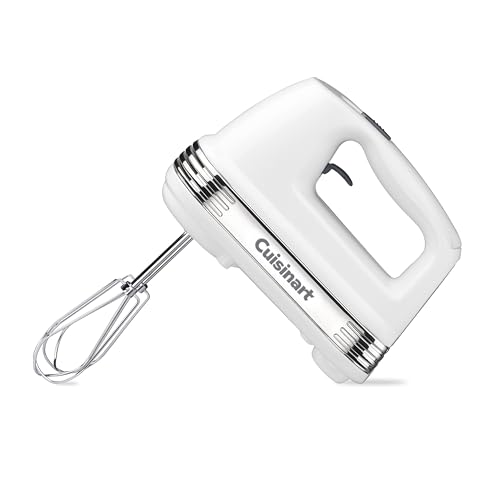
Cuisinart Power Advantage 5-Speed Hand Mixer HM-50 — Best Simple Hand Mixer
The Cuisinart HM-50 is the minimalist’s first mixer: five speeds chosen by one lever, extra-long beaters that reach into deep bowls, a swivel cord that stays out of the batter whichever hand you favour, and nothing else to learn. Cuisinart’s kitchen reputation rides along, and the beaters go in the dishwasher when you are done. For a beginner who finds appliances faintly annoying, this is the one that stays out of the way.
Strengths
- Five speeds — impossible to misconfigure
- Extra-long beaters suit deep bowls and pots
- Swivel cord and dishwasher-safe beaters minimise fuss
Trade-offs
- No storage case, unlike the Hamilton Beach rival
- Five speeds is the whole repertoire — no boost button
- Hand-mixer limits apply: no serious dough
Key specs
- Speeds: 5
- Motor: 220 watts
- Beaters: Extra-long, dishwasher-safe
- Cord: 60-inch swivel
Beginners split into two tribes: those who want features explained, and those who want the tool to disappear. The HM-50 serves the second tribe perfectly. It creams, whips and mixes with total adequacy and zero learning curve, and its beaters’ extra length quietly solves the deep-bowl problem that frustrates new bakers. Choose it over the Hamilton Beach if you value simplicity over the storage case and boost button; choose it knowing both are excellent first mixers and the difference is temperament, not quality.
The HM-50’s ownership pleasure is its refusal to be interesting: it works, it cleans, it stores, and it never once makes a beginner feel the machine is the problem. Its extra-long beaters quietly handle the deep stockpot of mashed potatoes and the tall mixing bowl with equal ease. For the simplicity tribe, this is the mixer that disappears so the baking can appear — and beginners underrate that disappearance until they have owned a fussy appliance.
Best for: simplicity-first beginners and small households / Not suited for: feature hunters or dough bakers
Check on Amazon — check the current price on Amazon for the exact configuration described above.

KitchenAid 5 Ultra Power Speed Hand Mixer KHM512 — Best Lightweight Pick
The KitchenAid KHM512 is for the beginner who will use a hand mixer constantly — sauces, toppings, batters, frostings several times a week — and wants it to feel pleasant every time. It is light enough to hold one-handed over a saucepan, its Turbo Beaters have no centre post for batter to climb and clog, the swivel cord locks to your side, and one button drops the beaters into the sink. KitchenAid’s name also makes it the one pick here that doubles as a genuinely welcome gift for a new household.
Strengths
- Lightweight body prevents beginner arm fatigue
- Turbo Beaters resist clogging and rinse clean
- One-button beater ejection is a small daily joy
Trade-offs
- Premium price for the hand-mixer class
- Five speeds, like the Cuisinart — simplicity by design
- Not a dough machine despite the famous brand
Key specs
- Speeds: 5
- Beaters: Stainless Turbo Beaters, dishwasher-safe
- Cord: Lockable swivel
- Release: Single-button ejection
- Colour listed: Contour Silver
Why would a beginner pay more for a hand mixer? Because frequency changes the maths: a tool used four times a week should be light, unclogging and pleasant, and the KHM512 is all three. Its honest ceiling is the hand-mixer ceiling — batters and creams, not loaves — and within that ceiling it is the nicest object in this guide. If your baking future is cakes, toppings and sauces rather than bread, this may be not just your first mixer but your only one, and a satisfying one.
The KHM512 becomes the favourite-tool phenomenon: the object reached for with a small pleasure each time, because its weight, its cord and its beaters all behave. Beginners who cook as much as they bake find it migrating to the stove — sauces, eggs, potatoes in the pot — expanding its territory beyond the baking that bought it. Premium hand mixers justify themselves exactly this way: not in specifications, but in touches per week.
Best for: frequent small-job bakers and gift buyers / Not suited for: bread beginners or tightest budgets
Check on Amazon — check the current price on Amazon for the exact configuration described above.
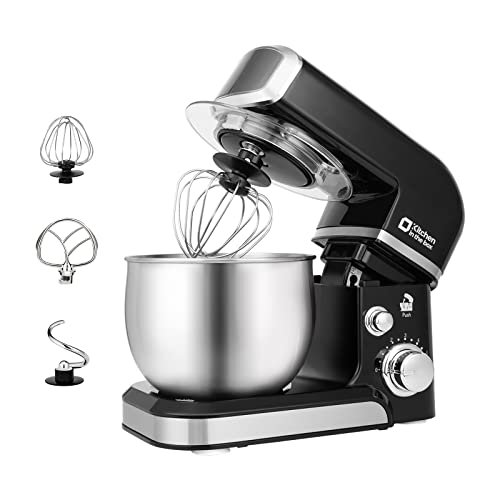
Kitchen in the box Stand Mixer 3.2Qt — Best for Small Kitchens
Beginners in small kitchens face a storage verdict the standard advice ignores: a full-size stand mixer may simply have nowhere to live. This Kitchen in the box machine answers with a 3.2-quart bowl, a lightweight portable body and — importantly — no amputations: six speeds, and the egg whisk, dough hook and flat beater trio included. It makes the daily scale of baking for one or two people a hands-free pleasure instead of a counter-space negotiation.
Strengths
- Fits the cupboards and counters beginners actually have
- Full trio included despite compact size
- Light enough to store away and retrieve happily
Trade-offs
- 3.2-quart ceiling is firm — small batches only
- Light body suits lighter doughs best
- Not a growing-family machine
Key specs
- Bowl: 3.2 quart
- Speeds: 6
- Attachments: Egg whisk, dough hook, flat beater
- Character: Portable, lightweight
Judge this mixer by its intended life and it is flawless: morning batter, a cake for two, a small loaf, whipped toppings — the daily baking of small households, done hands-free, by a machine that stores where a shoebox stores. Beginners in studios and first apartments routinely abandon baking because standard equipment bullies their space; this is the pick that keeps the habit alive until the kitchen grows. And when it does, this little machine becomes the beloved second mixer or the hand-me-down that starts someone else.
The little Kitchen in the box machine’s ownership story is permanence on the counter — the only stand mixer here small enough to live out in a tiny kitchen, and therefore the one used daily. Its bakers develop a small-batch repertoire with genuine pride: the loaf for two, the cake that gets finished fresh. When a bigger kitchen arrives, it graduates to second-mixer status without a whisper of regret, having carried a baking habit through the years when space argued against it.
Best for: apartments, dorms, couples and first kitchens / Not suited for: families or batch bakers
Check on Amazon — check the current price on Amazon for the exact configuration described above.

Cuisinart Power Advantage Plus 9-Speed Hand Mixer HM-90S — Best Step-Up Hand Mixer
The Cuisinart HM-90S is the hand mixer for the beginner who suspects — correctly — that they will get serious. Nine speeds give finer control than the five-speed picks as recipes advance, SmoothStart ramps up gently so your first ingredient explosion never happens, and the snap-on storage case keeps the beaters and accessories together like the Hamilton Beach’s. It is the hand-mixer ceiling: everything the format can offer, in one machine a beginner can operate on day one.
Strengths
- SmoothStart prevents the classic flour-cloud first use
- Nine speeds grow with your recipes
- Snap-on case stores the full accessory set together
Trade-offs
- Most expensive hand-mixer direction here
- Still bound by hand-mixer dough limits
- Feature richness is wasted on the rarest bakers
Key specs
- Speeds: 9
- Feature: SmoothStart anti-splatter
- Storage: Snap-on case
- Brand: Cuisinart Power Advantage Plus
The step-up logic is longevity. A five-speed mixer teaches the basics; a nine-speed with a gentle start keeps teaching — delicate folding at the bottom of the range, confident whipping at the top, and speed steps fine enough to follow recipes written for stand mixers with a little translation. For the beginner who reads cookbooks for fun, this is the hand mixer that will not need replacing when the recipes get ambitious. It remains, honestly, a hand mixer — bread belongs to the stand picks — but within its format it is the complete education.
The HM-90S rewards the beginner who grows: SmoothStart protects the first month, the nine speeds reward the sixth, and the storage case keeps the expanding accessory set one object instead of five. Its owners are the cookbook readers, and for them the machine reads like a curriculum — each new recipe finds the speed and attachment it needs already present. It is the hand mixer as a long-term tutor, and its graduates speak of it the way drivers speak of the car they learned on.
Best for: ambitious beginners wanting one long-term hand mixer / Not suited for: bread-focused beginners or minimalists
Check on Amazon — check the current price on Amazon for the exact configuration described above.
Comparison Table
The beginner ladder at a glance: badge, format and the new baker each machine serves. The pattern to notice is that format — hand or stand — matters more than any single specification, and the reviews are organised to help you choose the format by your recipes first and the model second. Every machine here forgives; they differ in what they forgive you for.
| Pick | Badge | Key spec | Best for |
|---|---|---|---|
| Hamilton Beach 6-Speed Electric Hand Mixer 62682G | Best First Mixer Overall | 6 speeds + QuickBurst, storage case | absolute beginners and occasional bakers |
| Hamilton Beach 4 Qt Electric Stand Mixer | Best First Stand Mixer | 4 qt, planetary, full trio | beginners aiming at bread and weekly baking |
| Cuisinart Power Advantage 5-Speed Hand Mixer HM-50 | Best Simple Hand Mixer | 5 speeds, extra-long beaters | simplicity-first beginners and small households |
| KitchenAid 5 Ultra Power Speed Hand Mixer KHM512 | Best Lightweight Pick | 5 speeds, Turbo Beaters, lightweight | frequent small-job bakers and gift buyers |
| Kitchen in the box Stand Mixer 3.2Qt | Best for Small Kitchens | 3.2 qt, 6 speeds, portable | apartments, dorms, couples and first kitchens |
| Cuisinart Power Advantage Plus 9-Speed Hand Mixer HM-90S | Best Step-Up Hand Mixer | 9 speeds, SmoothStart, storage case | ambitious beginners wanting one long-term hand mixer |
How to Choose Your First Mixer as a Beginner
Choose by your first ten recipes. List what you will actually bake first — honestly, from your real cravings — and let the list decide the form: cakes, cookies and creams say hand mixer; bread at the top of the list says stand mixer. This single honest exercise prevents both classic beginner errors, the underpowered disappointment and the cupboard-filling overbuy, more reliably than any specification comparison.
Within the form, buy forgiveness: clear speed controls you cannot set wrong, attachments that store with the machine, a bowl sized for standard recipes, and — on hand mixers — a weight your arm enjoys holding. The picks in this guide were ranked on exactly those qualities, which is why the friendliest machines lead it and the specification monsters are absent entirely.
Leave yourself a ladder, not a leap. Every pick here remains useful as you improve — hand mixers become the quick-jobs tool beside a future stand mixer; the stand picks handle a second year of growth. A beginner’s first mixer should be the start of a collection that makes sense, bought at the rung you are actually standing on.
Hand Mixer or Stand Mixer: The Beginner’s Only Real Decision
Everything else in this guide is detail; this is the decision. A hand mixer costs less, stores in a drawer, mixes in any bowl, and handles the majority of beginner baking — cakes, cookies of the softer kind, whipped cream, frostings, batters — completely well. Its honest limits are dough, big batches and your arm’s endurance. A stand mixer costs more, lives on a counter or in a cupboard, and repays it with hands-free patience: kneading, long creaming, big bowls, and the ability to wash up while it works.
So decide by your recipes, not by aspiration. If your first ten bakes are cakes and cookies, a hand mixer from this guide is the correct, complete purchase — and the stand-mixer money stays in your pocket until baking proves itself a habit. If bread is items one through five on your list, skip ahead: the Hamilton Beach stand mixer exists for you, and a hand mixer would only delay you by one purchase.
The reassuring truth is that neither path wastes money. Hand mixers remain useful forever beside a stand mixer — quick jobs, small jobs, hot pans — and stand mixers bought after a hand-mixer apprenticeship are bought with real knowledge. Beginners cannot lose this decision if they make it by recipe; they can only lose it by buying for a fantasy baker they have not yet become.
How to Use Your First Mixer: The Five Habits That Prevent Beginner Disasters
Every beginner mixer disaster has a known cause and a free prevention. Learn these five habits with your first bake and your machine will seem twice as capable.
- Start slow, always. Begin every mix at the lowest speed until dry ingredients are damp — the flour cloud that coats a first kitchen is a speed mistake, and every machine here, even the SmoothStart Cuisinart, rewards a gentle start.
- Soften butter properly: room-temperature butter creams; fridge butter fights the beaters and loses. Twenty minutes on the counter before baking is the cheapest quality upgrade in this entire guide.
- Use the right attachment: flat beater for creaming and mixing, whisk for whipping air into cream and eggs, dough hook — stand mixers only — for kneading. The whisk does not mix cookie dough and the beater does not whip cream; the trio exists because each job has a tool.
- Respect the dough line. Hand mixers make batters; stand mixers knead standard loaves. If a recipe’s dough makes your machine labour, rock or stall, stop — split the batch or finish by hand. A survived machine and a hand-finished loaf beat a burnt motor and no loaf.
- Scrape the bowl. Once mid-mix, with the machine off, run a spatula around the bowl and fold the edges in. Beginners blame mixers for uneven cakes that one scrape would have perfected.
- Clean immediately and store attachments with the machine. Dried batter is concrete; a warm rinse is ten seconds. The storage cases on several picks exist because a beater you cannot find is a bake that does not happen.
Five habits, zero cost, and the difference between a first mixer that gathers dust and one that builds a baker. Technique is a beginner’s real budget — spend it freely.
Your First Five Bakes: A Beginner Syllabus That Works
Bake one: a simple butter cake. It teaches creaming — butter and sugar beaten until pale — which is the foundational mixer skill, and it forgives everything except impatience. Use the flat beater or hand-mixer beaters, start slow, and let the machine take its minutes. Eat the result warm and note what the texture tells you: this cake is your baseline for every comparison that follows.
Bakes two and three: whipped cream and a pavlova or meringue. These teach air — the whisk’s whole purpose — and bowl discipline: clean, dry, fat-free. They also teach the machine’s top speeds and the look of soft versus stiff peaks, knowledge that transfers to every frosting and mousse in your future. Bake four is cookies, the creaming masterclass at slightly higher stakes, where gradual egg addition and a final low-speed mix for the flour produce the texture difference between good and bakery.
Bake five is bread — if bread is your road. A basic sandwich loaf, made with the stand mixer’s dough hook and this guide’s gradual-flour discipline, teaches kneading’s look and feel in one afternoon. If bread is not your road, bake five is a repeat of bake one, which will now be visibly, measurably better — and that comparison, your first cake against your fifth bake, is the moment a beginner becomes a baker.
Storing, Cleaning and Keeping a First Mixer for Years
A first mixer dies of neglect more often than of work. The care routine is three minutes: attachments rinsed or dishwashed immediately, the body wiped with a damp cloth — never immersed, for hand mixers especially — and everything stored together. The storage-case picks in this guide exist because ‘together’ is where beginners’ attachments fail to be; a beater in a random drawer is a bake postponed until the habit cools.
Storage geography decides use. The best place for a beginner’s mixer is the easiest reach in the kitchen — the front of the cupboard, the drawer by the bowls, a permanent counter corner for stand mixers small enough to earn it. Every step of retrieval friction subtracts bakes from your year; every convenience adds them. Arrange the kitchen so the mixer is easier to use than to skip.
And keep the paperwork — model number, purchase date, the manual’s attachment list — in the kitchen drawer or a phone note. Replacement beaters and bowls are ordered by model, and the beginner who records theirs joins the minority of owners whose five-year-old mixer still runs complete. Small administrations like this are how appliances become heirlooms instead of landfill with a cord.
What Should a Beginner Bake in the Second Month? Building on the Basics
Month two is where a beginner’s mixer starts paying compound interest. The techniques from month one — creaming, whipping, gentle starts — now combine: a frosted layer cake uses all three in one afternoon, and a Swiss roll adds the confidence of a thin sponge folded without fear. These are the bakes where the machine’s patience becomes your ambition’s enabler, because none of them forgive tired arms and all of them reward a mixer that simply keeps going.
Introduce one new attachment behaviour at a time. If month one was the beater’s, month two belongs to the whisk’s finer work — meringue kisses, a mousse, zabaglione over gentle heat with a hand mixer — and, for stand owners, the dough hook’s second act: enriched dough. A simple brioche or milk bread teaches butter incorporation, the technique that separates adequate home bread from the kind neighbours request by name.
Start reading recipes like a mixer owner: translating ‘beat until pale’ into your machine’s speeds, recognising when a stand-mixer recipe’s timing assumes a patience your hand mixer can match with rest breaks, and noting which recipes your current machine cannot honestly attempt. That literacy — knowing your tool’s map and the recipe’s terrain — is the real graduation of the second month, and it makes every future equipment decision obvious.
Keep a tiny baking log: date, recipe, one line on what the mixer did and what you would change. It feels precious for exactly one week, then becomes the most useful document in your kitchen — the record that turns vague improvement into visible progress and tells you, with evidence, when your skills have genuinely outgrown a machine. Upgrades decided by a log are never regretted.
And bake for an audience occasionally: a cake carried to friends teaches more about consistency than a month of private bakes, because it must travel, slice and please. Beginners hide their practice too long. The mixers in this guide were chosen to make early bakes presentable — let them be presented.
Safety and Confidence: Using a Mixer Without Fear
New bakers sometimes treat mixers as faintly dangerous machinery, so let the record be plain: the machines in this guide are among the safest powered tools in the kitchen, and their few rules are simple. Keep fingers, hair, jewellery and utensils out of a moving bowl — the spatula scrape in this guide’s how-to is always done with the machine off, and that ‘off’ is the entire rule. Unplug a hand mixer before changing beaters; park a stand mixer’s speed at zero before reaching in.
Electrical common sense is the second rule: dry hands on plugs, cords kept out of the batter and away from hot pans — the swivel cords on several picks exist partly to make that routing easy — and no immersing a hand mixer’s body in water, ever. The beaters wash; the motor wipes. Follow that division and the machine’s electrical life is measured in decades.
Stability is the third: a stand mixer belongs on a flat, dry counter with its cord untrapped; a hand mixer belongs in a bowl heavy enough not to travel — or held with your other hand on the bowl, which is the beginner’s natural stance anyway. A machine that walks is telling you the surface or the load is wrong, and listening to it early is a skill worth forming in week one.
Confidence is the real subject underneath the rules. Beginners abandon baking less from failure than from the feeling that the equipment is judging them; it is not. These machines have no memory and no standards — they will mix your fiftieth cake with the same patience as your first, and every habit in this guide exists to make the first feel as manageable as the fiftieth will. The rules above take a paragraph to learn and a lifetime to benefit from.
So set the mixer where you can reach it, plug it in without ceremony, and start slow. The safest mixer is the understood one, and by this point in the guide, yours is understood.
Common Buying Mistakes
The first beginner mistake is buying for the fantasy: the huge stand mixer for a monthly cake habit, colonising a small kitchen until the resentment kills the baking. Buy for your actual next ten bakes. This guide’s ladder exists so you can climb it as the habit proves itself.
The second is the reverse — expecting a hand mixer to knead weekly bread because a video made it look possible. It is possible the way walking to another city is possible. If bread is the dream, the stand mixer is the honest first purchase, and its review above says so without blushing.
The third is speed violence: full power into dry flour, hard butter attacked cold, dough forced past the machine’s comfort. Beginners think power solves problems; in mixing, sequence solves them — soften, start slow, add gradually, scrape once. The how-to above is the whole curriculum.
Finally, do not hide the mixer. A machine stored in a deep cupboard behind the slow cooker will not build a habit. Counter, front of cupboard, drawer by the bowls — wherever your kitchen’s easy reach is, that is where a beginner’s mixer earns its keep.
Final Recommendation
Start with the Hamilton Beach hand mixer for the complete beginner toolkit, the Cuisinart HM-50 for minimalist simplicity, or the KitchenAid KHM512 if your hand mixer will work weekly and should feel lovely doing it. Take the Hamilton Beach stand mixer if bread is the mission, the little Kitchen in the box if your kitchen is small, and the Cuisinart HM-90S if you want a hand mixer with years of headroom.
Whichever rung you start on, confirm the exact model on the Amazon listing and check the current price on Amazon before ordering. Then bake something this week — the best beginner mixer is the one that gets used while the motivation is fresh.
Short on time? Go straight to the listings: Hamilton Beach Hand Mixer 62682G, Hamilton Beach 4 Qt Stand Mixer, Cuisinart HM-90S 9-Speed.
Related guides on this site: Best Bargain Stand Mixers Best Bang For Your Buck Mixers Best Bang For Your Buck Audio Mixers Best Battle Mixers Best 10 Quart Mixers Best Battery Operated Protein Mixers
Every baker you admire started with a first mixer and a first imperfect cake. The machines in this guide were chosen to make that start kind: forgiving controls, honest limits, and results good enough to bring you back to the bowl next week, which is where bakers are actually made.
Pick the rung that matches your recipes and your kitchen, confirm the model on the listing, and check the current price on Amazon. Then bake the first thing — imperfect, warm and entirely yours.
Frequently Asked Questions
What is the best first mixer for a total beginner?
For most, a hand mixer — the Hamilton Beach 62682G here — because it is inexpensive, stores in a drawer, and covers cakes, cookies and whipped cream completely. If bread is your main goal from day one, go straight to the Hamilton Beach stand mixer instead.
Can beginners knead bread dough with a hand mixer?
Small, soft doughs briefly — but it is genuinely the wrong tool for regular bread, and struggling teaches bad habits. Stand mixers knead hands-free and patiently. Match the tool to the bread ambition honestly and your first loaves will encourage you instead of defeating you.
How many speeds does a beginner need?
Five to seven cover everything a beginner bakes; what matters more is a true slow speed for starting mixes without flour clouds. Nine-speed models like the Cuisinart HM-90S are growth room, not necessity.
What size stand mixer should a beginner buy?
Four quarts suits standard recipes and small-to-mid households, and it is the size in this guide’s stand picks for good reason. Smaller kitchens have the 3.2-quart option; bigger bowls only earn their space when double batches become your normal.
Which attachments do I actually need?
Three: a flat beater for mixing and creaming, a whisk for whipping, and — on stand mixers — a dough hook for kneading. Every stand pick here includes the trio. Extra attachments are a later hobby, not a beginner requirement.
How do I stop my mixer making a mess?
Start at the lowest speed until ingredients combine, soften butter before creaming, use the splash guard on stand mixers, and choose a bowl with room to spare. Ninety percent of mixer mess is speed and sequence, both free to fix.


