Disclosure: airfryerkitchensupply.com is reader-supported. When you buy through links on our site, we may earn an affiliate commission at no extra cost to you.
Where to buy
Every linked pick in this guide to the best band mixers was verified against Amazon’s catalog on 2026-11-21, so the model names and specifications below are the models you will actually land on. Start with Yamaha MG16XU 16-Input Mixer with Effects, Mackie ProFX16v3 16-Channel Mixer with USB, Allen & Heath ZED-16FX 16-Channel Analog Mixer. Any pick described without a link is flagged honestly as unlinked in our notes. Check the current price on Amazon from any pick’s link, because finishes, bundles and stock rotate often.
The best band mixers are not simply audio mixers with more channels — they are the control centre of a band’s whole live system, judged on microphone count, monitor mixes, vocal effects and survival in transit. Every pick here was verified by brand and model, and each review states plainly whether the board is passive (needing powered speakers or an amp) or powered, because confusing the two is the most expensive mistake in band sound.
The field splits three ways: routing-rich passive boards for bands running full PAs (Yamaha MG16XU, and Mackie’s ProFX16v3 for stage-mixers), quality- and effects-led boards (Allen & Heath, Soundcraft), a compact workhorse for small venues (Mackie 1402VLZ4), and one powered mixer (Yamaha EMX5) for bands whose speakers are passive. Match the board to your speakers and your lineup — in that order.
Key Takeaways
- Monitor mixes — buses and aux sends — matter as much as channel count.
- Match the mixer format to your speakers: powered mixer with passive speakers, passive mixer with powered speakers.
- Buy one size above today’s channel count if the band is growing.
- Record gigs over USB where available; bands that listen back improve.
In this guide
Quick Picks
- Best Overall for Bands: Yamaha MG16XU 16-Input Mixer with Effects — 16 inputs, 6 buses and USB — the complete self-run band system brain.
- Best for Gigging Bands: Mackie ProFX16v3 16-Channel Mixer with USB — stage-tuned Onyx and GigFX for bands that mix from the stage.
- Best Sound Quality Focus: Allen & Heath ZED-16FX 16-Channel Analog Mixer — the finest channel strips here, for bands that compete on sound quality.
- Best for Vocal Harmony Bands: Soundcraft EFX12 12-Channel Mixer with Lexicon Effects — Lexicon reverb for harmony stacks, on a 12-channel frame.
- Best Compact for Small Bands: Mackie 1402VLZ4 14-Channel Compact Mixer — 14 channels in a pub-corner footprint, with Mackie toughness.
- Best Powered Mixer: Yamaha EMX5 12-Input Powered Mixer with DSP Effects — the amplifier is built in — pair with passive speakers and play.
How These Picks Were Chosen
Every mixer in this guide was verified against Amazon’s catalog for airfryerkitchensupply.com on 2026-11-21: we searched by brand and model, matched the returned listing title, and only then took the ASIN used in the links. Live mixers are sold under confusingly similar names across generations, so title-level verification is what guarantees the links land on the current model described.
For band use we ranked on the count of real microphone preamps (not headline channels), the quality of the vocal effects, monitor-send flexibility, and how the board behaves under gig conditions: knobs you can find by feel, channel strips laid out logically, and a build that survives being carried in a car boot twice a week. USB recording was treated as a valuable bonus — capturing the gig is how bands improve — but never as a substitute for live sound fundamentals.
We also considered the two ownership paths honestly: passive mixers that need powered speakers or a separate amplifier, and powered mixers with amplification built in. Neither is universally right; the guide flags which path each pick belongs to so a band does not buy half a system by accident.
The 6 Best Band Mixers

Yamaha MG16XU 16-Input Mixer with Effects — Best Overall for Bands
For a working band, the MG16XU is the most complete passive board in this guide: sixteen inputs, six buses for real monitor mixes, D-PRE preamps and USB for capturing the gig. It suits five- and six-piece bands playing bars, functions and small festivals who run their own sound.
Strengths
- Enough buses for separate singer and drummer monitor mixes
- 16 inputs cover full drum miking plus guests
- USB captures every gig for review and demos
Trade-offs
- Passive — budget for powered speakers or an amplifier too
- Big board: needs a case and setup time
- More routing than three-piece acts will use
| Inputs | 16 (6-bus) |
| Preamps | D-PRE |
| Connection | USB audio interface |
| Power | Passive — needs powered speakers or amplifier |
Band mixing is monitor mixing. The audience hears the main mix, but the band plays to the monitors, and the MG16XU’s bus count is what lets each member hear what they need. Sixteen inputs end the classic compromise of un-miking the toms to free a channel for a guest vocalist. The D-PRE preamps stay clean at stage levels, and the USB stereo capture turns every performance into a rehearsal tool. It asks for powered speakers, a case and an hour of learning — the standard price of a band sounding like a band.
The MG16XU’s six buses also serve recording-adjacent tricks: a subgroup of backing vocals under one fader, a separate feed for a livestream distinct from the room mix, a monitor world that does not disturb the front of house. This is the board in the guide that most rewards an engineer who reads the manual — its ceiling is set by the operator’s imagination rather than by missing features. Bands with such an engineer, or willing to become one, will not outgrow it quickly.
Over a season of gigs, the Yamaha MG16XU 16-Input Mixer with Effects will be judged on the nights this guide has described: the full room, the guest musician, the ringing monitor. Its contribution to those nights is set as much by the band’s habits — fixed patching, photographed settings, a spares bag — as by its own specification, and the reviews above have tried to be honest about where the board’s responsibility ends and the band’s begins.
Best for: Five- and six-piece bands running their own PA / Not suited for: Trios and duos — the MG12XU covers them for less. Check on Amazon to check the current price on Amazon.
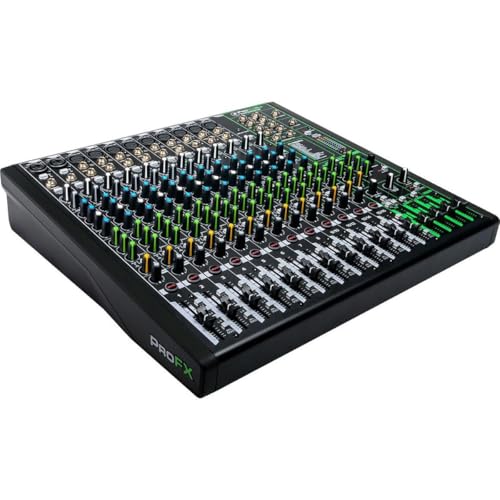
Mackie ProFX16v3 16-Channel Mixer with USB — Best for Gigging Bands
The ProFX16v3 is the stage-tuned alternative: Onyx preamps, the GigFX effects engine and a layout designed to be read in the dark between songs. It suits gigging bands that set up fast, mix from the stage and record every show to USB.
Strengths
- GigFX effects are voiced for live vocals
- Layout is readable under stage lighting and time pressure
- Onyx preamps handle hot stage signals cleanly
Trade-offs
- Passive — powered speakers required
- Stereo USB capture only
- Large footprint for small stages
| Channels | 16 |
| Preamps | Onyx |
| Connection | USB recording |
| Power | Passive — needs powered speakers or amplifier |
Mackie builds for the moment when the singer is also the engineer, reaching for a fader mid-song. Big, well-spaced controls, effects that flatter live voices without tweaking, and preamps that forgive enthusiastic drummers — the ProFX16v3 is optimised for the gig rather than the spec sheet. Sixteen channels cover a full band with spares, and USB recording means the demo is always being made. Against the Yamaha it trades some routing depth for stage immediacy; working bands will know instantly which they value.
Growth insurance has a second face with the ProFX16v3: it is also the board a band can hire out. Sixteen channels with friendly effects and USB is a rentable specification for small events, and more than one band has let its mixer pay for its own case that way. Even without hire income, the arithmetic of buying once at sixteen channels beats buying at twelve and again at sixteen within two years — the commonest false economy in band equipment.
Treat the Mackie ProFX16v3 16-Channel Mixer with USB as band infrastructure: case it, insure it with the rest of the backline if the band insures anything, and keep its channel map in the case lid. Bands that do this discover their mixer quietly becomes the longest-serving member of the act — present at every rehearsal, every gig and every recording the USB captures along the way.
Best for: Self-mixing gigging bands who record their shows / Not suited for: Bands with an engineer who wants maximum monitor routing. Check on Amazon to check the current price on Amazon.

Allen & Heath ZED-16FX 16-Channel Analog Mixer — Best Sound Quality Focus
The ZED-16FX is the audiophile’s band board: sixteen Allen & Heath channel strips with onboard effects and USB I/O, for bands whose venues and audiences reward sound quality — acoustic acts, function bands in good rooms, church teams.
Strengths
- Channel-strip EQ quality is the best in this guide
- 16 channels with USB I/O and onboard effects
- Build quality aimed at years of regular use
Trade-offs
- Passive — amplification is a separate purchase
- Heaviest board here; transport matters
- Premium positioning within the band-mixer market
| Channels | 16 |
| Connection | USB I/O |
| Effects | Onboard FX |
| Power | Passive — needs powered speakers or amplifier |
Some bands compete on repertoire; others on how good the room sounds. The ZED-16FX serves the second kind. Its EQ corrects without harshness, its faders feel like instruments, and the whole board carries the discipline of a company that builds consoles for professionals. Sixteen channels and sensible effects complete a package that asks only for amplification and care in return. If your band’s venues have listeners rather than just crowds, this is the board that respects them.
Sixteen channels also buy calm: the channel you are not using is the channel that absorbs the surprise — the guest percussionist, the second keyboard, the playback laptop that appears at the Christmas show. Allen & Heath’s strip quality means those spare channels are as good as the used ones, which is not true of every large small board. Venues buying the ZED-16FX are really buying the end of the input-count conversation, and anyone who has run a venue knows what that peace is worth.
Over a season of gigs, the Allen & Heath ZED-16FX 16-Channel Analog Mixer will be judged on the nights this guide has described: the full room, the guest musician, the ringing monitor. Its contribution to those nights is set as much by the band’s habits — fixed patching, photographed settings, a spares bag — as by its own specification, and the reviews above have tried to be honest about where the board’s responsibility ends and the band’s begins.
Best for: Quality-focused bands, function acts and church teams / Not suited for: Bands wanting amplification built in — see the Yamaha EMX5. Check on Amazon to check the current price on Amazon.

Soundcraft EFX12 12-Channel Mixer with Lexicon Effects — Best for Vocal Harmony Bands
Harmony bands live or die by their reverb, and the EFX12’s built-in Lexicon processor is the finest vocal effect in this guide. Twelve channels cover most harmony-led lineups — several vocalists, guitars, keys and a spare — making it the pick for folk, country, gospel and acoustic acts.
Strengths
- Lexicon reverb flatters stacked harmonies like nothing else here
- 12 channels suit harmony-band lineups
- Soundcraft preamps are clean and gig-proven
Trade-offs
- 12 channels will not cover a full drum kit plus everything else
- No USB recording
- One shared effects engine, as standard in this class
| Channels | 12 |
| Effects | Lexicon effects processor |
| Type | Analog mixer |
| Power | Passive — needs powered speakers or amplifier |
Stack three voices in harmony and a cheap reverb turns them to soup; the Lexicon algorithms in the EFX12 keep each voice placed while wrapping them in a shared space — the exact trick harmony singing needs. The board around the effects is honest Soundcraft: clean gain, sensible EQ, nothing precious. The channel ceiling is the real limit — a fully miked drum kit on top of four vocalists will not fit — so drum-light and acoustic lineups are the natural home. For them, no other pick here sounds as expensive.
The EFX12 rewards a specific listening test: put a single voice through its Lexicon reverb at a modest send and compare it with any budget board’s effects at the same level. The difference — depth without muddiness, a tail that decays like a room rather than a spring — is the whole product. Worship leaders and acoustic acts, whose entire sound is voices in a space, will hear it instantly. Everyone else should still hear it before deciding the premium belongs elsewhere.
Treat the Soundcraft EFX12 12-Channel Mixer with Lexicon Effects as band infrastructure: case it, insure it with the rest of the backline if the band insures anything, and keep its channel map in the case lid. Bands that do this discover their mixer quietly becomes the longest-serving member of the act — present at every rehearsal, every gig and every recording the USB captures along the way.
Best for: Harmony-led folk, country, gospel and acoustic bands / Not suited for: Loud full-kit rock bands needing 16 channels. Check on Amazon to check the current price on Amazon.

Mackie 1402VLZ4 14-Channel Compact Mixer — Best Compact for Small Bands
The 1402VLZ4 is the small band’s workhorse: fourteen channels with Onyx preamps in a compact frame that fits the stages — pubs, cafés, rehearsal rooms — where bigger boards physically do not. It suits trios and quartets who mix themselves and travel light.
Strengths
- Compact frame fits cramped stages and small cars
- Onyx preamps across the main channels
- 14 channels cover a quartet with spares
Trade-offs
- Fewer buses — monitor flexibility is limited
- No built-in effects or USB on this classic design
- Not a full-kit, big-band solution
| Channels | 14 |
| Preamps | Onyx |
| Type | Compact analog mixer |
| Power | Passive — needs powered speakers or amplifier |
Not every band plays rooms with a sound booth. The 1402VLZ4 is built for the corner of a pub: small enough to sit beside the drummer, tough enough to live in a cable crate, and honest enough in its preamps that nobody blames the board. Fourteen channels is a generous count at this size — a quartet with a couple of spare lines for guests or playback. What it lacks in effects and routing it repays in turning up, working, and going home. For small bands, reliability is a sound quality.
The 1402VLZ4’s compactness has a hidden benefit: it fits in the rehearsal room permanently, so the band rehearses through the same board it gigs with — same gains, same EQ, same monitor behaviour. That familiarity is a performance advantage no specification sheet captures. It is also the easiest board here to lend, borrow and find second-hand, an ecosystem virtue that matters to bands on real budgets. Small, tough and everywhere: a workhorse in the literal sense.
Over a season of gigs, the Mackie 1402VLZ4 14-Channel Compact Mixer will be judged on the nights this guide has described: the full room, the guest musician, the ringing monitor. Its contribution to those nights is set as much by the band’s habits — fixed patching, photographed settings, a spares bag — as by its own specification, and the reviews above have tried to be honest about where the board’s responsibility ends and the band’s begins.
Best for: Trios and quartets playing small venues and rehearsing in tight spaces / Not suited for: Bands needing built-in effects, USB or extensive monitor mixes. Check on Amazon to check the current price on Amazon.

Yamaha EMX5 12-Input Powered Mixer with DSP Effects — Best Powered Mixer
The EMX5 solves the other half of the band equation: it is a 12-input powered mixer, meaning the amplifier is built in and passive speakers plug straight in. It suits bands that own passive speakers, venues installing a simple house system, and anyone who wants one box to carry instead of a mixer plus a power amp.
Strengths
- Built-in amplification — just add passive speakers
- 12 inputs cover most band lineups
- Yamaha DSP effects for vocals out of the box
Trade-offs
- Powered format ties you to its amplifier’s capacity
- Heavier than a passive board of similar size
- If you already own powered speakers, you are paying for an amp you cannot use
| Inputs | 12 |
| Type | Powered mixer — built-in amplifier |
| Effects | DSP effects |
The powered mixer is the pragmatic band format: one heavy box instead of two, one mains lead, speaker cables and done. The EMX5 executes it with Yamaha’s usual discipline — enough inputs for a standard band, DSP effects that make vocals presentable, and amplification sized for small-to-mid venues and rehearsal rooms. The format decision is the whole decision: bands with passive speakers or starting from zero get a system in a box; bands already invested in powered speakers should take a passive board from the picks above. Matched to the right speakers, the EMX5 is the fastest route from van to first song in this guide.
Powered mixers live or die by system matching, so one caution completes the EMX5’s case: confirm your passive speakers’ impedance and power handling suit the amplifier, and buy speaker cables of honest gauge for the run lengths involved. Matched well, the format’s simplicity is unbeatable — the whole band PA is this box, two speakers, two stands. Matched badly, no mixer can save the sound, which is why the guide insists on the check before the purchase rather than after the first quiet gig.
Treat the Yamaha EMX5 12-Input Powered Mixer with DSP Effects as band infrastructure: case it, insure it with the rest of the backline if the band insures anything, and keep its channel map in the case lid. Bands that do this discover their mixer quietly becomes the longest-serving member of the act — present at every rehearsal, every gig and every recording the USB captures along the way.
Best for: Bands with passive speakers, and venues wanting a simple house system / Not suited for: Bands already owning powered speakers. Check on Amazon to check the current price on Amazon.
Comparison Table
| Pick | Badge | Key spec | Best for |
|---|---|---|---|
| Yamaha MG16XU 16-Input Mixer with Effects | Best Overall for Bands | D-PRE | Five- and six-piece bands running their own PA |
| Mackie ProFX16v3 16-Channel Mixer with USB | Best for Gigging Bands | Onyx | Self-mixing gigging bands who record their shows |
| Allen & Heath ZED-16FX 16-Channel Analog Mixer | Best Sound Quality Focus | USB I/O | Quality-focused bands, function acts and church teams |
| Soundcraft EFX12 12-Channel Mixer with Lexicon Effects | Best for Vocal Harmony Bands | Lexicon effects processor | Harmony-led folk, country, gospel and acoustic bands |
| Mackie 1402VLZ4 14-Channel Compact Mixer | Best Compact for Small Bands | Onyx | Trios and quartets playing small venues and rehearsing in tight spaces |
| Yamaha EMX5 12-Input Powered Mixer with DSP Effects | Best Powered Mixer | Powered mixer — built-in amplifier | Bands with passive speakers, and venues wanting a simple house system |
How to Choose a Band Mixer: Preamps and Monitor Mixes Decide
A band mixer lives or dies on two numbers: how many microphone preamps it has, and how many independent monitor mixes it can feed. Count your microphones honestly — vocals, guitar amps if miked, drum kit pieces, a spare for guests — then add the monitor question: if the singer and drummer need different mixes, you need buses or aux sends to give them, and that requirement, not channel count, often picks the board.
Everything else is secondary but real: effects for vocals, a layout the band’s de-facto engineer can run in the dark, and construction that survives the car boot. USB recording is the modern bonus — capturing gigs is how bands tighten up — but it never compensates for a monitor mix that leaves the drummer guessing.
Passive or Powered: The System Decision
A passive mixer is one half of a system: it needs powered speakers or a separate amplifier driving passive speakers. A powered mixer includes the amplifier and pairs with passive speakers. Neither is better in the abstract — the right choice is whichever matches the speakers you own or plan to own, and buying a powered mixer to feed powered speakers wastes money on an amplifier with nothing to do.
If the band is starting from zero, price both routes completely — mixer plus speakers, stands and cables — before deciding. The powered route often wins on simplicity and setup speed; the passive route wins on upgrade flexibility, because speakers and mixer can be replaced independently as the band grows.
Effects and EQ for Live Vocals
Live vocals need two things from a mixer: EQ that can carve out feedback-prone frequencies and add presence, and a reverb that places the voice in the room without washing it. Named effects engines in this guide — GigFX, Lexicon, Yamaha DSP — differ in flavour, but all clear the bar of usable; the discipline is in the sends, using less than you think.
Feedback control is mostly placement and gain discipline — speakers in front of microphones, gain set with headroom — but a mixer’s EQ is your last line of defence. Boards with more flexible channel EQ give the engineer more room to work before reaching for drastic cuts.
Sizing the Board for the Band You Will Be
Bands grow: a percussionist appears, the keyboard player goes stereo, a guest vocalist becomes permanent. A board bought exactly at today’s count is a board replaced within two years. The counterweight is transport — a 16-channel board in a flight case is a commitment in a small car. The honest rule: buy one size above the current count if the band is stable and gigging, exactly at count if the lineup is settled and small.
How to Set Up a Band Mixer at a Gig
Arrive and place first
Position the mixer where the person running sound can hear the room — ideally out front; if mixing from stage, place it within reach of the least busy member. Run speaker cables before signal cables to keep the floor sane.
Patch in a fixed order
Always patch the same way: drums, bass, guitars, keys, vocals, playback. A fixed order means any member can troubleshoot any channel without a diagram.
Line-check every channel
Before soundcheck, confirm every input makes sound at the desk and in the monitors. A line-check catches dead cables and flat batteries while there is still time to fix them.
Ring out the monitors
Raise monitor levels gradually and cut the frequencies that begin to ring. Monitors that feed back once will do it all night; five patient minutes here buy a clean show.
Soundcheck loudest first
Set gains with the full band playing the loudest passage, not with solo whispers. Headroom found in soundcheck is feedback avoided in the show.
Mark and photograph
Once balanced, mark fader positions with tape or photograph the board. If anything gets knocked during the break, the show is one photograph away from restored.
Common Buying Mistakes
Buying channels but no monitor capability
A band that cannot hear itself plays badly no matter how good the main mix is. Buses and aux sends are band features, not luxuries.
Mismatching powered and passive gear
A powered mixer into powered speakers, or a passive mixer into passive speakers with no amplifier, are the two classic no-sound disasters. Check the chain before the gig, not at it.
Soundchecking one whisper at a time
Gains set on quiet solo checks collapse when the whole band plays. Always set gain at performance level.
Running effects as the fix for a bad mix
Reverb cannot repair balance. Get the dry mix right, then season it.
No spare cables, batteries or a backup plan
Bands fail on five-dollar parts. A spares bag is part of the mixer purchase, morally if not financially.
Skipping the recording you could have made
If the board has USB, record the gig. Bands that listen back improve; bands that rely on memory repeat the same mistakes.
A Last Word Before the Band Spends Its Money
A mixer purchase is one of the few equipment decisions a band makes collectively, and it deserves a collective test: every member should be able to state, in one sentence, what the new board fixes about the current sound. If the sentences agree — monitors, channels, the vocal reverb, the amplifier question — the choice is already made and this guide’s ranking merely confirms it. If the sentences disagree, the band’s real problem is not the mixer, and a rehearsal spent agreeing the problem will save more money than any discount.
Then buy once, buy recognised, and put the board to work the same week. Bands improve fastest when their equipment stops changing and their attention returns to the music — which is, after all, what the audience came for in the first place.
Troubleshooting the Three Noises Every Small Mixer Makes
Hiss is a gain-structure confession: somewhere a stage is set too low and a later stage is compensating. Find it by muting channels one at a time until the hiss localises, then raise that channel’s preamp gain and lower its fader until the balance returns without the noise. If the hiss survives with every channel muted, it lives in the output stage or the monitoring chain — swap the headphone or speaker feed before blaming the board.
Hum is almost always a connection story: an unbalanced cable run beside a power supply, two devices powered from distant sockets forming a ground loop, or a guitar with single-coil pickups sitting near a transformer. Shorten and balance the signal cables first, power the whole chain from one strip second, and only then suspect the mixer itself — in practice, it is almost never the mixer itself.
Crackle is mechanical: a dirty fader, a worn jack, a cable whose conductor is letting go strand by strand. Exercise the suspect control through its travel a dozen times, substitute cables one at a time, and note which channel misbehaves. These three noises account for nearly every small-mixer complaint ever filed, and all three are diagnosable in ten minutes with the method above — before any purchase, return or repair is contemplated.
The Second-Hand Question and Buying for Keeps
Band mixers hold their value unusually well when they are recognised models in working order, which cuts both ways for buyers: the boards in this guide are safe purchases new, because a band that outgrows one can sell it into a deep second-hand market — and they are also the boards worth hunting used, provided the faders run clean, every channel passes signal and the power supply is the correct original. A used professional board with honest wear often serves a young band better than a new anonymous one.
Buying for keeps changes the accessory list: the case is bought with the board, the spare power supply is priced into the budget, and the channel map lives in the lid from the first gig. Bands that treat the mixer as infrastructure rather than as this season’s purchase discover it is still on the rider, unchanged, when the songs have turned over twice.
That longevity is the final argument for the recognised names throughout this guide. A band’s mixer is a decade-scale companion or a two-year regret, and the difference is rarely the purchase price — it is whether the board was chosen for the band’s real life: its speakers, its monitors, its transport and its growth.
The Gig That Tests the Board: A Field Report in Advance
Every band mixer in this guide will eventually face the same night: a room fuller than expected, a support act that needs channels, a monitor that starts to ring as the crowd’s noise pushes the band louder. The boards separate there. Routing depth becomes the singer’s confidence; spare channels become the guest’s welcome; a layout the engineer knows by touch becomes the fix applied in the dark in four seconds.
Bands prepare for that night in rehearsal, not at the venue: the fixed patch order, the photographed settings, the monitor mixes built calmly and carried in as the starting point. The mixer is the constant in that preparation — which is why this guide keeps returning to the unglamorous virtues of buses, build and familiarity over any single night’s features.
Choose the board your band can grow into, case it, learn it and record with it, and the bad night becomes a story about the room rather than about the equipment. That is the entire promise of the band-mixer class, and every pick here was chosen for its ability to keep it.
Transport, Cases and the Life of a Working Board
A band mixer is professional equipment that travels like luggage, and its lifespan is set more by transport than by electronics. A padded case or a flight case is not an accessory but part of the purchase: knobs and faders — the parts that fail — are exactly the parts a case protects. Budget it from the start, sized for the board you chose, with room for its power supply.
Cable discipline is the second lifespan factor. A band that coils cables properly, keeps a labelled spares bag — two XLRs, a power lead, batteries, tape, a torch — and patches in the same order every night will still be using the same mixer in a decade. Bands that throw the board in a car boot loose with the drum hardware will not, whatever they paid for it.
Finally, photograph your settings and keep a one-page channel map in the case. When a knob moves in transit — one always does — the photograph restores the show in a minute. Working bands treat these habits as part of musicianship, because they are: the audience hears their results.
Setting Up the Rehearsal Room So Gigs Get Easier
Bands that rehearse through their gig rig, set up the same way every time, soundcheck in minutes at venues; bands that rehearse acoustically and meet the mixer only at gigs spend their soundcheck learning it. If space allows, leave the board patched in the rehearsal room — drums, bass, guitars, keys, vocals in the fixed order this guide recommends — and treat every rehearsal as a quiet gig.
Rehearsal is also where monitor mixes should be built. The singer’s needs and the drummer’s needs, discovered calmly at rehearsal, become the saved starting point at every venue, leaving soundcheck free for the room’s surprises rather than the band’s basics. USB recording, available on several picks here, turns those rehearsals into evidence: the balance problem the band argues about is audible, undeniable and fixable on playback.
None of this requires new equipment — it requires treating the mixer as an instrument the band plays together, practised like any other. The boards in this guide are all capable of that role; the habit is the upgrade.
Three Bands, Three Boards
The function band — five pieces, two singers, a diary of weddings — runs powered speakers and mixes from the stage. The ProFX16v3’s layout and effects were drawn for their Fridays. The originals band in the rehearsal room across town has an engineer-in-training and ambitions: the MG16XU’s buses let the monitor mixes grow with the songs, and its USB turns rehearsals into homework.
The third band is the harmony quartet in the church hall, where the audience sits close and listens. Their board is the EFX12, bought for one reason — what its Lexicon reverb does to stacked voices in a live room. Equipment guides love a single winner; bands, sensibly, buy for the band they are.
The Monitor Mix: Where Band Mixers Earn Their Money
Ask audiences what a band sounded like and they describe the main mix; ask the band how the gig felt and they describe the monitors. A singer who cannot hear themselves sings out of tune through no fault of their own, and a drummer guessing at the bass line plays tentatively. This is why this guide weights buses and aux sends so heavily: they are the difference between a band performing and a band surviving.
The working method is to build monitor mixes deliberately at soundcheck — each member asks for what they need, the engineer sets it, and the band plays a full song at full volume to test it under real conditions. Monitor mixes set on solo instruments collapse in the show. Bands that record their gigs, as several picks here allow over USB, can even review the monitor question honestly the next day.
If your current board cannot give the singer and the drummer different mixes, that limitation — not channel count, not effects — is probably your band’s true ceiling. Several picks in this guide exist specifically to lift it.
Final Recommendation
The full shortlist, for convenience: Yamaha MG16XU 16-Input Mixer with Effects, Mackie ProFX16v3 16-Channel Mixer with USB, Allen & Heath ZED-16FX 16-Channel Analog Mixer, Soundcraft EFX12 12-Channel Mixer with Lexicon Effects, Mackie 1402VLZ4 14-Channel Compact Mixer, Yamaha EMX5 12-Input Powered Mixer with DSP Effects. Each link lands on the exact model verified for this guide; check the current price on Amazon there before you decide.
For a full band running its own PA, the Yamaha MG16XU is the most complete answer, with the Mackie ProFX16v3 the stage-friendly alternative. Bands that compete on sound quality should hear the Allen & Heath; harmony bands should hear the Soundcraft’s Lexicon reverb; small-venue acts should take the 1402VLZ4; and bands with passive speakers should take the powered EMX5 and be done by soundcheck.
These boards overlap deliberately with our wider guides — compare the full tier in Best Audio Mixers Under $500, the budget starting point in Best Audio Mixers Under $100, and the value shortlist in Best Bang For Your Buck Audio Mixers before committing the band’s money.
Frequently Asked Questions
How many channels does our band actually need?
Count every microphone and stereo source, then add two spares. A five-piece with a fully miked drum kit commonly needs fourteen to sixteen; a trio with one vocal microphone and DI’d instruments may need only eight. The spare channels are not waste — they are the guest vocalist and the keyboard upgrade that always arrive.
What is the difference between a powered and a passive mixer?
A powered mixer includes an amplifier and drives passive speakers directly. A passive mixer outputs line level and needs powered speakers or a separate amplifier. They are not interchangeable — the mixer must match the speakers you own, which is why every review in this guide states the format.
Can one mixer feed both the audience and our monitors?
Yes, if it has the buses or aux sends. The main output feeds the audience speakers; aux sends feed stage monitors, ideally one send per distinct monitor mix. This is why bus count matters as much as channel count for bands — see the MG16XU review.
Do we need effects on a band mixer?
For vocals, a usable reverb is close to essential in most rooms — it places the voice and covers a multitude of room sins. Every pick here except the compact Mackie includes effects; the Soundcraft’s Lexicon processor is the standout for harmony singing.
Can we record our gigs with a band mixer?
The Yamaha, Mackie ProFX and Allen & Heath picks record a stereo mix over USB — perfect for demos and post-gig review. Multitrack recording of individual channels requires a different class of device and is a separate purchase decision.
Who should run the mixer during the show?
Ideally someone out front who hears what the audience hears. If the band self-mixes from stage — as most of these picks assume — put the board with the member who plays least during sound-critical moments, set monitor mixes carefully at soundcheck, and change little mid-show.


