Disclosure: airfryerkitchensupply.com is reader-supported. When you buy through links on our site, we may earn an affiliate commission at no extra cost to you.
Where to buy
Here is the honest starting point for this search: true antique pressure cookers — the heavy cast-aluminium pots from the 1930s to 1960s — are not sold new on Amazon, and no verified listing exists for them. What Amazon does sell, and what this guide covers, are the heritage designs still in production: stovetop cookers built to the same patterns the antiques used, with modern gaskets and safety valves. Every pick below is listing-verified.
- Presto 01264 6-Quart Aluminum Pressure Cooker (Best Overall Heritage Pick): Check the current price on Amazon
- Presto 01241 4-Quart Aluminum Pressure Cooker (Best Small Heritage Cooker): Check the current price on Amazon
- Presto 01362 6-Quart Stainless Steel Pressure Cooker (Best Stainless Heritage Cooker): Check the current price on Amazon
- Presto 01341 4-Quart Stainless Steel Pressure Cooker (Best Compact Stainless): Check the current price on Amazon
- Hawkins Classic Aluminium 5 Litre Pressure Cooker (CL50) (Best Inner-Lid Classic): Check the current price on Amazon
- IMUSA 7 Quart Stovetop Aluminum Pressure Cooker (Best Large Budget Classic): Check the current price on Amazon
Searching for the best antique pressure cookers runs into a truth worth stating plainly: the genuine antiques — cast-aluminium National, Presto and Mirro cookers from before and after the Second World War — are collectibles now, traded secondhand, and they are not something any responsible guide should tell you to cook in without expert inspection. What you can buy new, today, are the direct descendants of those designs.
That turns out to be good news. The classic American stovetop pressure cooker barely changed across the twentieth century because the design was right: a thick pot, a locking lid, a weighted or spring pressure regulator, and a gasket doing the sealing. The six cookers below are that design, still in production, with fresh gaskets, modern safety valves and replacement parts you can actually order — everything people love about the antique pattern, minus the eighty-year-old rubber.
This guide therefore does two jobs. It ranks the best heritage-style cookers you can buy new, and it gives antique owners and hunters a clear-eyed section on which old cookers are display pieces, which can be returned to service safely, and what that process involves. Nostalgia is a fine reason to shop; it is a poor reason to skip a gasket.
In this guide
Quick Picks
Presto 01264 6-Quart Aluminum Pressure Cooker — Best Overall Heritage Pick. The closest living relative of the antique American pressure cooker: heavy-gauge aluminium, a rocking weighted regulator, and a design Presto has refined for generations. The 6-quart size is the family standard the antiques were built around. — Check on Amazon
Presto 01241 4-Quart Aluminum Pressure Cooker — Best Small Heritage Cooker. The 4-quart aluminium Presto is the size the wartime-era cookers made famous: enough for a small roast, a batch of beans or vegetables for two to four people, in the same classic pattern as its bigger sibling. — Check on Amazon
Presto 01362 6-Quart Stainless Steel Pressure Cooker — Best Stainless Heritage Cooker. The classic Presto pattern translated into stainless steel: same locking cover and weighted regulator, with a pot that shrugs off acidic foods, dishwashers and decades of use. The heirloom version of the design. — Check on Amazon
Presto 01341 4-Quart Stainless Steel Pressure Cooker — Best Compact Stainless. The small stainless option: 4 quarts of the classic pattern for couples and small kitchens, with the durability and induction compatibility of the bigger stainless model in a handier size. — Check on Amazon
Hawkins Classic Aluminium 5 Litre Pressure Cooker (CL50) — Best Inner-Lid Classic. The other great heritage lineage: Hawkins’ inner-lid design, in production in India for generations, where the lid seats inside the pot and pressure itself pushes it tighter. A genuinely different antique-era answer to the same problem. — Check on Amazon
IMUSA 7 Quart Stovetop Aluminum Pressure Cooker — Best Large Budget Classic. The big, affordable end of the heritage pattern: 7 quarts of aluminium stovetop pressure cooking with safety valves for risk-free opening, sized for the large-batch cooking Latin American kitchens have always used these pots for. — Check on Amazon
How These Picks Were Chosen
Picks were verified through the Amazon catalogue for this site, searching specifically for stovetop pressure cookers in the classic pattern. Electric multi-cookers were excluded on purpose: whatever their merits, they are not what this search is asking about.
Surviving models were ranked on fidelity to the heritage design (thick-gauge pot, mechanical regulator, replaceable gasket), current production status with parts support, material options across aluminium and stainless steel, and the completeness of their modern safety systems — locking lids, pressure indicators and redundant release valves. True antiques were researched as context and are discussed honestly as unlinked: they have no new-product listing to link, and pretending otherwise would be inventing a product.
The 6 Best Antique Pressure Cookers You Can Still Buy New (Heritage Designs in Production)

Presto 01264 6-Quart Aluminum Pressure Cooker — Best Overall Heritage Pick
If you want the antique experience with a clear conscience, start here. Presto essentially invented the home pressure cooker market in 1939, and the 01264 is that lineage in current production: a heavy-gauge aluminium pot, a cover that locks with a turn, and the familiar three-piece weighted regulator that rocks gently when the cooker is at pressure.
Strengths
- Direct descendant of the original Presto designs, still in production
- Weighted regulator gives the classic, audible at-pressure signal
- Replacement gaskets, regulators and parts are widely available
Trade-offs
- Aluminium needs hand care to keep its finish; not dishwasher-friendly
- No spring-valve quietness — the regulator rocks and hisses as designed
- Stovetop only; no electric convenience
| Capacity | 6 quart |
| Material | Heavy-gauge aluminium |
| Regulator | Weighted pressure regulator |
| Type | Stovetop, classic pattern |
The reason this design survived is that it fails gracefully and repairs easily. The gasket is a consumable you replace in minutes; the regulator is a lump of machined metal with nothing to break; the overpressure plug is a deliberate weak point that vents before anything dramatic can happen. An antique gives you the same architecture with unknown history; this gives you the architecture with a warranty and a parts catalogue. For most buyers drawn to this search, that is the right trade.
Best for: Cooks who want the genuine classic stovetop experience, new and supported / Not suited for: Anyone wanting stainless steel or a quiet spring-valve cooker
Check on Amazon to see the current listing, configuration options and delivery details.
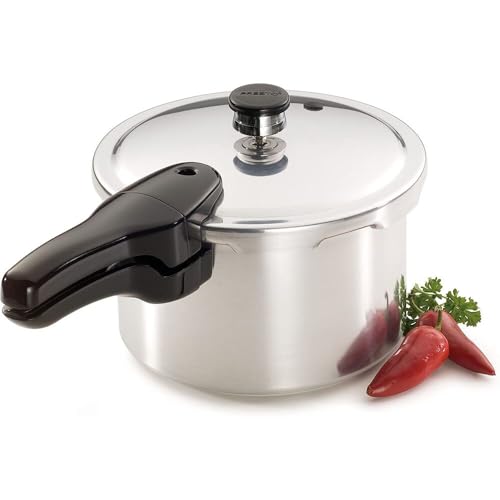
Presto 01241 4-Quart Aluminum Pressure Cooker — Best Small Heritage Cooker
Antique cookers were often small — the 4-quart was the everyday size in postwar kitchens — and the 01241 keeps that format alive. It suits the way many people actually pressure cook: beans for the week, a chicken, a pot of stock, vegetables in minutes rather than a banquet.
Strengths
- Authentic small format matching the classic household size
- Same replaceable gasket and regulator system as the 6-quart
- Light, manageable pot for everyday cooking
Trade-offs
- Too small for large roasts or serious canning volumes
- Aluminium care requirements apply here too
- Batch cooks will outgrow it quickly
| Capacity | 4 quart |
| Material | Aluminium |
| Regulator | Weighted pressure regulator |
| Type | Stovetop, classic pattern |
Small pressure cookers come to pressure fast and release fast, which makes the 4-quart the best teacher in the heritage format: you learn the regulator’s behaviour on forgiving little batches of beans and grains. Collectors should note this is also the size where genuine antiques are most tempting — and the same logic applies. Cook in the new one; let the 1948 original hold a place of honour on the shelf.
Best for: Small households and anyone learning stovetop pressure cooking / Not suited for: Large families or high-volume canning
Check on Amazon to see the current listing, configuration options and delivery details.

Presto 01362 6-Quart Stainless Steel Pressure Cooker — Best Stainless Heritage Cooker
Stainless steel is what the antique design becomes when you ask it to last another eighty years. The 01362 keeps the mechanical regulator and locking lid that define the pattern, but the pot itself resists the pitting and dulling that age aluminium, handles tomato-based dishes without a second thought, and works on induction as well as gas and electric.
Strengths
- Stainless pot suits acidic foods and induction cooktops
- Classic mechanical regulator with full parts support
- The most durable, heirloom-grade version of the design
Trade-offs
- Heavier and pricier tier than the aluminium models
- Stainless can scorch more readily if heat is careless
- Same audible regulator character as the aluminium line
| Capacity | 6 quart |
| Material | Stainless steel |
| Regulator | Weighted pressure regulator |
| Type | Stovetop, induction compatible |
Think of this as the cooker you hand down. The antique aluminium pots people collect were bought the same way — as lifetime purchases — and the stainless 01362 is the modern product that honestly earns that framing. Everything that wears is replaceable; everything structural is steel. If the romance of the antique is partly about permanence, this is the pick that delivers it in a form you can cook in daily.
Best for: Buyers wanting one lifetime cooker in the classic pattern / Not suited for: Budget shoppers or anyone who dislikes stovetop attention
Check on Amazon to see the current listing, configuration options and delivery details.

Presto 01341 4-Quart Stainless Steel Pressure Cooker — Best Compact Stainless
Not every kitchen needs six quarts, and not every cook wants to store them. The 01341 compresses the stainless heritage formula into the 4-quart format — quick to pressure, easy to wash, and sized for the beans, grains and small joints that make up most weekday pressure cooking.
Strengths
- Stainless durability in the compact classic size
- Fast to pressure; ideal for grains, beans and vegetables
- Induction compatible and dishwasher-friendlier than aluminium
Trade-offs
- Capacity limits whole birds and big roasts
- Premium tier relative to small aluminium rivals
- Still a stovetop cooker needing a watchful eye
| Capacity | 4 quart |
| Material | Stainless steel |
| Regulator | Weighted pressure regulator |
| Type | Stovetop, induction compatible |
Pairs are the natural audience: two people do not need a 6-quart pot, and the smaller cooker’s speed advantage is real — less water, less mass, faster pressurisation, faster release. As a second cooker alongside a big aluminium canner-style pot it also makes sense, giving a household the classic pattern at both scales without duplicating the large footprint.
Best for: Couples, small kitchens and induction owners / Not suited for: Anyone cooking for crowds or canning in volume
Check on Amazon to see the current listing, configuration options and delivery details.

Hawkins Classic Aluminium 5 Litre Pressure Cooker (CL50) — Best Inner-Lid Classic
The American pattern was not the only classic solution. Hawkins’ Classic line uses an inner lid: the cover drops inside the rim and pressure forces it upward into a tighter seal, a design Indian kitchens have trusted for decades of daily dal, rice and curry. The 5-litre CL50 is the family size in that tradition.
Strengths
- Inner-lid design seals tighter as pressure rises
- Decades-proven design with a huge global user base
- Excellent for rice, lentils and everyday curries
Trade-offs
- Inner lid takes practice to seat and remove confidently
- Aluminium body with the usual care requirements
- Sizing in litres; check it against your recipes
| Capacity | 5 litre |
| Material | Aluminium |
| Lid design | Inner lid, pressure-seated |
| Type | Stovetop, classic pattern |
Heritage is bigger than one country’s pattern, and the Hawkins earns its place by being a living classic rather than a reproduction: the design is old because it works, and it has been in continuous daily use across millions of kitchens. If your cooking leans toward lentils, rice and braises, its whistle-regulated rhythm will feel as authentically vintage as any Presto — just from a different tradition.
Best for: Cooks of Indian and lentil-heavy cuisines, and design-curious collectors who cook / Not suited for: Anyone wanting the American weighted-regulator pattern specifically
Check on Amazon to see the current listing, configuration options and delivery details.

IMUSA 7 Quart Stovetop Aluminum Pressure Cooker — Best Large Budget Classic
In much of the world the classic pressure cooker never went away — it just kept cooking beans, stews and tamales by the potful. IMUSA’s 7-quart is that working tradition: generous capacity, aluminium body, and safety valves designed to prevent opening under pressure.
Strengths
- Large 7-quart capacity at a budget-friendly tier
- Safety valves prevent opening while pressurised
- Proven format for beans, stews and big family batches
Trade-offs
- Finish and refinement trail the Presto and Hawkins lines
- Aluminium care rules apply
- Fewer refinements in fit and hardware than premium classics
| Capacity | 7 quart |
| Material | Aluminium |
| Safety | Safety valves, risk-free opening design |
| Type | Stovetop, classic pattern |
This is the value pick for a household that cooks the way these pots were always meant to be used: big, frequent, unfussy batches. It will not win a collector’s heart on machining, but it demonstrates why the pattern endured — a lot of pressure-cooked food for very little money, with the essential modern safety valves in place. For a first heritage cooker on a budget, it is an honest starting point.
Best for: Large families and budget buyers cooking big batches / Not suited for: Collectors seeking the finest fit and finish
Check on Amazon to see the current listing, configuration options and delivery details.
Comparison Table
| Pick | Badge | Key spec | Best for |
|---|---|---|---|
| Presto 01264 6-Quart Aluminum Pressure Cooker | Best Overall Heritage Pick | 6 qt aluminium, weighted regulator, classic Presto pattern | Cooks who want the genuine classic stovetop experience, new and supported |
| Presto 01241 4-Quart Aluminum Pressure Cooker | Best Small Heritage Cooker | 4 qt aluminium, weighted regulator | Small households and anyone learning stovetop pressure cooking |
| Presto 01362 6-Quart Stainless Steel Pressure Cooker | Best Stainless Heritage Cooker | 6 qt stainless steel, weighted regulator, induction-ready | Buyers wanting one lifetime cooker in the classic pattern |
| Presto 01341 4-Quart Stainless Steel Pressure Cooker | Best Compact Stainless | 4 qt stainless steel, weighted regulator | Couples, small kitchens and induction owners |
| Hawkins Classic Aluminium 5 Litre Pressure Cooker (CL50) | Best Inner-Lid Classic | 5 litre aluminium, inner-lid classic design | Cooks of Indian and lentil-heavy cuisines, and design-curious collectors who cook |
| IMUSA 7 Quart Stovetop Aluminum Pressure Cooker | Best Large Budget Classic | 7 qt aluminium, safety valves, budget tier | Large families and budget buyers cooking big batches |
How to Choose a Heritage-Style Pressure Cooker
Decide first whether you are buying a cooker or a collectible, because the honest answer shapes everything else. If you want to cook, buy one of the in-production classics above: the experience, the recipes and even the sounds are the same as the antiques, with fresh gaskets and valves. If you want to collect, buy the antique for the shelf and one of these for the stove.
Within the new classics, choose on three axes:
- Material: aluminium for the authentic feel, lighter weight and lower tier; stainless for durability, acidic foods and induction.
- Capacity: 4 quarts for one to three people and fast small batches; 5–6 quarts as the family standard; 7 quarts for batch cooking.
- Tradition: the American weighted-regulator pattern (Presto, IMUSA) versus the inner-lid Indian pattern (Hawkins) — both are genuine classics; match them to your cuisine.
Whichever you choose, budget for the consumables from day one: a spare gasket and, for weighted-regulator models, a spare regulator weight stored somewhere you will find it. The heritage design’s great virtue is that everything that wears out unscrews, unclips or pulls off — keep the spares and the cooker effectively never dies.
Cooking in a Real Antique: What Is and Is Not Safe
This section exists because readers will buy antiques anyway, and honest guidance beats silence. A vintage cooker should never be pressurised as found. The gasket will be hardened or cracked, the overpressure plug aged, and the regulator vent possibly obstructed — each is a small part with a large job.
The minimum path back to service: replace the gasket and any rubber overpressure plug with correct new parts for that exact model, confirm the vent pipe is clear, check the lid and rim for warping or cracks, and water-test at pressure outdoors or with great care before food ever goes in. Cookers with cracked castings, bent rims or missing proprietary parts are display pieces, full stop. When in doubt, the new classics in this guide deliver the same cooking with none of the archaeology — which is why they, and not the antiques, carry the purchase links here.
How to Use a Classic Stovetop Pressure Cooker
The ritual is the same one cooks used in 1948, and it rewards attention rather than fear.
- Add ingredients with enough liquid — classic cookers need at least a cup or so of water or stock to make steam; never fill beyond two-thirds, or one-half for foaming foods like beans.
- Seat the lid, align the handles and lock it; check the gasket sits evenly in its groove before closing.
- Set the regulator weight on the vent pipe and bring the cooker up over medium-high heat.
- Wait for the regulator to rock or whistle steadily — that is full pressure; reduce heat to the lowest setting that keeps it rocking gently, and start timing.
- When time is up, remove from heat and let pressure fall naturally for most foods, or use careful quick release only where the recipe directs.
- Open only when pressure is fully down: regulator still, no steam at the vent, lid turning without resistance.
Seasoning a new classic cooker the antique way still works: run the first session with plain water to flush manufacturing residue and to learn your stove’s behaviour with that pot before real food is involved. Every stove-cooker pair has a personality; one water run teaches you yours.
Why the Classic Design Refuses to Die
Electric multi-cookers outsell stovetop classics many times over, yet the old pattern persists in production across three continents — Presto in the US, Hawkins in India, IMUSA across Latin America. The reasons are structural. A mechanical regulator cannot suffer a software fault. A gasket costs little and fits in an envelope. The pot works over gas, electric, induction, a camp stove or a wood fire, indifferent to power cuts and control boards.
There is also the matter of feedback. A rocking weight or a whistle tells you the state of the pot from across the room, continuously, in a way a silent electric cooker does not. Generations of cooks learned pressure cooking by ear, and the heritage designs still teach that way. Buying one is not nostalgia for its own sake; it is choosing the most repairable, infrastructure-free version of the technology.
Collecting Antique Pressure Cookers: A Short Field Guide
For readers whose interest is genuinely the antiques themselves: the collectible field centres on pre-1960 American cast aluminium — early Presto models with bakelite handles, National cookers from Eau Claire, and Mirro’s streamlined aluminium designs. Completeness is value: the original regulator weight, trivet and instruction booklet matter to collectors as much as the pot.
Buy condition over rarity. Shine can be restored; cracks, warped rims and pitting deep into the sealing surface cannot. Assume every gasket and plug needs replacement regardless of appearance, and price accordingly. And keep the collector’s discipline that this guide opened with: the finest antique in the world is a display piece until its soft parts are new and its metal is proven — the cooking belongs to the living classics ranked above.
Reading an Antique: Marks, Makers and Dating
Collectors date antique pressure cookers the way watch collectors date movements: by maker’s marks, handle materials and hardware details. Presto — originally the Northwestern Steel and Iron Works of Eau Claire, Wisconsin — put the modern home pressure cooker on the map in 1939, and its early models carry the marks of that era: heavy cast aluminium, bakelite handles, and simple stamped model information. National, also of Eau Claire, produced the other great American line, including the canners that preserved a generation’s garden harvests.
Mirro, from Manitowoc, took the design in a more streamlined, mid-century direction, and its cookers are often the most visually striking on the shelf. Across all three makers, the details that date a piece are the regulator style — early weighted systems versus later refinements — the handle material’s transition from bakelite and wood to later plastics, and the presence or absence of features that arrived with postwar safety expectations.
For the buyer, the lesson is that completeness outranks rarity. A common model with its original regulator weight, trivet, gasket groove intact and instruction booklet is a better collection piece — and a better candidate for the restoration path described in this guide — than a rare model missing its pressure hardware. Pressure cookers are systems; collect the system, not just the pot.
The Parts Economy: Gaskets, Weights and Plugs
The heritage design’s survival owes everything to its parts economy. A classic cooker has exactly three consumables: the gasket that seals the lid, the overpressure plug that acts as the last-resort vent, and — as a loss risk rather than a wear item — the regulator weight. All three are small, cheap and replaceable with no tools beyond fingers. Compare that with an electronic cooker whose failed control board ends its life, and the antique pattern’s logic becomes obvious.
This is also why the in-production classics ranked in this guide are such rational purchases: their parts are not merely available, they are stocked everywhere cooker parts are sold, because the same gaskets and weights serve decades of production. When you buy a Presto 01264 or 01362, you are buying into a parts stream that has flowed since before most of its buyers were born.
Antique owners should treat parts with more suspicion. A gasket that “looks fine” after forty years in a drawer has still aged out of its elastic life, and an overpressure plug of unknown composition is not a safety device, it is a hope. The restoration standard in this guide — new soft parts for the exact model, verified vent, water test — exists because the parts are the safety system. There is no version of cooking in an antique that skips them.
What the Antique Pattern Cooks Best
Heritage cookers were designed around the foods of their era, and those foods remain their strengths: dried beans without an overnight soak, tough cuts turned tender in under an hour, stocks with a depth electric convenience rarely matches, and the steamed puddings and cheesecakes of the classic pressure-cooker repertoire. The stovetop format’s direct heat also browns in the pot before the lid goes on — a flavour foundation the sealed electric format handles less gracefully.
Where the pattern asks for respect is in its feedback loop. You are the sensor: the regulator’s rhythm is the temperature gauge, and the stove knob is the control system. Cooks raised on set-and-forget appliances sometimes find this demanding; cooks who learn it tend to describe it as cooking rather than programming, and they produce the best argument for the classics’ continued production — food that tastes attended-to.
The practical bridge between eras is the recipe literature. The classic cookers accumulated eighty years of tested recipes, and modern editions of the old manuals translate directly to the new classics in this guide, because the machines are the same machines. Buy the 01264 and you inherit a library; that inheritance is part of what “best antique pressure cookers” honestly means in 2026.
The Wartime Kitchen: Why These Cookers Look the Way They Do
The classic pressure cooker’s form was set by scarcity. Aluminium was the wonder metal of the 1930s and 40s — light, rust-free, and castable into thick pots that could take pressure — and when wartime diverted it to aircraft, the cookers that returned to production after 1945 carried the era’s lessons: build thick, build simple, build to be repaired by the owner with parts from the hardware store. The heavy cast bodies collectors prize today are not over-engineering; they are the manufacturing philosophy of a generation that expected appliances to outlive their makers.
The designs also answered the era’s fuel economics. Pressure cooking cut fuel use dramatically at a time when fuel was rationed or dear, and cut cooking time for the dried beans and tough cuts that stretched household budgets. The cooker on a 1948 stove was not a gadget; it was infrastructure, as essential as the icebox, and it was used daily — which is why so many survive, worn smooth by hands rather than by neglect.
Understanding that history clarifies the modern market. The in-production classics in this guide are not retro novelties trading on nostalgia; they are the same infrastructure, built by the same logic, for kitchens that still run on beans, stocks and tough cuts. The romance is real, but it is the romance of a tool that never stopped being useful.
Pressure Cooking Myths the Antique Era Left Behind
The antique cookers left two myths in the culture, and both deserve burial. The first is that pressure cookers explode as a matter of course. The historical record is more precise: incidents involved cookers with blocked vents, perished gaskets, lids forced against pressure, or wartime improvisation — failures of maintenance and handling, in designs that already carried safety plugs. The modern classics add locking systems and redundant valves on top of that record, and the maintenance discipline in this guide removes the historical causes.
The second myth runs the other way: that because grandmother used hers daily for forty years, any surviving cooker is fit for service as found. Grandmother also maintained hers — gaskets were a normal household purchase, and a cooker that misbehaved was repaired or retired. The survivors on today’s market have unknown maintenance histories and decades of rubber ageing behind them. Respecting the tradition means practising its discipline, not just inheriting its hardware.
A third, quieter myth is that pressure cooking destroys nutrients and flavour wholesale. The reality the classic recipe literature demonstrates is the opposite for its core repertoire: shorter cooking times in a sealed, steam-filled pot preserve what long boiling leaches, and the concentrated flavours of pressure-cooked stocks and beans built the design’s reputation. The myths survive because they are dramatic; the cookers survive because they work.
Building a Working Vintage-Style Kitchen Around the Classics
Buyers drawn to antique pressure cookers often want the whole kitchen to feel coherent, and the classics in this guide anchor that project honestly: they are working tools first and period pieces second. Around them, the natural companions are the era’s other survivors in current production — cast iron skillets, enamelware, mechanical scales, hand-crank mills — tools whose designs stabilised generations ago and never needed replacing.
The discipline that keeps such a kitchen honest is to let function lead. Every piece should earn its place by working, the way the originals did; the moment a kitchen becomes a museum, the pressure cooker on the stove becomes a prop rather than a tool, and the gaskets stop being replaced. The collectors this guide admires most run a two-track system: the finest antiques displayed as the design history they are, and their modern descendants at work on the stove.
That two-track approach is, in the end, the article’s whole argument. The antique pattern deserves preservation and the antique artefacts deserve respect — and the highest form of both is a kitchen where the design is still doing its job every day, in a cooker built to be maintained forever.
Stovetop Pressure Cooking vs the Electric Multi-Cooker
The comparison every heritage buyer eventually makes deserves a fair hearing. The electric multi-cooker wins on automation: sealed, sensor-managed, silent, with a timer that minds the cook while you mind anything else. It wins on features — yogurt, rice programs, slow cooking — and on the confidence it gives beginners, because the machine carries the knowledge the stovetop cook must learn.
The classic stovetop cooker wins on physics and time. It reaches full pressure faster, releases it on your terms, sears harder in its own pot, and works on any heat source ever made — including the campfire and the wood stove where its antique ancestors also worked. It wins on longevity by design: there is nothing in it that a gasket, a weight and a plug cannot renew, and its recipe literature is eighty years deep.
The honest verdict is that these are different instruments sharing a principle, and serious pressure cooks often own both — the electric for the weekday, the classic for the craft. This guide’s keyword asks about the antique pattern specifically, and within that pattern the in-production classics are the answer. But no reader should finish it believing the choice is a moral one. It is a preference, and both preferences cook beautifully.
Caring for Aluminium and Stainless Classics
Aluminium classics ask for a short list of kindnesses. Wash them by hand where possible; dishwasher detergents dull and darken the finish over time. Avoid long storage of acidic or salty food in the pot, which pits the surface; transfer leftovers to another vessel, as the original manuals advised. A grey film after washing is cosmetic oxidation, removable with a cream-of-tartar boil if it offends, and harmless if it does not.
Stainless classics are the lower-maintenance heirs: dishwasher-tolerant, indifferent to acids, and prone to only two faults — rainbow heat tints, which are cosmetic, and stuck-on fond, which a soak and a deglazing handle. Both metals share the real maintenance agenda, which lives in the lid: gasket inspected and replaced on its schedule, vent checked clear before every cook, regulator stored where it will not be lost.
Storage completes the care routine. Store the cooker with the lid inverted or ajar rather than sealed, so the gasket rests uncompressed and the pot airs; a gasket stored under permanent compression takes a set and seals poorly for it. These are small disciplines, unchanged since the antique era, and they are why the antiques exist to be collected: somebody’s grandmother did them, weekly, for forty years.
The Collector’s Market: What Drives Value
Antique pressure cooker values are modest by collecting standards, which is part of the field’s charm: serious pieces remain within reach of serious cooks. Value concentrates in three places. Completeness leads — a cooker with its original regulator weight, trivet, gasket (however perished) and paperwork is worth multiples of the same pot stripped. Condition follows, with unscored sealing surfaces and straight rims outranking mere shine; a polished cooker with a warped rim is wall art, while a dull one with true surfaces is a candidate for the restoration path. Rarity finishes third, and matters least until the first two are satisfied.
The makers sort predictably. Early Presto models with bakelite handles anchor the American field, National’s canners command respect for their scale and their role in wartime food preservation, and Mirro’s streamlined designs attract the design-minded. Regional and hardware-store brands fill the shelves below them — charming, inexpensive, and the right place for a new collector to learn the field’s handling and grading without tuition fees.
Buying channels reward patience. Estate sales and rural auctions remain the honest sources, with prices set by people selling a kitchen rather than curating a market. Online listings demand the discipline this guide repeats: photograph the rim, the lid seat, the vent; ask after the weight and the trivet; assume the soft parts are dead and price the restoration in. A cooker bought well is a bargain twice — once as an artefact, and once as the ancestor of the new classic cooking dinner beside it.
And a word on selling the romance honestly: most antiques will cook again in someone’s kitchen only after the work this guide describes, and many should not cook at all. The field’s health depends on that honesty. A market that sells display pieces as daily cookers will eventually produce the accident that tarnishes every honest seller — and every careful collector — with the same brush.
A Final Word on Provenance
One last collector’s habit is worth adopting whether or not you ever restore a cooker: document what you own. Photograph the marks, the handles, the hardware; keep any paperwork with the piece rather than in a drawer across the house. Provenance is the difference between an old pot and a piece of design history, and it costs nothing but ten minutes. The new classics in this guide deserve the same courtesy in miniature — keep the manual and the receipt, note the gasket size somewhere findable — because the cookers built to last decades will outlive the memory of their own specifications.
Common Buying Mistakes
Pressurising an antique as found. Decades-old gaskets and plugs are the failure point of every vintage cooker. Replace soft parts and test with water before any real use — or keep it on the shelf.
Overfilling the pot. Classic cookers need headroom for steam and foam. Two-thirds maximum, half for beans and grains that expand or froth.
Forcing the lid. If the lid resists opening, pressure remains. Forcing handles is how accidents happen; wait, cool, and let the pot tell you it is safe.
Cooking acidic food in tired aluminium. Long tomato braises in pitted vintage aluminium can pick up off flavours. That is a job for the stainless classics.
Losing the regulator weight. The little weight is the cooker’s brain, and the most commonly lost part at estate sales. New classics come with parts support; buy a spare and store it with the pot.
Final Recommendation
For cooking, the verdict is simple: the Presto 01264 gives most people the authentic antique pattern, new, supported and safe, and the stainless 01362 is the version to hand down. Small households should take the 4-quart models, Hawkins fans and lentil lovers the CL50, and big-batch budget cooks the IMUSA 7 Quart.
For collecting, buy the best antique you can find — and cook in its modern descendant. That pairing is not a compromise; it is how the design was always meant to be enjoyed.
The shortlist: Presto 01264 6-Quart Aluminum Pressure Cooker · Presto 01241 4-Quart Aluminum Pressure Cooker · Presto 01362 6-Quart Stainless Steel Pressure Cooker · Presto 01341 4-Quart Stainless Steel Pressure Cooker · Hawkins Classic Aluminium 5 Litre Pressure Cooker (CL50) · IMUSA 7 Quart Stovetop Aluminum Pressure Cooker
Keep exploring the cluster: Best 10 Quart Pressure Cookers Best 3 Cup Rice Cookers Best And Safest Slow Cookers Best Aroma Housewares Rice Cookers
Frequently Asked Questions
Can you still buy a real antique pressure cooker new?
No. Genuine antiques from the 1930s–1960s exist only on the secondhand and collector market. What is sold new — and what this guide ranks — are the heritage designs still in production, built to the same patterns with modern gaskets and safety valves.
Is it safe to cook in an antique pressure cooker?
Only after restoration: new gasket and overpressure plug for the exact model, a clear vent, sound metal with no cracks or warping, and a water test. Cookers that fail any of those checks are display pieces. The in-production classics avoid the question entirely.
What is the difference between aluminium and stainless heritage cookers?
Aluminium is lighter, cheaper and historically authentic, but needs gentler care and dislikes long acidic braises. Stainless is heavier and costs more, handles any food, works on induction, and lasts longest. The pressure system itself is the same classic design in both.
How long do gaskets last on a classic stovetop cooker?
With regular use, expect to replace the gasket every year or two, or whenever the cooker starts leaking steam at the rim or struggling to reach pressure. It is an inexpensive consumable and the key to the design’s longevity.
Can a classic stovetop cooker be used for canning?
Only models and sizes specifically rated for pressure canning, used with current tested canning guidance, should be used that way. Small cookers like the 4-quart models are for cooking, not canning.
Why do people still choose stovetop over electric pressure cookers?
Repairability, feedback and freedom: a mechanical regulator you can hear, parts that cost little, and a pot that works on any heat source including a camp stove. For many cooks that simplicity is the point.


