Disclosure: airfryerkitchensupply.com is reader-supported. When you buy through links on our site, we may earn an affiliate commission at no extra cost to you.
Where to buy
Comparing the best 30 smooth electric cooktops? Every linked model below was verified against the verified product feed for this site before earning its link. We print no static prices — use the links to check the current price on Amazon. One installation fact applies to the whole page: these are hardwired 220–240V built-in cooktops with no plug, so plan on a junction-box connection by a qualified installer.
- Frigidaire Professional FPEC3077RF 30 Inch Electric Cooktop — check the current price on Amazon
- Empava 30 Inch Radiant Electric Cooktop 4 Burners — check the current price on Amazon
- Karinear 30 Inch Electric Cooktop 4 Burners Knob Control 6700W — check the current price on Amazon
- VEVOR Built-In Electric Stove Top 30 Inch 5 Burners 8600W — check the current price on Amazon
- Electric Cooktop 30 Inch Ceramic 4 Burners 6700W Satin Glass Touch — check the current price on Amazon
- VEVOR Electric Cooktop 30 Inch 4 Burners 7200W Knob and Touch — check the current price on Amazon
Introduction: The Honest Case for the Best 30 Smooth Electric Cooktops
The best 30 smooth electric cooktops — radiant ceramic-glass models — live in the shadow of induction these days, and that is partly unfair. A smooth radiant cooktop works with every pan you own, including the aluminum roaster and the copper saucepan induction rejects. It costs less to buy than a comparable induction model, its technology is simple and repairable, and the flat glass surface wipes clean in seconds. For plenty of kitchens — rentals, budget remodels, households with a beloved non-magnetic cookware collection — radiant smooth-top is not the compromise choice; it is the correct one.
The trade-offs deserve equal honesty. Radiant elements heat the glass, and the glass heats the pan, so response is slower than induction or gas: elements cycle on and off to hold temperature, residual heat lingers after shutdown (hence the hot-surface indicators throughout this roundup), and a sugary spill left on hot glass can pit the surface if ignored. Boil times trail induction. None of that prevents excellent cooking — generations of good meals came off radiant tops — but it does mean the best models distinguish themselves with smart element design: dual-zone elements that match pan size, fast-heating elements for the main burner, and controls you can set precisely.
The six picks below pair one legacy flagship — Frigidaire’s Professional five-burner — with a deep value bench from Empava, Karinear and VEVOR, in both knob and touch control styles. Wattages in this class run higher than induction equivalents on paper because radiant cooking is less efficient; what matters is element sizing and layout, which the reviews take up model by model. Every model here was verified before writing, and every spec quoted comes from its verified listing.
A word about who this guide is not for, because honest scoping saves returns: if your cooking style is built on instant flame response — wok tossing, flambé, the constant nudge-and-glance rhythm of restaurant gas cooking — a radiant smooth-top will feel like driving with a delay in the steering, and our induction or gas guides will serve you better. If, instead, your cooking is the steady repertoire of family meals, baking support and one-pot dinners, radiant’s calm, predictable heat is not a compromise at all. It is the home game most kitchens actually play.
In this guide
Quick Picks
- Best Overall: Frigidaire Professional FPEC3077RF 30 Inch Electric Cooktop — five burners on ceramic glass with stainless trim — the Professional-series benchmark for radiant smooth-tops
- Best Value Dual Zone: Empava 30 Inch Radiant Electric Cooktop 4 Burners — a dual-zone element that matches pan size, ETL certification and compatibility with all cookware at a value price
- Best Knob Control: Karinear 30 Inch Electric Cooktop 4 Burners Knob Control 6700W — physical knobs, 6700W and a hot surface indicator — the tactile choice among smooth-tops
- Best Five-Burner Value: VEVOR Built-In Electric Stove Top 30 Inch 5 Burners 8600W — five radiant burners, 8600W, sensor touch, timer and child lock — flagship counts at a value price
- Best Budget Touch: Electric Cooktop 30 Inch Ceramic 4 Burners 6700W Satin Glass Touch — satin glass, touch sensor controls, timer and child lock — the lowest-cost route into a modern smooth-top
- Best Hybrid Controls: VEVOR Electric Cooktop 30 Inch 4 Burners 7200W Knob and Touch — knob and touch control together, 11 power levels, 7200W and an over-heat guard
How These Picks Were Chosen
Each candidate was checked against this site’s verified product feed; model names, element counts, wattages and control types in the reviews come from the manufacturers’ own listing data, and only confirmed models received Amazon links. No prices or ratings are printed anywhere in the article — both change too often to be useful in a guide meant to last.
Judging criteria for radiant smooth-tops differ from induction. First, element configuration: at least one large element for the main skillet, a dual-zone element if your pan sizes vary, and sensible spacing so two big pans are not fighting. Second, control style and precision — knobs that turn smoothly through their range, or touch controls with enough levels to matter. Third, the safety layer: hot-surface indicators are essential on a top that stays hot after the element is off, and child locks matter on touch models. Fourth, glass quality and cleanability, including how the surface tolerates metal pans and the occasional boil-over. Fifth, certification (ETL or equivalent) and the brand’s support model, because a hardwired appliance should be bought with its decade of service in mind.
The 6 Best 30 Smooth Electric Cooktops

Frigidaire Professional FPEC3077RF 30 Inch Electric Cooktop — Best Overall
This is the pick for buyers who want the radiant smooth-top format executed by a major brand at its flagship level: five burners where most 30-inch radiant models offer four, a ceramic-glass surface framed in stainless trim, and the Electrolux service network behind a hardwired appliance. If the remodel is a keeper and the budget allows one step up, this is the step.
Strengths
- Five burners in the 30-inch radiant class, where four is the norm — a real flexibility edge for multi-pot cooking
- Frigidaire Professional platform: mature documentation, broad parts availability and a national service network
- Stainless steel trim protects the glass edges and gives the top a finished, built-in look
Trade-offs
- Flagship pricing within the radiant category — value brands undercut it substantially
- Radiant physics still apply: slower response and lingering residual heat versus induction
- Five burners in 30 inches crowd two oversized pans, as on every cooktop this size
| Spec | Detail (from the verified listing) |
|---|---|
| Size | 30 inch built-in |
| Burners | 5 burners |
| Surface | Ceramic glass with stainless steel trim |
| Series | Frigidaire Professional |
| Model | FPEC3077RF |
Five genuinely placed burners change how a 30-inch cooktop cooks a real meal: a main element for the skillet, a second large-capable position, and smaller elements for sauces and sides, without the constant pan-shuffling a four-burner top imposes at the dinner rush. Frigidaire’s Professional execution adds the unglamorous virtues — elements sized to common cookware, controls with clear settings, and a glass deck whose trim guards the vulnerable edges against the pan knocks that chip untrimmed glass. As a radiant top it will not match induction’s instant response, but its heat is steady, predictable and compatible with every pan in the cupboard, which is the format’s whole argument.
Ownership is the standard radiant routine, done properly: respect the hot-surface indicator, let sugary spills cool then lift them with a razor scraper (the classic ceramic-glass technique), and clean with a dedicated glass-ceramic cleaner to keep the surface glossy. Behind the scenes, the Frigidaire badge pays its dividend in documentation and parts — elements and switches for Professional models stay available for years, and any appliance technician will know the platform.
Best for: keeper remodels that want five radiant burners and a major brand’s support behind them / Not suited for: buyers chasing induction speed, or strict budgets
Check on Amazon — check the current price on Amazon and confirm the cutout dimensions and fuel or voltage requirements in the listing before you order.

Empava 30 Inch Radiant Electric Cooktop 4 Burners — Best Value Dual Zone
The Empava is the value pick with its priorities straight. Its dual-zone element is the feature that matters most in daily radiant cooking — one element that runs as a small burner for a saucepan or expands to a large one for a skillet, so heat matches the pan instead of wasting around it. Add ETL certification and the format’s universal cookware compatibility, and it covers the needs of most households for the least money in this roundup.
Strengths
- Dual-zone element adapts to pan size — better efficiency and less wasted heat on small pans
- ETL certified and hardwired 220–240V, as a built-in appliance should be
- Works with all cookware types, no induction compatibility test required
Trade-offs
- Four burners only — multi-pot cooks will hit the ceiling the Frigidaire flagship avoids
- Value-tier control feel and glass finishing versus the legacy brands
- Online-first brand support rather than a local dealer network
| Spec | Detail (from the verified listing) |
|---|---|
| Size | 30 inch built-in |
| Burners | 4 burners including dual zone element |
| Surface | Ceramic glass smooth surface, black |
| Electrical | 220–240V hardwired, no plug |
| Certification | ETL certified |
Radiant cooking’s efficiency weakness is wasted heat: a big element under a small pan heats the kitchen, not the sauce. The dual-zone element is the direct fix, and it is telling that Empava includes it at this tier while some pricier rivals treat it as an upgrade. In practice it means the morning saucepan and the evening skillet share one position gracefully, and the four-burner layout keeps sensible spacing around them. The rest of the package is honest basics — black ceramic glass, straightforward controls, a hardwired connection with no plug to melt or loosen — executed without obvious corner-cutting.
Empava’s support model is company-direct and online, so keep your documentation and expect ship-based warranty handling. The cooktop itself asks for the usual radiant care: the glass stays hot after cooking (watch the indicators), spills wipe easiest once the surface cools, and glass-ceramic cleaner keeps it presentable. For a rental upgrade or a first remodel, the value equation here is hard to beat.
Best for: budget remodels and rentals that want a certified radiant top with a genuinely useful dual-zone element / Not suited for: five-burner households or buyers who want local dealer support
Check on Amazon — check the current price on Amazon and confirm the cutout dimensions and fuel or voltage requirements in the listing before you order.
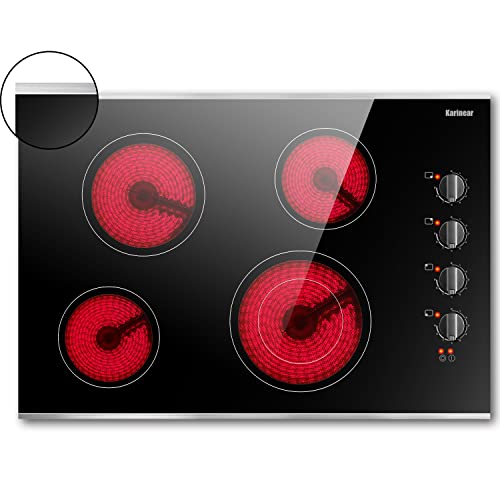
Karinear 30 Inch Electric Cooktop 4 Burners Knob Control 6700W — Best Knob Control
Some cooks will never love tapping glass to change heat, and Karinear built this model for them: four radiant burners on ceramic glass, controlled by real knobs you can turn by feel, with a hot surface indicator doing the essential radiant safety job. It is a particularly good fit for older cooks, gloved hands, and anyone replacing a coil cooktop who wants the smooth-top cleanup without relearning the controls.
Strengths
- Knob controls that adjust by feel and work with wet or floury hands — no touch-panel fussiness
- Hot surface indicator fitted, the non-negotiable safety feature on a radiant top
- 6700W across four burners is a sensible, honest power budget for the format
Trade-offs
- Knobs interrupt the flat glass, adding a small cleaning detail the touch models avoid
- Four burners and mid-pack wattage — not the choice for power users
- Karinear is a value brand with online-first support
| Spec | Detail (from the verified listing) |
|---|---|
| Size | 30 inch built-in |
| Burners | 4 burners |
| Output | 6700W |
| Controls | Knob control |
| Safety | Hot surface indicator |
| Surface | Ceramic glass |
There is a real usability argument for knobs on a radiant cooktop. Radiant elements respond slowly, so cooks adjust by anticipation — a nudge up before the pan goes on, a nudge down as the sauce thickens — and a knob’s tactile, eyes-free adjustment fits that rhythm better than tapping a glass pad and checking a display. Karinear’s implementation keeps the rest of the formula simple: ceramic glass that wipes clean, four burners in a conventional layout, and the hot-surface indicator that every radiant top owes its household, because glass that looks identical hot or cold is the format’s one genuine hazard.
Expect the standard radiant ownership pattern with a knob tax: the glass wipes down in seconds, and the knobs want an occasional lift-off clean underneath. Power at 6700W total is adequate for family cooking without stressing older electrical services the way very high-wattage models can. Karinear’s growing catalog of built-in cooktops means documentation is easy to find; support remains an online experience.
Best for: cooks who want smooth-top cleanup with traditional knob control, including households upgrading from coil tops / Not suited for: touch-control fans or five-burner cooks
Check on Amazon — check the current price on Amazon and confirm the cutout dimensions and fuel or voltage requirements in the listing before you order.

VEVOR Built-In Electric Stove Top 30 Inch 5 Burners 8600W — Best Five-Burner Value
If the Frigidaire flagship’s five burners appeal but its price does not, VEVOR’s answer is this: five radiant burners under glass, a strong 8600W total, sensor touch controls with nine power levels, plus a timer and child lock. It is the maximum-coverage radiant top in this roundup for households that cook several things at once and count value in burners per dollar.
Strengths
- Five burners and 8600W — the strongest paper specification in this roundup’s value tier
- Sensor touch controls with nine power levels, timer and child lock included
- Glass radiant surface keeps the format’s wipe-clean, all-cookware virtues
Trade-offs
- Five burners share the glass and the wattage; two oversized pans still crowd
- Touch controls need dry fingers and a glance down to adjust
- VEVOR’s appliance support is online-based and thinner than legacy brands’
| Spec | Detail (from the verified listing) |
|---|---|
| Size | 30 inch built-in |
| Burners | 5 burners |
| Output | 8600W |
| Controls | Sensor touch control, 9 power levels, timer |
| Safety | Child lock |
VEVOR’s strategy is transparent: match the flagship’s headline numbers — five burners, high total wattage, touch controls, timer, lock — at a fraction of the flagship’s price. The engineering question is whether the execution keeps up, and on the evidence of the spec, the fundamentals are right: nine power levels give usable granularity for a radiant element’s cycling control, the timer acknowledges that radiant cooking is timed cooking (elements respond slowly, so walking away with a timer set is the correct technique), and the child lock matters precisely because touch controls are easy for small hands to activate. Heat distribution across five radiant burners in 30 inches follows the class pattern: a stronger center or rear position for the big pan, satellites for the supporting cast.
Plan the electrical side honestly: 8600W is a serious hardwired load, so the circuit and breaker must match the manual’s specification. In daily use, the glass wants the radiant routine — respect residual heat, scrape sugary spills once cool, keep a ceramic-glass cleaner under the sink. VEVOR’s scale means manuals and common parts are findable; warranty handling is an online process.
Best for: multi-pot households that want five burners and touch controls without flagship pricing / Not suited for: knob loyalists, or buyers prioritizing local service networks
Check on Amazon — check the current price on Amazon and confirm the cutout dimensions and fuel or voltage requirements in the listing before you order.

Electric Cooktop 30 Inch Ceramic 4 Burners 6700W Satin Glass Touch — Best Budget Touch
This unbranded four-burner model is the budget floor of the category done sensibly: satin-finish ceramic glass (which hides smears better than gloss), touch sensor controls with nine power levels, a timer and a child safety lock, at 6700W. It suits first apartments, rental kitchens and guest-house installs where the brief is ‘modern, safe, inexpensive’ in that order.
Strengths
- Satin glass finish disguises fingerprints and minor marks between cleans
- Touch controls with nine levels, timer and child safety lock — the modern feature set intact at the budget tier
- 6700W is a manageable electrical load for older homes’ circuits
Trade-offs
- Unbranded: long-term parts and support are the weakest in this roundup — buy with that expectation set
- Four burners of modest individual output; big-pot boiling is patient work
- Touch pads on budget models can be less responsive with damp fingers than branded equivalents
| Spec | Detail (from the verified listing) |
|---|---|
| Size | 30 inch built-in |
| Burners | 4 burners |
| Output | 6700W |
| Surface | Satin glass, black |
| Controls | Touch sensor control, 9 power levels, timer |
| Safety | Child safety lock |
| Electrical | 220–240V |
Judged as an appliance rather than a badge, the formula is coherent. The satin glass is a genuinely practical choice — glossy black glass is a fingerprint exhibition, while the satin finish keeps a working kitchen looking tidy. Nine power levels and a timer cover the radiant repertoire, and the child lock addresses the touch-control risk honestly. Where the money was saved shows in the margins: burner output is modest, so this top simmers and sautés happily but will not hurry a lobster pot, and the unbranded reality means the purchase should be treated as a consumable-grade appliance — excellent service for its price, with a replacement rather than a repair as the long-term plan.
Installation is the standard hardwired 220–240V job; because support is thin, have the installer verify every burner and control at fitting, while any problem is still a returns conversation rather than a warranty one. Daily care is the glass routine. For landlords and budget remodelers, that is an acceptable, even savvy, bargain — as long as it is struck with open eyes.
Best for: rentals, first apartments and budget remodels wanting a modern touch-control smooth-top / Not suited for: power users, or anyone who expects decade-long parts support
Check on Amazon — check the current price on Amazon and confirm the cutout dimensions and fuel or voltage requirements in the listing before you order.

VEVOR Electric Cooktop 30 Inch 4 Burners 7200W Knob and Touch — Best Hybrid Controls
Households argue about controls; this VEVOR declines to choose. Its knob/touch hybrid layout lets the knob cook adjust by feel while the touch user gets 11 levels of set-and-forget precision, and an over-heat guard watches the whole operation. For mixed-preference households — and for cooks who want knob speed with touch precision for low simmers — it is the diplomat’s pick.
Strengths
- Hybrid knob/touch controls satisfy both control philosophies in one household
- 11 power levels give finer low-end granularity than the nine-level norm in this class
- Over-heat guard adds a thermal safety layer, and 7200W is a healthy four-burner budget
Trade-offs
- Hybrid layouts are nobody’s pure ideal — knob purists and touch purists both compromise a little
- Four burners, so the five-burner flexibility of its sibling is traded away
- Online-first value-brand support, as with the other VEVOR pick
| Spec | Detail (from the verified listing) |
|---|---|
| Size | 30 inch built-in |
| Burners | 4 burners |
| Output | 7200W, 220V, no plug |
| Controls | Knob/touch control, 11 power levels |
| Safety | Over-heat guard |
| Surface | Ceramic radiant glass |
The 11 power levels are the detail worth dwelling on. Radiant elements hold temperature by cycling, and the quality of a simmer depends on how finely the control can slice that cycle. Eleven levels versus the usual nine is a modest but real improvement in low-end manners — the difference between a sauce that ticks over and one that surges. The over-heat guard is the other grown-up feature: a thermal cutoff that intervenes if a zone runs away, the kind of unglamorous protection that matters in real kitchens with distractions. Between the hybrid controls and these two details, this is the most thoughtfully specified four-burner value model in the roundup.
The 7200W hardwired load needs the correct circuit, as with all models here. Cleaning splits the difference between its siblings: glass wipes clean, knobs need their occasional detail clean. VEVOR’s documentation is readily available online, and the brand’s sheer volume in this category means troubleshooting knowledge is easy to find — a practical form of support, if not a concierge one.
Best for: mixed households that cannot agree on knobs versus touch, and cooks who value fine low-end control / Not suited for: purists of either control style, or five-burner cooks
Check on Amazon — check the current price on Amazon and confirm the cutout dimensions and fuel or voltage requirements in the listing before you order.
Comparison Table
| Pick | Badge | Key spec | Best for |
|---|---|---|---|
| Frigidaire Professional FPEC3077RF 30 Inch Electric Cooktop | Best Overall | 5 burners, ceramic glass, stainless trim, Professional series | keeper remodels that want five radiant burners and a major brand’s support behind them |
| Empava 30 Inch Radiant Electric Cooktop 4 Burners | Best Value Dual Zone | 4 burners, dual zone element, ETL certified | budget remodels and rentals that want a certified radiant top with a genuinely useful dual-zone element |
| Karinear 30 Inch Electric Cooktop 4 Burners Knob Control 6700W | Best Knob Control | Knob control, 6700W, hot surface indicator | cooks who want smooth-top cleanup with traditional knob control, including households upgrading from coil tops |
| VEVOR Built-In Electric Stove Top 30 Inch 5 Burners 8600W | Best Five-Burner Value | 5 burners, 8600W, sensor touch, child lock | multi-pot households that want five burners and touch controls without flagship pricing |
| Electric Cooktop 30 Inch Ceramic 4 Burners 6700W Satin Glass Touch | Best Budget Touch | Satin glass, touch control, 6700W, child lock | rentals, first apartments and budget remodels wanting a modern touch-control smooth-top |
| VEVOR Electric Cooktop 30 Inch 4 Burners 7200W Knob and Touch | Best Hybrid Controls | Knob/touch hybrid, 11 levels, over-heat guard, 7200W | mixed households that cannot agree on knobs versus touch, and cooks who value fine low-end control |
How to Choose a 30 Smooth Electric Cooktop
Start by confirming the format is right for you. Radiant smooth-top’s case rests on three pillars: it accepts every pan you own, it costs less than induction, and it is simple technology any electrician understands. Its costs are slower response and residual heat. If your cookware is heavily non-magnetic or your budget is firm, radiant is the rational choice; if you crave instant control and the fastest boils, read our induction guide instead and pay the difference knowingly.
Measure the cutout and check the electrical supply. All models here are hardwired 220–240V with no plug; the circuit must match the model’s wattage — a 6700W top and an 8600W top do not ask the same of your panel. Cutout dimensions vary by brand, so verify the published cutout, not the nominal 30-inch label, against your counter.
Choose the element layout by your pans. One large element for the main skillet is the minimum; a dual-zone element (Empava) is the efficiency upgrade if your pan sizes vary; five burners (Frigidaire, VEVOR) buy multi-pot flexibility at the cost of crowding. Then choose controls by habit: knobs for tactile cooks, touch for wipe-clean minimalists, hybrid if the household is divided.
Finally, check the safety and certification lines: hot-surface indicators on radiant tops are essential, child locks matter on touch models, and ETL or equivalent certification should be present on any hardwired appliance you install. Brand support is the last filter — a legacy badge buys parts availability; a value badge buys features per dollar. Both are legitimate; choose consciously.
Radiant vs Induction vs Coil: Picking Your Electric Format
Coil elements are the oldest electric format: cheap, rugged, tolerant of warped pans, and a nuisance to clean under. Radiant smooth-top replaced the coil with an element under ceramic glass — same heating idea, transformed cleanup and appearance, plus a flat surface that doubles as counter space when cool. Induction is the different technology entirely: the pan itself becomes the heating element, giving speed, precision and a cool surface at a higher price and with a cookware compatibility requirement.
In daily cooking, radiant sits between the two in responsiveness: slower to heat and cool than induction, comparable to coil, and perfectly capable once you learn to cook with its rhythm — preheat deliberately, move the pan off the element to stop cooking instantly, and use residual heat for keeping warm instead of fighting it. Many cooks raised on gas adapt to induction faster; cooks raised on coil or radiant often prefer the smooth-top’s familiarity. Neither preference is wrong; the mistake is buying a format whose habits annoy you daily.
How to Use and Care for a Smooth Electric Cooktop
Radiant glass rewards a few specific habits. Build them from the first week and the surface will stay clear and glossy for the life of the appliance.
- Match pan size to element size. A pan much smaller than the element wastes energy and overheats the exposed glass; much larger, and it heats unevenly and can stress the surface.
- Preheat on a medium-high setting, then reduce. Radiant elements hold momentum like a cast-iron pan — overshooting then waiting is slower than approaching the target temperature steadily.
- To stop cooking fast, slide the pan to a cool part of the top rather than just switching off; the element’s residual heat keeps cooking for minutes, which is a feature for keeping warm and a trap for delicate sauces.
- Respect the hot-surface indicator every time, and teach the household that smooth glass gives no visual warning of its own — the indicator light is the warning.
- Clean spills promptly once the surface is cool. For burnt-on or sugary spills, soften, then lift with a single-edge razor scraper held flat — the standard, safe technique for ceramic glass.
- Use a dedicated ceramic-glass cleaner weekly, avoid abrasive pads and powders, and lift heavy pans instead of sliding them to prevent scratches and metal marks.
Matching Wattage and Circuits: The Installation Reality
The wattage spread in this roundup — 6700W to 8600W — is not a performance ranking; it is an electrical requirement. Higher-wattage models heat large elements faster but demand a circuit and breaker sized for the load, and older homes may need panel work to supply it. An honest installer will check the nameplate requirement against your panel before the cooktop is unboxed. If your electrical service is limited, the 6700W models are not a downgrade; they are the models your house can actually run.
All six picks are hardwired, no-plug appliances, which is correct for built-in equipment: a hardwired junction connection cannot work loose or overheat like a plug in a hidden box. It also means installation and any future swap are electrician jobs, not DIY moments. Budget for that professional hour as part of the purchase — it is the cheapest insurance in the whole project.
Element Sizing and the Two-Pan Test
Radiant cooktops are bought by burner count and judged by element sizing, so apply the two-pan test before anything else: take your largest skillet and your largest saucepan — the pair that cooks your most common real meal — and check them against the element layout in the listing diagram. The skillet needs an element close to its base diameter; an element far smaller leaves a cool ring and a pale crust, while an element far larger wastes heat around the pan and overheats the surrounding glass. The saucepan needs a position it can occupy simultaneously without the two pans’ handles colliding or one pan stealing the other’s space. Models that pass your personal two-pan test will satisfy you; models that fail it will annoy you daily regardless of wattage.
This is where the roundup’s design choices sort themselves. The dual-zone element on the Empava exists precisely for households whose pan sizes swing between small saucepans and wide skillets on the same position. The five-burner models (Frigidaire, VEVOR) pass more simultaneous combinations but squeeze each one. The four-burner models with generous spacing pass the two-pan test with the most comfort and fail the four-pot holiday test instead. There is no universal winner — there is your cookware, measured honestly.
Ceramic Glass: What It Tolerates and What It Does Not
Ceramic glass is a more remarkable material than its kitchen familiarity suggests: engineered to expand almost not at all under heat, it survives the thermal shock of a cold pan on a hot element that would crack ordinary glass instantly. Its real enemies are mechanical, not thermal. Impact — a pan dropped on an edge, a cast-iron lid rolling off a stack — is the first. Abrasion is the second: dragging rough pan bases, scouring pads and gritty cleaners all micro-scratch the surface, and scratches collect stains and weaken the panel over years. Sugar is the third, oddly specific enemy: molten sugar spilled on hot glass can pit the surface as it cools and contracts, which is why jam-making and candy work demand prompt, careful cleanup once the glass is cool enough to approach.
The care regime that follows from those three enemies is short enough to memorize: lift pans, soften and scrape spills with the razor technique, clean with ceramic-glass products and soft cloths, and never use the cooktop as a landing pad for oven trays or a cutting surface. Households that keep those four habits report glass that looks new at a decade; households that treat the top as a counter get the scratched, cloudy surface that gives the format an undeserved reputation. The material is not fragile — it is specific, and specificity is manageable.
Cooking Technique for Radiant Heat: Working With the Lag
Radiant cooking has a rhythm, and cooks who learn it stop experiencing the format as slow. The core skill is anticipation: because an element takes time to reach temperature and longer to shed it, you cook one step ahead of the food. Preheat the pan while you prep the ingredients — radiant rewards mise en place more than any other format. When a dish needs to drop from a sear to a simmer, do not wait for the element to cool: move the pan to a cold zone or off the cooktop entirely for thirty seconds, then return it to the now-reduced element. Professional cooks call this ‘cooking on the pass,’ and on radiant it is not a workaround but the native technique, the equivalent of a gas cook lifting the pan off the flame.
Residual heat, properly used, is a feature with a menu of its own: it keeps a finished dish at serving temperature without energy input, finishes a sauce’s last thickening off the boil, warms plates, and holds a resting steak. The cooks who curse residual heat are the ones who discover it with a curdled custard; the cooks who plan for it treat the cooktop as having a free ‘keep warm’ zone that follows every cooking zone. Buy any model in this roundup and spend the first week deliberately practicing these two moves — anticipation and the off-element finish — and the format’s reputation for slowness will quietly expire in your kitchen.
Common Buying Mistakes
- Buying a wattage your panel cannot feed. Check the circuit requirement first; an 8600W cooktop on an undersized circuit is a breaker-tripping disappointment.
- Leaving sugary spills on hot glass. Sugar can pit ceramic glass as it cools; wipe or scrape promptly once the surface is safe to approach.
- Treating the smooth top as a cutting board or counter for hot oven trays. It is glass: impact and thermal shock are its enemies.
- Ignoring the hot-surface indicator. Radiant glass looks identical at room temperature and at cooking temperature; the light exists because burns happen otherwise.
- Using abrasive cleaners or pads. They micro-scratch the surface, and scratched glass holds stains and weakens — use ceramic-glass cleaner and soft cloths.
- Assuming all 30-inch cutouts are equal. Verify the published cutout dimensions for your exact model against your counter before ordering.
Final Recommendation
For most kitchens, the Frigidaire Professional FPEC3077RF is the best 30 smooth electric cooktop to own: five burners, flagship execution and a service network worthy of a hardwired appliance. Value shoppers are well served — the Empava’s dual-zone element is the smartest single feature at its price, the Karinear answers knob loyalists, VEVOR offers both a five-burner touch model and a hybrid-control four-burner with unusually fine power levels, and the satin-glass budget model keeps rentals modern and safe for the least money.
Weighing the other formats before you decide? Compare with Best 30 Induction Cooktops, Best 30 Inch Kitchen Gas Cooktops, Best 30 Electric Cooktops, Best 30inch Cooktops Gas, and the wider Best 36 Cooktops if your counter allows. Whatever you choose: verify the cutout, size the circuit, and plan to keep a bottle of ceramic-glass cleaner under the sink.
If you are ordering today, start the shortlist with Frigidaire Professional FPEC3077RF 30 Inch Electric Cooktop, Empava 30 Inch Radiant Electric Cooktop 4 Burners and Karinear 30 Inch Electric Cooktop 4 Burners Knob Control 6700W — check the current price on Amazon for each, confirm the fit against your measurements, and let your fuel, your pans and your budget make the final call.
Frequently Asked Questions
What is the difference between a smooth electric cooktop and an induction cooktop?
A smooth (radiant) cooktop heats elements under ceramic glass, and the hot glass heats your pan — it works with any cookware. An induction cooktop generates heat directly in the pan using magnetic fields, so it is faster and the surface stays cooler, but pans need magnetic bases and the cooktop costs more. Both share the flat, wipe-clean glass format.
Why does the surface stay hot after I turn the burner off?
Radiant elements heat the glass itself, and glass holds heat. The cooktop keeps a hot-surface indicator lit until the zone cools to a safe temperature. Use the residual heat deliberately — it is excellent for keeping food warm — and treat the indicator as a hard rule for hands, towels and plastic utensils.
Can I use cast iron and warped pans on ceramic glass?
Cast iron works well; lift it rather than sliding to avoid scratches, and avoid dropping it — glass’s enemy is impact. Slightly warped pans rock and heat unevenly on any flat top; badly warped pans waste energy and can overheat the exposed glass around them, so flat-bottomed cookware is best.
How do I remove burnt-on food without damaging the glass?
Let the surface cool, soften the deposit with ceramic-glass cleaner, then lift it with a single-edge razor scraper held at a shallow angle — this is the manufacturer-approved technique for ceramic glass. Never use abrasive pads, oven cleaner or a knife held steeply, all of which scratch or chip the surface.
What size circuit does a 30-inch radiant cooktop need?
It depends on the model’s total wattage — the models here span 6700W to 8600W at 220–240V, which translates to different breaker requirements. The installation manual states the required circuit for your exact model; have an electrician confirm your panel can supply it before purchase.
Are five burners worth it on a 30-inch radiant cooktop?
If you regularly cook multi-part meals, yes — the fifth position removes the pan-shuffling bottleneck. The cost is crowding: two oversized pans will not sit comfortably at once on any 30-inch top. Occasional big-meal cooks are usually happier with four well-spaced burners and a dual-zone element.
Can a radiant smooth-top boil water as fast as my old coil cooktop?
Comparable, and usually a little faster with a well-matched pan: the flat glass couples the element to flat-bottomed cookware more consistently than a coil couples to anything but a perfectly matched pan. It will not match induction’s boil speed — that gap is physics, not a defect of any model here — but for the everyday kettle and pasta pot, a radiant top in the 6700–8600W class performs the job without drama. Use a lid; it is the cheapest speed upgrade in any format.
Why do radiant elements cycle on and off visibly?
That glowing pulse is the control system working as designed. A radiant element holds a set temperature by switching between full power and off in proportion to your setting — more on-time at high settings, brief pulses at low ones. It is why radiant heat feels steady in the pan despite the element’s visible rhythm, and why fine low-end control depends on how finely the control slices that cycle, as discussed in the VEVOR hybrid review.


