Disclosure: airfryerkitchensupply.com is reader-supported. When you buy through links on our site, we may earn an affiliate commission at no extra cost to you.
Where to buy
Buying the best 12 volt camping heater: Camping heaters are safety equipment as much as comfort equipment, and listings blur important categories — electric versus diesel, indoor-rated versus vehicle-only. Every pick below was verified against current catalog data before publication. Use the links to check the current price on Amazon, and read the full listing’s safety and ventilation requirements before you order.
- VEVOR 8KW Diesel Heater (Bluetooth App Control) (Best Overall) — Check the current price on Amazon
- VEVOR 8KW Diesel Heater (CO Alarm, Bluetooth) (Best Safety Features) — Check the current price on Amazon
- LF Bros 5KW Diesel Heater (110V/12V, Plateau Mode) (Best Dual Power) — Check the current price on Amazon
- ICECOSMOS Diesel Heater (15000 BTU, 4 Air Outlets) (Best for Tents) — Check the current price on Amazon
- VEVOR 8KW Diesel Heater All-in-One (1.9 Gal Tank) (Best All-in-One Portability) — Check the current price on Amazon
- CYDZSW 12V 500W Electric Heater (Best Electric (Small Jobs Only)) — Check the current price on Amazon
The search for the best 12 volt camping heater collides immediately with physics, and this guide will not pretend otherwise. A 12 volt battery cannot power meaningful electric heat for long — the plug-in electric heaters in this category are defroster-class devices that warm hands and small spaces briefly. The heaters that genuinely warm a tent, camper or RV through a cold night on a 12 volt system are diesel parking heaters: compact furnaces that sip diesel for heat and use 12 volt electricity only to run their fan and controls. Five of the six picks here are those diesel units, and the sixth is the best honest electric option, labelled for what it is.
That framing is a service, not a disappointment. A diesel parking heater is one of the great cold-weather camping upgrades: it produces dry, abundant heat for many hours on a small amount of fuel, runs from the same 12 volt battery ecosystem as your fridge and lights, and turns a shivering shoulder-season trip into a comfortable one. Thousands of van, RV, truck-camper and even tent campers (with the heater outside and warm air ducted in) rely on them all winter. The picks below span the category’s main forms — app-controlled units, an all-in-one with its own tank, a dual-power model, and a tent-focused multi-outlet design.
Safety runs through this whole guide, because combustion heat demands respect: exhaust must vent outside, a carbon monoxide alarm belongs in any heated sleeping space, and the manufacturer’s clearances and instructions override anything summarized here. Read the buying-guide sections on sizing and safe installation before choosing, and treat the how-to as an overview of a typical install — not a substitute for the manual that ships with your heater.
A note on who these heaters serve, because it is wider than the word ‘camping’ suggests: the same diesel units warm ice-fishing shelters, hunting blinds, overland rigs, boat cabins, workshops, greenhouses and off-grid cabins, anywhere a 12 volt battery system exists and diesel is easy to store. Campers are simply the largest tribe of users. If your need is a warm space that is not a house, the shortlist below is probably your shortlist too — just re-read the sizing advice against your own space and insulation rather than a tent’s.
In this guide
Quick Picks
VEVOR 8KW Diesel Heater (Bluetooth App Control) — Best Overall. The category benchmark: 8KW diesel heat, Bluetooth app control plus remote and LCD, and automatic altitude adjustment for mountain camping. — Check price on Amazon
VEVOR 8KW Diesel Heater (CO Alarm, Bluetooth) — Best Safety Features. The same 8KW class with a CO alarm headline feature, 12V/24V flexibility, app control and remote — for campers who put the safety layer first. — Check price on Amazon
LF Bros 5KW Diesel Heater (110V/12V, Plateau Mode) — Best Dual Power. A 5KW unit that runs on 110V or 12V, with a plateau mode, timer controller, stated 9–27 hour runtime and a 5L tank — the flexible-power pick. — Check price on Amazon
ICECOSMOS Diesel Heater (15000 BTU, 4 Air Outlets) — Best for Tents. A 15000 BTU diesel heater with four air outlet ducts and 12V or 110–120V power, aimed at tents, garages and campers — distribution is its talent. — Check price on Amazon
VEVOR 8KW Diesel Heater All-in-One (1.9 Gal Tank) — Best All-in-One Portability. The self-contained formula: 8KW heat with its own 1.9 gallon tank in one portable unit, app control included — no vehicle fuel system to tap. — Check price on Amazon
CYDZSW 12V 500W Electric Heater — Best Electric (Small Jobs Only). The honest electric option: a battery-wired 500W heater/defroster for taking the edge off a small cab or vestibule — not a tent furnace, and labelled so. — Check price on Amazon
How These Picks Were Chosen
Every heater was verified against live catalog data through this site’s product-verification system, confirming the model, its power and fuel arrangement, and its headline features as currently listed. Electric and diesel units are identified as what they are, with no electric pick described as a whole-space heater. Features quoted — app control, CO alarm, tank size, altitude adjustment — come from the verified listings themselves.
The shortlist balances the diesel category’s real choices: control sophistication, safety features, tank and form factor, multi-outlet tent use, and dual-power flexibility, plus one electric pick for the small, simple jobs electric heat can honestly do.
- Confirmed 12 volt system compatibility, with fuel and heat type stated plainly
- Heat class matched honestly to space — tent, van, RV or cab
- Safety features verified from the listing, especially CO alarm where featured
- Fuel arrangement clear: integrated tank or vehicle tank feed
- Control options that matter at 2 a.m. — remote, app, thermostat
- Installation demands stated, including exhaust venting
The 6 Best 12 Volt Camping Heaters
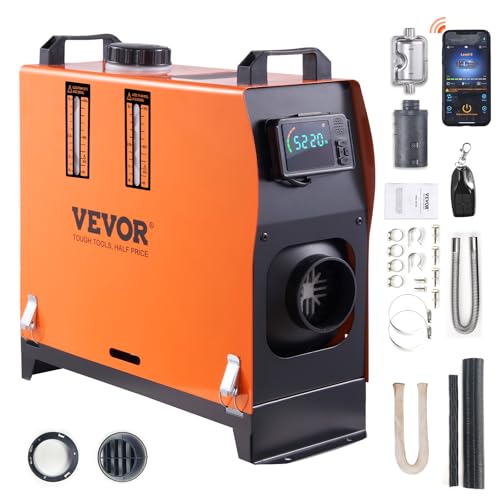
VEVOR 8KW Diesel Heater (Bluetooth App Control) — Best Overall
VEVOR’s 8KW diesel heater is the unit that made this category mainstream, and its specification explains the success. Eight kilowatts is serious heat — enough for a van, a mid-size RV, a truck camper or a well-ducted tent setup — delivered as dry forced air that does not add the condensation moisture of unvented combustion inside the space. Bluetooth app control joins a physical remote and an LCD controller, so the heat can be started from a sleeping bag and adjusted without crossing a cold floor at 2 a.m.
The feature campers in the mountains should note is the automatic altitude adjustment, rated in the listing to over 18,000 feet: diesel heaters traditionally run sooty and unhappy at altitude, and automatic compensation is the fix, making this the default pick for high-country hunters and ski-trip van campers. As with every diesel unit here, the install — exhaust outside, intake clear, fuel lines sound — is the price of admission, and the safety sections of this guide apply in full.
Strengths
- Full heat output for vans, RVs and campers
- App, remote and LCD control options
- Automatic altitude adjustment for mountain use
Trade-offs
- Installation required — exhaust, intake and fuel supply
- 8KW is oversized for a small tent on mild nights
- Diesel ownership means fuel, filters and basic upkeep
| Spec | Detail |
|---|---|
| Output class | 8KW diesel air heater |
| Control | Bluetooth app, remote control, LCD |
| Altitude | Automatic adjustment to 18045 ft (as listed) |
| System | 12V parking heater |
If you are buying your first parking heater and your rig is a van, camper or RV, start here and stop second-guessing: this is the reference specification the rest of the category is priced against. Size down only if your space is genuinely small and your winters mild — an oversized heater cycles gently, while an undersized one runs flat-out and still loses.
Ownership includes the diesel ritual: clean fuel, a monthly run, an exhaust kept clear. VEVOR’s scale means filters, glow plugs and advice are easy to source — the unglamorous advantage that decides whether a heater is a five-year appliance or a one-season experiment.
Best for: van, RV and truck-camper owners wanting full winter heat / Not suited for: minimalist tent campers on mild shoulder-season trips
Check on Amazon — check price on Amazon before you order, and confirm the listing matches the model described here.

VEVOR 8KW Diesel Heater (CO Alarm, Bluetooth) — Best Safety Features
Carbon monoxide is the invisible risk of combustion heating, and this VEVOR variant builds the response into the product: a CO alarm listed as a headline feature, alongside the same 8KW heat, Bluetooth app control, remote and display screen as its sibling. For campers heating a sleeping space — which is most of this category’s users — choosing the model that watches the air while you sleep is an easy decision to defend, and this guide badges it accordingly.
The 12V/24V dual-voltage compatibility widens its vehicle fit, from 12 volt camper systems to 24 volt trucks. None of this replaces the non-negotiables: exhaust sealed and vented outside, a separate battery-powered CO detector as a second layer, and clearances respected. Think of the built-in alarm as one layer in a system you control — the right way to approach any combustion appliance in a small space.
Strengths
- CO alarm integrated as a headline safety feature
- 12V/24V compatibility fits more vehicles
- Full control set: app, remote and display
Trade-offs
- Still requires full diesel installation discipline
- Built-in alarm supplements — never replaces — a separate detector
- Premium positioning over the base 8KW model
| Spec | Detail |
|---|---|
| Output class | 8KW diesel air heater |
| Safety | CO alarm (as listed) |
| Power | DC 12V/24V |
| Control | Bluetooth app, remote, display screen |
Buy this version when the heated space is a sleeping space, which for most campers is the whole point of the purchase. The price difference over the base heater is small against a winter of nights slept in a van or camper, and the dual-voltage flexibility future-proofs it across vehicles. Safety features are the least glamorous line in any listing and the most important one in this category.
The CO-alarm model adds one ownership habit: test the alarm function on the schedule the manual sets, and log it with the detector test in the sleeping space. Safety devices that are never tested are decorations; tested ones are a system.
Best for: anyone sleeping in the space the heater warms / Not suited for: open-air or workshop-only heating
Check on Amazon — check price on Amazon before you order, and confirm the listing matches the model described here.

LF Bros 5KW Diesel Heater (110V/12V, Plateau Mode) — Best Dual Power
The LF Bros heater is built around flexibility. Its dual-power design runs on 110V household power or a 12V system, which changes how you can use it: pre-heat the camper on the driveway, heat a garage or workshop tent at home, then run the same unit from the vehicle battery at a site. The 5KW output class suits small-to-mid spaces — vans, small campers, tents with ducted air — more proportionately than the 8KW units, and the stated 9–27 hour runtime from its 5L tank covers long nights without refuelling choreography.
Plateau mode addresses altitude operation, the timer controller handles start-before-you-wake scheduling, and the listing’s six-layer safety framing plus freeze-resistant wiring speak to genuine winter use rather than fair-weather marketing. The foldable handle and all-in-one lean make it one of the more portable serious heaters here — a unit that can move between the camper, the ice-fishing shelter and the workshop across a season.
Strengths
- Runs on household 110V or 12V — unique flexibility here
- 5KW size suits tents and small campers proportionately
- Timer and plateau modes for scheduling and altitude
Trade-offs
- 5KW will work hard in a large RV in deep cold
- Dual-power hardware adds complexity
- Runtime varies with setting — the top figure is low-power use
| Spec | Detail |
|---|---|
| Output class | 5KW diesel heater |
| Power | 110V / 12V dual power |
| Tank | 5L |
| Runtime | 9–27H (as listed) |
| Features | Plateau mode, timer controller, 6-layer safety |
This is the pick for campers whose heating life spans home and road: the workshop in January, the camper in February, the hunting tent in November. If your heater will only ever live in one vehicle, a dedicated install may suit better; if it will roam, the LF Bros’ dual power and portability make it the most adaptable serious heater in this guide.
The LF Bros’ dual-power design changes storage too: a heater that can run on household power can be test-run on the bench in autumn without a vehicle, which is when you want to discover a tired glow plug — not on the season’s first frozen night.
Best for: multi-use heating across camper, tent and workshop / Not suited for: large RVs in severe cold
Check on Amazon — check price on Amazon before you order, and confirm the listing matches the model described here.

ICECOSMOS Diesel Heater (15000 BTU, 4 Air Outlets) — Best for Tents
Tent heating has a distribution problem: the heater sits outside or in a vestibule for safety, and one duct delivers one stream of warm air to one corner. The ICECOSMOS answers with four air outlet ducts, letting you run warm air to multiple points of a large tent, split heat between a tent and an annex, or warm a garage workspace evenly. Its stated 15000 BTU capacity is honest mid-class heat — right-sized for tents and small campers rather than large RVs.
The dual-voltage design (12V and 110–120V) repeats the LF Bros flexibility in a distribution-focused package: driveway and garage use on household power, field use on the battery. For tent campers specifically, multi-outlet ducting also solves the cold-spot complaint that makes single-duct tent heating feel uneven — warm air arriving at both ends of a big family tent changes the whole night’s comfort.
Strengths
- Four outlets distribute heat where tents actually need it
- Dual voltage for home and field use
- Tent and garage use named in its design brief
Trade-offs
- Mid-class output for large or very cold spaces
- Four ducts mean more setup and more ducting to manage
- Exhaust discipline is entirely the user’s responsibility
| Spec | Detail |
|---|---|
| Output class | 15000 BTU diesel heater |
| Outlets | 4 air outlet ducts |
| Power | 12V & 110-120Volt |
| Use | Tent, garage, RV, campers |
Family tent campers and ice-shelter anglers are this heater’s people — anyone whose ‘room’ is fabric and whose heater must live outside it. Plan your duct runs before the first trip, keep the exhaust far from any intake or opening, and place a CO detector inside the sleeping space regardless of the heater’s position. Set up that way, it makes winter tent camping a genuinely comfortable proposition.
For the ICECOSMOS, ownership is about the duct set: coil ducts without crushing them, cap the outlets against nesting insects in storage, and inspect the duct insulation each season. Its distribution advantage lives entirely in those ducts’ condition.
Best for: tent campers and multi-space heating / Not suited for: large RVs or single small cabs
Check on Amazon — check price on Amazon before you order, and confirm the listing matches the model described here.

VEVOR 8KW Diesel Heater All-in-One (1.9 Gal Tank) — Best All-in-One Portability
The all-in-one format removes the diesel category’s biggest installation hurdle: the fuel supply. Instead of tapping a vehicle tank or mounting a separate one, this VEVOR carries its own 1.9 gallon tank in the same portable housing as the heater, with Bluetooth app control on top. Place the unit, route the exhaust outside, duct the warm air in, connect 12 or 24 volt power — and a truck, van, RV or camper has heat without a single hole in its fuel system.
Portability compounds the appeal: the same unit can serve the camper this weekend, a rented cabin’s porch room next month, and a workshop all winter, moving in minutes. The trade-offs are the format’s own — an integrated tank means refuelling the unit itself, and a portable unit still demands the same exhaust and clearance discipline as a fixed install, every single time it is placed. Convenience must never become casualness with combustion.
Strengths
- Integrated tank — no vehicle fuel plumbing
- Portable between vehicles and buildings
- Full 8KW output with app control
Trade-offs
- Tank refills are a manual chore
- Portable placement tempts sloppy exhaust routing — resist it
- Larger single unit to store and move
| Spec | Detail |
|---|---|
| Output class | 8KW diesel, all-in-one |
| Tank | 1.9 gal integrated fuel tank |
| Power | DC 12V/24V |
| Control | Bluetooth app control |
Renters, multi-vehicle households, and campers who cannot modify their vehicle should start here. The all-in-one is also the easiest diesel heater to resell or hand on, because nothing about it is married to one rig. If your life has one vehicle and one winter, a fixed install is tidier; if your life moves, this is the format that moves with it.
The all-in-one’s portability creates one discipline of its own: a placement checklist, repeated every time — exhaust out and away, intake clear, unit level, clearances respected — because a heater that moves must be re-sited perfectly every time. Write the checklist on the carry case if you must.
Best for: portable heat across vehicles, rentals and workshops / Not suited for: buyers wanting a permanent, invisible install
Check on Amazon — check price on Amazon before you order, and confirm the listing matches the model described here.

CYDZSW 12V 500W Electric Heater — Best Electric (Small Jobs Only)
This pick exists so the guide can be complete and honest about electric heat. The CYDZSW is a 500W battery-wired electric heater with four outlets, sold for UTV and truck cabs and camping use. Five hundred watts is real warmth at close range — it will defrost a windshield, warm hands and feet in a small cab, and take the bite out of a camper’s entry area while the engine or a generator runs. It is not, and cannot be, an overnight tent heater: at roughly 42 amps of draw, it consumes a campsite battery in a couple of hours.
Where does that leave it? As the right tool for engine-running warmth in small working vehicles, for short pre-warm sessions, and for campers whose ‘heating’ need is really fifteen minutes of defrost and comfort while the main heat source starts. Bought for those jobs it is simple, instant and maintenance-free in a way no diesel unit matches. Bought as a night heater, it will strand your battery — the badge on this pick is a warning as much as a recommendation.
Strengths
- Instant, silent, maintenance-free heat
- No fuel, exhaust or combustion concerns
- Excellent defroster and spot warmer
Trade-offs
- Draws about 42 amps — engine-running use only
- Cannot heat a sleeping space through the night
- Modest total warmth beside any diesel pick
| Spec | Detail |
|---|---|
| Power | 12V, 500W electric |
| Outlets | 4 holes |
| Use | UTV / truck cab heater and defroster |
Every category guide should include the product that defines its boundary, and this is ours. If your camping is a UTV at dawn, a truck cab on a work morning, or a camper where the engine runs while you dress, the CYDZSW is genuinely useful. If your need is sleeping warm, buy diesel and never look back.
The CYDZSW’s ownership is the simplest here: no fuel, no exhaust, no cool-down cycle — just wiring to inspect and a battery to respect. For the small jobs it is badged for, that simplicity is a legitimate reason to choose electric and be done.
Best for: defrosting and short engine-on warmth in small cabs / Not suited for: overnight heating of any sleeping space
Check on Amazon — check price on Amazon before you order, and confirm the listing matches the model described here.
Comparison Table
| Pick | Badge | Key spec | Best for |
|---|---|---|---|
| VEVOR 8KW Diesel Heater (Bluetooth App Control) | Best Overall | 8KW diesel, app + remote, auto altitude | van, RV and truck-camper owners wanting full winter heat |
| VEVOR 8KW Diesel Heater (CO Alarm, Bluetooth) | Best Safety Features | 8KW diesel, CO alarm, 12/24V, app control | anyone sleeping in the space the heater warms |
| LF Bros 5KW Diesel Heater (110V/12V, Plateau Mode) | Best Dual Power | 5KW, 110V+12V, 5L tank, plateau mode | multi-use heating across camper, tent and workshop |
| ICECOSMOS Diesel Heater (15000 BTU, 4 Air Outlets) | Best for Tents | 15000 BTU, 4 outlets, dual voltage | tent campers and multi-space heating |
| VEVOR 8KW Diesel Heater All-in-One (1.9 Gal Tank) | Best All-in-One Portability | 8KW all-in-one, 1.9 gal tank, app control | portable heat across vehicles, rentals and workshops |
| CYDZSW 12V 500W Electric Heater | Best Electric (Small Jobs Only) | 500W electric, battery-wired, defroster class | defrosting and short engine-on warmth in small cabs |
How to Choose the Best 12 Volt Camping Heater: Diesel vs Electric, Honestly
The decision tree has one trunk: how much heat, for how long, in what space? Electric 12 volt heat is for minutes of defrost and spot warmth with an engine running. Diesel heat is for hours of whole-space warmth — the only technology in the 12 volt ecosystem that delivers it. Propane, the other common camping heat, is outside this guide’s 12 volt brief, and unvented propane in sleeping spaces carries its own moisture and safety debates. For a camper already invested in 12 volt power — fridge, lights, battery — diesel integrates beautifully: tiny electrical draw, abundant heat, fuel available everywhere.
Sizing within diesel follows space and insulation. Tents and small campers thrive on 5KW-class units like the LF Bros; vans and mid RVs are the 8KW heartland; the multi-outlet ICECOSMOS trades peak output for distribution, which fabric shelters need most. Oversizing modestly is safe — these heaters modulate — while undersizing in deep cold means a heater running at maximum all night and still losing ground. Altitude campers should insist on altitude compensation, whether automatic like the lead VEVOR or a plateau mode like the LF Bros.
- Tent, ducted air: ICECOSMOS or LF Bros 5KW
- Van / truck camper / RV: VEVOR 8KW models
- Sleeping space priority: CO-alarm model
- No vehicle modification allowed: all-in-one with its own tank
- Defrost and spot warmth only: CYDZSW electric
Safety: The Non-Negotiable Section
Diesel parking heaters are safe when installed and used correctly, and unforgiving of shortcuts. The exhaust must terminate outside the living space, away from windows, doors and the heater’s own intake, with every joint sealed — exhaust contains carbon monoxide, which is colorless, odorless and lethal. Keep a battery-powered CO detector inside any space you sleep in while a combustion heater runs, test it, and treat the CO-alarm heater model in this guide as a supplement to that detector, never a replacement.
Respect clearances around the unit and its hot air outlet, keep combustibles — bedding, fuel containers, clothing — away from both, and route fuel lines where they cannot chafe or drip onto hot surfaces. Never refuel a hot unit, never run a heater in a sealed space without the ventilation the manufacturer specifies, and stop using any unit that soots, smells of raw fuel in the cabin air, or behaves erratically until it is inspected. These are not legal disclaimers; they are the operating culture of everyone who heats with combustion for decades without incident.
Fuel, Runtime and Living With a Diesel Heater
Diesel heaters are famously frugal: the heat comes from a small, metered burn, and a few litres of diesel cover nights that would flatten any battery asked to do the same work electrically. The 5L tank on the LF Bros, with its stated 9–27 hour runtime depending on setting, and the 1.9 gallon tank on the all-in-one VEVOR frame the practical range: a weekend is easy, a week is a fuel-can plan. The 12 volt side is almost an afterthought — fans and controls sip power compared with a fridge — which is why these heaters pair so well with modest battery systems and solar.
Ownership includes light upkeep: run the heater monthly even in summer to keep fuel fresh through its system, use clean diesel, keep the intake filter and exhaust clear, and expect a glow plug or filter service eventually, as with any small diesel appliance. Campers who do this own heaters that start first time on the coldest night of the year. Campers who store them wet and forgotten own a project. The difference is twenty minutes of attention per season.
Tents and Combustion Heat: Doing It the Way Experienced Winter Campers Do
Because tents are the most demanding case, they deserve their own protocol. The experienced pattern is consistent: the heater unit lives outside the tent or in a vestibule designed for gear, never loose inside the sleeping space; warm air arrives through a duct whose outlet is positioned low, away from bedding, with its clearance respected; the exhaust terminates well away from the tent, downwind, where its plume cannot drift back through a door or vent; and a battery-powered CO detector rides inside the tent, at sleeping height, tested before the trip.
Duct management is the comfort skill: one long duct loses heat along its run, so insulate or shorten runs where you can, and aim the outlet to wash warm air across the floor rather than at the ceiling — warm air rises on its own and needs no help. The multi-outlet ICECOSMOS exists precisely because a big family tent has cold corners a single stream cannot reach. Start the heater before bed so the tent’s fabric and bedding are warm when you turn in; heating a cold-soaked tent from inside a sleeping bag is a slow, morale-testing wait.
Finally, rehearse the shutdown as carefully as the startup: let the heater complete its cool-down cycle on power before disconnecting anything (interrupting a diesel heater’s cool-down is the classic way to coke it up), cap the duct, and store the detector with the tent so it is never forgotten. Winter tent camping with a diesel heater is one of outdoorsmanship’s great pleasures — warm, dry, quiet — and it is earned entirely by these unglamorous disciplines.
Running Costs and Fuel Planning for a Season of Warm Camps
Diesel heat is inexpensive heat, but a season of it still deserves a plan. Start with consumption honesty: a heater loafing on low through a mild night sips fuel, while the same heater fighting -15°C in a drafty tent drinks several times faster. Plan fuel for your coldest expected night, carry it in a proper diesel container stored outside the sleeping space, and treat the vehicle’s own diesel supply — where your install draws from it — as shared with tomorrow’s drive, never to be spent to empty on warmth.
The electrical budget is smaller but real: startup draws the most, the fan sips thereafter, and a multi-night stand without driving wants the battery watched like the fridge’s budget is watched. Solar that covers a fridge usually covers a heater’s fan too. Campers who run both appliances learn to think of the battery as one household budget with two tenants, and to give the heater its share first on the coldest nights, because a warm camper with a slightly warm fridge sleeps better than the reverse.
End the season as deliberately as you began it: run the heater on fresh fuel, exercise it monthly through summer, store tanks sealed and labelled, and service filters and glow plugs on the manufacturer’s rhythm rather than on failure’s. A diesel heater’s second season should start exactly like its first — first press, clean burn, warm tent — and with this small liturgy of care, it will, for many seasons in a row.
How to Install and Use a Diesel Parking Heater (Overview)
Installations vary by vehicle and model, and the manufacturer’s manual for your exact heater is the authority. This overview describes the typical shape of an install so you can plan the job, the tools, and whether to hand it to a professional installer — a common and respectable choice.
- Choose the mounting location: protected from road spray and impacts, with a short, safe exhaust route to outside air and room for the warm-air duct into the living space
- Mount the heater body level and secure, following the manual’s orientation limits, on a surface that tolerates heat
- Route the exhaust outside with sealed joints, terminating away from openings and the combustion intake; insulate it where it passes anything heat-sensitive
- Fit the combustion air intake where it draws clean outside air and cannot be blocked by snow, mud or stored gear
- Install the fuel supply — tank or vehicle feed — with the pump and filter as specified, lines secured against chafe and kept from hot surfaces
- Wire the 12 volt supply through the specified fuse to the battery system, and mount the controller where you can reach it from bed
- Commission the heater per the manual: prime the fuel line, run a full heat cycle outside sleeping hours, and check for leaks, smells and error codes
- Fit a CO detector in the sleeping space, test it, and only then treat the installation as finished
Your first heated night is a test, not a victory lap: check the exhaust joints again the next morning, confirm the fuel connections are dry, and note how much fuel and battery the night actually used — those two numbers plan every future trip. Keep the manual, a spare fuse and the heater’s error-code list in the vehicle. A diesel heater installed with this care becomes the most-loved appliance in a winter rig; installed casually, it is a risk no amount of warmth justifies.
Budget a commissioning evening at home before the first trip: assemble the heater on the driveway or in the workshop, run it through several full cycles, learn its controller’s language and error codes, and confirm your ducting reaches where you think it reaches. Every diesel heater has a personality in its startup sequence and sounds; learning them on a mild evening at home, manual in hand, is what makes a -10°C start at a dark campsite a non-event.
Common Buying Mistakes
Trying to heat a tent all night with an electric 12V heater. The battery math forbids it: even 500W empties a campsite battery in a couple of hours. Electric is for defrost; diesel is for the night.
Venting exhaust ‘just outside’ the tent door. Exhaust drifts. Terminate it well away from openings and intakes, sealed at every joint, and keep a CO detector in the sleeping space regardless.
Skipping the CO detector. A detector is inexpensive, silent insurance for combustion heat. The heater model’s built-in alarm is a supplement — fit the separate detector too.
Undersizing for the space and season. A small heater at maximum all night is loud, thirsty and still cold. Size for your coldest expected night, not your average one.
Storing the heater all summer without running it. Stale fuel and a dry system make autumn’s first start a failure. Run it monthly, briefly, all year.
Blocking the warm-air outlet with bedding. The outlet is hot and needs its clearance. Route ducts and arrange the sleeping space so nothing soft can fall against the heat source.
Final Recommendation
For most van, RV and camper owners the lead VEVOR 8KW is the buy — full heat, full controls, altitude compensation — and those sleeping in the heated space should step to the CO-alarm variant for the extra safety layer. Tent campers should choose between the ICECOSMOS’s four-outlet distribution and the LF Bros’ dual-power flexibility, renters and multi-vehicle households the all-in-one VEVOR, and anyone needing only defrost and spot warmth the honest little CYDZSW electric.
Buy the heater your coldest night requires, install it like the combustion appliance it is, and keep a CO detector where you sleep. Do those three things and a 12 volt camping heater stops being a purchase and becomes the reason your camping season is suddenly two months longer.
Reflect, finally, on what changes when a camper trusts their heat. Trips stop being gambles on the forecast and become choices: the late-season weekend taken because the heater makes it kind, the high-country camp chosen for its silence rather than avoided for its cold, the extra hour of fishing at dusk because a warm tent waits. Every pick in this guide — from the flagship diesel units to the little electric defroster that knows its limits — exists to widen that circle of possible trips. Choose yours with the sizing and safety disciplines this guide insists on, and the cold stops being the thing your camping is organized around avoiding. It becomes simply weather, happening outside a warm space, while you sleep the deep sleep of the properly equipped.
- VEVOR 8KW Diesel Heater (Bluetooth App Control) (Best Overall) — Check on Amazon
- VEVOR 8KW Diesel Heater (CO Alarm, Bluetooth) (Best Safety Features) — Check on Amazon
- LF Bros 5KW Diesel Heater (110V/12V, Plateau Mode) (Best Dual Power) — Check on Amazon
- ICECOSMOS Diesel Heater (15000 BTU, 4 Air Outlets) (Best for Tents) — Check on Amazon
- VEVOR 8KW Diesel Heater All-in-One (1.9 Gal Tank) (Best All-in-One Portability) — Check on Amazon
- CYDZSW 12V 500W Electric Heater (Best Electric (Small Jobs Only)) — Check on Amazon
Keep exploring the cluster: Best 12 Volt Cab Heater Best 12 Volt Camping Fridge Best 12 Volt Camping Cooler Best 12 Volt Camping Shower
Frequently Asked Questions
Can a 12 volt electric heater warm a tent overnight?
No — the battery math makes it impossible. Even a 500W electric heater draws about 42 amps and empties a typical campsite battery in a couple of hours. Overnight heat on a 12 volt system means a diesel parking heater, which uses 12 volts only for its fan and controls.
Are diesel parking heaters safe in a camper or tent?
They are widely and safely used when installed correctly: exhaust sealed and vented outside, clearances respected, and a carbon monoxide detector in the sleeping space. Most tent users place the heater outside and duct warm air in. Follow the manufacturer’s instructions exactly — they override any general guidance.
How much diesel does a camping heater use?
Very little — that is the technology’s appeal. Depending on setting, expect a long night to use well under a litre to a few litres at maximum output. The LF Bros in this guide states 9–27 hours from its 5L tank across its settings, which is representative of the class.
What size heater do I need — 5KW or 8KW?
Tents, small campers and mild-to-moderate cold suit the 5KW class; vans, larger RVs and serious winter suit 8KW. Insulation matters as much as volume: a well-insulated small van may thrive on 5KW, while a drafty large tent in deep cold wants all the heat and distribution it can get.
Do diesel heaters work at altitude?
Standard units run poorly as air thins, producing soot and weak heat. Choose a model with altitude compensation — automatic adjustment on the lead VEVOR here, or the LF Bros’ plateau mode — if you camp in mountains, and expect any heater to need the feature above a few thousand metres.
Can I install a diesel heater myself?
Many owners do, carefully, with the manual. The job involves mounting, exhaust routing, fuel lines and fused wiring — all safety-relevant. If any part is beyond your experience, professional installation is a sensible cost; a correct install is the entire safety case for combustion heat.
Do diesel heaters smell or make noise inside the tent or camper?
A correctly installed heater’s combustion is entirely outside the living space: what enters is only warmed air, which should carry no exhaust smell — any fuel or exhaust odor inside means stop and inspect the installation. Noise is a soft fan and a faint fuel-pump tick, which most sleepers rate below a campsite’s wind and rain.
Can a diesel heater run while driving?
Parking heaters are designed for stationary use and are commonly run in parked vehicles; running while driving depends on the model and installation, and the manufacturer’s instructions govern. Most campers heat the space while parked and let vehicle heat take over on the move.


