Disclosure: airfryerkitchensupply.com is reader-supported. When you buy through links on our site, we may earn an affiliate commission at no extra cost to you.
Where to buy
The fastest way to compare the best commercial grade vacuum sealers in this guide is on Amazon, where each model below is sold with its full specification sheet, current configuration options, and delivery terms in one place. Every pick in this article was cross-checked against Amazon’s own catalog data before it earned a link, so the product name and model you see here match the listing you will land on. Prices move with promotions and configurations, so we do not print fixed prices in this guide — use the links to check price on Amazon for the exact size, color, or bundle you want. If a pick is marked as unlinked in our notes, that means we could not confirm a confident catalog match for it, and we would rather describe it honestly than send you to the wrong listing.
- VacMaster VP320 Chamber Vacuum Sealer — view on Amazon
- VacMaster VP230 Chamber Vacuum Sealer — view on Amazon
- Weston Pro-3000 Vacuum Sealer — view on Amazon
- Weston Pro-2300 Vacuum Sealer — view on Amazon
- Weston Pro-1400 Vacuum Sealer — view on Amazon
- Avid Armor JARMAX Chamber Vacuum Sealer — view on Amazon
The best commercial grade vacuum sealers are defined by duty cycle, not marketing. A commercial grade vacuum sealer runs cycle after cycle through a full service or processing day without overheating, pulls a consistent deep vacuum on the five-hundredth seal as reliably as on the first, and can be serviced — seals, bars, pump oil, wear parts — instead of replaced. If sealing protects your food cost, your prep system, or your product, that is the standard to buy to.
This guide covers six machines across the commercial spectrum: large chamber sealers with oil pumps for wet and high-volume work, wide-bar external sealers from Weston for oversize dry goods, and a deep-chamber jar and infusion specialist. Every model was verified against Amazon’s catalog data. We are direct about which businesses each machine fits, because an undersized sealer in a working kitchen is a bottleneck that costs money every day.
In this guide
Quick Picks
Six picks cover the realistic spread of best commercial grade vacuum sealers. Each one earned its badge for a different reason, and each one is reviewed in full further down the page with its strengths, trade-offs, and a clear verdict on who should buy it and who should skip it.

VacMaster VP320 Chamber Vacuum Sealer — Best Overall Commercial
The flagship chamber pick. A 16-inch seal bar takes pouches up to 16 x 18 inches, the half-horsepower oil pump drives fast, deep cycles, and the chamber swallows large primals and high-volume liquid work. For serious operations, this is the benchmark.
Check on Amazon — check price on Amazon.

VacMaster VP230 Chamber Vacuum Sealer — Best for Small Commercial Kitchens
Commercial oil-pump performance at a mid-commercial size. The VP230’s 12.25-inch bar and 12 x 15 pouch capacity cover most restaurant portioning and prep, with faster, deeper cycles than any dry-pump machine.
Check on Amazon — check price on Amazon.
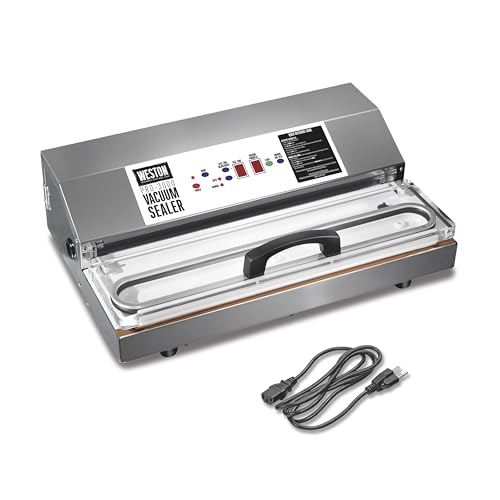
Weston Pro-3000 Vacuum Sealer — Best Wide-Bar External Sealer
For oversize dry goods, nothing beats a wide external bar. The Pro-3000 seals bags up to 15 inches wide, runs a fan-cooled 1020-watt motor for back-to-back duty, and adds programmable controls. Hunters and processors sealing large cuts swear by this format.
Check on Amazon — check price on Amazon.

Weston Pro-2300 Vacuum Sealer — Best Value Commercial External
The Pro-3000’s formula at a lower tier: same 15-inch wide sealing, same fan-cooled 1020-watt platform, simpler controls. For high-volume dry sealing without programmability needs, this is the value peak of the Weston line.
Check on Amazon — check price on Amazon.

Weston Pro-1400 Vacuum Sealer — Best Compact Commercial External
Commercial Weston build in a smaller format: bags up to 11 inches wide, 720 watts, stainless body. The Pro-1400 fits delis, cafes, and market stalls that seal steadily but do not need a 15-inch bar.
Check on Amazon — check price on Amazon.

Avid Armor JARMAX Chamber Vacuum Sealer — Best for Jars, Marinades, and Infusions
A chamber specialist with a deep cavity that fits mason jars upright — for vacuum-sealing dry goods in jars, rapid marinades, and infusions. It is explicitly not a pressure canner; it is a vacuum tool, and a distinctive one.
Check on Amazon — check price on Amazon.
How These Picks Were Chosen
We selected these machines on commercial criteria. Duty cycle first: fan-cooled motors, oil pumps, and manufacturer ratings for continuous or heavy use. Seal width and chamber dimensions second, since they decide what product you can package. Third, seal quality systems — wide seal wires, double seals, and programmable seal times — because a failed seal in commerce is wasted product, not an inconvenience. Fourth, serviceability: replaceable seal bars, accessible pumps, and brands with parts networks. Fifth, control programmability for operations that run the same cycle hundreds of times and need it identical every time.
Every pick was cross-checked against Amazon’the Amazon catalogue data before linking. Home-grade machines wearing commercial language in their titles were excluded. Where a machine is an external sealer rather than a chamber model, we say so plainly and explain the operational trade — external machines handle unlimited length; chamber machines handle liquids. Confusing the two is the most expensive mistake in this category.
The 6 Best Options for best commercial grade vacuum sealers
VacMaster VP320 Chamber Vacuum Sealer — Best Overall Commercial
The VP320 is built for operations whose sealing volume justifies a flagship: restaurants portioning proteins for service and sous vide, processors packaging retail cuts, and commissaries handling sauces at scale. The 16-inch seal bar and chamber capacity for 16 by 18 inch pouches mean large items seal whole instead of being broken down to fit a smaller box. The half-horsepower rotary oil pump delivers the deep, repeatable vacuum commercial work requires and recovers quickly between cycles, keeping a processing line moving rather than waiting on the machine.
Strengths
- Largest chamber and seal bar in this guide
- Oil pump built for continuous commercial duty
- Handles liquids, large cuts, and high-volume portioning in one machine
Trade-offs
- Flagship-tier investment — justify it with real volume
- Large, heavy footprint needs a dedicated station and strong counter
- Oil maintenance schedule is mandatory, not optional
| Specification | Detail |
|---|---|
| Seal bar | 16 inches |
| Max pouch | 16 x 18 inches |
| Pump | 1/2 HP rotary oil pump |
The operational math is straightforward: pouch costs are minimal in a chamber format, seal consistency protects product, and throughput protects labor. The VP320’s cost is recovered by operations that seal daily at volume; it is not recoverable by a business sealing a few bags a week, which should buy a tier down. If your volume is real, this is the machine that stops being a bottleneck and starts being infrastructure.
At the VP320’s scale, workflow design matters as much as the machine. Operations get the most from it by sealing at a dedicated station with pouches pre-sorted, a scale for portion control, and a labeling step built into the cycle rather than added afterward. The big chamber handles two smaller pouches side by side in many layouts, which doubles throughput on portion work — test your pouch sizes against the chamber floor and standardize. Oil changes and gasket inspections belong on the preventive maintenance calendar alongside refrigeration service. Treated as infrastructure and maintained like it, the VP320 anchors a prep system for years.
Best for: restaurants, processors, and commissaries sealing at daily volume / Not suited for: low-volume businesses or any home kitchen
Check on Amazon — check price on Amazon.
VacMaster VP230 Chamber Vacuum Sealer — Best for Small Commercial Kitchens
The VP230 is the rational commercial chamber sealer for small restaurants, butcher counters, and serious prep kitchens. It shares the VP320’s oil-pump architecture — deep vacuum, quick cycles, quiet operation — in a chamber sized for the work most kitchens actually do: portioned proteins, sauces, marinades, and sous vide preparation in 12 by 15 inch pouches or smaller. Programmable vacuum and seal times let a kitchen standardize cycles so any team member produces identical seals.
Strengths
- Oil-pump depth and speed in a mid-size chamber
- Programmable cycles standardize results across staff
- Covers the great majority of restaurant portioning work
Trade-offs
- Smaller chamber than the VP320 for very large items
- Oil checks and changes are part of the routine
- Still a substantial counter footprint
| Specification | Detail |
|---|---|
| Pump | 1/2 HP rotary oil pump |
| Seal bar | 12.25 inches |
| Max pouch | 12 x 15 inches |
Most small operations should start their commercial search here rather than at the flagship. The VP230 handles the daily list without strain, costs meaningfully less than the VP320 tier, and only gives up the extreme pouch sizes few kitchens use weekly. If your menu or product line genuinely includes large primals sealed whole, step up. Otherwise, the VP230 is commercial grade in the ways that matter: duty, consistency, and serviceability.
Oil-pump ownership on the VP230 comes down to one five-minute habit: check the oil sight glass on a schedule, keep the level where the manual specifies, and change oil when it clouds. In return, the pump delivers the same deep vacuum on a harvest weekend’s two-hundredth cycle as on the first — the consistency that separates commercial equipment from enthusiastic home gear. The large chamber also invites a batching discipline: process proteins by type, label everything at the machine, and freeze pouches flat so the freezer becomes a filing system instead of a pile. Operations that build that discipline around the VP230 rarely outgrow it.
Best for: small restaurants and prep kitchens sealing daily / Not suited for: operations needing 16-inch pouches or homes with light use
Check on Amazon — check price on Amazon.
Weston Pro-3000 Vacuum Sealer — Best Wide-Bar External Sealer
The Weston Pro-3000 represents the other commercial architecture: an external sealer with an extra-wide bar. Because bags feed from a roll outside the machine, length is unlimited — whole briskets, long fish, and bulk cuts that no chamber can swallow seal without portioning. The 5mm seal wire lays a wide, secure seal, the 1020-watt fan-cooled motor is built for repeated cycles without thermal shutdowns, and programmable settings let processors lock in repeatable seal times for production runs.
Strengths
- Seals bags up to 15 inches wide with unlimited length
- Fan-cooled motor built for back-to-back cycles
- Programmable controls for repeatable production sealing
Trade-offs
- External sealers cannot seal liquids — dry and moist solids only
- Uses embossed bags, which cost more per bag than chamber pouches
- Large counter footprint in a different shape than chamber machines
| Specification | Detail |
|---|---|
| Seal bar | Up to 15 inches wide, 5mm seal |
| Power | 1020 watts |
| Motor | Fan-cooled for continuous duty |
Choose the Pro-3000 when your product is large and dry: game processing, bulk meat packing, and dry goods at volume. Do not choose it as your only sealer if sauces, marinades, or soups are part of the operation — physics forbids it, and no technique fully compensates. Many processors run this Weston beside a chamber machine, each doing the job its architecture does best. As a wide-bar external specialist, the Pro-3000 is commercial grade without qualification.
The Pro-3000’s programmable memory pays off when more than one person runs the machine: store the standard cycle for your main product, and every operator produces the same seal regardless of experience. For game processing, the wide bar’s real advantage appears with long cuts — loins and whole fish fillets seal without folding, which keeps portions presentable and freezer-efficient. Keep the seal area scrupulously clean during fatty work; a single smear across the seal zone is the leading cause of the slow leaks that show up weeks later as freezer burn. A quick wipe between bags is the cheapest quality control in the building.
Best for: hunters, processors, and packers sealing large dry goods / Not suited for: liquid sealing or kitchens needing one machine for everything wet
Check on Amazon — check price on Amazon.
Weston Pro-2300 Vacuum Sealer — Best Value Commercial External
The Weston Pro-2300 keeps the hardware that matters — the extra-wide 5mm seal bar for bags up to 15 inches, the 1020-watt fan-cooled motor for sustained cycling, stainless construction — and simplifies the control set to reduce cost. For operations running one standard cycle on dry product all day, programmable memory is a convenience, not a necessity, and the Pro-2300’s manual controls deliver the same seal quality with less to configure and less to go wrong.
Strengths
- Wide 15-inch sealing with a heavy 5mm seal band
- Fan-cooled motor for sustained production runs
- Lower tier than the Pro-3000 with the same core hardware
Trade-offs
- No programmable cycle memory
- Liquids remain off-limits, as with all external sealers
- Embossed bag costs exceed chamber pouch costs over time
| Specification | Detail |
|---|---|
| Seal bar | Up to 15 inches wide, 5mm seal |
| Power | 1020 watts |
| Motor | Fan-cooled |
The Pro-2300 suits the single-product processor, the hunting camp that becomes a packing operation each season, and the small business sealing dry goods in volume. Its honest limitation is the external format itself, shared with its sibling. Judged as a wide-bar dry sealer, it offers the strongest value in this guide: commercial duty hardware without paying for control features a steady workflow never uses.
Owners stepping up to the Pro-2300 from home edge sealers should recalibrate one expectation: this machine is built to be run, not babied, and its fan-cooled motor expects back-to-back work. What it does not forgive is a dirty seal zone or bags loaded carelessly off-center. Develop the habit of a centered load and a clean seal area and the wide 5mm band does the rest. Because it lacks programmable memory, operations with several product types should post the manual settings for each product at the machine — a laminated card restores most of the convenience the Pro-3000 builds in, at the Pro-2300’s lower tier.
Best for: high-volume dry-goods sealing on a controlled budget / Not suited for: liquid sealing or multi-program production lines
Check on Amazon — check price on Amazon.
Weston Pro-1400 Vacuum Sealer — Best Compact Commercial External
Not every commercial operation seals briskets. The Weston Pro-1400 brings the Pro line’s stainless, commercial-grade construction to the 11-inch bag format that covers portioned meats, cheese, charcuterie, and retail dry goods. At 720 watts it cycles respectably through steady workloads, and its smaller footprint suits deli counters, cafe prep stations, farmers market operations, and food trucks where the wide-bar machines simply do not fit the counter.
Strengths
- Commercial build sized for standard 11-inch bags
- Smaller footprint for tight commercial counters
- Weston parts and support network behind it
Trade-offs
- Narrower bar excludes wide cuts and large family packs
- Lower wattage cycles slower than the 1020W models
- External format — no liquid sealing
| Specification | Detail |
|---|---|
| Seal bar | Bags up to 11 inches wide |
| Power | 720 watts |
The Pro-1400 is the correct buy when your product mix is portion-scale and your counter is real. Cafes sealing beans and prep, delis packaging cuts to order, and small retailers will find its duty rating honest and its size livable. Operations that regularly exceed 11-inch widths should not compromise — buy the bar width your product demands, because forcing wide product into narrow bags wastes both product and bags.
The Pro-1400 fits the rhythm of counter service: a deli sealing cuts to order, a cafe packaging beans and prep, a market stall preparing product through the day. Its moderate wattage means cycles are steady rather than rapid-fire, which suits that pace honestly. Keep rolls or pre-cut bags in the two sizes your products actually use — most portion work standardizes fast — and the machine disappears into the workflow, which is the highest compliment for counter equipment. If your product mix grows into wider cuts, the Pro-1400 remains useful as the portion station beside a wide-bar sibling rather than becoming waste.
Best for: delis, cafes, and small retailers sealing portion-size goods / Not suited for: wide-cut processing or any liquid sealing
Check on Amazon — check price on Amazon.
Avid Armor JARMAX Chamber Vacuum Sealer — Best for Jars, Marinades, and Infusions
The JARMAX fills a niche no other machine in this guide touches: a deep chamber that accepts mason jars upright, so you can vacuum-seal flour, grains, coffee, and dry goods directly in jars for pantry storage, and run rapid marinades and oil or spirit infusions under vacuum. Its 10.5-inch seal bar also handles standard chamber pouches for everyday sealing, so it is a fully capable chamber sealer that happens to have a specialty. Avid Armor is explicit that this is not a pressure canner and does not make shelf-stable canned food — vacuum sealing jars is for freshness and freezer or pantry storage, and we repeat that clarification because confusing the two is a genuine food safety error.
Strengths
- Deep chamber fits mason jars upright for jar vacuum sealing
- Excellent for rapid marinades and infusions
- Functions as a full chamber sealer for pouches too
Trade-offs
- Specialty premium for the jar capability — wasted if you never seal jars
- Not a pressure canner; vacuum-sealed jars are not shelf-stable canned goods
- Chamber width is mid-size at a 10.5-inch bar
| Specification | Detail |
|---|---|
| Seal bar | 10.5 inches |
| Chamber | Deep chamber, fits mason jars |
| Note | Vacuum sealer only — not a pressure canner |
For producers of infused oils, cocktail ingredients, marinated products, or jar-packaged dry goods, the JARMAX does work that otherwise needs separate accessories and workarounds. For a conventional kitchen, its pouch sealing matches mid-size chamber rivals and the jar depth is a bonus. Buy it for the specialty if the specialty is your business; buy it as a general chamber sealer only if the price tier still makes sense against the VP210-class alternatives.
JARMAX owners find the jar workflow habit-forming: dry staples go into jars the day they come home, get vacuum-sealed in the chamber, and stay visibly fresh in the pantry without a forest of half-closed bags. For infusions, vacuum accelerates flavor transfer dramatically — an oil or spirit that would steep for weeks develops character in days of cycled vacuum — but keep records of ratios and times, because the speed makes experimentation easy to forget and hard to repeat. And repeat the safety line until it is reflex: vacuum-sealed jars are stored like fresh food, refrigerated or frozen as the contents require, never treated as canned goods.
Best for: infusion, marinade, and jar-sealing specialists / Not suited for: anyone seeking a canning appliance or needing the widest chamber
Check on Amazon — check price on Amazon.
Comparison Table
| Pick | Badge | Key spec | Best for |
|---|---|---|---|
| VacMaster VP320 Chamber Vacuum Sealer | Best Overall Commercial | 16-inch seal bar, 1/2 HP oil pump, 16 x 18 pouches | restaurants, processors, and commissaries sealing at daily volume |
| VacMaster VP230 Chamber Vacuum Sealer | Best for Small Commercial Kitchens | 1/2 HP oil pump, 12.25-inch bar, 12 x 15 pouches | small restaurants and prep kitchens sealing daily |
| Weston Pro-3000 Vacuum Sealer | Best Wide-Bar External Sealer | 15-inch wide 5mm seal bar, 1020W, fan-cooled, programmable | hunters, processors, and packers sealing large dry goods |
| Weston Pro-2300 Vacuum Sealer | Best Value Commercial External | 15-inch 5mm bar, 1020W, fan-cooled motor | high-volume dry-goods sealing on a controlled budget |
| Weston Pro-1400 Vacuum Sealer | Best Compact Commercial External | 11-inch bags, 720W, commercial grade build | delis, cafes, and small retailers sealing portion-size goods |
| Avid Armor JARMAX Chamber Vacuum Sealer | Best for Jars, Marinades, and Infusions | Deep chamber fits mason jars, 10.5-inch seal bar | infusion, marinade, and jar-sealing specialists |
How to Choose the Best Commercial Grade Vacuum Sealers for Your Operation
Begin with architecture, because it is a physics decision. Chamber sealers evacuate a whole chamber and are the only format that seals liquids cleanly; they also use the cheapest pouches. External sealers pull air through the bag opening, cannot handle free liquid, but seal unlimited lengths and the widest dry goods. Operations doing both jobs at volume buy both formats, as several picks in this guide illustrate. An operation doing only one job should buy the architecture that does it and not pay for the other.
Size the machine to throughput, not to your biggest imaginable day. Count your realistic peak cycles per hour and choose a duty rating that sustains it: fan-cooled external motors and oil-pump chamber machines exist precisely because standard motors overheat and pause mid-service. Then size the bar or chamber to your product’s honest dimensions, and check serviceability — replaceable seal bars, available gaskets, pump oil access, and a manufacturer that sells parts. A commercial machine you cannot service is a disposable machine at a commercial price.
Run the consumables math before you buy. Chamber pouches cost a fraction of embossed external bags per unit, so a high-volume wet or mixed operation recovers a chamber machine’s premium quickly. A dry-goods operation sealing oversize product has no chamber option at that size and should optimize bag purchasing instead. Either way, the machine price is only the first line of the real cost sheet — bags, seals, oil, and downtime complete it.
Duty Cycle, Seal Quality, and Food Safety in Commercial Sealing
Commercial grade means the machine maintains vacuum depth and seal temperature across a full shift. Seal failures in commerce are doubly expensive: the product is wasted and the labor is wasted with it. Wide 5mm seal wires and double seals exist to widen the margin for error on imperfectly loaded bags, and programmable seal times let you match heat to bag thickness instead of guessing. Build a test into your workflow: seal water pouches at shift start, check for channels and leaks, and replace worn seal tape or bars before they cost you product.
On food safety, be precise about what vacuum sealing does. It removes air, slowing oxidation and freezer burn and extending refrigerated life of properly handled food. It does not sterilize food, does not make perishable food shelf-stable, and does not replace refrigeration, freezing, or proper canning. Vacuum-sealed perishables belong in the refrigerator or freezer, labeled with dates. Any seller language implying otherwise — including confusion between vacuum jar sealing and pressure canning — should disqualify the claim, not the category.
Budget Tiers in Commercial Sealing
Commercial tiers track duty and size. Compact commercial external sealers serve portion-scale operations at the entry tier. Wide-bar fan-cooled models cost more and return it in throughput on large dry goods. Chamber machines start at a prosumer tier and climb with pump size and chamber dimensions to flagship oil-pump models. We do not print fixed prices because they move with promotions and configurations; check price on Amazon for each pick and evaluate it against your cycle volume and consumables math. The expensive mistake is never the higher tier itself — it is a mismatch between the machine’s duty and the operation’s day.
Total Cost of Ownership: The Spreadsheet Behind the Machine
Commercial sealing decisions should be made on total cost per sealed unit, not on machine price. Build the real figure: machine cost spread across its service life, plus pouches or bags per unit, plus wear parts — seal bars, gaskets, tape, pump oil — plus the labor minutes each cycle consumes, plus the cost of seal failures measured in wasted product. Run that arithmetic and format choices often reverse themselves: the chamber machine that looked expensive becomes the cheap option at volume because its pouches cost a fraction of embossed bags, while the budget external sealer’s bag bill quietly exceeds a flagship’s price difference within a busy year.
Downtime belongs in the spreadsheet too. A machine awaiting a proprietary part during your peak week costs more than a year of maintenance on a serviceable model. This is why this guide weights parts networks and replaceable wear items as heavily as vacuum depth. The operations that seal profitably are rarely the ones with the most impressive machine; they are the ones whose cost per sealed unit is known, monitored, and boringly consistent month after month.
Training Staff and Standardizing Seal Quality
In a commercial kitchen, the sealer is only as good as the least-trained person who uses it on a Saturday night. Standardization is the fix: posted cycle settings per product, a defined seal-check — firm tug, visual inspection for channels, occasional water-pouch leak test — and a rule that any pouch failing the check is resealed or discarded, never shrugged into the cooler. Programmable machines help by locking settings; manual machines achieve the same discipline with a laminated settings card at the station.
Build the supporting habits into the station itself. Pouches stocked at the machine, a marker and labels that live at the station and nowhere else, a wipe for the seal zone within arm’s reach, and a small bin for failed seals so failure is visible rather than hidden. When managers review waste, seal failures should appear as a countable line — what gets counted gets fixed. Operations that train sealing as a skill, rather than assuming it, see their food-cost savings actually arrive; operations that skip training blame the machine for what was always a process problem.
When to Add a Second Machine Instead of a Bigger One
Growth tempts every operation toward a single flagship, but two mid-size machines often beat one large one in practice. Two machines give redundancy — a failure during service degrades you to half speed instead of zero — and they let you split architectures: a chamber for wet and portion work beside an external wide-bar for oversize dry goods, each doing its physics best. They also flex with staffing: two operators seal in parallel at peak, one machine rests in the troughs.
The counter-argument is real: two machines need two maintenance routines, two pouch inventories if architectures differ, and more counter space in total. The decision rule we recommend is throughput-shaped. If your bottleneck is one product type at extreme size, buy the specialist flagship. If your bottleneck is varied work queuing at a single station, add the second machine. Most growing kitchens and processors discover their queue is varied — and that the chamber-plus-external pairing in this guide exists precisely because commercial sealing is, in the end, two different jobs wearing one name.
Chamber Pouch and Bag Sourcing for Operations
Consumables sourcing is an operational decision, not an afterthought. Chamber pouches should be bought in case quantities once your sizes are standardized, from suppliers who hold consistent film thickness — thin, inconsistent film is the hidden cause behind many mysterious seal failures blamed on machines. External sealer operations face a different market: embossed rolls and pre-cut bags vary widely in quality, and the cheapest embossed stock often seals less reliably and punctures more readily on bone-in product, erasing its price advantage in wasted product.
Standardize ruthlessly. Most operations discover that three pouch or bag sizes cover ninety percent of production, and every additional size adds inventory cost and operator hesitation. Negotiate restock triggers — reorder when the working shelf hits a set level, not when it empties — because a sealer without bags stops a production line as completely as a broken pump. The unglamorous truth of commercial sealing is that the operations with the lowest cost per unit are usually the ones with the tidiest consumables shelf.
Preventive Maintenance Schedules That Prevent Downtime
Commercial sealers reward a written maintenance rhythm. Weekly: wipe the chamber or bag path, inspect the seal bar surface and tape for wear or residue, and check the lid gasket’s condition and seating. Monthly: inspect oil level and clarity on oil-pump machines, verify seal quality with water-pouch tests across your standard settings, and review wear-part stock so replacements are on hand. Seasonally or per the manual: change pump oil, replace seal tape and gaskets showing wear, and deep-clean areas that daily wiping cannot reach.
Log the work. A simple maintenance card taped inside a cabinet door — dates, oil changes, parts replaced — turns troubleshooting from archaeology into reading, and it protects warranty and resale value. Assign ownership of the schedule to a role, not a person, so vacations do not become maintenance gaps. The machines in this guide are built to run for years in commercial service; the difference between the ones that do and the ones that fail mid-season is almost never the purchase decision. It is this page of habits, kept or skipped.
A Practical Buying Checklist Before You Order
Before ordering, audit your product honestly for one full week: count cycles per day, note the largest item you seal whole, and record how much of your volume involves liquid. That one-week audit, written down, decides architecture, size, and duty tier more reliably than any product page. Measure the station space with the same honesty — chamber lids need vertical clearance, external sealers need bag-handling room in front — and confirm the circuit can carry the machine alongside the equipment already sharing it during service.
Order wear parts and consumables with the machine: spare seal bars or tape, a gasket set, pump oil for oil-pump models, and pouches or bags in your standardized sizes at working volume. A commercial sealer that arrives without its consumables is a paperweight with a warranty. Then schedule the unglamorous essentials before the first production run: posted settings per product, a seal-check habit, a maintenance card, and one named owner of the routine. Operations that do this homework once find that the machine decision — the subject of this entire guide — becomes the easiest part of commercial sealing, and the system around it delivers the savings the purchase promised.
Renting, Leasing, and Seasonal Capacity: Thinking Beyond the Purchase
Some operations face sealing demand that spikes seasonally — hunting season for processors, holidays for retailers, harvest for farm businesses — and sits modest the rest of the year. Before buying a flagship sized for the spike, price the alternatives honestly: a mid-tier machine owned year-round plus seasonal help, a second compact machine added only when volume proves permanent, or cooperative arrangements with a neighboring business whose peak falls in a different month. Ownership is usually right for steady volume; it is not automatically right for a three-week surge.
The reverse error also exists: businesses that rent or improvise through what turns out to be permanent growth, paying in labor and inconsistency for years to avoid a purchase their volume justified long ago. The one-week audit recommended in this guide, repeated after any season that felt strained, keeps the decision current. Commercial equipment decisions should be revisited as the operation changes — the right sealer at one volume is the bottleneck at another, and the honest operators are the ones who notice the moment it changes.
How to Set Up a Commercial Sealing Workflow That Does Not Bottleneck
Stage the station like a line. Bags or pouches sorted by size within reach, a scale for portioning, labels and a marker at the sealing position, and clear space for sealed product to accumulate without blocking the chamber lid or bag feed. Most sealing bottlenecks are staging failures, not machine failures: the operator waits on bags, hunts for labels, or stacks product in the machine’s way. Fix the layout before blaming the equipment.
Standardize cycles and train to them. For chamber machines, set vacuum and seal times per product type and post the settings at the station; for programmable external machines, store them as presets. Require a seal check — a firm tug and a visual inspection for channels — on the first pouch of every batch and spot checks through the run. Log oil checks for oil-pump machines on the same schedule as other kitchen maintenance, because a pump neglected for a season fails in the middle of your busiest week.
Close the loop with labeling and rotation. Every sealed unit gets contents, weight where relevant, and date before it leaves the station. Store flat where the format allows, rotate oldest stock forward, and review freezer or cooler inventory weekly. Vacuum sealing extends the window for using product well; it does not abolish the need for rotation discipline. Operations that treat sealing as a system — station, cycles, checks, labels — get the food-cost savings the machines promise.
Common Buying Mistakes
Mistake one: buying an external sealer for a liquid workload, or a chamber sealer for oversize dry product. Architecture follows physics; no setting fixes a mismatch. Mistake two: undersizing duty. A machine that overheats at cycle forty of a two-hundred-cycle day is not commercial grade for your operation, whatever its title says.
Mistake three: neglecting wear parts. Seal bars, gaskets, and seal tape are consumables in commercial service. Spares belong on the shelf before you need them, not in a shopping cart during a service outage. Mistake four: treating vacuum sealing as preservation magic. Sealed perishables still require refrigeration or freezing and date discipline — the safety rules do not bend because the bag looks professional.
Mistake five: ignoring pouch and bag economics until the reorder shock arrives. Cost your consumables per unit of product sold, at your real volume, before choosing a format. Mistake six: no seal-check habit. One tug test per batch catches the worn bar, the contaminated seal zone, and the wrong setting while the cost is still one pouch.
Final Recommendation
For most commercial operations handling mixed and wet work, the VacMaster VP230 is the balanced recommendation, with the VP320 as the flagship step-up when pouch size and volume demand it. Dry-goods processors should look to Weston’s wide-bar line — the Pro-3000 for programmability, the Pro-2300 for value, the Pro-1400 for compact counters — and infusion or jar specialists have a unique tool in the Avid Armor JARMAX. Match architecture to physics, duty to volume, and the machine will pay for itself in product saved.
Round out the comparison with the neighboring guides: Best Chamber Vacuum Sealers, Best Vacuum Sealers, Best Vacuum Sealer Bags, and Best Commercial Vacuum Sealers cover the home-to-commercial spectrum and the consumables that decide long-run cost.
Shortlist again with direct links: VacMaster VP320 Chamber Vacuum Sealer · VacMaster VP230 Chamber Vacuum Sealer · Weston Pro-3000 Vacuum Sealer — check price on Amazon for each before you decide.
Frequently Asked Questions
What makes a vacuum sealer commercial grade?
Duty cycle, consistency, and serviceability. A commercial grade machine sustains repeated cycles without overheating, holds vacuum depth and seal quality across a full shift, and offers replaceable wear parts — seal bars, gaskets, pump service — backed by a manufacturer parts network, rather than being replaced when a wear item fails.
Should my business buy a chamber or external commercial sealer?
Buy a chamber sealer if you seal liquids, marinades, or sauces, or if pouch cost at volume matters — chamber pouches are far cheaper. Buy an external wide-bar sealer if your product is dry and oversize, since external machines seal unlimited lengths. High-volume mixed operations often run both.
Can a commercial vacuum sealer make food shelf-stable?
No. Vacuum sealing removes air and slows spoilage, but perishable food still requires refrigeration or freezing. Vacuum sealing is not canning and does not sterilize food. Treat any claim of shelf stability from vacuum sealing alone as a food safety red flag.
How wide a seal bar does my operation need?
Measure your product, not your ambitions. Portion-scale work fits 11-inch external bars or mid-size chambers. Large cuts and family packs need 15-inch external bars or 12-inch-plus chambers. Whole primals and the largest pouches point to a 16-inch chamber flagship or unlimited-length external sealing.
What maintenance do commercial sealers need?
Oil-pump chamber machines need scheduled oil level checks and changes. All machines need seal bar and gasket inspection, seal tape replacement as it wears, and regular cleaning of the chamber or bag path. Keeping spare wear parts on hand prevents a minor wear item from becoming downtime.
Are chamber pouches really cheaper than vacuum bags?
Yes, substantially at volume. Chamber pouches are smooth and simple, while external sealers require embossed, textured bags that cost more per unit. For an operation sealing hundreds of units weekly, that per-bag difference is often the deciding economic factor between formats.


