Disclosure: airfryerkitchensupply.com is reader-supported. When you buy through links on our site, we may earn an affiliate commission at no extra cost to you.
Where to buy
Every linked pick in this guide to the best baking cooling racks was verified against Amazon’s own catalog data before writing, so each link below leads to a real, currently listed product. Use the links in this box, in the quick picks, in each review and in the comparison table to check live availability and the current price on Amazon.
- Ultra Cuisine Cooling and Baking Rack Set 11.5 x 16.5in — Check the current price on Amazon
- Spring Chef Cooling Rack 10 x 15in Set of 2 — Check the current price on Amazon
- Checkered Chef Cooling Racks — Check the current price on Amazon
- HIWARE Collapsible Cooling Rack 3 Tier — Check the current price on Amazon
- Geesta Collapsible Cooling Rack Adjustable Tiers — Check the current price on Amazon
- P&P CHEF Cooling Baking Rack 16.6 x 11.5in 2-Pack — Check the current price on Amazon
The best baking cooling racks do three jobs that look simple and are not: they lift hot food into moving air so it cools evenly instead of steaming itself soggy, they hold weight — a roast, a layer cake, a tray of bacon — without sagging, and they survive the oven, the dishwasher and years of Tuesday nights. This guide covers the six worth buying, from the half-sheet workhorse most kitchens should start with to collapsible three-tier racks that multiply a small counter’s capacity on baking day.
The buying decision is mostly geometry. Racks are sold to fit pans — half sheet, jelly roll, quarter sheet — and a rack that matches the pan you already own drops inside it for oven work and roasting, then lifts out for cooling. Wire spacing decides what the rack can hold: tight grids keep cookies and small items from sagging through, wider wires suit roasts and whole cakes. Material decides the rest: uncoated stainless steel goes in the oven at any temperature you bake at, washes clean, and does not peel; coated racks are for cooling only, whatever their titles imply.
Every pick below was verified against Amazon’s catalog data before writing, and all six are stainless-steel, oven-capable designs, because a cooling rack that cannot enter the oven is half a tool. They divide by size and by trick: the standard half-sheet pair, a jelly-roll pair, a no-warp grid design, two collapsible tiered systems for serious batch bakers, and a budget pair that covers the basics honestly.
Key Takeaways
- Buy the rack that fits the pan you own: half sheet (about 12×17in) is the standard most kitchens should start with.
- Tight wire grids hold cookies and small bakes without sagging; all six picks here use close-spaced stainless wire.
- Uncoated stainless steel is oven-safe and dishwasher-safe; non-stick coated racks are cooling-only and eventually peel.
- Tiered collapsible racks multiply cooling space on baking days and fold away afterwards — the small-kitchen answer.
- A rack earns its keep beyond baking: roasting, bacon, draining fried food, and resting meat all happen on the same grid.
In this guide
Quick Picks
Six picks for the best baking cooling racks, each with a distinct job. The badge beside each name is used consistently through the reviews and the comparison table, so you can track a pick from this summary to its full review.
- Best Overall: Ultra Cuisine Cooling and Baking Rack Set 11.5 x 16.5in — A pair of heavy-duty stainless racks sized for half sheet pans — oven-safe, dishwasher-safe, and the standard against which the rest are measured. Check the current price on Amazon
- Best for Jelly Roll Pans: Spring Chef Cooling Rack 10 x 15in Set of 2 — A heavy-duty stainless pair at 10 by 15 inches, fitted to jelly roll pans — the right size for smaller ovens and sheet cakes. Check the current price on Amazon
- Best Anti-Sag Grid: Checkered Chef Cooling Racks — Stainless racks built around a cross-grid design that resists warping and sagging — for bakers whose cookies and cakes demand a flat, supportive surface. Check the current price on Amazon
- Best Tiered for Small Kitchens: HIWARE Collapsible Cooling Rack 3 Tier — A three-tier stainless rack at half-sheet footprint that stacks a batch vertically, then collapses flat when the baking is done. Check the current price on Amazon
- Best Adjustable Tiered Rack: Geesta Collapsible Cooling Rack Adjustable Tiers — A collapsible tiered rack with three height settings and two-to-four tier flexibility — adjustable clearance for everything from biscuits to tall bakes. Check the current price on Amazon
- Best Budget Pair: P&P CHEF Cooling Baking Rack 16.6 x 11.5in 2-Pack — A budget pair of dense-wire stainless racks at near-half-sheet size, with smooth edges and easy cleaning — the essentials, honestly covered. Check the current price on Amazon
How These Picks Were Chosen
Candidates were verified against Amazon’s catalog data through the site’s own product data connection, confirming each rack’s material, dimensions and construction claims before it could be recommended. That check matters in this category because listings blur three different products — true stainless oven-safe racks, chrome-plated racks that dislike dishwashers, and coated cooling-only racks — under identical titles. Only genuinely stainless, oven-capable racks were shortlisted.
The shortlist was judged on the working criteria: wire gauge and spacing (does it sag under a cake, do cookies dip between wires), the rim and foot design (raised feet keep food off the counter and let air underneath), pan fit, weld quality at the frame, and behaviour in the dishwasher over time. Tiered models were additionally judged on stability when stacked loaded — a wobbling tower of hot trays is worse than no tower.
Six roles emerged cleanly. The Ultra Cuisine half-sheet pair is the overall standard. The Spring Chef pair fits the jelly roll pans many home ovens actually use. The Checkered Chef’s grid is the anti-sag specialist. HIWARE’s and Geesta’s collapsible tiers serve batch bakers in small kitchens, with different folding philosophies. And the P&P CHEF pair covers the essentials at the budget tier. Sizes are stated from the verified listings throughout, because in this category a quarter-inch is the difference between fitting your pan and rattling around in it.
The 6 Best Baking Cooling Racks

Ultra Cuisine Cooling and Baking Rack Set 11.5 x 16.5in — Best Overall
If a kitchen buys one rack purchase, it should be this shape: two stainless racks at 11.5 by 16.5 inches, dropping into standard half sheet pans for oven work and covering cooling duty for everything from cookies to roasts. The heavy-duty wire build and tight spacing handle a layer cake’s weight and a cookie’s small footprint with equal indifference, and the pair format means one can be in the oven while the other cools the previous batch.
Strengths
- True half-sheet fit — the most useful size in home baking
- 100% stainless steel: oven-safe at full baking temperatures and dishwasher-safe
- Heavy-duty tight wire supports cakes and roasts without sagging, cookies without dipping
Trade-offs
- Half-sheet size is too big for toaster ovens and the smallest ovens
- A pair is the minimum purchase — single-rack buyers pay for two
- Stainless shows water spots if your water is hard; a cosmetic point only
| Specification | Detail |
|---|---|
| Size | 11.5 x 16.5 inches (fits half sheet pan) |
| Material | 100% stainless steel |
| Oven / cleaning | Oven-safe; dishwasher-safe |
| Pack | Set of 2 |
The half-sheet ecosystem is the home baker’s quiet standard: the pans are cheap, the parchment is precut, and recipes assume them. A rack that fits inside the pan unlocks the rack’s second career — bacon rendered crisp in the oven, chicken roasted with air underneath, vegetables that caramelise instead of steaming in their own juices. Cooling racks that only cool are a unitasker; this pair is a roasting system that also cools, which is why it tops the guide.
Construction is the other half of the recommendation. Tight, heavy wire on a rigid frame is what separates a rack that lasts a decade from one that twists in the first dishwasher cycle. Nothing about this design is novel, and that is the point: it is the correct execution of a settled idea, in the size most kitchens need, sold as the pair most bakers end up wanting anyway.
Best for: most home bakers and cooks — the default half-sheet purchase / Not suited for: toaster-oven owners or anyone needing a very small footprint
Check the current price on Amazon

Spring Chef Cooling Rack 10 x 15in Set of 2 — Best for Jelly Roll Pans
Plenty of kitchens run on jelly roll pans rather than half sheets — smaller ovens, smaller households, and the whole tradition of sheet cakes, Swiss rolls and traybakes that the 10 by 15 pan exists for. This Spring Chef pair is cut for those pans exactly, in the same heavy-duty stainless, oven-safe pattern as the guide’s top pick. If your pans measure 10 by 15, this is your version of the standard purchase.
Strengths
- Exact jelly roll pan fit for in-pan roasting and cooling
- Heavy-duty stainless build, oven-safe and easy to clean
- Sold as a pair for batch baking rhythm
Trade-offs
- Too small for half-sheet owners — measure your pans before ordering
- Jelly-roll size holds fewer cookies per batch than the half-sheet format
- Same honest stainless care: dry it and it stays bright
| Specification | Detail |
|---|---|
| Size | 10 x 15 inches (fits jelly roll pan) |
| Material | Stainless steel, heavy duty |
| Oven / cleaning | Oven-safe; dishwasher-friendly |
| Pack | Set of 2 |
Pan fit is the least glamorous and most decisive specification in this entire category. A rack two sizes down from its pan slides, tips, and cannot be lifted out loaded; a rack that drops in squarely turns the pan into a roasting system and the pair into a production line — one in the oven, one cooling, swap and repeat. Spring Chef’s pair exists to give jelly-roll kitchens exactly that system.
The cookie duty in its listing is honestly earned: tight wire at this size is the difference between biscuits cooling flat and biscuits cooling with wire marks and sagging centres. For the smaller-oven household, this is not the compromise pick — it is the correct one.
Best for: jelly roll pan owners, smaller ovens, sheet-cake bakers / Not suited for: half-sheet pan owners, who should take the Ultra Cuisine pair
Check the current price on Amazon

Checkered Chef Cooling Racks — Best Anti-Sag Grid
Most racks are parallel wires; Checkered Chef’s are a grid, with cross-wires that stop the two classic failures — long wires bowing under a heavy cake, and small items tipping between parallel rails. The range spans sizes to fit quarter, jelly and half sheet pans, so the pick is really a system: choose your pan size and get the grid version of it. Bakers of delicate items — meringues, small biscuits, iced goods that must not tilt — feel the benefit first.
Strengths
- Grid design resists warping and supports small items evenly
- Size options across quarter, jelly and half sheet pans
- Stainless, oven-capable construction like the other top picks
Trade-offs
- Grid intersections are slightly slower to scrub than parallel wires after sticky bakes
- Size choice requires knowing your pan — the range is a virtue only if you measure
- Pure cooling-rack focus; no tiered or folding tricks
| Specification | Detail |
|---|---|
| Design | No-warp grid (cross-wire) |
| Material | Stainless steel |
| Sizes | Options for quarter, jelly and half sheet pans |
| Oven / cleaning | Oven-safe per listing; dishwasher-friendly |
Warping is the slow death of cheap racks: a few dozen hot cycles and the frame twists, the rack rocks on the counter, and one corner of every cake cools at a different height. The grid’s cross-bracing is the engineering answer, distributing load in two directions instead of one. It is the kind of improvement you notice in year three rather than day one, which is exactly when the cheap rack’s bill comes due.
The multi-size range also makes this the gift-friendly and second-rack pick: a quarter-sheet grid for the toaster oven or the small bake, alongside your main racks. Buy the size that matches the pan you reach for most; the grid will handle the rest.
Best for: bakers of delicate or heavy items who hate sagging wires / Not suited for: buyers wanting tiered capacity or the absolute budget option
Check the current price on Amazon

HIWARE Collapsible Cooling Rack 3 Tier — Best Tiered for Small Kitchens
The December problem: four dozen biscuits, one metre of counter. HIWARE’s answer is a three-tier rack on a half-sheet footprint — each tier a 12 by 16.5 inch stainless rack — that multiplies cooling capacity upward and then collapses for storage. It suits batch bakers, cookie-swap producers, and anyone whose kitchen shrinks precisely when production expands.
Strengths
- Three tiers on one half-sheet footprint — serious batch capacity
- Collapses flat for storage in a cupboard or beside the pans
- Stainless tiers are oven-capable individually as standard racks
Trade-offs
- Stacked tiers need a steady hand and a level counter when loaded with hot trays
- Vertical cooling is slower on the lower tiers than a single open rack
- More parts to wash after a big bake than a single rack
| Specification | Detail |
|---|---|
| Tiers | 3 |
| Tier size | 12 x 16.5 inches (half sheet class) |
| Material | Stainless steel |
| Storage | Collapsible / stackable |
Judge tiered racks by two moments: the wobble test with the top tier loaded, and the storage test the morning after. The HIWARE design’s appeal is that it passes the second perfectly — flat, away, forgotten — while giving a fair account of itself on the first for the loads it is meant for: biscuits, buns, pastries and cakes in tins, rather than a tower of roasting joints. Used within its brief, it turns a small kitchen into a bakery for a day and then gives the kitchen back.
A practical tip from the design’s logic: load from the bottom tier up, put the heaviest items lowest, and let the first fierce heat leave items on an open rack or the pan for a few minutes before stacking. The tiers reward a moment’s thought with tripled capacity.
Best for: batch bakers and small kitchens needing vertical cooling space / Not suited for: roasters wanting one heavy-duty flat rack for joints and birds
Check the current price on Amazon

Geesta Collapsible Cooling Rack Adjustable Tiers — Best Adjustable Tiered Rack
Where the HIWARE fixes its tiers, the Geesta adjusts them: three height settings let the gaps between racks match the food — low for biscuits, tall for muffins, iced bakes and small cakes that would be decapitated by a fixed shelf. The two-to-four tier configuration adapts to the size of the bake day. It is the tiered pick for bakers whose output varies in height as much as in quantity.
Strengths
- Adjustable tier heights suit tall and short bakes alike
- Flexible two-to-four tier setup scales with the batch
- Collapses for storage like all good tiered designs
Trade-offs
- Adjustment mechanisms add fiddliness compared with fixed racks
- Loaded towers still demand level counters and bottom-up loading
- Not a substitute for a heavy flat rack under a big roast
| Specification | Detail |
|---|---|
| Tiers | 2 / 3 / 4 tier configurations |
| Adjustment | 3 height settings |
| Use | Cooling, roasting, drying per listing |
| Storage | Collapsible, stackable |
Adjustability sounds like a gimmick until the first batch of tall muffins meets a fixed-height tiered rack and loses its tops. The Geesta’s height settings are the direct answer, and they extend the tiered idea from biscuits — the easy case — to the full range of home baking. The same flexibility serves drying and roasting duty in its listing, making it the most versatile frame in this guide.
The cost is the usual one for moving parts: a little more care in assembly, and a structure to check before loading it with anything precious and hot. For the baker whose bakes vary, that is a fair trade, and it is why this pick stands beside the HIWARE rather than behind it — different answers to the same small-kitchen problem.
Best for: bakers of varied-height goods needing flexible tiered space / Not suited for: buyers wanting the simplest possible flat rack
Check the current price on Amazon
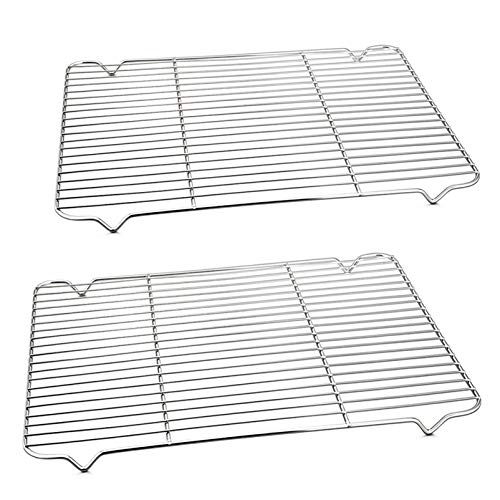
P&P CHEF Cooling Baking Rack 16.6 x 11.5in 2-Pack — Best Budget Pair
The budget pick keeps the specification that matters and trims the rest: stainless steel, dense wires that support small bakes properly, smooth finished edges that do not snag cloths or fingers, and a two-pack at a near-half-sheet 16.6 by 11.5 inches for baking, roasting, grilling and drying duty. For a first rack purchase, a rental kitchen, or a second set for barbecue days, it covers the job at the budget tier.
Strengths
- Dense wires support cookies and small items properly — no budget sag
- Smooth edges are a small detail you feel every time you handle them
- Two-pack value for baking, roasting, grilling and drying
Trade-offs
- Slightly off the true half-sheet standard — check your pan fit before in-pan roasting
- Thinner long-term margin than the heavy-duty top picks under very heavy loads
- Plain finish and presentation compared with the premium brands
| Specification | Detail |
|---|---|
| Size | 16.6 x 11.5 inches |
| Material | Stainless steel |
| Wires | Dense spacing, smooth edges |
| Pack | 2 racks |
Budget racks fail in predictable places — sparse wires, sharp edges, plating that flakes — and this pair’s listing reads like a checklist of those failures avoided: dense wires, smooth edges, solid stainless. That is the correct way to save money in this category, because the rack’s whole value is in those unglamorous properties over years of use.
The one caution is dimensional: at 16.6 by 11.5 inches it sits close to, but not exactly on, the half-sheet standard. For open cooling and most roasting that is irrelevant; for dropping precisely into a specific pan, measure first. Everywhere else, it is the sensible economy buy in the guide.
Best for: first-time buyers and budget kitchens wanting a proper stainless pair / Not suited for: perfectionists needing exact half-sheet pan fit
Check the current price on Amazon
Comparison Table
| Pick | Badge | Key spec | Best for |
|---|---|---|---|
| Ultra Cuisine Cooling and Baking Rack Set 11.5 x 16.5in | Best Overall | 11.5×16.5in, stainless, half-sheet fit, pair | most home bakers and cooks — the default half-sheet purchase |
| Spring Chef Cooling Rack 10 x 15in Set of 2 | Best for Jelly Roll Pans | 10x15in, stainless, jelly-roll fit, pair | jelly roll pan owners, smaller ovens, sheet-cake bakers |
| Checkered Chef Cooling Racks | Best Anti-Sag Grid | Cross-wire grid, stainless, multi-size | bakers of delicate or heavy items who hate sagging wires |
| HIWARE Collapsible Cooling Rack 3 Tier | Best Tiered for Small Kitchens | 3-tier collapsible, half-sheet footprint | batch bakers and small kitchens needing vertical cooling space |
| Geesta Collapsible Cooling Rack Adjustable Tiers | Best Adjustable Tiered Rack | Adjustable heights, 2–4 tiers, collapsible | bakers of varied-height goods needing flexible tiered space |
| P&P CHEF Cooling Baking Rack 16.6 x 11.5in 2-Pack | Best Budget Pair | 16.6×11.5in, dense wire, stainless pair | first-time buyers and budget kitchens wanting a proper stainless pair |
How to Choose the Best Baking Cooling Racks
Measure your pans before you measure anything else. The rack sizes in this guide map to the standard pan family: half sheet (roughly 13 by 18 inches outside, taking an 11.5–12 by 16.5 rack), jelly roll (10 by 15), and quarter sheet (9 by 13). A rack bought to the pan drops in for roasting and lifts out for cooling; a rack bought by guesswork does neither job well. If you own no pans yet, start with half sheets and the Ultra Cuisine pair and you have joined the ecosystem most recipes assume.
Wire spacing and gauge
Cookies, biscuits and small pastries need tight wire spacing — close enough that a soft, hot biscuit cannot sag between wires and set with a grid of grooves. Heavy roasts need the opposite virtue: thick-gauge wire and a rigid frame that does not bow under a bird or a joint. The best general racks, including every pick here, split the difference with dense, sturdy wire; dedicated bakers of tiny items should favour the grid design, whose cross-wires give the flattest support of all.
Material: stainless, chrome, or coated
Uncoated stainless steel is the only finish this guide recommends without reservation: it enters the oven at any home baking temperature, survives the dishwasher, does not rust in normal use, and never peels into food. Chrome-plated racks look similar and cost less, but dislike prolonged soaking and can rust at scratches. Non-stick coated racks are cooling-only — their coatings are not oven finishes — and once the coating fails, the rack is done. The price gap between coated and stainless is small; the lifespan gap is not.
Feet, rims and the counter
Look at the underside. Raised feet or a raised frame lift food clear of the counter so air circulates underneath — the entire point of a cooling rack — and keep a hot rack’s metal off surfaces it could mark. A rimmed, framed edge adds the rigidity that stops twisting in the dishwasher. These are the details that separate a five-year rack from a fifteen-year one, and they are all visible in a listing’s photographs if you know to look.
One Rack, Many Jobs: Getting Full Value
The cooling rack’s second career begins in the oven. Fitted inside its pan, it roasts chicken and vegetables on moving air for crisper skin and better browning, renders bacon flat and evenly, and holds breaded items so their undersides crisp instead of steaming. Out of the oven it drains fried food better than paper — air below, no soggy pool — and rests roasts while their juices redistribute, catching the drippings in the pan for the gravy. A rack over a pan is also the correct stage for icing cakes and glazing, letting the excess fall through instead of pooling at the base.
Tiered racks add a seasonal superpower: production. Holiday baking, bake sales and freezer stock-ups are limited by cooling space long before they are limited by oven space, because hot items cannot be boxed or stacked. A collapsible tower that appears for December and vanishes in January is the rare seasonal tool that earns its storage — which, folded flat, is almost none.
Care is minimal and mostly about water. Stainless racks can live in the dishwasher; drying them before stacking prevents water spots and keeps cupboards dry. Sticky glazes release easier after a short soak. Never use a rack as a trivet directly on a delicate worktop straight from a hot oven without checking its feet — most are fine, but the habit of a board underneath costs nothing.
Rack Techniques for Roasting, Bacon and Crisp Bottoms
The rack-in-pan roasting method deserves a fuller treatment, because it converts the most cooks. Elevating food lets hot air reach its underside and lets fat leave it — the two mechanisms behind crisp chicken skin, evenly browned vegetables and bacon that cooks flat without swimming. Chicken pieces, wings and whole small birds are the showcase: set them on the rack, season the skin dry, and roast hot; the skin renders against moving air instead of stewing in its own juices in the pan. Vegetables cut to even sizes caramelise on all sides for the same reason, provided they are given space — the single-layer rule from the how-to section applies with full force.
Bacon is the gateway technique: laid on the rack over a foil-lined pan, it cooks evenly, stays flatter than pan-fried bacon, and surrenders its fat cleanly into the pan for disposal or for cooking. Thick slices benefit most. Breaded and battered foods — cutlets, fish, anything crumbed — are the other winners, because the crumb’s underside is where sogginess is born; on a rack it sets crisp in the oven’s air and stays crisp when served, instead of steaming against a plate.
Two refinements separate good results from great ones. First, a light coating of oil on the rack itself prevents sticking for lean and sugary items without affecting browning. Second, rest discipline: roasted meats rested on the rack keep their crisp surfaces, while the same meat rested in its juices re-steams its own underside. The rack is not a serving suggestion — it is the difference between textures that survive to the table and textures that peaked in the oven.
Buying a Second Rack: Building the Set Over Time
Few bakers plan a rack collection; it accretes, and it accretes better with a little strategy. The first purchase should be the standard pair matched to your main pan — half sheet for most kitchens, jelly roll for the smaller-oven household — because that pair covers cooling, roasting and production in one stroke. Live with it through a season of baking and the gaps in your setup will announce themselves honestly, which is a better guide than any list.
The second purchase is usually one of two things. Bakers whose volume grows — holiday production, bake sales, a household that discovered bread — need capacity, and the tiered collapsible picks exist precisely for them: they multiply cooling space without consuming the kitchen permanently. Bakers whose range grows — smaller bakes, toaster-oven work, delicate items — need the grid rack in a smaller size, whose cross-wires support what parallel wires cannot. Roasters, meanwhile, often add a second heavy flat rack so one can hold the roast while the other handles the vegetables, synchronising a whole dinner’s exit from the oven.
What the set never needs is duplication of the mediocre. One cheap coated rack, bought in a hurry, teaches the lesson this guide opened with: stainless, framed, dense-wired racks are bought once a decade, while their imitations are bought annually. Build the set slowly from the picks above and it will outlast several ovens — which, in a kitchen, is the definition of a tool rather than a purchase.
Cooling Science: Why Airflow Decides Texture
Cooling is a physical process with a texture agenda, and understanding it makes the rack’s value obvious. A hot bake carries two enemies: its own residual heat, which keeps cooking it after it leaves the oven, and its own steam, which — trapped against a tray or plate — condenses exactly where crispness lives. The rack answers both at once: air beneath the food carries heat away evenly from the surface a tray would insulate, and steam escapes downward and outward instead of soaking the base. Cookies set with snap, cake bases stay dry, fried coatings keep the crust the fryer gave them.
The same science explains the technique details scattered through this guide. Spacing matters because steam needs an exit path that neighbouring items can block. Timing matters because a bake’s structure is still setting as it cools — moved too early it slumps, too late it has already steamed. Tiered racks cool their lowest tier slowest because warm air rises through the stack, which is why the fiercest items start on top or wait a few minutes before stacking. None of this requires equipment beyond the rack itself; it requires only that the cook treat cooling as a stage of the recipe rather than an interval between stages.
There is a storage corollary: food cooled completely on the rack keeps better than food boxed warm, because the trapped steam that ruins texture in the short term invites staleness and worse in the long term. Biscuits for the tin, bread for the freezer, fried food for later reheating — all of them reward a full, patient cool on the rack first. The rack, in other words, is not where food waits. It is where food finishes.
A Quick Word on Rack Storage and Longevity
Racks die in cupboards more often than in ovens: stacked under heavy pans, their frames bend a degree at a time until the rock that ruins a cooling cake appears. Store them upright like baking trays, or flat on top of the stack rather than beneath it, and a stainless rack’s working life is measured in decades. Tiered models should be stored collapsed with their frames latched, not forced — a bent hinge pin is the one injury the design cannot shrug off.
Longevity also has a chemistry footnote. Stainless steel is not stain-proof, merely stain-resistant: racks left wet in a closed dishwasher overnight, week after week, can develop cosmetic spotting, and racks stored against other metals in a damp cupboard can pick up surface marks that look like rust and wipe off like dust. Dry them, store them dry, and the finish that made them worth buying stays the finish they keep. It is a small discipline, and it is the whole maintenance manual for the best tools in this guide.
How to Use a Cooling Rack for Perfect Results
Cooling is a technique, not a waiting room. The steps below are the difference between crisp bottoms and dry cakes and the soggy, steamed results that make people blame recipes.
- Move baked goods to the rack at the right moment: biscuits and cookies after a few minutes firming on the hot tray, cakes in their tins for the first minutes the recipe specifies, then turned out onto the rack.
- Space items with air gaps. A crowded rack traps steam between pieces and recreates the sogginess you were avoiding; use the second rack or a tier instead of crowding.
- For oven work, set the rack inside its pan before the food goes on, so drips land in the pan and the whole assembly lifts out together.
- When roasting on the rack, expect faster, more even browning — check a few minutes earlier than the recipe’s pan-only timing, especially for bacon and breaded items.
- Rest roasts on the rack over the pan: air underneath prevents the base steaming in its own juices, and the juices themselves are saved for gravy.
- Ice and glaze cakes on the rack over a tray or parchment, letting excess fall through for clean edges.
- Wash promptly after sticky or fatty work — a short soak first makes stainless racks nearly effortless — and dry before storing.
Troubleshooting is short because the failure list is short. Soggy bottoms mean the food sat in its own steam: it stayed on the tray too long, or the rack was crowded. Wire marks on soft bakes mean the item went onto the rack too hot and soft, or the wires are too widely spaced for it — give delicate items a few minutes to firm, and use the grid rack for the smallest goods. A rack that rocks has warped; retire it to garden or garage duty and replace it with a framed, heavier build.
For tiered racks, load bottom-up, heaviest lowest, and let the fiercest heat leave tall items before stacking them under another tier. The tower is a cooling tool, not an oven — nothing goes back into the heat once it is stacked.
Common Buying Mistakes
Buying a rack that fits no pan you own
The most common and most avoidable error in the category. A rack’s usefulness doubles when it drops into your pan, and pan sizes are standardised — half, jelly roll, quarter. Measure the inside of your pan, then buy the rack size made for it, not the size that was cheapest that day.
Putting a coated rack in the oven
Non-stick cooling racks are cooling-only; their coatings are not oven finishes and fail — sometimes into the food — at roasting temperatures. If a rack will ever see the inside of an oven, it must be uncoated stainless steel, like every pick in this guide.
Cooling on the tray because it is easier
Leaving biscuits and cakes on the hot tray keeps cooking their bases and traps steam underneath them. The two minutes saved are paid for in soggy bottoms. The rack exists precisely for this moment; use it every time and the habit becomes invisible.
Crowding the rack
A rack piled edge to edge is a tray with holes. Steam needs somewhere to go, and items need air on all sides. When the bake exceeds the rack, that is what the second rack in every pair — or a tiered system — is for.
Choosing sparse wires for small bakes
Wide-spaced wires let soft cookies sag and set with grooves, and drop small items clean through. Dense wire or a grid design is the correct tool for anything smaller than a scone. Check the spacing in the listing photographs before buying for biscuit work.
Final Recommendation
Most kitchens should simply buy the Ultra Cuisine half-sheet pair: correct size, correct material, built to be used hard for years. Jelly roll households take the Spring Chef pair instead, delicate bakers the Checkered Chef grid, and batch bakers in small kitchens choose between the HIWARE’s fixed tiers and the Geesta’s adjustable ones. The P&P CHEF pair covers the same honest ground at the budget tier for first kitchens and second sets.
Whichever rack you choose, buy stainless, buy to your pan, and buy the pair — the second rack is always wanted sooner than expected. It pairs naturally with the ovens elsewhere in this program: the large countertop models in Best And Biggest Countertop Convection Ovens and the combination units in Best Combination Ovens Microwave Convection both assume a good rack is waiting when the food comes out.
Related guides in this program: Best And Biggest Countertop Convection Ovens; Best Combination Ovens Microwave Convection; Best Air Fryer Convection Ovens; Best Toaster Ovens; Best Countertop Convection Ovens.
Frequently Asked Questions
What size cooling rack should I buy first?
The half-sheet size — roughly 11.5 to 12 by 16.5 inches — is the best first purchase for most kitchens, because half sheet pans are the standard that recipes, parchment and other accessories assume. If your oven or pans are smaller, match the rack to the pan you actually own: jelly roll owners want the 10 by 15 size, and toaster-oven bakers should look at quarter-sheet sizes.
Can I put a cooling rack in the oven?
Yes, if it is uncoated stainless steel — every pick in this guide qualifies, and in-pan roasting is half their value. Do not oven-use non-stick coated racks, whose finishes are made for cooling only, and be cautious with chrome-plated racks at high temperatures. When a listing does not state oven safety plainly, treat the rack as cooling-only.
Why do my cookies get soggy bottoms even on a rack?
Usually timing or crowding. Cookies left on the hot tray too long keep steaming from below before they ever reach the rack, and cookies packed edge-to-edge on the rack trap steam between them. Move them after a few minutes of firming, space them with air gaps, and use a tight-wire or grid rack so soft biscuits are supported while they set.
Are tiered cooling racks stable enough for cakes?
For biscuits, buns, pastries and cakes in tins, yes — loaded bottom-up, heaviest lowest, on a level counter. They are not the tool for a heavy roast or a tall, fragile layer cake being moved around the kitchen; those belong on a single rigid rack. Within their brief — multiplying cooling space for batch baking — tiered racks are dependable and fold away to nothing afterwards.
How do I clean a stainless cooling rack?
Dishwasher, normally — stainless racks are built for it. For baked-on glaze or fat, soak the rack in hot soapy water for fifteen minutes first and the residue releases easily. Dry before storing to avoid water spots, especially in hard-water areas. Avoid leaving chrome or coated racks soaking; that advice is one more reason this guide recommends stainless.
What else can I use a cooling rack for besides baking?
Roasting meat and vegetables with air underneath, cooking bacon flat and crisp, draining fried food, resting roasts while saving their juices, icing and glazing cakes, drying herbs and pasta, and even as a staging surface for breading food. Fitted in its pan, a good stainless rack is one of the most used tools in a working kitchen — the cooling is only where it starts.
