Disclosure: airfryerkitchensupply.com is reader-supported. When you buy through links on our site, we may earn an affiliate commission at no extra cost to you.
Where to buy
Every pick in this guide to the best 12 volt 8ah battery options is sold on Amazon, and that is where we recommend buying, with the fitment warning this size deserves: 8Ah batteries share their case with the 7Ah class in some brands and step up in others, and both F1 and F2 terminals appear, so confirm dimensions and terminal width on the listing against the battery you are replacing. All six picks were verified against Amazon’s catalog through the Creators API on 2026-11-20, spanning the sealed lead acid mainstream and the newer lithium iron phosphate alternatives in this exact capacity.
- Mighty Max Battery ML8-12 12V 8Ah SLA AGM Battery F1 — Best Overall Lead Acid: Check the current price on Amazon
- Casil CA1280 12V 8Ah AGM Battery F2 — Best F2 Terminal Pick: Check the current price on Amazon
- ExpertPower EXP1280 12V 8Ah UPS Battery F2 — Best for UPS and FIOS Backup: Check the current price on Amazon
- Interstate Batteries SLA Battery 12V 8Ah AGM VRLA SLA1075 F1 — Best National-Brand F1: Check the current price on Amazon
- VEMDIA 12V 8Ah LiFePO4 Lithium Battery — Best Lithium Upgrade: Check the current price on Amazon
- SEFEPODER 12V 8Ah LiFePO4 Lithium Deep Cycle Battery 2-Pack — Best Lithium Two-Pack: Check the current price on Amazon
The best 12 volt 8ah battery sits at an interesting crossroads in the small-battery market. The 8Ah size is the traditional step up from the ubiquitous 7Ah block, specified by larger UPS units, FIOS and telecom backup boxes, alarm systems that want more reserve, fish finders and feeders, and it exists in two technological generations at once. The sealed lead acid incumbents are inexpensive, universally compatible and well understood. The lithium iron phosphate challengers offer the same nominal capacity at roughly half the weight, far deeper usable discharge and many times the cycle life, at a higher purchase price and with charging requirements your equipment may or may not meet.
This guide covers both generations honestly rather than pretending one has abolished the other. Lead acid remains the correct answer where the host device’s charger is a simple lead-acid float circuit that cannot be changed, which describes most UPS and alarm equipment, and where purchase cost rules. Lithium earns its place where the battery cycles frequently, where weight matters, in solar, fish finder and camping service, and where the charger can be chosen to suit it. Each pick below is labelled by chemistry in its specification data, and the buying guide gives you the decision framework rather than a slogan.
A second honest note: the 8Ah label itself needs the same care as its smaller sibling. Some listings describe this class as 8Ah at one discharge rate and more at another, and a few 7Ah-case batteries are marketed optimistically. Every pick here was verified as a genuine 8Ah-class product from its listing, and the reviews note where a pick’s format, such as a two-pack or an F2 terminal, defines its proper home.
Key Takeaways
- Choose chemistry by charger and duty: lead acid where a built-in float charger governs, lithium where you control the charger and cycle often.
- An 8Ah lithium battery delivers roughly twice the usable capacity of an 8Ah lead acid battery in cycling service, because lead acid should stay above half charge.
- The 8Ah class splits between F1 and F2 terminals across mainstream models; the picks here are labelled, so match your harness.
- A lithium battery’s BMS current limit is a hard specification: add up your loads before buying.
In this guide
Quick Picks
Mighty Max Battery ML8-12 12V 8Ah SLA AGM Battery F1 — Best Overall Lead Acid. The reference 8Ah lead acid block: AGM sealed construction, F1 terminals, standard case, from the deepest small-SLA catalogue in this guide. Check the current price on Amazon
Casil CA1280 12V 8Ah AGM Battery F2 — Best F2 Terminal Pick. The F2 answer in this size, with the listing publishing full case dimensions and a stack of cross-references including UB1280 F2 and PS-1280 F2. Check the current price on Amazon
ExpertPower EXP1280 12V 8Ah UPS Battery F2 — Best for UPS and FIOS Backup. An F2 battery whose listing reads like a map of the 8Ah world: APC and FIOS UPS units, alarms, fish finders and deer feeders, all named. Check the current price on Amazon
Interstate Batteries SLA Battery 12V 8Ah AGM VRLA SLA1075 F1 — Best National-Brand F1. Interstate’s SLA1075 brings the national distributor’s name and dealer network to the F1 side of the 8Ah class, in proper AGM VRLA construction. Check the current price on Amazon
VEMDIA 12V 8Ah LiFePO4 Lithium Battery — Best Lithium Upgrade. The lithium case in one listing: 8Ah of LiFePO4 rated for thousands of deep cycles, 103 watt-hours, IP67 sealing, at a fraction of lead acid’s weight. Check the current price on Amazon
SEFEPODER 12V 8Ah LiFePO4 Lithium Deep Cycle Battery 2-Pack — Best Lithium Two-Pack. Two matched LiFePO4 batteries with built-in 10A battery management, for the paired and small-bank installations where lithium’s cycle life compounds. Check the current price on Amazon
How These Picks Were Chosen
Verification ran through the Creators API on 2026-11-20 across two searches, one for sealed lead acid 8Ah batteries and one specifically for 8Ah LiFePO4, because a single search would have buried one generation under the other. Listings had to confirm 12V and 8Ah-class capacity, and ASINs were recorded from the API responses for both chemistries.
Picks were balanced deliberately: four sealed lead acid batteries covering the F1 and F2 terminal cases, the value single, and the national-brand option, plus two lithium iron phosphate batteries, a single and a two-pack, for the cycling and weight-sensitive duties. That balance reflects the real market rather than an editorial preference, and the guide text argues each chemistry’s case on its merits. No prices or fixed ratings are printed; the price gap between chemistries is real but moves, so judge it on the day via the check-price links.
The two-generation shortlist in this guide is a deliberate editorial stance. A guide that listed only lead acid would be ignoring where this size’s growth and innovation actually are; a guide that listed only lithium would be recommending drop-in replacements that much standby equipment cannot safely charge. Presenting both, with the boundary conditions argued openly, is more work than either purity, and it is the only version of this guide worth trusting.
The 6 Best 12 Volt 8Ah Batteries

Mighty Max Battery ML8-12 12V 8Ah SLA AGM Battery F1 — Best Overall Lead Acid
The ML8-12 is the default 8Ah replacement for the mainstream of this size: UPS units, alarm and access systems and standby devices wired for F1 spades. Its AGM construction allows flexible mounting, its case follows the common 8Ah footprint, and Mighty Max’s volume in this category makes it the battery most likely to be identically replaceable in four years’ time. Owners needing F2 terminals should take the Casil or ExpertPower below; owners needing cycle life should read the lithium picks before deciding.
Strengths
- Reference model for the 8Ah lead acid class
- AGM sealed construction, any-orientation fitting in most equipment
- F1 terminals match the majority of standby harnesses
Trade-offs
- Lead acid weight and cycle limits apply in full
- Single format only under this model
- Value-brand documentation is workmanlike rather than deep
| Voltage | 12 Volt |
| Capacity | 8 AH |
| Chemistry | SLA AGM, rechargeable |
| Terminals | F1 |
Reference status in this class is earned by distribution as much as by specification, and the ML8-12 has both: the correct numbers, the correct case, and availability that has made it the default answer in device forums and support threads for years. For standby duty, where the battery’s virtues are consistency and predictability, that status is a genuine technical merit, because a battery model with a long production history has had its surprises already, in other people’s equipment.
Fit it where a lead-acid charger governs, date it, and schedule it. In float service this class typically serves three to five years, and the ML8-12’s job is to make those years uneventful, which it is well equipped to do.
Best for: Standard 8Ah replacements in UPS, alarm and standby equipment with F1 fittings / Not suited for: equipment wired for F2 terminals, or frequent deep cycling
Check the current price on Amazon

Casil CA1280 12V 8Ah AGM Battery F2 — Best F2 Terminal Pick
Buy the CA1280 when your equipment’s harness takes F2 terminals, the wider 0.250 inch spade common on larger UPS units, and you want the manufacturer to confirm it. Casil publishes the case dimensions numerically, 5.95 by 2.56 by 3.70 inches, and names the replaced models, which together make this the most verifiable lead acid listing in the guide. It suits UPS, alarm and backup-power equipment first, and any 8Ah device whose owner prefers documentation to guesswork.
Strengths
- F2 terminals stated and cross-referenced in the listing
- Full case dimensions published for pre-purchase fit checks
- Names UB1280 F2, EXP1280 and PS-1280 F2 replacements
Trade-offs
- F2 fitment excludes the F1-wired majority
- Alarm and UPS focus gives less cycling-duty detail
- Single-battery format only
| Voltage | 12V |
| Capacity | 8Ah |
| Chemistry | AGM sealed lead acid |
| Terminals | F2 |
| Dimensions | 5.95 x 2.56 x 3.70 in (per listing) |
Terminal discipline is the difference between the 7Ah and 8Ah classes in practice: the bigger class splits its loyalties between F1 and F2, and Casil’s listing handles that split the way it should be handled, by stating the terminal, the dimensions and the cross-references where a buyer cannot miss them. A UPS owner with F2 harnesses can order this battery with a confidence that most listings in the category never earn.
Use the published dimensions properly: measure your compartment, not just the old battery, because some UPS units accept this case with millimetres to spare and cable routing decides whether the lid closes. Ten seconds with a ruler is the cheapest insurance in this entire guide.
Best for: UPS and alarm equipment wired for the wider F2 spade / Not suited for: equipment wired for F1 terminals
Check the current price on Amazon
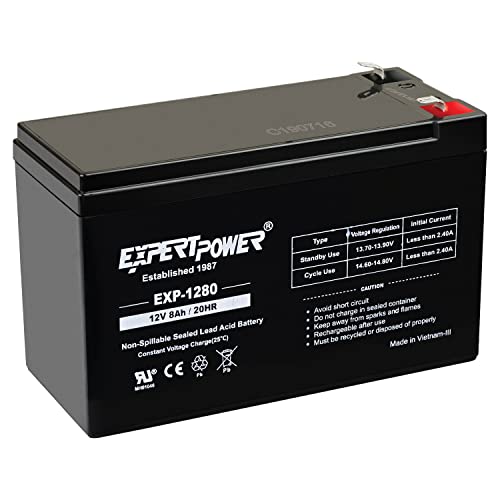
ExpertPower EXP1280 12V 8Ah UPS Battery F2 — Best for UPS and FIOS Backup
The EXP1280 suits the F2-equipped mainstream of this size, and its listing is unusually helpful about where that mainstream lives: the telecom backup box in the garage, the APC unit under the desk, the feeder in the field. If your device is one of those and its terminals are F2, this is the straightforward, brand-backed replacement. F1 devices should choose the ML8-12 instead, and frequent cyclers should weigh the lithium picks, because this battery’s virtues are standby virtues.
Strengths
- Listing names APC, FIOS, alarm, fish finder and feeder service
- F2 terminals for the larger-UPS harness standard
- Established SLA brand with depth in this size
Trade-offs
- Standby-first design is not a cycling battery
- F2 only, so F1 equipment needs a different pick
- Heavier than the lithium alternatives, as all lead acid is
| Voltage | 12V |
| Capacity | 8Ah |
| Chemistry | Sealed lead acid, rechargeable |
| Terminals | F2 |
| Applications | UPS (APC, FIOS), alarm, fish finder, feeder (per listing) |
The FIOS and telecom backup application deserves a word, because it is where 8Ah batteries quietly do some of their most valuable work: keeping phone and internet alive through outages from a box most households forget exists until it beeps. Batteries in that service live on float for years and are replaced in mild annoyance, and a listing that names the application signals a maker who understands the duty. The EXP1280 brings that understanding plus the fish finder and feeder span that makes it the most versatile F2 pick here.
As with all telecom backup batteries, silence the unit’s beeper only after ordering the replacement, not instead of it. The beep is the one honest notification this equipment gives, and this battery is the correct response to it.
Best for: APC and FIOS UPS replacements, alarms, fish finders and feeders on F2 fittings / Not suited for: equipment wired for F1 terminals, or cycling duty
Check the current price on Amazon

Interstate Batteries SLA Battery 12V 8Ah AGM VRLA SLA1075 F1 — Best National-Brand F1
The SLA1075 suits the buyer who prefers an established national battery brand and whose equipment takes F1 terminals. Its listing is terse next to the Casil’s, but the construction is stated correctly, AGM VRLA, the model number is a long-running one in Interstate’s standby range, and offline support exists behind it. Choose it for the accountability chain; choose the Casil or ExpertPower for listing detail; the batteries themselves serve the same standby duties.
Strengths
- National brand with dealer network behind the listing
- AGM VRLA construction stated in the title
- Long-running standby model number (SLA1075)
Trade-offs
- Listing detail is minimal compared with rivals
- Premium-brand positioning in the class
- F1 only, with no F2 sibling in this guide
| Voltage | 12V |
| Capacity | 8Ah |
| Chemistry | AGM VRLA |
| Terminals | F1 |
| Model | SLA1075 |
Interstate’s presence in this class matters for a specific kind of buyer: the one maintaining equipment for someone else, a small business, a rental property, a parent’s house, where a recognisable brand and a physical dealer network simplify every future conversation. The SLA1075 is a conventional, correctly specified standby battery, and its premium buys process rather than performance, which for that buyer is a rational trade.
Verify the F1 terminal against your harness before ordering, since Interstate’s terse listing asks the buyer to do the confirming. Do that, and this is the low-drama F1 purchase in the guide.
Best for: Buyers wanting a national battery brand in the F1 8Ah format / Not suited for: equipment wired for F2 terminals
Check the current price on Amazon

VEMDIA 12V 8Ah LiFePO4 Lithium Battery — Best Lithium Upgrade
The VEMDIA suits the cycling applications where lead acid wears out fastest: a fish finder battery charged weekly, a small solar installation, camping power, a Power Wheels toy in daily use. Its listing claims a deep-cycle life in the thousands of cycles, against the few hundred a lead acid battery delivers when deeply cycled, and its IP67 rating suits outdoor duty. It does not suit direct drop-in replacement inside a UPS or alarm panel whose built-in charger is a lead-acid float circuit, unless the equipment maker approves lithium; that caveat is explained fully in the buying guide.
Strengths
- LiFePO4 chemistry rated for thousands of deep cycles per the listing
- 103Wh in a much lighter package than lead acid
- IP67 waterproofing suits marine and outdoor service
Trade-offs
- Needs a lithium-appropriate charger; lead-acid float circuits may not suit it
- Higher purchase cost than every lead acid pick here
- Not a universal drop-in for UPS and alarm panels
| Voltage | 12V |
| Capacity | 8Ah, 103Wh (per listing) |
| Chemistry | LiFePO4 lithium iron phosphate |
| Cycle rating | 3000+ deep cycles (per listing) |
| Rating | IP67 waterproof (per listing) |
The arithmetic that sells lithium is cycle arithmetic. A lead acid 8Ah battery deeply cycled gives a few hundred cycles and should really be kept above half charge, so its usable capacity is nearer 4Ah; a LiFePO4 battery can use most of its 8Ah thousands of times. For a fish finder or solar user cycling weekly, the lithium battery is not the expensive option over three years; it is several lead acid batteries not bought, at half the carrying weight each time. VEMDIA’s listing states that case with specific figures, which is how lithium should be sold.
The discipline lithium demands is charging discipline: a LiFePO4-appropriate charger, no lead-acid equalisation modes, and respect for the built-in battery management system’s limits. Provide that, and this pick outlasts everything else in the guide by years in cycling service.
Best for: Solar, fish finder, camping and Power Wheels duty where the battery cycles often / Not suited for: drop-in standby use inside lead-acid-charged UPS or alarm equipment
Check the current price on Amazon

SEFEPODER 12V 8Ah LiFePO4 Lithium Deep Cycle Battery 2-Pack — Best Lithium Two-Pack
The SEFEPODER pack suits lithium installations that come in twos: a pair for a larger ride-on toy, two batteries paralleled for a small solar or lighting bank, or a working battery plus its rotation partner for off-grid use. Its listing states a 2000-plus cycle rating and a built-in 10A BMS, the protection electronics that guard each battery against over-charge, over-discharge and excess current. Like the VEMDIA, it belongs in cycling service with a lithium charger, not inside lead-acid-charged standby equipment.
Strengths
- Matched lithium pair for paired and small-bank installations
- Built-in 10A BMS stated in the listing
- 2000+ cycle rating for genuine deep-cycle duty
Trade-offs
- Two lithium batteries is a real upfront commitment
- 10A BMS limits high-draw applications
- Requires lithium charging discipline across the whole system
| Voltage | 12V per battery |
| Capacity | 8Ah per battery |
| Chemistry | LiFePO4 |
| Protection | Built-in 10A BMS (per listing) |
| Pack | 2 batteries |
Lithium pairs raise a question lead acid pairs do not: whether the batteries may be connected in series or parallel, and within what limits, which is governed by the maker’s specification for the BMS. SEFEPODER sells this as a two-pack for small solar, Power Wheels, lighting and fish finder service, the parallel and paired applications where matched lithium makes sense, and buyers planning series strings for higher voltage should confirm the listing’s stated limits before building. That caution aside, a matched lithium pair is the foundation of every small off-grid system that actually survives its second year.
Commission the pair properly: charge each battery fully with a lithium charger before connecting them together, so they begin life balanced, and keep them together as a pair thereafter. Lithium rewards that initial care with years of indifference to the cycling that destroys lead acid.
Best for: Paired lithium installations: small solar banks, Power Wheels pairs, off-grid lighting / Not suited for: standby equipment with lead-acid-only charging, or loads above the BMS limit
Check the current price on Amazon
Comparison Table
| Pick | Badge | Key spec | Best for |
|---|---|---|---|
| Mighty Max Battery ML8-12 12V 8Ah SLA AGM Battery F1 | Best Overall Lead Acid | 12V 8Ah SLA AGM, F1 terminal | Standard 8Ah replacements in UPS, alarm and standby equipment with F1 fittings |
| Casil CA1280 12V 8Ah AGM Battery F2 | Best F2 Terminal Pick | 12V 8Ah AGM, F2 terminals, replaces UB1280 F2 | UPS and alarm equipment wired for the wider F2 spade |
| ExpertPower EXP1280 12V 8Ah UPS Battery F2 | Best for UPS and FIOS Backup | 12V 8Ah SLA, F2 terminals | APC and FIOS UPS replacements, alarms, fish finders and feeders on F2 fittings |
| Interstate Batteries SLA Battery 12V 8Ah AGM VRLA SLA1075 F1 | Best National-Brand F1 | 12V 8Ah AGM VRLA, F1 terminal, SLA1075 | Buyers wanting a national battery brand in the F1 8Ah format |
| VEMDIA 12V 8Ah LiFePO4 Lithium Battery | Best Lithium Upgrade | 12V 8Ah LiFePO4, 103Wh, IP67 | Solar, fish finder, camping and Power Wheels duty where the battery cycles often |
| SEFEPODER 12V 8Ah LiFePO4 Lithium Deep Cycle Battery 2-Pack | Best Lithium Two-Pack | 12V 8Ah LiFePO4 x2, built-in 10A BMS | Paired lithium installations: small solar banks, Power Wheels pairs, off-grid lighting |
How to Choose a 12 Volt 8Ah Battery: Lead Acid or Lithium?
Decide the chemistry by the charger and the duty, in that order. If the battery lives inside equipment with a built-in lead-acid charger, a UPS, an alarm panel, a telecom backup box, choose sealed lead acid unless the equipment maker explicitly approves lithium, because a lead-acid float circuit holds a lithium battery at a voltage regime its management system may tolerate but was not designed around, and standby equipment is the wrong place for experiments. If you choose the charger yourself, a fish finder, solar, camping or toy setup, lithium becomes a live option and the duty decides: occasional use favours lead acid’s low purchase cost, frequent cycling favours lithium overwhelmingly.
Then apply the usable-capacity correction that honest comparisons require. A lead acid 8Ah battery in cycling service should be treated as roughly 4Ah usable if you want it to last, and delivers a few hundred deep cycles. A LiFePO4 8Ah battery offers most of its capacity as usable and thousands of cycles. In standby float service the correction reverses in importance: cycle life barely matters, calendar life and charger compatibility dominate, and lead acid’s decades of standardisation win. The keyword’s buyers split across both worlds, which is why this guide refuses to crown one chemistry for everyone.
Finish with the physical checks that no chemistry escapes: case dimensions against the compartment, terminal width, F1 and F2 both live in this class, polarity orientation, and, for lithium, the BMS current rating against your load. A fish finder draws little; a trolling application or inverter draws more than a 10A BMS allows. Match the protection rating to the load or the battery will protect itself by disconnecting, correctly and inconveniently.
Terminals, Cases and Cross-References in the 8Ah Class
The 8Ah class inherits the 7Ah class’s standard case, roughly 151 by 65 by 94 to 100 millimetres, and adds its own complication: a genuine split between F1 and F2 terminals across mainstream models, with the larger UPS brands favouring F2 and much alarm and standby equipment wired for F1. The picks here are labelled by terminal for exactly this reason, and the Casil listing shows the gold standard, publishing dimensions and cross-references, UB1280, PS-1280, that let you confirm a match from your old battery’s label alone.
Cross-references are worth using properly. Photograph the old battery’s label, search this guide for its model number among the stated replacements, and you have converted a guess into a manufacturer’s claim. Where no cross-reference covers your model, fall back on the physical trio: dimensions, terminal width, polarity. An 8Ah battery that passes all three is the right battery, whatever its brand.
How to Replace an 8Ah Battery and Commission a Lithium Pair
Replacement follows the same safe rhythm as the smaller classes, with one addition for lithium buyers: the first charge and pairing procedure decides whether a lithium installation starts balanced or begins life correcting an imbalance. The steps below cover the standard swap, then the lithium-specific commissioning.
Calendar Life vs Cycle Life: The Two Clocks Every 8Ah Battery Runs On
Every battery ages on two clocks at once, and the 8Ah choice turns on which clock your application winds faster. Calendar life is ageing by time alone: the float-service clock, dominant in UPS and alarm duty, where lead acid’s three to five years is set by corrosion and dry-out whether the battery works or not. Cycle life is ageing by work: the cycling clock, dominant in fish finders, solar and toys, where lead acid’s few hundred deep cycles expire in a season or two of hard use while lithium’s thousands barely notice.
Misreading the clocks is the expensive mistake in this class. The standby owner who buys lithium for its cycle life has paid for a clock that never ticks, while inheriting charger-compatibility questions that matter on the clock that does. The cycling owner who buys lead acid for its price replaces it so often that the cheap battery becomes the expensive system, in money, weight and waste alike. This guide’s structure, standby picks and cycling picks clearly separated, exists to route each buyer to their own clock.
There is a hybrid case worth naming: the battery that mostly floats but occasionally cycles, a cabin solar backup, a sump or gate battery. Here the honest answer is usually the better lead acid pick plus disciplined recharging, unless the cycling is weekly or deeper, at which point lithium’s case takes over. Frequency and depth of discharge, stated plainly, will tell any owner which side of that line they live on.
Weight, Space and the Physical Case for Lithium
Lithium’s second argument, after cycle life, is physical. An 8Ah LiFePO4 battery weighs roughly half as much as its lead acid equivalent, and in applications carried by hand or mounted in weight-sensitive equipment, a fish finder battery hauled to the water daily, a Power Wheels fleet, a portable solar box, that difference is felt on every single use rather than read on a spec sheet. Mounting also simplifies: no orientation anxiety, no spill possibility even in a damaged case scenario the BMS guards against.
The counterweights are equally physical in their own way. Lead acid is tolerant of crude charging, cheap to replace in any town, and recyclable through the most mature stream in the battery world. Lithium’s recycling stream exists and is growing but is less universal, and its transport and storage carry their own rules, particularly for damaged units, which must never be charged and should be handled through proper channels.
For the equipment designer hidden inside every buyer, the summary is this: where the battery is installed and forgotten inside charger-governed equipment, lead acid’s maturity wins; where the battery is a working tool, carried, cycled and depended on outdoors, lithium’s physics win. The 8Ah class is big enough to contain both truths, and this guide’s picks are arranged so each buyer can find theirs without wading through the other’s.
How to Swap an 8Ah Battery (and Set Up a Lithium Pair Correctly)
Switch mains equipment off and unplug it before opening any battery compartment. Keep tools from bridging terminals, and keep the old battery at hand until the new installation has passed a real load test.
- Photograph the installation: lead positions, polarity, and, in paired installations, every link between the batteries.
- Remove the negative connector first and the positive second, lift the old battery out, and compare the new battery’s label, dimensions and terminal width against it on the bench.
- For lead acid, fit the new battery, reconnect positive first and negative last, push connectors fully home, and tug-test both.
- Charge fully with the equipment’s own charger or a sealed-appropriate smart charger, then load-test: run the UPS self-test, sound the alarm test, or run the fish finder before trusting the installation.
- For a lithium single or pair, charge each battery individually to full with a LiFePO4 charger before installation or before connecting a pair together, so all units start at the same state of charge.
- Connect lithium pairs only in the configuration the maker’s listing permits, parallel for capacity in most small systems, and confirm the combined BMS limits exceed your maximum load.
- Date every battery, record the chemistry in any maintenance log, because a lithium and a lead acid battery in the same building must never be swapped into each other’s chargers by a helpful stranger.
- Recycle the old battery through a retailer or collection point; both chemistries are recyclable through established streams and neither belongs in household waste.
If a lithium battery’s BMS disconnects under a load your old lead acid battery handled, the battery is reporting a specification mismatch, usually current draw above its rating, not a fault. Respect the report and resize the battery or the load rather than defeating the protection.
Float Charging Lithium: Why the Caveat Exists
The lithium caveat repeated through this guide deserves its technical explanation, because it is widely misunderstood as superstition. A lead-acid float charger holds its battery at a constant voltage indefinitely, around 13.5 to 13.8 volts for a 12V battery. A LiFePO4 battery at that voltage sits at or near full charge, and while its BMS will protect it from outright overcharge, indefinite float at full state of charge accelerates lithium ageing and keeps the protection electronics working as the primary defence rather than as a backstop, a role reversal good engineering avoids.
Standby equipment adds a second mismatch: its low-battery alarms, runtime estimates and shutoff points are calibrated to lead acid’s discharge curve, which slopes steadily, while lithium’s curve is flat then abrupt. A UPS on lithium may report hours remaining and then stop, not from any defect but because its fuel gauge speaks the wrong language. Equipment makers who approve lithium have done the calibration work; where approval is absent, the mismatch is real even when the battery physically fits.
None of this indicts lithium, which is superb in its proper system. It indicts improvisation inside safety and standby equipment, where the correct battery is the one the system’s designer specified. Our charger guide covers the lithium-appropriate chargers that make the cycling picks in this guide thrive in their proper home.
Sizing Up and Down: When 8Ah Is the Wrong Answer
Honesty about a size class includes its boundaries. If your runtime arithmetic, honestly done, needs twelve usable amp-hours daily, no 8Ah battery in either chemistry will save you, and the correct purchase is a larger battery or a bank, not optimism. The 8Ah class tops out where small solar systems, serious trolling duty and whole-day UPS protection begin, and recognising that boundary before purchase is cheaper than discovering it during an outage.
At the lower boundary, some 8Ah purchases are really 7Ah purchases wearing a bigger case: equipment whose compartment was designed for the smaller battery, or whose loads never touch the extra capacity. There, the 7Ah class’s deeper catalogue and lower cost serve better, and our companion guide covers it fully. Capacity you cannot fit or never use is not reserve; it is dead weight with a price tag.
The 8Ah size earns its existence in the wide middle: the larger UPS, the telecom box, the feeder and finder, the alarm that wants real reserve, the small cycling system lithium transforms. If your application lives in that middle, you are in the right guide, and the remaining work is the pleasant kind: pick the chemistry by your clock, the terminal by your harness, and the brand by your appetite for documentation.
The Telecom Box in the Garage: A Case Study in 8Ah Duty
Somewhere in millions of homes sits the purest 8Ah application of all: the telecom backup box, keeping fibre or cable phone and internet alive when the mains fail. It is worth studying because it distils standby duty to its essence. The load is modest and constant, the battery floats for years in a garage whose temperature swings with the seasons, nobody thinks about it at all, and its entire value is realised in the few outage hours when it is the difference between a working phone line and silence.
That duty profile explains the class’s centre of gravity. The telecom box’s maker chose 8Ah because it buys a working day of reserve in a compact case at consumable cost, and chose lead acid because its charger is simple, its behaviour over a decade of product life is known, and its failure mode, a beep and a red light after years of service, is legible to any householder. The EXP1280 in this guide names this application in its listing because its maker understands it is the class’s home ground.
The householder’s part in the contract is tiny and total: hear the beep, order the correct battery, F2 terminals and this case size in most such boxes, swap it in ten minutes, recycle the old one. Households that do this live through outages with their connectivity intact and never think about batteries again for four years. Households that silence the beep and mean to get round to it discover the omission during the next storm, which is precisely when the box was bought for. The battery is cheap; the lesson, retaught by every storm season, is the expensive version of the same fact.
Maintainers, Rotation and Running a Small 8Ah Fleet
Households accumulate 8Ah batteries the way they accumulated 7Ah ones, across a telecom box, a UPS or two, a feeder and a finder, and at some point the collection becomes a fleet that rewards management. The fleet habits are the ones this series repeats because they work: every battery dated, every device on a replacement interval matched to its location’s temperature, and a single shelf where the spare and the charger live, so that a beep from any box in the house starts a known procedure rather than a research project.
Rotation deserves one more emphasis at this size, because 8Ah devices are often the critical ones. Where two devices use the same battery, the telecom box and a UPS, for instance, a spare rotated through them annually keeps all three batteries proven and evenly aged, and guarantees that the battery in the critical box is never the oldest one you own. The labour is two ten-minute swaps a year; the return is that no battery in the house is an untested hypothesis.
Finally, keep the fleet’s chemistry honest as lithium enters it. Label any lithium battery and its charger as a pair, store them together, and make sure anyone else in the household knows the lithium battery never meets the lead-acid charger and vice versa. Fleets fail at their interfaces, and in a mixed-chemistry house the interface is a helpful person with the wrong charger. A strip of tape and a marker on each unit, applied today, is the cheapest systems engineering in this entire guide.
Common Buying Mistakes
Dropping lithium into a lead-acid float charger and forgetting it. Some combinations work, many age badly, and standby equipment is no place to experiment. If the equipment maker has not approved lithium, fit lead acid and sleep well.
Comparing 8Ah lead acid with 8Ah lithium as equals. Usable capacity and cycle life differ by multiples. Compare cost per delivered cycle for cycling duty, and cost per year for standby duty, and the right answer usually reveals itself.
Ordering the wrong terminal width in a split class. The 8Ah class splits between F1 and F2 across mainstream models. The picks here are labelled; check your harness and order the match.
Ignoring the BMS current limit on lithium picks. A 10A BMS will disconnect above its rating. Add up your loads before buying, especially inverters and motors with surge draws.
Mixing an old and a new battery in a pair, in either chemistry. Pairs age as systems. Replace both together, charge lithium pairs to full before joining them, and keep pairs together for life.
Final Recommendation
For standby equipment with a built-in charger, buy lead acid: the ML8-12 for F1 fittings, the Casil CA1280 or ExpertPower EXP1280 for F2, and the Interstate SLA1075 where a national brand matters. For cycling duty you control the charger for, buy lithium: the VEMDIA single for fish finders, solar and toys, the SEFEPODER pair for small banks and paired installations. The chemistry decision, made by charger and duty rather than by fashion, is the whole guide in one sentence. Related guides: Best 12 Volt 7ah Battery, Best 12 Volt 7ah Sealed Lead Battery, Best 12 Volt 5ah Battery For Home Alarm System, Best 12 Volt 600 Cca Deep Cycle Batteries.
Start your shortlist here: Mighty Max Battery ML8-12 12V 8Ah SLA AGM Battery F1 (Check the current price on Amazon), Casil CA1280 12V 8Ah AGM Battery F2 (Check the current price on Amazon), and Interstate Batteries SLA Battery 12V 8Ah AGM VRLA SLA1075 F1 (Check the current price on Amazon).
Frequently Asked Questions
Can I replace my UPS’s lead acid 8Ah battery with a lithium one?
Only if the UPS maker approves it. Many UPS chargers are simple lead-acid float circuits and their low-battery calibration assumes lead-acid voltage behaviour, so run-time gauges and shutoff points can misread with lithium. Where approval exists, lithium offers weight and cycle advantages; where it does not, a quality lead acid battery like the picks here is the correct replacement.
How much longer will a lithium 8Ah battery run my fish finder than lead acid?
Meaningfully longer in practice, because you can use most of the lithium battery’s capacity without shortening its life, while a lead acid battery should be kept above roughly half charge in cycling service. The honest comparison is about 8 usable amp-hours against about 4, before counting lithium’s much longer cycle life.
What is the difference between 8Ah batteries with F1 and F2 terminals?
Only the spade width: F1 is 0.187 inch and F2 is 0.250 inch. Larger UPS equipment commonly uses F2, much alarm and standby equipment uses F1. This guide labels every lead acid pick by terminal, and matching your harness matters more than any other single detail.
How long should an 8Ah battery last in a FIOS or telecom backup box?
Typically three to five years on float, less in a hot garage where many of these boxes live. The unit’s beeping is the replacement signal; answer it promptly with a battery matched on terminal and case, such as the EXP1280 for F2 installations.
Can I connect two 8Ah lithium batteries in parallel?
Generally yes for matched batteries of the same model, charged to full before joining, provided the maker’s listing permits parallel connection and your load stays within the combined BMS limits. Confirm the listing’s stated configuration limits before building any series arrangement, which is more restricted.
Do lithium 8Ah batteries need a special charger?
Yes, a charger with a LiFePO4 profile. Lead-acid chargers with desulfation pulses or equalisation modes can damage lithium batteries or trip their protection. A dedicated lithium charger is a modest one-time purchase that protects the considerably larger battery investment.


