Disclosure: airfryerkitchensupply.com is reader-supported. When you buy through links on our site, we may earn an affiliate commission at no extra cost to you.
Where to Buy
Every switch kit in this guide is sold on Amazon and was verified against Amazon’s catalog data — 12 volt operation, four relay channels, and 433MHz wireless control — before inclusion. Use the Check on Amazon links in the Quick Picks, the reviews, and the Final Recommendation to confirm availability and check the current price on Amazon; we do not print static prices. A candid note about this category: it is a hobbyist-electronics market, not an appliance market. The kits are inexpensive, capable, and documented with varying enthusiasm, which is why this guide weights wiring clarity, relay ratings, and transmitter quality as heavily as headline features — and why every review tells you what to test in the return window.
Start with our top three: QIACHIP DC 12V 4CH 433MHz Wireless RF Remote Control Switch, DieseRC DC 12V 24V 4CH Wireless Remote Control Switch, DieseRC 4 Channel Wireless Relay Switch with 2 Transmitters.
The best 12 volt 4 channel remote switch is a small box with an outsized talent: it lets you switch four separate 12 volt circuits — lights, a water pump, a winch accessory, gate and garage triggers, awning motors, bilge fans — from a handheld remote, without running switch wires through walls, bulkheads, and dashboards. A receiver module wired to your 12 volt supply carries four relays; a 433MHz transmitter in your pocket or on the dash tells each relay when to close. In RVs, boats, off-grid cabins, workshops, and vehicles, it is the difference between a control panel you planned and one you can retrofit in an afternoon.
The category is also a minefield of sameness: dozens of near-identical kits, optimistic relay ratings, and instructions of varying clarity. This guide verifies six real kits — from established hobbyist brands like QIACHIP and DieseRC and from value listings — and separates them by the things that actually differ: input voltage range, relay capacity, transmitter count and range, operating modes (momentary, toggle, latching), and documentation quality. It also covers the discipline that makes these little boards safe and reliable: fusing, load limits, and knowing which jobs a 10 amp relay should never be given.
In this guide
Quick Picks
Short on time? These are the six best 12 volt 4 channel remote switch options we would actually buy, each matched to a different job. Every pick below was verified against Amazon’s own catalog data before it earned a place here, and every linked pick lets you check the current price on Amazon rather than trusting a number printed in an article.
- QIACHIP DC 12V 4CH 433MHz Wireless RF Remote Control Switch — Best Overall: A four-channel relay receiver and transmitter kit from the hobbyist market’s most recognizable name, with the mode flexibility most installs need. — Check on Amazon
- DieseRC DC 12V 24V 4CH Wireless Remote Control Switch — Best Wide Voltage: A 4-channel receiver accepting DC 6–30V with 10A relays — one kit that serves 12V and 24V systems alike. — Check on Amazon
- DieseRC 4 Channel Wireless Relay Switch with 2 Transmitters — Best with Spare Remote: The DieseRC 4-channel receiver bundled with two transmitters — because the remote you lose is always the only remote you had. — Check on Amazon
- 12V 4 Channel Wireless Remote Switch Kit (433MHz Relay Module) — Best Budget: The value-tier expression of the category: a 12V four-channel relay module with transmitter and receiver, for straightforward switching jobs. — Check on Amazon
- Jiangbao 12V 4 Channel Wireless Remote Control Switch — Best for Gates and Access: A 4-channel 12V relay switch marketed for lighting and access control — gates, garage doors, and entry points are its home turf. — Check on Amazon
- fushionsea DC 12V 24V 36V 4CH Remote Control Switch — Best for Garage Doors: A 4-channel 10A remote switch spanning 12V, 24V, and 36V inputs, listed for garage door and similar control duties. — Check on Amazon
How These Picks Were Chosen
We verified the candidates against Amazon’s catalog data with the keyword as the checklist: native 12 volt operation (or a range including it), four independent relay channels, and 433MHz wireless control with a transmitter included. Single-channel novelties, Wi-Fi-only switches (a different and valid category, but not this keyword), and kits whose channel count existed only in the headline were excluded. Relay ratings are reported as their makers state them — and then, in the reviews and the buying guide, deliberately derated in our advice, because a relay’s printed maximum and its wise working load are different numbers with different consequences.
The six picks divide the real territory: QIACHIP as the documented all-rounder, two DieseRC variants split by voltage range and transmitter count, a budget kit for simple jobs and standardization, and two access-oriented kits for gates and garage operators at 12 volt and at the wider 12–36 volt span. In a category this commoditized, those differences — documentation, voltage, remotes in the box, intended application — are the product. The boards themselves are cousins; the ownership experience is not.
A methodological note on safety: every pick here is a low-voltage control device, and this guide treats it as one. Relays switch loads within their rating, through fused circuits, and gate and door safety systems are never bypassed. Any listing or forum post suggesting these boards be wired into mains voltage or safety circuits is wrong in a way that matters, and nothing in this guide should be read as endorsing it.
The 6 Best 12 Volt 4 Channel Remote Switch Options, Reviewed

QIACHIP DC 12V 4CH 433MHz Wireless RF Remote Control Switch — Best Overall
Check the current price on Amazon
QIACHIP is the brand hobbyists reach for first in this category, and its 4-channel 12V kit is the reference design: a receiver board with four relays, a matched 433MHz transmitter, and support for the operating modes that cover real installations — momentary (relay active while the button is held), toggle (press on, press off), and latching interlock behaviors for loads that must never run together. That mode menu is the product, because the same hardware becomes four light switches, a pump controller, or a motor direction interlock purely by configuration.
Strengths
- Full mode set: momentary, toggle, and latching options
- Recognized hobbyist brand with comparatively clear documentation
- Four independent channels on one receiver
Trade-offs
- Relay ratings are hobbyist-grade — respect the 10A class ceiling and fuse accordingly
- Range depends on antenna placement and environment, like all 433MHz gear
- You supply the enclosure, wiring, and installation craft
| Spec | Detail |
|---|---|
| Input | DC 12V |
| Channels | 4 relay channels |
| Frequency | 433MHz RF |
| Modes | Momentary / toggle / latching (configurable) |
What separates QIACHIP from the anonymous end of this market is not the silicon — it is the paper. Wiring diagrams that match the board, mode instructions that can actually be followed, and a large enough user community that your exact question has usually been asked and answered. In a category where the hardware costs little and confusion costs weekends, documentation is a performance specification, and this kit leads the guide on it.
Set it up like a professional and it behaves like one: mount the receiver away from large metal masses that swallow RF, give the antenna air, fuse the supply, and test each channel’s mode before the loads are connected. The board rewards that hour of care with years of unglamorous reliability — which is the highest praise a switch can earn, since a switch you notice is a switch that failed.
Best for: general RV, boat, cabin, and workshop switching projects of all kinds / Not suited for: loads beyond relay-class currents or safety-critical control

DieseRC DC 12V 24V 4CH Wireless Remote Control Switch — Best Wide Voltage
Check the current price on Amazon
Most kits in this category are 12 volt only, and that is a genuine limitation in a world of 24 volt trucks, boats, and industrial equipment. The DieseRC answers with a receiver that accepts DC 6–30 volts, switching four channels of 10 amp relay capacity from a 433MHz remote. One kit, both system voltages — which also makes it the spare to keep on the shelf, because it can be pressed into service anywhere in the building.
Strengths
- Wide 6–30V input covers 12V and 24V systems
- 10A relay channels suit lights, pumps, and accessories
- DieseRC’s documentation is a category strength
Trade-offs
- 10A per channel is a ceiling, not a target — derate for motor loads
- Transmitter count and style vary by listing configuration; confirm what ships
- Still a bare board: enclosure and wiring are your department
| Spec | Detail |
|---|---|
| Input | DC 6–30V |
| Channels | 4 channels, 10A relays |
| Frequency | 433MHz RF |
| Use case | 12V/24V vehicles, boats, equipment |
The wide input range is more than a convenience; it changes the failure math. A receiver fed from a vehicle system sees charging voltage, load dumps, and the general electrical weather of mobile life. A board designed for a broad input window shrugs at weather that stresses a narrow 12.0V-only design. In a boat with a 24 volt house system or a truck with mixed voltages, this is not the alternative pick — it is the only correct one in the guide.
DieseRC also earns its place the QIACHIP way: instructions written by people who expect you to succeed. Between the two brands, choose on voltage (need 24V? DieseRC) and on the specific transmitter in the box. The boards themselves are peers, and in this category peers with documentation beat bargains without it, every season of the year.
Best for: 24V systems and mixed-voltage vehicle and marine fleets / Not suited for: buyers who want two transmitters in the box by default

DieseRC 4 Channel Wireless Relay Switch with 2 Transmitters — Best with Spare Remote
Check the current price on Amazon
Ask experienced users of these kits what actually goes wrong, and the answer is rarely the receiver. It is the transmitter: lost in a cushion, drowned in a bilge, driven over, or simply in the other vehicle. This DieseRC bundle attacks the real failure mode directly by including two transmitters for its 4-channel, 433MHz receiver, which accepts a wide DC input range (5–30V class) and switches 10 amp relay channels. One remote lives on the key ring; the other lives in the drawer that saves the weekend.
Strengths
- Two transmitters included — the category’s most practical bundle
- Wide input voltage range suits 12V and 24V installs
- 10A channels for typical lighting and accessory loads
Trade-offs
- Spare remote discipline still required: program both before you need the spare
- Hobbyist relay ratings apply — fuse and derate
- Enclosure and installation remain DIY
| Spec | Detail |
|---|---|
| Input | DC wide range (5–30V class) |
| Channels | 4 channels, 10A relays |
| Transmitters | 2 included |
| Frequency | 433MHz RF |
Program both transmitters on day one, even if the second goes straight into storage. Pairing a fresh remote is a five-minute job at the bench with the manual open and the coffee hot; it is a miserable job at a dark campsite with the manual on a phone at 4 percent battery. The bundle’s value is only real if the spare is a working spare, and that is a decision made at installation, not at the moment of loss.
Two transmitters also enable the two-location pattern these kits secretly excel at: one remote at the helm, one at the stern; one in the cab, one in the camper; one by the door, one by the bed. Loads that are controlled from where life happens get controlled thoughtfully — lights off from bed, pump off from the sink — and the system’s convenience compounds daily.
Best for: anyone whose remote will eventually be lost, dropped in the bilge, or needed in two places at once / Not suited for: single fixed installations with one control point
12V 4 Channel Wireless Remote Switch Kit (433MHz Relay Module) — Best Budget
Check the current price on Amazon
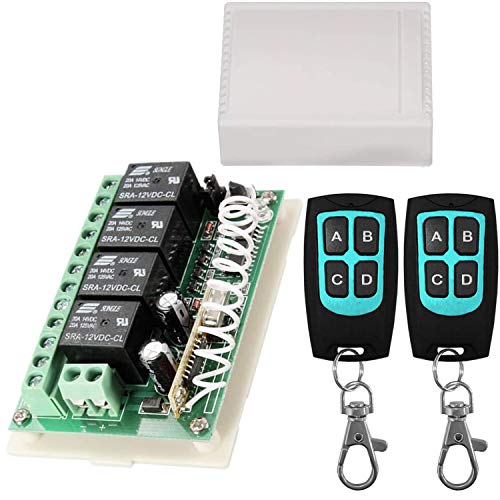
Not every switching job justifies a premium kit. For the workshop door lights, the garden pump, the shed fans — loads that are simple, supervised, and forgiving — this budget 4-channel kit covers the brief: a 12V receiver with four relay channels, a 433MHz transmitter, and the standard mode behaviors, at the tier where buying two kits (one to install, one as the shelf spare) is a rational strategy.
Strengths
- Lowest-cost route to four remote channels
- Standard 433MHz architecture — remotes and receivers are plentiful
- Ideal for simple, supervised switching jobs
Trade-offs
- Documentation is the thinnest in this guide; expect to consult community knowledge
- Relay and range performance should be verified in the return window
- No brand support channel to speak of
| Spec | Detail |
|---|---|
| Input | 12V DC |
| Channels | 4 relay channels |
| Frequency | 433MHz transmitter/receiver |
| Type | Budget kit |
Budget kits in this category are a known quantity if you shop them correctly: the hardware is usually serviceable, the instructions are the gamble. Mitigate by testing everything on the bench before installation — pair the remote, exercise every channel, confirm the modes — while returning is still free. A kit that passes the bench will usually serve for years; the bench test is the entire difference between a bargain and a lottery ticket.
There is also a legitimate fleet logic here: for a property with several simple jobs, standardizing on one inexpensive kit means every receiver, remote, and spare part is interchangeable. Hobbyists call this the drawer of identical boards, and it has kept more sheds and barns running than any premium product ever made.
Best for: simple supervised loads and painless multi-kit standardization / Not suited for: complex installs needing genuinely strong documentation

Jiangbao 12V 4 Channel Wireless Remote Control Switch — Best for Gates and Access
Check the current price on Amazon
Access control is the use case where remote switching stops being a convenience and becomes the point of the building, and this Jiangbao kit is aimed squarely at it: a 12 volt, 4-channel wireless relay switch listed for lighting fixtures, access control, and gate remote applications. Four channels map naturally onto gate work — open, close, stop, and a courtesy light, or a gate, a pedestrian door, and two lighting zones — and the momentary mode that gate controllers expect is standard fare for this class of board.
Strengths
- Positioned and configured for gate and access-control work
- Four channels cover open/close/stop plus an auxiliary load
- 12V native — matches gate controller and alarm system power
Trade-offs
- Verify your gate operator’s control inputs before ordering; interfaces vary
- Security note: 433MHz fixed-code systems are convenience-grade, not high-security
- Documentation requires the usual bench-test diligence
| Spec | Detail |
|---|---|
| Input | 12V |
| Channels | 4 channels |
| Applications | Lighting, access control, gates |
| Frequency | 433MHz RF |
The honest security paragraph belongs here. These 433MHz kits are convenience devices: they keep honest people and weather out of your switch circuits, and they make a gate open from the car like magic. They are not bank vaults — fixed-code RF can be captured by a determined attacker with cheap equipment. For a farm gate or a garage, that trade is usually acceptable and universally made. For anything whose compromise would genuinely harm you, use the operator’s own secured controls and let this board run the lights instead.
Wired correctly into a gate operator’s low-voltage control terminals — never into mains, never across safety sensors — a kit like this adds remote channels the operator never shipped with. Keep the safety circuits sacred: photocells and auto-reverse functions stay wired exactly as the operator’s manual demands, and the remote board only ever asks politely, through the same inputs a wall button uses.
Best for: gates, garage doors, and access-adjacent lighting circuits / Not suited for: high-security applications or direct motor wiring

fushionsea DC 12V 24V 36V 4CH Remote Control Switch — Best for Garage Doors
Check the current price on Amazon
The fushionsea board’s headline is voltage span: a 4-channel, 10 amp remote switch that accepts 12, 24, or 36 volt DC inputs, listed for garage door and general wireless control work. That span covers the awkward middle kingdom of control voltages — 24 volt commercial operators, 36 volt legacy systems — where 12 volt kits simply cannot go, and it does so in the same four-channel, 433MHz form as the rest of this guide.
Strengths
- Widest input span here: 12V/24V/36V
- 10A channels suit control and accessory loads
- Garage-door and operator-control orientation
Trade-offs
- Confirm your operator’s control voltage and input type before ordering
- Lesser-known brand — bench test thoroughly
- Same convenience-grade RF security caveat as the class
| Spec | Detail |
|---|---|
| Input | DC 12V / 24V / 36V |
| Channels | 4 channels, 10A |
| Frequency | 433MHz |
| Applications | Garage door and general control |
Garage and gate operators are a world of inherited voltages, and the cost of guessing wrong is a receiver that never wakes up. This kit exists for the owners who measured first and discovered their system is not 12 volt at all. If that is you, the span is the whole story — and the discipline is to verify the operator’s control circuit is a dry-contact style input the relay can serve, rather than a proprietary bus the relay cannot speak.
As with the access pick above, the safety rule is absolute: the board requests; it never overrides. Wire it in parallel with the existing wall control, leave every safety sensor and auto-reverse function exactly as installed, and test the door’s safety behavior after the install as if you had never touched it — because the standard it must meet is the one it met before you arrived.
Best for: 24V and 36V operators and other non-12V control systems / Not suited for: pure 12V installs, where simpler kits cost less
Comparison Table
| Pick | Badge | Key Spec | Best For |
|---|---|---|---|
| QIACHIP DC 12V 4CH 433MHz Wireless RF Remote Control Switch | Best Overall | 12V supply, 4 relay channels, 433MHz, multi-mode | general RV, boat, cabin, and workshop switching projects of all kinds |
| DieseRC DC 12V 24V 4CH Wireless Remote Control Switch | Best Wide Voltage | Wide 6–30V input, 4 channels, 10A relays | 24V systems and mixed-voltage vehicle and marine fleets |
| DieseRC 4 Channel Wireless Relay Switch with 2 Transmitters | Best with Spare Remote | 4 channels, 10A relays, 2 transmitters included | anyone whose remote will eventually be lost, dropped in the bilge, or needed in two places at once |
| 12V 4 Channel Wireless Remote Switch Kit (433MHz Relay Module) | Best Budget | 12V supply, 4 channels, 433MHz link, budget tier | simple supervised loads and painless multi-kit standardization |
| Jiangbao 12V 4 Channel Wireless Remote Control Switch | Best for Gates and Access | 12V supply, 4 channels, access-control focus | gates, garage doors, and access-adjacent lighting circuits |
| fushionsea DC 12V 24V 36V 4CH Remote Control Switch | Best for Garage Doors | Wide 12–36V input, 4 channels, 10A relays | 24V and 36V operators and other non-12V control systems |
How to Choose a 12 Volt 4 Channel Remote Switch
Start with your loads, in amps, honestly measured or honestly estimated. These receivers carry relay channels in the 10 amp class, which comfortably covers LED lighting, small pumps, fans, solenoids, and the low-voltage control inputs of larger machines. It does not cover a winch’s main current, a big inverter, or a heater — those loads need a relay or contactor rated for them, which the little board can happily control through its coil circuit. The professional pattern is: small board switches the signal, big hardware switches the power. Choose a kit whose channels match your signal loads and never ask a hobby relay to be a contactor.
Second, the modes. Momentary mode runs a load while the button is held — right for winch inching, horn-like signals, and gate triggers. Toggle mode turns a press into on, the next into off — right for lights. Latching or interlocked mode ensures only one channel is active at a time — right for motor direction pairs and mutually exclusive loads. Confirm the kit you buy supports the modes your project needs and that the modes are configurable per channel or globally, as your design requires; this is where projects quietly succeed or fail.
Third, the practicalities: input voltage range (24 volt systems need the wide-range picks), transmitter count (buy the two-remote bundle if loss is a when, not an if), antenna and range realism (433MHz range collapses through metal and masonry; plan receiver placement accordingly), and documentation quality, which in this category is a genuine performance feature. Judge any kit — in this guide or out of it — against that list in that order.
Relay Ratings, Fusing, and the Discipline of Small Boards
A relay marked 10A is telling you its laboratory maximum under friendly conditions, usually a resistive load at room temperature. Real loads are ruder: motors and pumps draw starting surges several times their running current, LED drivers gulp inrush, and inductive loads strike an arc across opening contacts that erodes them a little every time. The experienced rule is to work a hobby relay at half its printed rating for resistive loads and a third or less for motor loads — or to let it switch the coil of a properly rated automotive relay or contactor and keep it out of the weather entirely.
Fusing is the second half of the discipline, and it protects the wiring, not the board’s feelings. Fuse the receiver’s supply near the source, fuse each load circuit appropriately, and remember that the board’s thin traces are themselves a fuse of last resort — one you do not want to use, because it fails permanently and occasionally with smoke. A correctly fused install makes the worst-case failure a blown fuse and a lesson; an unfused one makes it a story told to insurance.
Finally, environment: these are bare or lightly cased boards in a world of vibration, condensation, and dust. An inexpensive enclosure, strain-relieved cables, and a mounting spot out of the bilge’s splash zone are the difference between a two-year install and a ten-year one. The boards are cheap; the labor of replacing one inside a finished wall is not.
Operating Modes Explained: Momentary, Toggle, and Latching
Modes are the software of these little systems, and choosing them is most of the design work. Momentary (sometimes called jog or inching) energizes the relay only while its button is pressed. It is the safe mode for anything that moves — gates mid-travel, winch lines, awning motors — because a released button, a dropped remote, or a dead battery all produce the same result: stop. If a load could hurt someone by running unattended, momentary is not a preference; it is the requirement.
Toggle mode is the light-switch pattern: press for on, press again for off. It suits lighting, fans, and pumps with their own protection, and it is where a status problem hides — the remote cannot tell you whether the load is on, only that you pressed. In installations where the load is out of sight (a bilge pump, a distant shed light), that ambiguity matters, and pairing the board with an indicator or choosing loads whose state announces itself is part of competent design.
Latching or interlock mode guarantees exclusivity: activating one channel releases the others. Motor reversing pairs are its classic home — forward and reverse contactors must never engage together — along with source selection (shore versus inverter feeds to a control circuit) and any set of loads that must take turns. Some kits add a mixed mode, assigning different behaviors per channel; if your project mixes a gate trigger (momentary) with yard lights (toggle), that configurability is the feature to shop for, and it is worth confirming before purchase rather than discovering after.
Range, Antennas, and Living with 433MHz
Every listing in this category quotes a range, and every quote assumes a laboratory: open field, fresh batteries, no interference. Real range is set by your environment. The receiver’s antenna wants to be vertical, away from large metal surfaces, and as high as the install allows; a receiver buried behind a steel bulkhead or inside a metal enclosure will hear whispers where the same board in the open hears shouts. If range disappoints, antenna placement is the first fix, the second, and usually the last one needed.
433MHz is a shared, unlicensed neighborhood. Garage remotes, weather stations, tire sensors, and your neighbor’s entire hobby life all transmit there. Quality receivers cope by learning specific transmitter codes and ignoring the rest, which all six picks do — but dense RF environments can still cost you the occasional missed press. For convenience loads this is a shrug; it is one more reason safety-relevant control never belongs on a convenience link.
Transmitter batteries are the silent variable: range decays as the coin cell ages, and the failure presents as ‘the system is dying’ when the system is fine. Replace the remote’s battery on suspicion, keep a spare cell with the spare remote, and write the cell type on the receiver’s enclosure the day you install it. Future you, standing in the dark, sends thanks.
Project Ideas That Justify Four Channels
If you are still deciding whether four channels is abundance or necessity, walk the classic installs. In an RV: awning lights, water pump, exterior floodlight, and the inverter’s remote switch — four channels, each used daily, none requiring a wire run through a finished wall. On a boat: cabin lights, bilge blower, anchor light, and a washdown pump, controlled from the helm or the dock. In a workshop: dust collector, compressor drain solenoid, task lighting, and the door — the dust collector alone, switchable from every machine’s position, justifies the kit to anyone who has crossed a shop mid-cut to start one.
The pattern to notice is that the fourth channel is never wasted; it is absorbed by the load you did not know you wanted remote until remotes existed. Buy the channel count for the system you will have in a year, not the one itemized today — the receiver is the cheap part of any retrofit, and the second receiver, added later in a different corner of the vehicle, is how these systems actually grow.
And a word for the simplest project of all, the one that converts skeptics: a single channel on the water pump of an RV or boat, remote by the sink and the shower. No more shouted requests through the vehicle, no pump left running against a closed tap. Small mercies, delivered by radio, are the soul of this category.
Troubleshooting: The Four Failures and Their Fixes
These kits fail in a small number of ways, and the diagnostic order is always the same: power, pairing, mode, load. If the receiver is silent, check its supply fuse and polarity first — more ‘dead boards’ have been resurrected by a fuse than by any other intervention — and confirm the supply voltage sits inside the board’s input range with a meter, not an assumption. If the receiver clicks for some channels and not others, suspect the load side of the silent channel: a welded relay contact (the signature of an overloaded channel) or a load whose fuse has gone.
If the remote works at arm’s length and nowhere else, the fault is range physics, not electronics: a tired transmitter battery, an antenna folded against metal, or a receiver entombed behind a bulkhead. Replace the cell, free the antenna, and retest before replacing anything. If a channel behaves in the wrong mode — latching when it should toggle — the board is not broken; its configuration is. These kits store mode settings through procedures involving jumpers or button sequences, and a board that was handled, reset, or re-paired may have reverted. Re-run the mode setup from the manual and label the enclosure with the result.
And if everything works except when it rains, believe the correlation: moisture in an unenclosed board or a corroding connector is the classic intermittent fault of mobile electronics. Dry it, enclose it, protect the connectors, and the ghost leaves. The meta-lesson of the category is that these boards are more reliable than their installs; troubleshoot the install first and the board last, and you will be right nine times in ten.
Integrating with an Existing 12V Panel: Doing It Like It Was Always There
The difference between a gadget and an installation is what the next owner finds. Wire the receiver’s supply from a labeled, fused position on the 12 volt panel rather than from a mystery tap on the nearest wire; label each channel’s output at both ends; and leave a channel map — a card in the electrical locker or a note in the vehicle’s documents — recording what each button does, which mode it uses, and where the receiver hides. Vehicles and boats outlive memories, and the map is the difference between a system and a riddle.
Match the new circuits to the panel’s existing discipline: same fuse style, same wire colors where the convention exists (red for positive DC, black or yellow for negative in marine practice), same labeling font if you can manage it. This is not fussiness. In a night-time fault, in the rain, with a flashlight in your teeth, the system you can read is the system you can fix — and a remote switch install that follows the panel’s own language disappears into the boat or vehicle exactly as good work should.
Keep the original manual switches functional where they exist, wired in parallel logic where the design allows. Redundancy is the professional’s signature: the remote is the convenience, the panel switch is the guarantee, and a system that can be operated both ways will never leave a load stranded by a lost transmitter or a flat coin cell.
How to Install a 4 Channel Remote Switch Safely
An afternoon’s work, done in the order that keeps it safe and testable.
- Bench-test before installing: power the receiver from a fused bench supply or the vehicle battery, pair the transmitter, and exercise every channel in every mode you intend to use. Installation is a terrible place to discover a misunderstanding.
- Plan the circuits: list each channel’s load, its running and surge current, and its mode. Confirm each load belongs on a relay channel at all — heavy loads get a contactor, with the board switching its coil.
- Mount the receiver in a dry, accessible spot with the antenna vertical and away from large metal masses; fit an enclosure if the environment has moisture, dust, or vibration.
- Wire the supply through a fuse near the source, observing polarity, and wire each channel’s contacts in series with its load’s fused feed. Keep low-voltage control wiring tidy and strain-relieved.
- Configure the modes per channel as planned, then test each load individually, then together — watching for the interactions (two pumps, one circuit) that bench tests miss.
- Program the spare transmitter now, label the remotes and the enclosure with channel assignments, and record the transmitter battery type where future you will find it.
Finish by walking the full intended range with the remote — every seat, doorway, and dock position from which you will actually command the system. Range verified in the real geometry is range you can trust; range assumed from a listing is a hope with a frequency.
Common Buying Mistakes
Switching a heavy load directly through a hobby relay. Winches, heaters, and big motors will weld or erode a 10A-class relay. Let the board switch a properly rated contactor’s coil instead.
Skipping the fuses because ‘it is only 12 volts’. A 12 volt battery delivers hundreds of amps into a short. Fuses protect the wiring; the wiring is the fire risk.
Burying the receiver behind metal and blaming the range. Antenna placement is range. Vertical, clear of metal masses, as high as practical — then judge the kit.
Using toggle mode for loads that move. Anything that can hurt someone or damage something by running on belongs on momentary control, where letting go means stop.
Treating 433MHz convenience control as security. These kits are for convenience switching. Gates get them as a comfort feature; security belongs to the operator’s secured systems.
Final Recommendation
For most projects, start with the QIACHIP kit — the documented, mode-flexible reference design of the category. Systems at 24 volts, or fleets of mixed voltage, belong with the DieseRC wide-range kit, and anyone who has ever lost a remote should take the two-transmitter DieseRC bundle. Simple supervised jobs can standardize on the budget kit, while gates and operators are served by the Jiangbao at 12 volts and the fushionsea across the wider voltage span.
Whichever kit you choose, the installation rules outrank the brand: fuse everything, derate the relays, choose modes like a safety engineer, and place the antenna like you mean it. Do those four things and a twenty-dollar class of electronics will quietly run parts of your world for years.
Shop the picks: QIACHIP DC 12V 4CH 433MHz Wireless RF Remote Control Switch · DieseRC DC 12V 24V 4CH Wireless Remote Control Switch · DieseRC 4 Channel Wireless Relay Switch with 2 Transmitters · 12V 4 Channel Wireless Remote Switch Kit (433MHz Relay Module) · Jiangbao 12V 4 Channel Wireless Remote Control Switch · fushionsea DC 12V 24V 36V 4CH Remote Control Switch
Keep researching the cluster: Best 12 Volt 24 Inch Tv Best 12 Volt 5 Amp Batteries Best 12 Volt 2000 Watt Inverter Best 12 Volt 25 Amp Battery Charger
Frequently Asked Questions
What can I actually control with a 12V 4 channel remote switch?
Anything whose current fits the relay channels or whose control input does: LED and incandescent lighting, small water and bilge pumps, fans, solenoids, awning and slide accessories within rating, and the low-voltage trigger inputs of gates, garage operators, and larger relays or contactors. The board is a commander; heavy loads need it to command a contactor rather than carry the current itself.
What is the difference between momentary, toggle, and latching modes?
Momentary energizes a channel only while its button is held. Toggle switches a channel on with one press and off with the next. Latching (interlock) allows only one channel active at a time, releasing the others — used for motor direction pairs and mutually exclusive loads. Most projects mix modes, so per-channel configurability is worth confirming before you buy.
How far will the remote work?
Listings quote open-field figures that real buildings and boats reduce substantially. Metal bulkheads, masonry, and a buried receiver antenna are the usual range killers; correct antenna placement recovers most of the loss. Treat any specific number as marketing and verify your own installation’s range from the positions you will actually use, during setup.
Can one receiver learn more than one transmitter?
Typically yes — receivers in this class can usually be paired with additional or replacement transmitters, and the two-transmitter DieseRC bundle in this guide builds on exactly that. Pair every remote you own during installation, including spares, because pairing at the bench is easy and pairing in the field, mid-crisis, is not.
Is a 433MHz remote switch secure enough for my gate?
It is convenience-grade security: fine for operating a farm or home gate as a comfort feature, not a substitute for the operator’s secured access system where real security matters. Fixed-code RF can be intercepted by determined attackers with inexpensive equipment. Let these boards run gates in low-risk settings and lighting everywhere; keep high-security access on systems designed for it.
Can I use a 4 channel remote switch on a 24V system?
Only with a receiver whose input range covers 24 volts — the DieseRC wide-range kit and the fushionsea 12–36V kit in this guide qualify; a 12V-only receiver must never be connected to a 24V supply. Check the input specification of the exact kit, because in this category the voltage range is the difference between a working install and a puff of smoke.


