Disclosure: airfryerkitchensupply.com is reader-supported. When you buy through links on our site, we may earn an affiliate commission at no extra cost to you.
Where to buy
Below are the best bbq barrel smokers picks verified for this guide, each with a live Amazon link where the model is sold.
- Weber Smokey Mountain Cooker 22-inch — Check the current price on Amazon
- Oklahoma Joe’s Bronco 18-inch Charcoal Drum Smoker and Grill — Check the current price on Amazon
- Weber Smokey Mountain Cooker 18-inch — Check the current price on Amazon
- Dyna-Glo DGO1890BDC-D Wide Body Vertical Offset Charcoal Smoker — Check the current price on Amazon
- Cuisinart 18-inch Vertical Charcoal Smoker COS-118 — Check the current price on Amazon
- InGrill 3-in-1 Charcoal Barrel Smoker, Grill & Oven, Medium — Check the current price on Amazon
Barbecue barrel smokers take the oldest shape in outdoor cooking — a steel barrel over a fire — and refine it into something controllable. The best bbq barrel smokers in this guide come in three honest forms: the vertical bullet barrel with a water pan, the sealed drum that hangs meat over coals, and the wide vertical cabinet fed by an offset firebox. All three cook with charcoal and wood, all three produce bark and smoke flavour that powered smokers chase, and all three were verified model by model before a single link was placed.
What ‘barbecue’ adds to the barrel idea is intent: these are cookers bought to smoke meat properly — brisket, pork butt, ribs, chicken — not grills that happen to smoke. That intent shows in the details that matter here: dual grates, water bowls, hanging rods, door seals, vent quality. A barrel bought for barbecue lives or dies on temperature control over six, ten, fourteen hours, so this guide weighs control and build more heavily than headline cooking area.
Every pick below is a current verified listing on Amazon for the exact model named. Prices are not printed — check price on Amazon at the listing — and neither are star ratings or review counts, because both change too fast to print honestly. What is printed is what stays true: how each barrel is built, how it cooks, who it suits, and where it will frustrate you. Read the trade-offs as carefully as the strengths; in smokers, the trade-offs are where satisfaction is decided.
In this guide
Quick Picks
Best Overall — Weber Smokey Mountain Cooker 22-inch: The barrel-format smoker that defined the category for home cooks: two grates, a water pan, porcelain enamel, and temperature manners so good it still anchors competitions and backyards alike. Check the current price on Amazon
Best for Hanging Meat — Oklahoma Joe’s Bronco 18-inch Charcoal Drum Smoker and Grill: A heavy sealed drum that hangs ribs and chickens over the coals for true barrel flavour, then converts to a grill — the pick for cooks who want meat over fire, not beside it. Check the current price on Amazon
Best Mid-Size Barrel — Weber Smokey Mountain Cooker 18-inch: The original mid-size Smokey Mountain: the same water-pan barrel design as the 22-inch, sized and priced for households that cook one brisket or two butts at a time. Check the current price on Amazon
Best Wide-Body Barrel Capacity — Dyna-Glo DGO1890BDC-D Wide Body Vertical Offset Charcoal Smoker: A wide vertical barrel-cabinet fed by an offset firebox: shelf after shelf of capacity for cooks who smoke in volume — jerky, sausages, multiple briskets — without a trailer. Check the current price on Amazon
Best Budget Barrel Smoker — Cuisinart 18-inch Vertical Charcoal Smoker COS-118: A straightforward 18-inch vertical barrel smoker with water bowl and dual vents at a starter price — the low-risk way to find out whether barrel smoking is your hobby. Check the current price on Amazon
Most Versatile Barrel — InGrill 3-in-1 Charcoal Barrel Smoker, Grill & Oven, Medium: A barrel that reconfigures between smoker, grill and outdoor oven — for cooks who want one charcoal unit that can smoke a butt on Saturday and bake bread or roast vegetables on Sunday. Check the current price on Amazon
How These Picks Were Chosen
Selection started with format coverage: a barbecue barrel guide that listed six near-identical bullets would fail its readers, so the final six span water-pan bullets (two sizes of Smokey Mountain), a hanging drum (Bronco), a wide-body vertical offset cabinet (Dyna-Glo), a budget vertical (Cuisinart) and a convertible barrel (InGrill). Each represents a real way people barbecue in a barrel, at a real price tier described in words rather than figures.
Verification used Amazon listing data: brand and model searched, returned title matched to the intended product, ASIN taken only from the listing response. Specs in the mini boxes — sizes, grate counts, listed features — come from those verified listings, and anything the listing does not state is not claimed here. Products whose listings could not be matched confidently were dropped rather than guessed at, and no product with a known safety recall appears in this guide.
Within formats, we favoured control: vents that adjust finely, doors that seal, steel that holds heat. Barbecue is a long cook, and a barrel that wanders fifty degrees while you are at the shops is a barrel that makes dry meat. The picks below hold temperature by design, not by luck.
The 6 Best BBQ Barrel Smokers

Weber Smokey Mountain Cooker 22-inch — Best Overall
The 22-inch Smokey Mountain suits the cook who wants barrel-style smoking with the deepest pool of shared knowledge on earth — every problem you might have, thousands of owners have solved publicly. It is less suited to direct grilling purists; it can grill, but its heart is low and slow.
Strengths
- Dual grates stack capacity vertically in true barrel fashion
- Porcelain-enameled steel shrugs off weather and cleans easily
- Water pan buffers temperature swings for forgiving long cooks
Trade-offs
- Accessing the lower grate means lifting the upper food out of the way
- Door and vents benefit from owner tuning for a perfect seal
- No hanging rod — meat cooks on grates, not hooks
Key specs: 22-inch bullet/barrel format; dual cooking grates (Amazon listing); porcelain-enameled steel; charcoal with water pan
The Smokey Mountain’s genius is thermal mass and moderation. The water pan sits between coals and meat, absorbing heat spikes, releasing steam, and turning the barrel into a gentle convection column. Briskets and butts cooked over water come out with the deep bark and rendered fat that made this cooker famous, and the porcelain enamel — inside and out — means the barrel itself is nearly maintenance-free compared with painted steel.
Running it is a ritual worth learning properly: fill the charcoal ring, light a small centre pocket of coals (the Minion method), assemble with hot water in the pan, and let the vents — mostly the bottom three — do the regulating. Once settled, a Smokey Mountain holds its temperature with a steadiness that embarrasses smokers costing twice as much. That predictability is why competition teams still cook on them.
Best for: serious home smoking of brisket, butts and ribs in barrel format / Not suited for: cooks who mainly want to hang meat or grill
Check the current price on Amazon

Oklahoma Joe’s Bronco 18-inch Charcoal Drum Smoker and Grill — Best for Hanging Meat
Choose the Bronco if the words ‘hanging ribs’ are why you are shopping for a barrel smoker at all. Its sealed drum and precise intake make it the most controllable cooker in this guide. Pass it over if your cooks are mostly flat, wide loads like multiple brisket packer cuts side by side.
Strengths
- Hanging cooking delivers the signature drum flavour from dripping fat vaporising on coals
- Sealed construction and fine intake control hold temperatures steadily
- Heavier steel than most drums at its size
Trade-offs
- 284 sq. in. grate is small for flat, wide loads
- Hanging long racks needs care so ends clear the coals
- Refuelling mid-cook takes more disassembly than an offset firebox
Key specs: 18-inch drum; 284 sq. in. cooking area (Amazon listing); hanging hooks and grate cooking; sealed intake control
Hang a rack of ribs in the Bronco and you understand the barrel idea instantly: the meat cooks in rising heat, every surface exposed, fat rendering and dripping onto the coals, the vapour rising to baste the next rack. There is no cooler grate corner and no hotter one — the column treats the whole load evenly, which is why drum ribs need no wrapping and no spritzing to come out glossy.
The Bronco also grills credibly once the cook is done: raise the fire, set the grate low, and sear over the same coals. Ownership is simple — keep the intake mechanism clean, empty ash cold, and learn your three or four intake positions for common temperatures. It is a specialist tool that does its speciality superbly.
Best for: ribs, chicken and hanging-meat enthusiasts / Not suited for: very large flat loads
Check the current price on Amazon
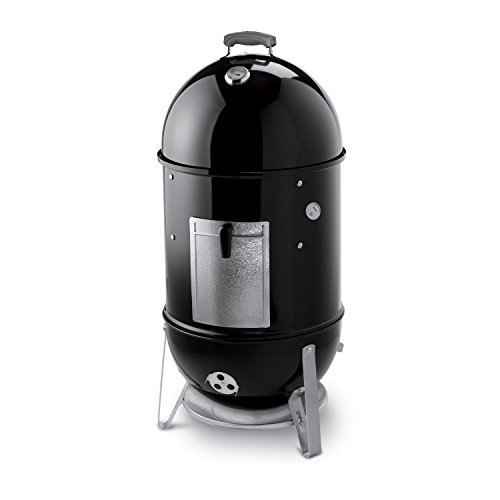
Weber Smokey Mountain Cooker 18-inch — Best Mid-Size Barrel
The 18-inch suits most households better than its bigger sibling: it heats faster, burns less charcoal, and still fits a brisket (folded or separated at first) or several racks of ribs rolled or racked. Choose the 22-inch instead only if you regularly cook for a crowd.
Strengths
- All the Smokey Mountain virtues in a thriftier, faster-heating size
- Dual grates still give real two-level capacity
- Porcelain enamel and Weber parts support promise a long service life
Trade-offs
- Full packer briskets are a squeeze until they shrink in the cook
- Less fuel capacity means attention on the longest overnight cooks
- Same lower-grate access shuffle as the 22-inch
Key specs: 18-inch bullet/barrel format; dual cooking grates (Amazon listing); porcelain-enameled steel; water pan
Most Smokey Mountain owners who ‘upgrade’ to the 22 do it for parties, then quietly admit the 18 cooked their weekly food better: less air to heat, a coal bed sized to the load, and temperatures that settle quickly. For a family that smokes twice a month — a butt here, ribs there, a turkey at the holidays — this is the rational barrel, and the second-hand and accessory ecosystem around it is unmatched.
Technique transfers completely from the big model: Minion-method lighting, water in the pan, bottom vents doing the fine work. If anything, the 18 teaches cleaner habits, because a smaller barrel punishes an oversized fire faster. Master this one and every other smoker you ever meet will feel familiar.
Best for: households wanting the classic barrel smoker without oversizing / Not suited for: regular crowd cooking
Check the current price on Amazon

Dyna-Glo DGO1890BDC-D Wide Body Vertical Offset Charcoal Smoker — Best Wide-Body Barrel Capacity
Pick the Dyna-Glo Wide Body when your smoking is about volume and variety at once: different meats on different shelves, all sharing one fire. It is not a grill, and it is not a small commitment of patio space — it is a dedicated smoking cabinet for people who plan cooks like projects.
Strengths
- Vertical shelves multiply capacity far beyond a simple drum
- Offset firebox keeps flame and ash away from the food chamber
- Adjustable grates fit tall items like turkeys and hams
Trade-offs
- Large steel cabinet takes time and fuel to heat fully
- Seals and latches on big doors reward owner tuning
- No direct-grilling function — pair it with a grill for searing
Key specs: Wide-body vertical cabinet with offset charcoal firebox (Amazon listing); multiple adjustable grates; built for large vertical loads
The wide-body vertical layout solves the drum’s one real limit — flat capacity — by stacking. Heat and smoke enter low from the firebox and rise through shelf after shelf, so a cook can run ribs up top, a butt in the middle and sausages low, each finishing on its own schedule. The offset firebox means refuelling never disturbs the food chamber, a genuine advantage on long cooks that drum owners envy.
Run it with a modest, steady fire and expect the top shelves to cook a touch faster once the cabinet is heat-soaked; rotate shelves on very long cooks. Seal the doors well, keep the firebox ash emptied so air flows, and this cabinet will smoke quantities that make neighbours ask questions — the good kind.
Best for: volume smoking, mixed loads and sausage/jerky makers / Not suited for: grilling or small occasional cooks
Check the current price on Amazon

Cuisinart 18-inch Vertical Charcoal Smoker COS-118 — Best Budget Barrel Smoker
The Cuisinart suits the curious beginner: first brisket, first ribs, modest investment, brand-name support. It will not match the Weber’s enamel or the Bronco’s steel over years of heavy use, and it is honest value precisely because it does not pretend to.
Strengths
- Water bowl and dual vents give real temperature control at a starter price
- 18-inch format fits family loads without a big footprint
- Integrated thermometer and simple assembly lower the barrier to a first cook
Trade-offs
- Lighter steel and chrome grates age faster than premium barrels
- Seals are basic — expect more vent management in wind
- Capacity tops out at one brisket or a couple of butts
Key specs: 18-inch vertical format; integrated thermometer; water bowl; dual vents (Amazon listing); chrome-plated grates
Budget vertical smokers earn their keep as teachers. The COS-118’s layout — fire at the bottom, water bowl above it, two grates over that — is the textbook barrel arrangement, and everything you learn on it (vent control, water management, when to refuel) transfers directly to any premium smoker later. Its dual vents matter more than its thermometer: they are what let you actually steer temperature instead of enduring it.
Cook the forgiving classics first: pork butt until it probes tender, chicken until the skin sets, ribs until they bend and crack the bark. Keep it covered, keep the ash out, and the Cuisinart will return seasons of good food for very little money — and if you outgrow it, you will know exactly why and for what.
Best for: beginners testing the barrel-smoking hobby / Not suited for: decade-long heavy use expectations
Check the current price on Amazon

InGrill 3-in-1 Charcoal Barrel Smoker, Grill & Oven, Medium — Most Versatile Barrel
Choose the InGrill if your outdoor cooking ranges widely and patio space allows only one charcoal cooker. Dedicated smokers smoke a little better and dedicated grills grill a little better; this barrel’s argument is that it does all three jobs in one footprint, which for many households is the argument that wins.
Strengths
- Three cooking modes in one barrel footprint
- Medium size suits family cooks without party-scale fuel use
- Oven mode opens baking and roasting most smokers cannot do
Trade-offs
- Convertible designs involve more parts to clean and store
- Jack-of-all-trades: specialists outperform it at each single task
- Smaller brand support network than Weber or Oklahoma Joe’s
Key specs: Barrel format combining smoker, grill and oven functions (Amazon listing); medium size; charcoal fuel
The oven mode is the surprise here. A sealed charcoal barrel with controlled airflow is, thermally, a convection oven — and once you trust its temperature control, it bakes flatbreads, roasts root vegetables and finishes casseroles with a whisper of smoke that a kitchen oven cannot give. Smoker mode uses the same column of heat at lower temperatures with wood chunks; grill mode opens the fire up for direct heat.
The discipline this cooker rewards is configuration: set it up deliberately for the mode you are in, preheat fully, and cook. Owners who treat the conversions casually get mediocre results in all three modes; owners who learn each setup get a genuinely flexible outdoor kitchen in a single barrel.
Best for: varied outdoor cooks with one-cooker patio space / Not suited for: purists wanting a dedicated competition-style smoker
Check the current price on Amazon
Comparison Table
| Pick | Badge | Key spec | Best for |
|---|---|---|---|
| Weber Smokey Mountain Cooker 22-inch | Best Overall | 22 in., dual grates, water pan | serious home smoking of brisket, butts and ribs in barrel format |
| Oklahoma Joe’s Bronco 18-inch Charcoal Drum Smoker and Grill | Best for Hanging Meat | 284 sq. in. drum, hanging + grate | ribs, chicken and hanging-meat enthusiasts |
| Weber Smokey Mountain Cooker 18-inch | Best Mid-Size Barrel | 18 in., dual grates, water pan | households wanting the classic barrel smoker without oversizing |
| Dyna-Glo DGO1890BDC-D Wide Body Vertical Offset Charcoal Smoker | Best Wide-Body Barrel Capacity | Wide-body vertical offset, multi-grate | volume smoking, mixed loads and sausage/jerky makers |
| Cuisinart 18-inch Vertical Charcoal Smoker COS-118 | Best Budget Barrel Smoker | 18 in. vertical, water bowl, dual vents | beginners testing the barrel-smoking hobby |
| InGrill 3-in-1 Charcoal Barrel Smoker, Grill & Oven, Medium | Most Versatile Barrel | 3-in-1 barrel: smoke, grill, bake | varied outdoor cooks with one-cooker patio space |
How to Choose a BBQ Barrel Smoker
Match the barrel to your barbecue menu. If brisket and pork butt are the mission, a water-pan bullet like the Smokey Mountain is the classic tool: gentle, moist, steady heat for very long cooks. If ribs and chicken are the mission, a hanging drum like the Bronco cooks them faster with a more direct, roasted character. If you smoke many different things at once — sausages, jerky, several cuts — a wide vertical cabinet earns its size. Menu first, metal second.
Think about fuel access over a whole cook. Drums and bullets ask you to add charcoal through a door or by lifting sections; offsets let you tend the fire without touching the food chamber. On a fourteen-hour brisket cook, that difference stops being a detail. Also consider grate access: two-level bullets make you lift the top grate’s food to reach the bottom level, which is manageable with planning and annoying without it.
Buy the best steel and seals your budget tier allows, in the size your typical cook needs. In barrel smokers, build quality is not vanity — it is temperature stability, fuel economy and years of service. A well-sealed mid-size barrel will out-cook and out-last a leaky large one every single weekend.
Water Pan or No Water Pan? The Barrel Debate
Water-pan barrels (the Smokey Mountains, the Cuisinart) cook in moist heat. The pan buffers the fire — absorbing spikes, releasing stored heat — and adds humidity that helps smoke adhere and bark set without drying the surface. The cost is a ceiling on bark crispness and the chore of refilling and cleaning the pan. Many owners run the pan with water for butts and brisket, and dry or foiled for ribs and chicken.
Dry drums (the Bronco) cook in the meat’s own vapour: drippings hit the coals and return as flavour. The result is more intense and more direct, with superb skin and edges, and less forgiveness — a dry drum running hot will scorch what a water pan would have cushioned. Neither camp is right; they are different flavours of barbecue. Choose by the food you love most.
Running a Barrel for Low and Slow Barbecue
Long barbecue cooks are won before the meat goes on. Use the Minion method — a ring or basket of unlit charcoal with a small pocket of lit coals in the centre — so the fire grows slowly and burns for hours without intervention. Add wood chunks, not chips: two to four fist-sized pieces of hickory, oak or fruitwood buried in the charcoal will smoke gently for the whole cook instead of flaring and vanishing.
Set vents conservatively and wait. A barrel takes twenty to forty minutes to show the full effect of a vent change, and impatient adjustments stack into wild swings. Cook to tenderness, not time: a brisket is done when a probe slides into the flat with almost no resistance, a butt when the bone wiggles loose, ribs when they bend and the bark cracks. Rest everything — brisket and butt benefit from an hour or more wrapped and held warm — and slice against the grain.
Keep a simple log. Fuel load, vent positions, weather, and the result. Barrel barbecue is a craft of small repeatable decisions, and the log turns one good brisket into a method you can repeat on demand.
Cleaning and Maintaining a BBQ Barrel Smoker
Ash is the enemy: emptied cold after every cook, it does no harm; left damp in the barrel, it corrodes steel and taints flavour. Brush grates warm, wipe the water pan before residue bakes on, and scrape creosote from the lid when it flakes — loose flakes fall on food. Porcelain-enameled barrels need only washing; painted barrels need occasional touch-ups where heat has blistered the finish.
Store covered, ideally under shelter, with vents open a crack so the interior stays dry rather than sweating in a sealed cover. Once a year, check door gaskets, vent dampers and thermometer accuracy (a probe in boiling water tells you the truth). A barrel maintained this way does not wear out so much as season in — most owners find year three cooks better than year one.
A Closer Look at the Shortlist: How the Six Compare in Real Cooks
Specifications only take a buyer so far with best bbq barrel smokers; what matters is how each cooker behaves on a wet Saturday with a brisket deadline. Start at the top of the shortlist. The Weber Smokey Mountain Cooker 22-inch earns its Best Overall badge because it balances the things that decide real cooks — temperature steadiness, capacity that matches its footprint, and a learning curve measured in one or two sessions rather than a season. Its closest rival here, the Oklahoma Joe’s Bronco 18-inch Charcoal Drum Smoker and Grill, answers a more specific brief: read its badge as a job description, and if that job is your typical cook, it may serve you better than the overall winner despite the ranking. Rankings order a guide; they do not cook your dinner, and the honest way to use this shortlist is to match badges to your own menu before you match them to anyone else’s verdict.
The middle of the list is where most buyers should actually shop. The Weber Smokey Mountain Cooker 18-inch and the Dyna-Glo DGO1890BDC-D Wide Body Vertical Offset Charcoal Smoker trade strengths in opposite directions — one prioritises control and refinement, the other capacity or value — and the right choice depends on whether your cooks are limited by finesse or by volume. Think about your last five cooks, not your next imagined one: if every one of them was a single cut for the family, finesse wins; if two of them involved cooking for a crowd and freezing the surplus, volume wins. The Cuisinart 18-inch Vertical Charcoal Smoker COS-118 exists for the buyer whose constraint is different again — budget, space or a specific format — and it is chosen often enough, by buyers who name their constraint honestly, to be one of the most satisfying purchases on the list.
The final pick, the InGrill 3-in-1 Charcoal Barrel Smoker, Grill & Oven, Medium, is the specialist. Specialists look like compromises in a comparison table and like revelations in the right backyard. If its particular strength — the thing its badge names — is the thing your cooking has been missing, it outranks everything above it for you. If it is not, it will feel like the wrong tool no matter how well it is made. That is the real lesson of a six-pick shortlist: the differences that matter are differences of fit, and fit is decided by your menu, your space, your weather and your patience, in roughly that order.
Before You Order: A Best Bbq Barrel Smokers Checklist
Measure the home this cooker will live in before you measure anything else. Note the patio or deck footprint available, the distance to anything combustible, the route from the delivery point to the cooking spot — gates, steps, corners — and where fuel will be stored dry. More smoker purchases disappoint over logistics than over cooking, and every one of those disappointments was visible in advance with a tape measure and five honest minutes.
Check the fuel ecosystem you are buying into. Charcoal and wood buyers should know their local supply of lump, briquettes and smoking chunks; pellet buyers should confirm pellet availability and plan dry storage; electric buyers should confirm a suitable outdoor outlet within cord reach and think about weather protection for the connection. A cooker is a system — machine, fuel, storage, cleaning supplies — and the system is what you will actually live with.
Plan the first cook before the cooker arrives. Choose a forgiving cut, buy the probe thermometer if your pick does not include one, and schedule the seasoning or burn-in session the makers recommend. Buyers who plan the first week own a smoker they understand within a month; buyers who improvise it spend a season blaming the equipment for the learning curve. The checklist is short: space measured, fuel sourced, first cook chosen, notes ready. Everything after that is barbecue.
Ownership Over the First Year: What Changes After the Honeymoon
The first month with any smoker in this guide is calibration: you learn its vent positions, its hot spots, its fuel appetite and its voice — the sounds and smells of a fire running right. Keep the log religiously during this month even if you never keep it again, because those notes compress a season of other people’s experience into your own cooker’s dialect. By the fourth or fifth cook, temperatures stop being surprises and start being decisions.
Months two to six are where accessories sort themselves into essentials and clutter. A good probe thermometer, a chimney starter where charcoal is involved, heat-resistant gloves and a proper ash container earn their keep weekly. Most other gadgets — injector kits, exotic rubs by the dozen, novelty tools — wait safely until a specific cook demands them. Let your log, not marketing, write the shopping list: every frustration recorded twice is a purchase justified; everything else is storage.
By the end of the first year the cooker will have a season in it — literally: an interior seasoned by smoke, gaskets settled, your adjustments practised into habit. Owners consistently report that the same cooker cooks better in year two, and the improvement is mostly the cook. That is the deepest argument for buying the right category now rather than a placeholder: the skill you build is specific to the format you own, and a year of drum, offset, pellet or ceramic craft is a year you keep for life.
Weather, Wind and Seasons: Cooking Outdoors All Year
Wind is the outdoor cook’s true opponent — it steals heat from one side, feeds the fire uneven gusts, and turns a settled cooker restless. Position any smoker with its intake sheltered where you can, cook on the lee side of the house when the day demands it, and allow extra fuel and preheat time rather than fighting the needle. The sealed and insulated designs in this guide shrug off weather that would bully a thin open design, which is one of the quieter reasons they cost what they cost.
Cold weather lengthens everything: preheats, cooks and recovery after the lid opens. It does not prevent great barbecue — some of the finest cooks happen on still, cold days when a cooker, once settled, holds its temperature with unusual calm. Rain demands shelter for the cook and protection for electronics and fuel; snow demands a shovel and commitment in roughly equal measure. What no season forgives is damp fuel: charcoal and pellets that have absorbed moisture will sabotage a cook in July as surely as in January.
Summer brings the opposite discipline: direct sun on a dark cooker adds free heat that can push a low cook high, and afternoon storms arrive on their own schedule. Shade the cooker where you can, start long cooks early, and remember that a rested, properly held brisket waits patiently through almost any weather drama — one more reason the rest is built into every timeline this guide recommends.
Fuel and Wood Pairing: Matching Smoke to Meat
Smoke flavour is an ingredient, and like salt it can be measured or dumped. Strong woods — hickory, mesquite — stand up to beef and game but bully poultry and fish within an hour. Medium woods — oak, pecan — are the all-rounders, present without dominating, and the safest choice for a mixed cook. Fruitwoods — apple, cherry, peach — are gentle and slightly sweet, made for pork, poultry and anything delicate. A new cook should own one medium wood and one fruitwood and learn them thoroughly before collecting varieties; depth of knowledge beats breadth of inventory in smoke as in seasoning.
Pair by the meat’s time in smoke as much as by its species. A brisket spending twelve hours in the pit accumulates flavour from even a mild wood; a chicken spending ninety minutes can take a stronger hand. This is why experienced cooks often smoke poultry over hickory happily and would never dream of running a brisket over mesquite for its full cook. When in doubt, go milder and longer: you can add smoke flavour at the table with a smoked salt or a finishing sauce, but you cannot take bitterness out of an over-smoked shoulder.
Fuel quality is the unglamorous half of pairing. Dry, seasoned wood and fresh, dry charcoal burn clean; damp or green fuel smoulders, and smouldering is where acrid flavours are born. Store fuel off the ground, under cover, with air moving around it, and buy from suppliers whose stock turns over. The finest cooker in this guide burning wet wood will lose to the humblest one burning dry oak — a truth every pitmaster learns exactly once, the hard way, in front of guests.
A Short Glossary for New Smoker Owners
A few terms recur in every review above and are worth fixing plainly. The stall is the plateau during a long cook when evaporating moisture holds the meat’s temperature steady for hours; it is normal, expected, and ridden out or wrapped through, never a fault. Bark is the dark, seasoned crust that forms on smoked meat — a product of rub, smoke, heat and time — and its quality is judged by colour, texture and whether it is set firmly enough not to smear. The smoke ring is the pink layer just under the surface of sliced brisket or ribs; it is chemistry, not doneness, and its absence says nothing about safety or flavour. Rendering is fat turning liquid and basting the meat from within, the process that makes a tough cut tender and juicy rather than greasy.
Two more: carryover is the continued rise in internal temperature after meat leaves the heat, which is why resting is timed rather than improvised; and hot holding is keeping finished meat warm and safe — wrapped, in a dry cooler or a low oven — until serving, the technique that lets a cook finish early and host calmly. None of these ideas is complicated, but together they are the vocabulary of every conversation about the cookers in this guide, and owning the words makes the next hundred pages you read about smoking twice as useful, and it makes your own log clearer, because a cook who can name the stall, the bark and the rest can also record them, compare them across sessions, and improve them deliberately instead of by accident.
How to Set Up a Barrel Smoker for an Overnight Cook
Overnight cooking is the barrel smoker’s party trick, and it is mostly preparation. Start the evening before with a full, clean firebox or charcoal ring, fresh batteries or power for your probe thermometer, and the meat trimmed, seasoned and refrigerated. Choose a calm spot out of the wind; wind is the overnight cook’s only real enemy.
Light with the Minion method in the early evening and let the barrel settle at temperature for a full hour before the meat goes on — stability proven before dark is stability you can trust at 3 a.m. Set your probe thermometer with a high and low alarm at grate level, plus a probe in the meat. Close the lid, note vent positions in your log, and go to bed only when the temperature has held steady through two checks an hour apart.
Expect one intervention at most: a falling trend near dawn usually means ash has choked the fire or fuel is running low, and a gentle stir or a handful of charcoal through the door restores it. When the meat probes tender in the morning, wrap and rest it in a dry cooler, where it will hold safely for hours until serving. The cook who preps this way sleeps; the cook who wings it watches a thermometer all night.
Common Buying Mistakes
Filling the barrel with lit charcoal all at once. A fully lit load burns hot and fast and is spent in hours. The Minion method — a small lit pocket in unlit fuel — is what makes long barbecue cooks possible.
Judging smoke by how much you can see. Thick white smoke is unburned volatiles and tastes bitter. Aim for a small, hot fire producing thin, nearly invisible smoke.
Cooking brisket to a number instead of tenderness. Internal temperature is a guide; the probe test — sliding in with almost no resistance — is the verdict. Tough brisket is almost always undercooked, not overcooked.
Ignoring the lower grate’s existence until serving time. Plan two-level cooks: what goes below should need less attention, and know before you start how you will lift the top grate’s food safely.
Saucing too early. Sugar-based sauces burn over long cooks. Apply them in the final stretch, or serve sauce at the table and let the bark speak for itself.
Skipping the rest. Slicing a brisket or pulling a butt the moment it leaves the barrel pours its juices onto the board. Rest, and the meat keeps what the cook worked all night to create.
Final Recommendation
Buy the Weber Smokey Mountain 22-inch if you want the definitive barbecue barrel: the deepest knowledge base, the steadiest long cooks, and capacity for almost any home barbecue ambition. Buy its 18-inch sibling if your household is smaller — it is the same craft in a thriftier size, and most owners never outgrow it. Buy the Oklahoma Joe’s Bronco if hanging ribs and chicken over coals is the flavour you are chasing; nothing else in this guide does that specific thing as well.
The Dyna-Glo Wide Body is the volume answer, the Cuisinart COS-118 is the low-risk first barrel, and the InGrill is the one-cooker household’s flexible friend. All six cook real barbecue. Choose by menu and load size, learn your vents, keep a log — and the barrel will repay you every weekend you use it.
Start with the top three if you are deciding today: Weber Smokey Mountain Cooker 22-inch — Check the current price on Amazon; Oklahoma Joe’s Bronco 18-inch Charcoal Drum Smoker and Grill — Check the current price on Amazon; and Weber Smokey Mountain Cooker 18-inch — Check the current price on Amazon. Each leads to the exact verified listing named in its review, so you can confirm the model, finish and configuration before ordering.
Related guides worth reading next: Best Barrel Grill Smokers Best Bbq Meat Smokers Best Bbq Pit Smokers.
Frequently Asked Questions
What size barrel smoker do I need for a brisket?
An 18-inch barrel fits a brisket, especially if you drape it over a rib rack or separate point and flat at first; a 22-inch takes a full packer flat with room to spare. As briskets shrink during cooking, a tight start usually resolves itself.
How long can a barrel smoker cook without refuelling?
With a full Minion-method load, bullets and drums commonly run through a long cook — often overnight — on one load, depending on weather and temperature. Wide cabinets and thin combos burn faster and may need one top-up.
Is a water pan necessary for good barbecue?
No — it is a tool, not a requirement. Water adds humidity and temperature buffering; dry drums make superb barbecue with a different, more direct character. Many cooks use water for brisket and butts and run dry for ribs and chicken.
What wood should I use in a barrel smoker?
Hickory and oak are the barbecue standards for beef and pork; fruitwoods like apple and cherry are gentler and excellent on poultry and ribs. Use chunks, avoid resinous woods, and remember that a little smoke flavour goes a long way.
Can a barrel smoker reach grilling temperatures?
Drums and convertible barrels can grill directly over the coals, and bullets can be reconfigured for direct heat. Dedicated vertical cabinets like the Dyna-Glo cannot — they are smokers only.
Why does my barrel smoker run hot?
Usually too much lit fuel at the start, an air leak feeding the fire, or direct sun and wind. Light less charcoal, check door seals, and close intakes earlier — barrels are easier to heat up than to cool down.
Keep exploring this category here: Best Accessories For Bbq Smokers Best Bbq Offset Smokers Trailers.


