Disclosure: airfryerkitchensupply.com is reader-supported. When you buy through links on our site, we may earn an affiliate commission at no extra cost to you.
Where to buy
An auto feed smoker meters its own fuel — pellets down an auger, or charcoal down a gravity hopper — so the fire holds temperature while you do something else. The best auto feed smokers pair that mechanism with a controller worth trusting and a hopper sized to your longest cook. The six verified picks below include the essential non-pellet alternative, because feeding automatically is an idea bigger than one fuel. Every capacity and feature is quoted from the live Amazon listing; check price on Amazon, and size the hopper to your Saturdays, not your dreams.
- Traeger Woodridge Pro Pellet Grill & Smoker — check price on Amazon; choose the listing sold or shipped by Amazon or the brand’s own store, and confirm hopper size and model name before you order
- Pit Boss 1600 Navigator Series Pellet Grill — check price on Amazon; choose the listing sold or shipped by Amazon or the brand’s own store, and confirm hopper size and model name before you order
- Masterbuilt Gravity Series 600 Charcoal Grill Smoker — check price on Amazon; choose the listing sold or shipped by Amazon or the brand’s own store, and confirm hopper size and model name before you order
- recteq DualFire 1200 Pellet Smoker Grill — check price on Amazon; choose the listing sold or shipped by Amazon or the brand’s own store, and confirm hopper size and model name before you order
- Z GRILLS 2026 Upgrade Pellet Grill, 28 lb Hopper — check price on Amazon; choose the listing sold or shipped by Amazon or the brand’s own store, and confirm hopper size and model name before you order
- Traeger Pro 22 Pellet Grill & Smoker — check price on Amazon; choose the listing sold or shipped by Amazon or the brand’s own store, and confirm hopper size and model name before you order
The best auto feed smokers sell a single, seductive thing: time. A hopper of fuel, a controller that thinks in small adjustments, and a fire that minds itself through the stall, the night and the second half of the football game. When auto feed works, smoking stops being a shift you work and becomes a result you collect. When it fails — a jammed auger at hour ten, a controller swinging forty degrees, a hopper that ran dry at dawn — it fails at the exact moment you trusted it most, which is why this category rewards engineering over advertising more than any other in the smoker world.
Six verified current models define the honest range: pellet systems from Traeger, Pit Boss, Z GRILLS and recteq, each automating at a different scale and philosophy, plus Masterbuilt’s gravity-fed charcoal machine for buyers who want automation without surrendering charcoal flavor. Capacities, hopper sizes and ranges are quoted from their live listings, verified for this site on 2026-11-20. No prices are printed — check price on Amazon — because the value question in auto feed is not the tag, it is whether the system still feeds faithfully in year three.
In this guide
Quick Picks
Flagship automation, maximum capacity, the charcoal alternative, a dual-chamber outlier, the PID value, and the proven original — six answers to one promise.
- Best Overall Auto Feed: Traeger Woodridge Pro Pellet Grill & Smoker — 970 square inches fed by a mature auto-feed system with WiFIRE supervision and a Super Smoke mode — automation that also answers for flavor.
- Best Capacity Auto Feed: Pit Boss 1600 Navigator Series Pellet Grill — 1,593 square inches of cook space fed from a 30 lb hopper, with a touchscreen controller, flame broiler and a listed 180°F to 500°F range.
- Best Charcoal Auto Feed: Masterbuilt Gravity Series 600 Charcoal Grill Smoker — the gravity answer: a GravityFed charcoal hopper that auto-feeds real charcoal under digital WiFi control across 600 square inches.
- Best Dual Chamber: recteq DualFire 1200 Pellet Smoker Grill — two chambers, one auto-feed system: hot-and-fast on one side, low-and-slow on the other, under Wi-Fi control.
- Best PID Value: Z GRILLS 2026 Upgrade Pellet Grill, 28 lb Hopper — PID auto temperature control, a 28 lb hopper and 697 square inches, with the grill cover included in the box.
- Best Proven Feed System: Traeger Pro 22 Pellet Grill & Smoker — the longest-proven auto-feed pairing in the business: 572 square inches, an 18 lb hopper and a 450°F top end.
How These Picks Were Chosen
Verification came through Amazon listing data for this site on 2026-11-20: every cooking area, hopper capacity, temperature range and control claim in the reviews is drawn from the model’s live listing title. Nothing about feed performance was taken from manufacturer marketing beyond what the listing itself states.
The criteria were the auto-feed criteria. Feed reliability first — auger and fire-pot design, or in the gravity case, a mechanism with no auger to fail. Controller quality second: PID where the listing claims it, app maturity where connectivity is the pitch. Hopper honesty third: pounds of fuel matched against the cabinet they must feed, because a big hopper on a small grill and a small hopper on a big grill are the same lie in opposite directions. And support always: an auto-feed smoker is a machine with moving parts and a brain, and the maker’s parts channel decides whether a failure is a repair or a replacement.
The 6 Best Auto Feed Smokers for Hands-Off Cooking

Traeger Woodridge Pro Pellet Grill & Smoker — Best Overall Auto Feed
Auto feed is a promise: load the hopper, set the temperature, and the machine meters fuel to the fire without you. The Woodridge Pro keeps that promise at flagship level — 970 square inches, WiFi with WiFIRE app control, a digital sensor, and a Super Smoke mode that runs the feed for flavor, not just temperature. It suits the cook who wants pellet automation to replace tending entirely. It does not suit the hands-on fire keeper, whose hobby is the tending itself — automation’s best customer is the person who wants the afternoon back.
Strengths
- Mature auger and controller pairing with a long development lineage
- Super Smoke mode makes the feed system serve flavor, not only heat
- WiFIRE app supervision turns a long cook into an occasional glance
Trade-offs
- Flagship tier pricing for the full automation package
- Large cabinet burns more pellets per cook than mid-size rivals
- App-dependent convenience assumes a buyer comfortable in the ecosystem
| Detail | Verified listing information |
|---|---|
| Cooking area | 970 square inches (per Amazon listing title) |
| Feed | Automatic pellet auger with WiFIRE control |
| Mode | Super Smoke (per Amazon listing title) |
The engineering question in auto feed is not whether the auger turns — they all turn — but how the system behaves at the edges: the cold start, the windy dip, the stall at hour nine when the meat stops cooperating. Traeger’s feed logic has been refined across more cooks than any rival’s, and it shows in the boring metric that matters: the temperature graph’s flatness over a full session. Super Smoke then spends that stability on flavor, cycling the fire through its smokiest band at low temperatures.
Ownership is the second half of the verdict. A 970-square-inch automated grill is a system — pellets to store dry, a fire pot to vacuum, an app to keep current — and buyers who embrace the rhythm get a machine that genuinely cooks while they do something else. That is the auto-feed ideal, and this is its most complete current expression for a home patio.
Best for: hands-off cooks who want flagship automation and smoke flavor / Not suited for: fire-tenders whose hobby is managing the fire itself
Check on Amazon — check the current price on Amazon and confirm the exact model name on the listing before ordering.
Pit Boss 1600 Navigator Series Pellet Grill — Best Capacity Auto Feed
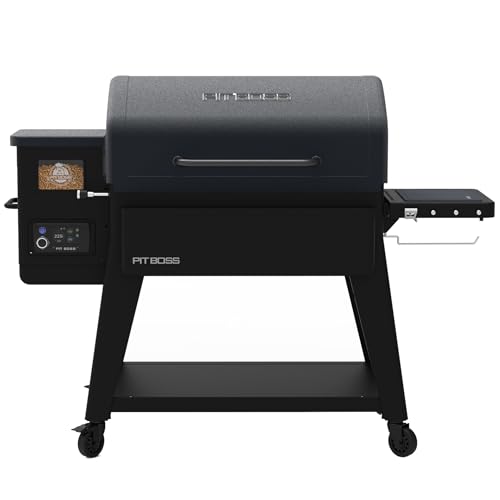
If auto feed exists to cook unattended, capacity is how much unattended cooking you get — and the Navigator 1600’s verified numbers are the largest in this guide: 1,593 square inches of cook space, a 30 lb hopper, a touchscreen controller, a flame broiler, a meat probe, and a listed range of 180°F to 500°F. It suits the event cook, the freezer filler and the household that hosts in dozens. It does not suit the small patio, physically or economically — heating this much steel for two burgers is a choice, not a necessity.
Strengths
- 1,593 square inches is the largest verified cook space in this guide
- 30 lb hopper matches the cabinet with real unattended runtime
- Touchscreen controller, flame broiler and probe complete the automation picture
Trade-offs
- Footprint and pellet appetite scale with the cabinet
- More steel and systems to clean after big cooks
- Touchscreen is one more electronic surface living outdoors
| Detail | Verified listing information |
|---|---|
| Cook space | 1,593 square inches (per Amazon listing title) |
| Hopper | 30 lb (per Amazon listing title) |
| Range | 180°F to 500°F, touchscreen control (per Amazon listing title) |
Scale tests an auto-feed system honestly. A big cabinet in wind asks the auger and controller for sustained, intelligent feeding — not bursts — and the Navigator’s pairing holds its line across the full rack stack, which is why Pit Boss can sell the flame broiler and the touchscreen as more than decoration. The broiler deserves its mention in an automation guide: it lets the same unattended machine finish with direct flame, closing the last gap between a pellet grill and a full outdoor kitchen.
Buy it when the headcount justifies it and the maintenance rhythm — ash, grease, pellet storage — fits your habits at scale. The worst auto-feed purchases are big systems bought for small lives; the best are big systems bought by big cooks. This one is unambiguously the latter’s machine, with the hopper and the controller to run its size without an attendant.
Best for: event cooks and large households automating big loads / Not suited for: small patios and two-person weeknight cooking
Check on Amazon — check the current price on Amazon and confirm the exact model name on the listing before ordering.

Masterbuilt Gravity Series 600 Charcoal Grill Smoker — Best Charcoal Auto Feed
Auto feed does not have to mean pellets. The Gravity Series 600 feeds charcoal instead: a GravityFed hopper lets fuel descend to the fire as it burns, under digital control with WiFi, across 600 square inches. The result is the combination offset lovers said was impossible — charcoal flavor with thermostat behavior. It suits the flavor-first cook who found pellet smoke too polite. It does not suit the pellet loyalist who values fuel convenience and clean storage over charcoal’s deeper voice; both positions are defensible, and this machine exists for one of them.
Strengths
- GravityFed hopper auto-feeds charcoal — no auger, no pellets
- Charcoal smoke depth that pellet systems cannot match
- Digital control with WiFi brings thermostat manners to charcoal
Trade-offs
- Charcoal fuel is messier to store and handle than pellets
- Hopper-fed charcoal still asks for ash management on a rhythm
- 600 square inches is mid-size beside the big pellet cabinets
| Detail | Verified listing information |
|---|---|
| Cooking area | 600 square inches (per Amazon listing title) |
| Feed | GravityFed charcoal hopper (per Amazon listing title) |
| Control | Digital with WiFi technology |
The gravity mechanism is elegantly stupid-proof: charcoal sits in a vertical hopper, burns at the bottom, and fresh fuel settles as the fire consumes it, while a fan and controller meter the air. There is no auger to jam and no pellet quality to police — the two classic auto-feed failure modes simply do not exist here. What remains is the discipline charcoal always asked: decent lump or briquettes, ash emptied on schedule, and a hopper topped before long cooks.
Flavor is the reason to accept that discipline. Charcoal smoke has a weight and a bark-building character that defines traditional barbecue, and getting it with set-and-forget control was, for decades, a contradiction. The Gravity 600 resolves the contradiction at a household size and price of attention. In an auto-feed guide dominated by augers, it is the essential alternative — proof that feeding the fire automatically is an idea bigger than any one fuel.
Best for: charcoal loyalists who want automated temperature control / Not suited for: pellet fans who prize fuel cleanliness above smoke depth
Check on Amazon — check the current price on Amazon and confirm the exact model name on the listing before ordering.

recteq DualFire 1200 Pellet Smoker Grill — Best Dual Chamber
The DualFire 1200 rethinks what one auto-feed machine should be: dual chambers — one for hot-and-fast cooking, one for low-and-slow — fed automatically under Wi-Fi control. A brisket can smoke on one side while burgers sear on the other, which is two cooks that normally need two machines or one long compromise. It suits the entertainer whose menus refuse to pick a lane. It does not suit the single-purpose smoker, who would be paying for a second chamber that hosts air. Judge it by your actual Saturdays.
Strengths
- Dual chambers run hot-and-fast and low-and-slow simultaneously
- Auto feed with Wi-Fi control supervises both cooks from one app
- Eliminates the second-grill purchase for mixed menus
Trade-offs
- Two chambers mean two zones to clean and learn
- Premium concept pricing over single-chamber rivals
- Entertainer-sized footprint demands a permanent patio home
| Detail | Verified listing information |
|---|---|
| Chambers | Dual: hot-and-fast + low-and-slow (per Amazon listing title) |
| Feed | Automatic pellet feed, Wi-Fi control |
| Format | Wood pellet smoker grill, 1200 class |
Mixed menus are the unspoken tax on single-chamber cooking: the ribs want 225 and the corn wants a ripping grate, so something waits, dries or compromises. Splitting the fire’s work across two purpose-built chambers removes the tax at the hardware level. The auto-feed system matters more here, not less — supervising two cooks by hand is a job, while supervising them through one app with two zone readouts is a pleasure.
recteq’s build reputation — heavy steel, tight tolerances — suits a machine with this many doors and seals to keep honest. It is a specialist’s flagship: buyers who regularly cook mixed menus will wonder how they managed without it, and buyers who smoke one cut at a time should spend the same money on capacity or precision instead. The badge says it plainly — best dual chamber — and the chamber count is either your problem solved or your money wasted. You know which household you are.
Best for: entertainers cooking mixed hot and low menus at once / Not suited for: single-cut smokers who never run two cooks together
Check on Amazon — check the current price on Amazon and confirm the exact model name on the listing before ordering.
Z GRILLS 2026 Upgrade Pellet Grill, 28 lb Hopper — Best PID Value
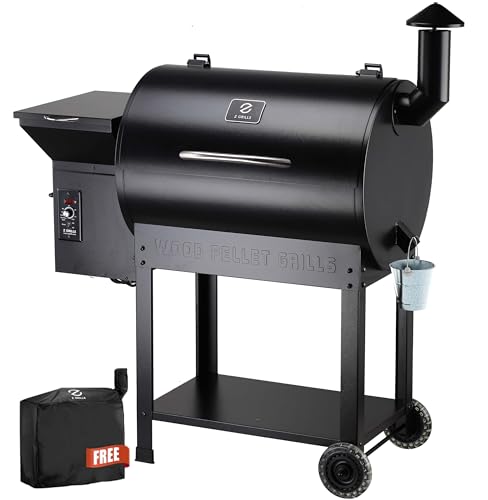
Z GRILLS’ 2026 upgrade puts the auto-feed essentials in one value-minded package: PID auto temperature control, a 28 lb hopper, 697 square inches of cooking area, 8-in-1 versatility, and a grill cover included rather than upsold. The hopper-to-size pairing is the story — 28 lb of fuel for a mid-size cabinet is genuine overnight autonomy. It suits the buyer who wants the automation core done right without flagship pricing. It does not suit the app maximalist; the value here lives in control quality and fuel capacity, not in the deepest connected ecosystem.
Strengths
- PID auto temperature control holds the line cheaper controllers wander from
- 28 lb hopper gives a mid-size grill true long-cook autonomy
- Cover included — the accessory every owner needs, in the box
Trade-offs
- Connected features are present but not the deepest ecosystem here
- 697 square inches batches the largest party loads
- Younger brand support network than the legacy names
| Detail | Verified listing information |
|---|---|
| Cooking area | 697 square inches (per Amazon listing title) |
| Hopper | 28 lb (per Amazon listing title) |
| Control | PID auto temperature control; cover included |
Auto feed quality is mostly controller quality, because the auger is a simple machine taking orders. PID orders are the good kind: small, frequent, predictive adjustments that keep the fire in a narrow band instead of swinging around the set point. Pair that brain with a 28 lb hopper and the practical result is a grill you load on Friday evening and supervise by exception. Z GRILLS keeps landing on these value lists by spending on exactly this layer while rivals spend on badges.
The included cover is a small line item with a large meaning: outdoor electronics live longer covered, and a maker who bundles the cover is a maker thinking about year three. For buyers whose priority is unattended competence per dollar — the purest auto-feed question there is — this is the guide’s answer.
Best for: value buyers who want PID control and a big hopper / Not suited for: app-ecosystem maximalists
Check on Amazon — check the current price on Amazon and confirm the exact model name on the listing before ordering.

Traeger Pro 22 Pellet Grill & Smoker — Best Proven Feed System
Every auto-feed claim eventually answers to the Pro 22, because its feed system has run more unattended cooks than any rival’s. The verified listing: 572 square inches, an 18 lb hopper, a meat probe, 6-in-1 versatility and a 450°F maximum. It suits the buyer who ranks proven reliability above every newer feature — the automation you choose when the cook matters more than the spec sheet. It does not suit the connectivity shopper, since this classic configuration keeps its supervision local, by design and by price.
Strengths
- Feed system proven across the category’s largest installed base
- 18 lb hopper covers standard overnight smokes with margin
- 450°F top end keeps grilling duty honest alongside smoking
Trade-offs
- No WiFi in this classic configuration
- 572 square inches is mid-size for crowd cooking
- Newer rivals offer PID and apps at similar money — with shorter track records
| Detail | Verified listing information |
|---|---|
| Cooking area | 572 square inches (per Amazon listing title) |
| Hopper | 18 lb (per Amazon listing title) |
| Top temperature | 450°F max, meat probe included |
There is a kind of evidence no launch event can manufacture: a decade of owners, parts on shelves, and every failure mode discovered, documented and engineered against. The Pro 22’s auto feed carries that evidence. Its auger, fire pot and controller are not the newest designs in this guide; they are the most known, which for a machine you trust with a brisket at 2 a.m. is the specification that outranks novelty.
Choose it when the cook is the point — a family brisket, a competition practice run, a holiday where the meat cannot be the variable. The newer machines here offer more features, and this guide recommends them for the buyers those features serve. But the proven feed system is a feature too, the one that only time can issue, and the Pro 22 holds it outright.
Best for: reliability-first buyers automating important cooks / Not suited for: connectivity-first buyers who want app supervision
Check on Amazon — check the current price on Amazon and confirm the exact model name on the listing before ordering.
Comparison Table
Hopper pounds against cooking area is the auto-feed ratio that matters: it tells you how long the machine can be trusted alone.
| Pick | Badge | Key spec | Best for |
|---|---|---|---|
| Traeger Woodridge Pro Pellet Grill & Smoker | Best Overall Auto Feed | 970 sq in, auto auger, Super Smoke | hands-off cooks who want flagship automation and smoke flavor |
| Pit Boss 1600 Navigator Series Pellet Grill | Best Capacity Auto Feed | 1,593 sq in, 30 lb hopper, touchscreen | event cooks and large households automating big loads |
| Masterbuilt Gravity Series 600 Charcoal Grill Smoker | Best Charcoal Auto Feed | 600 sq in, GravityFed charcoal, WiFi | charcoal loyalists who want automated temperature control |
| recteq DualFire 1200 Pellet Smoker Grill | Best Dual Chamber | Dual chambers, Wi-Fi auto feed | entertainers cooking mixed hot and low menus at once |
| Z GRILLS 2026 Upgrade Pellet Grill, 28 lb Hopper | Best PID Value | 697 sq in, PID, 28 lb hopper | value buyers who want PID control and a big hopper |
| Traeger Pro 22 Pellet Grill & Smoker | Best Proven Feed System | 572 sq in, 18 lb hopper, proven auger | reliability-first buyers automating important cooks |
How Auto Feed Actually Works — Augers, Gravity and Control
A pellet auger is a screw conveyor: the controller turns it in measured bursts, dropping pellets into a fire pot where a fan and igniter keep them burning. The controller’s quality is the system’s quality — basic units cycle on wide temperature swings, while PID controllers make small, predictive adjustments that hold a narrow band. Everything else — jams, flameouts, swings — is a failure of fuel quality, cleanliness or that control loop, in roughly that order of frequency.
Gravity feed removes the screw entirely. Charcoal stacked in a vertical hopper burns at its base and settles downward as it is consumed, while the controller meters air with a fan. The fuel is charcoal, the flavor is charcoal, and the failure list shrinks to ash management and fuel quality. Choosing between the systems is choosing a fuel and a flavor first, and a mechanism second — which is why this guide includes both and refuses to pretend one has won.
Sizing the Hopper to Your Longest Cook
Hopper pounds translate to hours through temperature and weather: smoking heat sips, grilling heat drinks, and winter wind taxes everything. As a planning rule from the verified listings here, an 18 lb hopper covers a standard overnight smoke, 28 to 30 lb hoppers add genuine margin for big cabinets and cold nights, and the 40 lb class exists for event cooking. Buy for your longest regular cook plus a margin you will actually use — an oversized hopper left full through a humid month is a pellet-storage problem wearing a feature’s clothes.
The companion discipline is fuel storage. Pellets live sealed and dry, off the floor; charcoal the same. Auto feed automates the fire, not the housekeeping, and the owners who understand that distinction are the ones whose systems feed faithfully for years. The machine’s promise is your time back — the small print is a vacuum, a dry bin and a cover.
How to Set Up an Auto Feed Smoker for an Unattended Cook
Prepare the system, not just the meat. Vacuum the fire pot or clear the ash path, confirm the auger turns freely or the gravity hopper settles, and load fuel that is dry and fresh — checking the hopper’s bottom for dust and crumbles that signal a tired bag. Ignite, let the smoker stabilize at temperature for a full quarter hour, and verify your probes read sanely before the meat goes on. Unattended cooking is earned in this half hour, not during the night.
Then set the supervision you actually have: app alerts if the model offers them, a probe alarm if it does not, and a hopper level that covers the cook with margin. Walk away — that is the point — but walk away from a system you prepared. In the morning, run the shutdown cycle, let the machine cool, and note the fuel used; three cooks of notes teach you your own hopper’s true hours better than any listing can.
Auto Feed vs the Stick Burner: A Respectful Comparison
The stick burner — the offset, tended by hand with splits of wood — is auto feed’s ancestor and its permanent critic, and the comparison deserves respect in both directions. The offset’s smoke is the deepest in barbecue, its bark the benchmark, and its process a craft that many cooks love for its own sake; auto feed does not beat it at its own altar, and this guide’s gravity-fed pick exists precisely because some of that altar can be automated without being abandoned. What auto feed beats, decisively, is the offset’s cost in human hours — and for households whose Saturdays are spoken for, that cost is the whole decision.
The middle truth is that the two machines produce different cooks, not ranked ones. An offset brisket eaten beside an auto feed brisket shows its lineage in the bark and the smoke ring’s depth; the auto feed brisket shows its lineage in the cook, who is rested, present and hosting instead of fire-tending in hourly rotations. Tables vote for the second more often than competitions do, which is why auto feed owns the home market the offset still owns in legend.
Many serious households resolve the comparison by owning both across time: the auto feed system for the calendar’s reality, the offset for the ceremonial cooks when tending is the treat. If you can only own one, this guide’s counsel is to count your free Saturdays honestly and buy the machine that fits them — the best auto feed smoker is the one whose cooks actually happen, and a legendary offset that runs twice a year is, by the only metric that feeds anyone, the worst smoker in this entire cluster.
Auto Feed in Bad Weather: Rain, Wind and the Cold Snap
Weather is auto feed’s final examination, and the systems in this guide sit it differently. Wind is the common tax: it strips heat from the cabinet, the controller answers with fuel, and hopper hours shrink on every machine — the defense is placement, a lee wall or windbreak turning a gale into a breeze at the grill’s back. Rain tests the electronics and the fuel: covered grills with dry hoppers shrug off a shower, while an open hopper lid in a downpour writes next week’s jam story in advance. The owners who cook through weather keep the cover discipline this guide repeats — cover on between cooks, hopper closed during them, connections dry.
Cold is the honest season. Every auto feed system burns more to hold temperature against winter air, pellet and charcoal alike, and cook times stretch at the margins. Insulation help — a welding blanket rated for the purpose over a pellet cabinet, the maker’s own jacket where offered — returns a surprising share of the tax. What cold does not do is break the proposition: an auto feed smoker holding 225 degrees in January while its owner watches the game is the category’s finest advertisement, and the systems recommended here, maintained on the guide’s rhythm, deliver it winter after winter.
The Auto Feed Glossary: Terms That Decide Purchases
A short glossary, because this category’s vocabulary is where purchases are won and lost. Auger: the screw that meters pellets; its motor and its jam history are the system’s biography. Fire pot: the small crucible where pellets burn; its cleanliness is the cook’s destiny. PID: a controller that adjusts in small, predictive steps instead of wide swings; the difference is visible in any temperature graph. Hopper: the fuel reservoir, judged in pounds and in proportion to the cabinet it feeds. Flameout: the fire dying mid-cook, almost always an ash or fuel story. Stall: the meat’s evaporative plateau, which no machine causes and every good machine out-waits.
GravityFed: Masterbuilt’s name for a hopper that settles charcoal to the fire without moving parts. WiFIRE, Super Smoke and their siblings: brand names for supervision and firing strategies, worth having, never a substitute for the fundamentals above. Read any auto feed listing with this glossary open and the marketing separates itself from the machinery in about a minute — the machinery being, as this entire guide has argued, the part that decides whether your Saturdays come back to you.
Common Buying Mistakes
Trusting auto feed before verifying it is the beginner’s error. Run your first long cook attended, graph the temperatures, and learn your machine’s habits before the overnight brisket that matters. Automation earns trust by demonstration, not by brochure.
Starving the system with bad fuel is the second. Damp pellets and dusty hopper bottoms cause the jams and flameouts that owners blame on augers. Dry storage and a vacuum are not accessories to auto feed; they are half of it.
Third, sizing by fantasy: the giant cabinet bought for one annual party, run half-empty all year at double the fuel cost, or the compact hopper expected to survive a winter overnight. The listings in this guide state their numbers plainly — believe them, and buy the size your calendar describes.
Final Recommendation
The Woodridge Pro is the complete automation package; the Navigator 1600 automates at event scale; the Gravity 600 proves charcoal can feed itself; the DualFire runs two cooks on one system; the Z GRILLS upgrade is the PID-and-hopper value; and the Pro 22 remains the proven original. Any of them returns your Saturdays — choose by fuel, size and how much supervision you want to keep. Check the current price on Amazon for your pick.
More from the cluster: Best Autofeed Smokers, Best And Worst Pellet Smokers, Best And Worst Electric Smokers, Best Affordable Pellet Smokers, Best Apple Wood For Smokers, Best 40 Inch Electric Smokers.
Auto Feed and the Overnight Cook: A Walk-Through
The overnight brisket is auto feed’s defining use case, so walk it once in detail. Evening: the smoker is cleaned, the hopper loaded with margin, the brisket trimmed and seasoned and resting cold. The grill ignites, stabilizes, and takes the meat at an hour chosen so the stall lands in the small hours and the finish lands at a civilized morning. The cook sets the app alerts — or the probe alarm — and goes to bed with the particular calm of a person who has prepared a system rather than lit a fire and hoped.
Night: the controller makes its thousand small decisions. Wind rises and the feed compensates; the brisket stalls and the temperature line does not care; the hopper descends at the rate your notes from rehearsal cooks predicted. Nothing about the night is dramatic, which is the entire point — drama in barbecue belongs in the slicing, not the supervising. The owner sleeps the sleep of the well-instrumented, waking once, perhaps, to an alert that says the cook has entered its final approach.
Morning: wrap or hold, rest, and the peculiar pride of a breakfast-time brisket that asked nothing of the night. Every pick in this guide can run some version of this night; they differ in capacity, fuel and how much of the supervision they carry. The worst auto feed smokers fail this exact story — at hour nine, in the dark, silently — which is why this guide’s criteria were feed reliability, controller quality and hopper honesty, in that order, from the first paragraph.
The Economics of Auto Feed: Fuel, Time and the Real Bill
Auto feed’s honest accounting starts with fuel. Pellet consumption at smoking temperatures is modest and predictable; at grilling temperatures it multiplies, and winter multiplies it again. Charcoal gravity systems burn their fuel at rates set by the same physics in different packaging. Either way, the household that smokes weekly spends a real, budgetable amount on fuel each season — less than the meat it cooks by a wide margin, and more than the nothing that stick-burners romanticize while splitting free wood with expensive weekends.
Time is the other side of the ledger, and it is where auto feed wins without argument. A traditional offset brisket consumes a skilled person’s day; an auto feed brisket consumes that person’s half hour of setup and their attention in glances. Whether that trade profits you depends on what your hours are worth and whether tending fire is your hobby or your obstacle — the question this guide has asked in every review, because it is the only economic question in the category that matters.
The third line is longevity. A well-kept auto feed system — vacuumed, covered, fed dry fuel — serves for years, amortizing its price across hundreds of cooks. A neglected one becomes the category’s cautionary tale inside two seasons. The purchase price is the smallest number in the whole accounting; the rhythm is the largest. Buy the system whose rhythm you will actually keep, and the economics take care of themselves.
Decide by fuel and trust: Traeger Woodridge Pro Pellet Grill & Smoker for the complete pellet package, Masterbuilt Gravity Series 600 Charcoal Grill Smoker for charcoal that feeds itself, and Traeger Pro 22 Pellet Grill & Smoker for the proven original. Check the price on Amazon on the system you will actually keep. — check price on Amazon.
A note on noise and neighbors, filed under practical ownership: an auto feed smoker’s fan and auger are modest sounds, but an overnight cook runs them within earshot of bedroom windows — yours and, in dense neighborhoods, other people’s. Placement softens most of it: off the shared fence line where possible, on a surface that does not drum, with the fan’s exhaust aimed at your own garden. The courtesy costs nothing at setup and buys the overnight cook its social license, which is a real feature in suburbs where smoke itself already files a presence.
Frequently Asked Questions
What does auto feed mean in a smoker?
The smoker meters its own fuel to hold temperature: a motor-driven auger feeds pellets into a fire pot, or a gravity hopper settles charcoal down to the fire as it burns. A controller decides how much fuel the fire needs. You load the hopper and set the temperature; the system does the tending that a traditional smoker demands from a person.
Are auto feed smokers really unattended?
Within the limits of preparation, yes for long stretches: a clean fire pot, dry fuel and a hopper sized to the cook let a good system run overnight with only app or probe supervision. Unattended does not mean unprepared — the half hour of setup in this guide is what the night runs on.
Pellet auger or gravity charcoal — which auto feed is better?
They automate different fuels and flavors. Pellets are cleaner to store and handle, with milder smoke; gravity charcoal delivers traditional charcoal depth with no auger to jam. Choose by the flavor you want and the fuel you prefer to manage; both systems in this guide hold temperature faithfully when maintained.
How long will a hopper run without refilling?
By temperature and weather more than by brand. The verified hoppers here run from 18 lb to the 30 lb class on pellet models; at smoking temperatures the larger hoppers cover the longest home cooks with margin, while grilling heat and winter wind shorten every figure. Top up before a long cook rather than testing the bottom of the hopper.
What causes an auto feed smoker to jam or flame out?
Usually fuel and ash, not machinery: damp or crumbling pellets bridge and jam augers, and an ash-choked fire pot smothers the fire. Dry storage, a vacuum rhythm for the pot, and fresh fuel prevent nearly all of it. Genuine mechanical failures exist but are the minority — and are why this guide weighs the maker’s parts support.
Can an auto feed smoker also grill?
Most can, within their listed ranges — several picks here reach 450°F to 500°F, and features like flame broilers and dual chambers extend real grilling and searing. Check the verified range in each review: a smoker listed to 500°F grills honestly, while a low-maximum model is a smoker only, whatever the photos suggest.
Can auto feed smokers be left running while I am away from home?
Manufacturers design these systems for supervised-at-a-distance cooking — app alerts, probe alarms — and owners routinely run them while at work or asleep. Prudent practice keeps the smoker on a non-combustible surface with clearance, the system freshly maintained, and notifications on. Local rules and your own insurer’s view govern the final call; the machine’s job is to make the cook boring, and boring still likes an audience within reach.
Do auto feed smokers use a lot of electricity?
Very little. The auger motor, fan and controller together draw a fraction of what an electric cabinet’s heating element draws — the fuel provides the heat. An overnight pellet cook’s electricity is a rounding error beside its pellets, which is one of auto feed’s quiet economic virtues.


