Disclosure: airfryerkitchensupply.com is reader-supported. When you buy through links on our site, we may earn an affiliate commission at no extra cost to you.
Where to buy
The best asian stand mixers answer a specific need: the doughs of Asian home baking — mantou and bao buns, hand-pulled-style noodle doughs, dumpling wrappers, mochi, milk bread and mooncake skins — are stiffer, lower-hydration and harder on a mixer than Western cake batters, and the machines built by Asian brands and for Asian kitchens are designed around that work. That means powerful kneading, bowls sized for family batches, and in the standout picks, a feature Western mixers rarely offer: built-in fermentation, so the same machine kneads the dough and proofs it at a controlled warm temperature. All six picks below were verified against their Amazon listings, so you can check the current price on Amazon from each review.
- Joydeem 7.4Qt Electric Dough Maker with Fermentation, HMJ-A701 — Best Overall. Check the current price on Amazon.
- Aucma Stand Mixer, 6.5-QT 660W Tilt-Head (Black) — Best Budget Stand Mixer. Check the current price on Amazon.
- Kitchen in the box Stand Mixer, 8.5 QT 900 Watt Heavy Dough Mixer — Best for Big Batches. Check the current price on Amazon.
- Kitchen in the box Stand Mixer, 3.2Qt Small Electric Food Mixer — Best Small. Check the current price on Amazon.
- VIVOHOME Stand Mixer, 6-Quart Tilt-Head (Black) — Best Mid-Range All-Rounder. Check the current price on Amazon.
- Electric Dough Mixer with Ferment Function, 6.5QT (Onyx Black) — Best Ferment Alternative. Check the current price on Amazon.
The best asian stand mixers are not simply stand mixers that happen to be sold in Asia — they are machines shaped by what Asian home bakers actually make. A Western stand mixer’s classic workload is cake batter, cookie dough and whipped cream: soft, forgiving mixtures. The Asian home workload runs the other way. Mantou and steamed bun doughs are firm. Noodle doughs are famously stiff — low hydration, almost crumbly before they come together — and they punish weak motors and flexing frames. Milk bread and tangzhong doughs need long, patient kneading to develop their signature pull. And proofing matters year-round, in kitchens that may be cold in winter and air-conditioned in summer, which is why the standout category here is the dough maker with a fermentation function: knead and proof in one bowl, at one controlled temperature.
This guide therefore ranks two families together, honestly labeled. The first is the dedicated dough machines from Asian brands — Joydeem above all — built specifically for kneading and fermenting the doughs named above. The second is the full stand mixers from Asian value brands — Aucma, Kitchen in the box, VIVOHOME — which bring the familiar tilt-head, beater-and-whisk versatility at prices the Western heritage brands do not approach, and which handle Asian doughs well within their batch limits. Which family is right depends on whether your kitchen’s center of gravity is dough or everything. Both are represented here at several sizes, because Asian home batches range from a couple’s dumpling wrappers to a festival’s worth of buns.
In this guide
Quick Picks
Best Overall: Joydeem 7.4Qt Electric Dough Maker with Fermentation, HMJ-A701 — The category’s defining idea, done well: powerful kneading, then the same bowl holds the dough at proofing temperature, with modes for summer and winter. Check on Amazon
Best Budget Stand Mixer: Aucma Stand Mixer, 6.5-QT 660W Tilt-Head (Black) — The famous budget answer: a big bowl, a real dough hook, whip and beater, and 660W of kneading for the price class the heritage brands ignore. Check on Amazon
Best for Big Batches: Kitchen in the box Stand Mixer, 8.5 QT 900 Watt Heavy Dough Mixer — When the batch is the point — a festival’s worth of buns, dough for a week of noodles — this is the big bowl and the heavy-duty motor to knead it. Check on Amazon
Best Small: Kitchen in the box Stand Mixer, 3.2Qt Small Electric Food Mixer — The compact counterpoint: a real stand mixer — hook, beater and whisk included — sized for two-person doughs and small kitchens. Check on Amazon
Best Mid-Range All-Rounder: VIVOHOME Stand Mixer, 6-Quart Tilt-Head (Black) — The steady middle of the list — a 6-quart tilt-head that covers the family repertoire without specializing or straining. Check on Amazon
Best Ferment Alternative: Electric Dough Mixer with Ferment Function, 6.5QT (Onyx Black) — The ferment concept at a mid-size point: a 6.5-quart dough maker with a stainless bowl, removable lid and simple knob control. Check on Amazon
How These Picks Were Chosen
We chose for dough first, because that is the category’s reason to exist. Motor claims in this market are marketing-friendly, so we weighted the things that predict kneading success: bowl capacity matched to realistic flour loads, low-speed torque behavior as described by the designs, the presence of a proper dough hook, and — for the dedicated machines — the knead-and-ferment combination that defines the category’s best idea. A machine that can knead a stiff dough and then hold it at proofing temperature removes the two most failure-prone steps of bun-making in one purchase, and the Joydeem picks earned the top of this list on exactly that merit.
Versatility was the second axis, and it is where the tilt-head stand mixers answer back: a beater and whisk turn the machine from a dough specialist into the kitchen’s general mixer for batters, fillings, whipped toppings and the thousand small jobs between festivals. Every product was verified by brand and model, with titles matched before linking, as throughout this program. We also kept the honesty rule this category needs: these are value and specialist brands, not heritage names, so the guide judges them on the work they demonstrably do — capacity, power class, functions — rather than on badge prestige in either direction.
We also applied the test of the second year. A mixer purchase in this category is justified by repetition — the weekly buns, the monthly festival, the daily noodles — so we favored machines whose designs serve repetition: bowls that wash easily, controls that become muscle memory, formats that store without a negotiation. A machine that is delightful twice a year and a burden the rest of the time fails that test whatever its specifications say. Every pick here is one a household can plausibly use weekly for years, and the reviews are written from that rhythm outward — because in this category, the best machine is not the most capable one, but the one that is still being reached for when the second year arrives.
The 6 Best Asian Stand Mixers

Joydeem 7.4Qt Electric Dough Maker with Fermentation, HMJ-A701 — Best Overall
Joydeem is a Chinese kitchen-appliance brand that has built its name on dough, and the HMJ-A701 is the machine that explains this entire category. It is a 7.4-quart electric dough maker whose second function is the inspired one: fermentation, with seasonal modes that adjust the proofing warmth for summer and winter kitchens. Anyone who has made mantou in a cold kitchen — dough sitting sullen and unrisen while dinner waits — understands immediately what this solves. The kneading is designed for the stiff, low-hydration doughs of buns, noodles and dumpling wrappers as much as for bread and pizza, and the capacity suits real family batches rather than demonstration quantities.
Strengths
- Knead-and-proof in one bowl removes the two hardest steps of bun-making
- Seasonal fermentation modes handle the cold-kitchen problem that stalls home bakers
- 7.4-quart capacity is sized for genuine family and festival batches
Trade-offs
- It is a dough specialist — no whisk-and-beater versatility for cakes and creams
- A large single-purpose machine needs a home in the kitchen
- Dough purists who proof by feel will use the ferment function as a tool, not an autopilot
Key specs: 7.4-quart electric dough maker with seasonal fermentation modes; kneading and proofing for pizza, bread and sourdough
The workflow is the revelation: flour, water, yeast in; the machine kneads to a smooth, elastic dough; without moving the dough anywhere, the ferment mode holds it at a steady warm proof until it has doubled, ready to shape. For steamed buns, where the proof is the difference between pillowy and dense, that controlled consistency turns a sometimes-recipe into an every-time recipe. It handles the Western doughs in its listing — pizza, bread, sourdough — with the same competence, but its heart is Asian: this is the machine a household buys when Sunday means buns, and it earns Best Overall by being the only pick that owns the whole process from flour to proof.
Best for: households whose baking centers on buns, breads and noodle doughs, especially in cold kitchens / Not suited for: bakers who need one machine for cakes, creams and dough alike — see the tilt-head picks
Check on Amazon — check the current price on Amazon before you buy.

Aucma Stand Mixer, 6.5-QT 660W Tilt-Head (Black) — Best Budget Stand Mixer
Aucma, a Chinese brand, built its reputation on a simple proposition: most of a premium stand mixer’s real-world performance, at a fraction of the price. This 6.5-quart tilt-head model is the proposition in full — a 660W motor, a stainless bowl sized for family batches, and the complete attachment trio of dough hook, wire whip and flat beater, so the same machine kneads bun dough on Sunday and whips cream on Saturday. For Asian home bakers it has become a default recommendation because its low speeds have the patience for dough work and its capacity matches the batch sizes of dumplings, buns and milk bread that define the workload.
Strengths
- Complete attachment set — dough, batter and whipping in one purchase
- 6.5-quart bowl and 660W motor cover family-size dough batches
- Value pricing that leaves budget for ingredients, steamers and the rest of the kitchen
Trade-offs
- Value-brand fit and finish — it feels like a workhorse, not a countertop jewel
- Very stiff noodle doughs should be made in smaller batches than the bowl suggests
- No fermentation function — proofing is still the kitchen’s job
Key specs: 6.5-quart tilt-head stand mixer, 660W, with dough hook, wire whip and beater
Used within its honest limits, this is a lot of mixer. The dough guidance that makes it succeed: keep flour loads moderate for stiff doughs, start every dough on the lowest speed until the flour is incorporated, and let the hook work in stretches rather than forcing pace with speed. For milk bread and bun doughs — the core Asian repertoire — it kneads to a proper windowpane with patience, and the tilt-head design makes the bowl and attachment changes that baking day demands genuinely easy. It is the pick for the baker who wants one machine for everything and whose budget is real, and its enormous owner base in exactly this role is the market’s own verdict.
Best for: budget-conscious bakers who want one versatile machine for doughs and everything else / Not suited for: commercial-volume bakers, or anyone who wants the knead-and-proof automation of the Joydeem
Check on Amazon — check the current price on Amazon before you buy.

Kitchen in the box Stand Mixer, 8.5 QT 900 Watt Heavy Dough Mixer — Best for Big Batches
Some baking days are not about a loaf; they are about production. Mooncake season, a dumpling party, a freezer being stocked with mantou for the month — those days are limited by bowl capacity and motor stamina, and this Kitchen in the box model is built to that brief: an 8.5-quart bowl, a 900W heavy-dough motor brief, ten speeds, and the tilt-head convenience and splash guard that big flour loads demand. It is the largest machine in this guide, aimed at the households whose Asian baking runs at family-and-festival scale, and at small-scale sellers whose home production has outgrown the standard bowl.
Strengths
- 8.5-quart capacity kneads batches the standard bowls can not attempt
- Heavy-dough design brief and 900W class suit stiff, large loads
- Ten speeds give low-speed control for dough and range for everything else
Trade-offs
- Size is real — this machine needs counter or storage commitment
- Big bowls are inefficient for small batches; a one-person dough still belongs in a smaller machine
- No fermentation function despite the dough focus
Key specs: 8.5-quart stand mixer, 900W heavy dough design, 10 speeds, tilt-head, with whisk, flat beater and splash guard
The honest way to use a machine this size is to respect both ends of its range. At the top end, it turns festival production from an all-day relay into a morning’s work, and its low speeds let a big stiff dough come together without the flour explosion that a splash guard then contains. At the bottom end, be realistic: a small noodle dough for two will ride around the big bowl un-kneaded, and owners of this machine usually keep the small-batch jobs for hand work or a compact second tool. Bought for the batches that justify it — and in the households this guide imagines, those batches come around with the calendar — it is the capacity pick that ends the ‘two batches, twice the time’ problem for good.
Best for: big families, festival bakers and home producers whose batches outgrew standard bowls / Not suited for: small households and small batches, where its size works against the dough
Check on Amazon — check the current price on Amazon before you buy.
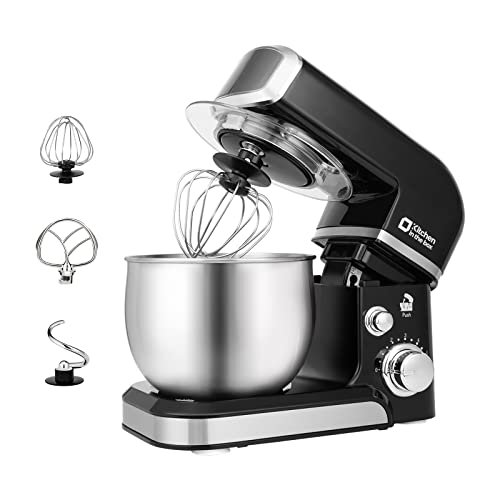
Kitchen in the box Stand Mixer, 3.2Qt Small Electric Food Mixer — Best Small
Not every Asian kitchen is a festival kitchen. For the couple making dumpling wrappers for two, the small apartment where counter space is negotiated, or the daily small batch of noodles for tonight’s dinner, the big machines are the wrong tool — and this 3.2-quart Kitchen in the box model is the right one. It keeps the full stand mixer architecture in miniature: six speeds, a tilt design light enough to move with one hand, and the complete trio of egg whisk, dough hook and flat beater, so nothing about the small format forces a compromise in what can be made — only in how much of it at once.
Strengths
- Genuinely compact and portable — it lives in a cupboard, not on the counter
- Full attachment trio despite the size: dough, batter and whipping all covered
- Small bowls knead small doughs properly, which big bowls can not
Trade-offs
- 3.2 quarts is a hard ceiling — family batches mean multiple rounds
- Lightweight frame walks a little under stiff doughs; a steadying hand is part of the technique
- Not the machine for festival production or heavy daily duty
Key specs: 3.2-quart small stand mixer, 6 speeds, portable lightweight design, with egg whisk, dough hook and flat beater
Its finest work is the daily rhythm: a wrapper dough in the morning, a small milk bread for the weekend, egg whites for a cake that serves four. Owners consistently discover that a small mixer gets used more than a big one precisely because it asks so little — out of the cupboard, onto the counter, washed and away — and in small households that frequency is worth more than capacity. Pair it with the honest expectation that celebrations will be batched in rounds, and it is the most livable machine in this guide for the kitchens most people actually have.
Best for: couples, small kitchens, beginners and daily small-batch bakers / Not suited for: families and festival bakers, whose batches will outgrow it immediately
Check on Amazon — check the current price on Amazon before you buy.

VIVOHOME Stand Mixer, 6-Quart Tilt-Head (Black) — Best Mid-Range All-Rounder
VIVOHOME’s 6-quart tilt-head mixer is the guide’s middle path: family-sized capacity, the familiar tilt-head format, and a generalist brief that suits kitchens where the mixer must do a bit of everything — bun doughs on the weekend, batters and fillings through the week, whipped toppings when the occasion calls. It sits between the Aucma’s budget aggression and the big Kitchen in the box’s production focus, and for many households that middle is exactly the point: one machine, honestly sized, that does not ask the kitchen to organize itself around either a bargain or a beast.
Strengths
- 6-quart capacity is the family sweet spot for doughs and batters
- Tilt-head format keeps bowl and attachment handling easy on baking days
- Generalist brief suits mixed Asian and Western repertoires equally
Trade-offs
- A generalist’s compromise — dedicated dough households will eventually want the Joydeem’s ferment function
- Mid-range in every sense: it wins no single category outright
- Stiff noodle doughs still deserve moderate batch discipline
Key specs: 6-quart tilt-head kitchen mixer with bowl
The case for this machine is the shape of a real week. A mixer in an Asian home kitchen is not only a dough machine: it is mixing dumpling fillings, whipping the cream for a fruit cake, beating the batter for castella, and then kneading Sunday’s buns. A generalist with a family-sized bowl does all of that without a second thought, and its tilt-head practicality shows on the days when the bowl comes off and on a dozen times. If the Joydeem is the specialist’s scalpel and the big Kitchen in the box is the production line, this is the kitchen’s everyday knife — and most kitchens, most weeks, reach for the everyday knife.
Best for: families wanting one honest all-rounder for a mixed baking repertoire / Not suited for: dough specialists who will miss fermentation, or producers who will miss capacity
Check on Amazon — check the current price on Amazon before you buy.

Electric Dough Mixer with Ferment Function, 6.5QT (Onyx Black) — Best Ferment Alternative
This 6.5-quart dough maker is the second expression of the category’s defining idea — kneading and fermentation in one machine — in a slightly smaller, simpler format: a 304 stainless steel bowl, a removable lid that makes loading and cleaning straightforward, and knob control instead of a panel of programs. For bakers who have already decided that knead-and-proof is the workflow they want, it offers the same liberation as the Joydeem — dough mixed and held at proofing warmth in a single vessel — sized for the household whose batches run a notch smaller, and controlled with a directness that some bakers honestly prefer to seasonal auto-modes.
Strengths
- Ferment function delivers the category’s key workflow: knead, then proof in place
- 304 stainless bowl and removable lid make cleaning and handling easy
- Knob control is direct and learnable in one session
Trade-offs
- A less established name than Joydeem — buy it for the format and functions, not the badge
- Mid-size capacity will not stretch to festival batches
- Dough-only brief: no beater-and-whisk versatility for the rest of baking
Key specs: 6.5-quart stand dough maker with ferment function, 304 stainless steel bowl, removable lid and knob control
Its argument is focus at a friendlier scale. The 6.5-quart bowl matches the standard family bun batch, the ferment function removes the cold-kitchen lottery from proofing, and the simple control scheme means the machine disappears into the routine — turn, wait, shape, steam. It makes most sense for the baker who looked at the Joydeem, agreed with the concept, and wanted it in a slightly smaller footprint and a simpler interface. Between the two ferment machines, the choice is capacity and control philosophy; the workflow they unlock — and the buns that result — is the same, and it is the workflow this category exists to sell.
Best for: mid-size households sold on knead-and-proof who prefer simple controls / Not suited for: bakers who want one machine for dough and cakes alike
Check on Amazon — check the current price on Amazon before you buy.
Comparison Table
| Pick | Badge | Key spec | Best for |
|---|---|---|---|
| Joydeem 7.4Qt Electric Dough Maker with Fermentation, HMJ-A701 | Best Overall | 7.4-quart electric dough maker with seasonal fermentation modes; kneading and proofing for pizza, bread and sourdough | Bun, bread and noodle doughs — knead and proof in one machine |
| Aucma Stand Mixer, 6.5-QT 660W Tilt-Head (Black) | Best Budget Stand Mixer | 6.5-quart tilt-head stand mixer, 660W, with dough hook, wire whip and beater | A full stand mixer — doughs, batters and whipping — at a value-brand price |
| Kitchen in the box Stand Mixer, 8.5 QT 900 Watt Heavy Dough Mixer | Best for Big Batches | 8.5-quart stand mixer, 900W heavy dough design, 10 speeds, tilt-head, with whisk, flat beater and splash guard | Festival batches and big families — the largest dough capacity in this guide |
| Kitchen in the box Stand Mixer, 3.2Qt Small Electric Food Mixer | Best Small | 3.2-quart small stand mixer, 6 speeds, portable lightweight design, with egg whisk, dough hook and flat beater | Couples, small kitchens and daily small batches |
| VIVOHOME Stand Mixer, 6-Quart Tilt-Head (Black) | Best Mid-Range All-Rounder | 6-quart tilt-head kitchen mixer with bowl | A middle path: family capacity and everyday versatility without the flagship price |
| Electric Dough Mixer with Ferment Function, 6.5QT (Onyx Black) | Best Ferment Alternative | 6.5-quart stand dough maker with ferment function, 304 stainless steel bowl, removable lid and knob control | Knead-and-proof devotees who want the Joydeem idea in a mid-size format |
How to Choose the Best Asian Stand Mixers for Your Baking
Start with your dough, honestly described. If your baking is dominated by stiff, low-hydration doughs — noodles, dumpling wrappers, firm bun doughs — and by proof-sensitive recipes like mantou, the dedicated dough makers are your family: the Joydeem HMJ-A701 at the full family size, or the 6.5-quart ferment model at the mid size. Their kneading is designed for resistance and their fermentation removes proofing from the list of things that can go wrong. If your baking is a repertoire — doughs plus batters, fillings, whipped creams and cakes — the tilt-head stand mixers are your family, and the choice inside it is capacity: 3.2 quarts for couples and small kitchens, 6 to 6.5 for families, 8.5 for production.
Second, respect the flour-load rule, which matters more with Asian doughs than with any other kind: a mixer’s comfortable flour load for a stiff dough is well below what its bowl volume suggests. Stiff dough climbs, strains and heats a machine in ways batter never does. The practical habit is to knead stiff doughs in the load the machine handles calmly — you will hear it in the motor’s voice — and to split a festival batch into two calm loads rather than one heroic one, unless you have bought the big-batch machine precisely to avoid that. Every machine in this guide will reward that respect with years of service; every machine in the category punishes its absence.
Third, decide how much the fermentation function is worth to your kitchen, because it is the category’s true dividing line. In a warm, stable kitchen with an experienced baker, proofing is a bowl, a towel and patience — free. In a cold winter kitchen, an air-conditioned apartment, or a household where buns must be ready at a predictable hour, controlled fermentation is the difference between a recipe that works on weekends and one that works on demand. Price that difference honestly against your own kitchen, and the choice between the guide’s two families usually makes itself.
Dough Technique: Getting the Most From Any of These Machines
Low and slow is the universal rule. Always start a dough at the lowest speed until the flour is fully incorporated — this prevents the flour cloud that coats new kitchens — and knead at low speed throughout: dough development is about time and folding, not violence. For stiff noodle and wrapper doughs, expect an ugly beginning; the mass looks dry and crumbly before it comes together, and the correct response is patience and, if needed, water added by the teaspoon, never by the splash. Resting is a technique, not a delay: a ten-minute rest mid-knead lets flour hydrate and gluten relax, and doughs that seemed impossible return to the hook transformed.
Learn the windowpane test, because it is how you know a bun or milk bread dough is done: stretch a small piece gently between your fingers, and a properly developed dough stretches into a thin, translucent membrane without tearing. Under-developed dough tears immediately; over-worked dough — rarer, and mostly a risk with long machine kneading — turns slack and sticky. For steamed buns, err a touch under rather than over, because the shaping and second proof continue the development. And oil the bowl or the dough surface lightly before proofing, in the machine’s ferment mode or out of it: a dried skin on the dough is the small, common tragedy of home bun-making, and it is entirely preventable.
Care and Longevity for Value and Specialist Machines
These machines reward simple care. Wash bowls and attachments promptly — dried dough is concrete’s cousin — and dry the bowl before storage so the stainless stays bright. Never immerse the machine body; a wipedown is all it wants. Give motors their rest on marathon days: between big loads, a few minutes of cool-down keeps a value machine’s motor in its comfort zone, and a machine that is never pushed to thermal distress is a machine that lasts. Store attachments in the bowl, keep the cord loosely coiled rather than tightly wound, and the everyday disciplines are complete.
One expectation to set honestly: the brands in this guide compete on capability per price, and their long-term support ecosystems are thinner than the heritage Western brands’. That is the trade the whole category makes, and it is usually a good one — the machines cost a fraction as much and do work the heritage machines do not attempt, fermentation above all. Buy them as the hard-working tools they are, keep the purchase records, treat them with the mechanical sympathy described above, and they will repay the household in the only currency that matters here: years of buns, noodles and breads that come out right.
The Asian Dough Repertoire, Mapped to the Machines
It helps to match the repertoire to the equipment plainly. Mantou and bao: any machine in this guide kneads the dough; the ferment machines then proof it in place, which is why they top the list for bun households. Noodle doughs: the stiffest test in the repertoire — favor the dough makers’ low-speed patience or the big Kitchen in the box’s stamina, keep loads moderate everywhere, and remember that a rest mid-knead is part of the recipe, not a concession. Dumpling wrappers: small, frequent batches, which is the small Kitchen in the box’s home ground and the one job where a compact bowl beats a grand one. Milk bread and tangzhong: long, gentle kneading to a windowpane — every tilt-head here can do it, and the ferment machines proof the enriched dough beautifully afterward.
Mooncakes and festival baking split by component: the skins and doughs belong to the kneading machines, while the fillings, salted-egg preparations and whipped elements belong to the tilt-heads with their beaters — which is why festival households often end up owning one of each family, a dough maker for the heavy work and a tilt-head for everything around it. Castella, chiffon and the sponge family are pure tilt-head territory, living and dying on the whisk. Read your own festival calendar before you buy, and let it vote: the household that steams weekly and bakes cakes monthly needs the dough maker first; the household that does both weekly needs the all-rounder and a warm proofing spot.
The meta-lesson is that ‘Asian stand mixer’ is not one machine but a small system, and this guide’s six picks are its sensible configurations. Start with the machine that covers your most frequent dough, add the complement when the repertoire demands it, and resist the urge to make one purchase answer every recipe you own. Kitchens, like the traditions they serve, are built one honest tool at a time.
How to Make Mantou Dough With a Knead-and-Ferment Machine, Step by Step
The category’s signature workflow, written for the Joydeem and the ferment-function pick — and adaptable, with a warm spot for proofing, to any machine in this guide.
- Measure into the bowl: flour, water at a lukewarm temperature, yeast and a pinch of sugar to wake it. For steamed buns the dough should be firm — it will look drier than a bread dough, and that is correct.
- Start the knead on the machine’s low setting. Let the mass come together fully before judging it; stiff doughs look hopeless at minute two and smooth at minute ten.
- Knead until the dough is smooth and elastic — it should pull away from the bowl cleanly and feel like an earlobe when pressed. Add water only by the teaspoon if it truly will not come together.
- Leave the dough in the bowl and start the fermentation mode — the seasonal setting that matches your kitchen, summer or winter. This is the step the machines exist for: a steady, warm, draft-free proof.
- Proof until doubled — the dough should hold a gentle fingerprint briefly before slowly springing back. In ferment mode this is predictable enough to set a timer by, after your first batch teaches you your flour’s pace.
- Knock the dough back with a brief second knead, then divide, shape your buns, and rest them on their parchment squares for the short second proof while the steamer comes up to heat.
- Steam over vigorously boiling water until the buns are set and springy, then — the veteran’s trick — turn off the heat and wait a few minutes before lifting the lid, so the temperature change does not wrinkle the tops.
- Serve immediately, and note your timings in the recipe. A knead-and-ferment machine makes the process repeatable; your notes make it yours.
Common Buying Mistakes
Loading a stiff noodle dough to the bowl’s full volume. Bowl volume is measured for batter, not for dough that fights back. Stiff doughs at full volume strain motors, climb hooks and knead unevenly. Half-loads kneaded calmly beat full loads kneaded heroically, in result and in machine life.
Adding water by the splash to a crumbly dough. Low-hydration doughs look wrong before they look right. Water added in a panic turns a firm dough slack and sticky, and there is no road back. Wait for the knead, rest the dough, and add water by the teaspoon only if time proves it necessary.
Proofing steamed buns in a cold, drafty kitchen and blaming the yeast. Yeast is rarely the culprit; temperature is. This is the exact failure the fermentation machines were invented to end — and if you proof without one, find the warmest draft-free spot in the house and give the dough the time that spot demands.
Judging these brands by heritage-brand standards in the wrong places. Value and specialist machines compete on capability — capacity, kneading, fermentation — not on countertop jewelry or century-old dealer networks. Judged on the work, they are excellent. Judged on the badge, you will talk yourself out of the machine that makes your buns.
Using high speed to hurry a dough. Speed does not develop gluten faster; it heats the dough, strains the machine and can tear what it should fold. Dough work is low-speed work. The minutes you think you are saving are being spent from the machine’s life and the dough’s quality.
Final Recommendation
Buy by family first. If dough is the center of your baking, the Joydeem HMJ-A701 is the machine this category exists to describe — kneading and seasonal fermentation in one 7.4-quart bowl — and the 6.5-quart ferment model is its smaller, simpler sibling for the same workflow. If your kitchen needs one machine for everything, the Aucma is the budget answer with a full attachment set, the VIVOHOME is the steady family middle, the small Kitchen in the box serves couples and compact kitchens properly, and the big 8.5-quart Kitchen in the box is there for the households whose festival batches have outgrown every standard bowl.
The wider mixer shelf in this program covers the neighboring needs: Best Affordable Stand Mixers for more value stand mixers beyond the Asian specialists, Best 6 Qt Standing Mixers for the classic family size in depth, Best 20qt Dough Mixers for true production scale, Best 10 Quart Mixers for the step below that, and Best Affordable Hand Mixers for the small jobs no stand mixer should be woken for. Whichever machine you choose, knead low and slow, respect the flour load, and let the fermentation do its quiet work — the buns will tell you that you chose well.
Ready to start? The three picks most readers should look at first are Joydeem 7.4Qt Electric Dough Maker with Fermentation, HMJ-A701, Aucma Stand Mixer, 6.5-QT 660W Tilt-Head (Black) and Kitchen in the box Stand Mixer, 8.5 QT 900 Watt Heavy Dough Mixer — check the current price on Amazon for each and choose by the badge that matches your need.
Related guides
Frequently Asked Questions
What makes a stand mixer an ‘Asian’ stand mixer?
Two things: origin and workload. The brands in this guide are Asian — Joydeem, Aucma, Kitchen in the box, VIVOHOME — and, more importantly, the machines are shaped by Asian home baking’s workload: stiff, low-hydration doughs for noodles, wrappers and buns, and proof-sensitive recipes like mantou. The clearest expression of that shaping is the fermentation function on the dough makers, a feature aimed squarely at bun and bread proofing that Western stand mixers essentially never offer.
Is a dough maker better than a stand mixer for buns?
For buns specifically, the dedicated dough maker has the edge, because it owns the whole process: it kneads stiff dough by design and then proofs it at a controlled temperature in the same bowl, which removes home bun-making’s two biggest failure points. A stand mixer kneads the same doughs well but leaves proofing to your kitchen, and in a cold kitchen that is a real gap. The stand mixer answers back with versatility — batters, whipping, fillings — so the choice is specialization versus range, not quality.
How much flour can these machines knead?
Less than the bowl size suggests, especially for stiff doughs — that is true of every stand mixer ever made. As a working rule, keep stiff noodle and wrapper doughs to a moderate load that the motor handles calmly, and treat the big 8.5-quart machine as the exception built for large loads. You will hear the right load in the motor’s sound: a calm, steady note is a happy machine, while straining and slowing is the machine asking you to split the batch.
What is the fermentation function and do I need it?
It holds the kneaded dough at a steady warm temperature inside the machine, so proofing happens on schedule regardless of your kitchen’s weather. Joydeem’s version even adjusts for summer and winter. You need it if your kitchen is cold or air-conditioned, if your bun schedule is unforgiving, or if inconsistent proofing has been your recipes’ failure point. In a warm, stable kitchen with a relaxed schedule, a bowl and a towel still work — the function buys consistency and predictability, not magic.
Can these mixers handle Western baking too?
The tilt-head stand mixers — Aucma, VIVOHOME and both Kitchen in the box models — are full generalists with beaters and whisks, and they handle cakes, cookies, creams and breads as their main job description. The dedicated dough makers are the specialists: they knead pizza, bread and sourdough doughs happily, as their listings say, but they do not whip or beat. Households that bake across both traditions usually belong with a tilt-head; households centered on dough belong with a dough maker.
Are these value brands reliable?
They are built to a price and should be bought with clear eyes: expect strong capability — capacity, kneading power, functions the heritage brands do not offer — with fit, finish and support ecosystems a step below the premium names. Treated with the mechanical sympathy this guide describes — sane loads, low speeds for dough, rest between marathon batches — owners in this category routinely get years of heavy service. The value proposition is real; it simply asks the owner to be part of it.
Do these machines work for pizza and sourdough too?
Yes — the dough makers list pizza, bread and sourdough among their intended work, and their kneading and fermentation suit all three; the tilt-head stand mixers handle them as standard dough work. Sourdough bakers in particular take to the fermentation machines, because a starter-driven dough’s long, temperature-sensitive rises are exactly what controlled proofing is for. Keep the same disciplines: moderate loads for stiff doughs, low speeds, and patience — the machines reward the same technique in every tradition.


