Disclosure: airfryerkitchensupply.com is reader-supported. When you buy through links on our site, we may earn an affiliate commission at no extra cost to you.
Where to buy
Each powered mixer below is a current Amazon listing from its manufacturer or an authorized dealer: the Yamaha EMX5 as our overall pick for a small church, the Rockville RPM45 for the tightest budgets, the Yamaha EMX7 for larger sanctuaries and choirs, the Behringer Europower PMP550M for maximum simplicity, the Behringer Europower PMP500MP3 for playback-heavy services, and the Rockville RPM109 V2 when a growing congregation needs power in reserve. Check the current price on Amazon, and confirm the speaker outputs and impedance range on the exact listing against the speakers your sanctuary already has.
Introduction
The best analog powered mixers for a small church are chosen by a different logic than almost any other sound purchase. The operator is usually a volunteer — sometimes a different volunteer each week. The program mixes speech, which must be understood in the back row, with music that ranges from a single piano to a small worship band. The room is often reverberant by design, the budget is a committee’s, and the system must work on the first try every Sunday, because there is no soundcheck culture of a concert venue and no engineer on staff. A powered mixer fits this life beautifully: mixer and amplifier in one box, passive speakers on the wall, a surface a volunteer can learn in an afternoon.
This guide selects six analog powered mixers for small-church duty and verifies each against its current Amazon listing. We weighted volunteer-proof operation first — clear layout, feedback tools, forgiving gain structure — because in a small church the best system is the one the team can actually run. Speech intelligibility came next: EQ and high-pass filtering that keep sermons clear in a live room. Then honest amplification for sanctuary-sized spaces with typical passive speakers, music capability for the worship team you have (not the one in a brochure), and playback for the hymns, tracks, and videos modern services use.
An honest framing: if your church already owns powered speakers, you need an unpowered mixer instead, and our companion guides cover those. If your sanctuary seats several hundred and runs a full band with in-ear monitors, you have outgrown this category and should look at a larger system. For the large middle ground — the small church building its first real system or replacing an aging one — the six powered mixers below are the strongest choices at their tiers.
One more thing this guide assumes: the people choosing the system care about the people hearing it. Small-church sound is a hospitality ministry — the elderly member who can finally follow the sermon, the visitor who can sing without straining to hear the leader, the child whose reading is amplified with the same care as the pastor’s. Every criterion below, from feedback tools to microphone advice, is in service of that hearing. Keep it in view and the technical choices become straightforward, because they all reduce to one question: will the whole congregation hear the whole service, clearly, every week, run by the team we actually have?
In this guide
Quick Picks
- Best Overall: Yamaha EMX5 — twelve-input powered mixer with feedback suppression and graphic EQ, sized and priced for a small sanctuary.
- Best Budget: Rockville RPM45 — a four-channel powered mixer with USB playback for chapels, Bible studies, and the smallest congregations.
- Best for Growing Churches: Yamaha EMX7 — more inputs, more amplifier, and mains-plus-monitor flexibility for a choir and band.
- Best for Simplicity: Behringer Europower PMP550M — five channels, one clear job: speech and simple music, run by anyone.
- Best for Playback: Behringer Europower PMP500MP3 — built-in MP3 playback for services built on recorded accompaniment.
- Best Power Reserve: Rockville RPM109 V2 — twelve channels with a high-output amplifier, Bluetooth, and dual graphic EQs for larger rooms on a budget.
How These Picks Were Chosen
We chose from analog powered mixers with track records in houses of worship, schools, and community venues, then verified every model against its live Amazon listing. The scoring reflects small-church reality. Volunteer operation: can a new team member run a service after one training session? Feedback management: does the box help find and kill ring frequencies in a reverberant room? Speech clarity: high-pass filters, usable EQ, and enough clean gain for a pastor’s microphone at a natural speaking level. Music capacity: inputs for the instruments and singers actually present, plus a monitor path so the team can hear itself. And institutional value: build quality and brand support appropriate to equipment a congregation will own for a decade. Prices are discussed by tier only, because a church budget deserves honest framing rather than a number that changes next month.
A note on what did not make the list, because committees ask: larger digital consoles were excluded even though some churches love them, because this guide’s brief is the analog powered category — one box, no menus, an amplifier inside — and because the volunteer-rotation reality of most small churches favors a surface that shows its entire state at a glance. Powered mixers with too few channels for a service, or with amplifier sections that cannot serve a monitor alongside the mains, were also set aside. What remains is a shortlist in which every entry can run a real Sunday in a real small church, at six different balances of size, simplicity, and budget.
The 6 Best Analog Powered Mixers for a Small Church

Yamaha EMX5 — Best Overall
The EMX5 is the powered mixer we would install in most small churches without hesitation. Its twelve-input format covers a pastor, a couple of vocalists, piano or keys, an acoustic guitar, and playback, with channels to spare for the guest singer and the children’s choir. Yamaha’s one-knob feedback suppressor and the graphic EQ on the outputs address the small sanctuary’s defining problem — a live room, close microphones, and a volunteer at the controls — and the amplifier is honestly matched to a pair of efficient passive mains in a modest space, with a monitor feed for the platform.
Strengths
- Feedback suppression and graphic EQ protect services run by volunteers.
- Yamaha speech clarity: sermons stay intelligible at the back of a live room.
- Complete one-box system with brand support a church can rely on for years.
Trade-offs
- Amplifier headroom suits small-to-medium sanctuaries, not large halls.
- Premium tier relative to budget boxes.
- Monitor capability is a single shared mix — fine for most small teams.
What congregations report, in effect, is that the EMX5 disappears: the service sounds clear, the system behaves the same every week, and the volunteer rotation stops dreading the sound booth. Its SPX effects give worship vocals a natural space without an outboard unit, and its build quality suits equipment that will be moved between sanctuary and fellowship hall for years. If your church buys one system and expects it to serve a decade of Sundays, this is the safest money in the guide. It is also the easiest system in this guide to hand over: when the sound ministry changes hands — as it does in every congregation eventually — the EMX5’s clarity of layout and the notebook routine described later in this guide make the transition a conversation rather than a crisis. Equipment that survives its operators’ turnover is a form of institutional kindness, and it is designed into this box.
Best for: most small churches — speech, a small worship team, and playback / Not suited for: large sanctuaries or full bands needing several monitor mixes. Check the current price on Amazon.
Rockville RPM45 — Best Budget
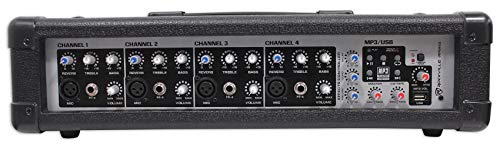
The RPM45 is the smallest commitment in this guide: a four-channel powered mixer with USB playback, echo and delay effects, and phantom power, designed for exactly the rooms where a full system would be overkill — a chapel, a prayer room, a Bible study that sings, a small congregation starting with a pastor’s microphone, one singer, an instrument, and recorded music. Its amplifier is sized for a pair of modest passive speakers in a small space, and its operation is simple enough for anyone in the building.
Strengths
- The most accessible tier here — a complete powered system for the smallest budgets.
- USB playback covers accompaniment tracks and recorded hymns.
- Four channels match chapel-scale ministry precisely.
Trade-offs
- Four channels is a hard ceiling; a growing music ministry will outgrow it.
- Modest amplifier output for small rooms only.
- Support and longevity trail the Yamaha and Behringer picks.
Judge the RPM45 by its intended rooms and it is the right product: it makes a small congregation audible and musical for the cost of a single microphone from a premium brand. Churches commonly buy it as the fellowship-hall or youth-room system even when the sanctuary has something larger, because a second simple system gets used constantly. If your ministry is small and your budget is smaller, start here without embarrassment — and keep it as the portable system when you grow. There is a dignity argument for the small system, too: a chapel where every voice is heard clearly through a modest, well-run box serves its people better than a sanctuary where an impressive system is run hesitantly. The RPM45’s entire design honors the small room, and small rooms are where a great deal of the world’s worship actually happens.
Best for: chapels, small congregations, fellowship and youth rooms / Not suited for: a main sanctuary with a worship band. Check the current price on Amazon.

Yamaha EMX7 — Best for Growing Churches
When the small church’s music grows — a choir joins the worship team, the band adds drums and a second guitar, the sanctuary is the larger kind of small — the EMX7 provides the headroom the EMX5 cannot: twelve inputs with more amplifier behind them, flexible mains-and-monitor configuration, the same feedback suppression and graphic EQ philosophy, and Yamaha’s system-level polish throughout. It is the natural step up within the same family, so a team’s EMX5 habits transfer directly.
Strengths
- More power and routing for choirs, bands, and larger sanctuaries.
- Same volunteer-friendly Yamaha approach as the EMX5.
- Effects and EQ depth suit a fuller music program.
Trade-offs
- The premium tier of this guide.
- Still a single-box system — very large or complex ministries need separates.
- Heavier and larger than the compact picks.
The EMX7 is the choice for the church that can see its next five years: the congregation is growing, the platform team is growing, and the system must not become the ceiling. Its amplifier drives typical sanctuary speakers with the reserve that keeps Easter and Christmas services — the fullest rooms of the year — from straining. Churches that host weddings, funerals, and community events will also appreciate a system that visiting operators can run without training.
Best for: growing congregations, choirs plus band, larger small sanctuaries / Not suited for: the smallest chapels or the tightest budgets. Check the current price on Amazon.

Behringer Europower PMP550M — Best for Simplicity
The PMP550M strips the powered mixer to its essence: five channels, a 500-watt-class amplifier section, a Klark Teknik effects processor for a touch of space on voices, and Behringer’s FBQ feedback detection to help any operator find a ringing frequency. For a church whose program is a pastor, a song leader, a piano, and playback — and whose sound team is whoever arrives first — this focus is a feature. There is simply less to set wrong.
Strengths
- Minimal, legible layout — the easiest full-size box here for new volunteers.
- FBQ feedback detection guides operators to the problem frequency.
- Compact and light for multi-room church use.
Trade-offs
- Five channels limits music ministry growth.
- Peak-oriented power figures; best with efficient speakers in modest rooms.
- Fewer EQ and routing tools than the Yamaha picks.
Small churches with a traditional service pattern will find the PMP550M covers their entire program with room for the occasional guest microphone, and its price tier lets a tight budget also afford the speakers and microphones that complete the system. It is also a sensible second system for the fellowship hall. Buy it for the ministry you have; if the band grows, it retires gracefully to the smaller room rather than to a closet. Its restraint is also a form of reliability: fewer features mean fewer settings that a well-meaning hand can leave in a strange state for the next operator, and in a volunteer-run room that predictability is worth real money. The PMP550M is the pick for churches that have learned — sometimes the hard way — that the best system is the one that behaves identically every single Sunday.
Best for: traditional small services, speech-focused ministries, multi-room churches / Not suited for: contemporary bands or growing music programs. Check the current price on Amazon.

Behringer Europower PMP500MP3 — Best for Playback
Many small churches run their music on recorded accompaniment — tracks, hymn recordings, videos — with live microphones for the pastor and song leader over the top. The PMP500MP3 is built for exactly that service pattern: a built-in MP3 player reads the service’s music from USB media, a wireless-ready option frees the pastor from a cable, and the eight-channel mixer handles the live voices and an instrument or two with reverb for warmth.
Strengths
- Onboard MP3 playback simplifies track-based services — no laptop required.
- Eight channels cover voices plus light live music.
- Wireless-ready design suits a pastor who moves.
Trade-offs
- Amplifier output is for small-to-medium rooms.
- Effects are a simple reverb set.
- Full live bands should look at the EMX7 or RPM109 V2.
The operational win is Sunday-morning simplicity: the service’s music lives on one USB stick, the operator presses play, and the live mixing is two or three faders. Churches without a worship band — a reality for many small congregations — get a complete, dignified sound system without pretending to be something else. It also serves funerals, weddings, and midweek meetings with the same one-stick convenience, which is where such systems quietly earn their keep.
Best for: track-based services, small congregations without a band, multi-use sanctuaries / Not suited for: full live worship bands. Check the current price on Amazon.

Rockville RPM109 V2 — Best Power Reserve
The RPM109 V2 is the budget answer to the larger small church: twelve channels with eight mic preamps, a high-output amplifier section, Bluetooth and USB/SD playback, 24 digital effects, dual seven-band graphic EQs for mains and monitors, and dual fan cooling. For a congregation whose sanctuary is big, whose speakers are already installed, and whose budget is fixed, it delivers the most complete system in this guide at its tier.
Strengths
- Twelve channels and strong output cover a full small worship team.
- Dual graphic EQs give the monitor mix its own feedback control.
- Bluetooth, USB, and effects cover modern service needs in one box.
Trade-offs
- Power figures are peak-oriented; match to speakers by the continuous rating.
- Brand support network is thinner than Yamaha’s or Behringer’s.
- The largest, heaviest unit here.
The RPM109 V2 suits the church plant in a rented hall, the growing congregation in a gymnasium-style space, and the budget committee that needs capability now. Its monitor EQ is a genuine ministry feature — the worship team hears itself clearly without stealing the mains’ tuning — and its channel count postpones the next upgrade for years. Set it up with efficient speakers and realistic levels, and it will run a full contemporary service without apology.
Best for: larger small churches, church plants, full worship teams on a budget / Not suited for: buyers who prioritize long-term brand support above capability. Check the current price on Amazon.
Comparison Table
| Pick | Badge | Key spec | Best for |
|---|---|---|---|
| Yamaha EMX5 | Best Overall | 12 inputs, feedback suppressor, graphic EQ | Most small churches |
| Rockville RPM45 | Best Budget | 4 channels, USB playback, phantom power | Chapels and small rooms |
| Yamaha EMX7 | Best for Growing Churches | 12 inputs, more amplifier, monitor flexibility | Choirs and bands |
| Behringer Europower PMP550M | Best for Simplicity | 5 channels, FBQ feedback detection | Traditional services |
| Behringer Europower PMP500MP3 | Best for Playback | Built-in MP3 player, wireless-ready | Track-based services |
| Rockville RPM109 V2 | Best Power Reserve | 12 channels, dual GEQ, Bluetooth | Larger rooms on a budget |
How to Choose a Powered Mixer for a Small Church
Begin with the service, written down. List every input in a typical Sunday — pastor, song leader, additional vocalists, piano or keys, guitar, playback — then add the special-service list: the Christmas choir, the guest quartet, the wedding soloist. Buy for the typical Sunday plus the specials you can foresee, with one spare channel, because a system that fails only on the biggest days of the year fails exactly when it matters most. Then count your operators honestly: if the sound team is a rotation of volunteers, simplicity and feedback assistance outrank features, and the Yamaha and Behringer philosophies in this guide exist for you.
Next, audit the room and the speakers you already own. A powered mixer drives passive speakers; confirm yours are passive, note their impedance, and check the mixer’s speaker configuration can serve your mains — and a platform monitor if the team needs one — simultaneously. In a reverberant sanctuary, prioritize the tools of clarity: high-pass filters on every mic channel, a graphic EQ for the room, and speakers placed and aimed to cover the congregation rather than the walls. Finally, plan the whole budget as a system: mixer-amplifier, speakers if needed, two good microphones before four mediocre ones, cables, and a small reserve for the stands and cases that make the system usable weekly. Churches that budget the system, not the box, end up with sound that serves the ministry instead of interrupting it.
How to Set Up Church Sound With a Powered Mixer
Install once, carefully, and then make Sunday a routine rather than a project. Mount or place the mixer where the operator sits with the congregation — hearing what the room hears is worth more than any single feature — and run speaker cables to mains positioned to cover the seats, angled down the room rather than across it. Connect the platform monitor if you use one, set the amplifier configuration for mains-plus-monitor per the manual, and label every channel with its permanent assignment: Pastor, Vocals, Piano, Guitar, Playback. Permanent labels are the small church’s secret weapon, because they turn a rotating volunteer team into a consistent one.
Set levels in a fixed order at a rehearsal, and write them down. Pastor’s microphone first: gain set for a natural speaking voice, high-pass filter engaged, a gentle presence lift if the room is dull, and the level marked on tape beside the fader. Then the music: each source gained and balanced against the others, effects kept light — a short reverb that supports singing without washing the words. Ring out the room with the graphic EQ: raise the mains slowly with the pastor’s mic open, cut the first two ringing frequencies, and stop; those settings then live on the EQ permanently, photographed and noted in the sound notebook. Save the notebook at the mixer: channel list, marked levels, EQ photo, and the one-page Sunday checklist.
The Sunday checklist itself is short: power on, recall the marked settings, line-check the pastor’s mic and playback, play the pre-service music, and adjust only for the day’s variables — a guest singer, an extra instrument. After the service, power down in reverse and note anything unusual in the notebook. Churches that adopt this routine discover that their sound problems shrink to the genuinely new, because the system stops being reinvented weekly. Every mixer in this guide is reliable enough to reward that discipline for years.
Common Buying Mistakes
The most common small-church mistake is buying for the band you hope to have instead of the ministry you have — a large system that intimidates the volunteers who must run the actual services. Buy for your real Sundays, with modest headroom for growth. The second mistake is the reverse: a system with no spare channel and no monitor path, outgrown by the first choir rehearsal. The third is ignoring the room: no mixer fixes speakers aimed at a back wall or a microphone three feet from a pastor’s mouth, so budget for placement, a good headset or podium microphone, and basic instruction alongside the box.
Fourth, churches buy by peak wattage, the category’s endemic trap; judge by continuous power into your speakers and by the room’s size. Fifth, they forget the total system budget — cables, stands, a second microphone, a case — and the shiny mixer arrives to a room that cannot quite use it. Sixth, they skip training: one Saturday session where the whole volunteer rotation runs a mock service on the new system prevents a year of Sunday-morning improvisation. The equipment in this guide is the easy part; these six habits are what make it sing.
Final Recommendation
For most small churches, buy the Yamaha EMX5: it is the balanced, volunteer-proof, decade-long answer. Choose the Yamaha EMX7 if the music program and the room are growing, the Behringer Europower PMP550M for a traditional speech-focused service, the Behringer Europower PMP500MP3 if the music comes from tracks, the Rockville RPM45 for a chapel or a first system on the smallest budget, and the Rockville RPM109 V2 for a larger room and a full team at a budget tier.
Finally, a note about patience: a sound system chosen carefully, installed once, and taught properly will not need this congregation’s attention again for many years, and that is the true return on the effort this guide asks for. The Sundays add up — hundreds of services, weddings, funerals, and celebrations across a decade — and on every one of them the system either serves quietly or intrudes noticeably. Choose, deliberately and together, for the quiet decade ahead. The six systems above were selected, above all else, to disappear into the life of a small church and let the ministry be what the room remembers.
A word to the committee, since committees sign the checks: ask for the total system figure, not the mixer figure. The honest proposal includes the mixer-amplifier, any speakers needed, the pastor’s microphone, cables, stands, and a small contingency — and it fits the budget or it does not, in full view. Proposals that present the box alone always return for the rest, piecemeal and at worse prices. Every recommendation in this guide was made with that total in mind, which is why the budget picks leave room for the microphones and why the premium picks assume the rest of the system already exists.
Whichever system your congregation chooses, treat the first month as installation, not just purchase: mount and label everything, run the training session, write the notebook, and hold one full rehearsal service before the first real Sunday on the new system. Churches that invest that month get a decade of quiet reliability; churches that plug in on Saturday night get a year of small surprises. The equipment in this guide is ready for the first path — the rest is the ministry of preparation, which small churches have always understood better than anyone.
See also: Best Analog Powered Mixers, Best Analog Mixers For Live Sound, Best Analog Mixers With Usb, Best Analog Mixers For Live Sound And Studio, Best Analog Mixers For Studios.
Speech Intelligibility: Why Sermons Sound Muddy, and the Fixes
Most small-church sound complaints are not about loudness; they are about understanding words, and intelligibility has known causes with known cures. The first cause is reverberation: sanctuaries are built to make singing glorious, which means sound bounces for a long time, and late reflections smear consonants — the sounds that carry meaning. The cures are proximity and direction: a microphone close to the speaker’s mouth captures far more direct sound than room sound, and speakers aimed at the congregation (and their absorptive clothing) rather than at bare walls deliver the direct sound where it is needed. The second cause is excess low frequency: podium and headset microphones pick up rumble, breath, and room boom that mask the voice’s clarity range, which is why the high-pass filter on the speech channel is the single most valuable control in a church system — engage it, always.
The third cause is level discipline. A sermon run a little too quietly forces listeners to strain; run a little too loudly into a live room, the reflections grow with the direct sound and clarity falls again. There is a comfortable middle, found at setup and marked on the fader, and it is steadier than any volunteer’s Sunday guess. The fourth cause is competing content: music under speech, playback left running, a choir microphone open during the sermon. Muting discipline — only the needed channels open — is free and transformative. Every mixer in this guide provides the tools; the setup routine in this article is how a church turns them into a house standard that survives volunteer rotation.
Special Services: Weddings, Funerals, and the Fullest Sundays
A church system earns its keep on the days that are not ordinary Sundays. Weddings bring guest musicians, a soloist with a track, and an officiant who may not know the microphones; funerals bring a family member reading through tears at half volume and a slideshow with audio; Christmas and Easter bring the choir, the extra instruments, and a full room that absorbs sound differently than a half-full one. A well-chosen powered mixer handles these days through the same virtues as ordinary ones — spare channels for the guests, marked baseline settings to return to, playback that works without a laptop negotiation, and an operator checklist that includes a line for “guest source: test before the service.”
Two preparations multiply a small system’s grace under these occasions. Keep a guest kit with the mixer: one spare microphone and cable, a cable for a phone or laptop, and fresh batteries for any wireless in the building. And keep the one-page “special service” addition to the notebook: where the extra channels are, how the slideshow audio connects, who to call if something fails. Churches discover that these occasions are when visitors form their impression of the congregation’s care; sound that simply works, run calmly by a prepared volunteer, is part of that witness. The six systems in this guide were all chosen to make those days unremarkable in the best sense.
Training Volunteers: The One-Session Plan
The difference between churches that love their sound system and churches that endure it is usually one Saturday morning. Gather the whole rotation — everyone who will ever sit at the mixer — and run a mock service. Teach four things only, in this order. First, the map: what each channel is, permanently labeled, and what each cable does. Second, the levels: how to set the pastor’s microphone gain, where the marked fader positions live, and why they should be trusted. Third, the two emergencies: feedback (mute the channel, then lower, then find the EQ cut — never reach for the master first in a panic, and never cup a microphone) and silence (check mute, then fader, then cable, in that order). Fourth, the notebook: where the settings are written and where to leave notes for the next operator.
Then let each volunteer run a segment while the others sit in the congregation and listen, because operators who have heard their own mixing from the pews make permanently better decisions. Finish by agreeing the house rules: settings return to the marks after every service, problems get written in the notebook the same day, and nobody apologizes for asking the experienced operator a question. Churches report that this single session converts sound from a weekly anxiety into a quiet ministry — and it costs nothing but a morning and coffee. Every mixer in this guide is simple enough to be taught this way; that teachability was a selection criterion, not an accident.
Maintaining the System Across Years
Church equipment fails slowly and then suddenly, usually at Christmas. A light maintenance rhythm prevents the second half of that sentence. Monthly, someone on the team powers the system, checks every channel with the pastor’s microphone, exercises the faders and knobs (analog controls that rest in one position for months develop noisy spots), and confirms the playback path. Quarterly, cables get the wiggle test at both ends while listening, batteries in wireless microphones and remotes are replaced on schedule rather than on failure, and the speaker connections are checked for looseness. Annually — ideally in a quiet month, not December — the system gets a full rehearsal-standard setup: ring out the room again, re-mark the fader positions, update the notebook, and replace anything that crackled during the year.
Keep the system’s papers together at the mixer: the manual, the warranty and purchase record, the notebook with its settings and history, and the contact for the brand’s service network. Congregations change staff and volunteers; the papers are the institution’s memory. The better-built systems in this guide — Yamaha above all, with Behringer’s wide service footprint behind it — reward this care with the decade-plus service lives that church budgets assume. A powered mixer maintained this way is not an expense that recurs; it is infrastructure, like the roof, and it should be bought and treated with the same seriousness.
Completing the System: Microphones, Cables, and Small Things
A powered mixer is the center of a church system, not the whole of it, and the surrounding choices decide what the congregation hears. Microphones first: the pastor’s microphone is the most important single purchase in the building. A quality headset microphone keeps a constant distance from the mouth, freeing the pastor to move and keeping the level steady — the largest intelligibility upgrade most small churches ever make. For vocalists, sturdy dynamic microphones forgive enthusiastic handling and resist feedback better than delicate condensers in a live room. Buy two excellent microphones before four adequate ones; the congregation hears the microphones, not the mixer.
Cables and hardware follow: proper speaker cable of adequate gauge (never instrument cable), microphone cables long enough to reach without tension, stands that do not creep downward mid-sermon, and a small stock of spares — one microphone cable, one speaker cable, batteries — kept at the mixer. Finally, the unglamorous essentials: gaffer tape for cable runs across walkways, labels and a marker that live in the sound area, a flashlight, and the notebook this guide keeps mentioning. Churches that budget these items alongside the mixer discover that “the sound system” works as a system from the first Sunday; churches that do not, discover it one missing cable at a time.
Related guides
Frequently Asked Questions
How many channels does a small church need?
Count a typical service: pastor (1), song leader and vocalists (2–3), piano or keyboard (1–2 as stereo), guitar (1), playback (1 stereo), plus a spare for guests. Most small churches land between eight and twelve inputs, which is why the twelve-input class dominates this guide. Chapel and study ministries with a pastor, one singer, and playback are served by the four-to-five-channel picks. Do the count twice — once for an ordinary Sunday and once for your fullest regular occasion, such as a choir Sunday or a combined service — and buy for the larger of the two if the difference is small. Running out of channels on the biggest day of the quarter is the failure mode churches remember; carrying two spare channels all year costs nothing by comparison.
Can volunteers really run these systems?
Yes — that is the design brief. Powered mixers put every control on one surface with no menus, and the picks here add feedback suppression or detection, clear labeling, and forgiving layouts. The churches that succeed add two habits: permanent channel labels with marked levels, and one training session for the whole rotation. After that, a service is a checklist, not an improvisation. It also helps to choose the operator’s seat honestly: a volunteer who sits with the congregation and hears the room will outperform a reluctant expert sealed in a booth, because most small-church mixing decisions are about balance and clarity in the seats, not about technology. Design the role for the people you have, and these systems will meet them more than halfway.
What speakers should a small church use with a powered mixer?
Passive speakers, matched to the mixer’s impedance range and chosen for efficiency and speech clarity. A pair of quality two-way speakers on stands or wall mounts, aimed at the congregation, covers most small sanctuaries; add a small wedge for the platform if the team needs a monitor. Never connect the powered mixer’s speaker outputs to powered speakers. Placement deserves as much care as the purchase: speakers high enough to project over the front rows to the back, angled toward the seats rather than the side walls, and far enough in front of the microphones that the feedback tools are a backup rather than a battle plan. If the sanctuary is long, two speakers covering the room evenly at modest level will always sound clearer than one loud pair at the front — an arrangement several of these mixers support by running both sides in mono.
How do we stop feedback during sermons?
Start with placement: the pastor’s microphone close to the mouth, speakers ahead of the microphones and aimed at the seats. Then use the tools: high-pass filter on the speech channels, careful gain, and the graphic EQ or the mixer’s feedback suppression to notch the ringing frequencies found at setup. A headset microphone for the pastor is often the single biggest improvement, because it keeps the mic position — and therefore the level — constant as they move. Teach operators the one counterintuitive rule: when feedback starts, do not push the microphone’s fader up or grab the microphone — mute or lower the channel calmly, then address the cause. Feedback in a service is startling mainly because it is rare in a well-set system; the setup routine in this guide, done once and maintained, is what keeps it rare.
Can we record or stream our services with a powered mixer?
Several picks include USB playback and basic stereo recording of the mix, which suits archiving and simple streaming; others can feed a recorder or streaming computer from a line output. If streaming becomes central to the ministry, an unpowered USB mixer from our companion guides may serve better as the hub, with the powered system remaining the room’s sound — many churches run exactly that combination. One practical caution for streaming from a sanctuary system: the mix that balances a live room is not automatically the mix a stream needs, because the room itself contributes sound the stream never hears. If the stream matters, have someone listen to it on headphones from another room during a rehearsal and adjust the balance for the recording — often a little more of the direct microphones and a little less of everything else — using a separate output feed where the mixer allows it.
Should we buy the biggest system we can afford?
Buy the system your ministry will use well, with modest headroom — not the biggest available. In a small church, operator confidence and room fit matter more than unused channels and wattage, and the money saved buys the microphones, cables, and training that the congregation will actually hear. Growth, when it comes, is easier to fund than an oversized system’s quiet intimidation is to undo. There is a stewardship point here that committees understand instinctively: money spent on capability the ministry never uses is money not spent on the microphones, music, and maintenance it uses every week. The right-sized system, completely equipped and confidently run, serves the congregation better than the impressive system, partially equipped and nervously run — every Sunday, without exception.


