Disclosure: airfryerkitchensupply.com is reader-supported. When you buy through links on our site, we may earn an affiliate commission at no extra cost to you.
Where to buy
The best baby food processors and makers come in two families — processors and makers are cousins, not twins: makers steam and blend in one vessel, processors chop and puree what you have cooked. This guide ranks six verified options across both families and labels each one clearly, so you buy the function you actually want. Confirm the exact model and included accessories on the listing, and check the current price on Amazon before ordering.
- Momcozy AutoMeal Baby Food Maker — search Amazon by the full model name and check price on Amazon; choose the listing sold or shipped by Amazon or the brand’s own store.
- Chefhandy Baby Food Maker — search Amazon by the full model name and check price on Amazon; choose the listing sold or shipped by Amazon or the brand’s own store.
- Béaba Babycook Solo 4-in-1 Baby Food Maker (Cloud) — search Amazon by the full model name and check price on Amazon; choose the listing sold or shipped by Amazon or the brand’s own store.
- NutriBullet Baby Complete Food-Making System NBY-50100 — search Amazon by the full model name and check price on Amazon; choose the listing sold or shipped by Amazon or the brand’s own store.
- KitchenAid 5 Cup Food Chopper KFC0516 — search Amazon by the full model name and check price on Amazon; choose the listing sold or shipped by Amazon or the brand’s own store.
- Cuisinart Elemental 4-Cup Chopper/Grinder ECH-4SV — search Amazon by the full model name and check price on Amazon; choose the listing sold or shipped by Amazon or the brand’s own store.
The phrase best baby food processors and makers covers two families that parents constantly confuse, so this guide separates them from the first paragraph. Makers — the Béaba, NutriBullet Steam + Blend, GROWNSY, Momcozy and Chefhandy type — cook and blend in one appliance: raw ingredients in, baby food out. Processors — mini food processors used for baby food — take cooked ingredients and reduce them to the texture your baby needs. Both routes end at the same spoon; they differ in equipment count, batch style and what the appliance does after weaning ends.
This guide is for the parent comparing across the families, which is most parents. Its six picks include the most automatic maker in the category, a maker with a stainless steam basket and reusable pouches, the proven Béaba system, the NutriBullet batch system, and two mini processors — from KitchenAid and Cuisinart — for families building the routine from general tools. Each review states its family in the first lines; nobody should finish a review unsure whether the machine steams.
A shared warning across both families: the appliance is the easy part. The system around it — portioning, freezing, labelling, reheating — decides whether homemade food survives contact with a busy month. The picks below were graded as systems, and the guide sections teach the batch routine that turns any of them into a working Sunday habit. As with our companion baby guide, this article covers equipment and comfort only; feeding decisions belong to your qualified guidance.
In this guide
Quick Picks
Momcozy AutoMeal Baby Food Maker — Best Fully Automatic Maker. The automation leader: one-step automatic steam-and-blend, automatic three-stage texture settings matched to weaning stages, a six-blade design and a self-cleaning function. Best for: time-poor parents who want the machine to run the whole cycle. Know the trade: the 15-ounce cup is a per-batch size for one baby, not a twin-scale freezer session. Check price on Amazon
Chefhandy Baby Food Maker — Best with Stainless Basket and Pouches. The materials-and-system pick: a stainless steel steam basket, BPA-free food-contact parts as listed, six reusable pouches for serving and storage, and a recipe guide in the box. Best for: parents who care about basket material and pouch feeding. Know the trade: a smaller brand, so judge it on its included system rather than ecosystem depth. Check price on Amazon
Béaba Babycook Solo 4-in-1 Baby Food Maker (Cloud) — Best Proven Maker System. The proven system: steam, blend, defrost and reheat in one 37-ounce vessel, one-handed, with capacity the listing states at up to 27 servings. Best for: parents who want the category’s reference design and its defrost-reheat daily convenience. Know the trade: manual sequencing and texture judgement, unlike the Momcozy’s automation. Check price on Amazon
NutriBullet Baby Complete Food-Making System NBY-50100 — Best Batch Blending System. The processor-side system: a 32-ounce blending platform built for batch baby food and portioning, for kitchens that already steam on the stove. Best for: organised batch cooks. Know the trade, clearly: no integrated steaming — this is the blending and portioning half of the routine. Check price on Amazon
KitchenAid 5 Cup Food Chopper KFC0516 — Best Processor for Baby Portions. The processor pick with range: a 5-cup bowl that precisely chops or purees, two speeds plus pulse for texture control, and a whisk accessory that outlives weaning by years. Best for: family-food weaning — cook for everyone, process the baby’s portion. Know the trade: no steaming, and 5 cups is a portion tool, not a batch system. Check price on Amazon
Cuisinart Elemental 4-Cup Chopper/Grinder ECH-4SV — Best Compact Processor and Grinder. The compact grinder-processor: a 4-cup chopper and grinder with a SmartPower blade and a BladeLock system that secures the blade for safe pouring. Best for: small kitchens, single portions and grinding tasks beyond baby food. Know the trade: the smallest capacity here, and like all processors, no steaming. Check price on Amazon
How These Picks Were Chosen
Selection then balanced the two families deliberately — four makers and two processors — because a guide for cross-family shoppers that only lists one family has failed its search intent.
Within the makers, we graded automation honestly: the Momcozy’s one-step auto steam-and-blend is a genuinely different ownership experience from a maker you sequence yourself, and it is badged that way. Within the processors, we graded texture range and afterlife: a mini processor that grinds, chops and whisks serves the family for years, and that longevity is a first-order value in a category defined by a short season. Cleaning, portion accessories and basket materials decided the remaining places.
The 6 Best Baby Food Processors and Makers: Full Reviews
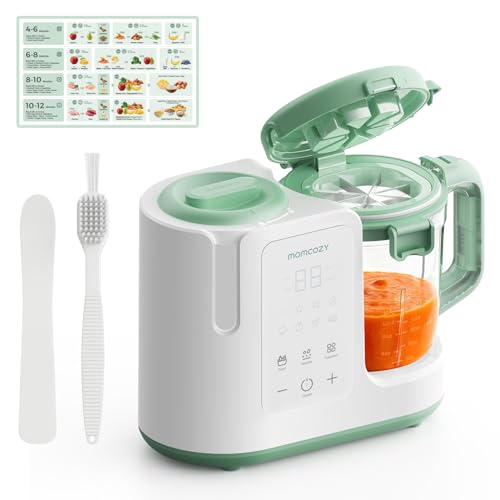
Momcozy AutoMeal Baby Food Maker — Best Fully Automatic Maker
The AutoMeal’s idea is to remove the parent from the middle of the process: load the 15-ounce cup, choose the texture stage, and the machine steams and blends in one automatic step. The three-stage texture settings map directly onto the weaning journey — smooth, then textured, then chunkier — which turns the category’s fiddliest judgement call into a button. A six-blade design handles the blending, and the self-cleaning function addresses the chore every parent actually dreads.
Strengths
- True one-step auto steam-and-blend cycle — the least attention of any maker here
- Automatic 3-stage texture settings follow the weaning stages without guesswork
- Self-cleaning function lowers the daily friction that kills homemade routines
Trade-offs
- 15 oz cup suits one baby’s batches; big freezer sessions mean multiple cycles
- Automation means less manual control for parents who like to fine-tune
- Newer model with a shorter ownership track record than Béaba
Key specs (from the verified listing): one-step auto steam and blend; 15 oz cup; 6-blade design; self-cleaning function; auto 3-stage texture settings.
Judge this machine by the evenings it saves. The typical homemade-food failure is not a bad puree; it is the third consecutive day the parent was too tired to start a multi-step process. An automatic cycle that runs while the parent does literally anything else — including sitting down — is the feature that keeps the habit alive. The texture staging is well judged, the cup size matches a day or two of portions for one baby, and self-cleaning closes the loop. Households batch-cooking for twins should look at the Béaba Neo in our companion guide; households cooking little and often should look here first.
AutoMeal households describe a distinctive pattern: the machine runs during other routines — the morning feed, the bath, the tidy-up — because it asks for nobody’s attention between loading and finishing. That background quality is what automation actually buys, and in a house where attention is the scarcest resource, it outranks capacity, accessories and every other specification in this guide. Its cup size simply asks for the little-and-often rhythm in return.
Best for: time-poor parents of one baby who cook little and often / Not suited for: twin-scale batch cooking
Check the current price on Amazon
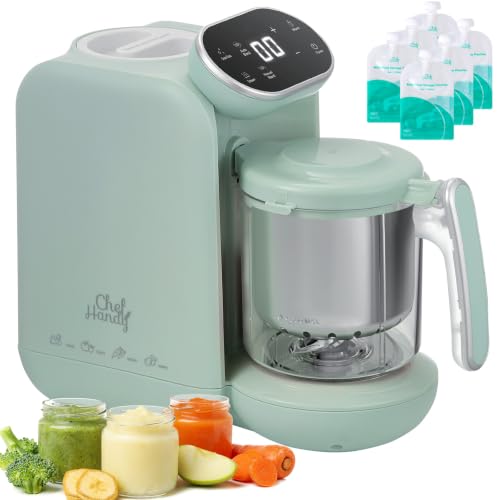
Chefhandy Baby Food Maker — Best with Stainless Basket and Pouches
Chefhandy differentiates on two things parents actually ask about. First, the steam basket is stainless steel — the material many parents prefer against hot food contact — within a design whose food-contact parts the listing states are BPA-free. Second, the box includes six reusable pouches, which changes the machine from a cooker into a feeding system: blend, fill pouches, and the food is ready for home or travel in the format babies learn to love and parents learn to carry.
Strengths
- Stainless steel steam basket answers the materials question directly
- Six reusable pouches included for serving, travel and storage
- Recipe guide in the box shortens the first-week learning curve
Trade-offs
- Smaller brand ecosystem for spares and community knowledge
- Pouches need their own cleaning routine to stay hygienic
- Steam-and-blend format still requires the parent to sequence the steps
Key specs (from the verified listing): stainless steel steam basket; BPA-free food-contact parts (as listed); 6 reusable pouches included; recipe guide included.
The pouch inclusion is smarter than it looks: pouch feeding is where many homemade routines quietly die, because filling disposable pouches feels wasteful and serving from bowls does not travel. Reusable pouches make homemade food portable, which extends the habit beyond the kitchen table. Combined with the stainless basket — a genuine material preference for many families, stated here exactly as the listing frames the product — the Chefhandy is the considered-choice pick: not the most automatic, not the biggest, but the one whose details match a specific, common set of parent priorities.
The Chefhandy’s pouches change where baby food happens: the park, the grandparents’ house, the car journey, without a bowl, a spoon-washing problem or a shop-bought substitute. Parents who travel or commute with the baby find the machine’s value concentrated there, and the stainless basket settles the materials question that brought many of them to this pick in the first place. It is the considered, system-minded choice.
Best for: materials-conscious parents who want a pouch system included / Not suited for: automation-first buyers
Check the current price on Amazon

Béaba Babycook Solo 4-in-1 Baby Food Maker (Cloud) — Best Proven Maker System
In a cross-family guide, the Babycook Solo is the maker’s benchmark: the 4-in-1 that steams, blends, defrosts and reheats in one vessel is still the most complete definition of what a maker should be, and the defrost-and-reheat functions — easy to overlook at purchase — are the ones used daily once the freezer system is running. One-handed operation and a 37-ounce capacity stated at up to 27 servings complete a design that has been refined across more parent feedback than any rival here.
Strengths
- Only pick here combining steam, blend, defrost and reheat in one vessel
- One-handed operation designed for parents holding the baby
- Large stated batch capacity for efficient freezer sessions
Trade-offs
- Parent sequences the steps and judges texture manually
- Premium positioning in the maker family
- Season appliance with limited afterlife compared with processors
Key specs (from the verified listing): 37 oz capacity; 4-in-1 steam, blend, defrost, reheat; one-handed operation.
The Solo’s case in this guide is completeness of the daily loop: cook on Sunday, defrost on Wednesday, reheat on Thursday, all in the vessel that lives on the counter. Newer rivals beat it on single features — automation, basket material, included pouches — and its review in our companion guide says the same. As a system bought once and used without friction for the whole season, it remains the standard. Parents choosing between it and the Momcozy are choosing between proven completeness and automation; both choices are defensible, and the deciding factor is how the parent cooks.
Across both of this programme’s baby guides, the Solo is the reference because its loop is complete: cook, freeze, defrost, reheat, in the vessel that never leaves the counter. Owners measure its value in the Wednesday evenings when dinner for the baby required no cooking at all — just the defrost cycle and a spoon. Completeness, repeated daily, is a feature no single specification captures.
Best for: parents wanting the proven complete maker system / Not suited for: automation seekers or processor loyalists
Check the current price on Amazon

NutriBullet Baby Complete Food-Making System NBY-50100 — Best Batch Blending System
Labelled plainly as this guide requires: the NBY-50100 is a system built around blending and portioning, not a steam-in-vessel maker. Its 32-ounce capacity handles the biggest blending batches in this guide, and the NutriBullet format’s speed and easy cleaning suit the Sunday-session workflow — steam a large pot of vegetables on the stove, blend in the system, portion, freeze. For kitchens with a good steamer already, it avoids paying twice for the cooking half of the job.
Strengths
- Largest blending capacity here for genuine batch sessions
- Fast, familiar format with quick cleanup between batches
- Blending platform has a family life after weaning
Trade-offs
- No steaming function; a pan or steamer is required
- Texture is entirely the cook’s judgement
- Less complete out of the box for a kitchen starting from zero
Key specs (from the verified listing): 32 oz capacity; complete food-making system.
Systems thinking decides this pick’s value: the total routine — stove steamer plus this system — costs less counter space than a maker plus a blender, and each half does its job at full size. Parents who already cook family meals find the workflow natural, because the baby’s food comes off the same stove as everyone else’s dinner. First-kitchen parents should buy a maker instead and keep the equipment count at one. The badge recognises the batch cook, not the beginner.
The NBY-50100’s owners are the session cooks: a kilo of vegetables, one pot, one blending system, a freezer filled in under an hour. Its strength with fibrous ingredients — the sweet potatoes and green vegetables that stall lesser blenders — is what makes the session rhythm possible. In a kitchen that already cooks in batches, it slots into the existing routine instead of demanding a new one.
Best for: batch cooks with an existing stove steaming setup / Not suited for: first-kitchen or one-appliance buyers
Check the current price on Amazon

KitchenAid 5 Cup Food Chopper KFC0516 — Best Processor for Baby Portions
The KFC0516 is the processor family’s strongest baby-food candidate because its controls map onto weaning textures: low speed and pulse for controlled mashes, full speed for smooth purees of cooked food, in a 5-cup bowl sized for family-meal portions rather than freezer batches. The whisk accessory — for whipping and emulsifying — signals its second life: this is a kitchen tool that happens to excel at baby portions, bought once and used for a decade of sauces, crumbs and whipped everything.
Strengths
- Two speeds plus pulse give the texture range weaning needs
- 5-cup bowl matches family-portion processing exactly
- Whisk accessory and brand platform give it a long afterlife
Trade-offs
- Does not steam; food must be cooked first
- Portion-sized, not a batch-and-freeze system
- Pureeing very smooth first foods needs added liquid and patience
Key specs (from the verified listing): 5-cup bowl; two speeds plus pulse; stainless multi-purpose blade; whisk accessory.
The family-food method is this chopper’s home ground: the pot of soup, stew or steamed vegetables the household is eating becomes the baby’s meal at the right texture in under a minute, which normalises homemade food as a by-product of cooking rather than a separate project. That is the most sustainable routine of all, and the reason a processor earns a top-four conversation in a makers’ guide. Pair it with any steamer you own and a set of portion pots, and the system is complete for a fraction of a dedicated setup’s commitment.
The KFC0516’s baby-food career is a prelude: after weaning it whisks, chops and purees its way through family cooking for years, and parents consistently rank it the best value-per-year in this guide. During the season itself, its two speeds and pulse make it the finest texture instrument among the processors — the tool for parents who cook family food and adapt it, portion by portion, with intent.
Best for: family-food weaning and long-life tool buyers / Not suited for: integrated steaming or big freezer batches
Check the current price on Amazon

Cuisinart Elemental 4-Cup Chopper/Grinder ECH-4SV — Best Compact Processor and Grinder
The Elemental ECH-4SV closes the guide as the compact processor option: 4 cups, a SmartPower blade covering chopping and grinding, and the BladeLock detail that parents will appreciate more than most — the blade locks in place for pouring, so serving a puree does not mean fishing a loose blade out of baby food. In small kitchens and for single-baby daily portions, its size is the feature: it lives within reach, washes in moments and stores anywhere.
Strengths
- BladeLock secures the blade for safe, clean pouring
- Chop-and-grind range covers purees through family grinding jobs
- Compact footprint suits the smallest counters and cupboards
Trade-offs
- 4-cup capacity caps batches at daily-portion scale
- No steaming function, as with all processors here
- Fewer speed options than the KitchenAid chopper
Key specs (from the verified listing): 4-cup capacity; SmartPower blade; BladeLock safety system.
Small processors earn their place on frequency, and baby food at the daily-portion scale is a frequency job: one cooked sweet potato, one portion of family stew, one banana-and-oat mash. The Elemental handles those in the time a maker takes to fill its water tank, and after weaning it remains the household’s spice, nut and crumb grinder. Buy it as the daily tool alongside any cooking method; buy a maker instead if the integrated steam cycle is the routine you know you will keep.
The Elemental’s BladeLock sounds like a footnote until you have poured puree around a loose blade with a baby waiting; then it reads as the detail of a designer who has done this job. Its grind function extends its baby use into family-food textures and its compactness keeps it reachable daily. Small, safe-pouring and dual-purpose, it is the minimalist’s complete answer on the processor side.
Best for: small kitchens and daily single portions / Not suited for: batch freezer sessions
Check the current price on Amazon
Comparison Table
| Pick | Badge | Key spec | Best for |
|---|---|---|---|
| Momcozy AutoMeal Baby Food Maker | Best Fully Automatic Maker | Auto steam & blend, 3-stage texture, self-cleaning | time-poor parents of one baby who cook little and often |
| Chefhandy Baby Food Maker | Best with Stainless Basket and Pouches | Stainless basket, 6 reusable pouches included | materials-conscious parents who want a pouch system included |
| Béaba Babycook Solo 4-in-1 Baby Food Maker (Cloud) | Best Proven Maker System | 37 oz, 4-in-1, up to 27 servings per listing | parents wanting the proven complete maker system |
| NutriBullet Baby Complete Food-Making System NBY-50100 | Best Batch Blending System | 32 oz batch blending system | batch cooks with an existing stove steaming setup |
| KitchenAid 5 Cup Food Chopper KFC0516 | Best Processor for Baby Portions | 5-cup chopper, 2 speeds + pulse, whisk | family-food weaning and long-life tool buyers |
| Cuisinart Elemental 4-Cup Chopper/Grinder ECH-4SV | Best Compact Processor and Grinder | 4-cup chopper/grinder with BladeLock | small kitchens and daily single portions |
Makers vs Processors: Which Family Fits Your Kitchen?
The maker’s promise is integration: raw in, food out, one vessel to wash. It suits parents starting from an empty kitchen, parents who value a self-contained routine, and the early silky-puree stage where steaming and blending small batches constantly is the whole job. Its costs are equally clear: a season of peak use, counter space during that season, and a purchase that duplicates a steamer and a blender you may already own.
The processor’s promise is longevity: cooked food in, texture out, in an appliance the kitchen keeps for a decade. It suits parents who already steam or cook family meals, who wean by adapting the household’s food, and who dislike single-season purchases. Its cost is process: you supply the cooking step and the texture judgement, and early purees take a touch more liquid and attention than a maker’s purpose-shaped vessel.
The hybrid answer is common and sensible: a maker for the intense early months — often received as a gift or bought for the season — and a mini processor that was already in the kitchen for stage two, family food and everything after. If you are buying one thing only, buy the maker for a first baby in an unequipped kitchen, and the processor for an equipped kitchen or a second child, when the household’s routines are already proven.
Whichever family you choose, grade the system around it before checkout: portion storage, a freezing method, labels, and a reheating plan. The six picks above were chosen because each anchors a workable system, not merely a working motor.
How to Run a Combined Routine: Steam Once, Process All Week
Steam or cook a base ingredient in family quantity — a tray of sweet potatoes, a pot of carrots and parsnips, a batch of pear and apple — using whatever cooking equipment you own. Makers take their share directly; processor households cook the family pot and set the baby’s portion aside before seasoning.
Process to the week’s stages. From one cooked base, make three textures: a smooth puree for the youngest meals, a pulsed mash for practice, and soft pieces left unprocessed. One cooking session, a week of progression, minimal extra work.
Portion into the cups, pouches or trays your system uses, label every portion with ingredient and date, and freeze flat where possible. The Chefhandy’s included pouches and the NutriBullet system’s cups exist to make this step thoughtless.
Reheat with care through the week: defrost in the fridge or with the maker’s defrost function where fitted, reheat thoroughly, stir to even the temperature, and check before serving following your current guidance. The routine, repeated, is the entire secret of households that sustain homemade food.
Wash as you go, using self-cleaning where fitted and the dishwasher where parts allow. A system that is clean is a system that gets used tomorrow; build the wash into the session, not after it.
Accessories That Matter — and Those That Do Not
Storage is the accessory category that decides systems: portion cups in the two weaning sizes, freezer trays with lids, and reusable pouches for travel. The NutriBullet Steam + Blend in our companion guide includes its cups; the Chefhandy here includes pouches. When comparing prices across any listings, add the storage you will actually buy to the machine price — the honest system price — before deciding which is cheaper.
Second in value: a second basket or bowl. Batch sessions stall while a single vessel is washed between flavours; a spare basket keeps a Sunday session moving. Third: a simple labelling kit — marker and tape or labels that survive the freezer — which costs almost nothing and prevents the universal mystery-portion failure.
Accessories that rarely matter: recipe books beyond a starter guide (your ingredient rotation will develop naturally), decorative storage, and specialised tools for single ingredients. Spend on the freeze-and-feed loop first; it is where homemade routines live or die, and every pound spent there outperforms a pound spent on features.
Common Buying Mistakes
Confusing a processor with a maker at checkout. The names blur and the disappointment is instant: a processor will not steam. Read for the words steam and basket; if they are absent, you are buying the texture half of the routine only — fine, if that is the plan.
Paying for automation you will override. The Momcozy’s automatic textures suit parents who want the machine to decide. Parents who enjoy adjusting will find manual makers more satisfying. Match the control style to the cook, not to the feature list.
Ignoring basket and contact materials until after purchase. If stainless baskets or stated BPA-free parts matter to your family, they are purchase criteria, not post-purchase discoveries. The Chefhandy and GROWNSY listings state their materials plainly; check every listing the same way.
Buying the batch system for a cook-fresh kitchen — or the reverse. A 32-ounce batch system in a daily-fresh kitchen and a 15-ounce automatic in a twin freezer kitchen are both wrong sizes. Your cooking rhythm is the specification; the machine follows it.
Forgetting the afterlife in the price comparison. A processor that serves ten years and a maker that serves one season can both be good value — but compare them knowing which you are buying. Cost per year of use reframes several decisions in this guide.
Skipping the storage plan. A maker without portion storage produces a bowl of food and a problem. Buy the cups, pouches or trays with the machine, label from day one, and the system works from the first session.
Safety and Materials: Reading Baby Product Listings Carefully
Baby equipment listings carry material claims that deserve slow reading, because the words are precise and the differences matter to many families. When a listing states BPA-free food-contact parts — as the Chefhandy and GROWNSY listings in this programme do — that is a claim about the parts named, and this guide reports it exactly as stated rather than generalising it to the whole product. When a basket is described as stainless steel, as the Chefhandy’s is, that is a specific, checkable design fact. Train yourself to buy on those stated specifics, and to treat vague wellness language in any listing as decoration rather than information.
Steam safety follows the ordinary rules of hot appliances, applied with a baby in the house: reservoirs and baskets are hot during and after cycles, machines belong at the back of the counter with cords out of reach, and lids open away from the face because the first escaping steam is the hottest. Automatic machines add one rule — know where the cycle is before opening — which their indicators exist to tell you. None of this is onerous; all of it belongs in the first week’s habits.
This guide deliberately stops at equipment. What to feed, when to start, how to introduce allergens and how long foods keep are questions for your paediatric and public-health guidance, which is current, qualified and specific to your baby. The machines here will execute whatever plan that guidance gives you; choosing the plan is not a function any appliance — or any buying guide — should claim.
Gift Buying: Choosing a Maker or Processor for Someone Else’s Baby
Baby food makers are gifted constantly and chosen badly almost as often, because the giver buys the machine they find impressive rather than the system the parents will run. The questions that decide success: does the household already steam and blend (buy the processor or the batch system), is counter space scarce (buy compact), are twins or a return to work involved (buy capacity or automation), and — most predictive of all — do these parents batch-cook anything else in their lives? Batch cooks get systems; daily cooks get small, fast tools.
If you cannot ask, the safest gifts in this guide are the complete ones: a maker whose box includes its storage, like the systems badged here, or the KitchenAid chopper whose usefulness survives every possible weaning outcome — including the outcome where the parents buy pouches and the chopper simply becomes their kitchen’s favourite small tool. A gift that cannot become useless is a gift chosen correctly.
Include the unglamorous extras: portion pots, a freezer marker, and the receipt. And if the parents already own a maker, the best gift in the category is a second set of storage cups and baskets for the one they have — the accessory that doubles a batch session is worth more than a second machine.
Second-Hand, Hand-Me-Downs and Passing Machines On
Baby food makers have one of the healthiest second lives of any appliance, because their first life is short and their mechanism is simple. If you are receiving or buying one used, the checks are quick: run a full steam cycle and confirm it completes and heats evenly, inspect the basket and bowl for cracks and deep staining, check the blade’s edge and the seal’s condition, and confirm every accessory in the manual’s list is present — a missing basket or cup is the commonest hand-me-down defect and the easiest to miss.
Deep-clean before first use with the thoroughness you would give any food equipment that has been stored: wash every removable part, run a plain-water steam cycle, and inspect seals and crevices where old puree hides. Parts like cups, baskets and seals are the wear items; where the maker sells them separately, a refresh set returns a used machine to something very close to new for a fraction of the purchase price.
When your own season ends, pass the machine on complete: cleaned, dried, accessories together, manual included. The economics of this category improve for everyone when machines circulate — a maker that serves three families across its life is a better purchase, environmentally and financially, than three makers serving one season each. The picks in this guide were chosen partly on that logic: build quality and parts that survive being loved more than once.
Cleaning Compared: Makers, Systems and Processors Side by Side
The three families in this guide clean differently, and the differences are predictable enough to shop by. Single-vessel makers rinse as one object: basket out, bowl rinsed, lid washed — the Béaba pattern, a few minutes with no hidden parts. Basket-and-blender systems add the blender’s blade base to the wash, offset by dishwasher-safe parts, as the NutriBullet listings state. Automatic makers add a self-cleaning cycle that handles the internal path while the parent handles the cup — the Momcozy’s division of labour.
Processors clean like the general tools they are: bowl, lid and blade, all dishwasher-manageable in the picks here, with the BladeLock and in-bowl designs minimising the fiddle. Their advantage is the absence of water reservoirs and steam paths — nothing to descale, nothing to harbour residue in a tube. Their cost is the cooking equipment washed alongside them, since the steaming happened elsewhere in the kitchen.
Judge the total session wash, not the machine alone: maker plus nothing versus processor plus steamer plus pan. For most households the totals land surprisingly close, which is liberating — it means the family choice can be made on cooking style and afterlife, as this guide recommends, without cleaning arithmetic overturning it. The exception is the household that knows itself: if an extra pan in the sink is genuinely the difference between cooking and not cooking, believe that knowledge and buy the maker.
Setting Up a Weaning Corner: The Small Logistics That Keep It Working
Machines fail in kitchens that make them hard to reach, so give the season a corner: the maker or processor within a step of the sink, its cups and baskets in the drawer beneath, the freezer trays stacked beside the machine rather than across the kitchen, and a clear stretch of counter for the hot vessel to land on. Five minutes of arrangement at the season’s start returns itself weekly, because every session’s friction is measured in steps and searches.
Add the consumables of the system to the same corner: labels and a freezer marker, portion bags if you freeze flat, and the spare basket or second set of cups if your household bought them. When everything a session needs lives within arm’s reach, a session takes the time the machine’s cycle takes and not a minute more — and that, in a house with a baby, is the difference between a system that runs and a system that is admired.
A Short Word on Resale and Residual Value
Complete, clean machines with their storage systems intact hold their value remarkably well in this category, because the next parent is buying the system, not the motor. Keep the box if you can, keep every cup and basket together, and keep the manual: the difference between a machine that resells as a system and one that sells as an appliance is mostly tidiness. It is the final, practical argument for buying the complete picks in this guide and storing them like you mean to pass them on — because you probably will.
Final Recommendation
If you want the machine to do the most, take the Momcozy AutoMeal: automatic steam-and-blend with staged textures and self-cleaning is the lowest-effort routine in either family. If you want the proven complete maker, take the Béaba Babycook Solo; if materials and pouches lead your priorities, take the Chefhandy with its stainless basket.
If your kitchen already cooks, take a processor instead: the KitchenAid 5 Cup Chopper for family-food weaning, the Cuisinart Elemental for compact daily portions, or the NutriBullet NBY-50100 system where batch blending is the plan. The right family, honestly chosen, matters more than the right model — and every pick here is the right model of its kind.
The shortlist, with live pricing for each pick: Momcozy AutoMeal Baby Food Maker (Best Fully Automatic Maker); Chefhandy Baby Food Maker (Best with Stainless Basket and Pouches); Béaba Babycook Solo 4-in-1 Baby Food Maker (Cloud) (Best Proven Maker System); NutriBullet Baby Complete Food-Making System NBY-50100 (Best Batch Blending System); KitchenAid 5 Cup Food Chopper KFC0516 (Best Processor for Baby Portions); Cuisinart Elemental 4-Cup Chopper/Grinder ECH-4SV (Best Compact Processor and Grinder).
Keep exploring the same shelf before you decide: Best Baby Food Processors Best Baby Food Blenders Best Food Processors Best Affordable Food Processors Best Bargain Food Processors
Frequently Asked Questions
What is the difference between a baby food processor and a baby food maker?
A maker cooks and blends in one appliance — steam and blend, sometimes defrost and reheat. A processor only processes: it chops, grinds and purees food you have cooked by other means. Both appear in this guide with their functions labelled in the first lines of each review.
Which is better for a first baby: maker or processor?
For an unequipped kitchen, a maker — the routine is self-contained during the intense early months. For a kitchen that already steams and cooks family meals, a processor adapts that food to baby textures and keeps working for years afterwards. Household equipment, not the baby, decides it.
Are automatic texture settings worth it?
For time-poor parents, yes: the Momcozy’s three-stage automatic textures remove the main judgement call from each session and keep results consistent. Parents who enjoy cooking control may prefer manual blending, where the trade is attention for precision.
Can I use a normal mini food processor for baby food?
Yes — the KitchenAid and Cuisinart picks in this guide are exactly that, chosen for their texture control and portion sizes. Cook the food soft first, process with a little of its cooking liquid, and the results cover the weaning journey. What you give up is integrated steaming and baby-specific storage in the box.
What accessories should I buy with a baby food maker?
Portion storage first: cups or trays for freezing, reusable pouches if you will feed on the go, and a labelling method. A spare basket helps batch sessions. Everything else is optional until a habit proves it necessary.
How long do baby food makers stay useful?
Makers peak during the puree and mash months and taper into smoothies, sauces and reheating. Processors and blending systems continue indefinitely as general kitchen tools. Households with several children get full value from makers across repeated seasons.


