Disclosure: airfryerkitchensupply.com is reader-supported. When you buy through links on our site, we may earn an affiliate commission at no extra cost to you.
Where to buy
Home use rewards reliability and forgiveness above spectacle, so every machine below was confirmed through Amazon’s product data and selected for years of daily service: clear cleaning prompts, available parts, and interfaces the whole household can run. Follow the link for the exact model named, verify the milk system matches your habits, and check price on Amazon before ordering.
- Philips 4400 Series Fully Automatic Espresso Machine with LatteGo (EP4444/90) — check price on Amazon
- De’Longhi Eletta Explore Espresso Machine — check price on Amazon
- Philips 3300 Series Fully Automatic Espresso Machine with LatteGo (EP3341/50) — check price on Amazon
- De’Longhi Dinamica Plus Fully Automatic Espresso Machine — check price on Amazon
- De’Longhi Magnifica Start Automatic Espresso Machine — check price on Amazon
- Jura E8 Piano Black (15648) — check price on Amazon
Choosing among the best automatic espresso machines for home use is a long-term decision disguised as an appliance purchase. The machine will be used half-asleep, cleaned in a hurry, fed whatever beans were on offer, and expected to perform identically for years. This guide therefore ranks six automatics the way home life actually tests them: consistency across thousands of drinks, tolerance of real-world habits, clarity of maintenance prompts, and the quality of the cup on an ordinary Tuesday — not a showroom Saturday.
Two ownership philosophies divide the field. Philips designs around subtraction — fewer milk parts, longer intervals between descaling, controls that explain themselves — betting that the machine which asks least gets maintained best. De’Longhi designs around proven mechanics — removable brew units rinsed under the tap, parts available everywhere, a platform refined across millions of homes. Jura, represented in the wider family of this guide, bets on sealed-system refinement. None is wrong; your household’s habits pick the winner, and the picks below are badged accordingly.
What is not in dispute is the underlying value: a home automatic grinding fresh beans per cup undercuts pod costs, eliminates capsule waste, and — at the level of the six machines here — produces espresso and milk drinks that satisfy genuinely critical drinkers. The task is matching machine to household so completely that, a year from now, the machine is simply part of the kitchen’s furniture of daily pleasures. That matching is what the rest of this guide is for.
In this guide
Quick Picks
Philips 4400 Series Fully Automatic Espresso Machine with LatteGo (EP4444/90) — Best Overall for Home Use. Twelve presets, SilentBrew, LatteGo, and Quick Start — the most liveable balance of variety, quiet, and near-zero milk chores for daily home service. Check the current price on Amazon
De’Longhi Eletta Explore Espresso Machine — Best for Families. Fifty-plus recipes, four profiles, hot and cold frothing, and travel-mug clearance — one machine that absorbs an entire family’s different mornings. Check the current price on Amazon
Philips 3300 Series Fully Automatic Espresso Machine with LatteGo (EP3341/50) — Best Easy Ownership. Five hot and iced presets with LatteGo cleanup and clear prompts — the automatic that asks the least of its owners, week after week. Check the current price on Amazon
De’Longhi Dinamica Plus Fully Automatic Espresso Machine — Best for Personalised Homes. Four profiles, twenty-four-plus recipes, three milk froth modes, and app-assisted dialling — for homes where everyone has a signature drink. Check the current price on Amazon
De’Longhi Magnifica Start Automatic Espresso Machine — Best Proven Value. The Magnifica platform’s long production run, thirteen grind settings, and five recipes — home reliability with the deepest owner community in this guide. Check the current price on Amazon
Jura E8 Piano Black (15648) — Best Premium for Home. The E8’s pulse-extracted espresso and seventeen drinks in piano black — the premium home machine for design-led kitchens. Check the current price on Amazon
How These Picks Were Chosen
Each machine was confirmed through Amazon’s product data and assessed for home-use durability: clarity of cleaning and descaling prompts, brew-unit service design, filter ecosystem, grinder tolerance of supermarket beans, interface learnability for all ages, manufacturer support and parts availability, and — as the entry requirement — convincing espresso and milk drinks from fresh medium-roast beans. We favoured machines with long production runs and large owner communities, because home appliances are ultimately judged in year four, and a proven platform is the best predictor of year four.
The 6 Best Automatic Espresso Machines For Home Use
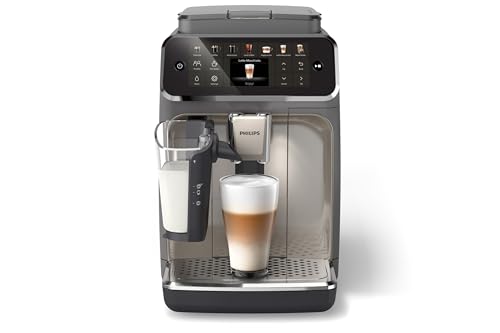
Philips 4400 Series Fully Automatic Espresso Machine with LatteGo (EP4444/90) — Best Overall for Home Use
The 4400 is the home-use sweet spot: enough menu for a varied household, quiet enough for dawn, and a milk system whose cleanup takes seconds, which is why it will still be clean in year three. It suits couples and families alike. Households wanting the largest menus should look at the Eletta class in the sibling guides; the simplest homes can step down to the 3300.
Strengths
- 12 hot and iced presets hit the menu size most households actually use
- SilentBrew tuning makes it one of the quietest grinders in this guide
- LatteGo milk system plus Quick Start — fast and nearly chore-free
Trade-offs
- Black chrome finish shows fingerprints and asks for a wipe
- Menu depth sits between the 3300 and 5500 — know which you need
- Ceramic grinder still prefers non-oily, medium-roast beans
| Specification | Detail |
|---|---|
| Type | Fully automatic bean-to-cup |
| Recipes | 12 hot & iced presets |
| Grinder | Integrated grinder, SilentBrew |
| Milk | LatteGo system |
The 4400 is the considered middle of the Philips range: a dozen presets including iced drinks, profiles enough for a couple, and SilentBrew engineering that genuinely lowers grinding noise — a feature you appreciate every single morning at 6 a.m. The LatteGo carafe keeps milk ownership painless, Quick Start trims heat-up waiting, and the black chrome finish looks like a premium appliance rather than a coffee robot. For a two-drinker household that wants variety without the flagship tier, this is the balanced buy in the Philips line. For readers weighing the automatic espresso machines for home use, its best overall for home use case rests on exactly this pattern of daily performance rather than on any single headline feature.
Best for: most households wanting variety without chores. / Not suited for: buyers seeking the biggest menu or the smallest budget.
Check the current price on Amazon

De’Longhi Eletta Explore Espresso Machine — Best for Families
For the family whose members order like a café queue — one travel mug, one cappuccino, one iced drink, one espresso — the Eletta Explore ends the appliance arms race by covering everything with profiles to match. It suits larger homes and entertainers. Its scale is wasted on a quiet couple, who should take the 4400 and the savings.
Strengths
- 50+ one-touch recipes — the largest menu in this guide by a wide margin
- Hot and cold frother covers everything from cappuccino to cold foam creations
- Four user profiles and a travel-mug-friendly design for busy households
Trade-offs
- Flagship tier pricing
- A menu this large takes time to explore — many drinks will never be used
- Larger presence on the counter than compact automatics
| Specification | Detail |
|---|---|
| Type | Fully automatic bean-to-cup |
| Recipes | 50+ one-touch recipes |
| Profiles | 4 user profiles |
| Milk | Hot & cold frother |
The Eletta Explore is the maximalist’s automatic: more than fifty recipes, cold extraction drinks and cold foam alongside the hot classics, profiles for four drinkers, and a design that accommodates a travel mug on the way out the door. Cold drinks are its party trick — the cold froth and cold-brew-style options are executed properly, not as afterthoughts — while hot espresso remains firmly in De’Longhi’s convincing house style. It is a lot of machine, priced accordingly, and it makes sense precisely for households that will actually roam its menu: families, entertainers, and anyone whose coffee order changes with the weather. For readers weighing the automatic espresso machines for home use, its best for families case rests on exactly this pattern of daily performance rather than on any single headline feature.
Best for: large families with varied orders. / Not suited for: small, quiet households.
Check the current price on Amazon

Philips 3300 Series Fully Automatic Espresso Machine with LatteGo (EP3341/50) — Best Easy Ownership
The 3300 is the recommendation for households honest about maintenance: they will do a little, gladly, and nothing elaborate. Philips obliges with the simplest milk system and prompts that read like plain language. It suits busy couples and shared homes. Personalisation devotees should take the Dinamica Plus below.
Strengths
- Five hot and iced presets cover the drinks most homes actually make
- LatteGo tube-free milk system with dishwasher-friendly cleanup
- Customisable strength and milk settings without menu-diving
Trade-offs
- Smaller menu than the 4400 and 5500 above it in the range
- No multi-user profile depth for large households
- Ceramic grinder is happiest with medium roasts
| Specification | Detail |
|---|---|
| Type | Fully automatic bean-to-cup |
| Recipes | 5 hot & iced presets |
| Grinder | Ceramic grinder |
| Milk | LatteGo system |
The 3300 is the sweet spot of the current Philips range for many homes: the same LatteGo convenience and ceramic grinder as its bigger siblings, a menu that includes iced options, and controls a guest can operate without instruction. Shots are clean and consistent, milk drinks take under a minute of actual attention, and the machine’s cleaning prompts are clear enough that owners actually follow them — which is why these machines age well. Choose it over the 3200 for the newer interface and iced range; choose the 4400 or 5500 only if profiles and a bigger menu will genuinely be used. For readers weighing the automatic espresso machines for home use, its best easy ownership case rests on exactly this pattern of daily performance rather than on any single headline feature.
Best for: busy homes wanting the lightest ownership routine. / Not suited for: deep customisers.
Check the current price on Amazon

De’Longhi Dinamica Plus Fully Automatic Espresso Machine — Best for Personalised Homes
Dinamica Plus fits the household of connoisseurs-by-accident: nobody calls themselves a barista, yet everyone has opinions, and four profiles store them all. The app’s bean-dialling guidance is genuinely used in such homes. It suits opinionated multi-drinker households. Solo drinkers should save with the 3300.
Strengths
- 24+ recipes and up to four user profiles — the deepest personalisation in the De’Longhi picks
- Automatic milk steam wand with three froth modes for different drinks
- App-connected recipe tweaking for households that love to fine-tune
Trade-offs
- Premium tier within the De’Longhi range
- Feature depth is wasted on one-drink households
- Connected features need the app to unlock their full value
| Specification | Detail |
|---|---|
| Type | Fully automatic bean-to-cup |
| Recipes | 24+ recipes |
| Profiles | Up to 4 user profiles |
| Milk | Automatic steam wand, 3 froth modes |
Dinamica Plus is De’Longhi’s flagship argument: a menu past two dozen drinks, four profiles that remember everything down to froth mode, and an automatic milk wand that adjusts texture for cappuccino versus latte rather than foaming everything the same way. The connected app sounds like garnish and turns out to be genuinely useful for dialling a new bean once and saving it. Shots are rich and consistent, and the machine manages its own rinsing and prompts with unusual clarity. It is the De’Longhi for households that treat the coffee machine like a shared family appliance with individual tastes. For readers weighing the automatic espresso machines for home use, its best for personalised homes case rests on exactly this pattern of daily performance rather than on any single headline feature.
Best for: multi-drinker homes with individual tastes. / Not suited for: solo or single-taste households.
Check the current price on Amazon

De’Longhi Magnifica Start Automatic Espresso Machine — Best Proven Value
Choose the Magnifica Start when proven-ness is the priority: this platform has lived in millions of kitchens, its quirks are documented, its parts are everywhere, and its weekly routine is a known, light quantity. It suits first-time buyers and reliability-first homes. Feature seekers will find touchscreens and cold froth in the Duo class above it.
Strengths
- Five one-touch recipes including iced options, with 13 grind settings to dial in beans
- De’Longhi’s proven Magnifica platform — the most widely owned automatic family in this guide
- Straightforward controls a first-time automatic owner masters in a day
Trade-offs
- Milk frothing on this configuration is the simpler system — check the exact listing variant
- Bean hopper and tank are sized for moderate households
- Exterior finish is practical rather than premium
| Specification | Detail |
|---|---|
| Type | Automatic bean-to-cup |
| Recipes | 5 one-touch recipes |
| Grinder | Built-in, 13 settings |
| Milk | Milk frother (see listing variant) |
The Magnifica Start is De’Longhi’s invitation model, and it is a generous one: the same core brew unit that made the Magnifica name, thirteen grind settings — more dial-in range than most rivals at the tier — and five one-touch recipes that include iced coffee. It suits buyers who want a real automatic without paying for touchscreen theatre. The ownership routine is the classic De’Longhi one: rinse the brew group monthly, descale when prompted, keep the grounds bin emptied. Do that and a Magnifica is a decade-class appliance, which is why the family name keeps reappearing in guides like this one. For readers weighing the automatic espresso machines for home use, its best proven value case rests on exactly this pattern of daily performance rather than on any single headline feature.
Best for: reliability-first and first-time buyers. / Not suited for: buyers wanting the newest features.
Check the current price on Amazon

Jura E8 Piano Black (15648) — Best Premium for Home
The piano black E8 suits the home where the machine is also furniture: it disappears into dark cabinetry, runs quietly, and serves the best straight espresso in this guide to the household’s most critical drinker. Its tablet-based cleaning suits owners who prefer a sealed, prompted system. It asks premium money and Jura-ecosystem commitment; value-led homes are better served above.
Strengths
- The E8’s 17-drink menu and pulse extraction in a piano black finish
- Same Swiss refinement and quiet operation as the chrome version
- Suits modern, dark-toned kitchens where chrome looks out of place
Trade-offs
- Gloss black shows fingerprints and dust more than chrome
- Same Jura ownership system: filters and cleaning tablets are ongoing costs
- Premium tier, as with all Jura machines
| Specification | Detail |
|---|---|
| Type | Fully automatic bean-to-cup |
| Recipes | 17 drinks |
| Finish | Piano Black |
| Model | E8 15648 |
Mechanically and in the cup, this is the E8: pulse-extracted espresso with unusual sweetness, seventeen customisable drinks, and Swiss fit and finish. The piano black finish is the reason to choose this listing — it disappears into a modern kitchen the way chrome never will, at the price of showing every fingerprint until you learn the microfibre habit. Everything said about the E8’s ownership applies: follow Jura’s prompted filter and tablet routine and the machine rewards you with the most café-convincing drinks in this guide, year after year. For readers weighing the automatic espresso machines for home use, its best premium for home case rests on exactly this pattern of daily performance rather than on any single headline feature.
Best for: design-led, espresso-first premium homes. / Not suited for: budget buyers or tap-rinse loyalists.
Check the current price on Amazon
Comparison Table
| Pick | Badge | Key spec | Best for |
|---|---|---|---|
| Philips 4400 Series Fully Automatic Espresso Machine with LatteGo (EP4444/90) | Best Overall for Home Use | 12 hot & iced presets | most households wanting variety without chores. |
| De’Longhi Eletta Explore Espresso Machine | Best for Families | 50+ one-touch recipes | large families with varied orders. |
| Philips 3300 Series Fully Automatic Espresso Machine with LatteGo (EP3341/50) | Best Easy Ownership | 5 hot & iced presets | busy homes wanting the lightest ownership routine. |
| De’Longhi Dinamica Plus Fully Automatic Espresso Machine | Best for Personalised Homes | 24+ recipes | multi-drinker homes with individual tastes. |
| De’Longhi Magnifica Start Automatic Espresso Machine | Best Proven Value | 5 one-touch recipes | reliability-first and first-time buyers. |
| Jura E8 Piano Black (15648) | Best Premium for Home | 17 drinks | design-led, espresso-first premium homes. |
How to Choose the Best Automatic Espresso Machines for Home Use, Long-Term
Think in years and design for your worst week, not your best. During the busiest, tiredest week of your year, will this machine still get its milk system rinsed? If the honest answer is ‘barely’, choose the simplest system — LatteGo — and never apologise for it. If your household reliably enjoys a small ritual, a carafe or a wand adds foam quality you will taste daily. The machine that survives your worst week is the best machine for your home.
Weight the support ecosystem as heavily as the drinks. An automatic contains pumps, valves, and seals; over a long home life it may want a service or a part. De’Longhi and Philips machines benefit from enormous installed bases and parts pipelines; Jura offers a premium, structured service path. A slightly less exciting machine from a deeply supported platform is, for home use, usually the wiser purchase than a exotic import with a brilliant menu and no local parts.
Finally, budget the whole ownership in one view: machine, filters or descaler for the first year, and the beans you will actually buy. Automatics reward good beans disproportionately — the difference between supermarket-fresh and months-old beans is the difference between the reviews you read and the cup you get. Buy the machine one class below your maximum if it lets you buy fresh beans forever; that trade wins in the cup every single morning.
How to Run a Home Automatic Week After Week: The Five-Minute System
Daily, the machine mostly runs itself: it rinses on wake and sleep, asks for the grounds bin to be emptied, and wants the milk system rinsed or refrigerated after use. Honour those three prompts and you have done ninety percent of home maintenance. Add one human habit — a wipe of the drip tray area while the kettle boils — and the machine never looks tired.
Weekly, spend the five minutes: wash the drip tray, grounds container, and water tank in hot soapy water; wash the milk carafe or LatteGo parts; wipe the machine’s exterior and the counter beneath it. Check the bean hopper and top it from your sealed store. This single ritual, attached to an existing moment in the week, is the difference between machines that taste clean for years and machines that slowly turn bitter.
Monthly and seasonally, follow the machine’s lead: rinse the brew unit or run its cleaning tablet, replace the water filter on its schedule, and descale the moment the prompt appears. Keep the consumables — one filter, one descaler dose, one cleaning tablet set — in the cupboard with the beans, so a prompt never waits on a delivery. Homes that stock the shelf keep the schedule; homes that order on demand drift, and drift is how good machines become disappointing ones.
Consistency Science: Why Automatics Taste the Same Every Day
The deepest pleasure of a good automatic is not its best cup but its thousandth: the machine doses by weight or timed grind, tamps with the same force, heats to the same temperature, and extracts for the same duration, on a tired Tuesday exactly as on a keen Saturday. Human baristas — even good ones — vary; the machines in this guide barely do, once dialled in. That consistency is why households report that their average coffee quality rises more from an automatic than from any single bag of exceptional beans.
Consistency has a shadow side worth understanding: the machine faithfully reproduces its settings, including mediocre ones. A grind one step too coarse will be served, identically, forever, until a human intervenes — which is why this guide’s dialling-in ritual matters and why profiles that store the good settings are worth money in multi-drinker homes. The machine is an amplifier: give it a great setting and fresh beans and it amplifies excellence; give it drift and it amplifies drift.
Bean ageing is the main source of that drift in home use. As a bag rests after opening, its ideal grind shifts subtly finer, and a household that notices its drinks thinning across a fortnight is tasting chemistry, not machine failure. The correction is one grind step, made once, mid-bag. Owners who learn this single adjustment report the eerie experience of a machine that seems to improve with age — it is not improving; they are conducting it.
Water: The Ingredient Nobody Buys but Everybody Tastes
Coffee is overwhelmingly water, and home water decides more of an automatic’s flavour — and lifespan — than any feature on its box. Too hard, and scale coats the heating system, temperatures sag, extraction sours, and the machine begins its slow decline months before any prompt complains. Too soft or heavily filtered to purity, and extraction tastes flat and thin, because coffee needs some mineral content to carry flavour into the cup.
The machines in this guide manage water two ways: filtration cartridges that reduce scale while keeping a sensible mineral balance — the Philips and Jura approach — and prompted descaling that removes what filtration misses, universal across the picks. The home user’s job is simply to cooperate: fit the filter if offered, declare your water hardness honestly at setup so prompts arrive on schedule, and never treat a descale prompt as decoration. In genuinely hard-water homes, the filter is not an accessory; it is the machine’s life insurance, priced like a bag of beans.
Taste is the audit that tells you the system is working: drinks that dull gradually over months, in a machine whose cleaning is current, usually trace to water — an exhausted filter or overdue descale. Restore the water and the machine you bought comes back. It is the cheapest resurrection in home coffee, and the one most often mistaken for a failing machine.
Teaching the Household: The First-Week Curriculum
A home automatic has as many operators as the household has drinkers, and its long-term health depends on the least careful of them. The first-week curriculum that works is short enough to survive contact with real life: lesson one, make your drink — the intuitive interfaces on the Philips and De’Longhi picks here mean this lesson takes two minutes. Lesson two, leave no trace — rinse the milk part you used, wipe the wand you frothed with, and if the machine asks for the bin, empty the bin. Lesson three, prompts are instructions — whoever sees a cleaning or descale message either acts on it or tells the household’s maintainer that day.
Notice what the curriculum omits: settings. Grind, strength defaults, and profiles are set once by the household’s most interested drinker during the dialling-in week and then left alone. The fastest way to make a shared machine taste permanently mediocre is five people adjusting it by feel. Put a small note of the agreed settings inside the bean cupboard door and the machine’s consistency — its great virtue — survives its democracy.
Homes that run this tiny curriculum report a specific domestic miracle: the machine simply works, for everyone, for years, and coffee stops being a topic of household negotiation at all. That quiet outcome — not the menu, not the touchscreen — is the true product a home automatic sells, and every pick in this guide was chosen because its design makes the curriculum easy to keep.
Warranties, Service, and What to Expect Over the Years
Home-use buyers should read an automatic’s support story as part of the product. The makers in this guide — De’Longhi, Philips, Jura, and their peers in the wider family — support their machines with parts pipelines, authorised service networks, and consumables that remain available for years after a model launches, because their installed bases are enormous. That ecosystem is invisible at purchase and decisive in year five, when a seal, a valve, or a grinder part is the difference between a repair and a replacement.
Warranties in this category typically cover defects for a defined initial period, with the practical understanding that documented maintenance — descaling performed, prompts honoured — keeps both the machine and the paperwork healthy. Keep the purchase record with the manual, register the machine if the maker offers it, and treat the first prompted descale as the start of a service diary rather than a nuisance. Households that can show a maintained machine meet a very different service conversation from those that cannot.
Set expectations realistically and the ownership is calm: consumables are a small annual cost, a professional service across a long life is possible rather than inevitable, and the common failures — scale, seals, a tired milk carafe — are the preventable or replaceable kind. The machines in this guide were chosen partly on the depth of the support behind them, because for home use, the best machine is the one somebody can fix in year seven.
A Seasonal Calendar for Your Home Automatic
A home machine tastes best when its menu follows the year, and the seasons give the household a pleasant rhythm of small changes. Spring is for lighter roasts and the first iced drinks: drop the grind a step finer for the brighter beans, and let the brew-over-ice recipes on machines like the Dinamica earn their place as afternoons warm. Spring is also the natural moment for the deep clean — filter changed, brew unit washed, milk system sanitised — a spring clean for the appliance that fuels all the others.
Summer belongs to cold drinks: cold foam if your machine offers it, iced lattes as the house standard, and an affogato appearing after dinners as if it had always lived there. Watch water use — tanks empty faster in iced season — and rinse milk parts with extra diligence in the heat. Autumn returns the menu to warmth and depth: chocolate-leaning beans, cappuccinos with properly textured foam, and the first spiced drinks of the year, which an automatic’s consistent shot carries beautifully.
Winter is the machine’s peak season and its maintenance exam: holiday guests multiply the drink count, so service the machine before the season — descale done, filter fresh, a spare carafe gasket in the drawer — and it will sail through the entertaining weeks. A household that keeps this gentle calendar finds the machine never has a bad month, because each season’s small attentions prevent the next season’s faults.
Knowing When to Upgrade: Signs Your Household Has Outgrown Its Machine
The honest final question of home use is when a good machine stops being the right machine. The clearest sign is volume: the tank that empties daily, the queue at the machine on family mornings, the profiles you wish existed. Households grow into machines like the Eletta and Dinamica Plus in this guide’s family, and upgrading within a brand you trust keeps the maintenance habits you have built. The second sign is menu: a household that has taken up iced drinks, or decaf evenings, or hosting in earnest, has outgrown a focused menu through no fault of the machine.
The third sign is subtler — the enthusiast’s itch. One drinker begins timing shots and reading about extraction; the automatic has done its teaching job and created a barista. That household does not replace the automatic; it adds a manual setup beside it, and the automatic remains the family’s machine while the enthusiast plays. Recognising this prevents the classic error of selling a beloved household appliance to fund one person’s hobby.
When none of the signs apply, the correct upgrade is usually beans. A household whose machine is maintained, whose menu fits, and whose drinks have merely plateaued is one great fresh bag away from falling in love again. Automatics reward loyalty because their consistency compounds: the tenth year of a kept machine, fed well, is often its most satisfying — which is the entire philosophy of home use in one sentence, and the note on which this guide is happy to end.
Keeping a Simple Maintenance Diary (and Why It Pays)
The households whose machines age best share one unglamorous artefact: a note — on paper inside the cupboard door or in a phone — recording three dates: when the filter was changed, when the last descale ran, and when the current bag of beans was opened. Three dates, updated in seconds, transform maintenance from memory into system. The filter date prevents the slow flavour fade of an exhausted cartridge; the descale date settles every ‘didn’t we just…?’ argument before it starts; the bean date ends the blaming of grinders for stale coffee.
The diary also protects warranties and resale. A machine offered second-hand with a written maintenance history is the used market’s unicorn — the one that sells quickly and dear — because it answers the buyer’s every fear in the seller’s own handwriting. Should a service conversation ever arise, the same three dates demonstrate the documented care that makers ask for, in the only form that cannot be argued with.
Start it with the machine’s first week and attach it to the five-minute weekly system described in this guide: glance at the dates while the tray washes, update what changed, done. It is the cheapest accessory in home coffee — a pencil — and across a decade of home use it may be the most valuable one in this entire article.
Sustainability at Home: Grounds, Waste, and the Long-Lived Machine
A home automatic is, by the standards of modern appliances, a quietly sustainable object — provided its household completes the thought. Its daily waste is a puck of spent grounds, which composts beautifully and returns coffee’s nitrogen to a garden rather than a landfill; households with houseplants can use cooled, diluted rinse water the same way. Against the capsule alternative — a manufactured, packaged, transported single-use container per drink — the arithmetic is not close, and regular pod households feel the difference in their bins within a month.
The machine itself extends the argument: a durable appliance, maintained on the light rhythm this guide describes and supported by its maker’s parts pipeline, displaces the cycle of cheap machines bought and discarded. Longevity is the deepest sustainability feature any product can have, and it is purchased not with money but with the five weekly minutes and the stocked cupboard shelf this guide keeps recommending. The greenest machine is the one still in service in year ten.
Even the consumables cooperate when chosen sensibly: filters and descaler bought in modest multiples reduce packaging and trips, and beans bought fresh from a local roaster travel fewer miles than pods ever will. None of this requires virtue signalling or sacrifice — the sustainable pattern and the delicious pattern are, in home coffee, the same pattern, which is perhaps the most encouraging sentence in this guide.
A Note on Patience: The Machine Rewards the Household That Learns It
Every theme in this guide converges on one unglamorous virtue: patience. Patience to dial in the first bag across days rather than drinks. Patience to run the rinse, change the filter, and descale on the prompt rather than the postponement. Patience to teach every drinker in the house the same three habits, so the machine’s consistency is met by the household’s. Automatics are often sold as the impatient choice — coffee without the craft — but their long, happy service belongs to households that discover the small patiences inside the convenience.
The reward structure is honest: nothing here asks for much, and everything here repays exactly what it asks. Five minutes a week buys years of clean-tasting coffee. One careful week of dialling buys a standard of drink that cafés charge daily rent for. A pencil-note of three dates buys a warranty-proof, resale-ready ownership story. There is no step in this guide that a busy household cannot perform, and no step whose omission the machine will not eventually report in the cup.
Choose, then, not merely a machine but the version of your household that will own it well — and choose the machine whose demands match that household’s real patience, whether that is the LatteGo’s near-zero ask or a carafe’s small daily ritual. The six picks here span that range deliberately. Match them honestly, and the best automatic espresso machine for your home use will still be earning the title long after this guide’s publication date is a memory.
The Short Version: Home Use, Distilled
The whole guide compresses into a shortlist by temperament. The balanced household: Philips 4400. The large, varied family: Eletta Explore. The light-maintenance home: Philips 3300. The house of individual tastes: Dinamica Plus. The reliability-first buyer: Magnifica Start. The premium, design-led, espresso-first home: the piano black Jura E8. Each recommendation is argued fully above; this distillation exists so the decision can be revisited at a glance, ideally with the household’s drink tally written beside it.
And the disciplines compress too: fresh beans in small, sealed quantities; one dialling-in ritual per bag; five minutes of cleaning a week, attached to a moment that already exists; prompts obeyed the day they appear; consumables stocked in the coffee cupboard. Five habits, none burdensome, jointly sufficient to keep any machine in this guide performing like new for years. Home use rewards exactly this kind of steady, unglamorous faithfulness — from the machine, and to it.
Common Buying Mistakes
Buying for the dinner party, not the weekday. A machine sized for annual entertaining but wrong for daily drinks fails 360 days a year. Buy for your ordinary mornings; guests adapt happily.
Hiding maintenance supplies ‘somewhere safe’. If the descaler is not in the coffee cupboard, the prompt gets postponed. Stock filters, tablets, and descaler beside the beans.
Feeding it bargain stale beans to save money. An automatic faithfully extracts whatever it is given. Fresh mid-range beans in a mid-range machine beat stale premium beans in a flagship, every morning.
Letting one person be the machine’s only operator. When the one expert travels, the machine gets misused or unused. Teach the whole household the basics in the first week.
Postponing descaling ‘until the weekend’ repeatedly. Scale accrues interest. The prompt weekend is the deadline, not the start of negotiations — run the cycle and protect the machine’s heating system.
Final Recommendation
For most households, the Philips 4400 is the best automatic espresso machines for home use pick — varied, quiet, and nearly chore-free. Families should take the Eletta Explore, light-maintenance homes the Philips 3300, personalised households the Dinamica Plus, reliability-first buyers the Magnifica Start, and premium espresso homes the piano black Jura E8. Keep the five-minute weekly system, stock the cupboard shelf, and any of these machines will repay you for years. The closest sibling guides refine the same shortlist: Best Automatic Espresso Machines For Home, Best Automatic Espresso Machines, Best Auto Espresso Machines, Best Automatic Espresso Coffee Machines, and Best Espresso Machines.
Frequently Asked Questions
How long do automatic espresso machines last in home use?
Quality models here are built for many years of daily drinks. Lifespan is decided mostly by maintenance rhythm — rinsing, filter changes, and prompt descaling — and by sensible beans. Neglected machines fail early regardless of brand.
What is the easiest automatic to own at home?
The Philips LatteGo models — the 3300 and 4400 here — because their milk system has two parts and no tubes, and their prompts are plain. De’Longhi’s removable brew unit is a close second for owners who like a rinse-under-the-tap routine.
Do I need a water filter if I descale regularly?
A filter reduces how often descaling is needed and protects flavour in hard-water areas; descaling remains necessary eventually on most systems. Follow your machine’s stated schedule — the two work as partners, not substitutes.
Can one machine serve a family with different tastes?
Yes — profiles are the feature to look for. The Eletta Explore and Dinamica Plus here store four drinkers’ preferences each, so strength, size, and milk settings are one touch per person.
Are automatic machines economical for home use?
Against café prices and pod costs, strongly yes for daily drinkers: fresh beans per cup cost a fraction of either. The machine’s tier is repaid by volume, which is why matching menu size to real household volume matters.
What should I stock alongside a home automatic?
Fresh beans in a sealed container, one spare water filter, descaler, cleaning tablets if your system uses them, and a microfibre cloth by the machine. That small shelf is the entire secret of painless long-term ownership.


