Disclosure: airfryerkitchensupply.com is reader-supported. When you buy through links on our site, we may earn an affiliate commission at no extra cost to you.
Where to buy
Every set below was checked two ways: the listing was confirmed through Amazon’s own product data, and the country-of-origin claim was checked against what the maker actually states for that specific line — because a famous American brand name does not mean a specific set was made in America. Where a well-known brand’s set is imported, we say so in this guide rather than quietly including it. Follow the links to the exact set named, confirm the piece list on the listing, and check price on Amazon before you buy.
- All-Clad D3 Stainless Steel 10-Piece Cookware Set — check price on Amazon
- Heritage Steel 10-Piece Cookware Set — Titanium Series — check price on Amazon
- All-Clad D5 Stainless Steel 10-Piece Cookware Set — check price on Amazon
- Heritage Steel Eater Series 8-Piece Core Set — check price on Amazon
- All-Clad D3 Stainless Steel 7-Piece Cookware Set — check price on Amazon
- Heritage Steel 5-Piece Essentials Cookware Set — Titanium Series — check price on Amazon
If you are shopping for the best american made cookware sets, the first honest fact is that this is a much smaller field than the marketing suggests. Most famous cookware brands — including several founded in the United States — manufacture most of their sets overseas, and a set’s box will rarely volunteer that information in large print. The genuinely American-made clad stainless field is dominated by two makers: All-Clad, whose bonded stainless steel cookware is made in Canonsburg, Pennsylvania, and Heritage Steel, a family-owned maker producing fully clad sets in Clarksville, Tennessee. Between them they account for almost every American-made set worth recommending, and this guide is built around their lines.
That narrow field is actually good news for a buyer. Instead of comparing thirty near-identical imported sets, you are choosing between two clear philosophies. All-Clad offers the broadest range, the longest track record, and tri-ply and five-ply constructions proven in professional kitchens for decades. Heritage Steel counters with five-ply construction throughout, a titanium-strengthened cooking surface on its flagship line, and handles and finishes tuned by a smaller maker that answers its own phones. Both make cookware that should outlast the stove it sits on, both work on induction, and both are repairable, reseasonable-by-scrubbing, coating-free stainless — the buy-it-once end of the cookware market.
One warning before the picks: several brands use ‘designed in the USA’, ‘American company’, or a flag on the box while the set itself is made in Italy, China, or elsewhere. One respected brand in this category, Made In, crafts its stainless clad sets in Italy — excellent cookware, but not American-made, so it does not appear below despite its American company story. Every set in this guide is included because that specific set is made in the USA, and the _SOURCES file for this article records the verification behind each pick.
In this guide
Quick Picks
All-Clad D3 Stainless Steel 10-Piece Cookware Set — Best Overall. The benchmark American-made set: tri-ply bonded construction, made in Pennsylvania, with the piece mix most home kitchens actually use daily. If you buy one set on this page, this is the default recommendation. Check the current price on Amazon
Heritage Steel 10-Piece Cookware Set — Titanium Series — Best Premium. Five-ply, fully clad, made in Tennessee, with a titanium-strengthened 316Ti cooking surface that resists salt pitting better than standard stainless. The connoisseur’s American-made set. Check the current price on Amazon
All-Clad D5 Stainless Steel 10-Piece Cookware Set — Best for Even Heat. All-Clad’s five-ply upgrade, also made in the USA: alternating stainless and aluminium layers smooth out hot spots for the most forgiving searing and simmering in this guide. Check the current price on Amazon
Heritage Steel Eater Series 8-Piece Core Set — Best Modern American Set. Heritage Steel’s newer Eater Series: five-ply fully clad, made in the USA, with stay-cool handles and a tight, modern eight-piece core selection with no filler. Check the current price on Amazon
All-Clad D3 Stainless Steel 7-Piece Cookware Set — Best Compact American Set. The D3 essentials in a seven-piece box: the same Pennsylvania-made tri-ply quality, trimmed to the pieces a small kitchen uses constantly. The smart way to buy American-made on a tighter budget. Check the current price on Amazon
Heritage Steel 5-Piece Essentials Cookware Set — Titanium Series — Best Starter Premium Set. The Titanium Series distilled to five essentials: the same 316Ti surface and five-ply body, made in Tennessee, as a starter set you expand over time. Check the current price on Amazon
How These Picks Were Chosen
We started by listing every cookware set sold as American-made, then removed any set whose origin claim applied only to the brand, to a different product line, or to final assembly of imported parts. What survived was checked through Amazon’s product data to confirm the exact set, piece count, and construction. We then ranked the survivors on the things that matter over a twenty-year life: cladding quality and evenness, cooking surface material, handle comfort and security, lid fit, induction compatibility, oven limits, and how complete the piece mix is for real cooking — two useful skillets beat a skillet plus four novelty pieces. Sets were also judged on the honesty of their own claims; makers that state materials and origin plainly scored ahead of makers that hide behind flags and adjectives.
The 6 Best American Made Cookware Sets
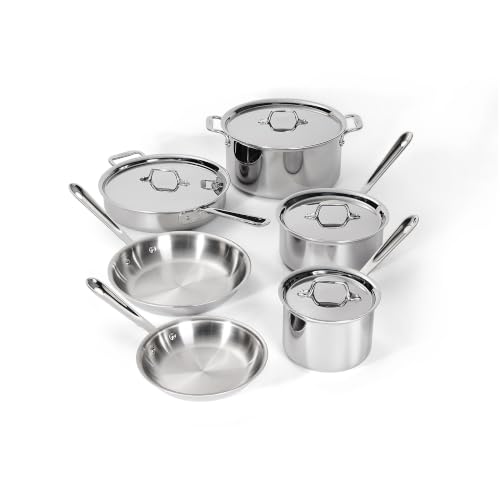
All-Clad D3 Stainless Steel 10-Piece Cookware Set — Best Overall
The D3 10-piece is the set that built All-Clad’s reputation, and it remains the easiest American-made set to recommend. It suits cooks who want one purchase to cover a decade or more of everyday cooking — eggs in the morning, a seared steak at night, a stockpot of soup on Sunday — without coatings to baby or replace. It is less suited to buyers who want the lightest possible pans or a nonstick surface out of the box; stainless asks for a little technique, covered later in this guide.
Strengths
- Tri-ply construction — stainless around an aluminium core — heats evenly without the hot ring cheaper disc-bottom pans produce
- Made in Canonsburg, Pennsylvania, with the consistent fit and finish that made the line a professional standard
- Piece mix is genuinely useful: two skillets, two saucepans with lids, a sauté pan and a stockpot cover most home cooking
Trade-offs
- Stainless cooking surface will stick eggs and fish until you learn preheating and fat timing
- Handles are the classic All-Clad shape — secure, but some hands find the groove uncomfortable under heavy loads
- Lids are stainless rather than glass, so you lift to check simmering food
| Specification | Detail |
|---|---|
| Construction | Tri-ply bonded stainless with aluminium core |
| Pieces | 10-piece set |
| Origin | Made in the USA |
| Compatibility | Induction compatible |
What separates the D3 from imported tri-ply sets is consistency: pan walls are the same thickness piece to piece, lids seat without rocking, and the cooking surface polishes to the same finish year after year. On the stove, the aluminium core spreads heat across the base and a short way up the walls, so sauces scorch less at the edges and a crowded skillet of chicken thighs browns instead of steaming in its own juices at the cool spots. The set is heavy enough to sit flat and resist warping on high heat, yet still light enough for most cooks to toss vegetables one-handed in the smaller skillet. Maintenance is the stainless routine — deglaze, wash, and use a powdered cleanser when rainbow heat tint or polymerised oil builds up. Do that and a D3 set bought today is realistically the last full set you buy, which is the entire economic argument for American-made clad cookware in one sentence.
Best for: cooks who want the proven, do-everything American-made set. / Not suited for: anyone who insists on nonstick convenience or the lightest pans.
Check the current price on Amazon
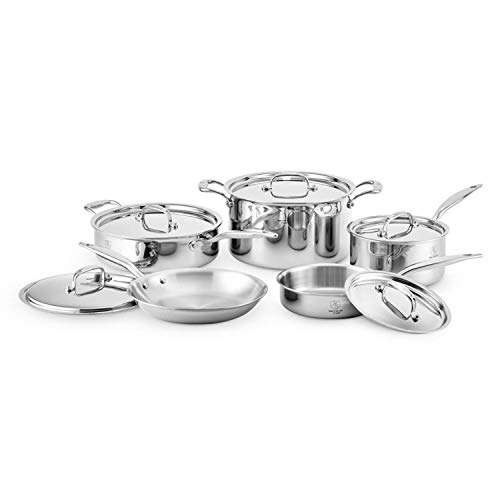
Heritage Steel 10-Piece Cookware Set — Titanium Series — Best Premium
Heritage Steel’s Titanium Series is what happens when a small American maker decides to out-spec the giant. It suits serious home cooks who sear hard, cook acidic sauces for hours, and want the most corrosion-resistant cooking surface in stainless cookware. It is less suited to bargain hunters — this is premium-priced cookware — and to anyone who would not notice or use the difference its surface makes.
Strengths
- 316Ti titanium-strengthened cooking surface resists pitting from salt and long acidic simmers better than common 304 stainless
- Five-ply fully clad construction carries heat up the sidewalls, not just across the base
- Made in Clarksville, Tennessee by a family-owned maker with direct, reachable support
Trade-offs
- Premium pricing puts it above every other set in this guide
- Five-ply pieces are noticeably heavier, especially the larger pans when full
- Smaller retail presence — you are buying from a specialist maker, not a department-store brand
| Specification | Detail |
|---|---|
| Construction | 5-ply fully clad stainless |
| Surface | 316Ti titanium-strengthened stainless |
| Pieces | 10-piece set |
| Origin | Made in USA |
| Compatibility | Induction ready |
The detail that matters here is the cooking surface. Most stainless cookware uses 304-grade steel inside; Heritage Steel’s Titanium Series uses 316Ti, a grade with titanium stabilisation that shrugs off the chloride pitting that can mark lesser pans when salted water sits in them. In daily cooking the five-ply body behaves like the best clad pans anywhere: responsive enough to pull a pan off the heat and stop a garlic scorch, stable enough to hold a gentle simmer without constant adjustment. Handles stay comparatively cool and are shaped for a full, confident grip. For a cook building a lifetime kitchen around American-made pieces, this set is the enthusiast’s endgame — and its maker publishes exactly what is in the pans and where they are made, which in this category is rarer than it should be.
Best for: serious cooks who want the finest American-made stainless surface available. / Not suited for: budget buyers or anyone who finds heavy pans tiring.
Check the current price on Amazon

All-Clad D5 Stainless Steel 10-Piece Cookware Set — Best for Even Heat
The D5 takes the D3 formula and adds two more layers — five alternating layers of stainless and aluminium — trading a little responsiveness for noticeably more even heat. It suits cooks on powerful gas burners or uneven electric elements, and anyone whose sauces scorch at the edges in thinner pans. If your stove is gentle and your cooking simple, the D3 gives you most of this for less; the D5 earns its keep in demanding, heat-sensitive cooking.
Strengths
- Five-ply alternating construction is the most even-heating body in this guide
- Brushed stainless exterior hides the fine scratches that polished pans show within months
- Oven safe to high temperatures and induction compatible, per the maker’s listing
Trade-offs
- Slightly slower to respond to burner changes than tri-ply — heat is buffered, for better and worse
- Heavier than the D3 across every comparable piece
- Costs more than the D3 for a difference gentle cooking may never reveal
| Specification | Detail |
|---|---|
| Construction | 5-ply bonded stainless and aluminium |
| Pieces | 10-piece set |
| Origin | Made in the USA |
| Oven safe | Up to 600°F |
| Compatibility | Induction compatible |
Think of the D5 as the D3 with a flywheel: the extra aluminium layer stores and redistributes heat, so a risotto simmers edge-to-edge at the same lazy bubble and a thick steak’s crust forms evenly even over a burner smaller than the pan. That buffering cuts both ways — when you drop the heat to save a butter sauce, the pan coasts a little longer before it responds — and experienced cooks adjust by moving the pan, not just the dial. The brushed finish is the pragmatic choice for a working kitchen, aging gracefully where mirror finishes catalogue every scratch. Like the D3 it is made in Pennsylvania, fully coating-free, and built to be inherited. Choose it over the D3 if your cooking leans on delicate sauces, candy, custards, or high-heat searing on imperfect burners.
Best for: heat-sensitive cooking and powerful or uneven burners. / Not suited for: cooks who prize instant responsiveness or light weight above evenness.
Check the current price on Amazon

Heritage Steel Eater Series 8-Piece Core Set — Best Modern American Set
The Eater Series is Heritage Steel’s answer for cooks who want American-made five-ply quality in a curated core set rather than a big box count. It suits smaller households, induction owners, and anyone who would rather have eight excellent pieces than fourteen mixed ones. Buyers who regularly cook for a crowd should look at the ten-piece sets above for the extra capacity.
Strengths
- Five-ply fully clad construction, made in the USA, in a filler-free core selection
- Stay-cool handle design is a genuine comfort upgrade during long stovetop sessions
- Induction ready and coating-free — nothing to wear out, flake, or replace
Trade-offs
- Eight pieces leaves out the big stockpot some families use weekly
- Newer line, so the decades-long owner track record of the flagship series is still being written
- Premium small-maker pricing for the piece count
| Specification | Detail |
|---|---|
| Construction | 5-ply fully clad stainless steel |
| Pieces | 8-piece core set |
| Origin | Made in USA |
| Compatibility | Induction ready |
Core sets live or die on whether the pieces match real cooking, and the Eater selection does: the pans you reach for on a Tuesday are all here, sized for one-to-four-person cooking. The five-ply body gives the same even, forgiving heat as the flagship line, and the stay-cool handles make a tangible difference when a saucepan lives on the burner through a long reduction. Because the set is coating-free stainless, it tolerates metal utensils, high searing heat, and the dishwasher when you are tired — though hand washing keeps any clad pan looking its best. For a first serious American-made set in a smaller kitchen, this is the modern, no-filler route in.
Best for: smaller households wanting American-made five-ply quality without filler pieces. / Not suited for: large families who need stockpot capacity in the box.
Check the current price on Amazon
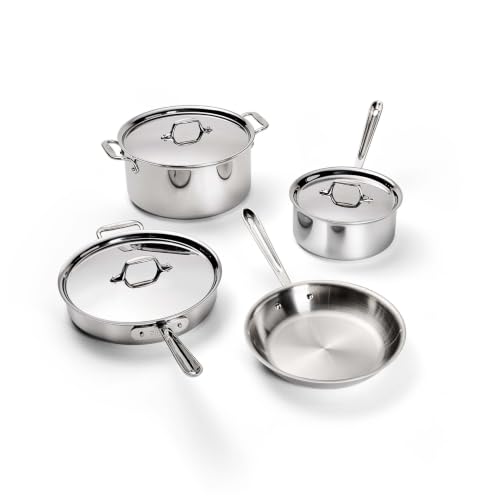
All-Clad D3 Stainless Steel 7-Piece Cookware Set — Best Compact American Set
Not everyone needs ten pieces, and the D3 7-piece proves the point: it keeps the construction, materials, and American manufacture of the flagship set and trims the count. It suits singles, couples, small kitchens, and buyers who would rather start with fewer genuine pieces and add individual pans later. If you regularly run three burners at once for family meals, step up to a ten-piece set instead.
Strengths
- Same made-in-USA tri-ply D3 construction as the 10-piece, at a lower entry point
- Induction compatible and oven safe to high temperatures, per the maker’s listing
- Every piece earns its storage space — no novelty filler
Trade-offs
- You will eventually want a larger stockpot or second skillet — budget for additions
- Same stainless learning curve as the full D3 set
- Seven-piece count includes lids, as with all sets in this guide
| Specification | Detail |
|---|---|
| Construction | Tri-ply bonded stainless |
| Pieces | 7-piece set |
| Origin | Made in the USA |
| Oven safe | Up to 600°F |
| Compatibility | Induction compatible |
Buying the smaller D3 set is the budget strategy this guide recommends most: because All-Clad sells open-stock pieces, a seven-piece start is not a compromise you are locked into — it is the foundation of a collection you extend pan by pan, all matching, all American-made. The cooking behaviour is identical to the larger set: even heat, confident searing, deglazing that lifts fond into sauces instead of leaving it welded to the pan. Storage is easier, the sink is less full, and the cost of entry to genuinely American-made clad cookware drops to its lowest honest point in this guide. For a two-person household, this may simply be the correct set, full stop.
Best for: singles, couples, and small kitchens starting an American-made collection. / Not suited for: cooks who routinely need many large vessels at once.
Check the current price on Amazon
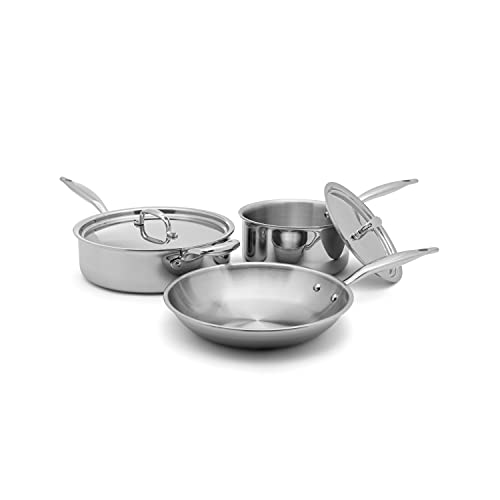
Heritage Steel 5-Piece Essentials Cookware Set — Titanium Series — Best Starter Premium Set
This five-piece Essentials set is the connoisseur’s starter kit: Heritage Steel’s flagship materials and American manufacture in the smallest complete selection. It suits a cook who prioritises surface quality over piece count — someone who sears and simmers in a couple of core pans daily and plans to add pieces deliberately. It is not a family feast set, and it does not pretend to be.
Strengths
- 316Ti titanium-strengthened surface — the most corrosion-resistant in this guide — in a starter format
- Five-ply fully clad body, made in the USA, induction ready
- Pairs naturally with later open-stock additions from the same maker
Trade-offs
- Five pieces is a starting point, not a complete kitchen
- Highest cost per piece in this guide
- Heavier construction than beginners may expect
| Specification | Detail |
|---|---|
| Construction | 5-ply fully clad |
| Surface | 316Ti stainless |
| Pieces | 5-piece essentials set |
| Origin | Made in USA |
| Compatibility | Induction ready |
Small sets from premium makers are often quietly downgraded; this one is not. The Essentials set uses the same five-ply, titanium-strengthened construction as the ten-piece flagship, so the pan you learn on behaves exactly like the pans you add later. In practice that means superb searing from the skillet, gentle control from the saucepan, and a surface that tolerates salted pasta water and tomato sauces without the pitting anxiety that comes with lesser stainless. Treat it as the first chapter of a lifetime set: buy it, cook on it for a year, then add the exact stockpot or sauté pan your cooking actually demands.
Best for: quality-first cooks building a premium American-made set gradually. / Not suited for: anyone who needs a complete, high-capacity set in one box.
Check the current price on Amazon
Comparison Table
| Pick | Badge | Key spec | Best for |
|---|---|---|---|
| All-Clad D3 Stainless Steel 10-Piece Cookware Set | Best Overall | Tri-ply bonded stainless with aluminium core | cooks who want the proven, do-everything American-made set. |
| Heritage Steel 10-Piece Cookware Set — Titanium Series | Best Premium | 5-ply fully clad stainless | serious cooks who want the finest American-made stainless surface available. |
| All-Clad D5 Stainless Steel 10-Piece Cookware Set | Best for Even Heat | 5-ply bonded stainless and aluminium | heat-sensitive cooking and powerful or uneven burners. |
| Heritage Steel Eater Series 8-Piece Core Set | Best Modern American Set | 5-ply fully clad stainless steel | smaller households wanting American-made five-ply quality without filler pieces. |
| All-Clad D3 Stainless Steel 7-Piece Cookware Set | Best Compact American Set | Tri-ply bonded stainless | singles, couples, and small kitchens starting an American-made collection. |
| Heritage Steel 5-Piece Essentials Cookware Set — Titanium Series | Best Starter Premium Set | 5-ply fully clad | quality-first cooks building a premium American-made set gradually. |
How to Choose an American-Made Cookware Set That Really Is American-Made
Start with the origin claim itself, because it is the whole point of this category. ‘Made in USA’ on a set should mean the pans are manufactured in the United States, not designed, warehoused, or boxed there. Check the specific product line, not the brand: several heritage American brands make their premium clad lines domestically and everything else overseas, and at least one well-known brand in this space crafts its stainless sets in Italy. Makers who manufacture domestically say so precisely, line by line. If a listing is vague — flags, eagles, ‘American company’ — treat the set as imported until proven otherwise.
Next, judge the construction, because origin alone does not cook dinner. Fully clad tri-ply (stainless–aluminium–stainless) is the proven standard: even heat, good responsiveness, sane weight. Five-ply adds buffering and evenness at the cost of weight and a slower response. Disc-bottom pans — a stainless pot with a heat plate welded to the base — are cheaper and cook well enough on the base but scorch at the sidewalls; none appear in this guide. Whichever you choose, confirm induction compatibility if it matters to you: all six sets here are induction ready, which also future-proofs the purchase against a stove change.
Finally, audit the piece mix against your actual week of cooking. Count lids honestly — every maker does — and ask which pieces you would use three times a week. Two skillets in different sizes, two saucepans, and one large vessel cover most households; steamer inserts and novelty pans mostly store. Smaller American-made sets plus open-stock additions, the route offered by the D3 7-piece and Heritage Steel Essentials above, usually beat a giant imported box on both quality and total long-run cost.
How to Season, Preheat and Care for Stainless Cookware So Food Stops Sticking
Stainless is not nonstick, but most sticking is a technique problem with a reliable fix. Preheat the empty pan over medium heat until a flick of water beads and dances across the surface rather than sizzling flat — that is the pan telling you it is ready. Add your oil, let it shimmer for a few seconds, then add the food and, crucially, leave it alone. Protein releases itself once a crust forms; food that will not move is food that is not ready. This single habit eliminates most of the frustration that sends stainless owners back to coated pans.
For eggs and other delicate foods, the same preheat works with a generous film of fat and a slightly gentler temperature once the food goes in. After cooking, deglaze while the pan is warm: a splash of water or wine lifts the browned fond — that is flavour for a pan sauce, and it makes washing nearly effortless. For stuck residue, simmer water in the pan for a few minutes rather than scouring.
Long-term care is simple. Wash with hot soapy water; use a powdered stainless cleanser and a soft sponge when heat tint, water spots, or polymerised oil film appear, and your pans will look new for years. Avoid thermal shock — let a ripping-hot pan cool a little before it meets cold water — and store pieces with a cloth between them if you stack. That is the entire maintenance regime behind cookware that lasts decades.
Tri-Ply vs Five-Ply: What the Extra Layers Actually Do
Every set in this guide is clad, but the two constructions behave differently enough that the choice deserves its own section. Tri-ply — the All-Clad D3 architecture — bonds a single aluminium core between two stainless layers. Aluminium is the heat engine: it conducts quickly and spreads burner energy sideways, while the stainless layers provide the cooking surface and the magnetic exterior induction needs. The result is a pan that responds when you lift it off the heat or drop the burner, which is why tri-ply remains the professional default for sauté work where timing is everything.
Five-ply, used by the D5 and by Heritage Steel throughout, alternates stainless and aluminium twice. The extra aluminium layer does not make the pan dramatically hotter or faster — it makes it calmer. Heat arriving unevenly from a too-small burner or a warped electric element is averaged over more conductive mass before it reaches the food, so the temperature map across the cooking surface tightens. Sauces simmer at the same bubble at the edge as at the centre, and a sugar syrup or custard gains a margin of forgiveness that tri-ply does not offer. The costs are weight — five-ply pieces are the heaviest in this guide — and a slower answer when you cut the heat, because stored heat coasts.
Which should you choose? Cooks who toss, flip, and chase fast reactions at the stove generally prefer tri-ply’s honesty. Cooks who braise, reduce, candy, and simmer — or who cook on powerful gas or uneven electric elements — feel five-ply’s benefit weekly. Neither construction wears out differently, cleans differently, or changes the stainless preheat technique described earlier. It is a handling preference between two excellent answers, which is a pleasant problem and exactly the kind an American-made set should give you.
How to Verify a ‘Made in USA’ Claim Yourself Before You Buy
Because this category attracts vague marketing, here is the five-minute verification routine used to build this guide, so you can apply it to any set you meet elsewhere. First, find the claim for the specific line, not the brand: a maker’s premium clad line may be domestic while its nonstick line is imported, and honest makers publish origin per line. Second, read the exact wording — ‘Made in USA’ is a regulated claim; ‘designed in the USA’, ‘American-owned’, and ‘assembled in the USA with global parts’ are different, weaker statements, and brands choose them carefully.
Third, check the maker’s own product page and the retail listing against each other; the listing-verified titles in this guide’s source file show how plainly the genuine claims read — the D5 and D3 7-piece titles say ‘Made in the USA’ outright, and every Heritage Steel title does the same. Fourth, be suspicious of flags without sentences: imagery is not a claim, and its presence beside silence about origin usually means the origin is not the selling point the imagery implies. Fifth, remember the Italy lesson from this guide’s research: a respected American company can craft its sets in Italy and say so plainly, as Made In does — which is honest, admirable, and still not American-made.
Applied consistently, this routine takes minutes and never embarrasses: the genuinely American-made field is small, stable, and proud of itself, so real claims are easy to find and easy to confirm. If a set resists all five checks, the market has given you your answer — buy one of the six verified sets above, or buy the imported set with open eyes at an imported set’s price, but do not pay an American-made premium for a flag on a box.
Cooking Techniques That Show Off American Clad Stainless
Clad stainless earns its premium in four techniques. The first is the hard sear: a D3 or Heritage Steel skillet, preheated until water dances, gives steaks and chops a deep, even crust because the aluminium core feeds heat back into the surface as the cold meat draws it out — thin pans simply surrender and steam. Pat protein dry, salt it, and give the crust time to form before moving anything; the pan will release the food when the crust is ready, a built-in doneness signal no coating can offer.
The second is deglazing and pan sauce construction. The browned fond that stainless deliberately creates — the thing nonstick prevents — is concentrated flavour waiting for liquid. Wine, stock, or even water, swirled in the hot pan, lifts it into a sauce in ninety seconds. This is the technique that most separates restaurant food from home food, and it is only available on uncoated metal, which is a core reason professional kitchens standardised on clad stainless in the first place.
The third is gentle, even simmering — five-ply’s home ground — where a béchamel or custard cooks at the same pace at the pan’s edge as at its centre, without the scorched crescent that disc-bottom pans print. The fourth is oven finishing: every set here moves from burner to oven without a thought about coatings or handle wraps, so a skillet of chicken can sear on the stove and roast to temperature in one vessel. Master these four and the American-made premium stops being a story about origin and becomes a story about dinner.
Beyond the Set: Building an American-Made Collection by Open Stock
A set is a beginning, and American-made clad rewards the collector’s approach because both makers in this guide sell open-stock pieces built to the same specifications decade after decade. The classic first addition is a larger skillet or a sauté pan in the size your household actually maxes out — you will know which within six months of cooking on the set, because it is the pan you wash mid-meal to reuse. Buy that one piece, in the same line, and the collection effect begins: matching performance, matching care, no orphans.
The second classic addition is capacity where sets compromise: a genuinely large stockpot for the household that makes soup in earnest, or a small saucepan for the cook who melts butter and reheats single portions daily. American-made open stock is priced as the premium product it is, so the discipline is to buy from evidence — a month of noticing what you reach for and find missing — rather than from a sale’s urgency. Pieces bought from evidence get used weekly for decades; pieces bought from urgency get stored.
There is also a quiet financial logic here. A collection assembled over years — set first, then one considered piece at a time — spreads the cost of the finest American cookware across the years it serves, and each piece arrives when the household budget and the cooking both call for it. The sets in this guide were chosen partly as foundations for exactly this path: start with the D3 7-piece or Heritage Steel Essentials if money is tight today, and let time, not credit, complete the kitchen.
Warranty Culture and Lifetime Value Among American Makers
American clad makers compete on a promise imports rarely match: the pan is warranted for a lifetime of cooking, and the maker answers for it from a domestic address. All-Clad’s and Heritage Steel’s warranties cover defects in materials and workmanship for the life of the product — the honest fine print excludes misuse, overheating damage, and cosmetic wear, which is fair, because the failures these warranties exist for are manufacturing failures: a handle weld that gives, a base that delaminates, a lid that never fit. Those are rare in this class, and when they occur, the makers’ reputations rest on resolving them without a fight.
Heritage Steel’s smaller scale cuts both ways in the owner’s favour: support comes from the people who made the pan, and the company’s entire brand is the relationship. All-Clad counters with the infrastructure of a large, long-established maker and a retail network where replacement and advice are easy to reach. Either way, the contrast with disposable cookware economics is stark: the warranty is not a marketing line but the business model — these makers profit when you never need them again.
For the buyer, the practical advice is simple. Register or keep proof of purchase, use the pans as directed — which, for stainless, means almost anything a cook would sensibly do — and contact the maker before discarding a piece with a defect. A cookware set that can be repaired, replaced under warranty, and ultimately handed down is not expensive in any honest accounting; it is the cheapest way to own great pans, purchased once.
Induction Performance: Why American Clad Suits the Modern Hob
Induction cooking rewards exactly the construction American clad makers specialise in. The hob heats the pan’s magnetic layer directly, so a flat, warp-resistant base — the kind D3, D5, and Heritage Steel pieces are built with — couples efficiently and heats with a speed that surprises gas loyalists: water boils startlingly fast, and a skillet reaches searing temperature in about the time it takes to season the meat. Because the energy goes into the pan rather than the room, the evenness of the cladding becomes the whole story, and it is a story these pans tell well.
Responsiveness on induction is the pleasant shock. An induction hob changes power instantly, and tri-ply answers instantly with it, giving a simmer control that rivals gas for delicacy — chocolate melts without a bain-marie, and a sauce held at the barest bubble stays there. Five-ply’s buffering smooths the pulsing some hobs use at low power, which is why delicate cooks on induction often gravitate to the D5 or Heritage Steel end of this guide.
One practical note: induction is unforgiving of warped or domed bases, which sing, spin, and heat unevenly. The long-term flatness of well-made American clad — thick, bonded, and resistant to thermal shock discipline — is therefore not just durability but compatibility insurance. Buy any set in this guide and your next hob, whatever it is, is already accommodated.
The Hand-Down Economy: Resale, Inheritance, and Cost Per Decade
Run the numbers the way estate sales do and American clad cookware behaves like furniture, not consumables. A D3 or Heritage Steel set bought today, used daily, and kept clean remains fully functional and cosmetically respectable in twenty years — which is why used examples change hands at meaningful fractions of their new price while used nonstick changes hands, if at all, as scrap. Owners rarely sell; they hand down, and the second cook in a pan’s life gets the same performance the first one did, because stainless has no performance cliff to fall off.
Cost per decade is the honest comparison this guide wishes more buyers ran. A premium American set amortised across twenty-plus years costs less per year than the cycle of mid-tier sets it replaces — before counting the cooking quality difference, the warranty behind it, or the landfill avoided. The premium is not a luxury tax; it is prepayment, at a discount, for decades of service.
There is a sentimental line in the ledger too, and this guide will not pretend otherwise: pans accumulate family history — the skillet that made a thousand Sunday breakfasts is not interchangeable with a new one. American-made clad is the category where that sentimentality is rational, because the object genuinely lasts long enough to earn it. Buy the set your grandchildren will argue about; in this guide, that is not a metaphor but a product specification.
Common Buying Mistakes
Believing the brand instead of the line. A famous American brand name guarantees nothing about a specific set. Always verify the origin of the exact line you are buying — this guide removed respected names whose sets are imported.
Paying for piece count instead of pieces. A 21-piece imported set with four lids and three utensils is not more cookware than an honest 8-piece clad set. Compare vessels you will actually heat food in.
Judging stainless by the first egg. Stainless sticks when it is under-preheated or the food is moved too early. Learn the water-bead preheat before concluding the pan is at fault.
Skipping induction compatibility. Even if your current stove is gas or electric, induction-ready clad sets keep their value and usefulness when kitchens change. All six picks here qualify.
Using high heat for everything. Clad pans are efficient; medium on a good clad pan does the work of high on a thin one. Excess heat causes heat tint, warping risk, and burnt oil film.
Final Recommendation
For most buyers, the decision is pleasantly simple. The All-Clad D3 10-Piece is the best american made cookware sets pick for the majority of kitchens — proven, complete, and fairly priced for what it is. If you want the finest cooking surface in American stainless and will pay for it, the Heritage Steel Titanium Series 10-Piece is the connoisseur’s set, while the D5 is the choice when even heat matters most. Smaller households should start with the D3 7-Piece or the Heritage Steel Eater Series and grow by open stock. Whichever you choose, you are buying coating-free, induction-ready, American-made cookware that should still be cooking in twenty years — and that, not the flag on the box, is the point. Explore the related guides alongside this one: Best Cookware Sets, Best Stainless Steel Cookware Sets, Best And Affordable Cookware Sets, Best And Cheapest Cookware Sets, and Best Induction Cookware Sets.
Frequently Asked Questions
Are All-Clad cookware sets really made in the USA?
All-Clad’s bonded stainless steel cookware — including the D3 and D5 sets in this guide — is made in Canonsburg, Pennsylvania. Some other All-Clad product categories and accessories are made elsewhere, which is exactly why this guide verifies line by line rather than brand by brand.
Which brands make cookware sets in the USA?
The clad stainless set market is dominated by All-Clad in Pennsylvania and Heritage Steel in Tennessee. Beyond them, genuinely American-made complete sets are scarce; many brands with American heritage manufacture their sets overseas, and at least one popular brand crafts its stainless sets in Italy.
Is five-ply better than tri-ply?
Five-ply buffers heat more, giving slightly more even results and more forgiveness on strong burners, at the cost of weight and a slower response to temperature changes. Tri-ply is lighter and more responsive. Both, well made, will outlast their owners — choose by cooking style, not by layer count alone.
Will stainless steel cookware work on induction?
Yes, provided the set is induction compatible — all six sets in this guide are. Clad stainless with a magnetic exterior layer heats quickly and evenly on induction, and it also future-proofs the set if you change stoves later.
How do I stop food sticking to stainless pans?
Preheat the empty pan until water beads dance on the surface, add oil, let it shimmer, then add food and leave it undisturbed until a crust forms and it releases naturally. Most sticking is under-preheating or impatience, not the pan.
Is American-made cookware worth the extra cost?
For clad stainless, usually yes over a long horizon: the sets here are coating-free, repairable by simple cleaning, and built to last decades, so the cost per year of use undercuts repeatedly replacing cheaper sets. The premium buys construction and longevity, not just origin.
