Disclosure: airfryerkitchensupply.com is reader-supported. When you buy through links on our site, we may earn an affiliate commission at no extra cost to you.
Where to buy
The fastest way to buy any pick in this guide is through Amazon, where stock and configurations change often, so check the current price on Amazon on the product page rather than relying on any number printed elsewhere. These are the verified picks for best 8 quart slow cookers:
- Crock-Pot Programmable Slow Cooker 8-Quart — Check on Amazon
- Hamilton Beach Set & Forget 8 Quart Programmable Slow Cooker — Check on Amazon
- Crock-Pot Manual Slow Cooker 8-Quart — Check on Amazon
- HOMECOOKIN 8-Quart Digital Programmable Slow Cooker — Check on Amazon
- Elite Gourmet 8.5 Qt Digital Programmable Slow Cooker MST-900D — Check on Amazon
- Ninja PossibleCooker PLUS 8.5-qt MC1010 — Check on Amazon
Listings at this size rotate with seasonal bundles, and the same cooker often appears in several finishes. Buy the control style and capacity you decided on, in whichever finish is in stock — the cooking hardware underneath is the same machine.
Shoppers searching for the best 8 quart slow cookers are usually standing in one of three kitchens. The first cooks for a crowd on a schedule — team dinners, church suppers, extended-family Sundays — and has outgrown a 6-quart twice in the same month. The second batch-cooks for the freezer, turning one Sunday cook into five weeknight dinners. The third hosts holidays and refuses, on principle, to run two small cookers when one big one exists. All three need the same thing: a genuine 8-quart crock, controls that match their schedule, and honest information about what living with a cooker this size actually involves.
This guide answers that search with six verified machines and a bias toward family-and-gathering cooking, because that is what the spelled-out ‘8 quart’ query usually means. You will find the programmable cookers that finish dinner before you get home, the manual cookers that will outlive their owners’ kitchens, the largest traditional crock in the class, and one multi-cooker that replaces the crock concept entirely. The companion guide in this series covers the abbreviated ‘8 qt’ form of the same search with a different emphasis; here, the lens is the big family table and the freezer side by side.
A note on expectations before the picks: an 8-quart cooker does not cook a 4-quart recipe better, it cooks a 6-quart recipe possible. Recipes scale, timings stretch slightly at full loads, and leftovers become a storage question as much as a cooking one. The sections after the reviews cover working capacity, timing at full loads, and the leftover logistics that decide whether a big cooker becomes a weekly habit or a holiday-only guest.
In this guide
Quick Picks
Best Overall for Families — Crock-Pot Programmable Slow Cooker 8-Quart: The family-table default: 20-hour digital timer, automatic warm, and a finish that survives being the centrepiece of a busy kitchen. Check on Amazon
Best for Busy Schedules — Hamilton Beach Set & Forget 8 Quart Programmable Slow Cooker: The schedule-proof programmable: flexible heat-and-time combinations that end in warm, sized for the biggest weekly batch. Check on Amazon
Best Value — Crock-Pot Manual Slow Cooker 8-Quart: The value anchor of the class: full 8-quart stoneware and a dial, for households where someone is always home to turn it. Check on Amazon
Best Straightforward Digital — HOMECOOKIN 8-Quart Digital Programmable Slow Cooker: A straightforward digital 8-quart with timer and keep-warm, for buyers who want programmability without paying for a legacy brand badge. Check on Amazon
Best Maximum Capacity — Elite Gourmet 8.5 Qt Digital Programmable Slow Cooker MST-900D: The maximum crock: 8.5 quarts and a 20-hour timer, for the cook whose batches genuinely overflow eight quarts. Check on Amazon
Best One-Pot Alternative — Ninja PossibleCooker PLUS 8.5-qt MC1010: The one-pot household play: 8.5 quarts that slow cook, sous vide, proof dough and go to the oven, in a pot light enough to lift full. Check on Amazon
How These Picks Were Chosen
Selection for this guide started from the same verified catalogue as the rest of this series: a model had to be a true 8-quart or larger, confirmed in its own listing, with a name and capacity that matched — no repackaged 7-quart machines, no guessed links. From the verified field, the six slots were assigned by household role rather than by brand: best all-round programmable, best schedule flexibility, best value manual, best straightforward digital, best maximum capacity, and best multi-use alternative. Two famous brands appear more than once because at this size they genuinely field distinct machines for distinct jobs; where a pick duplicates a sibling guide’s machine, the review here is written for the family-and-gathering lens, not copied.
Judging weighted family-scale realities: how a cooker behaves across a 10-hour day, how its warm hold treats food through a long serving window, whether the lid and crock survive weekly dishwasher cycles, and how the machine stores in a normal cabinet. Specs that do not change a family’s Tuesday — preset counts, app features, exotic modes — were weighted accordingly, which is to say barely.
The 6 Best 8 Quart Slow Cookers
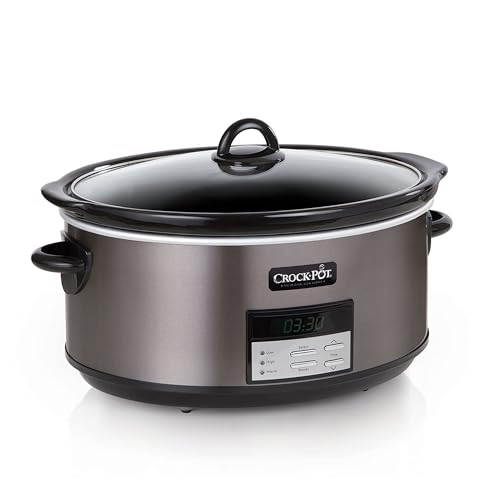
Crock-Pot Programmable Slow Cooker 8-Quart — Best Overall for Families
If one cooker has to serve a family’s whole slow-cooking life — Sunday pot roast, Friday chili for the team, a ham at the holidays — the programmable Crock-Pot 8-quart is the safest pair of hands in this guide. Its formula is the mature one: stoneware for even heat, a digital timer that runs as long as any schedule could demand, and an automatic move to warm when the cook ends, so the meal waits for the family instead of the family rushing for the meal.
Strengths
- Digital timer up to 20 hours with automatic warm — the full set-and-serve toolkit in one machine
- Sized by its maker for 10+ people, which matches real extended-family loads
- Dishwasher-safe lid and stoneware keep a weekly habit sustainable
Trade-offs
- Black stainless shows fingerprints in a busy family kitchen — expect a wipe-down ritual
- Stoneware weight is the class norm, which is to say substantial when full
- Long timer range tempts all-day warm holds that food quality does not reward
Key specs: 8-quart capacity for 10+ people; digital timer up to 20 hours; auto warm; dishwasher-safe lid and stoneware pot (per Amazon listing title).
The capacity claim is one of the few in this category stated plainly by its maker: 10+ people. In working terms that is six quarts of stew with headroom, a pork shoulder with room for onions and peppers around it, or a soup batch that fills the table’s bowls and still leaves a freezer container. The oval takes whole birds and long roasts flat, which is how family cooks actually load a cooker.
Nothing here is exotic, and that is the recommendation. Family cooking rewards reliability over features: controls a grandparent and a teenager both understand, parts that go in the dishwasher, and behaviour that is identical in year three to day one. Households that want the sear-in-pot trick or app control should look at the Ninja pick; households that want dinner handled should take this one.
Best for: best overall for families / Not suited for: households where this matters most — black stainless shows fingerprints in a busy family kitchen.
Check on Amazon — check the current price on Amazon before you decide, because configurations and included accessories vary by listing.
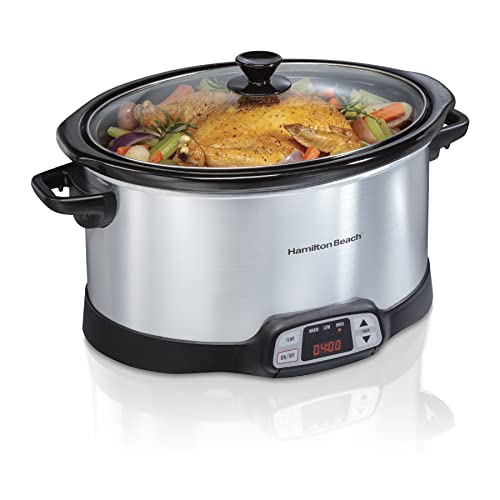
Hamilton Beach Set & Forget 8 Quart Programmable Slow Cooker — Best for Busy Schedules
The Hamilton Beach Set & Forget earns its badge on the strength of one scenario: the cook must end at 6 p.m., but nobody can promise to be home at 6 p.m. Its programmable control lets you pair heat and time settings to the recipe and the day — low for the long braise, high for the afternoon soup — and when the countdown finishes the cooker steps down to warm and holds dinner there, safely and without further cooking. For dual-commute households, that behaviour is not a feature; it is the entire product.
Strengths
- Programmable combinations of heat and time adapt to 4-hour and 10-hour days alike
- Automatic warm at the end of the countdown protects the meal from your calendar
- The Set & Forget line’s controls are the most legible in the class for mixed-ability households
Trade-offs
- Silver housing shows splashes; a dark finish hides a busy kitchen better
- Stoneware lift, as ever, is a two-handed job when the crock is full
- No locking lid for transport — potluck trips need a careful, level carry
Key specs: 8-quart stoneware crock; 3 heat settings with adjustable time settings; dishwasher-safe crock and glass lid (per Amazon listing title).
Around that core, the machine is reassuringly ordinary: a stoneware crock for gentle, even heat, a glass lid you can check without lifting, and dishwasher-safe parts that keep an 8-quart habit from becoming a washing-up deterrent. The controls deserve a specific mention — in a household where a partner, a parent or an older child might start or stop the cook, legibility is a safety feature, and this panel is the clearest in the guide.
It gives up a locking lid, so families who cook at home and carry to gatherings should either transport food in containers or look at the Cook & Carry style machines in the programmable guide elsewhere in this series. At home, on a counter, feeding a family on a schedule, it is the most forgiving cooker here.
Best for: best for busy schedules / Not suited for: households where this matters most — silver housing shows splashes; a dark finish hides a busy kitchen better.
Check on Amazon — check the current price on Amazon before you decide, because configurations and included accessories vary by listing.

Crock-Pot Manual Slow Cooker 8-Quart — Best Value
Every category has a pick that embarrasses the expensive ones on value, and in 8-quart slow cookers it is this manual Crock-Pot. You give up the timer and the automatic warm shift. You keep everything that makes slow cooking work: a full-size stoneware crock, even gentle heat, an oval that fits the roasts and birds families actually cook, and a serving capacity its maker states at ten or more people.
Strengths
- Full 8-quart family capacity at the manual tier’s honest simplicity
- Dial control with high, low and warm — teachable in ten seconds, fixable never (there is nothing to fix)
- Stoneware crock removes for serving and washing like every pick here, with no electronics in the wash path
Trade-offs
- No timer and no auto-warm: the cook ends when a person ends it
- Warm must be set by hand after cooking, and forgotten warm means continued cooking on low
- Plain black finish is functional rather than decorative on a table
Key specs: 8-quart removable stoneware; High/Low/Warm settings; serves 10+ people (per Amazon listing title).
The case strengthens over time. A dial cooker has no control board to fail, no display to fade, and no behaviour change after a power flicker — it simply resumes heating when the power returns, which is more than some programmable rivals manage. For a household where someone is home during the day, a retiree’s kitchen, a cabin, or a second cooker bought purely for holidays, the manual machine is not the compromise choice; it is the rational one.
The discipline it asks in return is presence: plan cooks that end when someone can attend to them, and set the warm by hand. Families whose dinners regularly finish in an empty house should pay for programmability and not look back. Families whose kitchens are occupied all day can pocket the difference and cook identically good food.
Best for: best value / Not suited for: households where this matters most — no timer and no auto-warm.
Check on Amazon — check the current price on Amazon before you decide, because configurations and included accessories vary by listing.

HOMECOOKIN 8-Quart Digital Programmable Slow Cooker — Best Straightforward Digital
Not every buyer wants to pay for a legacy badge, and the HOMECOOKIN 8-quart digital is the verified alternative for them: a programmable timer, an automatic keep-warm, and the standard three heat settings in a family-size cooker whose listing states the same 10+ serving capacity as the famous names. The proposition is simple — the programmable behaviour that matters, without the brand tax.
Strengths
- Digital timer and keep-warm deliver the programmable essentials without brand premium
- Three heat settings — keep warm, low and high — cover the full slow-cooking repertoire
- Sized for family dinners at 10+ servings, matching the legacy brands’ working capacity
Trade-offs
- A newer name: long-term parts availability and support are less proven than Crock-Pot’s or Hamilton Beach’s
- Listing detail is thinner than the majors’ — fewer published specifics on crock construction
- No locking or gasketed lid mentioned, so treat transport as a level-carry job
Key specs: 8-quart capacity; digital programmable timer; Keep Warm/Low/High settings; serves 10+ people (per Amazon listing title).
In use, that behaviour is the whole story of modern slow cooking: set the cook in the morning, let the timer end it, and let keep-warm hold dinner until the table is ready. The digital control is the straightforward kind — time and temperature, no app, no account, no preset library to learn — which many households actively prefer. For a first programmable cooker, or a second cooker for a holiday kitchen, straightforward is a feature.
The honest caveats are about the unknown long term. Crock-Pot and Hamilton Beach have decades of replacement crocks, lids and support behind them; a newer brand asks you to trade that assurance for the lower tier. If the cooker will be a daily driver for a decade, the majors earn their premium. If it will serve big batches a few times a month, this pick’s value logic is sound.
Best for: best straightforward digital / Not suited for: households where this matters most — a newer name.
Check on Amazon — check the current price on Amazon before you decide, because configurations and included accessories vary by listing.

Elite Gourmet 8.5 Qt Digital Programmable Slow Cooker MST-900D — Best Maximum Capacity
Some cooks do not need a bigger cooker in theory; they need it every second Sunday, when the soup batch, the chili batch or the pulled-pork batch hits the rim of an 8-quart and something has to be left out. The Elite Gourmet MST-900D answers with 8.5 quarts in the traditional format — stoneware, glass lid, programmable timer — and for the batch cookers and freezer fillers in this guide’s audience, that extra half quart is the most valuable spec on the page.
Strengths
- 8.5 quarts: the largest traditional crock here, for batches that overflow a true eight
- 20-hour timer plus a rare medium heat setting for gentle, long, delicate cooks
- Removable stoneware and dishwasher-safe lid keep the big machine washable
Trade-offs
- Largest footprint in the guide — confirm cabinet and counter fit first
- Medium is off-recipe territory; expect to adapt timings by experience
- Support and spares trail the two legacy brands
Key specs: 8.5-quart capacity; 20-hour timer; low/medium/high settings; removable stoneware crock, dishwasher-safe glass lid (per Amazon listing title).
The controls add one genuine rarity: a medium setting between low and high. Family recipes are written for the standard two, but experienced slow cooks know loads that want a gentler high or a warmer low — a full crock of delicate soup, an overnight grain porridge — and medium serves exactly those. Paired with a 20-hour timer, the machine covers the widest scheduling range of any traditional pick here.
Buy it with a tape measure in hand. It is the biggest cooker in this guide, and the household that needs its capacity usually has the pantry or cabinet to house it — but check. For the high-volume household, it is the end of the overflow problem; for everyone else, the standard 8-quart picks are capacity enough.
Best for: best maximum capacity / Not suited for: households where this matters most — largest footprint in the guide.
Check on Amazon — check the current price on Amazon before you decide, because configurations and included accessories vary by listing.

Ninja PossibleCooker PLUS 8.5-qt MC1010 — Best One-Pot Alternative
The PossibleCooker PLUS is the pick for the kitchen that cannot house a fleet. Its 8.5-quart pot slow cooks the family batch, then — on other days — proofs bread dough, holds a sous vide bath, sears, steams and finishes in the oven, because the pot itself is oven-safe and presentable enough to serve from. For small kitchens, dorm-adjacent family apartments, and households decluttering on principle, one vessel doing six jobs is not a gimmick; it is the storage plan.
Strengths
- Six functions in one 8.5-quart pot — slow cook, sous vide, proof, sear and more — for kitchens short on cupboards
- Pot is oven-safe to high heat and goes cooker-to-oven-to-table, one vessel for the whole meal
- Nonstick pot is dramatically lighter than stoneware, empty and full
Trade-offs
- Slow cooking character differs from stoneware: more responsive heat, less thermal-mass gentleness
- Digital multi-function controls ask for a learning curve the dials never will
- You pay for functions — if you only ever slow cook, the value sits unused
Key specs: 8.5-quart capacity; 6-in-1 functions including sous vide and proof; glass lid; nonstick oven-safe pot (per Amazon listing title).
As a slow cooker for a crowd it is fully credible: the capacity matches the largest picks here, the glass lid allows the no-lift check, and the pot’s lighter weight quietly solves the full-crock carry that stoneware owners plan their kitchens around. Browning in the same pot before the slow cook is the flavour upgrade every slow-cooker cookbook begs for and most crocks cannot do.
The trade is tradition. Stoneware’s mass cooks with a particular, forgiving inertia; the Ninja’s engineered heat is more responsive and asks a touch more attention the first few cooks. And the control panel is a small computer compared with a dial. Households that will use three or more of its functions get excellent value; pure slow-cook households should take the Crock-Pot programmable and spend the difference on ingredients.
Best for: best one-pot alternative / Not suited for: households where this matters most — slow cooking character differs from stoneware.
Check on Amazon — check the current price on Amazon before you decide, because configurations and included accessories vary by listing.
Comparison Table
| Pick | Badge | Key spec | Best for |
|---|---|---|---|
| Crock-Pot Programmable Slow Cooker 8-Quart | Best Overall for Families | 8-quart capacity for 10+ people | Best Overall for Families |
| Hamilton Beach Set & Forget 8 Quart Programmable Slow Cooker | Best for Busy Schedules | 8-quart stoneware crock | Best for Busy Schedules |
| Crock-Pot Manual Slow Cooker 8-Quart | Best Value | 8-quart removable stoneware | Best Value |
| HOMECOOKIN 8-Quart Digital Programmable Slow Cooker | Best Straightforward Digital | 8-quart capacity | Best Straightforward Digital |
| Elite Gourmet 8.5 Qt Digital Programmable Slow Cooker MST-900D | Best Maximum Capacity | 8.5-quart capacity | Best Maximum Capacity |
| Ninja PossibleCooker PLUS 8.5-qt MC1010 | Best One-Pot Alternative | 8.5-quart capacity | Best One-Pot Alternative |
How to Choose an 8 Quart Slow Cooker for Family Cooking
Decide by dinner, not by spec sheet. Write down your three biggest recurring cooks — the Sunday roast, the chili, the soup — with their real finished volumes. An 8-quart crock works between half and three-quarters full, so your biggest regular batch should land near six quarts. If it lands near four, a 6-quart cooker will cook it better and store easier; if it lands near seven, step up beyond this class. The most common 8-quart mistake is buying for the biggest meal of the year and cooking the other fifty weeks in a cooker that is too big for them.
Then decide who ends the cook. If a person is reliably home, manual picks cook identically and cost less, with nothing electronic to age. If the cook must end in an empty house, programmability with automatic warm is not optional — it is the difference between dinner and a dried-out apology. Families in between — someone usually home, sometimes not — should buy programmable anyway; the one evening a month it saves the meal pays for the feature.
Close with the physical audit: crock weight and your serving style, lid behaviour at a crowded table, and the storage slot measured with a tape. A cooker that lives on the counter gets used; a cooker exiled to a high shelf gets used at Christmas. Every pick in this guide is a good machine — the right one is the one whose size, controls and storage fit the kitchen it is actually joining.
Timing and Leftovers: Running a Family-Size Batch Well
Full loads cook on full-load timings. A six-quart batch of stew on low wants the long end of recipe ranges — typically 8 to 10 hours for large roasts, 6 to 8 for stews and soups — because the thermal mass of a full crock takes time to come up and even out. Resist the urge to split the difference with a half-crock and full-load timing; load size and time are a pair. When adapting a beloved 6-quart recipe, scale ingredients by half again, keep the liquid proportion slightly conservative (big batches release more liquid than intuition says), and check doneness by texture and temperature, not by the clock alone.
Leftovers are the second half of the big-cooker skill. A family batch should leave the crock within two hours of serving: ladle into shallow containers, which chill fast and reheat evenly, and refrigerate or freeze in meal-size portions labelled with the date. Soups, stews, chili and pulled meats freeze beautifully for weeks and reheat gently — in a smaller slow cooker, on the stove, or in the microwave — which is the entire economic argument for cooking at this size. The household that masters the portion-and-freeze routine gets weeknight dinners from Sunday effort; the household that leaves the crock on warm until bedtime gets neither safety nor quality.
How to Set Up an 8 Quart Slow Cooker for a Family Dinner Day
Morning, ten minutes: load the crock in the order that cooks best — root vegetables and aromatics on the bottom where heat is strongest, meat on top of them, liquid to halfway up the meat, seasonings over everything. If your pick is programmable, set the cook to end about half an hour before the earliest plausible dinner; the automatic warm will hold the gap gracefully. If your pick is manual, set low for an all-day cook or high for an afternoon one, and make sure someone owns the moment it needs attention.
During the day: leave the lid alone. At family scale, each lift dumps the accumulated heat of a large crock and adds recovery time you cannot see but will taste as uneven doneness. Check through the glass if you must. An hour before serving, taste for salt and acid — big batches under-season by default, and a squeeze of lemon or a splash of vinegar at the end wakes up a whole crock more effectively than any mid-cook intervention.
Serving and shutdown: bring the cooker to the table or set up a serving spot beside it, ladle from the crock, and keep the lid on between servings to hold temperature. After the meal, portion leftovers into shallow containers promptly, let the crock cool before washing (stoneware dislikes thermal shock), and soak rather than scour. That rhythm — load, leave, season, serve, portion — is the whole craft of family slow cooking, and an 8-quart machine run this way earns its cabinet space every single week.
Freezer Strategy: Turning One Cook into Five Dinners
The economic heart of the 8-quart cooker is the freezer, and it rewards a system. Cook the batch, serve dinner one, then portion the rest deliberately: flat freezer bags for soups and stews (they stack like books and thaw in minutes under warm water), rigid containers for shredded meats in their juices, and everything labelled with dish and date in plain language your future self will thank you for. Most slow-cooked staples — chili, pulled pork, bean soups, curries, braised beef — hold their quality for two to three months frozen, and several improve after a day’s rest in the fridge before freezing, as flavours marry in the cold.
Reheating is where the system’s quality is kept or lost. Thaw in the fridge overnight when you can, reheat gently to a full simmer rather than a microwave blast, and refresh the dish at the end — a squeeze of citrus, fresh herbs, a swirl of something creamy — because long-cooked flavours mute in storage and wake up beautifully with one bright addition. Households that run this loop find the big cooker changes their weeknight question from ‘what can we cook in twenty minutes’ to ‘which of the good dinners do we feel like’, and that change, more than any single recipe, is what an 8-quart machine is actually for.
Cooking for a Crowd Without Losing Your Mind: A Host’s Playbook
The 8-quart cooker is the host’s secret weapon precisely because it removes work from the party day. The playbook runs a day ahead: shop and prep the day before, load the crock in the morning, and let the cook finish into its warm hold an hour before guests arrive, which builds in a buffer for every late start and long hello. Set the cooker where it will serve — not where it cooked — before it gets hot and heavy, dress the station with bowls, spoons and the toppings that make a simple batch feel like an event (herbs, cheeses, pickled onions, good bread), and the cooker becomes both kitchen and buffet in one object.
Two disciplines protect the party. First, food safety across a long serving window: keep the cooker on warm, stir occasionally, and after a few hours of grazing, retire the remainder to shallow containers and the fridge rather than letting it coast. Second, the second-batch question: for crowds beyond one crock, a second cooker running a vegetarian or side batch beats one cooker refilled mid-party in every way — which is why so many hosts in this guide’s audience own the manual pick as a holiday second. Run the playbook once and the big cooker stops being an appliance you host with and becomes the reason hosting feels easy.
Two Cooks, One Crock: The Sunday-to-Wednesday Relay
The most efficient pattern this size enables is the relay: one Sunday cook designed to become two different dinners. A pork shoulder cooked simply — salt, aromatics, its own juices — serves Sunday as pulled pork with slaw, then returns Wednesday as carnitas crisped in a skillet, or as the base of a pozole-style soup, or folded through barbecue sauce for sandwiches that taste nothing like Sunday. A whole chicken becomes Sunday’s roast and Wednesday’s chicken-and-rice soup from its own carcass stock, made in the same crock on Monday. The relay works because the first cook is deliberately plain: seasoning lives in the finishing, so one batch can travel to two cuisines without tasting like leftovers in either.
Planning the relay takes one sentence on the shopping list — ‘shoulder: Sun pulled, Wed carnitas’ — and one storage habit: portion the second act separately on Sunday night, in its juices, so Wednesday is an assembly job rather than a excavation of a congealed container. Families that adopt the relay find the 8-quart cooker halves their weeknight cooking without a single repeated dinner, which is the outcome batch cooking always promised and the freezer-only approach rarely delivers. It is also, not incidentally, how restaurants think — and the big oval crock on your counter is exactly the equipment that makes the thinking possible at home.
Game Day, Holidays and the Cooker’s Biggest Weeks
Every 8-quart cooker has two seasons: the weekly rhythm this guide has mostly described, and the peak weeks when it becomes the most important appliance in the house. Game day is the rehearsal — a chili or a queso held at temperature from kickoff to the final whistle, feeding a room in waves without the host leaving the room. The holidays are the main event: the ham that frees the oven, the mashed potatoes held without scorching, the mulled cider, the make-ahead gravy, the breakfast casserole for a house full of guests. In those weeks the cooker’s virtues reorder themselves — warm hold becomes the headline feature, capacity becomes oven space, and the programmable timer becomes the difference between a host who cooks and a host who attends their own party.
Preparing for the peak weeks is a small discipline of its own. Test the holiday recipe once in October rather than debuting it in December; confirm the crock’s shelf-to-counter path before it is full and hot; and decide in advance which dish the cooker owns, because a machine assigned one job performs it perfectly while a machine asked to rotate three jobs serves none of them hot. Households that run their big cooker this way — weekly engine, seasonal star, one job at a time — describe the same discovery this guide’s picks were chosen to deliver: the cooker did not just add capacity to the kitchen, it removed stress from the calendar, and that removal, repeated across years of gatherings, is the purchase’s true return.
Reading the Reviews Like an Owner: What to Weight and What to Ignore
Shoppers comparing these machines elsewhere will meet a thicket of opinions, and a short guide to weighting them protects the purchase. Weight heavily anything about behaviour over time: whether the warm hold scorches at the edges after three hours, whether the crock’s glaze crazes, whether the lid’s rim chips in the dishwasher — these are the reports of the machine’s real life, and they cluster honestly around the picks in this guide. Weight lightly the first-week enthusiasms and the single angry outlier with a shipping story; neither describes the cooker you will own in year two. And treat capacity complaints as sizing confessions in disguise: ‘smaller than expected’ almost always means a working-fill lesson learned the hard way, which this guide has already taught you for free.
The same scepticism applies in reverse to praise. A programmable cooker praised for its app by a reviewer who cooked twice is telling you about a novelty; the owner who reports, three winters in, that the timer ended ten thousand dinners correctly is telling you about the product. This series verified every pick at the catalogue level and weighted the long behaviours — seals, crocks, timers, parts — precisely because those are what separate the machines that anchor a kitchen from the ones that anchor a garage sale. Read everything, by all means. Just read it like an owner, and the shortlist above will keep agreeing with you.
Soups, Stews and the Architecture of a Batch That Freezes Well
Not every big batch freezes equally, and designing for the freezer is a small architecture worth learning. Soups and stews built on beans, lentils, braised meats and sturdy vegetables freeze almost perfectly, because their textures were soft by design. Dairy is the traitor: cream soups split and grain on reheating, so freeze the base and add the cream fresh at serving, when it takes two minutes and tastes like the dish was made that day. Potatoes go waxy in some frozen stews — many cooks undercook them slightly in freezer batches, or swap in barley and white beans that hold their character through the freeze. Pasta should never freeze in the soup at all; cook it fresh into the reheated base and the bowl tastes assembled, not stored.
Cooling is the architecture’s foundation, and it is a safety practice before it is a quality one. A finished batch leaves the crock within two hours, divided into shallow containers where it chills quickly and evenly, rather than cooling as one deep, slow mass. Label with the dish and the date, freeze flat where the format allows, and keep a running list on the freezer door — the household inventory that turns ‘what is in there’ from archaeology into a menu. Run that system and the 8-quart cooker stops being an appliance that occasionally makes a lot of food, and becomes what its best owners describe: a small, reliable food factory whose busiest day is Sunday and whose dividends are collected all week.
Common Buying Mistakes
Scaling a recipe up without scaling the seasoning up. A half-again batch with the original salt tastes flat no matter how long it cooks. Season proportionally, then adjust at the end.
Cooking a small recipe in the big crock because it is already out. Below half full, edges scorch and timings lie. Use the right-size cooker, or double the recipe and freeze half — the better big-cooker move.
Holding finished food on warm through an entire evening of grazing without a plan. Warm is for the serving window. After a few hours, portion and refrigerate; tomorrow’s lunch will be better for it.
Forgetting the storage measurement. An 8-quart oval is wide. Measure the shelf first, or accept a permanent counter resident.
Lifting the lid to check every hour. At this volume, peeking is expensive. Trust the timer, check through the glass, and open once — at the end.
Final Recommendation
For the family table, start with the programmable Crock-Pot 8-quart: it is the complete, uncomplicated answer. Busy-schedule households should take the Hamilton Beach Set & Forget for its flexible programming; value hunters with someone at home should take the manual Crock-Pot; brand-independent buyers should consider the HOMECOOKIN digital; true high-volume cooks should take the Elite Gourmet 8.5; and small kitchens should take the Ninja one-pot instead of a crock at all.
Keep exploring the cluster: Best 8 Qt Slow Cookers, Best 8qt Electric Pressure Cookers, Best Affordable Programmable Slow Cookers, Best 4 Qt Slow Cookers and Best 6 Qt Pressure Cookers.
Short on time? Start with the top three: Crock-Pot Programmable Slow Cooker 8-Quart, Hamilton Beach Set & Forget 8 Quart Programmable Slow Cooker, Crock-Pot Manual Slow Cooker 8-Quart — each links to its listing so you can check the current price on Amazon and confirm the configuration before you buy.
Frequently Asked Questions
What is the difference between ‘8 qt’ and ‘8 quart’ slow cookers?
Nothing but spelling. They are the same size class, which is why this series covers both search forms: this guide takes the family-and-gatherings angle on the spelled-out query, and its companion covers the abbreviated form with an entertaining-and-capacity emphasis. The machines overlap because the market does.
How much food should I put in an 8 quart slow cooker?
Between half and three-quarters full — roughly 4 to 6 quarts of food. That range cooks evenly, avoids spills, and matches how the makers size their servings: the 8-quart picks here are listed for 10+ people at a full working load.
Can an 8 quart slow cooker replace a stockpot for soup?
For soup and stock batches up to about six quarts, yes, and with a gentler, unattended simmer than a burner gives. Beyond that volume, or when you need a hard boil, the stockpot still wins. Many batch cooks use the slow cooker for the long simmer and the stockpot only for canning-day scale.
Do 8 quart slow cookers cook faster on high than smaller ones?
High and low reach similar final temperatures; high simply gets there sooner. A full 8-quart load takes longer to come up to temperature than a small load in any cooker, so full-batch timings run to the long end of recipe ranges regardless of size class.
How do I store an 8 quart slow cooker?
Measure a cabinet or pantry shelf for the wide oval footprint, store the lid inverted on the crock to save height, and keep the cord loosely coiled rather than wrapped tight around the body. If it must live on the counter, the finished picks — black stainless or slate — were chosen partly for that reality.
Is a programmable 8 quart worth it for a family that is home all day?
It is a convenience, not a necessity, in that household: a manual cooker cooks the same food. Programmability earns its keep when schedules vary — the late meeting, the overtime game — so buy it if your days are unpredictable, and save the money if they are not.


