Disclosure: airfryerkitchensupply.com is reader-supported. When you buy through links on our site, we may earn an affiliate commission at no extra cost to you.
Where to buy
If you are shopping for the best affordable natural gas grills, start with the verified shortlist below — every model was confirmed against a live Amazon listing, and for this category verification matters more than usual: natural gas and propane versions of the same grill look identical in photos, and only the listing title and specification confirm which fuel a given unit actually burns.
Natural gas grills cost more up front than their propane twins and require a plumbed gas line with a quick-disconnect at the patio — that installation, not the grill, is the real entry ticket. What you get back is a grill that never runs out of fuel mid-cook and costs very little per hour to run. Confirm the fuel type in the listing title before ordering and check the current price on Amazon.
- Weber Spirit E-325 Natural Gas Grill (Best Overall) — Check the current price on Amazon
- Monument Grills M415BZNG 4+1 Burner Natural Gas Grill (Best Value Natural Gas) — Check the current price on Amazon
- Weber Spirit E-425 Natural Gas Grill (Best for Bigger Family Cooks) — Check the current price on Amazon
- Nexgrill Deluxe 6-Burner Natural Gas Grill with Griddle Insert (Best for Entertaining) — Check the current price on Amazon
- Monument Grills Denali 605 Convertible Natural Gas Smart Grill (Best Convertible / Future-Proof) — Check the current price on Amazon
- Weber Spirit E-435 Natural Gas Grill (Best Premium-Affordable Weber) — Check the current price on Amazon
The best affordable natural gas grills start from an honest admission: ‘affordable’ is a relative term in this category. A natural gas grill is a propane grill with different jets, a different regulator arrangement, and a hose instead of a tank — but it is sold in smaller volumes, so it carries a premium, and it only works where a gas line reaches. If your patio already has a stub-out, or you are planning one, the economics flip in your favor quickly: no tanks to refill, no mid-cook flameouts, and per-cook fuel costs that are the lowest of any flame grill.
The six picks here span the realistic affordable range of the category: a three-burner and two four-burner Weber Spirit models in factory natural gas trim, a Monument model that undercuts them with a hose included, a large Nexgrill for households that cook big, and a convertible Monument Denali that can start on propane and convert — useful if the gas line is a next-year project. Every one was verified as a natural gas configuration, not assumed from a shared product photo.
What you will not find here is a bargain-bin natural gas grill, because that product effectively does not exist: the category’s floor is set by real brands with real parts support. That is good news disguised as bad. A natural gas grill is a ten-year appliance bolted to your house; the affordable move is buying the least expensive one that is built like it, not the cheapest one that is plumbed like it.
In this guide
Quick Picks
Weber Spirit E-325 Natural Gas Grill — Best Overall. The natural gas Spirit to buy: three burners, a boosted sear zone, and cast-iron grates in the category’s sweet spot.
Monument Grills M415BZNG 4+1 Burner Natural Gas Grill — Best Value Natural Gas. Four main burners plus a side burner and the hose in the box — the most equipment per dollar in natural gas.
Weber Spirit E-425 Natural Gas Grill — Best for Bigger Family Cooks. The E-325 formula stretched to four burners — more grate, same sear zone, same cast iron.
Nexgrill Deluxe 6-Burner Natural Gas Grill with Griddle Insert — Best for Entertaining. 775 square inches, six burners, and a griddle insert — the party-size natural gas grill at a non-party price.
Monument Grills Denali 605 Convertible Natural Gas Smart Grill — Best Convertible / Future-Proof. Starts on propane, converts to natural gas with the included kit — the pick when the gas line is next year’s project.
Weber Spirit E-435 Natural Gas Grill — Best Premium-Affordable Weber. The fullest Spirit specification in natural gas: four burners, the boost sear zone, and the side burner the others lack.
How These Picks Were Chosen
Verification for this guide meant reading the fuel in the listing itself. Each pick’s Amazon listing, retrieved through the airfry site’s Amazon listing data, names natural gas in its title or configuration — several sibling propane versions of the same grills were excluded despite identical photos. If you take one habit from this guide, take that one: never order a gas grill from a picture.
Scoring then weighed the things that decide a plumbed grill’s decade of service: burner and firebox construction, grate material, heat distribution across the primary grate, and the maker’s parts channel — because a grill connected to your house gas line is not a disposable appliance, and a failed valve or rotted burner must be replaceable, not fatal. Included equipment was credited honestly: a factory hose and quick-disconnect in the box saves a separate purchase, and convertible models earned flexibility points for households whose gas line is planned but not yet installed.
Installation reality was the final filter. Natural gas grills need a properly sized line and, in most jurisdictions, a permitted stub-out installed by a licensed plumber or gas fitter. Picks were chosen from makers whose documentation states line and pressure requirements clearly, so your installer is never guessing. The buying guide below covers those requirements in plain terms before you spend anything.
A note on why this guide contains no conversion instructions for propane grills you already own: the boundary is safety, not secrecy. Factory kits exist for specific models and are the only acceptable route, and even then the work ends with a professional-grade leak check. Several picks here — the Denali above all — exist precisely to make that path legitimate. Everything else in this category should be bought as the fuel it will burn, verified in its listing, which is how every pick in this guide was chosen.
The 6 Best Affordable Natural Gas Grills

Weber Spirit E-325 Natural Gas Grill — Best Overall
The E-325 is where Weber’s natural gas line stops being an appliance and starts being a tool: three burners, a dedicated sear zone whose boost burners push one section of grate far hotter than the rest, and porcelain-enameled cast-iron grates that hold that heat. It suits households with a patio gas line who grill several times a week and cook for four to six people.
Strengths
- Sear Zone with Boost Burners solves the classic gas-grill steak problem
- Cast-iron grates retain heat and mark food properly
- Weber’s parts and support network is the benchmark for a plumbed appliance
Trade-offs
- Premium over the propane version and over budget-brand NG grills
- No side burner at this configuration
- You are committed: this grill lives where the gas line is
| Fuel | Natural gas (from Amazon title) |
| Burners | 3, with Sear Zone and Boost Burners (from Amazon title) |
| Grates | Porcelain-enameled cast-iron (from Amazon title) |
Judged as a natural gas purchase rather than a gas grill purchase, the E-325’s case is total cost over a decade. The burners, firebox, and grates are built to be serviced, the sear zone removes the one performance complaint gas grillers actually have, and the fuel will cost a fraction of propane per cook for as long as you own it. The three-burner layout is also the right size for plumbed grilling: big enough for a family cookout with a true two-zone fire, small enough to preheat quickly on a weeknight. If your line is installed and your headcount is ordinary, this is the natural gas grill to buy once.
Best for: households with a patio gas line grilling several times a week / Not suited for: renters, movers, or anyone without a gas stub-out
Check the current price on Amazon

Monument Grills M415BZNG 4+1 Burner Natural Gas Grill — Best Value Natural Gas
Monument’s M415BZNG is the value play of this category: a stainless 4+1 burner layout rated at 50,000 BTU, a broil zone for fast high heat, knob lights for evening cooks, and — the detail that matters — the natural gas hose included rather than sold separately. It suits larger families and entertainers who want capacity without paying the premium-brand toll.
Strengths
- Natural gas hose included in the box
- 4+1 burner layout gives capacity plus a side burner for sauces and sides
- Broil zone concentrates heat for searing
Trade-offs
- Stainless finish needs regular wiping to stay presentable
- Long-term parts depth is not yet Weber-tier
- Assembly is a substantial project with many components
| Fuel | Natural gas, hose included (from Amazon title) |
| Output | 50,000 BTU (from Amazon title) |
| Burners | 4 main + 1 side (from Amazon title) |
The honest comparison is equipment per dollar against the Weber picks: you get more burners, more stated output, a side burner, and the hose, for the affordable end of natural gas money. What you give back is the intangible — a shorter track record and a thinner parts catalog, which matters more on a plumbed appliance than on a cart you can wheel away. Monument has been building a real support presence, and for a household that grills big and often, the capacity-per-dollar math is compelling. Keep the stainless wiped down, register the warranty, and this is the category’s value benchmark.
Best for: larger households wanting maximum natural gas capacity for the money / Not suited for: buyers who prioritize a decades-deep parts catalog above capacity
Check the current price on Amazon

Weber Spirit E-425 Natural Gas Grill — Best for Bigger Family Cooks
The E-425 NG is the step-up for households that found three burners tight: four burners across a wider grate, the same boosted sear zone, and the same porcelain-enameled cast-iron cooking surface. It suits families of five or six and anyone who cooks a full menu — proteins, vegetables, and a warming zone — at once.
Strengths
- Four burners make multi-zone cooking genuinely flexible
- Same sear performance as the E-325, over more area
- Fuel is effectively unlimited once plumbed
Trade-offs
- Wider footprint needs a wider stretch of patio near the line
- Costs more than the E-325 for capacity some households will rarely use
- Still no side burner in this configuration
| Fuel | Natural gas (from Amazon title) |
| Burners | 4, with Sear Zone and Boost Burners (from Amazon title) |
| Grates | Porcelain-enameled cast-iron (from Amazon title) |
Four burners change the cooking, not just the capacity: you can run a hot sear zone, a medium zone for chicken, and a low zone for vegetables simultaneously, which is how a full meal lands at the same time instead of in shifts. On natural gas that flexibility costs nothing in fuel anxiety — there is no tank to nurse through a long cook. The question is purely whether your headcount justifies the wider grate and the wider price. If you regularly cook for five or more, it does; if you cook for three, the E-325’s tighter firebox preheats faster and cooks just as well.
Best for: families of five or six cooking full menus at once / Not suited for: small households paying for grate they will not heat
Check the current price on Amazon
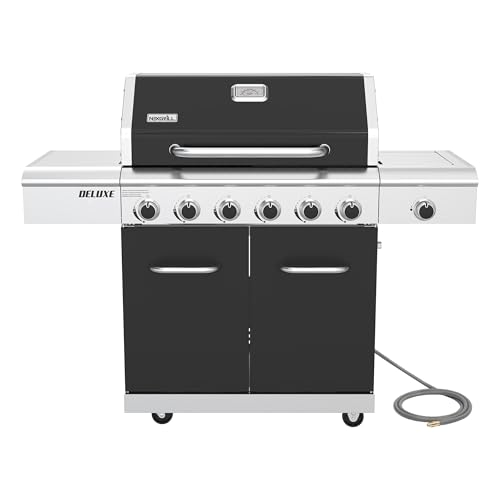
Nexgrill Deluxe 6-Burner Natural Gas Grill with Griddle Insert — Best for Entertaining
When the cookout is the point, this Nexgrill is the affordable natural gas answer: six burners under 775 square inches of cast-iron grate, a side burner, and a griddle insert that turns part of the grill into a flat-top for smash burgers, onions, and breakfast. It suits entertainers, big families, and anyone whose grill is the neighborhood’s summer kitchen.
Strengths
- Largest cooking area in this guide, with cast-iron grates
- Griddle insert adds flat-top cooking without a second appliance
- Six burners allow several temperature zones at once
Trade-offs
- A grill this size needs a properly sized gas line; confirm capacity with your installer
- Big lid and firebox take longer to preheat for small cooks
- Consumes patio space and demands a serious cover
| Fuel | Natural gas (from Amazon title) |
| Output | 75,000 BTU (from Amazon title) |
| Cooking area | 775 sq. in. (from Amazon title) |
| Extras | Side burner and griddle insert (from Amazon title) |
Large natural gas grills live or die on supply: six burners at full output need a line sized for them, which is why the buying guide below insists on an installer conversation before ordering. Fed properly, this Nexgrill does what it promises — crowd capacity with zone control, plus the griddle trick that makes it two appliances. The compromises are the usual large-grill ones: it is overkill for two burgers, and its stainless frame wants wiping. For the household that hosts monthly and cooks for a crowd weekly, it is the most grill per dollar in the natural gas category that we could verify.
Best for: entertainers and large families cooking at crowd scale / Not suited for: small households, or patios whose gas line capacity is unknown
Check the current price on Amazon

Monument Grills Denali 605 Convertible Natural Gas Smart Grill — Best Convertible / Future-Proof
The Denali 605 solves a timing problem: you want a big grill now, but the patio gas line is a future renovation. It ships convertible with its conversion kit, so it can run today and be plumbed later without replacing the grill. Six burners and smart monitoring features put it at the feature-rich end of this guide. It suits planners, new homeowners, and upgraders.
Strengths
- Conversion kit included — no second grill purchase when the line goes in
- Six-burner capacity with smart temperature monitoring
- Stainless build suits a permanent patio installation
Trade-offs
- Conversion must be done carefully and leak-checked; many buyers should hire it out
- Smart features add cost and an app dependency
- At the top of this guide’s affordable range
| Fuel | Convertible natural gas with conversion kit (from Amazon title) |
| Burners | 6 (from Amazon title) |
| Format | Smart grill, stainless steel (from Amazon title) |
Convertible grills are often a compromise that serves neither fuel well; the Denali earns its place because the conversion is a factory-supported kit rather than a third-party hack, with the jets and hardware engineered for this firebox. The smart features — remote temperature monitoring — are genuinely useful on long cooks, though they are a bonus rather than the reason to buy. The reason to buy is sequencing: one purchase that spans your propane present and your natural gas future. If your line is already in, the factory NG models above are simpler; if it is genuinely planned, this is the bridge.
Best for: buyers whose gas line is planned but not yet installed / Not suited for: anyone who wants the simplest possible fixed installation today
Check the current price on Amazon

Weber Spirit E-435 Natural Gas Grill — Best Premium-Affordable Weber
The E-435 NG is the Spirit for the cook who uses every feature: four main burners, the boosted sear zone, and a side burner for sauces, beans, and keeping a pan of onions going while the grate is full. It suits committed grillers who treat the patio as a second kitchen and want it plumbed once, properly.
Strengths
- Side burner completes the outdoor-kitchen brief
- Four burners plus sear boost covers every technique gas offers
- Weber Works rails accept the accessory system for prep and storage
Trade-offs
- Highest price among the Spirit picks here
- Side burner is one more valve and igniter to maintain
- Still a fixed installation: choose the spot carefully
| Fuel | Natural gas (from Amazon title) |
| Burners | 4 plus side burner, Sear Zone with Boost (from Amazon title) |
| Grates | Porcelain-enameled cast-iron (from Amazon title) |
Feature by feature, this is the most complete affordable natural gas grill we verified — and the honest question is whether you will use the completeness. The side burner is the dividing line: cooks who make sauces, boil corn, or keep sides hot outdoors will use it weekly and should pay for it; cooks who grill and go inside for everything else should save the money and take the E-425. Everything else — the sear zone, the cast iron, the parts support — matches the family’s standard. As a ten-year plumbed appliance bought once, the fullest specification is defensible precisely because replacing it later costs so much more than specifying it now.
Best for: committed outdoor cooks who will use a side burner weekly / Not suited for: grill-and-go cooks paying for features they will not touch
Check the current price on Amazon
Comparison Table
| Pick | Badge | Key spec | Best for |
|---|---|---|---|
| Weber Spirit E-325 Natural Gas Grill | Best Overall | 3 burners, natural gas, Sear Zone with Boost, porcelain-enameled cast-iron grates | households with a patio gas line grilling several times a week |
| Monument Grills M415BZNG 4+1 Burner Natural Gas Grill | Best Value Natural Gas | 4+1 burners, 50,000 BTU, natural gas hose included | larger households wanting maximum natural gas capacity for the money |
| Weber Spirit E-425 Natural Gas Grill | Best for Bigger Family Cooks | 4 burners, natural gas, Sear Zone with Boost, cast-iron grates | families of five or six cooking full menus at once |
| Nexgrill Deluxe 6-Burner Natural Gas Grill with Griddle Insert | Best for Entertaining | 6 burners, 75,000 BTU, 775 sq. in., griddle insert included | entertainers and large families cooking at crowd scale |
| Monument Grills Denali 605 Convertible Natural Gas Smart Grill | Best Convertible / Future-Proof | 6 burners, convertible with conversion kit, smart features | buyers whose gas line is planned but not yet installed |
| Weber Spirit E-435 Natural Gas Grill | Best Premium-Affordable Weber | 4 burners + side burner, natural gas, Sear Zone with Boost | committed outdoor cooks who will use a side burner weekly |
How to Choose the Best Affordable Natural Gas Grills (and Plumb Them Safely)
A natural gas grill purchase has two halves: the grill, and the gas supply that feeds it. Getting the second half wrong makes the first half irrelevant, so start there.
The gas line comes first: size, pressure, and a licensed installer
Natural gas grills run on low-pressure household gas, and a large grill can demand more volume than a long, thin line can deliver — the symptom is a grill that never gets truly hot. Have a licensed plumber or gas fitter confirm the stub-out location, line size, and pressure for the grill you intend to buy, and pull a permit where your jurisdiction requires one. Most factory NG grills include or specify a quick-disconnect hose; the connection point should be close enough that the hose reaches without strain and never crosses a walkway underfoot.
Factory natural gas vs. conversion: know which you are buying
Factory NG models ship with the correct jets, regulator setup, and hose for natural gas. Convertible models ship as propane with a manufacturer kit to change over. Both are legitimate; what is not legitimate is drilling jets or fitting third-party kits not made for the firebox — that voids warranties and creates real danger. If you convert, follow the kit instructions exactly and leak-check every disturbed fitting with soapy water before the first ignition, or hire the installer to do the conversion while the line is being run.
Size the grill to the line and the household, not the showroom
Bigger NG grills need bigger supply. A three- or four-burner Spirit-class grill is the sweet spot for most homes: enough grate for family cooking, modest line requirements, fast preheats. Six-burner models are for genuine crowd cooking and need their supply confirmed in writing by your installer. Remember that a plumbed grill cannot be moved to chase shade or dodge a renovation — pick its home as carefully as its model.
Think in decades: parts, valves, and service access
A natural gas grill should be bought like a furnace, not like a patio toy. Favor makers with stocked burner, valve, igniter, and grate parts, and check that the firebox and valves are reachable for service without dismantling the installation. Keep the manual’s parts list, photograph the rating plate (it states the exact fuel configuration and input rating your installer and insurer care about), and budget for a quality cover — a plumbed grill lives outdoors permanently, in all weather, for its whole life.
Clearances and placement rules for a fixed installation
A plumbed grill’s spot is permanent, so choose it against the manual’s clearances: distance from combustible walls, siding, and overhangs; a level, non-combustible surface; and a hose route that crosses no walkway. Consider wind as well — a grill in a wind tunnel lights poorly and cooks unevenly, and you cannot wheel a plumbed grill out of the weather. Shade matters less than shelter: a spot under a roof edge with legal clearances is the natural gas grill’s ideal home.
What to ask your installer before you sign anything
Get the line size and the grill’s input rating reconciled in writing, confirm the shutoff valve’s location and type, ask whether a permit and inspection are required locally, and have the quick-disconnect positioned so the hose reaches with slack. Ask, too, what converting or adding a second appliance later would involve — patios evolve, and a line sized with a little foresight is cheaper than a second trenching. A good gas fitter answers all of this without blinking; hesitation is information.
The Real Economics of Natural Gas Grilling
Natural gas grills ask for money in an unfamiliar order: installation first, grill second, fuel almost never. A stub-out installation typically costs as much as a budget grill itself, which is why the category looks expensive from outside. The payback is equally real. Per hour of grilling, natural gas is the cheapest flame fuel by a wide margin, and it eliminates the propane economy’s hidden taxes: the half-empty tank swapped ‘just in case,’ the Saturday-morning refill run, and the cookout that dies mid-sear because someone misjudged the gauge.
Convenience compounds the economics. A plumbed grill gets used more, because using it costs no errand and no thought — you turn a valve and press an igniter. Households consistently report that a natural gas grill shifts weeknight cooking outdoors in a way a tank grill never quite did, which is the actual return on the installation: not cheaper burgers, but more grilled dinners across ten years. When you evaluate ‘affordable’ in this category, price the decade, not the receipt.
The counterweight is commitment. A natural gas grill is a fixture: it does not travel to the new house easily, it does not rearrange with the patio furniture, and its resale is limited to buyers with a line in the right place. Renters and frequent movers should buy propane and keep their options; settled homeowners with a line near the patio are the people this category quietly serves better than any other.
Living With a Plumbed Grill: Maintenance Across the Years
A natural gas grill asks for a different maintenance rhythm than a portable-fuel grill: less often, but more deliberately, because the appliance is a fixed installation connected to your home. The seasonal anchor is a spring inspection — hose and quick-disconnect checked for cracking, abrasion, and insect nests in the venturi tubes (the classic cause of weak, yellow flames), burners brushed, and every connection leak-checked with soapy water before the first cook of the year. That single appointment prevents most of the category’s failures.
Through the season, the rhythm is the familiar one: brush grates while warm, empty the grease tray on a schedule rather than a symptom, and keep the cover on between cooks. A plumbed grill cannot be wheeled into the garage for winter, so its cover is not an accessory — it is the roof of a permanent outdoor appliance, and it should be replaced when it cracks rather than mourned when the firebox rusts. Stainless models want a wipe with the grain; enameled models want nothing but to be left covered and dry.
Valve and igniter care deserve a sentence of their own, because on a natural gas grill they are the components a decade tests. Work the valves through their full range occasionally so they never sit seized in one position all winter; if your installation has a patio shutoff, exercise it too, so the day you need it in a hurry is not the day it refuses. Igniters are wear items — when one dies, replace it from the maker’s parts channel rather than adopting a lighter as a lifestyle. The parts support scored in this guide exists for exactly these moments.
The long view is this category’s reward. A natural gas grill that gets its spring inspection and its cover will commonly outlast two or three tank grills, because it is never dragged, tipped for transport, or left with a corroding tank connection. The installation that made it expensive in month one makes it cheap in year ten. Maintain it like the fixture it is, and ‘affordable’ stops being the word you bought it under and becomes the word you describe it with, retrospectively, to neighbors buying their third propane grill.
Natural Gas vs. Propane: The Head-to-Head for Households Still Deciding
Heat first, because it is the comparison shoppers get wrong. A properly supplied natural gas grill and its propane twin reach the same cooking temperatures and cook the same food the same way — the fuels differ in energy per cubic foot, and the grills’ jets are sized to compensate. Anyone who tells you one fuel ‘grills hotter’ is describing an installation problem or a sales pitch. Choose on logistics and economics, because performance is a draw.
Economics is where the fuels diverge honestly. Propane’s costs are visible and portable: tanks, refills, exchanges. Natural gas front-loads its cost into installation and then nearly vanishes from the household budget — per hour of cooking it is the cheapest flame fuel available to a home. The crossover is usage: a household grilling weekly recovers installation costs in a few years and banks convenience every single week; a household grilling monthly may never recover them, and should not pretend otherwise. Run your own frequency honestly and the fuel chooses itself.
Logistics is the third axis. Propane is freedom: the grill moves with the patio furniture, travels to the new house, and works during a gas outage. Natural gas is permanence with a dividend — no tank ever dies mid-cook, no refill errand exists, and the grill is simply always ready, which quietly increases how often a household grills. That readiness effect is the category’s worst-kept secret: plumbed grills get used more, because using them costs no thought at all.
The deciding questions, then, are these. Do you own the home and expect to stay? Is a gas line near the patio, or cheap to run? Do you grill at least weekly in season? Three yeses make natural gas the rational, eventually-cheaper, always-ready choice — and make this guide’s picks your shortlist. Any no makes propane the flexible answer, and this program’s propane guide is built for exactly you. Neither answer is a compromise; they are different households being honest about different lives.
Permits, Insurance, and the Paperwork of a Plumbed Grill
A natural gas grill is a home improvement wearing an appliance’s clothes, and its paperwork deserves a short, serious section. Permits first: many jurisdictions require one for a new gas stub-out, and the permit is not red tape to dodge — it triggers the inspection that confirms your installation is sound, and it creates the record that your insurer and a future home buyer will want to see. Your licensed installer will know the local rule; if an installer suggests skipping a required permit, that suggestion is itself the review of that installer.
Insurance is the second file. A permitted, professionally installed gas line is a non-event for homeowners’ insurance; an unpermitted one discovered after any fire — even an unrelated one — is a complication nobody needs. Keep the installer’s invoice, the permit, and a photograph of the grill’s rating plate together with the house papers. That rating plate photo does triple duty: it proves the fuel configuration, states the input rating for any future service call, and identifies the exact model for parts a decade from now, when the manual is long gone.
Resale is the pleasant third act. A permitted patio gas line is a selling feature — outdoor-kitchen-ready is a phrase real estate listings use because buyers respond to it — and a well-kept plumbed grill conveys with the house more gracefully than it moves. None of this paperwork is burdensome: one permit, one invoice, one photograph. It is simply the adult paperwork of a permanent installation, and handling it once, at the start, is part of what makes the natural gas category the settled homeowner’s category.
How to Set Up a Natural Gas Grill Safely, From Stub-Out to First Cook
Most of this is your installer’s job — that is the point of hiring one — but knowing the sequence lets you verify the work and run the grill correctly from day one.
- Confirm the plan with your installer before ordering: stub-out location, line size, shutoff valve placement, and the grill’s stated input rating from its rating plate.
- After installation, leak-check every connection: with the gas on and burners off, brush soapy water on each fitting and watch for bubbles. Any bubbling fitting gets tightened or resealed and retested — never ‘watched for a while.’
- Connect the quick-disconnect hose with slack, routed where it cannot be stepped on, pinched by the cart, or heated by the firebox. The hose is a lifeline, not a trip wire.
- Do the first ignition exactly per the manual, one burner at a time, and confirm each lights promptly. A burner that fills with gas before igniting needs attention before it needs a second try.
- Run a 20–30 minute empty burn-off at high heat to clear manufacturing oils, then map hot spots with the bread test so you know your zones before food depends on them.
- Learn the shutoff by heart: the patio shutoff valve and the grill’s own valves. Everyone in the household who grills should be able to kill the gas in seconds, in the dark.
- Schedule the standing habits: brush grates warm, empty the grease tray, check the hose each spring for cracking or abrasion, and keep the cover on between cooks.
A natural gas grill that is installed properly and maintained lightly will outlast several propane grills — the absence of tank swaps and the permanence of the installation both work in its favor. Respect the plumbing, and the grill itself is the easy part.
Common Buying Mistakes
Ordering the propane version by mistake. The photos are identical and the boxes are similar. Verify ‘natural gas’ in the listing title and on the rating plate when the grill arrives — before assembly, not after.
Assuming any patio stub-out can feed any grill. Undersized lines starve big grills of heat. Line capacity is an installer question, answered before purchase.
Converting with a universal or third-party kit. Only the manufacturer’s kit for your exact firebox is acceptable. Improvised jets are how warranties die and hazards are born.
Skipping the leak check to save ten minutes. Soapy water on every fitting, every time a connection is disturbed. This is the cheapest safety procedure in all of grilling.
Placing the grill where the hose becomes a trip hazard. Plan the route when you plan the stub-out. A snagged hose is a damaged hose, and a damaged gas hose is an emergency, not an inconvenience.
Buying six burners for a household of two. The plumbed grill you preheat nightly should be sized to nightly cooking. Oversized NG grills preheat slowly and waste the convenience that justified the installation.
Final Recommendation
For most plumbed patios, the Weber Spirit E-325 Natural Gas is the buy: three burners, a real sear zone, cast-iron grates, and a decade of parts support. Step up to the E-425 if your headcount demands the wider grate, or the E-435 if a side burner will genuinely earn its keep. On a tighter budget, the Monument M415BZNG delivers the most equipment per dollar, hose included.
Choose the Nexgrill Deluxe 6-Burner when crowd cooking is the mission and your installer confirms the line can feed it, and choose the Denali 605 when the gas line is planned but not yet poured — it is the only pick that spans both sides of that project. Whichever you pick, spend the installer money without flinching: in natural gas grilling, the plumbing is the product, and the grill is the appliance it feeds.
- Weber Spirit E-325 Natural Gas Grill — Check the current price on Amazon
- Monument Grills M415BZNG 4+1 Burner Natural Gas Grill — Check the current price on Amazon
- Weber Spirit E-425 Natural Gas Grill — Check the current price on Amazon
Keep exploring the grills in this series: Best Affordable Grills Best Affordable Propane Grills Best Affordable Pellet Grills Best Affordale Grills Best Affordsble Grills Best Affordable Indoor Grills
Frequently Asked Questions
Can I convert my propane grill to natural gas?
Only if the manufacturer offers a conversion kit for your exact model, and only using that kit, followed by a full leak check. Many budget propane grills are explicitly not convertible. Never drill jets or use universal kits. If your grill has no factory kit, the safe and usually cheaper answer is a factory natural gas model like the picks in this guide.
How much does it cost to run a natural gas line to a patio?
It varies widely with distance from the existing gas run, local labor rates, and permitting, from modest to several times the price of the grill itself. Get two quotes from licensed gas fitters before buying the grill — the installation quote, not the grill price, is the number that decides whether this category is affordable for your home.
Is natural gas cheaper to grill with than propane?
Yes, per hour of cooking, typically by a large margin, and it never runs out mid-cook. The savings accumulate over years, which is why the category makes most sense for settled homeowners who grill often. Occasional grillers may never recoup the installation cost — propane remains the rational choice for them.
Do natural gas grills get as hot as propane grills?
A properly supplied NG grill reaches the same cooking temperatures; natural gas carries less energy per cubic foot, but NG grills use larger jets and higher volume to compensate. The common cause of a ‘weak’ natural gas grill is an undersized or over-long supply line, which is an installation issue, not a fuel flaw.
What size natural gas grill should I buy?
Match the grill to your household and your line. Three to four burners cover most families and place modest demands on the gas supply. Six-burner models are for regular crowd cooking and need installer confirmation of line capacity. Remember the grill is fixed in place — measure the patio spot, the hose reach, and the clearance to walls and overhangs before ordering.
Can a natural gas grill be moved or taken to a new home?
It can be disconnected at the quick-connect and moved, but it only works where a compatible natural gas supply exists, and reinstalling usually means another stub-out at the new home. Treat it as a fixture you may take, not a portable you will — one more reason this category suits settled households best.
Does a natural gas grill need a different cover or storage routine?
The cover matters more, not differently: the grill lives outdoors permanently, so a fitted, breathable cover in good repair is essential, and it should be replaced when it tears. There is no winter storage move to make — instead, do the autumn version of the spring inspection: grease tray emptied, valves exercised, hose checked, and the patio shutoff confirmed working before the cold months.
Will a natural gas grill work during a power outage?
Yes, in the way that matters: the burners need no electricity, and most igniters are battery or piezo powered. A natural gas grill is genuinely useful in an outage — it is an outdoor stove with a lid. Pellet grills, by contrast, stop with the power, and electric grills obviously do too. For outage-prone regions, this is a real point in natural gas’s favor.


