Disclosure: airfryerkitchensupply.com is reader-supported. When you buy through links on our site, we may earn an affiliate commission at no extra cost to you.
Where to buy
If you are shopping for the best 2 burner small grills, your real specification is not square inches — it is the rectangle of balcony, patio, or storage closet the grill has to fit, and the number of people it has to feed from inside that rectangle. Every pick below was verified against a live Amazon listing, and every pick is a genuine two-burner grill chosen for a small footprint: compact carts, tabletops, and a folding design. Check the current price on Amazon, and measure your space before ordering — the dimensions that matter are in each review.
- Weber Spirit E-210 Gas Grill (Best Small Cart Overall) — Check the current price on Amazon
- Charbroil Classic 2-Burner Propane Gas Grill (Best Budget Small Cart) — Check the current price on Amazon
- Nexgrill Tabletop 2 Burner Gas Grill, Stainless Steel (Best Small Tabletop) — Check the current price on Amazon
- Kenmore 2-Burner Portable Tabletop Retro Gas Grill (Best for Balconies and Style) — Check the current price on Amazon
- Coleman RoadTrip 225 Portable Tabletop Grill (Best Small Portable) — Check the current price on Amazon
- Megamaster Tabletop 2 Burner Gas Grill, Stainless Steel (Best Compact Tabletop Value) — Check the current price on Amazon
Small Grill, Full Technique: Why Two Burners Is the Right Small
The best 2 burner small grills share a insight that one-burner portables miss: small should describe the footprint, not the cooking. Two burners in a compact body still give you the defining technique of gas grilling — a hot zone and a cool zone — so a small grill can sear on one side and finish gently on the other, exactly like its full-size relatives. A one-burner grill, however portable, gives you one temperature everywhere, and no amount of compactness compensates a cook who has tasted the difference.
The small-grill buyer is usually one of four people: the apartment dweller with a balcony and a lease, the couple in a small house with a small patio, the camper whose grill lives in the vehicle, or the household that grills for two most nights and four on weekends. All four are served by this guide, but by different picks — a compact cart for the patio that can host one, tabletops for the balcony and the campsite, and a folding-leg design for the household whose grill must disappear into a closet between cooks. Read the badges with your own living situation in mind; in this category, format fit beats every specification.
A note on honesty in small-grill marketing: “compact” is the most abused word in the category. Carts are measured with shelves folded, areas are quoted with warming racks included, and “serves six” claims assume burgers the size of coasters. This guide quotes the verified listing figures and then translates them into honest headcounts in each review, because a small grill bought on inflated numbers is a small grill returned.
In this guide
Quick Picks
- Best Small Cart Overall: Weber Spirit E-210 — Weber itself positions it as its small propane grill; cast-iron grates and premium heat in the tightest cart footprint of its line. Check the current price on Amazon
- Best Budget Small Cart: Charbroil Classic 2-Burner — 280 sq in and 20,000 BTU in a compact cart with shelves. Check the current price on Amazon
- Best Small Tabletop: Nexgrill Tabletop Stainless — 251 sq in with a locking lid and a listing-rated 28,000 BTU. Check the current price on Amazon
- Best for Balconies and Style: Kenmore 2-Burner Retro — a compact tabletop whose looks suit a visible balcony. Check the current price on Amazon
- Best Small Portable: Coleman RoadTrip 225 — 11,000 BTU, Instastart ignition, and a cleanup-friendly water pan. Check the current price on Amazon
- Best Compact Tabletop Value: Megamaster Tabletop Stainless — 199 sq in, 16,000 BTU, and 20 lb tank compatibility at a value position. Check the current price on Amazon
How These Picks Were Chosen
Every candidate had to clear three filters. First, exactly two burners, verified from the manufacturer’s Amazon listing — the small-grill search results are polluted with one-burner portables wearing two-burner keywords, and they were all excluded. Second, a genuinely small format: compact carts whose footprints suit small patios, and tabletops that store indoors. Third, an honest capacity story — enough grate for two to four people cooked properly, with the review stating plainly where each grill’s ceiling sits.
Within the verified shortlist we weighed footprint against function: shelves that fold, lids that lock for transport, legs that fold flat, tank options that suit both balcony and campsite. A small grill that needs a big grill’s clearances and storage has failed its only assignment, however well it cooks. Every ASIN was cross-checked on 2026-11-20, and the specs in the mini boxes come from the listed listings.
The 6 Best 2 Burner Small Grills

Weber Spirit E-210 Gas Grill — Best Small Cart Overall
Weber’s own listing calls the E-210 its small propane grill, and it earns this guide’s top badge by being the most complete small cart available: cast-iron grates, Snap-Jet ignition, and the line’s signature even heat, in the tightest cart footprint Weber sells. It suits small patios that can host a permanent grill and owners who grill often. It does not suit balconies with tank restrictions or anyone who must store the grill indoors.
Strengths
- Full Weber cooking quality — cast-iron grates, even heat — in a small cart
- Deep parts and accessory support for a decade of ownership
- Two real zones for proper technique at small scale
Trade-offs
- Premium position — the most expensive way to grill small in this guide
- A cart is still a cart: it lives outside, under a cover, permanently
- Capacity tops out at family-of-four cooking
Key specs (from the verified listing): 2 burners; porcelain-enameled cast-iron grates; Snap-Jet ignition; Weber Works rails; positioned by Weber as its small propane grill.
The E-210’s smallness is relative — it is small the way a well-designed apartment is small, by wasting nothing. The firebox is compact, the shelves are where your hands want them, and the cooking system is the full Weber system rather than a shrunk apology for one. On a small patio it reads as a deliberate appliance; beside it, most small carts read as compromises. For the household whose space is small but whose grilling is serious and frequent, this is the correct over-investment.
Its limit is the category’s limit: four people eat well, six eat in batches, and the grill does not travel. If your life fits inside those lines, no other pick here will make you happier across a decade of dinners.
Best for: small patios with serious, frequent grilling / Not suited for: indoor storage, balconies with restrictions, crowds — Check the current price on Amazon

Charbroil Classic 2-Burner Propane Gas Grill — Best Budget Small Cart
The Classic is the small cart for real budgets: 280 square inches, 20,000 BTU, side shelves, and a footprint that fits the decks and patios this category is actually bought for. It suits first-time owners and small households grilling a few times a month. It does not suit daily grillers or anyone chasing premium longevity.
Strengths
- Complete cart format — shelves, lid, storage — at an entry position
- Compact footprint that respects small outdoor spaces
- Straightforward assembly and operation for first-time owners
Trade-offs
- Porcelain-coated grates mark food more gently than cast iron
- Lighter construction; a seasons-long rather than decade-long appliance
- Noticeable heat gradient to manage by rotating food
Key specs (from the verified listing): 2 burners; 20,000 BTU; 280 sq in cooking area; porcelain-coated grates; compact cart with side shelves.
Proportions are this grill’s virtue. The area feeds four in one round; the heat is honestly matched to the area; the shelves hold the tray that budget rivals make you balance on the rail. For a small household learning to grill — or replacing a deceased grill without drama — the Classic is the category’s default recommendation, and its presence in nearly every guide in this series is a reflection of that, not a lack of imagination.
Best for: first-time cart owners and small households on a budget / Not suited for: daily heavy use or premium expectations — Check the current price on Amazon

Nexgrill Tabletop 2 Burner Gas Grill, Stainless Steel — Best Small Tabletop
The Nexgrill tabletop is the small grill as a precision instrument: 251 square inches of stainless steel, folding legs, a locking lid for transport, and a listing-rated 28,000 BTU that we flag in the honesty note below. It suits couples, campers, and balcony cooks who want tabletop size without tabletop timidity. It does not suit buyers who want a warming rack or a standing cart.
Strengths
- Locking lid and folding legs — genuinely travel-tight
- Stainless body cleans easily and handles outdoor storage better than painted steel
- Listing-rated heat output is exceptional for the format
Trade-offs
- The 28,000 BTU figure is the listing’s claim — treat it as a claim, as discussed below
- 251 sq in is a two-to-four-person surface, honestly stated
- No warming rack in the verified listing
Key specs (from the verified listing): 2 burners; 28,000 BTU (listing-stated); 251 sq in cooking space; stainless steel; folding legs; locking lid; push-and-turn ignition; LP compatibility.
A word on that BTU figure, because small-grill shoppers deserve it: 28,000 BTU would be remarkable output for a tabletop of this size, and this guide repeats it only as the manufacturer’s listing claim. The grill underneath the claim is genuinely strong for its class — quick to preheat, confident with a sear — and buyers should judge it by that performance rather than by the laboratory number. Even discounted, it is the hottest small tabletop in this guide.
The travel details complete the case: a lid that locks means a trunk that stays clean, and legs that fold flat mean a closet shelf instead of a garage corner. For the small-space household that also camps, this is the one-grill answer.
Best for: couples, campers, and balcony cooks wanting a strong, storable tabletop / Not suited for: warming-rack devotees or cart seekers — Check the current price on Amazon

Kenmore 2-Burner Portable Tabletop Retro Gas Grill — Best for Balconies and Style
Most small grills are designed to be hidden; the Kenmore Retro is designed to be looked at. Its retro-styled body makes it the rare tabletop that improves a balcony’s appearance instead of apologizing for itself, while the two-burner layout underneath does the real work. It suits design-conscious apartment grillers and small households whose grill lives in view. A note on verification: the listed listing title for this model is brief, so detailed specifications beyond its two-burner tabletop format should be confirmed on the product page — this guide invents none.
Strengths
- Retro styling that suits a visible balcony or patio corner
- Two-burner tabletop format — real zone cooking at apartment scale
- Portable body that stores away when the season or the lease demands
Trade-offs
- Listing information is thinner than its rivals’ — verify specs on the product page
- Tabletop format: the surface it sits on is yours to provide
- Style-led models reward buyers who confirm details before ordering
Key specs (from the verified listing): 2 burners; portable tabletop format; retro design. (Full specification list to be confirmed on the product page — the Amazon listing title is brief.)
Do not dismiss the style argument as vanity. A grill that lives in view gets used more than a grill that lives in a closet, because it is present at the moment the dinner decision is made — and a two-burner tabletop that a household is slightly proud of will cook more weeknight meals than a technically superior box hidden away. The Kenmore’s retro design is a use feature disguised as a look.
Buy it with the verification step done: open the product page, confirm the dimensions against your balcony and the features against your expectations, and then enjoy owning the best-looking small grill in this guide.
Best for: balcony grillers whose grill lives in view / Not suited for: buyers who want every spec documented in advance — Check the current price on Amazon
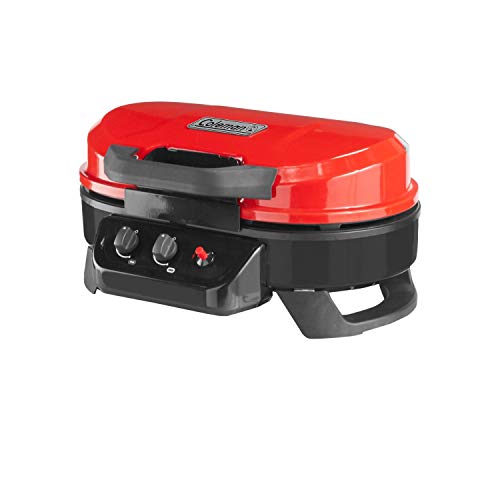
Coleman RoadTrip 225 Portable Tabletop Grill — Best Small Portable
The RoadTrip 225 is the small portable perfected over many seasons of Coleman’s RoadTrip line: two burners, 11,000 BTU, Instastart ignition that needs no matches, and a removable water pan that makes cleanup the easiest in this guide. It suits campers, tailgaters, and picnickers whose grill travels weekly. It does not suit high-heat searing or cooking for more than four.
Strengths
- Instastart push-button ignition — lights without matches or lighters
- Removable water pan catches drippings; cleanup is a tip and a wipe
- Adjustable temperature control across two burners for basic zone work
Trade-offs
- 11,000 BTU is picnic heat — adequate, not aggressive
- Cooking area serves two to four
- Stand is a separate consideration in this format
Key specs (from the verified listing): 2 burners; 11,000 BTU; Instastart ignition; adjustable temperature control; removable water pan; tabletop portable format.
The RoadTrip’s virtues are the virtues of a tool that gets brought along: it lights every time, it cooks the picnic menu evenly, and it cleans up in the field without a scrubbing session. The water pan deserves its reputation — drippings land in water rather than carbonizing in the firebox, and the difference at cleanup time is the difference between a grill you bring next weekend and one you start leaving home. For small households whose grilling happens at campsites and tailgates more than on patios, this is the pick.
Best for: camping, tailgating, and picnics with easy cleanup / Not suited for: high-heat searing or crowds — Check the current price on Amazon

Megamaster Tabletop 2 Burner Gas Grill, Stainless Steel — Best Compact Tabletop Value
The Megamaster tabletop is the smallest honest two-burner in this guide: 199 square inches, 16,000 BTU, stainless steel with foldable legs, a built-in thermometer, and — the detail that lifts it above its class — compatibility with a standard 20 lb tank, so home use does not run on expensive canisters. It suits solo cooks, couples, and anyone whose storage space is a shelf. It does not suit families cooking in one round.
Strengths
- The most compact verified two-burner here — stores almost anywhere
- Runs on a standard 20 lb tank, keeping home fuel costs low
- Built-in thermometer, a feature many small tabletops delete
Trade-offs
- 199 sq in is a one-to-three-person surface — plan batches for four
- Value-tier materials and finish
- Foldable-leg portables want a stable, heat-safe surface underneath
Key specs (from the verified listing): 2 burners; 16,000 BTU; 199 sq in cooking space; stainless steel; foldable legs; built-in thermometer; uses standard 20 lb tank.
Smallness, done honestly, is a feature: this grill preheats in minutes, sips fuel, wipes down in moments, and stores in spaces — a closet shelf, a cabinet, the corner of a storage unit — where no other pick in this guide fits. For the solo griller or the couple that cooks two burgers and a tray of vegetables, its surface is not a compromise at all; it is exactly sized, and the bigger grills are the wasteful ones. The 20 lb tank compatibility is the detail to underline: it makes the Megamaster a legitimate home grill, not just a camping accessory with delusions.
Best for: solo cooks, couples, and the tightest storage situations / Not suited for: family-scale single-round cooking — Check the current price on Amazon
Comparison Table
| Pick | Badge | Key spec | Best for |
|---|---|---|---|
| Weber Spirit E-210 | Best Small Cart Overall | Cast-iron grates, small cart | Serious grilling on a small patio |
| Charbroil Classic 2-Burner | Best Budget Small Cart | 20,000 BTU, 280 sq in | First cart for a small household |
| Nexgrill Tabletop Stainless | Best Small Tabletop | 251 sq in, locking lid | Strong tabletop that stores and travels |
| Kenmore Retro Tabletop | Best for Balconies | Retro-styled 2-burner tabletop | Visible balcony grilling |
| Coleman RoadTrip 225 | Best Small Portable | 11,000 BTU, water pan | Camping and easy cleanup |
| Megamaster Tabletop | Best Compact Value | 199 sq in, 20 lb tank ready | Tightest storage, solo and couple cooking |
How to Choose a Small 2 Burner Grill: Fit First, Then Features
Begin with the tape measure, in three places. The space the grill will occupy while cooking — remembering that a cart’s working footprint includes its open lid and you standing in front of it. The space it will occupy while stored, if it stores at all: tabletops in this guide fold to shelf size, carts do not fold at all. And the path between the two, because a grill that must be carried through a narrow door or down stairs weekly will teach you its weight and dimensions personally. A small grill that fails any of the three measurements is not small in the way that matters.
Then match capacity to your honest headcount. The translation that cuts through marketing: roughly 200 square inches cooks for two, 250 to 280 for three to four, and anything in this guide feeds six only in batches. Households that cook for two on ninety percent of nights should buy the two-person size and batch-cook the exceptions; buying for the exception is how small patios end up housing big grills that make every ordinary Tuesday feel oversized.
Weight deserves a line of its own in a small-grill decision, because these are the grills people actually carry. A tabletop that one person can lift comfortably — with its lid locked and its tank disconnected — will travel; one that needs two people and a plan will gradually stop traveling, and a portable that stays home is just a small grill with handles. If the grill’s life includes stairs, campsites, or a car trunk, put your hands on the decision: choose the model whose weight you can imagine carrying at the end of a long day, not the one you can lift once in a showroom.
Finally, check your building’s rules before the grill arrives, not after. Apartment leases and condo rules commonly restrict tank size, require distances from railings and siding, or ban gas grills on balconies outright in favor of electric. A tabletop that runs on a small tank, or stores indoors and travels to legal ground, solves most of these; a cart solves none of them. The best small grill is the one you are allowed to use where you live.
How to Set Up a Small Grill on a Balcony or Small Patio
Placement comes first: the grill sits on a stable, level, heat-safe surface — a metal or stone-topped table for tabletops, never plastic — with the clearances your local code and lease require from railings, walls, and anything combustible. Keep the tank upright and its hose routed without kinks or contact with the hot firebox. If your space is a balcony, position the grill so smoke drifts away from your own windows and, as a courtesy that preserves grilling privileges, consider your neighbors’ as well.
The first cook should be a calibration, not a performance. Preheat fully, run a round of burgers, and learn your grill’s hot geography with the bread test described in our propane guide — small grills have pronounced personalities because their burners sit close to the food. Establish the storage routine the same day: where the grill cools, where it folds to, where the tank lives. Small-space grilling succeeds as a system — placement, calibration, storage — and the households that set the system up once grill happily for years in spaces their friends insist are too small.
Making a Small Grill Cook Like a Big One
Small grills reward technique more than big ones do, because their margins are thinner. Preheat completely — a small firebox reaches temperature fast, and impatient loading is the main cause of pale food. Cook in sequenced batches rather than crowded ones: proteins first over the hot zone, resting on the cool side or a warm plate while vegetables take the heat. Use the lid as an oven for thick items, and finish chicken on the cool zone to render skin without burning it. Keep a spray bottle for flare management on conventional models, and an instant-read thermometer to replace guesswork — on a small grill, the difference between done and overdone is about ninety seconds.
One more technique pays outsized dividends at this scale: the rest-and-hold. Because a small grate has no spare corner, finished food should leave the grill entirely — onto a warm plate, loosely tented — rather than crowding the cool zone while the next batch cooks. Resting improves the food anyway, and the freed grate cooks the next round at full quality instead of at the compromised temperature of an overloaded surface. Small-grill cooks who internalize sequencing and resting produce meals their guests assume came off something twice the size.
The encouraging truth is that none of this is advanced cooking. It is the same two-zone discipline the whole two-burner category is built on, applied at a scale where the feedback is immediate. Many cooks report that a season on a small grill made them better grillers than years on a large one, precisely because the small grill refuses to hide sloppy technique behind spare capacity.
Storage Solutions for Grills That Have Nowhere to Live
Storage is where small-grill ownership is won or lost, because a grill without a home becomes a grill in the way. The tabletops in this guide fold to genuinely storable shapes — legs flat, lids locked on the models that offer it — and their correct homes are a closet shelf, the top of a storage unit, or a lidded bin that keeps dust and garage grime off the cooking surface. Store the grill clean and dry; a tabletop put away with a greasy firebox perfumes everything stored near it and invites pests. Disconnect the regulator, cap the tank connection, and store tanks upright, outdoors or in a ventilated space, never in a sealed living area.
Cart owners in small spaces have a different problem and a simpler answer: the grill lives outside, and the investment that protects it is a fitted cover and a sensible parking spot — out of the prevailing rain path, off bare earth, with the tank valve closed between cooks. A compact cart under a good cover in a patio corner occupies less household attention than a tabletop that must be fetched, unfolded, and re-stored at every cook. Choose the format whose storage story matches the space you actually have, not the space you plan to organize someday.
The One-Burner Temptation, Examined Honestly
Every small-grill shopper meets the one-burner portable: smaller, lighter, cheaper, and pitched as the truly minimalist choice. It deserves a fair hearing. For a solo camper cooking single items — a steak, two sausages, a pan of vegetables — a one-burner grill is honestly sufficient, and its simplicity is real. But the moment a second food, a second temperature, or a second person enters the picture, the single burner becomes the constraint that defines every meal: everything cooks at one heat, finished food cools while the rest finishes, and delicate items share a grate with searing ones.
Two burners is where that constraint disappears, and the size penalty for the second burner is surprisingly small — compare the footprints in this guide with their one-burner cousins and the difference is inches, not feet. That is the whole argument of this category: the smallest grill that still cooks like a grill has two burners. Shoppers who choose one burner for a household, rather than for a solo kit, almost always re-buy within two seasons, and the second purchase is the two-burner they talked themselves out of.
Accessories Sized for a Small Grill
Small grills punish oversized accessories. The right kit is short and scaled: a pair of 12-inch tongs rather than the 16-inch patio set, a compact spatula, a brush matched to your grate coating, and a cover or storage bin fitted to the grill’s actual dimensions — a cover three sizes too large is a rain sail, not protection. A small instant-read thermometer earns its drawer space many times over at this scale, where doneness windows are short. For tabletops, a heat-safe stand or mat is not an accessory but part of the installation, and a tank hose — for the models that accept a full-size tank — converts a camping tool into a home appliance.
What to skip: the sprawling tool sets, the grill-top pizza stones sized for four-burner grills, and any accessory whose storage footprint rivals the grill’s. In a small-space household, every accessory must justify not only its price but its cubic inches. The test is simple — if it does not fit where the grill fits, it does not belong to the grill.
Small Grills in Wind and Cold Weather
Compact grills feel weather more than big ones: a small firebox has less thermal momentum, and a crosswind steals a larger share of its heat. The countermeasures are simple and effective. Position the grill out of the prevailing wind — a corner, a wall at its back — and keep the lid down while preheating and cooking, opening it decisively rather than hovering. In cold weather, extend preheats, expect dial settings one notch higher than summer’s, and favor the cast-iron and higher-output picks in this guide, whose heat storage and burner strength shrug off conditions that leave lighter tabletops struggling.
None of this disqualifies a small grill from winter service — two-burner owners grill year-round in serious climates — but it does reward the buyer who chooses with their weather in mind. A sheltered balcony and a Nexgrill or Weber will cook in January. An exposed deck and the lightest tabletop will make January feel like an argument. Buy for your climate as faithfully as for your floor plan.
A Week of Dinners on a Small Grill: Proof of Capacity
Skepticism about small grills usually dissolves in a week of actual menus. Monday: two chicken breasts and a halved zucchini, cooked in zones, on any pick in this guide. Tuesday: burgers for four with corn on the warming side — the carts and the Kenmore-style tabletops handle it in one round, the compacts in two quick ones. Wednesday: salmon fillets and asparagus, the delicate test, passed by the two-zone layout that a one-burner grill cannot offer. Thursday: sausages and peppers, the small grill’s easiest night. Friday: steaks for two, seared hard on the hot zone of a fully preheated grill — the Weber E-210‘s signature performance, with the Nexgrill tabletop close behind.
The weekend is where the format’s real ceiling shows, and it is higher than the skeptics claim: a Saturday cookout for six runs as two sequenced batches with a warming strategy, and Sunday’s breakfast — on the tabletops especially — is a pleasure rather than a production. What a small grill cannot do is the twelve-person holiday in one round. What it can do is everything a small household actually eats, which is the only capacity claim that should ever have mattered.
Small Grill Safety Essentials
Small spaces concentrate risk, so the safety basics deserve explicit statement. Keep the grill on its stable, heat-safe surface with the clearances your lease and local code require, and never grill inside a garage, tent, or enclosed porch — carbon monoxide does not care how small the grill is. Keep the tank upright, check connections with soapy water at the start of each season and after every tank change, and let the grill cool completely before folding, covering, or storing it; a tabletop folded warm into a closet is a fire story with the ending still unwritten.
Grease discipline matters more at small scale, because a compact grease tray fills faster: empty it on a schedule, not when it overflows. Keep a lid or a baking sheet within reach to smother a flare, keep children and pets out of the cooking triangle, and treat the balcony railing as what it is — not a shelf for hot tools. None of this is burdensome; all of it is the difference between small-space grilling as a pleasure and small-space grilling as an incident report.
When to Size Up: The Honest Limits of the Format
A guide to small grills should say plainly when small is wrong. Size up when your regular headcount passes six — batch cooking works, but a host who spends every gathering managing rounds instead of talking to guests owns the wrong grill. Size up when your menu leans on whole large items — a full brisket, a spatchcocked turkey, a rotisserie chicken — that physically exceed a compact grate. Size up when you grill daily for a family and the two-burner preheat-and-cook rhythm, however efficient, has become the bottleneck of your evenings.
And notice the graceful exit this category offers: a small grill is rarely wasted when a household sizes up. It becomes the camping grill, the tailgate grill, the second grill for vegetables and sides at big gatherings, or the hand-me-down that starts another household’s grilling life. Few purchases in the category age that usefully. Buy the small grill that fits your life now, without anxiety about the life you might have in five years — the grill will find its role in that life too.
Common Buying Mistakes
The first mistake is buying a “small” cart without measuring — compact carts still need a permanent home with working clearance, and a balcony that cannot host one turns the purchase into storage furniture. The second is believing capacity claims: stated areas include warming racks and “serves six” assumes appetites no one has. The third is ignoring building rules until the grill is assembled. The fourth is choosing a one-burner portable for its smaller size and discovering that the missing burner — not the missing inches — was the real compromise: two burners is the smallest format that still cooks like a grill rather than a hot plate.
Final Recommendation
Put the Weber Spirit E-210 on a small patio if grilling is a weekly ritual and the space allows a cart; choose the Charbroil Classic for the same job on a budget. For tabletops, the Nexgrill stainless is the strongest all-rounder, the Kenmore Retro the balcony charmer, the Coleman RoadTrip 225 the camper’s friend, and the Megamaster the tightest-storage value in the category. Keep exploring with our companion guides: Best 2 Burner Grills, Best 2 Burner Propane Grills, Best 2 Person Propane Grills, Best 2 Burner Grills Under $200, and Best 2 Burners Grills.
Frequently Asked Questions
How small is too small for a grill?
When it cannot hold your typical meal in one batch. For most couples that floor is around 200 square inches of primary grate — the Megamaster’s territory — and for families of four it is closer to 280. Below your meal’s size, every cook becomes batch management; above it, you are storing and heating capacity you rarely use. Buy to your Tuesday dinner, not your Thanksgiving. And remember that “typical meal” includes the sides you grill beside the protein: a household that grills its vegetables, corn, and bread on the same surface should count that load honestly, because a grate that fits the chicken but exiles the vegetables to the oven has quietly failed its one job.
Can a small 2 burner grill really cook for four people?
Yes — four is exactly the design center of this category. A 250 to 280 square inch grate holds eight burgers or four chicken breasts with vegetables worked in around them, and the two-zone layout lets you hold finished food warm while the rest cooks. Six is possible in batches; eight is where you should honestly be shopping a larger format. The batch math is kinder than it sounds, by the way: a second round of burgers takes four minutes on an already-hot grill, so “cooking for six in batches” usually means the last two plates arrive five minutes after the first — a delay most cookouts absorb without anyone noticing.
Are tabletop grills allowed on apartment balconies?
It depends entirely on your lease and local fire code, which is why this guide insists you check before buying. Common restrictions involve tank size, distance from the building, or outright bans on gas appliances on balconies. Where gas is banned entirely, an electric grill is the legal route; where small tanks are permitted, the tabletops in this guide are your format. When in doubt, ask the building management in writing and keep the answer — a permission you can point to is worth more than a neighbor’s assurance that everyone does it.
Do small grills use less propane?
Yes, proportionally — two small burners at moderate settings sip fuel compared to heating a four-burner firebox for two burgers, and the compact tabletops are the most frugal of all. The savings are real across a season and are one of the underappreciated arguments for sizing a grill to the household rather than to the imagination. There is a second, quieter economy: a small grill’s parts — grates, burners, covers — are smaller and generally cheaper to replace, and its preheat wastes less of your evening as well as your propane. Across a year of weeknight cooking, the small grill’s total cost of operation is the lowest in the entire two-burner category, which is part of why so many two-person households never size up at all.
What surface can a tabletop grill sit on?
A stable, level, heat-safe one: metal, stone, or a purpose-built grill stand. Never a plastic folding table, never a glass patio table, and never directly on a wooden surface without a protective mat rated for the purpose. The grill’s feet get hot, drippings fall, and the surface is part of the safety system. When you shop for a stand, match its footprint to the grill’s feet rather than its body, and choose the height that puts the grate at comfortable working level — a tabletop grill on a too-low surface is a backache with burners.
How long does a small tabletop grill last?
With covered or indoor storage and the basic brush-and-grease routine, the tabletops in this guide serve for years; their enemies are weather left in the firebox and grease left in the tray, both owner-controlled. Stainless models like the Nexgrill and Megamaster shrug off outdoor life best. Treat a tabletop as a stored tool rather than patio furniture and its lifespan stops being a concern.
Can I use a small grill indoors or in a garage?
No, never. Every propane grill in this guide is an outdoor appliance — combustion produces carbon monoxide, and enclosed or semi-enclosed spaces accumulate it to dangerous levels regardless of the grill’s size or how briefly it runs. Grill outside, in open air, with the clearances your local code specifies. For genuinely indoor grilling, the stove top plate format covered in our stove top guide is the correct tool.
Is a small grill a good first grill?
It is the best first grill for most households. It costs less to buy and to feed, it teaches two-zone technique at a forgiving scale, it stores anywhere, and if your household outgrows it, it retires gracefully into camping and tailgating duty rather than the curb. Many lifelong grillers started exactly here. The deeper reason is feedback: a small grill answers every decision immediately — preheat too short, grate too crowded, zone too hot — in a way that a large grill’s spare capacity politely conceals. A season of that honest feedback builds more skill than a season of forgiving abundance, and the cook who learned small can walk up to any grill anywhere and run it well.


