Disclosure: airfryerkitchensupply.com is reader-supported. When you buy through links on our site, we may earn an affiliate commission at no extra cost to you.
Where to buy
If you are shopping for the best 2 burner grills for stove top use, you are shopping for a double-burner grill plate — a reversible slab of cast iron or cast aluminum that turns two burners of your range into a grill on one side and a flat griddle on the other. Every pick below was verified against a live Amazon listing. Measure your stove’s burner span before ordering anything in this guide: the plate must bridge your front and back burners with a small margin, and no review score in the world fixes a plate that is two inches too short. Check the current price on Amazon once your measurements say a model fits.
- Lodge Pro-Grid Reversible Grill/Griddle, 20 x 10.5 Inches (Best Overall) — Check the current price on Amazon
- SENSARTE Nonstick Griddle Grill Pan, Pro-Grid Reversible, Two Burner Cast Aluminum, 19.5 x 10.7 Inches (Best for Glass and Ceramic Tops) — Check the current price on Amazon
- Lodge Reversible Cast Iron Grill/Griddle Pan, 16.75 x 9.5 Inches (Best Budget Cast Iron) — Check the current price on Amazon
- Lodge Blacklock Double Burner Griddle, 10 x 20 Inches, Lightweight Cast Iron (Best Lightweight Cast Iron) — Check the current price on Amazon
- Victoria Rectangular Cast Iron Griddle, Double Burner, 18.5 x 10 Inches (Best Seasoning Out of the Box) — Check the current price on Amazon
- NutriChef Cast Iron Reversible Griddle, 18 x 10 Inches (Best Value Alternative) — Check the current price on Amazon
Grilling on a Stove Top: What a Two-Burner Plate Can and Cannot Do
The best 2 burner grills for stove top cooking earn their place in a kitchen for a simple reason: they give you a grill’s two essential gifts — a large, hot, ridged surface and a flat top for everything else — without a patio, a tank, or good weather. On the grill side, raised ridges lift food out of its own fat, leave genuine sear marks, and let a steak or a tray of asparagus cook over dry heat. Flip the plate and the griddle side handles the foods a grate cannot: pancakes, eggs, bacon, smash burgers, and a full breakfast for a family in one batch.
Be clear about the limits, because they are physics rather than flaws. A stove top plate has no lid, so it cannot roast or bake the way a kettle grill does; thick cuts finish in the oven after their sear, which turns out to be a chef’s technique rather than a compromise. It produces smoke — real grilling always does — so a working range hood is part of the system, not an accessory. And its heat is your burners’ heat: a plate over two strong gas burners sears beautifully, while a plate over a weak electric coil does its best and should be judged kindly. Within those truths, a good double-burner plate is one of the highest-value tools a small kitchen can own, and the six below are the strongest current options across cast iron and aluminum.
One distinction matters before the picks: this guide covers all materials, not only cast iron. Cast iron is the classic choice — heaviest heat storage, best sear, longest life — but cast aluminum nonstick plates are lighter, kinder to glass cooktops, and easier for many households to live with daily. Both earn places here, and the buying guide below helps you choose between them honestly.
In this guide
Quick Picks
- Best Overall: Lodge Pro-Grid 20 x 10.5 — the largest classic cast iron plate here, with the heat storage serious searing wants. Check the current price on Amazon
- Best for Glass and Ceramic Tops: SENSARTE Nonstick Pro-Grid — cast aluminum, light enough to handle one-handed, nonstick on both faces. Check the current price on Amazon
- Best Budget Cast Iron: Lodge LPGI3 16.75 x 9.5 — the category’s benchmark plate at its most accessible position. Check the current price on Amazon
- Best Lightweight Cast Iron: Lodge Blacklock 10 x 20 — triple-seasoned cast iron engineered to weigh noticeably less than classic plates. Check the current price on Amazon
- Best Seasoning Out of the Box: Victoria 18.5 x 10 — seasoned with flaxseed oil for a head start on a non-stick surface. Check the current price on Amazon
- Best Value Alternative: NutriChef 18 x 10 — a full-size pre-seasoned cast iron plate at a value position. Check the current price on Amazon
How These Picks Were Chosen
The filters were physical. First, the product had to be a genuine double-burner plate — long enough to bridge two burners, reversible between a ridged grill side and a flat griddle side — verified from the manufacturer’s Amazon listing. Single-burner grill pans, however good, were excluded as a different product. Second, dimensions had to be stated in the listing, because fit is the whole purchase; every spec box below carries the listing’s outer dimensions. Third, we covered the material spectrum deliberately: classic cast iron, lightweight cast iron, flaxseed-seasoned cast iron, value cast iron, and nonstick cast aluminum, so the guide answers the material question with products rather than opinions.
Within the verified shortlist we weighed heat storage (mass is the honest proxy), surface size against real stove dimensions, handle and edge design — a plate you cannot move safely when hot is a plate you will stop using — and seasoning or coating quality out of the box. Every ASIN was cross-checked against its live listing on 2026-11-20.
The 6 Best 2 Burner Grills for Stove Top

Lodge Pro-Grid Reversible Grill/Griddle, 20 x 10.5 Inches — Best Overall
The Pro-Grid is the plate serious stove top grillers graduate to: twenty inches of cast iron spanning two burners with room to spare, a ridged grill side that marks food properly, and a flat side big enough for a family pancake run. It suits gas-range households that cook breakfasts and seared dinners in equal measure. It does not suit glass-top owners who should not risk cast iron’s weight and roughness on a ceramic surface, or anyone whose burner span is too short for its length.
Strengths
- The largest cooking footprint of the classic cast iron plates here
- Serious cast iron mass — the best heat storage and searing in this guide
- Dual-sided design with even heat distribution as its stated design goal
Trade-offs
- Heavy — moving it hot demands two hands and real mitts
- Not the right choice for glass or ceramic cooktops
- Cast iron care applies: dry it, oil it, never soak it
Key specs (from the verified listing): 20 x 10.5 inches outer dimensions; cast iron; reversible grill/griddle; double burner; PFAS-free.
Size is a cooking feature on a stove top plate. Twenty inches lets you run a genuinely two-zone cook indoors — food over the front burner, food resting over the back one at lower heat — and it swallows a spatchcocked chicken’s worth of vegetables or eight burgers without crowding, which is where smaller plates start steaming instead of searing. The Pro-Grid’s mass is the second feature: once it is hot, a load of cold steaks does not crash its temperature, and the marks it leaves are the deep, even kind that read as “grilled” rather than “striped.”
Ownership is classic Lodge: pre-seasoned, nearly indestructible, and happiest with a two-minute routine — wash hot, dry on the burner, wipe with oil. Buy it if your range is gas and your cooking is serious; it is the plate the others are measured against.
Best for: gas-range households wanting maximum size and searing mass / Not suited for: glass cooktops or small burner spans — Check the current price on Amazon
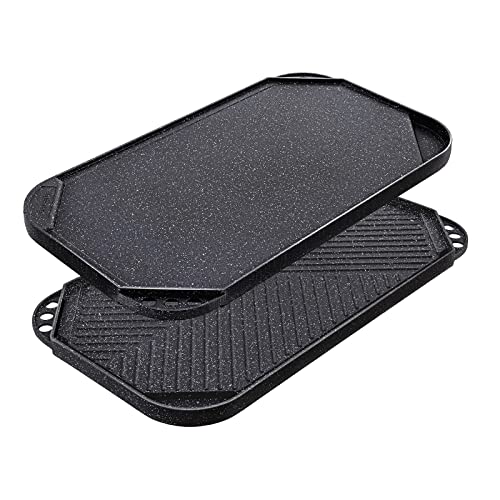
SENSARTE Nonstick Griddle Grill Pan, Pro-Grid Reversible, Cast Aluminum — Best for Glass and Ceramic Tops
The SENSARTE answers the question cast iron cannot: what does a glass-top or induction-adjacent household grill on? A cast aluminum plate at 19.5 by 10.7 inches — full double-burner size — with a nonstick surface on both the grill and griddle faces, light enough to lift, flip, and wash without a workout. It suits glass and ceramic cooktop owners, smaller households, and anyone who wants the format without the iron’s weight or seasoning ritual. It does not suit cooks chasing the deepest possible sear, where mass still wins.
Strengths
- Cast aluminum — the glass-top-safe way to own a double-burner plate
- Nonstick on both faces; cleanup is a wipe and a rinse
- Full 19.5-inch length at a fraction of cast iron’s weight
Trade-offs
- Less heat storage than cast iron — sears well, but not identically
- Nonstick coatings are a wear surface with a finite life
- Metal utensils and maximum burner heat shorten that life — cook accordingly
Key specs (from the verified listing): 19.5 x 10.7 inches; cast aluminum; reversible grill & griddle; nonstick; two-burner format; portable for stovetop or outdoor use.
The honest physics: aluminum conducts heat faster than iron but stores less of it, so the SENSARTE heats quickly and evenly — no waiting ten minutes for the plate — and gives back a good sear on burgers, chicken, and vegetables, with the deepest steak crusts reserved for its iron rivals. In exchange you get the daily-life virtues that make a tool get used: it is light, it releases eggs, it washes in the sink, and it will not crack a glass top or demand a seasoning religion.
For the large and growing share of kitchens with smooth-top ranges — where cast iron plates are discouraged or banned by the range manufacturer — this is not the compromise pick. It is the correct pick, and the only one in this guide we recommend for those stoves without reservation.
Best for: glass and ceramic cooktop owners, and anyone prioritizing light weight and easy cleanup / Not suited for: maximum-sear purists — Check the current price on Amazon

Lodge Reversible Cast Iron Grill/Griddle Pan, 16.75 x 9.5 Inches — Best Budget Cast Iron
The LPGI3 is the plate that defined the category for a generation: a compact double-burner cast iron reversible, made in the USA, at the most accessible position in the Lodge line. It suits smaller ranges, couples, and first-time plate buyers who want the genuine cast iron experience without the Pro-Grid’s size or price tier. It does not suit big-batch breakfast cooking, where its 16.75-inch length runs out of room.
Strengths
- The benchmark cast iron plate at an entry position
- Compact length fits shorter burner spans the big plates cannot
- Made in USA, pre-seasoned, effectively immortal with basic care
Trade-offs
- Smallest cooking area of the cast iron picks here
- Same cast iron weight-to-size reality — dense for its footprint
- Not recommended for glass cooktops
Key specs (from the verified listing): 16.75 x 9.5 inches; cast iron; reversible dual-sided double burner griddle; PFAS-free; made in USA.
Do not let the budget badge undersell it: this is the same iron, the same foundry discipline, and the same cooking physics as the Pro-Grid, in a smaller frame. For a household of two — two steaks, four burgers, a modest pile of vegetables, a half-batch of pancakes — its surface is not a limitation at all, and its shorter span fits the apartment ranges where the twenty-inch plates overhang dangerously. Many owners buy this plate first, learn the format, and never feel the need to upgrade; the ones who do upgrade keep it as the second plate for simultaneous grill-and-griddle work.
Best for: couples, small ranges, and first-time cast iron plate buyers / Not suited for: family-scale batch cooking — Check the current price on Amazon

Lodge Blacklock Double Burner Griddle, 10 x 20 Inches — Best Lightweight Cast Iron
The Blacklock line is Lodge’s answer to cast iron’s oldest complaint — the weight — engineered to be noticeably lighter than classic plates while keeping iron’s cooking behavior, and triple-seasoned for a strong start. At 10 by 20 inches it matches the Pro-Grid’s footprint in a plate that is simply easier to lift, flip, and store. It suits cooks who love cast iron cooking but not cast iron heft: smaller households, cooks with wrist or strength limits, anyone who stores the plate in a low cabinet. It does not suit buyers who equate mass with quality in all cases — this plate trades a little heat storage for its lightness, knowingly.
Strengths
- Full 20-inch footprint at a meaningfully lighter weight than classic iron
- Triple-seasoned surface — the strongest factory seasoning in the Lodge line
- Smooth surface that handles pancakes and burgers beautifully
Trade-offs
- Less thermal mass than the Pro-Grid — sears very well, stores slightly less heat
- Premium position within the cast iron plates here
- Still cast iron: glass tops and soaking remain off the menu
Key specs (from the verified listing): 10 x 20 inches; lightweight cast iron; triple-seasoned; smooth surface; cast in the USA.
Weight is not a cosmetic spec on a tool you move while it is hot. A plate that a cook can lift confidently with one mitt while steadying a tray with the other hand is a plate that gets used on weeknights; a plate that feels like a commitment gets used on weekends. The Blacklock’s engineering — thinner walls, refined casting — keeps the cooking surface’s behavior recognizably cast iron while cutting the penalty, and its triple seasoning means eggs behave sooner in its life than on any other iron here.
Choose it when the Pro-Grid’s size appeals but its heft does not. The searing difference at home-cooking scale is small; the handling difference is felt every single time you pick it up.
Best for: cast iron lovers who want the big footprint without the big lift / Not suited for: maximum-mass searing absolutists or glass tops — Check the current price on Amazon

Victoria Rectangular Cast Iron Griddle, Double Burner, 18.5 x 10 Inches — Best Seasoning Out of the Box
Victoria’s plate competes on the surface itself: seasoned with flaxseed oil — the seasoning enthusiasts choose when they build a finish from scratch — for a slicker start than standard factory seasonings typically give. At 18.5 by 10 inches it sits between the compact Lodge and the twenty-inch plates in size. It suits cooks who cook eggs and delicate foods on the griddle side often and want the least sticky learning curve cast iron offers. It does not suit buyers who want the deepest brand ecosystem behind their iron.
Strengths
- Flaxseed-oil seasoning — a genuinely slicker out-of-box surface
- Mid-size footprint that fits most ranges with room to work
- Reversible grill/griddle design with a quality casting finish
Trade-offs
- Smaller brand footprint than Lodge — fewer matching accessories and less lore
- Cast iron weight and care, as with all the iron picks
- Not for glass cooktops
Key specs (from the verified listing): 18.5 x 10 inches; cast iron; reversible double burner griddle; seasoned with 100% kosher certified non-GMO flaxseed oil.
Seasoning is the difference between a plate that fights you for a month and one that cooks eggs in week one, and Victoria’s flaxseed finish is the connoisseur’s detail in this guide. Flaxseed oil polymerizes into an especially hard, slick layer, and owners of flaxseed-seasoned iron consistently report the shortest break-in in the category. The plate beneath it is well cast, with a smooth finish that reinforces the effect.
If your griddle side will see as much breakfast as your grill side sees dinner, this is the iron to buy. If you are a steak-first cook, the Lodge plates’ mass argues louder. Either way, the Victoria proves the category is not a one-brand story.
Best for: breakfast-heavy households wanting the slickest cast iron start / Not suited for: buyers prioritizing brand ecosystem — Check the current price on Amazon

NutriChef Cast Iron Reversible Griddle, 18 x 10 Inches — Best Value Alternative
The NutriChef brings the full cast iron formula — pre-seasoned, reversible, flat top on one side and ridged grill on the other — at a value position, in an 18 by 10 inch frame that fits the majority of ranges. It suits budget-first buyers who want genuine iron rather than a coated substitute. It does not suit buyers who want the foundry pedigree and finish refinement of the Lodge and Victoria plates.
Strengths
- True cast iron construction at a value-tier position
- Pre-seasoned flat and ridged sides — both surfaces ready to cook
- 18-inch length covers most home burner spans
Trade-offs
- Finish and casting refinement trail the premium iron brands
- Seasoning may need a few cooks to reach its best behavior
- Value-tier support and accessory ecosystem
Key specs (from the verified listing): 18 x 10 inches; cast iron; reversible pre-seasoned griddle with flat top and ridged grill side; for stove tops, gas grills, indoor and outdoor cooking.
Value cast iron is a legitimate tradition — iron is iron, and a well-poured plate at a lower position cooks far more like the premium plates than its price suggests. The NutriChef’s surface may start life a touch rougher and its seasoning a touch thinner, and both gaps close with the same cooking-and-oiling routine every iron in this guide wants anyway. A month in, most owners would struggle to identify it blind against plates costing notably more.
Buy it when the budget is the argument and iron is the requirement. The savings buy a lot of steaks to practice on.
Best for: budget-first buyers committed to real cast iron / Not suited for: buyers wanting premium finish out of the box — Check the current price on Amazon
Comparison Table
| Pick | Badge | Key spec | Best for |
|---|---|---|---|
| Lodge Pro-Grid 20 x 10.5 | Best Overall | Cast iron, largest classic footprint | Serious gas-range searing and big batches |
| SENSARTE Nonstick Pro-Grid | Best for Glass Tops | Cast aluminum nonstick, 19.5 x 10.7 | Glass/ceramic ranges, easy cleanup |
| Lodge LPGI3 16.75 x 9.5 | Best Budget Cast Iron | Cast iron, compact span | Couples and small ranges |
| Lodge Blacklock 10 x 20 | Best Lightweight Cast Iron | Lightweight iron, triple-seasoned | Big footprint, easier handling |
| Victoria 18.5 x 10 | Best Seasoning | Flaxseed-oil seasoned cast iron | Breakfast-heavy cooking |
| NutriChef 18 x 10 | Best Value Alternative | Pre-seasoned cast iron, value tier | Real iron on a firm budget |
How to Choose a Stove Top Grill Plate: Size, Material, and Your Range
Measure first, and measure the right thing: the distance your plate must span is from the front edge of your front burner to the back edge of your back burner, plus a small margin so the plate sits stable rather than teetering. Most home ranges land between the LPGI3’s compact span and the twenty-inch plates; if your span is borderline, choose the plate whose length clears it with the least overhang, because a plate hanging far past the burners develops cold ends that cook unevenly. Width matters too — a ten-inch-wide plate centers over standard burners, while wider plates suit ranges with broad burner spacing.
Material is the second decision, and it is really three questions. Is your cooktop glass or ceramic? Then the answer is the SENSARTE’s cast aluminum (or no plate at all, if your range’s manufacturer forbids long griddles — check the manual, because some do). Do you want the deepest sear and a tool that outlives you? Cast iron, in whichever size and weight your arms accept. Do you want the easiest daily cleanup? Nonstick aluminum, accepting its coating as a wear surface. There is no universal winner; there is a winner per kitchen, and this guide’s badges map them.
Finally, consider your hood. Indoor grilling makes smoke in proportion to how well you are doing it. A range hood that vents outside turns stove top grilling into an all-weather pleasure; a recirculating hood or an open window and a fan make it a more occasional event. Buy the plate either way — but set the expectation, and keep a splatter screen in the drawer.
Cast Iron vs Cast Aluminum: The Honest Trade
Cast iron’s case is thermal mass and permanence. It stores heat through a full load of cold food, sears with authority, develops a better surface the longer you own it, and can be restored after almost any abuse short of cracking. Its costs are weight, rust discipline, and cooktop restrictions. Cast aluminum’s case is responsiveness and ease: it heats fast and evenly, weighs a third as much, carries a nonstick surface that forgives beginners, and is the only responsible choice for smooth-top ranges. Its costs are a shallower sear on the thickest cuts and a coating that will eventually wear.
Notice that both materials cook the everyday menu — burgers, chicken, vegetables, breakfast — genuinely well. The differences concentrate at the extremes: the two-inch steak (iron), the fried egg for a child on a school morning (aluminum, and it is not close). Most households know which extreme visits their kitchen more often. Buy for that one.
How to Use a Two-Burner Grill Plate: Setup, Searing, and the Oven Finish
Setup begins cold: center the plate over both burners before any heat, so you are never maneuvering a hot slab. Preheat on medium for five to ten minutes — cast iron wants the longer end, aluminum the shorter — and test readiness with a flick of water: droplets that dance and evaporate briskly mean the surface is ready; droplets that sit and simmer mean wait. Set the two burners unequally from the start — the front a notch hotter than the back — and you have built the two-zone system the plate’s whole design promises: sear over the front burner, rest and finish over the back.
The signature stove top technique is sear-and-finish. Steaks and chops get their crust on the grill side over the hot zone, then move — plate and all, or onto a waiting sheet pan — into a hot oven to finish to temperature without burning the exterior. Chicken pieces sear skin-side down, then finish the same way. On the griddle side, the discipline is batch order: bacon first (its fat seasons the surface for everything after), eggs last and gentlest. Clean while the plate is still warm — a wipe for aluminum, a hot rinse and dry-on-the-burner for iron, with a thin oil film for storage. Run this routine and a stove top plate stops being a gadget and becomes the most-used surface in the kitchen.
Seasoning and Care for Cast Iron Plates
Factory seasoning is a starting point, not a finish. The first month of iron ownership decides the surface’s character: cook fatty foods early and often, avoid soaking, dry the plate on the burner every time, and wipe on the thinnest possible film of high-smoke-point oil while it is warm. Eggs sticking in week one is normal; eggs releasing in week six is the same plate, educated. If food ever scorches badly onto the surface, simmer water on the plate to loosen it rather than attacking with steel wool, then dry and oil as usual.
Long-term, iron asks almost nothing and forgives almost everything — a rust spot from a forgotten wet day scrubs off and re-seasons in a few cooks. The plates in this guide, iron ones especially, are among the few kitchen tools that genuinely improve with age, which is why the category’s classics have production histories measured in decades.
Breakfast on the Griddle Side: The Workflow That Sells the Format
Ask owners what converted them and most describe a Saturday morning. The plate goes on cold, burners at medium, and by the time the coffee is poured the surface is ready. Bacon goes down first, spread across both zones — its fat renders onto the iron or the nonstick and becomes the cooking medium for everything that follows. Hash browns or home fries take the hot zone next, pressed flat and left alone to crust. Pancakes follow on the now-seasoned surface, four to six at a time instead of a skillet’s two, and eggs go last, over the cooler back zone, in the last of the bacon fat. Toast finishes directly on the plate while the eggs set.
The point is not any single item — it is the sequencing. A two-burner plate is a short-order line in miniature: two temperatures, one continuous surface, no pan juggling, no oven preheating, and one thing to wash. Families who cook weekend breakfast together routinely report that the griddle side alone justified the purchase, with the grill side — the reason they thought they were buying it — as the bonus. If your household’s ritual is breakfast, weight the badges accordingly: the Victoria’s seasoning and the Blacklock’s smooth surface are breakfast specifications, and the SENSARTE’s nonstick makes the egg course effortless.
Stove Top Grilling for Small Kitchens, Renters, and the Patio-Less
A large share of this guide’s readers have no outdoor option at all: apartments without balconies, rentals that forbid grills, climates that forbid them half the year. For those kitchens, a two-burner plate is not a substitute for a grill — it is the grill, and it deserves to be bought with the same seriousness a homeowner gives a patio cart. The calculus changes in their favor in two ways. First, the plate stores in a cabinet or a deep drawer, asking nothing of a small kitchen’s floor plan. Second, it runs on the range they already own, so the entire investment is the plate itself and a pair of good mitts.
The disciplines that matter most in small spaces are the ones this guide repeats: measure the span, respect the hood, and learn the oven finish. A renter with a Pro-Grid or a SENSARTE, a working vent, and a sheet pan for finishing thick cuts can produce a steak dinner indistinguishable from a patio cook’s for two to four people, in February, in a studio. That is not a consolation prize; for a great many cooks it is simply the correct tool, and the outdoor grill becomes the optional extra rather than the other way around.
Your First Week With the Plate: A Cooking Plan That Teaches the Tool
Day one, griddle side: pancakes and bacon. You learn the preheat timing, the two zones, and how your plate’s surface behaves with batter and fat — the friendliest possible introduction. Day two, grill side: burgers. You learn the smoke reality under your hood, the mark the ridges leave, and why patting the meat dry matters. Day three: vegetables on the grill side — asparagus, zucchini planks, peppers — where the plate’s evenness shows and nothing can fall through anything. Day four: chicken thighs, skin-side down on the grill side, finished in the oven, which teaches the sear-and-finish workflow that unlocks the format. Day five: a steak, cooked with everything you now know.
By the end of that week you will know your plate’s hot geography, your hood’s honest capacity, and your own preference between the sides — knowledge no specification can give you. You will also have seasoned an iron plate through five real cooks, which is worth a month of oven-seasoning rituals. New owners who follow a plan like this keep their plates for years; owners who start with a ribeye under a closed window and a screaming smoke alarm sometimes do not make it to day two.
Storage, Handling, and Living With a Hot Slab of Iron
The unglamorous half of plate ownership is moving and storing the thing, and it deserves planning before the first cook rather than improvisation after it. A hot plate never gets carried by its edges with a dish towel — that is the burn story every emergency room knows — so the kit is two proper mitts or a set of plate lifters, and a landing zone (a trivet, a cold burner, the oven rack) decided before the food goes on. The Blacklock’s lighter build and the SENSARTE’s aluminum make this routine genuinely easier, which is a real part of their value and not a soft one.
Storage follows the same logic. Iron plates store best clean, dry, and lightly oiled, standing on edge in a cabinet like a cutting board or lying flat under the oven’s broiler drawer if your range has one; a paper towel or cloth between stacked items protects the seasoning. Aluminum plates store anywhere, in anything, which is the whole point of them. Give the storage question thirty seconds at purchase — measure the cabinet as faithfully as the burners — and the plate becomes a permanent resident instead of a countertop squatter you resent by spring.
How Your Range Type Changes the Results
The same plate cooks three slightly different ways on the three range types, and matching expectations to your stove prevents the only disappointments this category really produces. On gas, the plate is in its element: flame wraps the underside, response to dial changes is quick, and the two-zone setup is precise — this is the reference experience every pick in this guide was judged against. On electric coil, output is strong but lumpier; the plate needs a longer preheat to even out, and cast iron’s mass becomes a genuine advantage because it smooths the coils’ hot rings into a uniform surface. Rotating food a quarter-turn mid-cook is a coil owner’s normal, not a failure.
On radiant glass and ceramic, the rules tighten: only flat-bottomed, smooth plates, lifted rather than slid — which in this guide means the SENSARTE, full stop — and heat discipline matters because glass tops cycle their elements and reward medium-high patience over maximum settings. Induction households have the narrowest door: the plate must be magnetic and manufacturer-rated for induction, a property none of this guide’s cast aluminum offers and only some iron does, so verify your exact model against the listing before ordering. None of these range types is disqualified from stove top grilling; each simply has a correct plate and a correct technique, and this guide’s badges exist to pair them.
Common Buying Mistakes
The first mistake is buying by cooking area without measuring the burner span — the plate that does not bridge your burners is a paperweight with ridges. The second is putting cast iron on a glass cooktop against the range manufacturer’s guidance; the SENSARTE exists precisely to prevent that expensive lesson. The third is expecting a lid’s behavior from an open plate — thick cuts need the oven finish, and cooks who learn that in advance love the format while cooks who do not blame the plate. The fourth is neglecting smoke management: the first ribeye on a new plate, cooked under a recirculating hood with the windows shut, has ended more stove top grilling careers than any product flaw. Vent first, sear second.
Final Recommendation
For most gas-range households, the Lodge Pro-Grid is the plate to buy — the size, the mass, and the permanence of the category’s benchmark. Glass-top owners should go straight to the SENSARTE aluminum plate and never look back. The LPGI3 serves small ranges and couples, the Blacklock serves anyone who wants iron without the heft, the Victoria rewards breakfast cooks, and the NutriChef puts real iron on a firm budget. For outdoor two-burner cooking, see our companion guides: Best 2 Burner Grills, Best 2 Burner Cast Iron Grills For Stove Top, Best 2 Burner Propane Grills, Best 2 Burner Small Grills, and Best 2 Zone Cookung Grills.
Frequently Asked Questions
Can I use a cast iron grill plate on a glass cooktop?
We advise against it, and many range manufacturers do too: cast iron is heavy, its underside can be rough, and dragging it can scratch or crack a glass surface. The damage, when it happens, is to a cooktop that costs many times the plate — an asymmetry that makes the aluminum route the only sensible recommendation here. The cast aluminum SENSARTE in this guide is the smooth-top-safe route to the same format. If your manual explicitly permits cast iron and you lift rather than slide, the risk is yours to take knowingly.
How do I stop a stove top grill plate from smoking out the kitchen?
Vent before you sear: hood on high, a window cracked to feed it air. Trim excess fat, pat food dry (surface water becomes steam and splatter), avoid sugary marinades on the grill side, and keep the plate’s heat at the lowest setting that still sears. Some smoke is the honest signature of grilling; a kitchen full of it is a ventilation problem, not a plate problem. A mesh splatter screen laid loosely over fatty items like bacon buys extra insurance on the griddle side, and costs almost nothing.
Grill side or griddle side — which will I use more?
Most households surprise themselves with the honest answer: the griddle side, once discovered, takes breakfast, sandwiches, burgers, and vegetables, and very often ends up the daily driver of the whole kitchen. The grill side owns steaks, chops, chicken skin, and anything that wants marks and dry heat. A reversible plate means the question never needs an answer in advance — which is the entire point of the format.
Do these plates work on electric coil stoves?
Yes, with adjusted expectations: coils heat less evenly than gas, so give the plate a longer preheat and rotate food more. Cast iron’s mass smooths coil hot spots better than aluminum does. On induction, only plates whose manufacturer states induction compatibility will work — check the listing for your exact model before assuming. One coil-specific caution: confirm the plate sits level across both coils without rocking, since a plate that teeters on a coil’s high spots heats unevenly and can stress the element; a slight rock on gas grates is normal and settles under the plate’s weight, but on coils it is worth a test fit before the first cook.
How long do nonstick plates last compared to cast iron?
Cast iron is effectively permanent; a nonstick coating is a wear surface whose life depends on heat discipline and utensils — years with care, less without. That is the trade at the heart of this guide: aluminum’s ease now versus iron’s forever. Neither is the wrong answer; they are answers to different questions about how you cook and what you maintain.
Why does food stick to my new cast iron plate?
Usually three common and entirely fixable causes: the plate was not fully preheated (food bonds to a warming surface and releases cleanly from a properly hot one), the food was moved too early (proteins release themselves once the crust forms — give them another thirty patient seconds), or the seasoning is still young. All three improve with the first month of fatty cooking. A metal spatula with a thin edge, used confidently, is a better tool than any spray.
Can I put a stove top grill plate in the oven or dishwasher?
Oven, yes for cast iron — plates double as roasting surfaces and oven searing tools, one of the format’s genuine hidden virtues. Dishwasher, no for iron (it strips seasoning and invites rust) and not recommended for nonstick aluminum either, despite many being labeled tolerant of it; both wash by hand in under a minute once you build the while-it-is-warm habit.
Can a stove top plate replace an outdoor grill?
For a small household’s weeknight cooking, remarkably often, yes — with the oven finish standing in for the lid and a good hood standing in for the outdoors. What it cannot replace is capacity, charcoal flavor, and the social geometry of cooking outside for a group. Many owners keep both and find the plate handles the majority of actual meals — the Tuesday chicken and the Saturday pancakes — while the outdoor grill keeps the holidays, the smoke, and the crowd. Judged by meals cooked rather than by specifications, the humble plate is frequently the hardest-working grill a household owns, which is why this category rewards buying a good one the first time.


