Disclosure: airfryerkitchensupply.com is reader-supported. When you buy through links on our site, we may earn an affiliate commission at no extra cost to you.
Where to buy
All six picks in this guide are sold through Amazon, where you can check the current price on Amazon and confirm the exact configuration — window kit, remote and smart features vary by listing. Window air conditioners are heavy, seasonal and freight-sensitive, so buying from a retailer with straightforward returns matters if the unit arrives with a bent case or turns out to be the wrong size for your window. Every model below was verified as a current listing during our research, and every one runs on a standard household outlet.
- Frigidaire 12,000 BTU Smart Window Air Conditioner — Check on Amazon
- Midea 10,000 BTU U-Shaped Smart Inverter Window AC — Check on Amazon
- LG 12,000 BTU Dual Inverter Smart Window Air Conditioner — Check on Amazon
- GE 12,000 BTU Smart Window Air Conditioner — Check on Amazon
- Frigidaire 5,000 BTU Window-Mounted Air Conditioner — Check on Amazon
- Frigidaire 8,000 BTU Window Air Conditioner — Check on Amazon
If you are looking for the best 110 volt window air conditioner, start with a small translation: there is no separate species of 110V air conditioner. North American household power is nominally 120V, and the same window units are labelled 110V, 115V or 120V depending on the brand’s convention. What you are actually shopping for is a window air conditioner that runs on a standard household circuit instead of a 230V dedicated line — and that single fact shapes the whole category, because it caps practical cooling at roughly 15,000 BTU and makes circuit capacity, not just room size, part of the sizing decision.
Within that cap, the modern category is better than its reputation. Inverter and dual-inverter compressors have brought genuinely quiet, efficient operation down into household-voltage machines; smart controls are now normal rather than premium; and the U-shaped design has solved the oldest window-AC annoyance by letting you open the window and keeping the compressor noise outside. The picks below span the realistic range: a 5,000 BTU budget unit for a small bedroom, mid-size machines for the rooms most people actually cool, and 12,000 BTU models for large living spaces — each one verified, each one honestly placed.
Sizing is the decision that decides satisfaction, so this guide repeats the core rule everywhere: roughly 20 BTU per square foot as a starting point, adjusted up for sun, kitchens and occupants, and down for shade and good insulation. An oversized unit short-cycles and leaves the room cold and clammy; an undersized one runs flat out and never arrives. Every pick below states its manufacturer’s coverage figure, taken from its own verified listing, so you can match machine to room without guesswork.
In this guide
Quick Picks
The six picks in one view — a default recommendation for most homes, the quiet and efficiency specialists, a smart-home pick, and the small-room value options.
- Frigidaire 12,000 BTU Smart Window Air Conditioner — Best Overall: Wi-Fi control, eco mode and three fan speeds cooling up to 550 sq ft — the complete package for most living rooms. Check on Amazon
- Midea 10,000 BTU U-Shaped Smart Inverter Window AC — Best for Quiet: The U-shape design keeps noise outside and lets the window open, cooling up to 450 sq ft with inverter efficiency. Check on Amazon
- LG 12,000 BTU Dual Inverter Smart Window Air Conditioner — Best Energy Efficiency: Dual-inverter operation with up to 35% more energy savings claimed by LG, ENERGY STAR rated, for up to 550 sq ft. Check on Amazon
- GE 12,000 BTU Smart Window Air Conditioner — Best Smart Features: Wi-Fi with Alexa and Google support and a quick install kit, for large rooms up to 550 sq ft. Check on Amazon
- Frigidaire 5,000 BTU Window-Mounted Air Conditioner — Best Budget for Small Rooms: Simple, quiet mechanical cooling for rooms up to 150 sq ft, with auto restart and two fan speeds. Check on Amazon
- Frigidaire 8,000 BTU Window Air Conditioner — Best Mid-Size Value: Remote control, eco mode and three fan speeds for rooms up to 350 sq ft — the classic bedroom-plus size. Check on Amazon
How These Picks Were Chosen
Every pick was verified against Amazon’s own catalogue data through the Creators API on the day of research: the brand, model, BTU rating and stated room coverage in this guide match each manufacturer’s current listing. That matters in this category because window-AC listings are frequently copied between sellers with drifted specifications — a unit described as 12,000 BTU in one place becomes something else in another. If a model’s own listing could not confirm its rating and coverage, it did not appear here.
Judging criteria, in order: correct sizing honesty — manufacturers’ coverage claims in this category are broadly comparable, and picks were matched to the room sizes they can genuinely serve; compressor type, because inverter machines run quieter and cheaper once the room is at temperature; noise, since many of these units cool bedrooms; control quality, from simple mechanical dials to full app and voice control; and installation reality — weight, window kit quality and whether one person can reasonably fit the unit. Energy ratings were weighed throughout: a window unit runs for hundreds of hours a season, so efficiency differences compound into real money.
A note on the voltage label, since it confuses buyers every summer: a unit listed as 115V and a unit listed as 120V are the same machine class for the same outlet. What deserves your attention instead is the circuit — a 12,000 BTU unit wants a household circuit that is not already carrying a microwave, a kettle circuit’s worth of kitchen loads, or a space heater. The buying-guide sections below cover circuit checks in plain terms.
The 6 Best 110 Volt Window Air Conditioners
Ordered by how most buyers should consider them: the all-rounder first, then the quiet and efficiency specialists, the smart pick, and the two smaller-room values.

Frigidaire 12,000 BTU Smart Window Air Conditioner — Best Overall
Frigidaire’s 12,000 BTU smart window unit is the default recommendation for a reason: it covers rooms up to 550 sq ft, connects over Wi-Fi, includes a remote, runs an eco mode and three fan speeds, and comes from the brand that has made window cooling for generations. For a living room, a large bedroom or an open-plan space, this is the size class that actually holds temperature on a hot afternoon rather than merely taking the edge off, and the smart layer — scheduling, remote start, adjusting from the sofa — is the version of convenience people genuinely use after the first week.
Check the current price on Amazon
Strengths
- Full smart package: Wi-Fi, remote, eco mode and three fan speeds
- 550 sq ft coverage handles the largest rooms a household circuit can serve well
- Frigidaire’s service and parts presence is the deepest in window cooling
Trade-offs
- A conventional compressor design — louder and less efficient at part load than the inverter picks
- 12,000 BTU class units are heavy; plan on two people for installation
- Oversized for a small bedroom, where it will short-cycle and dehumidify poorly
| Specification | Detail |
|---|---|
| Cooling capacity | 12,000 BTU |
| Stated coverage | Up to 550 sq ft |
| Controls | Wi-Fi smart control, remote control |
| Fan speeds | 3 |
| Modes | Eco mode |
The case for this unit is completeness. Nothing about it is the best in this guide — the Midea is quieter, the LG inverter is thriftier — but nothing about it is weak, either, and completeness is what most households need from the one air conditioner that cools their main living space. The app control earns its keep in one specific scenario: turning the unit on before you get home, so the room is already down to temperature. Scheduling does the same job for predictable routines, and eco mode trims the cost of the long evening hours when the room only needs maintaining.
Buy it at the right size or not at all. In a 200 sq ft bedroom this machine will blast the room cold, satisfy the thermostat and shut off while the air is still humid — the classic oversized-AC complaint — and you will blame the unit for a sizing decision. In its proper 400–550 sq ft territory it is the safest pair of hands in the category. Check the current price on Amazon, and measure your window before ordering: units in this class need a window opening that suits their width and a sill that can take the weight with the supplied supports.
Best for: living rooms and large bedrooms up to about 550 sq ft on a standard circuit / Not suited for: small bedrooms, or windows that cannot support a full-size chassis

Midea 10,000 BTU U-Shaped Smart Inverter Window AC — Best for Quiet
The U-shaped design is the one genuine structural innovation in window cooling in years, and this 10,000 BTU Midea is its mainstream form: the unit saddles the window sill, the window closes down into the U, and the compressor — the noisy half — sits outside. The results are a much quieter room, a window you can still open on mild days, and a better seal than a conventional chassis typically achieves. Add an inverter compressor, smart control with Alexa and Google support, and a stated 35% energy saving over conventional designs, and you have the pick for bedrooms, nurseries and home offices up to 450 sq ft where noise is the deciding factor.
Check the current price on Amazon
Strengths
- U-shape puts the compressor outside and lets the window open — the quietest format in the guide
- Inverter operation saves energy and holds temperature without on-off cycling
- Smart control with voice assistant support included
Trade-offs
- Installation is more involved than a conventional unit — the bracket system needs care
- 10,000 BTU caps out around 450 sq ft; large living rooms need the 12,000 class
- The design suits standard double-hung windows best; unusual window types need checking
| Specification | Detail |
|---|---|
| Cooling capacity | 10,000 BTU |
| Stated coverage | Up to 450 sq ft |
| Design | U-shaped, inverter |
| Controls | Smart control, Alexa / Google compatible |
| Claimed saving | 35% energy savings (manufacturer) |
Noise claims need translating. Every maker quotes its quietest setting, which is a low-fan maintenance mode — but the U-shape’s advantage is structural rather than a fan-speed trick: with the compressor outside a closed window, the sound that reaches the room is mostly moving air, and moving air is the easiest sound to sleep through. For a light sleeper, a nursery or a desk you sit at for eight hours, that difference is the product. The inverter reinforces it by avoiding the start-stop clunk cycle of conventional compressors through the night.
The compromises are installation and ceiling. Fitting the support bracket properly is a real, if one-time, job, and renters should confirm the bracket arrangement suits their lease and window type before ordering. And 10,000 BTU is 10,000 BTU: in a 500 sq ft sunlit living room this unit will run constantly and still lose ground on the worst afternoons. Buy it for the room it fits — a bedroom or office up to roughly 450 sq ft — and it is the most civilised window cooler in this guide.
Best for: bedrooms, nurseries and home offices where quiet matters most / Not suited for: rooms much above 450 sq ft, or windows the bracket system cannot fit

LG 12,000 BTU Dual Inverter Smart Window Air Conditioner — Best Energy Efficiency
LG’s dual inverter is the efficiency pick: a 12,000 BTU, 115V window unit for rooms up to 550 sq ft, ENERGY STAR rated, with LG claiming up to 35% more energy savings than conventional designs, plus ThinQ app control and Alexa and Google voice support. Dual-inverter compressors vary their speed continuously instead of cycling on and off, which is where both the savings and the quiet come from — once the room reaches temperature, the machine sips power to hold it instead of repeatedly restarting at full draw. For a unit that will run all summer in a main living space, that behaviour is worth real money by September.
Check the current price on Amazon
Strengths
- Dual-inverter efficiency with ENERGY STAR rating — the cheapest 12,000 BTU cooling to run here
- Ultra-quiet operation by category standards, especially at maintenance speeds
- Full smart layer: ThinQ app, Alexa and Google voice control
Trade-offs
- Premium-tier positioning within the 12,000 BTU class
- Inverter electronics are costlier to repair out of warranty than a simple conventional unit
- Same full-size weight and installation effort as any 12,000 BTU chassis
| Specification | Detail |
|---|---|
| Cooling capacity | 12,000 BTU |
| Input | 115V |
| Stated coverage | Up to 550 sq ft |
| Compressor | Dual inverter |
| Rating | ENERGY STAR |
| Claimed saving | Up to 35% more energy savings (manufacturer) |
The arithmetic of efficiency is seasonal, not hourly. A window unit in a hot climate can run 800–1,500 hours a summer; across that span, an inverter’s part-load advantage compounds from a curiosity into the difference between two otherwise similar electricity bills you can actually see. The dual-inverter design also treats the circuit kindly — no hard start-up surge, lower running draw at maintenance — which matters on older household wiring where a conventional unit’s start can dip the lights.
Choose the Frigidaire instead if purchase price is the binding constraint or if the unit will cool a rarely used guest room, where running hours are too few for efficiency to repay the premium. Choose this LG if the unit will live in your main room and run daily: it is the long-hours pick, and its quiet maintenance mode makes it the rare 12,000 BTU unit that also behaves in a large bedroom.
Best for: main living spaces and large bedrooms that run long daily hours all summer / Not suited for: rarely used rooms where the efficiency premium cannot repay itself

GE 12,000 BTU Smart Window Air Conditioner — Best Smart Features
GE’s 12,000 BTU smart window unit is the pick for the connected home: Wi-Fi control with Alexa and Google support, an energy-efficient design for rooms up to 550 sq ft, and — a detail owners appreciate more than any app feature — a quick install kit that makes fitting and seasonal removal less of a wrestle. GE Appliances’ smart ecosystem is mature, and for a household already running voice control and routines, this is the window unit that slots in with the least friction: schedules, geofencing-style routines through your assistant, and remote control from anywhere.
Check the current price on Amazon
Strengths
- Polished smart integration with Alexa and Google ecosystems
- Quick install kit reduces the worst part of window-AC ownership
- 550 sq ft coverage matches the other 12,000 BTU picks
Trade-offs
- Conventional compressor — the inverter picks run quieter and cheaper at part load
- Smart features need a stable Wi-Fi signal at the window to be worth anything
- Full-size chassis weight, like every 12,000 BTU unit here
| Specification | Detail |
|---|---|
| Cooling capacity | 12,000 BTU |
| Stated coverage | Up to 550 sq ft |
| Controls | Wi-Fi, Alexa / Google support |
| Installation | Quick install kit included |
Judge smart features by the second month, not the first day. Voice control is a novelty in week one; what remains valuable is scheduling that matches the household’s rhythm and remote control on the drive home. GE’s implementation is among the most dependable in the category, and the app experience is the reason to pick this unit over a similarly specified rival. The quick install kit is the sleeper feature: anyone who has fitted a 12,000 BTU unit knows the mounting and sealing process is where installations go wrong, and a kit designed to simplify it reduces both swearing and air leaks.
If your home has no voice assistant and no interest in one, this pick’s premium buys you little — the Frigidaire matches its cooling with a simpler pitch, and the LG beats it on efficiency. If your home runs on routines and assistants, the GE is the natural citizen of that household and the pick to beat.
Best for: smart-home households wanting voice and app control in their main room / Not suited for: buyers with no smart-home setup, or weak Wi-Fi at the intended window

Frigidaire 5,000 BTU Window-Mounted Air Conditioner — Best Budget for Small Rooms
At the small end, honesty is simple: a 5,000 BTU unit cools a small room — Frigidaire states up to 150 sq ft — and within that brief this mechanical-control model is the budget benchmark. Two fan speeds, effortless temperature control, auto restart after power cuts, and a compact chassis one person can install in minutes. There is no app, no remote and no inverter, and for a spare bedroom, a dorm, a small office or a child’s room, there does not need to be: the job is to make one small room comfortable, quietly and cheaply, for years.
Check the current price on Amazon
Strengths
- Budget-tier price with Frigidaire reliability behind it
- Mechanical controls — nothing to pair, update or fail electronically
- Light, compact and genuinely one-person to install and store
Trade-offs
- 150 sq ft ceiling is firm — it will not rescue a larger room
- No remote, timer sophistication or smart features
- Two fan speeds only; fine control is not its game
| Specification | Detail |
|---|---|
| Cooling capacity | 5,000 BTU |
| Stated coverage | Up to 150 sq ft |
| Controls | Mechanical, effortless temperature control |
| Fan speeds | 2 |
| Feature | Auto restart |
Small units are where oversizing discipline matters most, paradoxically because the penalty for undersizing is so visible. Put this unit in a 250 sq ft room and it will run continuously, cool inadequately and collect unfair blame; put it in the 120 sq ft bedroom it was designed for and it cycles gently, dehumidifies properly and sips power. Mechanical controls suit this duty perfectly — they survive power surges, dusty workshops and a decade of storage in a way touch panels sometimes do not, and auto restart means a mid-summer outage does not leave the room baking until someone notices.
Buyers who want a remote without leaving the small-room class should look at Frigidaire’s remote-control 5,000 BTU variant; buyers whose room is even slightly above the coverage figure should step straight to the 8,000 BTU pick below rather than hoping. Within its stated room, this is the value anchor of the guide.
Best for: bedrooms, dorms and small offices up to about 150 sq ft / Not suited for: any room above its coverage, or buyers who want remote and smart control
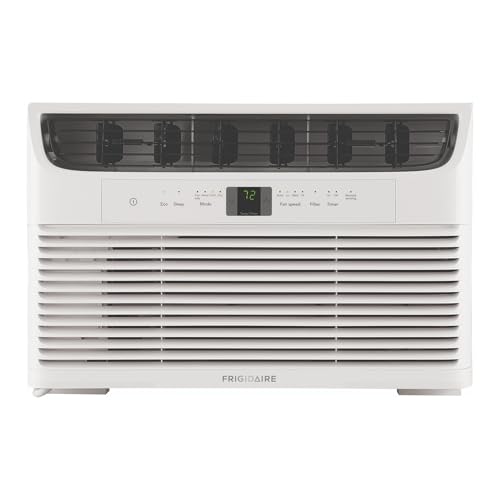
Frigidaire 8,000 BTU Window Air Conditioner — Best Mid-Size Value
The 8,000 BTU class is the quiet workhorse of window cooling — big enough for a proper bedroom, a studio or a small living room, small enough to stay manageable — and Frigidaire’s remote-control model, rated up to 350 sq ft with eco mode, three fan speeds and auto restart, is its representative here. This is the size most single-room buyers should start from: it holds a master bedroom through a hot night without the weight, cost or circuit appetite of the 12,000 BTU class, and the remote and eco mode cover the conveniences people actually use.
Check the current price on Amazon
Strengths
- The right size for the most common single-room jobs — up to 350 sq ft
- Remote, eco mode and three fan speeds cover real-world convenience
- Manageable weight and gentler circuit demand than the 12,000 BTU class
Trade-offs
- Conventional compressor; the Midea U is quieter for noise-sensitive sleepers
- No Wi-Fi — remote control only
- Will struggle in large, sun-exposed living rooms at the top of its range
| Specification | Detail |
|---|---|
| Cooling capacity | 8,000 BTU |
| Stated coverage | Up to 350 sq ft |
| Controls | Remote control |
| Fan speeds | 3 |
| Modes | Eco mode, auto restart |
Think of this unit as the default bedroom answer. Overnight, its job is to reach temperature before bed and then maintain it unobtrusively; eco mode’s fan-cycling behaviour suits that duty, and the three fan speeds give a genuine low for the small hours. In a studio apartment it doubles as the main cooler for the whole space in all but the worst heat. What it is not is a living-room unit for a family space with west-facing glass — that job belongs to the 12,000 BTU picks, and stretching an 8,000 to cover it produces the constant-running, never-quite-cool outcome that fills complaint threads.
Value is this pick’s argument: meaningfully cheaper to buy and to run than the big chassis, with none of the small unit’s coverage anxiety in a normal bedroom. If your room measures between roughly 200 and 350 sq ft, start here and only move up a class if sun exposure, a kitchen’s heat or high ceilings argue for it.
Best for: master bedrooms, studios and small living rooms up to about 350 sq ft / Not suited for: large or sun-blasted living spaces, or buyers who need Wi-Fi control
Comparison Table
Coverage is the first filter — a unit outside its room-size class fails no matter how good its features are. Match the room first, then choose by noise, efficiency and controls.
| Pick | Badge | Key spec | Best for |
|---|---|---|---|
| Frigidaire 12,000 BTU Smart Window Air Conditioner | Best Overall | 12,000 BTU, up to 550 sq ft, Wi-Fi | living rooms and large bedrooms up to about 550 sq ft on a standard circuit |
| Midea 10,000 BTU U-Shaped Smart Inverter Window AC | Best for Quiet | 10,000 BTU U-shape inverter, up to 450 sq ft | bedrooms, nurseries and home offices where quiet matters most |
| LG 12,000 BTU Dual Inverter Smart Window Air Conditioner | Best Energy Efficiency | 12,000 BTU dual inverter, ENERGY STAR | main living spaces and large bedrooms that run long daily hours all summer |
| GE 12,000 BTU Smart Window Air Conditioner | Best Smart Features | 12,000 BTU, Alexa/Google, quick install kit | smart-home households wanting voice and app control in their main room |
| Frigidaire 5,000 BTU Window-Mounted Air Conditioner | Best Budget for Small Rooms | 5,000 BTU, up to 150 sq ft, mechanical | bedrooms, dorms and small offices up to about 150 sq ft |
| Frigidaire 8,000 BTU Window Air Conditioner | Best Mid-Size Value | 8,000 BTU, up to 350 sq ft, remote | master bedrooms, studios and small living rooms up to about 350 sq ft |
How to Choose a 110 Volt Window Air Conditioner: Size the Room, Not the Label
Ignore the voltage number entirely — 110V, 115V and 120V listings describe the same household-outlet class. Size by the room. The working rule is about 20 BTU per square foot, then adjust: add capacity for a south- or west-facing wall of glass, a kitchen’s cooking heat, a third or fourth regular occupant, or a ceiling well above standard height; subtract a little for a shaded, well-insulated room that already stays civilised. Then sanity-check against the manufacturer’s stated coverage for the specific model, which is the figure used throughout this guide — if your adjusted calculation and the stated coverage disagree, believe the more conservative one.
The two failure modes are asymmetric. Undersizing is merely disappointing: the unit runs constantly, the room stays a few degrees warm on the worst afternoons, and the machine wears faster. Oversizing is actively unpleasant: the compressor satisfies the thermostat in short bursts, the air never gets properly dried, and the room feels cold and clammy while the humidity — the thing that actually makes heat miserable — stays. When your room falls between sizes, the smaller unit with good airflow usually makes people happier, especially in bedrooms.
Circuit, Window and Weight: The Three Physical Checks
Check the circuit before the unit arrives. A 12,000 BTU window unit is one of the largest loads on a household circuit; it deserves a circuit that is not simultaneously feeding a microwave, a hair dryer or a portable heater. If breakers trip when the compressor starts, the fix is a different circuit or an electrician — never a bigger breaker on the same wiring. Smaller 5,000–8,000 BTU units are far more forgiving and suit older homes whose circuits are already spoken for.
Check the window with a tape measure, not optimism: opening width and height against the unit’s stated requirements, sill strength, and whether the window type suits the chassis — the Midea U, for example, is designed around standard double-hung windows and its bracket system. Finally, respect the weight. Units in the 12,000 BTU class are two-person lifts with awkward balance; plan the installation with help, a clear path and the unit supported at every moment. More window air conditioners are damaged by installation drops than by a decade of operation.
Inverter vs Conventional Compressors, Explained Plainly
A conventional compressor is a light switch: fully on or fully off. It cools at maximum power until the thermostat is satisfied, stops, and restarts when the room warms — simple, proven, and responsible for both the temperature sawtooth and the start-up clunk you hear through the night. An inverter compressor is a dimmer: it slows down as the room approaches temperature and then runs continuously at low power to hold it. The consequences are steadier temperature, lower running cost at part load, gentler circuit demand and less noise — paid for with a higher purchase price and more complex electronics.
Which matters to you depends on hours. A guest-room unit that runs twenty nights a year will never repay an inverter premium; buy the simple Frigidaire and be happy. A main-room or bedroom unit running daily from June to September lives exactly in the part-load regime where inverters win, and the LG dual inverter or Midea U earn their price in comfort and running cost. This is why the guide’s efficiency picks are inverters and its budget picks are not — both are correct, for different duty patterns.
How to Install a Window Air Conditioner So It Cools Like It Should
Installation quality decides half of a window unit’s real performance. A well-fitted unit in a sealed frame will out-cool a bigger unit leaking air around its chassis every day of the summer.
- Prepare the window: clean the sill and tracks, check the frame is sound, and fit any supplied support bracket now — before the unit is in your arms. For U-shaped models, the bracket is the installation; follow its sequence exactly.
- Lift with help and a plan: two people for anything above the smallest class, a clear route, and the unit kept level and supported throughout. Set it into the opening and secure it to the frame per the manual before letting go.
- Level it correctly: most units want a very slight outward tilt so condensate drains outside rather than into the room — the manual states the angle; guesswork here causes the classic indoor drip.
- Seal every gap: fit the side panels snugly and use the supplied foam — and extra weatherstrip where needed — around the chassis and sash. Air leaking in around the unit is cooling capacity thrown away and insects invited in.
- Manage the cord properly: plug directly into the wall outlet, never a power strip or a thin extension cord, and route the cord where it cannot be pinched by the window or walked on.
- Run and verify: run the unit for fifteen minutes, confirm cold air, normal drainage outside, no abnormal vibration, and that the breaker holds with the room’s other usual loads running.
- Set it up for the season: configure the thermostat, eco mode and any app pairing now, and clean the filter on the schedule the manual gives — a clogged filter quietly taxes every unit in this guide.
At season’s end, clean the filter, let the unit dry on fan-only, and store it upright indoors if you remove it. Ten minutes of end-of-season care is the difference between a unit that lasts a decade and one that smells of mildew by its third summer.
Living With a Window Unit: What a Season Actually Teaches
The first week with a window air conditioner is about temperature; the rest of the season is about everything else, and buyers who know the syllabus in advance get more from any machine in this guide. The first lesson is airflow geography: the unit cools the air it can reach, and the room’s furniture decides what that means. A sofa back against the intake, a bookcase deflecting the throw, a bedroom door closed against a hall unit — these small arrangements move comfort more than a size class does. Walk the room in the first evenings, feel where the cool pools and where it never arrives, and rearrange once, deliberately, rather than compensating with the thermostat all summer.
The second lesson is that humidity management is a setting, not an outcome. On muggy evenings when the temperature is nearly right, a lower fan speed or a dry mode — where fitted — wrings more comfort from the same machine than two degrees of extra cooling, at a fraction of the running cost. Owners who learn this stop describing their unit as ‘not quite strong enough’ and start describing the weather correctly. The third lesson is the filter’s quiet tyranny: by mid-season a neglected filter has taxed every unit in this guide measurably, and the five-minute rinse that restores it is the highest-value maintenance in the home. Put it on the calendar rather than in your intentions.
The final lesson is about the shoulder weeks at both ends of the season, when the unit earns its window in unexpected ways. Fan-only mode on a cool evening ventilates a house that has been shut all day; a brief cooling run on a humid spring afternoon dries a room that feels clammy at a comfortable temperature. A window unit is a fan, a dehumidifier and a ventilator wearing a cooler’s name, and owners who use the whole repertoire consistently report the highest satisfaction with whichever model they bought — which is the real secret this category keeps from specification sheets.
Common Buying Mistakes
The complaints that follow window air conditioners home are remarkably consistent — and mostly preventable at the buying stage.
- Buying by the voltage label: 110V, 115V and 120V are the same household class. Buy by BTU, coverage and circuit — the label is a distraction.
- Oversizing for a bedroom: a 12,000 BTU unit in a small room short-cycles and leaves the air clammy. Match the stated coverage to the room.
- Ignoring the circuit: the biggest units need a circuit with real spare capacity; breaker trips are an electrical mismatch, not a faulty unit.
- Measuring the window after ordering: opening dimensions, sill strength and window type decide fit. Measure first, twice.
- Skipping the sealing step: unsealed gaps around the chassis waste capacity and whistle. The foam in the box is not packing material — it is part of the machine.
- Judging noise by the headline figure: quoted quietness is the gentlest setting. Format matters more: a U-shape or inverter at working speed beats a conventional unit’s brochure number.
A Short Word on Noise Ratings and How to Read Them
Every unit in this guide is described somewhere by its maker as quiet, and the claims are not lying — they are simply measured at the gentlest fan setting in the stillest conditions, which is not the setting your room will need at 4 p.m. in August. Read noise claims comparatively rather than absolutely: within a maker’s own range, the ordering is honest, and format predicts more than figures do. A U-shaped unit at working speed will be easier to live with than a conventional unit at its brochure speed, because its compressor is outside a closed window; an inverter at maintenance will be easier than either at full chat. If noise decides your purchase, decide it by format first and figures second, and treat any single quoted number — from any brand, including the picks here — as the floor of the machine’s voice, not its everyday register.
Final Recommendation
For most homes, start with the Frigidaire 12,000 BTU Smart: it cools the largest rooms a household circuit can serve, carries the conveniences people keep using, and asks nothing exotic of the window or the wiring. If quiet is the priority, the Midea U is the pick — its format advantage is real and no fan-speed trick on a conventional unit matches it. If the unit will run long hours daily, the LG dual inverter’s efficiency repays its premium across a single hot summer or two. Smart-home households should take the GE; small rooms should take the little Frigidaire 5,000 without a second thought; and the Frigidaire 8,000 remains the value centre of the whole category for an ordinary bedroom.
Whichever you choose, measure the room and the window, and check the circuit, before the box arrives. Window air conditioning rewards ten minutes of preparation more than any other appliance category we cover.
- Frigidaire 12,000 BTU Smart Window Air Conditioner — Check on Amazon
- Midea 10,000 BTU U-Shaped Smart Inverter Window AC — Check on Amazon
- LG 12,000 BTU Dual Inverter Smart Window Air Conditioner — Check on Amazon
Keep exploring the same cluster before you decide: Best 115 Volt 12000 Btu Window Air Conditioner Best 110 Volt Window Air Conditioner For Large Rooms Best 115 Volt Air Conditioner Best 110 Volt Window Air Heat
Frequently Asked Questions
The questions below are the ones this guide’s readers actually ask after the sizing conversation, collected from the pattern of the category rather than from a keyword list. If your question is about a specific room, the honest answer usually begins with its measurements — but the principles here cover the great majority of cases, and they are stated the way this guide has stated everything: with the limits included.
Is a 110 volt window air conditioner different from a 115 or 120 volt one?
No. Household power in North America is nominally 120V, and manufacturers label the same class of unit 110V, 115V or 120V by convention. All of them plug into a standard outlet. What actually varies — and what you should compare — is BTU capacity, room coverage, efficiency and the load the unit places on your circuit.
What size window air conditioner do I need for my room?
Start with about 20 BTU per square foot, then adjust up for strong sun, kitchens and extra occupants, and down for shade and good insulation. Cross-check against the manufacturer’s stated coverage for the model — a 5,000 BTU unit typically covers up to about 150 sq ft, an 8,000 up to 350, and a 12,000 up to 550. When between sizes, bedrooms usually feel better with the smaller unit because it dehumidifies more thoroughly.
Can a window air conditioner run on any household circuit?
Small units, yes, almost always. A 12,000 BTU unit is a major load and wants a circuit without other heavy appliances running on it; if the breaker trips on compressor start, move the unit to a different circuit or consult an electrician. Never solve trips with a larger breaker, and never run a window unit from a power strip or light extension cord.
Why does my window air conditioner make the room cold but clammy?
That is the signature of oversizing. The compressor cools the air to the thermostat setting quickly and shuts off before the coil has run long enough to wring out humidity. The fixes are a correctly sized unit, a lower fan speed to lengthen run time, or a dry/dehumidify mode if the unit offers one. It is a sizing problem, not a defect.
Inverter or conventional — which should I buy?
Buy the inverter if the unit will run daily for long hours in a main room or bedroom: it holds temperature more steadily, runs quieter at maintenance speed and costs less to run across a season. Buy the conventional unit for occasional or guest-room duty, where low purchase price matters more than part-load efficiency.
Can I install a 12,000 BTU window unit alone?
It is strongly discouraged. Units in this class are heavy with awkward balance, and most installation damage — bent cases, cracked sills, injured backs — happens during solo installs. Two people, a fitted support bracket and a clear path turn it into a twenty-minute job. The smallest 5,000 BTU units are the exception and are genuinely one-person work.


