Disclosure: airfryerkitchensupply.com is reader-supported. When you buy through links on our site, we may earn an affiliate commission at no extra cost to you.
Where to buy
Every compressor below is a 110V plug-in pancake model verified against Amazon’s catalogue through the Creators API before ranking. If you are choosing the best 110 volt pancake air compressor for trim work, tyres, staplers and the hundred small inflations of a household, these six are the shortlist — the classic Porter-Cable, its Bostitch and Craftsman cousins, two Metabo HPT machines at different pressures, and a DeWalt combo kit for anyone starting from zero tools.
- PORTER-CABLE C2002-WK 6 Gallon Pancake Compressor (Best Overall) — Check the current price on Amazon
- Metabo HPT EC914S 6 Gallon 200 PSI Pancake Compressor (Best High Pressure) — Check the current price on Amazon
- Bostitch BTFP02012 6 Gallon Pancake Compressor (Best for Trim Carpentry) — Check the current price on Amazon
- CRAFTSMAN 6 Gallon 150 PSI Pancake Compressor CMXECXA02106410 (Best Value) — Check the current price on Amazon
- Metabo HPT EC711S 6 Gallon 165 PSI Pancake Compressor (Best Lightweight) — Check the current price on Amazon
- DEWALT Pancake Compressor + 18 Gauge Brad Nailer Combo Kit (Best Starter Kit) — Check the current price on Amazon
The pancake compressor is the home workshop’s most honest machine: a squat, stable, oil-free pump on a flat 6-gallon tank that plugs into any 110V outlet and spends its life doing unglamorous, essential work — seating brad nails, topping tyres, blowing dust out of everything, running a stapler, inflating the things a household inflates. The best 110 volt pancake air compressor is not the most powerful compressor you can buy; it is the one whose pressure, airflow and manners match that job list, from a brand that will still sell you a regulator knob in ten years.
Three numbers govern the category, and this guide will teach them properly in the buying section: tank size (6 gallons across this whole roundup — the pancake format has standardised on it), maximum pressure (150 to 200 PSI here), and delivered airflow in SCFM at 90 PSI, which is the number that decides which tools the machine can actually run. Headline pressure is the marketing number; SCFM is the truth. A compressor that makes 200 PSI but delivers air slowly will still starve a hungry tool, while a modest-pressure machine with strong airflow runs nailers all day.
The field divides by intent. Porter-Cable’s C2002 is the reference design the category is named around. Bostitch and Craftsman serve the same trim-and-household brief at their own price points. Metabo HPT builds the muscle (200 PSI, high flow) and the lightweight (165 PSI, efficiency motor) variants. DeWalt sells the on-ramp: compressor and brad nailer in one box. All six are oil-free, all run on household power, and all are judged below on the work they will actually meet in a garage like yours.
In this guide
Quick Picks
Six verified pancakes, six reasons to buy. Badges match the full reviews below.
PORTER-CABLE C2002-WK — Best Overall. The category’s reference machine: a 6-gallon oil-free pancake with the accessory kit included, from the brand that defined the format — the default recommendation for most garages. Check on Amazon.
Metabo HPT EC914S — Best High Pressure. A 200 PSI, 6-gallon pancake with a 4 CFM flow rate per its listing, built to run multiple nailers simultaneously — the jobsite-leaning pick. Check on Amazon.
Bostitch BTFP02012 — Best for Trim Carpentry. A 6-gallon pancake from the nail-gun people, tuned by a brand whose whole business is driving fasteners — the trim carpenter’s natural choice. Check on Amazon.
CRAFTSMAN CMXECXA02106410 — Best Value. A 6-gallon, 150 PSI oil-free pancake delivering 2.6 SCFM at 90 PSI with dual couplers, at the value tier — the household workhorse specification without the premium. Check on Amazon.
Metabo HPT EC711S — Best Lightweight. A 6-gallon, 165 PSI pancake with a 1.0 HP high-efficiency oil-free motor and quick couplers, positioned on portability — the one to carry up stairs and across sites. Check on Amazon.
DEWALT Combo Kit — Best Starter Kit. A 165 max PSI pancake delivering 2.6 CFM at 90 PSI, bundled with an 18-gauge brad nailer — compressor and first tool in a single purchase. Check on Amazon.
How These Picks Were Chosen
Three gates came first. The machine had to be a true pancake: a flat-profile, oil-free, plug-in 110V compressor on a roughly 6-gallon tank — hot-dog, twin-stack and belt-drive shop compressors belong to other guides. It had to come from an identifiable manufacturer with a real support footprint, because compressors are pressure vessels with motors, and both halves deserve a company behind them. And the exact model had to verify through the Creators API against Amazon’s live catalogue, so every ASIN, pressure and airflow figure quoted here is the manufacturer’s own listing data.
Within those gates we weighted: delivered airflow at working pressure, the honest measure of what a compressor can run; maximum pressure, which decides tyre and tool headroom and how long the tank’s stored air stays useful; recovery behaviour, because a pancake’s small tank means the motor cycles often and its manners matter; coupler count, since two tools or a tool plus a helper is a common trim-day pattern; and kit completeness, because a compressor without a hose and fittings is a project, not a purchase.
Excluded: no-name pancakes with airflow figures that changed between title and specification table, oiled models mislabelled into household searches (they are fine machines and the wrong recommendation for most homes), and any compressor whose listing promised die-grinder or sandblaster performance from a 6-gallon tank — a claim the physics section below dismantles.
The 6 Best 110 Volt Pancake Air Compressors
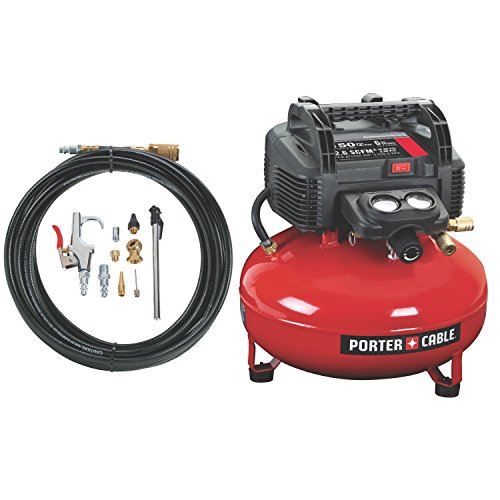
PORTER-CABLE C2002-WK 6 Gallon Pancake Compressor — Best Overall
The C2002 is the machine the category is measured against, and the ‘-WK’ matters: this is the kit version, with the accessory package included, which makes it the complete purchase rather than the start of one. Porter-Cable’s pancake has been the default garage recommendation for years because it does the format’s whole job — nailers, staplers, tyres, blow guns — without drama, from a brand whose parts and service footprint covers the continent.
Strengths
- The reference design: proven, understood by every tool counter in the country
- Kit version includes the accessories to work on day one
- Oil-free pump: no oil to check, and it runs happily in the cold and on its side in a truck
Trade-offs
- Its specification is the class standard, not the class maximum — Metabo’s EC914S out-pressures and out-flows it
- Pancake noise is pancake noise; it is not a quiet-shop machine
- The design’s maturity means no headline novelties — it is the safe pair of hands, proudly
| Spec | Detail |
|---|---|
| Tank | 6 gallon pancake |
| Model | C2002-WK (kit version) |
| Pump | Oil-free |
| Input power | 110V household |
| Use | Nailers, staplers, inflation, blow guns |
Longevity is the C2002’s real specification. A compressor is a decade-scale purchase, and the questions that matter in year seven — a regulator, a coupler, a pressure switch, a tank drain — are questions a Porter-Cable answers from stock at any tool supplier. The budget machines that undercut it are answering those questions with a shrug and a search engine. For the garage that buys tools to keep, that difference is the review.
Performance-wise it sits exactly where a household pancake should: enough pressure for tyres and tools, enough airflow for intermittent nailing at a human pace, recovery quick enough that trim work flows. It will not run a framing crew or a sandblaster, and neither will anything else in this guide — the final section is honest about that ceiling.
Best for: most home garages wanting one proven, supported, do-everything pancake / Not suited for: crews running multiple hungry tools continuously
Check on Amazon — check price on Amazon before you decide, since tool pricing moves with promotions.

Metabo HPT EC914S 6 Gallon 200 PSI Pancake Compressor — Best High Pressure
The EC914S is the pancake with its sleeves rolled up: 200 PSI maximum pressure and a 4 CFM flow rate per its listing, with the manufacturer explicitly positioning it to power multiple framing, siding and roofing nailers and brad guns simultaneously. That is jobsite language, and the specification backs it — this is the pick for the owner whose ‘home projects’ include framing a deck, siding a shed or roofing with a helper.
Strengths
- 200 PSI: more stored-energy headroom in the same 6 gallons
- 4 CFM flow rate — the strongest delivery figure in this roundup
- Built and positioned for multiple nailers at once
Trade-offs
- Premium-tier pricing for capability many households will never tap
- Higher pressure is not higher suitability for delicate tools — regulate down and know why
- Jobsite manners: it works hard and sounds like it
| Spec | Detail |
|---|---|
| Tank | 6 gallon pancake |
| Max pressure | 200 PSI |
| Flow rate (listing) | 4 CFM |
| Model | EC914S |
| Positioning | Multiple nailers simultaneously, jobsite-ready |
Why does 200 PSI matter if tools regulate down to 90 anyway? Because a tank is a battery for air. Charged to 200 instead of 150, the same 6 gallons hold meaningfully more usable air above the tool’s working pressure, so the motor starts less often, pressure at the tool sags less during rapid nailing, and two guns can share the tank without taking turns. Pair that storage with the strongest flow figure here and the EC914S is the only pancake in the guide that a two-person trim or framing day cannot embarrass.
Metabo HPT — the former Hitachi power-tool line — brings a pro-tool support culture with it, which suits a machine bought for work rather than weekends. If your project list is ambitious and your helper is booked, this is the badge to buy.
Best for: serious DIY builders, two-nailer workdays, framing/siding/roofing projects / Not suited for: light household duty, where its capability — and price — go unused
Check on Amazon — check price on Amazon before you decide, since tool pricing moves with promotions.

Bostitch BTFP02012 6 Gallon Pancake Compressor — Best for Trim Carpentry
Bostitch’s business is fasteners — the guns, the nails, the compressors that feed them — and the BTFP02012 is its 6-gallon pancake expression of that single-mindedness. Trim carpentry is the pancake’s home turf: brad nailers, finish nailers, pin nailers and staplers, carried room to room, shooting intermittently all day. A compressor designed by the company that makes the guns those hoses plug into earns its badge on alignment alone, and the machine itself completes the argument.
Strengths
- Designed inside a fastener ecosystem: the compressor and the guns share a design brief
- 6-gallon pancake portability tuned for room-to-room trim work
- Bostitch’s dealer and parts presence wherever finish carpentry is sold
Trade-offs
- Specification is class-standard; the Metabo EC914S beats it on pressure and flow
- Sold as a compressor — budget for hose and fittings if you are starting empty-handed
- Trim focus means no concessions to workshop-air ambitions
| Spec | Detail |
|---|---|
| Tank | 6 gallon pancake |
| Model | BTFP02012 |
| Brand focus | Fastening tools and compressors |
| Input power | 110V household |
Trim work has a rhythm compressors must respect: carry in, set down, shoot a run of baseboard, wait while the carpenter measures and cuts, shoot again. The tank covers the bursts; the motor idles through the thinking. A 6-gallon pancake is sized almost suspiciously well for that rhythm, and Bostitch’s version is the one found in finish carpenters’ trucks for a reason — it is light enough to carry one-handed with the gun case in the other, and it recovers during the measuring, every time.
If your household projects skew to woodwork, casings, crown and cabinetry installs, ecosystem thinking wins: one brand’s guns, nails and compressor, with consumables at every supplier. The Bostitch is the specialist’s pancake in a field of generalists.
Best for: trim carpenters and woodwork-focused homeowners / Not suited for: buyers wanting maximum pressure/flow, or a full starter kit in one box
Check on Amazon — check price on Amazon before you decide, since tool pricing moves with promotions.

CRAFTSMAN 6 Gallon 150 PSI Pancake Compressor — Best Value
The Craftsman makes the value case with honest numbers in its own title: 6 gallons, 150 PSI, oil-free, 2.6 SCFM at 90 PSI, dual couplers. That specification is the household brief written plainly — enough pressure for any tyre or nailer, enough airflow for one tool working at a human pace (and a second coupler for the helper or the blow gun), from a brand with a tool counter in every town in America.
Strengths
- Full household specification at the value tier
- Dual couplers: two hoses without a splitter
- Craftsman’s retail footprint makes service and accessories a non-event
Trade-offs
- 150 PSI ceiling: less stored-air headroom than the 165/200 PSI rivals
- 2.6 SCFM is one-tool-at-a-time airflow — crews need the Metabo
- Value-tier fit and finish versus the premium badges
| Spec | Detail |
|---|---|
| Tank | 6 gallon pancake |
| Max pressure | 150 PSI |
| Airflow (listing) | 2.6 SCFM at 90 PSI |
| Couplers | Dual |
| Model | CMXECXA02106410 |
| Pump | Oil-free |
Value compressors should be judged by whether their specification is honest, and this one publishes the number that matters — SCFM at 90 PSI — in its own title. 2.6 is not a crew figure and does not pretend to be; it is exactly the delivery a homeowner’s nailer, stapler, tyre chuck and blow gun consume. Buyers who understand that sentence will be perfectly served by this machine for years.
The dual couplers deserve their line: the commonest two-hose day in a household is a nailer plus a blow gun, or two people sharing inflation and fastening. A splitter costs little, but a factory second coupler costs nothing and leaks less. Small mercies, correctly priced, are the Craftsman’s whole pitch.
Best for: households wanting the complete pancake specification at the value tier / Not suited for: two-tool continuous work or maximum-pressure ambitions
Check on Amazon — check price on Amazon before you decide, since tool pricing moves with promotions.

Metabo HPT EC711S 6 Gallon 165 PSI Pancake Compressor — Best Lightweight
The EC711S is Metabo HPT’s other answer: where the EC914S maximises output, this one optimises the carry. Its listing leads with a 1.0 HP high-efficiency oil-free motor, 165 PSI, quick couplers for fast tool changes, and the word ‘lightweight’ in the specification itself. For the owner whose compressor climbs stairs, rides in a car boot, or works room-to-room in finished houses, the pounds are the product.
Strengths
- Lightweight positioning with a high-efficiency motor — built to be carried
- 165 PSI: a step above the 150 PSI class standard for stored-air headroom
- Quick couplers suit the multi-tool, move-fast work it is designed for
Trade-offs
- Not the flow leader — its sibling EC914S owns that badge
- Portability engineering costs more than the value tier charges
- Still a 6-gallon machine: ‘lightweight’ is relative to its class, not to a handbag
| Spec | Detail |
|---|---|
| Tank | 6 gallon pancake |
| Max pressure | 165 PSI |
| Motor | 1.0 HP oil-free, high efficiency |
| Model | EC711S |
| Positioning | Lightweight, quick couplers |
Portability is a specification with a body count: the compressor that stays in the garage because it is awkward to move is the compressor that does not get used for the upstairs bedroom’s trim or the neighbour’s fence. The EC711S is engineered against that failure — efficient motor, manageable mass, couplers that swap tools without a wrench ritual. In finished interiors, where the work is a room at a time and the machine follows the carpenter, those qualities outrank raw flow.
Between the two Metabos, choose by day shape: stationary and hungry (EC914S) versus mobile and intermittent (EC711S). It is a credit to the brand that the choice exists inside one badge.
Best for: mobile installers, upstairs work, and anyone who carries their compressor often / Not suited for: stationary high-demand work, where the EC914S is the better spend
Check on Amazon — check price on Amazon before you decide, since tool pricing moves with promotions.

DEWALT Pancake Compressor + 18 Gauge Brad Nailer Combo Kit — Best Starter Kit
Starting from zero is its own use case, and DeWalt’s combo answers it in one box: a pancake compressor rated at 165 max PSI delivering 2.6 CFM at 90 PSI, bundled with an 18-gauge brad nailer — the single most useful first nail gun for trim, furniture and household woodwork. No compatibility puzzles, no second purchase before the first project: open, connect, and the baseboards are on the wall by lunch.
Strengths
- Compressor and the right first nailer in one matched purchase
- 165 PSI and 2.6 CFM at 90 PSI — a full household specification
- DeWalt’s ecosystem: the second and third tools you buy will match the first
Trade-offs
- If you already own a brad nailer, you are paying for a duplicate
- Kit economics favour the bundle; the compressor alone elsewhere may price lower
- One nailer is a start, not a collection — finish and framing guns remain future purchases
| Spec | Detail |
|---|---|
| Max pressure | 165 PSI |
| Airflow (listing) | 2.6 CFM at 90 PSI |
| Included tool | 18-gauge brad nailer |
| Type | Pancake compressor combo kit |
Combo kits live or die on whether the bundled tool is the one you would have bought anyway, and an 18-gauge brad nailer passes that test for most households: it is the gun for trim, mouldings, cabinet backs, picture frames and a hundred repairs, usable by a beginner within the hour. Pairing it with a compressor whose specification matches the class standard makes the bundle the lowest-friction entry into pneumatic work in this entire guide.
The ecosystem point is the long game. Pneumatic tools accumulate — a finish nailer next, a stapler after — and they accumulate most happily inside one brand’s fittings, manuals and service counters. DeWalt knows exactly what it is selling here: not a compressor, but the first chapter of a tool wall.
Best for: first-time pneumatic buyers starting a trim or woodwork hobby / Not suited for: owners who already have nailers, or who need crew-level airflow
Check on Amazon — check price on Amazon before you decide, since tool pricing moves with promotions.
Comparison Table
| Pick | Badge | Key spec | Best for |
|---|---|---|---|
| PORTER-CABLE C2002-WK | Best Overall | 6 gal kit, oil-free, the reference design | most garages, one proven machine |
| Metabo HPT EC914S | Best High Pressure | 6 gal, 200 PSI, 4 CFM flow | two-nailer days and big builds |
| Bostitch BTFP02012 | Best for Trim Carpentry | 6 gal pancake, fastener-brand design | trim and finish work |
| CRAFTSMAN 150 PSI | Best Value | 6 gal, 150 PSI, 2.6 SCFM @ 90, dual couplers | full household spec at value tier |
| Metabo HPT EC711S | Best Lightweight | 6 gal, 165 PSI, 1.0 HP efficient motor | carrying upstairs and room to room |
| DEWALT Combo Kit | Best Starter Kit | 165 PSI, 2.6 CFM @ 90, brad nailer included | starting pneumatics from zero |
Read the table by airflow first and pressure second — the reverse of how the boxes are marketed. SCFM at 90 PSI decides what you can run; max PSI decides how the tank buffers it; the badge decides who answers the phone in year seven.
How to Choose a Pancake Air Compressor: SCFM Is the Truth
Airflow is measured in SCFM — standard cubic feet per minute — quoted at a working pressure, usually 90 PSI, because that is where nailers live. A brad or finish nailer sipping air in bursts is happy with 2 to 3 SCFM of delivery, because the tank buffers the bursts and the motor refills during the pauses. A framing nailer driven fast wants more. Anything with a trigger that stays down — die grinders, sanders, sandblasters, paint sprayers at volume — wants five, eight, twelve SCFM sustained, which no 6-gallon pancake on Earth delivers. Match the machine to the tool’s duty pattern: intermittent tools, pancake; continuous tools, a bigger compressor class entirely.
Pressure: what the bigger number actually buys
Maximum pressure is storage, not strength — your tools regulate down to their working pressure regardless. A 200 PSI tank holds more usable air than a 150 PSI tank of the same size, so tools run longer between motor starts and pressure sags less under rapid fire. That is a real benefit, priced by the Metabo EC914S, and a modest one at household pace, which is why the 150 PSI Craftsman remains a rational buy. What max pressure never does is make a small compressor run a continuous tool: the motor’s delivery, not the tank’s ceiling, decides that argument within a minute of trigger time.
Oil-free: the household default, honestly explained
Every pick here is oil-free, and for household duty that is correct: no oil levels to check, no oil mist in the air line, no complaint about running cold or being stored on a tilt, and maintenance reduced to draining the tank. The trade is lifespan under industrial duty and noise — oil-free pumps run louder and wear faster in continuous service. Inside the pancake’s intermittent brief, the trade favours oil-free decisively; it is one of the reasons the format owns the home market.
The noise conversation
Pancakes are loud in the way small, hard-working motors are loud, and the garage-door-open, hearing-protection-on culture around them exists for a reason. Site the compressor away from where people linger, set it on a mat rather than bare concrete to kill the drumming, and never enclose it in a cabinet it cannot breathe in — heat is the other tax. Owners who need genuinely quiet air should know the honest answer lives in a different, pricier compressor class; within this guide’s category, expectations should be set to ‘brief and businesslike’, and every pick here meets that standard about equally.
How to Set Up and Use a Pancake Compressor
Ten minutes of method at the start saves the machine and the work.
- Unbox onto a level surface, fit any included feet or handle hardware, and locate the tank drain — know where it is before you need it, because you will need it after every session.
- Check the couplers and regulator: set the regulator to zero, connect the hose, and confirm your tool’s coupler standard matches; mismatched quick-connect profiles are the day-one frustration of this category.
- Power from a healthy outlet, ideally without a long light extension cord — voltage drop makes motors start hard and run hot. If a cord is unavoidable, make it short and heavy-gauge.
- Start the compressor with the tank drain cracked open for the first moments on a new machine, then close it and let the tank charge to cut-off. Listen for leaks at every fitting while pressure builds; soapy water on a suspect joint will bubble its confession.
- Set working pressure at the regulator for the tool in hand — nailers have their number in the manual — and test on scrap: a brad should set just below the surface, and you tune depth with pressure and the gun’s adjustment together.
- Work, and let the machine cycle as it wants. Short cycling under rapid nailing is normal pancake behaviour; a motor that never stops during ordinary nailing is telling you the tool out-eats the compressor.
- Shut down properly: switch off, then drain the tank fully through the drain valve — every session, without exception. The water that condenses inside is the tank’s only real enemy, and the drain is a ten-second execution of it.
That drain habit, honestly kept, is worth more years of service than any feature on any box in this guide.
One more habit separates long-lived systems from short ones: let the compressor finish its cycle. Switching a machine off mid-charge and restarting it against a full tank forces the hardest start a small motor ever makes, repeatedly. When the work pauses, let the tank top off and the motor rest on its own schedule; when the day ends, the shutdown sequence above takes over. Machines forgive almost everything except impatience at the switch, and the forgiveness shows up years later, compounded.
Cold weather deserves a sentence of its own, because garages are cold and compressors notice. Oil-free pumps — every pick here — start willingly in the cold that makes oiled machines sulky, which is one more household argument for the format. Condensate still forms, seals still stiffen, and a machine stored in an unheated garage should be given its first cycle gently rather than loaded instantly. Treat winter as a reason for the mat, the drain and a moment’s patience, and the pancake will treat January like any other month.
The same patience applies to altitude and age, the two quiet taxes on every compressor: thinner air fills a tank more slowly, and an older pump’s delivery drifts gently downward from its brochure figure. Neither matters at household pace — a tyre does not care about thirty extra seconds — but both explain why a veteran machine feels lazier than its replacement without anything being broken. Measure a compressor by whether the work flows, not by whether it matches a number printed when it was new.
That is, finally, the standard this whole category should be bought by: not the loudest specification, but the machine whose absence you would notice — the one that has quietly inflated, fastened, cleaned and carried a household’s small pneumatic life for years without ever becoming a topic. Every pick in this guide can be that machine, in the garage that matches it best of all garages anywhere at all.
Maintenance: The Short, Complete List
Drain the tank after use — already said, worth repeating as the entire first paragraph of maintenance. Keep the air filter clean or replaced; a choked filter makes the motor work for its air and shortens everything downstream. Check the safety valve occasionally by pulling its ring briefly with the tank pressurised; it should vent and reseat. Inspect the cord and hose for damage, store the hose loosely coiled, and keep the machine somewhere dry. Oil-free ownership is genuinely this light, which is precisely the format’s household genius.
Common Buying Mistakes
Buying by max PSI alone. Pressure is storage; SCFM at 90 PSI is capability. A 200 PSI badge on a weak pump still starves hungry tools.
Expecting pancake power for continuous tools. Grinders, sanders and blasters need a different compressor class. No pancake listing’s optimism changes the airflow arithmetic.
Never draining the tank. Condensate rusts tanks from the inside, invisibly, until the day it matters. Ten seconds after every session is the whole defence.
Running the compressor on a long, thin extension cord. Voltage drop overheats motors and trips breakers. Short and heavy, or move the machine.
Ignoring coupler standards when buying tools. Mismatched quick-connects leak and frustrate. Pick a profile and keep the household on it.
Paying for a combo kit you half-own already. The DeWalt bundle is superb value from zero and a duplicate purchase if a brad nailer already lives in your drawer.
Final Recommendation
For most garages, the PORTER-CABLE C2002-WK is the best 110 volt pancake air compressor: the proven reference machine in its complete kit form. Builders with two-nailer days should step up to the Metabo HPT EC914S; trim specialists to the Bostitch; carriers and stair-climbers to the EC711S; value hunters to the Craftsman; and absolute beginners to the DeWalt combo. Buy by SCFM, drain the tank every session, and any of the six will be the least dramatic tool you own — which is the highest praise a compressor can earn.
Keep reading in this cluster: Best 110 Volt Mig Welder 141; Best 110 Volt Oscillating Edge Sander; Best 110 Volt Mini Split; Best 110 Volt Mini Water Heater; Best 110 Volt Outdoor Landscape Electric Outlet.
Pancake vs Hot-Dog vs Twin-Stack: Why the Shape Won the Garage
Small compressors come in three classic silhouettes, and the pancake’s victory in home garages is worth understanding. The hot-dog — a long horizontal tank — stores the same air in a shape that tips, rolls awkwardly and eats floor length. The twin-stack splits its volume into two cylinders for a narrower profile and a higher carry, beloved of trim crews who valued its balance. The pancake’s flat, low, wide tank is the most stable of the three, the least likely to be knocked over by a hose tug, and the easiest to stash under a bench or a truck seat. Its centre of gravity is its personality: unglamorous, planted, dependable. Where the three overlap in specification — and at 6 gallons they overlap almost completely — shape becomes the deciding vote, and the pancake’s stability is why this entire guide, and most of the market, lives in its silhouette.
Three Project Days, Matched to Machines
The baseboard Saturday. One installer, one brad nailer, a houseful of trim, a compressor carried room to room a dozen times. Every pick here completes this day; the EC711S completes it with the least shoulder complaint, and the DeWalt combo completes it for the owner who started the morning owning no pneumatic tools at all. This is the pancake’s home fixture, and it is not close.
The deck-framing weekend. Two people, a framing nailer each, joists arriving faster than one compressor’s recovery. Now the table’s order asserts itself: the EC914S’s flow and 200 PSI storage keep both guns fed, the class-standard machines fall a half-step behind the pace by Sunday, and the value picks ask the crew to alternate. Ambition is a specification; buy it before the lumber arrives.
The household everything month. Tyres on two cars and a mower, a stapler for the fence repair, a blow gun for the workshop, pool inflatables, a bicycle fleet. No single day is demanding; the month is relentless. This is the C2002-WK and Craftsman pattern — the kit-complete, dual-coupler, always-ready household utility — and it is the duty cycle most pancakes actually live. Judge your purchase by your month, not your mightiest day.
Hoses, Couplers and the Air Line You Actually Live With
The compressor gets the glory; the hose decides the day. Length first: buy the shortest hose that reaches your work, because every extra coil is pressure drop, tangle and trip hazard — and keep a short whip hose at the tool end, since a light, flexible whip makes a nailer feel half its weight. Material second: rubber stays flexible in the cold and lies flat; hybrid blends trade a little suppleness for less weight; the stiff bargain PVC coil hoses fight you in winter and are the false economy of this category. Couplers third: pick one quick-connect profile for the whole household and standardise every tool, hose and accessory on it, because a mixed drawer of near-fitting couplers leaks at every joint and teaches vocabulary no one wanted to learn. Finally, fittings leak by default and seal by effort — thread tape on tapered threads, snug not brutal, and a soapy-water lap of every joint the day the system is built. None of this is in the compressor’s box or its specification table, and all of it is in your experience of owning it, which is why this guide spends a section on plumbing the brochure forgets.
Safety With Stored Air
A charged tank is stored energy, and the category’s safety rules are short because they are absolute. Never exceed the tank’s rated pressure and never defeat or adjust the safety valve — it is the last witness between a fault and a rupture. Inspect the tank’s drain and shell for rust damage; a tank corroded thin is retired, not repaired. Keep the compressor out of standing water and off wet floors while running, as with any motor tool. Wear eye protection with blow guns — the debris a blow gun liberates is travelling at debris speed, toward faces — and never use compressed air to dust clothing or skin. Children and charged tanks are a combination that requires the tank to lose: drain it down when the shop empties. These rules take less time to keep than to read, and they are the difference between a tool that serves a household for decades and a story told about one.
Troubleshooting: Problems Owners Actually Meet
Problem: the motor runs but the tank never reaches cut-off. → Work the cheap list first: drain valve not fully closed, a leaking fitting (soapy water finds it), a choked intake filter, or a tool connected and passing air. A pump that still cannot build pressure after those checks has worn valves or rings — a service conversation, starting with the brand’s parts desk.
Problem: the compressor trips the breaker on start-up. → Usually the circuit, not the machine: a long thin extension cord, a shared circuit with another load, or a cold garage thickening everything. Plug directly into a healthy outlet, alone on its circuit, and most ‘faulty’ compressors heal instantly.
Problem: nails stop setting fully late in a long run. → Tank pressure sagging under rapid fire — the tool is out-eating delivery. Slow the pace a beat, confirm the regulator setting under flow (not at rest), and if the pattern is your normal, your work has outgrown the class standard: that is the EC914S’s reason to exist.
Problem: water sprays from the blow gun. → Condensate carried over from an undrained tank. Drain it, and consider an inline filter for finish-sensitive blowing; the tank’s water is a maintenance report, delivered by hose.
Frequently Asked Questions
What can a 6-gallon pancake compressor actually run?
Brad, finish and pin nailers, staplers, tyre inflation, blow guns and intermittent framing-nailer work at a human pace. It cannot sustain continuous-draw tools — die grinders, orbital sanders, sandblasters — which need several times its airflow from a larger compressor class.
Is 150 PSI enough, or do I need 200 PSI?
For household tools, 150 PSI is enough: tools regulate down to their working pressure anyway. Higher max pressure buys stored-air headroom — longer runs between motor starts, less sag under rapid nailing — which matters to busy builders and barely registers on weekend duty.
Why does my compressor’s tank fill with water?
Compressing air squeezes its moisture out as condensate, which collects in the tank. That is normal physics, and the defence is the drain valve: open it after every session and let the water out before it can rust the tank from inside.
Can I leave a pancake compressor pressurised in the garage?
Briefly, yes; habitually, no. Stored pressure plus stored condensate is the corrosion recipe, and a charged tank is stored energy that deserves respect around children and accidents. Drain it down as part of shutdown and the machine will outlast the habit.
Oil-free or oiled — which is better for a home garage?
Oil-free, for the duties in this guide: zero oil maintenance, clean air for tyres and tools, cold-weather and tilted-storage tolerance. Oiled compressors earn their keep in continuous professional service, which is a different category and a different purchase.
How loud is a pancake compressor, really?
Loud enough that hearing protection is a good habit and conversation pauses when it cycles. A mat under the machine and distance from living space tame most of it. If near-silence is a hard requirement, shop the dedicated quiet-compressor class instead — no pancake in this guide pretends to be that.
Can a pancake compressor run a paint sprayer?
Small touch-up and detail guns at low volume, briefly — the tank buffers a minute of spraying and then the arithmetic arrives. Panel-scale spraying wants sustained airflow several times this class’s delivery, and the finish quality collapses as pressure sags mid-panel. For furniture-scale projects, an HVLP turbine system is the honest tool; for a fence’s worth of spraying, a larger compressor. The pancake’s spraying career is measured in drawer fronts, not car doors.
How long should a pancake compressor last?
With the drain habit kept and the filter clean, household pancakes serve for many years of intermittent duty — the format’s simplicity is its longevity. The usual end-of-life stories are a tank rusted by undrained condensate or a pump worn by continuous work it was never sized for. Both are owner decisions wearing the disguise of machine failure, which is the most useful thing this guide can tell you about compressor lifespan.
It is also, in the end, the argument for buying a known badge at a fair tier rather than the cheapest silhouette on the page: when the wear items finally do wear — a switch, a regulator, a coupler — the brands in this guide answer with a part number and a counter that stocks it. A compressor is a simple machine, and simple machines should be repairable machines; that is the whole ownership philosophy in one sentence, and every pick above was chosen inside it.


