Disclosure: airfryerkitchensupply.com is reader-supported. When you buy through links on our site, we may earn an affiliate commission at no extra cost to you.
Where to buy
Every system below is a genuine 115V (110/120V) ductless mini split that was verified against Amazon’s catalogue through the Creators API before ranking. If you are comparing the best 110 volt mini split options for a room, garage, workshop or addition that has no 240V service, these six are the shortlist — three 9,000 BTU systems for smaller spaces and three 12,000 BTU systems for larger ones, all inverter heat pumps that cool in summer and heat in winter.
- Pioneer Quantum Ultra 9,000 BTU 24 SEER2 115V (Best Overall) — Check the current price on Amazon
- Senville LETO 9,000 BTU 110/120V (Best for Small Rooms) — Check the current price on Amazon
- Pioneer Diamante Pro 12,000 BTU 115V (Best for Larger Rooms) — Check the current price on Amazon
- DELLA Vita 12,000 BTU 20 SEER2 115V (Best Smart Features) — Check the current price on Amazon
- COSTWAY 12,000 BTU 20 SEER2 115V (Best Value 12,000 BTU) — Check the current price on Amazon
- ROVSUN 9,000 BTU 20 SEER2 115V (Best Budget) — Check the current price on Amazon
The best 110 volt mini split is the one that matches your room and your electrical panel, because this category exists for a specific reason: not every space has, or can cheaply get, a 240V circuit. A 115V mini split plugs into the world of ordinary household power — a dedicated 120V circuit of the kind an electrician can often add from a nearby panel without a service upgrade — and still delivers proper inverter-driven heating and cooling, not the compromise of a window unit. Garages, workshops, home offices, sunrooms, accessory dwelling units, older homes with small panels and rental-friendly additions are where these systems earn their keep.
Be clear about the ceiling, though. On 115V, the practical top end is 12,000 BTU — one ton — because current draw climbs fast beyond that. Every 18,000 and 24,000 BTU system on the market steps up to 208/230V, so if your space genuinely needs more than a ton of cooling, the honest answer is an electrician and a 230V system, not a bigger 115V wish. Within the one-ton envelope, though, the six systems here are real mini splits with real inverter compressors, and the differences between them — efficiency ratings, kit completeness, smart controls and brand support — are what this guide sorts out.
One more piece of honesty before the rankings: a mini split is not a window air conditioner you happen to mount higher. Installation means mounting an indoor air handler, placing an outdoor condenser, running a line set through the wall, evacuating the lines and wiring a dedicated circuit. Handy owners do install these themselves with pre-charged systems and care; everyone else should budget for a professional install. Either way, the running costs afterwards are where inverter mini splits repay you, and that is why the efficiency numbers below matter.
In this guide
Quick Picks
Six verified systems, six different reasons to buy. Badges are consistent between this list and the full reviews that follow.
Pioneer Quantum Ultra 9,000 BTU — Best Overall. The efficiency flagship of the 115V class: a 24 SEER2, Energy Star rated inverter heat pump that sips power in small-to-medium rooms and sets the standard the others are judged against. Check on Amazon.
Senville LETO 9,000 BTU — Best for Small Rooms. The established-name option for bedrooms, offices and studios: a 0.75-ton 110/120V inverter system with Alexa compatibility and a long track record in North American homes. Check on Amazon.
Pioneer Diamante Pro 12,000 BTU — Best for Larger Rooms. A full one-ton 115V system with a variable-speed DC inverter and a 16 ft installation kit, for living areas and open spaces at the top of what household voltage can do. Check on Amazon.
DELLA Vita 12,000 BTU — Best Smart Features. A 20 SEER2 one-ton system rated for rooms up to 550 sq ft, with WiFi and Alexa voice control, a pre-charged condenser and a 16 ft kit in the box. Check on Amazon.
COSTWAY 12,000 BTU — Best Value 12,000 BTU. A 20 SEER2 inverter system rated for spaces up to 750 sq ft at a value-tier price — the most capacity per dollar in this roundup. Check on Amazon.
ROVSUN 9,000 BTU — Best Budget. A 20 SEER2 115V system with a pre-charged condenser and installation kit at the budget tier — the cheapest credible way into ductless comfort for one room. Check on Amazon.
How These Picks Were Chosen
The first gate was voltage honesty. The listing had to state 115V (or 110/120V) operation outright, because a large share of mini splits sold online are 208/230V machines that surface in 110V searches. Any system whose own title or specification contradicted the voltage claim was cut. The second gate was verification: each surviving model was checked through the Creators API against Amazon’s live catalogue, so the ASINs, titles and headline specifications quoted in the reviews are the manufacturers’ own listing data.
Within those gates we weighted, in order: efficiency (SEER2), because a mini split runs for thousands of hours and efficiency is money every single month; correct sizing coverage, because an oversized or undersized system is uncomfortable either way; installation completeness — pre-charged condensers and included line-set kits materially change the true installed cost; heating capability, since every pick here is a heat pump and winter performance separates the serious systems from cooling-only thinking; and brand support, because a mini split is a 10-plus-year appliance, not a gadget.
We also excluded the noise: no-name listings with no identifiable manufacturer, systems whose BTU claims changed between the title and the specification table, and 230V machines wearing 115V keywords. What remains is a short list where every system can be bought, installed on household voltage, and serviced like the long-term appliance it is.
The 6 Best 110 Volt Mini Splits

Pioneer Quantum Ultra 9,000 BTU 24 SEER2 115V — Best Overall
Most 115V mini splits cluster around 19–21 SEER2. The Pioneer Quantum Ultra posts 24 SEER2 with Energy Star certification, and that gap is not a rounding error — over a long cooling season it is the difference between a system you forget about and a system you notice on the bill. For a bedroom, office, studio or small living space up to roughly 400 square feet, this is the most efficient way to heat and cool on household voltage that we could verify.
Strengths
- 24 SEER2 efficiency with Energy Star certification — top of the verified 115V class
- Inverter heat pump heats as well as cools, replacing space heaters and window units in one system
- Pioneer’s North American support and documentation are a tier above the budget brands
Trade-offs
- Premium-tier pricing: you pay upfront for the efficiency that pays you back monthly
- 9,000 BTU is a one-or-two-room answer; it will not rescue an open-plan floor
- Full installation still applies — mounting, line set, vacuum and a dedicated circuit
| Spec | Detail |
|---|---|
| Capacity | 9,000 BTU |
| Efficiency | 24 SEER2, Energy Star |
| Input power | 115V |
| Type | High-wall ductless inverter heat pump, full set |
Efficiency deserves a paragraph of its own, because it compounds. An inverter compressor does not bang on and off like a window unit; it throttles to match the load, sipping power while holding temperature steady. Pair that behaviour with a 24 SEER2 rating and a small room becomes remarkably cheap to keep comfortable — the system spends most of its life at part load, exactly where high-SEER2 equipment shines brightest. Shoulder seasons, when you need a little heat in the morning and a little cooling by afternoon, are where this machine quietly outclasses everything else in the roundup.
The Pioneer badge carries a second, quieter advantage: this is a brand that publishes proper documentation, stocks parts, and has been selling ductless systems into the North American DIY and pro market for years. When a mini split needs a control board or a remote in year seven, that infrastructure is the difference between a repair and a replacement.
Best for: small-to-medium rooms where running cost and long-term support matter most / Not suited for: large open spaces, or buyers minimising upfront cost above all else
Check on Amazon — check price on Amazon before you decide, since pricing on HVAC equipment moves with the season.
Senville LETO 9,000 BTU 110/120V — Best for Small Rooms
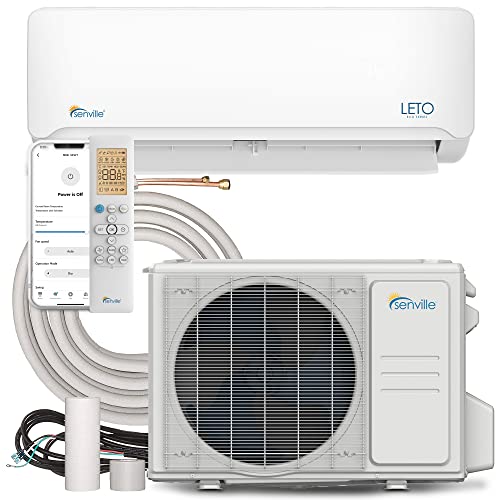
Senville is one of the names North American homeowners have bought for years, and the LETO series is its workhorse: a 9,000 BTU (0.75-ton) inverter heat pump that runs on 110/120V, works with Alexa, and is explicitly marketed around quiet operation — which is exactly the profile a bedroom, nursery, home office or studio needs. If brand familiarity and a long model history matter to you more than the last point of SEER2, this is your pick.
Strengths
- Established brand with a long-selling model line and broad installer familiarity
- Quiet-operation design suits bedrooms and offices where noise decides satisfaction
- Works with Alexa for voice and app control out of the box
Trade-offs
- Efficiency trails the Pioneer Quantum Ultra’s flagship rating
- 9,000 BTU ceiling applies: measure the room honestly before ordering
- Professional installation recommended; budget for it if you are not an experienced DIYer
| Spec | Detail |
|---|---|
| Capacity | 9,000 BTU (0.75 ton) |
| Input power | 110/120V |
| Type | Wall-mounted ductless inverter heat pump |
| Smart control | Works with Alexa |
The LETO’s appeal is maturity. A model line that has sold for years accumulates the things new listings cannot fake: installers who know it, spare parts that exist, documentation that answers real questions, and a manufacturer whose warranty process has been exercised many times. For a system that will hang on your wall for a decade, that boring reliability is a feature, not a footnote.
In the room, what owners notice is the quiet. Inverter systems already run softer than window units because the compressor lives outside; the LETO leans into that with a design brief built around low indoor noise. For a bedroom that means sleep without the on-off clunk cycle of a window shaker, and for a home office it means calls without a compressor soundtrack.
Best for: bedrooms, nurseries, offices and studios up to roughly 400 sq ft, and buyers who value an established brand / Not suited for: buyers chasing the highest possible efficiency rating, or rooms beyond its capacity
Check on Amazon — check price on Amazon before you decide, since pricing on HVAC equipment moves with the season.

Pioneer Diamante Pro 12,000 BTU 115V — Best for Larger Rooms
When the room outgrows 9,000 BTU — a living room, a big primary bedroom, a garage conversion, an open studio — the Diamante Pro is the step up that stays on household voltage: a full 12,000 BTU (one ton) on 115V, with a variable-speed DC inverter and a 16 ft installation kit in the set. It is the largest room you can condition properly without calling an electrician for a 230V circuit first.
Strengths
- Full one-ton capacity on 115V — the practical maximum for household voltage
- Variable-speed DC inverter holds temperature without on-off swings
- 16 ft installation kit included, and Pioneer’s documentation and parts support behind it
Trade-offs
- At maximum output it draws the most current of any pick here; a properly sized dedicated circuit is non-negotiable
- Oversizing a small room with it causes short-cycling and clammy air — size honestly
- Premium-tier pricing within the Pioneer line
| Spec | Detail |
|---|---|
| Capacity | 12,000 BTU |
| Input power | 115V |
| Compressor | Variable-speed DC inverter |
| Included | 16 ft installation kit |
Sizing is the whole story at one ton. A 12,000 BTU system in a 500–700 square foot space with normal ceilings will loaf along at part load most of the season, dehumidifying properly and whispering. The same system crammed into a 250 square foot bedroom satisfies the thermostat too quickly, shuts off, and leaves the air cool but damp — the classic oversizing complaint. The Diamante Pro is an excellent machine aimed at the top of the 115V envelope; give it a room that deserves it.
As with the Quantum Ultra, the Pioneer support ecosystem is part of the purchase: real manuals, available parts, and a brand that answers for its equipment. In a category filling up with disposable listings, that staying power is worth money.
Best for: living rooms, large bedrooms and conversions in the 450–700 sq ft range on household voltage / Not suited for: small bedrooms, where its capacity works against comfort
Check on Amazon — check price on Amazon before you decide, since pricing on HVAC equipment moves with the season.

DELLA Vita 12,000 BTU 20 SEER2 115V — Best Smart Features
The DELLA Vita is the connected one-ton option: 20 SEER2 efficiency, a pre-charged inverter heat pump rated for rooms up to 550 sq ft, a 16 ft installation kit, and WiFi with Alexa voice control as headline features rather than afterthoughts. If your home already runs on routines and voice commands, this is the 115V system that slots into that life.
Strengths
- WiFi and Alexa control for schedules, routines and voice operation
- 20 SEER2 efficiency at one ton, with a pre-charged condenser and 16 ft kit simplifying installation
- Clear room rating (up to 550 sq ft) makes sizing decisions straightforward
Trade-offs
- Brand support is a step below Pioneer and Senville in depth and history
- Smart features depend on your WiFi behaving; the remote remains the reliable fallback
- 550 sq ft rating is a ceiling, not a suggestion — sun-loaded rooms need margin
| Spec | Detail |
|---|---|
| Capacity | 12,000 BTU (1 ton) |
| Efficiency | 20 SEER2 |
| Coverage (manufacturer) | Up to 550 sq ft |
| Input power | 115V |
| Smart control | WiFi, works with Alexa |
| Included | Pre-charged condenser, 16 ft kit |
Smart control on a mini split is more useful than it sounds. Pre-cooling a bedroom before bed from your phone, warming a home office before your first call, or checking that you actually turned the workshop unit off — these are daily conveniences, and scheduling is also an efficiency tool, since conditioning an empty room is the purest waste there is. The Vita’s 20 SEER2 hardware underneath the connectivity is respectable in its own right, so the smart layer is a bonus on a sound system rather than lipstick on a weak one.
Installation completeness matters here too: a pre-charged condenser and an included 16 ft kit remove two of the surprise costs that ambush first-time mini split buyers. You still need proper evacuation and a dedicated circuit — no kit changes that — but the box contains more of the total job than most.
Best for: connected homes wanting app and voice control over a one-ton room system / Not suited for: buyers who prefer the deepest possible brand support network, or rooms beyond 550 sq ft
Check on Amazon — check price on Amazon before you decide, since pricing on HVAC equipment moves with the season.

COSTWAY 12,000 BTU 20 SEER2 115V — Best Value 12,000 BTU
COSTWAY’s pitch is capacity per dollar: a 12,000 BTU inverter heat pump at 20 SEER2, rated by the manufacturer for spaces up to 750 sq ft, at a value-tier price. For a big bedroom, a living area or a workshop that needs a full ton without a flagship budget, this is the arithmetic that wins.
Strengths
- One-ton capacity and 20 SEER2 efficiency at a value-tier price
- Manufacturer coverage rating up to 750 sq ft — the largest claim in this roundup
- Inverter heat pump heats and cools, like every pick here
Trade-offs
- Treat the 750 sq ft figure as a best case for mild, shaded, well-insulated spaces; size down your expectations for sunrooms and garages
- Brand support and parts depth trail Pioneer and Senville
- Fit, finish and remote quality are a tier below the premium picks
| Spec | Detail |
|---|---|
| Capacity | 12,000 BTU |
| Efficiency | 20 SEER2 |
| Coverage (manufacturer) | Up to 750 sq ft |
| Input power | 115V |
| Type | Wall-mounted ductless inverter heat pump |
Coverage claims deserve a translator. A manufacturer’s square-foot number assumes reasonable insulation, standard ceilings and a moderate climate. A 750 sq ft rating in a shaded, insulated living room in a mild climate is plausible; the same system in a 750 sq ft metal-roofed workshop in a hot climate will run hard and still fall behind on the worst afternoons. Buy the COSTWAY for a genuinely large but conventional room and it is the value star of this guide; buy it as a loophole for an extreme space and physics will collect its debt.
Within its honest envelope, the fundamentals are right: inverter drive, heat-pump heating, and a modern efficiency rating. COSTWAY sells a lot of home equipment through Amazon, and its support is reachable — just calibrate expectations to the tier you paid for.
Best for: large conventional rooms that need a full ton on a value budget / Not suited for: extreme-heat or poorly insulated spaces at the top of its coverage claim
Check on Amazon — check price on Amazon before you decide, since pricing on HVAC equipment moves with the season.

ROVSUN 9,000 BTU 20 SEER2 115V — Best Budget
The ROVSUN 9,000 BTU is the budget door into ductless: a 20 SEER2 inverter heat pump on 115V with a pre-charged condenser, remote control and installation kit included, at the lowest tier in this roundup. For one bedroom, office or small studio, it delivers the core mini split experience — quiet, efficient, heat and cool — without the flagship price.
Strengths
- 20 SEER2 efficiency at the budget tier — no efficiency penalty for saving money
- Pre-charged condenser and installation kit included keep the total project cost down
- Full heat-pump heating and cooling in a compact one-room package
Trade-offs
- Brand support is online-first and thinner than the established names
- 9,000 BTU is strictly one-room territory
- Long-term parts availability is less certain than Pioneer or Senville
| Spec | Detail |
|---|---|
| Capacity | 9,000 BTU |
| Efficiency | 20 SEER2 |
| Input power | 115V |
| Included | Pre-charged condenser, remote, installation kit |
Budget HVAC purchases should be made with open eyes and a simple test: does the specification hold up, and does the box contain the whole job? The ROVSUN passes both checks better than most at its tier. The efficiency rating is genuinely modern, the condenser arrives pre-charged, and the kit is in the box. What you give up versus the Pioneer and Senville is depth — of documentation, of parts pipeline, of support history.
For a first ductless system in a spare room, a rental-adjacent space or a workshop, that trade is frequently correct. Money saved here can go toward the professional installation that makes any mini split perform to its rating, which is a better use of funds than a badge upgrade installed badly.
Best for: one-room comfort on the tightest budget, with efficiency intact / Not suited for: buyers who want a decade-deep parts and support network behind the nameplate
Check on Amazon — check price on Amazon before you decide, since pricing on HVAC equipment moves with the season.
Comparison Table
| Pick | Badge | Key spec | Best for |
|---|---|---|---|
| Pioneer Quantum Ultra 9,000 | Best Overall | 9,000 BTU, 24 SEER2, Energy Star, 115V | small-to-medium rooms where running cost matters most |
| Senville LETO 9,000 | Best for Small Rooms | 9,000 BTU, 110/120V, Alexa, quiet design | bedrooms and offices, established-brand buyers |
| Pioneer Diamante Pro 12,000 | Best for Larger Rooms | 12,000 BTU, 115V, DC inverter, 16 ft kit | living areas at the top of the 115V envelope |
| DELLA Vita 12,000 | Best Smart Features | 12,000 BTU, 20 SEER2, WiFi/Alexa, up to 550 sq ft | connected homes |
| COSTWAY 12,000 | Best Value 12,000 BTU | 12,000 BTU, 20 SEER2, up to 750 sq ft claim | large conventional rooms on a value budget |
| ROVSUN 9,000 | Best Budget | 9,000 BTU, 20 SEER2, pre-charged, kit included | one-room comfort at the lowest tier |
Two numbers decide most purchases from this table: the size of your room, which picks the BTU column, and how many hours a year the system will run, which decides how much the SEER2 column is worth to you. Everything else is refinement.
How to Choose the Right Size 110 Volt Mini Split
Sizing is the decision this category punishes most, because both directions of error are uncomfortable. Start with the standard rule of thumb — roughly 20 BTU per square foot for a normally insulated room with standard ceilings — then adjust honestly. Add capacity for high ceilings, big south- or west-facing glass, kitchens, and rooms over unconditioned garages. Subtract nothing for optimism. On the 115V ceiling of 12,000 BTU, a normal room up to about 550–700 square feet is the realistic envelope; beyond that, plan on two zones or a 230V system.
Undersizing is the error people fear, but oversizing is the error people live with. An oversized inverter is less catastrophic than an oversized fixed-speed unit — it can throttle down — but a grossly oversized system still short-cycles in mild weather, dehumidifies poorly, and costs more to buy and wire. A correctly sized system runs long, gentle cycles that hold temperature and humidity steady, which is the entire comfort argument for inverter equipment.
What SEER2 actually buys you
SEER2 is the current North American efficiency yardstick for seasonal cooling efficiency; higher is cheaper to run. The spread in this roundup — from 20 SEER2 up to the Pioneer Quantum Ultra’s 24 — sounds small until you multiply it by thousands of operating hours across a 10-to-15-year service life. For a system that runs a few weekends a year in a workshop, the difference is pocket change and the budget picks make sense. For a bedroom system that runs every night of the year, in heating mode as much as cooling, the efficiency flagship earns its premium back and then keeps paying.
The electrical reality of 115V
A 115V mini split still needs its own dedicated circuit, sized to the manufacturer’s specification, with the correct breaker and disconnect. What 115V saves you is not the electrician — it is the panel capacity. Homes with 100-amp service, full panels, or long expensive runs to a subpanel often cannot add a 230V circuit cheaply, while a 120V circuit is comparatively straightforward. Confirm the required circuit size in the manual before purchase, and have the electrical work inspected where your jurisdiction requires it.
Heating: the heat pump half of the bargain
Every pick here is a heat pump, which means the purchase replaces two appliances: the air conditioner and whatever resistive heater — space heater, baseboard — the room used before. Heat pumps move heat rather than making it, so they deliver the same warmth for a fraction of the electricity of resistance heat. Performance does taper as outdoor temperatures fall, and in genuinely cold climates a mini split should be planned as the primary heat for its room with a backup for the coldest nights, not as a whole-house promise. For garages, workshops and additions in mild-to-moderate climates, it is often all the heat the space ever needs.
How to Install a 115V Mini Split (and When to Call a Pro)
Installation quality decides whether any of these systems performs to its rating. The outline below is the standard sequence; if any step exceeds your tools or your local code’s allowances, that step is the one to hand to a professional.
- Plan placement: mount the indoor unit high on an exterior wall with clear airflow, and place the outdoor condenser on a pad or wall brackets with room to breathe, as close as the line set sensibly allows.
- Fit the mounting plate level, drill the wall penetration with a slight downward slope to the outside, and route the line set, drain hose and communication cable through it.
- Hang the indoor unit, connect the flare fittings to the specified torque, and run the condensate drain so it falls continuously — a trapped or uphill drain is the number one cause of indoor drips.
- Set the outdoor unit, connect the line set and wiring per the manual’s diagram, and confirm the dedicated circuit, breaker and disconnect match the nameplate requirements.
- Evacuate the line set with a vacuum pump and micron gauge, hold the vacuum to prove there are no leaks, then release the condenser’s pre-charge. Skipping or rushing this step is how good systems become mediocre ones.
- Commission the system: power up, test cooling and heating, check condensate drainage, verify temperatures across the indoor coil, and walk the remote’s modes so the first hot day holds no surprises.
Be honest about the DIY boundary. The mechanical mounting is well within a competent homeowner’s reach; the vacuum and refrigerant-side work demands proper tools and, in many jurisdictions, certified handling. A common middle path is owner-mounting with a professional evacuation and commissioning — you save much of the labour cost while the critical step is done with the right gauges.
How to Maintain a Mini Split So It Lasts
Maintenance on a ductless system is light but not optional. Rinse or vacuum the indoor unit’s mesh filters every month or two — clogged filters are the leading cause of weak airflow and icing complaints. Keep the outdoor coil clear of leaves, grass and snow, and gently hose off accumulated dust each season. Once a year, check that the condensate drain runs freely, look over the line-set insulation for sun damage, and clean the indoor coil and blower wheel if airflow or odours suggest buildup. Ten minutes of attention a few times a year is what separates a system that hums along for fifteen years from one that fades in five.
Common Buying Mistakes
Buying a 230V system because the listing appeared in a 110V search. Search results are not specifications. Verify the voltage in the manufacturer’s own data before ordering, or your bargain becomes a panel upgrade.
Sizing by the manufacturer’s most optimistic coverage claim. Square-foot ratings assume kind conditions. Sun-loaded, high-ceiling or poorly insulated rooms need the next size up — or a smaller promise.
Oversizing a small bedroom with a one-ton system. Cool-but-clammy is the signature of oversized equipment. Match the machine to the room, not to your anxiety.
Skipping the vacuum step on a self-install. Air and moisture left in the line set quietly destroy efficiency and compressor life. There is no shortcut that works.
Forgetting the dedicated circuit in the budget. The system price is not the project price. Electrical work, a pad or brackets, and possibly a permit belong in the maths from the start.
Ignoring heating until October. These are heat pumps; the winter half of their value is half the reason to buy one. Check the heating specifications before purchase, not after the first cold snap.
Final Recommendation
For most buyers, the Pioneer Quantum Ultra 9,000 BTU is the best 110 volt mini split: flagship efficiency, Energy Star certification and a support network worthy of a long-life appliance. Choose the Senville LETO if you prefer the most established name in a small room, the Pioneer Diamante Pro or DELLA Vita when the room honestly needs a full ton, and the COSTWAY or ROVSUN when the budget leads and the room is conventional. Size carefully, install properly, and any of the six will quietly outperform the window unit it replaces for years.
Keep reading in this cluster: Best 110 Volt Outdoor Landscape Electric Outlet; Best 110 Volt Mini Water Heater; Best 110 Volt Mig Welder 141; Best 110 Volt Pancake Air Compressor; Best 110 Volt On Demand Pump For A Camp.
Mini Split vs Window Unit vs Portable AC: An Honest Comparison
Because a 115V mini split costs several times what a window unit does, the comparison deserves more than a shrug. A window air conditioner wins on purchase price and immediacy: buy it, lift it, cool the room tonight. It loses on almost everything else — it is loud because the compressor sits in the room with you, it seals poorly around the edges, it blocks the window and the view, it cannot heat, and its efficiency is a fraction of an inverter mini split’s. For a temporary situation — a rental you are leaving, a room you use twice a year — those losses may be perfectly acceptable.
A portable air conditioner, the kind on casters with a hose to the window, is the weakest of the three on physics: single-hose models pull conditioned air out of the room and draw warm air in through every crack, fighting themselves all day. It survives in the market because it asks nothing of the window or the wall, but as a long-term answer for a room you care about, it is the one to skip.
The mini split wins wherever the space is permanent. The compressor lives outside, so the room hears only moving air. The inverter drive holds temperature within a narrow band instead of swinging around the setpoint. There are no ducts to leak energy into the attic, because there are no ducts at all. And the heat-pump half of the machine quietly replaces the space heater that was costing a fortune to run. The honest summary: window units rent you cooling cheaply; a mini split buys you comfort properly. Choose by how long the room will matter to you.
Running Costs, Climate Fit and the Winter Question
Operating cost is where the efficiency ratings in this guide stop being abstract. A one-ton inverter system conditioning a bedroom typically draws only a few hundred watts once the room is at temperature, because the compressor throttles down and sips. The same room cooled by a window unit cycles a much hungrier fixed-speed compressor, and heated by a plug-in space heater draws the full resistive load every minute it runs. Across a year of nightly use, the gap between the best and worst of those options is the kind of money that repays installation costs; across a decade it dwarfs the purchase-price differences between the picks above.
Climate fit matters as much as cost. In hot, humid regions the mini split’s long, gentle cycles wring moisture from the air far better than short-blasting alternatives, and humidity control is most of what ‘comfortable’ means in August. In cold regions the question flips to heating capacity at low outdoor temperatures: heat pumps extract less heat from colder air, so output falls exactly when demand rises. The systems here are excellent primary heat for their rooms across mild and moderate winters; in severe climates, plan them as the main heat with a backup for the coldest stretch, and size with that honesty from the start.
What ‘Full Set’ and ‘Installation Kit’ Actually Include
Listings in this category use ‘full set’ and ‘installation kit’ loosely, so translate before you compare prices. A complete system always means an indoor air handler and an outdoor condenser. A kit typically adds the refrigerant line set (the copper pair, usually 16 ft in the systems here), the communication cable, a drain hose, a wall sleeve and basic mounting hardware. Pre-charged means the outdoor unit ships holding the refrigerant charge for a standard line length — it does not mean the lines arrive pre-evacuated or that installation is tool-free.
What is never in the box matters as much: the electrical whip and disconnect, the condenser pad or wall brackets on some brands, the line-set cover that makes the exterior run look finished, and any condensate pump for installs where gravity drainage is impossible. Price the whole project — system, electrical, mounting, finishing — when comparing a premium pick against a budget one. The gap between the Pioneer flagship and the ROVSUN budget pick narrows considerably once both are honestly installed, which is an argument for buying the better machine when the totals are close, and an equally good argument for the budget machine when you can self-install the mechanical work.
Warranty and Support: The Decade-Long View
A mini split is closer to a furnace than to a phone: you are choosing a manufacturer relationship for ten to fifteen years. Read the warranty for structure, not just length — which parts are covered, whether the compressor carries a longer term than the rest, and what registration steps the coverage requires, because several brands condition full terms on registering the unit after installation. Keep the purchase record and the installer’s invoice with the manual.
Support quality shows itself in unglamorous places: a manual that includes a real wiring diagram and error-code table, a parts catalogue that still lists your model in year six, and a phone line or email desk that answers technical questions with more than a script. That is the substance behind the brand badges in this roundup. Pioneer and Senville have the deepest North American track records of the six; DELLA, COSTWAY and ROVSUN compete on specification and price with thinner, online-first support. Neither strategy is dishonest — but you should know which one you bought before the first service call, not during it.
Troubleshooting: Problems Owners Actually Meet
Problem: the indoor unit drips water. → Almost always the condensate drain: check that the drain line falls continuously, is not kinked or clogged, and that the indoor unit hangs level or tilted slightly toward the drain side. Clear the line before assuming a mechanical fault.
Problem: cooling feels weak on the hottest afternoons. → Check the simple causes first — clogged filters, an outdoor coil buried in leaves or grass, a room whose load (sun, cooking, many occupants) exceeds the system’s size at peak. Clean filters and coil restore more ‘broken’ systems than any part replacement.
Problem: the system short-cycles in mild weather. → Usually oversizing or a thermostat set far from room temperature habits; inverter systems should run long and low. If the room is much smaller than the system’s rating, this is a sizing lesson, not a defect.
Problem: ice on the outdoor unit in winter. → Heat pumps periodically defrost themselves; brief frost and a defrost cycle are normal. Persistent heavy icing with poor heating points to airflow blockage, low charge or a sensor issue — that is a service call, not a DIY refrigerant job.
Frequently Asked Questions
Can a 110 volt mini split heat as well as cool?
Yes — every system in this roundup is an inverter heat pump, so it reverses to heat in winter with far better efficiency than a space heater. Output tapers in deep cold, so very cold climates should keep a backup heat source for the coldest nights.
What size room can a 12,000 BTU 115V mini split handle?
Realistically 450–700 square feet of normally insulated space with standard ceilings. Manufacturer claims at the top of that range assume kind conditions; sunrooms, kitchens and high ceilings pull the practical number down.
Do I need an electrician for a 115V mini split?
You need a dedicated circuit sized to the nameplate, and in most jurisdictions that work should be done or at least inspected by a licensed electrician. The advantage of 115V is that the circuit is usually easier and cheaper to add than a 230V run, not that electrical work disappears.
Can I install a mini split myself?
The mounting and routing are within a competent DIYer’s ability, and these systems ship with pre-charged condensers and kits. The vacuum/evacuation step needs proper tools and may require certified handling locally. Many owners mount everything and hire a pro for evacuation and commissioning.
Why not just buy a window air conditioner instead?
A window unit is cheaper to buy and needs no installation craft, but it is louder, less efficient, blocks the window, and does not heat. A mini split costs more upfront and repays it in quiet, efficiency and year-round heating — the right answer depends on how long you will keep the space.
How long does a mini split last?
With clean filters, a clear outdoor coil and a free-flowing drain, ductless systems commonly serve well beyond a decade. Installation quality and maintenance habits move that number more than the badge on the box does.
Does a 115V mini split need a surge protector?
It is a wise, inexpensive precaution. Inverter systems are electronics as much as machinery, and a surge device fitted at the disconnect or panel protects the control boards — the most expensive parts to replace — from the voltage spikes that arrive with storms and grid switching. Many installers fit one by default; if yours does not, ask for it while the electrical work is being done, when adding it costs the least.


