Disclosure: airfryerkitchensupply.com is reader-supported. When you buy through links on our site, we may earn an affiliate commission at no extra cost to you.
Where to buy
First, the spelling: ‘absenthe’ is an old variant of absinthe, and the best absenthe mixers are not machines at all — they are the traditional tools that ‘mix’ absinthe the way it has been mixed since the belle époque: a fountain that drips ice water, a slotted spoon that holds a sugar cube, a reservoir glass that measures the dose, and the louche — the milky bloom that appears as water meets spirit — doing the actual mixing. Every pick below is a current, verified Amazon listing: complete fountain sets for the full ritual, starter kits, proper glasses and the right sugar. No alcohol is sold here; these are the instruments, and they outlast any bottle.
- ALANDIA Absinthe Fountain Set Heure Verte — check price on Amazon; choose the listing sold or shipped by Amazon or the brand’s own store, and confirm the exact model variant before you buy.
- Amehla Absinthe Fountain Set (2 Spout) — check price on Amazon; choose the listing sold or shipped by Amazon or the brand’s own store, and confirm the exact model variant before you buy.
- ALANDIA Absinthe Fountain Set Bubble — check price on Amazon; choose the listing sold or shipped by Amazon or the brand’s own store, and confirm the exact model variant before you buy.
- ALANDIA Premium Absinthe Spoons Glasses Set — check price on Amazon; choose the listing sold or shipped by Amazon or the brand’s own store, and confirm the exact model variant before you buy.
- La Perruche Pure Cane White Sugar Cubes — check price on Amazon; choose the listing sold or shipped by Amazon or the brand’s own store, and confirm the exact model variant before you buy.
- Amehla Absinthe Glasses, Pontarlier Reservoir, Set of 4 — check price on Amazon; choose the listing sold or shipped by Amazon or the brand’s own store, and confirm the exact model variant before you buy.
Absinthe is the only spirit with its own machinery. The best absenthe mixers — to use the search’s antique spelling, a nod to the drink’s nineteenth-century heyday — are the fountain, spoon, glass and sugar that perform the ritual French café society called la préparation: ice water dripping slowly through a sugar cube into a measure of green spirit, until the oils bloom into the famous louche and the drink turns opalescent, fragrant and ready. It is mixing in its oldest sense — dilution, sweetening and aeration by hand — and the tools have barely changed in a hundred and fifty years because they were right the first time.
That history creates a specific shopping problem. The market divides into serious reproductions of the classic instruments — balanced fountains with metal spigots, reservoir glasses in the Pontarlier style, spoons pierced in period patterns — and decorative novelties that photograph well and drip badly. The difference is not visible in a listing’s headline; it is in the drip rate, the spigot’s control, the glass’s reservoir accuracy and whether the spoon sits flat and stable over the rim. This guide ranks on those working qualities.
The six picks cover the ritual at every level of commitment: two complete fountain sets at different scales, a four-spout showpiece for groups, a starter kit that needs nothing else, the correct sugar (it matters more than you would think), and a set of proper reservoir glasses for those building their kit piece by piece. Whether you are preparing your first glass or furnishing a home bar’s green corner, the right tools are below — with the honest trade-offs of each stated as plainly as the romance.
In this guide
Quick Picks
The ALANDIA Heure Verte set is the complete, correct answer — fountain, four glasses, four spoons and sugar in one box. Beginners on a budget should start with the Amehla two-spout set or the ALANDIA spoons-and-glasses kit, and everyone should buy the La Perruche sugar.
- Best Overall: ALANDIA Absinthe Fountain Set Heure Verte — the complete traditional kit — a four-spout fountain, four glasses, four spoons and sugar cubes, from a specialist absinthe house. — Check on Amazon
- Best for Beginners: Amehla Absinthe Fountain Set (2 Spout) — a two-spout glass dripper with two Pontarlier glasses and spoons — the full ritual at a gentler scale and price. — Check on Amazon
- Best for Groups: ALANDIA Absinthe Fountain Set Bubble — ALANDIA’s premium four-spout Bubble fountain with the full kit — the dinner-party and home-bar showpiece. — Check on Amazon
- Best Starter Kit: ALANDIA Premium Absinthe Spoons Glasses Set — no fountain, no problem — two reservoir glasses, two steel spoons, sugar and instructions for the classic carafe-style preparation. — Check on Amazon
- Best Sugar for the Ritual: La Perruche Pure Cane White Sugar Cubes — the rough-cut French cane sugar cubes whose slow, uneven dissolve is exactly what a spoon over absinthe needs. — Check on Amazon
- Best Glasses: Amehla Absinthe Glasses, Pontarlier Reservoir, Set of 4 — four proper Pontarlier reservoir glasses — the dose-measuring, louche-showing glass the ritual was designed around. — Check on Amazon
How These Picks Were Chosen
Each pick was verified as a current Amazon listing on the day of writing, with its contents taken from the listing title — important in a category where ‘sets’ vary wildly in what they actually include. We favoured complete, working kits from sellers who specialise in absinthe equipment over generalist giftware, and we checked the component list the way a buyer should: fountain, spigots, glasses, spoons, sugar — named, counted, present.
Ranking then weighed the ritual’s working qualities. Drip control first: a fountain that cannot slow to a drop-by-drop pace cannot make a proper louche. Glass correctness second: a true reservoir glass measures the dose and shows the bloom. Then spoon stability, sugar quality, and the unglamorous matter of whether the whole kit cleans and stores like bar equipment rather than living as a fragile ornament.
- Verified current listing with the set’s contents stated in the title
- Drip control fine enough for a slow, drop-by-drop louche
- Reservoir-style glasses that measure the dose accurately
- Spoons that sit flat and stable over the glass rim
- Materials that clean and store like working bar equipment
- The correct rough-cut sugar available for the ritual
The 6 Best Absenthe Mixers

ALANDIA Absinthe Fountain Set Heure Verte — Best Overall
The Heure Verte set is the ritual bought correctly in one decision: a four-spout absinthe fountain, four reservoir glasses, four spoons and absinthe sugar cubes, from ALANDIA, a house that exists for this category. The listing’s own sign-off — ‘Drink Traditionally’ — is the correct summary. It suits the buyer who wants the full ceremony for up to four people without assembling components across five orders, and who values a specialist’s curation: every piece in the box belongs with the others, in period style and in working proportion.
Strengths
- Complete for four: fountain, glasses, spoons and sugar in one purchase
- Specialist maker — components matched in style and function
- Four spigots serve a table without re-filling ceremony between glasses
Trade-offs
- A full fountain is a centrepiece commitment — it needs a home on the bar
- Four-spout capacity is wasted on a strictly solo ritual
- Glass components demand the handling any good glassware demands
| Set | Heure Verte fountain set |
| Fountain | 4 spouts |
| Included | 4 glasses, 4 spoons, absinthe sugar cubes (per listing title) |
A fountain changes the ritual from a technique into an occasion. Filled with ice water and set over the glasses, it drips at the pace the louche wants — slow, cold, drop by drop — while the sugar dissolves through the spoons and the room fills with the anise-and-herb perfume that is half the pleasure. Four spigots mean the ceremony scales: four glasses blooming at once is a small piece of theatre that guests remember, and it is the way the drink was served in its heyday, socially and unhurried.
As a purchase, the set’s virtue is coherence. Fountain height matches glass height; spoons match glass rims; the included sugar is the right rough-cut style for a slow dissolve. Buying components separately can match that coherence, but only with research and luck across multiple sellers. For most readers, this set is the research already done — the guide’s top badge is essentially a certificate that the box contains no weak link.
Care is the only discipline it asks: rinse the fountain after use (sugar water dries sticky), hand-wash the glasses if you want them clear for decades, and store the spoons flat. Do that, and the Heure Verte will outlast every bottle it ever serves — which is the correct relationship between a ritual and its tools.
Best for: anyone wanting the complete traditional ritual for up to four, bought once and correctly / Not suited for: solo drinkers with no bar space for a fountain centrepiece
Check on Amazon — check the current price on Amazon and confirm the variant, included accessories and seller before ordering.

Amehla Absinthe Fountain Set (2 Spout) — Best for Beginners
The Amehla set is the beginner’s correct first purchase: a two-spout glass absinthe dripper, two Pontarlier-style reservoir glasses and the spoons to go with them. It performs the identical ritual as the grand fountains — ice water, sugar, the slow louche — at a scale and price suited to one or two drinkers learning the ceremony. It suits the curious, the couple setting up a small home bar, and gift-buyers who want to give the complete experience rather than a fragment of it.
Strengths
- The complete ritual for one or two, in one box
- Pontarlier reservoir glasses teach correct dosing from the first pour
- Glass dripper shows the water level and the drip beautifully
Trade-offs
- Two spouts only — groups will queue, prettily but slowly
- Glass fountain construction wants more careful handling than metal
- You will still want the proper sugar — see the La Perruche pick
| Set | Amehla fountain set |
| Fountain | 2-spout glass dripper |
| Included | 2 Pontarlier glasses and spoons (per listing title) |
Beginners should learn the ritual on equipment that shows them what is happening, and the Amehla’s glass dripper does exactly that: you watch the ice water’s level, see each spigot’s drip rate, and learn the pace of a proper louche with your eyes. The Pontarlier glasses complete the lesson — the reservoir in the stem measures the dose the traditional way, so the ratio of spirit to water, the variable that decides whether absinthe tastes harsh or glorious, is correct from the first glass.
Scale is its honest limit and its honest virtue. Two spouts serve a couple or a solo drinker with a spare; they do not serve a dinner party, and pretending otherwise would make this a worse recommendation, not a better one. For its intended scale, the set’s proportions are right, its footprint is modest, and its price leaves budget for the two things that complete it: a good bottle, bought locally, and the correct sugar from the pick below.
If the ritual takes hold — it usually does — this set remains the ‘small evening’ fountain even after a larger one arrives. If it does not, you have learned that at the gentlest price the complete ritual offers. That asymmetry is what a beginner’s pick is for.
Best for: beginners and couples wanting the complete ritual at a modest scale / Not suited for: hosts serving groups of three or more at once
Check on Amazon — check the current price on Amazon and confirm the variant, included accessories and seller before ordering.

ALANDIA Absinthe Fountain Set Bubble — Best for Groups
The Bubble set is the Heure Verte’s more theatrical sibling: ALANDIA’s premium four-spout fountain in the distinctive bubble design, with four glasses, four spoons and sugar cubes completing the kit. It is built for the social form of the ritual — a table of guests, four glasses blooming simultaneously under one fountain — and for home bars that want a centrepiece with a silhouette. It suits hosts, collectors and anyone furnishing a bar corner where the fountain will live on display and earn its space as an object as well as a tool.
Strengths
- Premium four-spout fountain serves a full table in one ceremony
- Distinctive bubble design is a genuine display piece
- Complete kit from the same specialist house — no weak components
Trade-offs
- The premium tier of this guide — you pay for design as well as function
- A display-scale object that demands bar space and dusting
- Over-equipment for the solo or occasional drinker
| Set | Bubble fountain set |
| Fountain | Premium, 4 spouts |
| Included | 4 glasses, 4 spoons, sugar cubes (per listing title) |
Absinthe’s ritual was always partly theatre — the green hour was a social performance as much as a drink — and the Bubble fountain leans into that honestly. Its form is the point: a fountain that guests photograph before they taste anything, around which the slow ceremony gathers people the way a fire does. Function keeps pace with form: four spigots, the full matched kit, and a specialist maker behind the components, so the theatre is performed with working instruments rather than props.
The comparison with the Heure Verte set above is a matter of emphasis, not quality: same completeness, same house, with the Bubble adding design presence at a premium. If your bar has a visible home for it and your absinthe evenings are social, the premium buys something real — the object your guests will associate with the ritual for years. If your ritual is private and practical, the Heure Verte delivers the same glasses of absinthe for less ceremony around them.
Treat it as furniture-grade bar equipment: a fixed place, a rinse after use, glasses washed and stored with the set. Fountains that live set-up get used; fountains that live in boxes become décor. This one deserves the counter it asks for.
Best for: hosts and home-bar builders wanting the ritual as a social centrepiece / Not suited for: private, occasional drinkers — the Heure Verte or Amehla serve them better
Check on Amazon — check the current price on Amazon and confirm the variant, included accessories and seller before ordering.
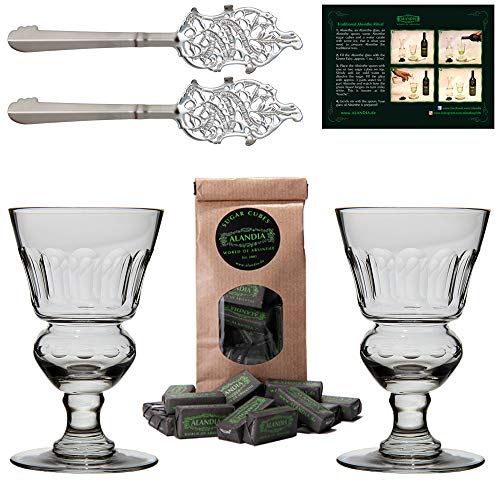
ALANDIA Premium Absinthe Spoons Glasses Set — Best Starter Kit
Not everyone needs a fountain to begin, and this set is the proof: two reservoir glasses, two stainless spoons, sugar cubes and an instructions card — everything for the original preparation method, in which ice water is dripped or thin-streamed from a carafe or a brouilleur over the spoon. It suits the beginner who wants to learn the ritual’s essentials at the lowest commitment, travellers and small kitchens without bar space, and anyone who prefers their equipment minimal and their technique manual.
Strengths
- The essential ritual with zero furniture — glasses, spoons, sugar, instructions
- Stainless spoons are durable, flat-sitting and easy to clean
- The instructions card makes it a genuinely self-teaching gift
Trade-offs
- No fountain means your hand provides the drip — technique required
- Serves two; the ceremony scales by buying more glasses, not spigots
- Carafe or brouilleur for the water is not included
| Set | ALANDIA spoons and glasses set |
| Included | 2 reservoir glasses, 2 stainless steel spoons, sugar cubes, instructions card (per listing title) |
There is a purist argument for starting here: the fountain is a convenience, but the ritual’s soul is the slow addition of water, and learning to pour a hair-thin stream from a carafe teaches you the louche’s pace in your hands. The reservoir glasses enforce the correct dose, the spoons are proper pierced stainless that sit flat and dissolve sugar at the right rate, and the sugar is in the box. Nothing in the set is a toy version of anything — it is the complete pre-fountain method, which served absinthe for decades before fountains became café furniture.
As a gift it is the strongest pick in this guide: self-contained, instructive, and sized for a stocking rather than a shelf. As a personal starter it has the same virtue — if the ritual becomes a habit, every piece remains in service alongside a later fountain; nothing is made redundant by upgrading. That is the mark of a well-chosen starter kit, and it is rarer than it should be.
The one discipline it asks is the pour itself: thin, slow, patient, ideally with the carafe rested so your hand does not tire into haste. Master that — the instructions card walks you through it — and you own the ritual in its original form, which many devotees quietly consider the best form.
Best for: beginners, gift-buyers and minimalists wanting the essential ritual without a fountain / Not suited for: hosts who want the fountain ceremony for a table of guests
Check on Amazon — check the current price on Amazon and confirm the variant, included accessories and seller before ordering.

La Perruche Pure Cane White Sugar Cubes — Best Sugar for the Ritual
It seems like the smallest pick in the guide, and it may be the most consequential. The sugar cube’s job in the ritual is to dissolve slowly and unevenly under the drip, sweetening the stream gradually rather than dumping sweetness at the end — and that requires rough-cut, irregular cubes of the traditional French style, not the hard, uniform, compressed cubes of a sugar bowl. La Perruche’s pure cane white cubes are that traditional article, from the French house whose rough cubes have sweetened café drinks for generations. It suits every absinthe drinker in this guide, whichever fountain or kit they chose.
Strengths
- Rough-cut texture dissolves at the ritual’s pace — gradually, not all at once
- Pure cane flavour is clean and neutral against absinthe’s botanicals
- The traditional French article, sized right for a spoon
Trade-offs
- A consumable — the one pick here you will buy again
- Rough cubes crumble if stored damp; keep the box dry
- Sold for tea and coffee too, so check you are ordering the cube format
| Product | La Perruche pure cane white sugar cubes |
| Size | 250g / 8.8oz box (per listing title) |
| Style | Rough-cut cubes |
Why does the cube matter enough to earn a badge in a guide about equipment? Because it is equipment — the ritual’s metering device for sweetness. A hard, dense, machine-pressed cube sits under the drip barely dissolving, then slumps all at once; a rough-cut cube erodes steadily, so each mouthful of the drink is sweetened a little more than the last, and the louche builds in step with the sugar. The difference is audible in the glass: properly sugared absinthe tastes integrated; badly sugared absinthe tastes like two drinks arguing.
La Perruche’s cubes also bring the right flavour neutrality. Pure cane, gently processed, sweetens without the molasses shadow of brown sugar (which has its own place — see this cluster’s cocktail-focused guide) or the chemical flatness of refined white. Against a botanical spirit as articulate as absinthe, that neutrality is a feature you can taste.
Buy a box with your first kit and a second box before the first runs out; the ritual without the right sugar is a fountain dripping on a problem. At this price-to-importance ratio, it is the easiest recommendation in the guide.
Best for: every absinthe drinker using the spoon-and-sugar ritual / Not suited for: drinkers who take absinthe unsweetened — a legitimate school, honestly noted
Check on Amazon — check the current price on Amazon and confirm the variant, included accessories and seller before ordering.

Amehla Absinthe Glasses, Pontarlier Reservoir, Set of 4 — Best Glasses
The glass is the ritual’s measuring instrument disguised as tableware. A Pontarlier glass carries a reservoir in its base — a bubble or well that holds exactly one dose of absinthe — so the drinker fills to the reservoir’s brim, then adds water to the level experience dictates, and watches the louche bloom in a bowl shaped to show it. This set of four Amehla reservoir glasses suits drinkers building a kit piece by piece, owners of a fountain whose glasses have thinned by breakage, and hosts who want matched, correct glassware for guests.
Strengths
- Reservoir dosing makes the spirit-to-water ratio correct by design
- The bowl shape shows the louche at its opalescent best
- A set of four matches the standard four-spout fountains in this guide
Trade-offs
- Glasses only — spoons, sugar and a water source are separate decisions
- Glassware breaks; budget a replacement set into a working bar’s life
- Reservoir styles vary between makers — match to your existing kit’s look
| Set | Pontarlier reservoir glasses, set of 4 |
| Style | Reservoir dose glass |
| Maker | Amehla |
Drink absinthe from the wrong glass and you lose information. The reservoir is a measuring device: fill it, and the dose is right without a jigger or a guess, which matters because absinthe’s water ratio — commonly three to five parts water to one of spirit — is the difference between a balanced, fragrant drink and a harsh or a washed-out one. The bowl above the reservoir then does the aesthetic work, giving the louche room to bloom visibly as the drip proceeds. A tumbler does neither job, which is why the ritual standardised this glass in the first place.
As a purchase, a matched set of four is the practical unit: it serves a four-spout fountain’s full ceremony, absorbs the occasional breakage without orphaning your kit, and keeps guests’ glasses identical — a small hospitality that rituals notice. Amehla’s set sits at the sensible tier: correct form, honest glass, priced for use rather than for a display cabinet.
Pair them with the spoons-and-glasses kit’s steel spoons if you are building from zero, or with the Ferrochef-style spoon sets sold for bars, and keep one habit from the first day: wash and dry them by hand, stacked never, stored upright. Reservoir glasses cared for that way will serve a decade of green hours.
Best for: kit-builders and hosts wanting correct, matched reservoir glassware / Not suited for: shoppers needing a complete kit in one box — see the sets above
Check on Amazon — check the current price on Amazon and confirm the variant, included accessories and seller before ordering.
Comparison Table
| Pick | Badge | Key spec | Best for |
|---|---|---|---|
| ALANDIA Absinthe Fountain Set Heure Verte — Check on Amazon | Best Overall | 4-spout fountain, full kit for 4 | anyone wanting the complete traditional ritual for up to four, bought once and correctly |
| Amehla Absinthe Fountain Set (2 Spout) — Check on Amazon | Best for Beginners | 2-spout glass dripper, kit for 2 | beginners and couples wanting the complete ritual at a modest scale |
| ALANDIA Absinthe Fountain Set Bubble — Check on Amazon | Best for Groups | Premium 4-spout fountain, kit for 4 | hosts and home-bar builders wanting the ritual as a social centrepiece |
| ALANDIA Premium Absinthe Spoons Glasses Set — Check on Amazon | Best Starter Kit | 2 glasses, 2 spoons, sugar, guide | beginners, gift-buyers and minimalists wanting the essential ritual without a fountain |
| La Perruche Pure Cane White Sugar Cubes — Check on Amazon | Best Sugar for the Ritual | Rough-cut cane cubes, 250g | every absinthe drinker using the spoon-and-sugar ritual |
| Amehla Absinthe Glasses, Pontarlier Reservoir, Set of 4 — Check on Amazon | Best Glasses | Pontarlier reservoir glasses ×4 | kit-builders and hosts wanting correct, matched reservoir glassware |
Read the table as a kit list rather than a contest: a fountain set, a starter kit, the right sugar and spare glasses are components of one ritual, and many readers will correctly buy two rows of it. The badges mark each component’s best-in-role, not rivals to be chosen between.
How to Choose Absenthe Mixing and Serving Gear
The ritual, explained: what each tool actually does
The preparation has four moving parts. The glass’s reservoir measures the spirit — one dose, no jigger. The spoon bridges the glass’s rim, holding the sugar cube over the spirit. The water — from a fountain’s spigot, a carafe’s thin stream or a brouilleur — arrives ice-cold and slow, dissolving the sugar on its way down. And the louche does the chemistry: as water dilutes the spirit, the essential oils that alcohol held dissolved come out of solution as a milky emulsion, releasing the aroma and softening the flavour. Every tool in this guide exists to serve one of those four parts, which is how you should judge any absinthe accessory you meet: what does it do for the dose, the sugar, the water or the bloom?
Ratios are the ritual’s one real variable. Three parts water to one of spirit gives a robust, spirit-forward glass; five to one gives a delicate, sessionable one. The reservoir glass makes the spirit end of that ratio automatic; your palate sets the water end, and the fountain’s slow drip is what lets you stop at the right moment instead of overshooting it.
Fountain, carafe or brouilleur: choosing your water
The fountain is the ceremonial answer — self-pacing, social, beautiful — and the sets in this guide are its best current forms. The carafe is the original answer: free, minimal, and entirely dependent on your hand’s patience. Between them sits the brouilleur, a small cup that sits over the glass and drips through a pinhole — an elegant middle path worth knowing about, though this guide’s verified picks concentrate on the two main roads. Choose by your ritual’s social shape: fountains for occasions and tables, the carafe method for solitary precision, and know that the drink itself does not care which delivered the water at the right pace.
- Fountain: best for groups, occasions and a self-pacing drip
- Carafe and spoon: best for minimal kits and practised hands
- Brouilleur: the elegant single-glass middle path
Sugar: the metering device, not a garnish
As the La Perruche review argues, the cube is a component, not a condiment. Rough-cut cubes erode steadily; hard pressed cubes resist then collapse. Brown rough cubes bring a gentle molasses note some drinkers love in winter glasses; white rough cubes stay neutral. One cube per glass is the classic dose; two is a sweet tooth’s prerogative; none is a legitimate purist school — but if you use sugar, use the right sugar, because the wrong cube genuinely changes the drink’s balance over the minutes the louche builds.
Reading a fountain listing like an inspector
Fountain listings reward the same scepticism as any equipment listing in this cluster. Count the spigots and check what they are made of — metal spigots with a positive, adjustable action are the working article; vague descriptions that never mention the drip mechanism are selling the silhouette, not the instrument. Confirm the glasses are reservoir style, not merely ‘absinthe glasses’ of arbitrary shape, and that spoons are counted and pictured flat across a rim. Finally, note whether sugar is included and of what style — a set that arrives without the right cubes leaves the ritual incomplete on its first night, which is why this guide treats the sugar as a pick in its own right rather than an afterthought.
A note on the spirit itself
This guide covers equipment, and the equipment is sold without alcohol — your absinthe itself comes from your local licensed seller, under your local rules. Choose a traditionally distilled, naturally coloured absinthe if you can; the louche is its quality certificate, blooming thick and white because real botanical oils are present. The finest fountain in this guide cannot louche a spirit that has nothing to bloom. Drink it slowly, diluted as the ritual intends, and responsibly — the green hour was always meant to be an hour, taken at leisure.
A Short, Honest History of the Green Hour
Absinthe rose in late nineteenth-century France from a medicinal wormwood tonic into the defining drink of café society — the hour between work and dinner when Paris turned, in the phrase of the time, green. The ritual standardised because the drink demanded it: too strong to drink neat, too aromatic to waste, it needed water, patience and a small ceremony, and cafés obliged with fountains on every zinc counter. The era’s artists made it mythology; temperance campaigns and wartime prohibition then made it contraband, and the ritual survived in whispers and in Spain until legal revival near the end of the twentieth century restored both the spirit and its tools.
The equipment in this guide descends directly from that café furniture — the multi-spout fountain is a café object, scaled for the home — and using it is a small act of historical re-enactment that happens to produce an excellent drink. That dual nature, tool and time machine, is why absinthe’s accessories reward buying well: you are furnishing a ritual, not just a bar.
Building the Kit Over Time: A Sensible Order
If budget argues for stages, buy in the order the ritual feels the gaps. First, glasses and spoons — the ALANDIA starter kit or the Amehla glasses with spoons — plus the right sugar: this is the complete working ritual, carafe method, for the least money. Second, the fountain, when the ceremony becomes social or frequent: the Amehla two-spout for couples, a four-spout ALANDIA for tables. Third, the redundancies a working bar accumulates: spare glasses against breakage, a second spoon set, a brouilleur for solo glasses.
What not to do is invert the order — the grand fountain first, drunk from tumblers with a teaspoon, is the category’s classic mistake, spending the budget on the ceremony’s furniture while starving its instruments. The drink is made at the glass, not at the fountain; furnish accordingly.
How to Prepare Absinthe the Traditional Way
The classic louche preparation, step by step — the method every pick in this guide exists to serve.
- Pour one dose of absinthe into the reservoir glass, filling the reservoir itself — that bubble is your measure.
- Rest the slotted spoon across the rim of the glass and place one rough-cut sugar cube on it, centred over the spirit.
- Position the glass under a fountain spigot, or ready your carafe of ice water — the water must be as cold as you can make it.
- Open the spigot to the slowest steady drip, or pour the thinnest stream you can sustain, directly onto the sugar cube.
- Watch the louche bloom from the bottom of the glass upward as the sugar dissolves and the water builds — this should take minutes, not seconds.
- Continue until the glass holds roughly three to five parts water to your one part spirit, stopping at the ratio your palate prefers.
- When the sugar has fully dissolved and the drink is fully opalescent, stir once gently with the spoon to marry the last of the sweetness.
- Set the spoon aside, let the glass rest a breath, and drink slowly — the aroma changes as the louche settles, and the last third of the glass is often the best.
Rinse the fountain and spoon in plain water and dry them; sugar residue is the only enemy this equipment has. Note the ratio you preferred — the ritual becomes yours when the water count is a habit rather than a measurement.
Common Buying Mistakes
- Setting the drink alight. The flaming preparation is a later tourist invention, not the tradition — it burns off aroma, risks the glass and insults the spirit. The louche is the ceremony; fire is a different show.
- Dripping too fast. A rushed louche is a weak one. If the water arrives in a stream rather than a drip, the oils shock rather than bloom — slow down, and chill the water more.
- Using hard, pressed sugar cubes. They resist, then collapse, sweetening unevenly. Rough-cut cubes are a functional component, as this guide’s sugar pick explains.
- Drinking it neat or barely diluted. Absinthe is formulated to be diluted three-to-five-fold; undiluted, its strength masks the botanicals the ritual exists to release.
- Skipping the reservoir glass. A tumbler cannot dose. The reservoir is a measuring instrument — using it is the difference between a ratio and a guess.
- Storing the fountain full of water. Rinse and dry after use. Standing water and sugar residue stale the spigots and cloud the glass.
Final Recommendation
For the complete ceremony in one correct purchase, take the ALANDIA Heure Verte set. For a gentler beginning, the Amehla two-spout set or the ALANDIA starter kit will teach you the ritual properly — and whichever route you choose, add the La Perruche sugar, because the cube is a component, not a detail. The Bubble set furnishes the social bar, and the Amehla glasses keep any kit correctly dressed.
Confirm the set contents in the listing before ordering — glasses and spoons counted, sugar included or ordered alongside — and check price on Amazon at the moment of purchase. Then buy your absinthe locally, pour slowly, and enjoy the oldest mixing ritual in the modern bar.
Keep exploring the cluster: Best Absinthe Mixers Best 4 Mixers For Cocktails Best Affordable Commercial Drink Mixers Best 0cal Mixers For Rum Best Alcohol For Mixers
Frequently Asked Questions
What does ‘absenthe’ mean — is it a different drink?
It is an archaic spelling of absinthe, found in older texts and labels — the same wormwood spirit and the same ritual. This guide uses the search’s spelling in its title and the standard spelling in its text, and covers the traditional mixing and serving equipment the search intends: fountains, spoons, reservoir glasses and sugar.
What is the louche, and why does it matter?
The louche is the milky, opalescent bloom that appears as water dilutes absinthe: botanical oils that were dissolved in strong alcohol come out of solution as a fine emulsion. It matters because it is both the drink’s signature beauty and its quality signal — a traditionally made absinthe louches thickly — and because the process releases the aroma and softens the flavour. The slow drip exists to build it properly.
Do I need a fountain to prepare absinthe correctly?
No — the fountain is the ceremonial and social form of the water delivery, but the original carafe-and-spoon method, covered by this guide’s starter kit, is fully traditional. What the ritual requires is ice-cold water added very slowly over the sugar. A fountain makes that effortless for several glasses at once; a practised hand and a carafe do it for one.
How much sugar belongs in a glass of absinthe?
One rough-cut cube per glass is the classic dose, dissolved gradually through the spoon. Two suits a sweeter palate, and none at all is a respected purist school — many modern absinthes are balanced enough to drink unsweetened. What matters is the cube’s style if you use one: rough-cut, so it erodes steadily rather than collapsing at the end.
Can I use these fountains and glasses for other drinks?
The glasses serve any aromatic aperitif handsomely, and the spoons are at home in champagne cocktails and layered drinks. The fountain itself is happiest in its own ritual — it is a specialised instrument — though hosts have pressed them into service as elegant water dispensers for a tasting table. Rinse thoroughly between lives; sugar and anise linger.
Is absinthe legal to buy?
In most markets, yes — genuine absinthe has been legally sold again for years, regulated like other spirits and bought from licensed sellers under local rules. This guide sells no alcohol and covers only the equipment, which is sold freely. Check your local regulations for the spirit itself, buy from a reputable licensed source, and enjoy it diluted and responsibly, as the ritual intends.
How do I clean and store a fountain between rituals?
Empty it, rinse the reservoir and spigots with plain warm water — sugar is the only residue the ritual leaves, and it dissolves — and let everything air-dry before reassembly. Avoid detergents inside the fountain; their perfume survives rinsing and will ghost the next glass’s aroma. Store glasses upright and unstacked, spoons flat in a drawer or bar roll, and the sugar box sealed and dry. Five minutes of this after a session keeps a kit serviceable for decades.


