Disclosure: airfryerkitchensupply.com is reader-supported. When you buy through links on our site, we may earn an affiliate commission at no extra cost to you.
Where to buy
Every candidate for the best 5 channel mixers below was checked against live Amazon listings on the day this guide was written, and all six picks carry confirmed listings so you can check the current price on Amazon from each review. Five-channel mixers are sold under a tangle of names — audio mixer, sound board, DJ mixer — so each review below states the exact input layout the listing confirms, which is the reliable way to compare them.
- Mackie Mix5 (Best Overall): Check the current price on Amazon
- Behringer Xenyx 502S (Best for Streaming): Check the current price on Amazon
- Behringer Pro Mixer DJX750 (Best for DJs): Check the current price on Amazon
- Socodox 5 Channel Audio Mixer (Best for Karaoke and Parties): Check the current price on Amazon
- Aveek 5 Channel Audio Mixer (Best Budget): Check the current price on Amazon
- Pyle 5-Channel Rechargeable Mini Portable Audio Mixer (Best Portable): Check the current price on Amazon
The best 5 channel mixers occupy the most practical corner of the small-mixer market: enough inputs for a microphone or two plus music, instruments and a computer, in a box small enough for a desk, a gig bag or a karaoke corner. It is the size that solo performers, streamers, small venues and party hosts actually need, once they stop shopping for the mixer they imagine and start counting the sources they own.
This guide compares six five-channel mixers that approach the format from different directions. There is a rugged compact classic from a live-sound institution, a streaming-first Behringer with a USB interface, a full five-channel DJ mixer with effects and a BPM counter, two feature-loaded boards built for karaoke, streaming and small events, and a rechargeable portable mixer that runs where there is no power outlet at all.
Every pick was verified, with the input layout taken from the verified listing. A quick counting note that will save you confusion across this whole category: five-channel usually means some arrangement of one or two microphone inputs plus stereo line channels, and the reviews spell out each arrangement. No static prices are printed, because these models are discounted and bundled constantly; the live listing is one click from every pick.
A note on who should skip this size entirely: bands with drum kits, podcast panels with three or more voices, and venues running multiple zones have all outgrown five channels before they start, and no pick here will rescue them. This class serves the small, the solo and the mobile — and serves them well precisely because it refuses to pretend otherwise.
In this guide
Quick Picks
Mackie Mix5 — Best Overall. The benchmark compact five-channel mixer: one microphone channel plus stereo line inputs, in the rugged metal build that made Mackie the default name in small live mixers. Check price on Amazon.
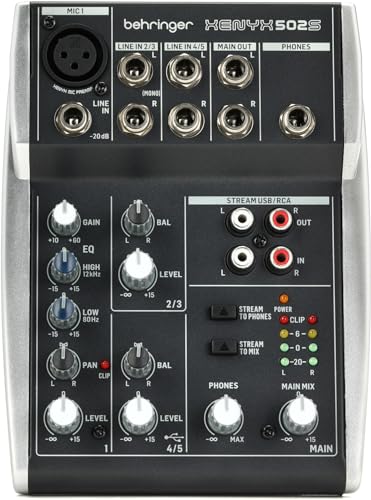
Behringer Xenyx 502S — Best for Streaming. The desk-streaming specialist: five inputs arranged around one microphone channel, with a USB interface designed to send the mixed result straight into a stream or recording. Check price on Amazon.
Behringer Pro Mixer DJX750 — Best for DJs. The DJ of the group: a true five-channel DJ mixer with digital effects, a BPM counter and the channel count to run multiple decks, a sampler and a microphone in a club-style layout. Check price on Amazon.
Socodox 5 Channel Audio Mixer — Best for Karaoke and Parties. The maximalist event board: five channels, Bluetooth, a deep bank of DSP effects, phantom power, USB recording and stereo inputs, aimed at karaoke, church and party work. Check price on Amazon.
Aveek 5 Channel Audio Mixer — Best Budget. The budget all-rounder: five channels with a built-in PC recording interface, Bluetooth and USB playback, phantom power and echo/delay effects for streaming, podcasting and karaoke. Check price on Amazon.
Pyle 5-Channel Rechargeable Mini Portable Audio Mixer — Best Portable. The off-grid pick: a compact five-channel mixer with a rechargeable battery, USB interface and an XLR combo microphone input, for busking, outdoor ceremonies and anywhere power is a rumor. Check price on Amazon.
How These Picks Were Chosen
We shortlisted mixers whose verified listings confirm a five-channel or five-input design, then verified each by searching brand and model and matching the returned title. That process matters here more than in most categories, because budget sound boards are frequently listed with inflated channel claims; if the layout could not be confirmed from the listing, the product did not make the guide.
Scoring started with the microphone channels, because they define a small mixer ceiling: how much clean gain is available, whether phantom power is offered for condenser microphones, and how the EQ treats a voice. After that came source flexibility — Bluetooth, USB, MP3 playback — then output options for speakers, headphones and computers, then build quality and the realism of the effects for the event-oriented picks.
Finally, we ranked for honesty of purpose. A DJ mixer, a streaming interface and a karaoke board can all be five channels and share almost no other DNA. Each pick is badged for the job it actually does best, and the verdict lines name the buyer it serves and the buyer it will frustrate, so the list reads as six tools rather than six contestants for one job.
We also checked each pick for the karaoke and streaming claims its listing makes, because this category is where marketing vocabulary inflates fastest. A board was credited with an effects or recording capability in its review only where the verified listing states it, and channel layouts in the spec boxes reproduce the listing language rather than the most generous interpretation of it.
The 6 Best 5-Channel Mixers

Mackie Mix5 — Best Overall
The Mix5 is the mixer other five-channel mixers get compared to, and the reason is boring in the best way: it is built properly. A metal chassis, controls that feel like they belong on professional gear, and a clean, simple signal path from a company whose entire reputation is live sound. One microphone channel and two stereo line channels cover the classic small-rig layout without a single wasted feature.
It suits keyboard players, solo performers, presenters, podcasters with a single mic and anyone whose mixer travels. Buyers who need two microphone channels, effects or Bluetooth should look at the event boards below, which trade this build quality for features.
Strengths
- Rugged construction that survives years of gig bags and cable trunks
- Clean, quiet signal path from a specialist live-sound maker
- Dead-simple layout that anyone can operate correctly the first time
Trade-offs
- One microphone channel only, which rules out duos and two-host formats
- No effects, USB or Bluetooth — a deliberately analog, wired tool
- Stereo channels are basic, with limited EQ compared to event boards
| Channels | 5: 1 microphone channel + stereo line channels |
| Format | Compact mixer, black (per Amazon listing title) |
The Mix5 natural work is sub-mixing and simple reinforcement: the keyboard rig with two instruments and a playback track, the solo act with one microphone and backing music, the presenter with a laptop and a clicker. In those roles its lack of features is the feature — there is nothing to misconfigure, nothing updating, nothing pairing, and the sound is clean enough that the mixer never becomes the topic of conversation.
Longevity is the deeper argument. Small mixers die from transport more than from electronics, and the Mix5 is built for the life small mixers actually lead. If your five channels are mostly line-level and your mixer lives in motion, this is the pick most likely to still be working, unchanged, in five years.
Best for: Keyboard rigs, solo acts, presenters and traveling users who value build and simplicity / Not suited for: Two-microphone work, karaoke effects and wireless streaming setups
Check on Amazon to see the current listing for the Mackie Mix5.
Behringer Xenyx 502S — Best for Streaming
The 502S is what happens when a mixer is designed backward from a streamers desk. One good microphone channel for the host, stereo inputs for game audio, music and a phone or console, and a USB interface whose job is to deliver that mix to the computer cleanly. Five inputs sounds small until you map it onto a real streaming desk, where it is exactly right.
It suits solo streamers, podcasters, VTubers, online teachers and anyone whose audience is on the other side of a computer. Live performers and event hosts should look at the DJ and event picks, which have the outputs and microphone count that rooms full of people require.
Strengths
- USB streaming interface purpose-built for the one-mic desk workflow
- Tiny footprint that fits crowded streaming and podcast desks
- Simple, learnable controls with proper gain staging for one voice
Trade-offs
- One microphone channel excludes co-hosts and guests on separate mics
- No built-in effects; voice polish must come from software
- Not a live-sound tool: outputs and headroom are desk-scale
| Inputs | 5: 1 microphone channel + stereo line channels |
| Verified feature | USB streaming interface (per Amazon listing title) |
| Signal path | Analog mixer with USB interface |
Streaming audio fails in one predictable place: the loop between the mixer and the computer. The 502S is engineered around that loop, so the streamer hears themselves properly, the audience receives a balanced mix of voice over game or music, and the levels behave. A bigger mixer can do all of this too, but it does it with more size, more cost and more ways to be configured wrong at 8pm before a stream.
Its ceiling is the single microphone, and it is a hard ceiling. The moment a podcast becomes a two-person show, this mixer is done, and no adapter fixes that. Buy it for the desk it describes — one voice, several playback sources, a computer — and it is arguably the most rational purchase in this entire guide.
Best for: Solo streamers, podcasters and online teachers with one microphone / Not suited for: Two-host shows, live events and bands
Check on Amazon to see the current listing for the Behringer Xenyx 502S.

Behringer Pro Mixer DJX750 — Best for DJs
The DJX750 answers a different question from the other picks: not how do I mix a few sources, but how do I DJ with room to spare. Five channels in a DJ layout — multiple phono and line inputs for decks, effects for transitions, a BPM counter for orientation — make it a small club or serious home DJ mixer that happens to share a channel count with compact boards.
It suits DJs who have outgrown two and three-channel mixers, home club setups and mobile DJs who want effects without flagship money. Streamers, presenters and karaoke hosts will find its DJ-first layout less convenient than the event boards, and should not buy channel count they cannot use.
Strengths
- Five DJ channels handle multi-deck and sampler setups properly
- Built-in digital effects support creative transitions
- BPM counter helps align sources and learn beatmatching discipline
Trade-offs
- Larger and more complex than compact five-channel boards
- DJ-first layout is overkill and less handy for speech and events
- No Bluetooth or streaming conveniences of the modern event boards
| Channels | 5 DJ channels |
| Verified features | Digital effects and BPM counter (per Amazon listing title) |
| Role | Professional DJ mixer |
Channel count changes DJing qualitatively, not just quantitatively. With five channels, the third deck, the sampler and the backup source stop competing for inputs, and sets gain the layered, prepared character that separates club mixing from two-deck survival. The effects section supports that ambition, giving transitions a polish that pure EQ blending cannot.
The honest framing is that this is the largest commitment in the guide: more size, more to learn, more mixer than a karaoke night will ever need. For its intended buyer that is the point. DJs shopping this search specifically should read the channel layout first — this pick is the only one here designed from the crossfader outward.
Best for: DJs building multi-source rigs who want effects and five channels at a sensible tier / Not suited for: Streamers, presenters and karaoke hosts, who are better served by the event picks
Check on Amazon to see the current listing for the Behringer Pro Mixer DJX750.

Socodox 5 Channel Audio Mixer — Best for Karaoke and Parties
The Socodox board takes the opposite design philosophy from the Mix5: include everything. Bluetooth for the phone playlist, a large DSP effects bank for karaoke voices, phantom power for a proper condenser microphone, USB recording for the stream or the archive, and five channels to hold it all. For event work, that checklist is the job description.
It suits karaoke hosts, party DJs, small churches, streamers who perform and hosts who need one board to cover unpredictable requests. Buyers who prize build quality and brand support above features should weigh the Mackie and Behringer picks, which invert this board priorities.
Strengths
- The broadest feature set in this guide, led by Bluetooth and a deep effects bank
- Phantom power supports condenser microphones for better vocal quality
- USB recording covers streaming and event archiving in the same box
Trade-offs
- Feature density means a busier panel and more to learn
- Long-term support and documentation trail the established brands
- Effects quantity exceeds most needs; the core few do the real work
| Channels | 5 |
| Verified features | Bluetooth, 99 DSP effects, 48V phantom power, 3-band EQ, USB recording, stereo inputs (per Amazon listing title) |
Karaoke is the use case that justifies maximalism. A karaoke night throws everything at a mixer — phones with tracks, two singers of wildly different volumes, a host microphone, requests for echo that would embarrass a studio — and the board that survives it is the one with a feature for each problem. The Socodox is specified for exactly that chaos, and its effects bank, whatever its depth, covers the echo-and-reverb vocabulary karaoke singers actually ask for.
For church and party work the same logic holds at lower intensity: Bluetooth removes the cable negotiation, phantom power upgrades the microphone, and USB recording turns services and sets into archives without extra gear. It is not the connoisseur choice in this guide, but for event buyers it may be the most useful one.
Best for: Karaoke hosts, party and church sound, and feature-first event setups / Not suited for: Buyers who prioritize build pedigree and minimalism over features
Check on Amazon to see the current listing for the Socodox 5 Channel Audio Mixer.

Aveek 5 Channel Audio Mixer — Best Budget
The Aveek board is the value expression of the modern five-channel idea: one box that records to a PC, plays from Bluetooth and USB, powers a condenser microphone and adds echo and delay for voices. For a first streaming, podcasting or karaoke setup, that combination covers the entire checklist at the accessible end of the market.
It suits first-time buyers, bedroom streamers, karaoke setups and podcasters testing the format before investing further. Buyers who already know they will use a mixer weekly for years should compare the Behringer and Mackie picks for the support and durability that heavy use rewards.
Strengths
- PC recording interface built in, covering streaming and podcast capture
- Bluetooth and USB playback handle phones and computers without adapters
- Phantom power and voice effects at a budget tier
Trade-offs
- Build and component feel are budget-grade
- Brand support and long-term parts availability are limited
- Preamp headroom is modest with demanding microphones
| Channels | 5 |
| Verified features | Built-in PC recording interface, 48V phantom power, Bluetooth and USB playback, echo delay effects (per Amazon listing title) |
The Aveek makes sense as a format test. Streaming and karaoke are hobbies many people try and some people keep, and this board lets a beginner run the full workflow — microphone, music, effects, recording — before deciding whether the hobby deserves the Mackie or Behringer tier. Every skill learned on it transfers, because its layout follows the standard small-board logic.
Its risks are the standard budget risks, stated plainly: lighter construction, thinner documentation, and a support path that assumes replacement more than repair. Priced as a first step, that is a fair exchange. The mistake would be buying it as a five-year professional tool, and this guide badges it as the budget pick precisely to prevent that misreading.
Best for: First-time streamers, podcasters and karaoke buyers on a budget tier / Not suited for: Heavy weekly use and professional event work
Check on Amazon to see the current listing for the Aveek 5 Channel Audio Mixer.

Pyle 5-Channel Rechargeable Mini Portable Audio Mixer — Best Portable
Every other pick in this guide assumes a wall outlet. The Pyle mini assumes the opposite: a rechargeable battery at its core, five channels including a proper XLR combo microphone input, slider EQ controls and a USB interface, in a compact body made for street performance, outdoor ceremonies, market stalls and mobile teaching.
It suits buskers, outdoor celebrants, mobile instructors and anyone whose venue is a park, a beach or a courtyard. Buyers with reliable power and bigger sound needs should take the fuller-featured boards above; this pick trades some depth for freedom from the outlet.
Strengths
- Rechargeable battery enables genuinely portable, off-grid mixing
- XLR combo input takes a real microphone despite the mini format
- USB interface covers recording and computer sources on the move
Trade-offs
- Battery runtime bounds session length in a way wired mixers never face
- Mini format means smaller controls and fewer refinements
- Output power and headroom suit small portable speakers, not events at scale
| Channels | 5 |
| Verified features | Rechargeable battery, USB interface, slider EQ controls, XLR combo mic input (per Amazon listing title) |
| Format | Mini portable audio mixer |
Portability reorders every priority. The best mixer for a busker is the one that fits the cart, runs the full session and survives being set up on a pavement daily — and a battery mixer with a real microphone input and enough channels for an instrument, a backing track and a spare is a genuinely enabling tool for that life. The USB interface even lets the same rig record the session or feed a phone for a livestream from the street.
The discipline it demands is power management: charge before the session, know your runtime, and treat the battery gauge like a fuel gauge. Within that discipline, it opens venues no other pick here can serve, which is why it closes this guide as the specialist pick rather than competing with the desk-bound boards on their own turf.
Best for: Buskers, outdoor ceremonies and mobile setups without reliable power / Not suited for: Fixed installations and larger events with dependable power
Check on Amazon to see the current listing for the Pyle 5-Channel Rechargeable Mini Portable Audio Mixer.
Comparison Table
The five-channel label hides five different tools: a rugged compact (Mix5), a streaming desk interface (502S), a DJ mixer (DJX750), two event boards (Socodox, Aveek) and a battery portable (Pyle). Choose by job first — the table verdict column is written as buyer descriptions for exactly that reason.
| Pick | Badge | Key spec | Best for |
|---|---|---|---|
| Mackie Mix5 | Best Overall | 5-channel compact mixer with rugged metal construction | Keyboard rigs, solo acts, presenters and traveling users who value build and simplicity |
| Behringer Xenyx 502S | Best for Streaming | 5-input analog mixer with USB streaming interface | Solo streamers, podcasters and online teachers with one microphone |
| Behringer Pro Mixer DJX750 | Best for DJs | 5-channel DJ mixer with digital effects and BPM counter | DJs building multi-source rigs who want effects and five channels at a sensible tier |
| Socodox 5 Channel Audio Mixer | Best for Karaoke and Parties | 5 channels with Bluetooth, 99 DSP effects and 48V phantom power | Karaoke hosts, party and church sound, and feature-first event setups |
| Aveek 5 Channel Audio Mixer | Best Budget | 5 channels with PC recording interface, Bluetooth and echo/delay effects | First-time streamers, podcasters and karaoke buyers on a budget tier |
| Pyle 5-Channel Rechargeable Mini Portable Audio Mixer | Best Portable | 5 channels with rechargeable battery, USB interface and XLR combo mic input | Buskers, outdoor ceremonies and mobile setups without reliable power |
How to Choose the Best 5 Channel Mixers for Your Actual Setup
Write down your five sources before reading any product page. A typical list might be: one microphone, a guitar, a keyboard, a phone for backing tracks, a laptop. Another might be: one microphone, game audio, music, a console, a phone. The lists look similar and lead to different mixers — the first wants two instrument-capable channels and live outputs, the second wants a USB streaming loop — which is why the list, not the channel count, is the real specification.
Microphone count is the sharpest dividing line in this class. Two of the picks here offer proper support for condenser microphones with phantom power; several offer exactly one microphone channel; the DJ pick offers a DJ-style mic input among its deck channels. If two people will ever speak or sing into your setup at once, that requirement outranks every feature in this guide, because it cannot be added later with an accessory.
Outputs decide the second half of the fit. Feeding powered speakers, feeding a computer and feeding headphones are three different jobs, and small mixers routinely do two of the three well. Streamers should verify the USB behavior specifically — some interfaces record the mix, others are playback-focused — while live users should verify the main output type matches their speakers without adapter chains.
Finally, weigh build against features at your tier honestly. The budget end of this category buys astonishing feature lists in light construction; the established brands sell fewer features in construction that survives a working life. Neither is a trick. The right choice depends on whether your mixer will live on one desk or in a bag, and how expensive a mid-season failure would be for the work you do.
Five Channels, Five Layouts: Reading Input Panels Like a Professional
Channel counts in this category are arrangements, not totals of identical things. The classic compact layout — one microphone channel plus two stereo line channels — is five inputs serving three sources at once. Event boards arrange five channels with more microphone and playback flexibility. The DJX750 arranges five full DJ channels, each ready for a deck. Same number, three different rigs, which is why this guide leads every review with the layout rather than the label.
Stereo channels deserve special attention. A keyboard, a phone and a laptop are stereo sources; plugging them into a mono channel with one cable throws away half the signal and all of the width. When your source list is mostly stereo, count stereo channels, not channels. When your list is mostly microphones and instruments, count mono channels with proper gain. The product photos on any listing show the panel clearly enough to do this count in ten seconds, and it is the highest-value ten seconds in small-mixer shopping.
Gain range is the quiet specification that separates usable channels from decorative ones. A microphone channel needs substantial clean gain; a line channel needs padding and control for hot sources like keyboards and phones. Boards that publish honest gain structure, and brands with live-sound heritage, tend to handle the extremes — the quiet singer, the loud keyboard — without the hiss or distortion that budget panels produce at their limits.
One layout question deserves its own paragraph: where the headphone output gets its signal. Performers and streamers need to hear the mix as the audience hears it, ideally with the ability to check a single source before it goes live. Boards differ quietly here, and a mixer whose monitoring frustrates you will be operated worse than a simpler mixer whose monitoring is obvious. If you perform live with backing tracks, rank monitoring alongside microphone count when comparing the picks above.
Effects, Bluetooth and USB: Which Modern Features Earn Their Place
Built-in effects earn their place when a voice is the product. Karaoke, small worship and solo performance all benefit from reverb and echo that make a dry microphone sound finished in a live room. The event picks here carry deep effects banks for that reason. For speech, streaming into software and sub-mixing instruments, effects are usually redundant — software does them better, or the room does them for free — and paying for a large bank buys a menu you will open twice.
Bluetooth earns its place when sources are unpredictable: the guest phone, the client playlist, the ceremony track sent that morning. It is a reliability feature disguised as a convenience, because the alternative is a drawer of adapters and a cable that fits nothing. Its cost is a small amount of latency and compression, which is why recording-focused users still prefer cables for their primary sources while keeping Bluetooth for the unpredictable ones.
USB is the feature with the widest variance in meaning. On the streaming picks it is a true interface, carrying the mix into a computer and monitoring back. On some event boards it is primarily a playback and recording convenience. Read which kind a given model offers before assuming, because the difference decides whether the mixer can be the heart of a streaming desk or merely a guest at one.
Small Mixer, Bigger System: Speakers, Microphones and Cables
A five-channel mixer is a component, and its results are capped by what surrounds it. The microphone matters most: a decent dynamic microphone into any pick here will outperform a poor microphone into the best of them, and a condenser microphone only justifies itself where phantom power and a reasonably quiet room exist. Buyers should budget the microphone with the mixer, not after it, because the pair is the actual product the audience hears.
Speakers come second. Compact mixers feed powered speakers in almost every modern small setup, and the pairing rule is simple: the speaker should be able to fill the intended room at half its comfortable effort, so the system runs relaxed instead of strained. A mixer upgrade cannot rescue undersized speakers, and oversized speakers forgive a modest mixer more often than the reverse.
Cables and small accessories complete the system: balanced microphone cables, the correct adapters for phones and laptops, a stand or shelf that puts the mixer at working height, and a case if it travels. These unglamorous items are where small systems actually fail in the field, and a modest allowance for them, planned at purchase time, is worth more than one tier of mixer upgrade.
Longevity and Support: The Five-Year View of a Small Mixer
Small mixers are bought in minutes and owned for years, and the ownership differences between brands compound quietly. An established maker offers manuals that answer real questions, firmware or documentation archives, replacement knobs and faders, and a support channel that has heard your problem before. A no-name board offers a lower price and a shorter memory. Neither is automatically wrong — a karaoke board replaced cheaply in year three may cost less than a premium board bought once — but the buyer should choose that trade deliberately rather than discovering it.
The practical longevity factors are physical. Metal chassis survive bags; plastic ones survive shelves. Controls mounted securely survive enthusiastic singers; board-mounted mini controls survive desks. Power supplies are the most lost and most proprietary part of any small mixer, so a model using a common, replaceable supply has a longer real life than its spec sheet suggests. When two picks tie on features, these are the tiebreakers that decide which one is still working at the fifth anniversary.
Care extends the timeline further than brand does. Unplug cables for transport so jacks are not strained, keep the mixer out of drink range at events, work scratchy controls through their range with the power off before assuming failure, and store the unit somewhere dry. The five-channel class is inexpensive enough to be treated as disposable, and the mixers that escape that treatment routinely outlast the systems around them.
How to Set Up a 5-Channel Mixer for a Small Performance
A representative setup: one microphone, an instrument, stereo backing tracks from a phone or laptop, and a spare channel, feeding one or two powered speakers — the rig behind solo acts, small worship, karaoke nights and market-day busking alike.
Step 1: Connect in the safe order, with levels down
Place the speakers where the audience is, ahead of the microphone position. Connect sources to the mixer with all gains and levels down, run the mixer main output to the powered speakers, and power up in order: sources, mixer, speakers last. This sequence prevents the pops and thumps that stress speakers and startle rooms.
Step 2: Set the microphone channel first
Plug the microphone into channel one. If it is a condenser, switch on phantom power after connecting. Speak or sing at real performance level while raising the gain until the level is strong and consistent without peaking. The microphone is the reference for the whole mix, so it gets set first and touched least afterward.
Step 3: Add the instrument and balance it under the voice
Connect the instrument to its channel and set its gain with the loudest playing you expect. Bring its level up until it supports the voice without competing with it. Instruments with their own volume controls should be run fairly high at the source, with the mixer doing the final balancing.
Step 4: Bring in backing tracks and the spare source
Connect the phone or laptop to a stereo channel, set the device volume around three-quarters, and gain the channel to match the live sources. Leave the fifth channel gained down and ready: a guest microphone, a second instrument or an emergency replacement source is what spare channels are for, and having it pre-checked turns a mid-set surprise into a thirty-second swap.
Step 5: Add effects to the voice only, and sparingly
If the mixer has effects, apply them to the microphone channel alone, starting from none and adding until the voice sounds placed in a room rather than processed. Backing tracks and instruments usually arrive already produced; effecting the whole mix muddies them. Taste in effects is measured in how little the audience notices.
Step 6: Soundcheck at performance volume and walk the space
Play and sing a full song at the volume you actually need, and walk the listening area. Check that the voice stays clear at the back, that nothing rings or feeds back at the loudest moments, and that the balance survives distance. Adjust speaker aim and channel levels from what you hear in the room, not from behind the speakers.
Photograph the final panel. Five-channel rigs get shared, borrowed and re-set by other hands, and a photo of a working setup is the fastest way back to a good sound when the next session starts from someone else’s settings.
Revisit the setup after the first real event and change one thing. Small systems improve iteratively — a cable rerouted, a gain re-trimmed, the spare channel reassigned — and the performers who keep notes converge on a rig that feels custom-built within a season.
Keep one spare cable of each type in the bag. In the five-channel world, cables — not mixers — are the leading cause of silence, and the spare is the difference between a story and a refund.
Common Buying Mistakes
Counting channels instead of sources
Five channels serve very different source lists depending on layout. The buyer who counts five and assumes five microphones discovers the stereo channels at setup. List your sources, match the layout, and the number on the box becomes irrelevant.
Buying effects depth you will never open
A bank of dozens of presets sounds like value and usually reduces to two used settings. If your work is speech, streaming or sub-mixing, spend the same money on build quality or a better microphone instead.
Running a condenser microphone without phantom power
The microphone is not broken; it is unpowered. This mismatch is one of the most common false faults in small audio. Check for the phantom power switch before concluding anything, and switch it only with the channel level down.
Feeding stereo sources into mono channels with one cable
Half the signal and all the stereo width disappear, and the backing track sounds thin for reasons buyers blame on the mixer. Use the stereo channels for stereo sources, with both cables, every time.
Ignoring the spare channel until the emergency
An unchecked spare channel is not a backup; it is a rumor. Gain it, test it during soundcheck, and it becomes the thirty-second save when a cable dies or a guest appears.
Letting the mixer outgrow the speakers
A better mixer into undersized speakers still sounds small, and the disappointment gets misdiagnosed as a mixer problem. Size the speakers for the room first; the five-channel class assumes modest rooms and rewards honesty about them.
Final Recommendation
Most buyers should start with the Mackie Mix5 for its build and clean simplicity, or the Behringer Xenyx 502S if the destination is a streaming desk. DJs should take the DJX750 without hesitation — it is the only true DJ instrument here — while karaoke and event hosts should choose between the Socodox feature bank and the Aveek budget all-rounding. The Pyle battery mixer owns the off-grid niche outright.
The five-channel format rewards buyers who shop by source list rather than by headline. Count your microphones, count your stereo sources, check the outputs against your speakers and computer, and the right pick from this list identifies itself.
If the choice still feels close, decide by failure cost. A streamer whose mixer dies loses a week; a karaoke host whose board dies on a Friday loses the booking. Buy support and build in proportion to what a failure costs you, and features with whatever budget remains — that ordering, applied honestly, is the whole art of this category.
Keep exploring the cluster: Best 4 Channel Mixers Best 3 Channel Dj Mixers Best 4 Channel Mixers For Djing Best 5 Pro Sound Tablet Mixers Best 40 Channel Digital Mixers For Live Outdoor Sound
Frequently Asked Questions
How many microphones can a 5-channel mixer run?
Usually one or two. Most five-channel layouts combine one or two microphone channels with stereo line channels for music and instruments. If your setup needs three or more microphones at once, step up to a larger mixer class rather than adapting line inputs.
What is the difference between a 5-channel mixer and a 5-input mixer?
In practice, very little — brands use the terms loosely for the same compact layouts. What matters is the arrangement: how many microphone channels, how many stereo channels, and what the USB connection actually does. This guide states the arrangement for every pick.
Do I need phantom power?
Only for condenser microphones, which include many popular vocal and streaming mics. Dynamic microphones do not need it. If a condenser is in your present or future, choose a pick that provides 48V phantom power, as the event and budget boards here do.
Can a 5-channel mixer work for a small band?
For a duo or trio with one or two microphones and the rest line-level instruments and tracks, yes. For a full band with drum microphones and multiple vocalists, no — that work starts at larger mixer classes with more microphone preamps.
Is a DJ mixer like the DJX750 good for karaoke?
It can run karaoke, but it is designed for DJing: deck inputs, crossfader and transition effects. Karaoke hosts are usually better served by the event boards in this guide, whose effects, Bluetooth and microphone handling are built for singers and hosts.
How long will a battery mixer run a session?
Runtime depends on the model, the volume and what is connected, so treat the maker’s figure as a best case and plan with margin. For busking and ceremonies, the discipline is simple: charge fully before the session and know your real-world runtime from a rehearsal, not from the box.


