Disclosure: airfryerkitchensupply.com is reader-supported. When you buy through links on our site, we may earn an affiliate commission at no extra cost to you.
Where to buy
Every candidate for the best 4 channel dj mixers below was checked against live Amazon listings on the day this guide was written. Five of the six picks carry confirmed listings, so you can check the current price on Amazon directly from each review. One pick, the Pioneer DJ DJM-750MK2, is covered without a link because the listed accessories for it rather than a confirmed listing for the mixer itself, and we would rather tell you that than link you to a dust cover. Club mixers are also sold through specialist DJ retailers, and for the flagship models it is worth comparing both channels before buying.
- Pioneer DJ DJM-A9 (Best Overall): Check the current price on Amazon
- Allen & Heath Xone:92 Mk2 (Best Analog Sound): Check the current price on Amazon
- Allen & Heath Xone:PX5 (Best Hybrid Performance Mixer): Check the current price on Amazon
- Allen & Heath Xone:96 (Best for Audiophile Rigs): Check the current price on Amazon
- Numark M6 USB (Best Budget): Check the current price on Amazon
- Pioneer DJ DJM-750MK2 (Best Mid-Range Pioneer): sold through specialist retailers and marketplaces; see the review below for sourcing notes.
The search for the best 4 channel dj mixers is really a search for the center of a serious DJ setup. Four channels is the club standard for a reason: two decks playing, a third ready, and a fourth for a sampler, a guest DJ or a backup source, all without re-plugging a single cable mid-set. Whether you are building a home rig that mirrors the booth, equipping a small venue, or upgrading from a two-channel starter mixer, this is the category where mixers stop being accessories and become instruments.
This guide compares six four-channel mixers across the full range of the market: a current flagship built for professional booths, two analogue models from the British school of mixer design, a hybrid performance mixer, a budget USB model that has introduced thousands of DJs to four channels, and a respected mid-range Pioneer covered honestly in prose because its current listing could not be verified.
A note on counting before we start: most picks here are true four-channel designs. One, the Xone:96, is listed by its maker with additional return and microphone channels beyond its four main channels, and we explain exactly how that layout works in its review rather than letting a headline number mislead you. Prices in this category move with stock and region, so every verified pick links to its live listing instead of printing a number that would be stale within weeks.
We also kept this guide deliberately honest about tiers. Four-channel mixers span from the M6 USB at the accessible end to flagships that cost many times more, and the expensive models are not simply better versions of the cheap ones — they are different tools with different centers of gravity. Each review below names the buyer it serves, so you can spend at the level your actual DJ life justifies.
In this guide
Quick Picks
Pioneer DJ DJM-A9 — Best Overall. The current flagship standard for professional booths: four channels, a built-in audio interface for recording and performance, and the layout that touring DJs expect to find when they arrive at a venue. Check price on Amazon.
Allen & Heath Xone:92 Mk2 — Best Analog Sound. The modern generation of the most respected analogue DJ mixer ever made: four channels, the famous Xone filters, and a sound that generations of house and techno DJs have treated as the reference. Check price on Amazon.
Allen & Heath Xone:PX5 — Best Hybrid Performance Mixer. The bridge between the analogue and digital schools: a 4+1 channel analogue performance mixer with digital connectivity and effects, built for DJs who refuse to choose between sound and features. Check price on Amazon.
Allen & Heath Xone:96 — Best for Audiophile Rigs. The analogue flagship of the Xone line. Its listing counts six channels because beyond the four main DJ channels it adds dedicated return and microphone channels, plus a high-quality dual interface for recording and hybrid rigs. Check price on Amazon.
Numark M6 USB — Best Budget. The accessible end of four channels done right: a built-in USB audio interface, three-band EQ per channel, a microphone input and a replaceable, slope-adjustable crossfader. Check price on Amazon.
Pioneer DJ DJM-750MK2 — Best Mid-Range Pioneer. The natural step below the A9 in Pioneer own line: four channels, club-style layout and effects, at a mid-range tier. Covered without a link because its current Amazon listing could not be confirmed through the API.
How These Picks Were Chosen
We verified every linked product, searching by brand and model and matching the returned title to the mixer we intended to review. That process matters in this category, where a search for a famous mixer often returns its flight case, its dust cover or a bundle first.
The ranking weighs the things working DJs actually argue about: sound quality and headroom, EQ and filter behavior, the quality and replaceability of the crossfader and line faders, effects and how they are routed, connectivity for media players, turntables and DVS systems, booth and record outputs, and build quality for transport. We also weighed ecosystem fit, because a mixer that integrates with the players and software you already own is worth more than a spec-sheet winner that fights your workflow.
Finally, we deliberately spread the picks across tiers and philosophies. A flagship digital mixer, an analogue rotary-era descendant and a budget USB mixer are not rivals so much as answers to different questions, and each review states plainly which question it answers and which buyers should look elsewhere in the list.
Availability shaped this list as much as quality did. Four-channel DJ mixers are a category where famous names linger online long after retail stock dries up, and where bundles and accessories crowd search results. We treated a pick as recommendable only when a current listing for the mixer itself could be confirmed, with the single labeled exception of the unlinked Pioneer, and we would rather publish five linked picks and one honest prose entry than six links we could not stand behind.
The 6 Best 4-Channel DJ Mixers

Pioneer DJ DJM-A9 — Best Overall
The DJM-A9 is the mixer that defines this category right now. It is the model venues install when they want every visiting DJ to feel at home, and the one home DJs buy when they want their practice rig to match the booth they aspire to play in. Four full channels, a comprehensive effects section and an audio interface for recording and performance make it a complete centerpiece rather than a component.
It suits working DJs, serious home rigs, venues and anyone whose setup mixes media players, turntables and digital sources. It is more mixer than a beginner needs, and analogue purists may prefer the Xone models below for pure sound character.
Strengths
- Club-standard layout means skills and muscle memory transfer directly to venue booths
- Built-in audio interface covers recording and performance without extra hardware
- Four full channels handle multi-deck, back-to-back and sampler setups with room to spare
Trade-offs
- Sits at the flagship tier, so it is a major purchase that only makes sense if you will use its depth
- Feature density means a learning curve for DJs moving up from simple two-channel mixers
- Digital effects character will not replace the analogue filter sound some DJs prefer
| Channels | 4 |
| Verified feature | Audio interface for recording and performance (per Amazon listing title) |
| Role | Professional DJ mixer |
What you are buying with the A9 is certainty. The channel layout, the effects workflow and the connectivity are the reference point the rest of the industry designs around, so media players, software and visiting DJs all integrate without friction. For a venue or a DJ who plays out, that compatibility is not a luxury; it is the difference between a five-minute setup and a stressful one.
For home buyers the calculation is different but still sound. An A9 anchors a rig for years, holds its relevance as the booth standard, and removes the upgrade itch that cheaper mixers trigger within a year. If your budget stretches to one flagship purchase in your setup, the mixer is the right place to spend it, because every source you own passes through it.
Best for: Working DJs, venues and serious home rigs that want the current professional standard / Not suited for: Beginners who need two channels and a lower tier, and analogue purists
Check on Amazon to see the current listing for the Pioneer DJ DJM-A9.

Allen & Heath Xone:92 Mk2 — Best Analog Sound
Few products in DJ culture carry the reputation of the Xone:92. Its four-band EQ, twin filters and analogue warmth shaped the sound of minimal, house and techno for two decades, and the Mk2 generation keeps that formula alive for buyers who want the analogue experience in a current, supported model.
It suits DJs who mix long blends, play vinyl or high-quality digital files, and treat the mixer as a musical instrument. DJs who depend on built-in effects libraries, USB recording or software integration should look at the A9 or the PX5 instead.
Strengths
- Analogue sound and four-band EQ give unmatched control over long, layered blends
- Twin filter system is a creative performance tool, not just a corrective one
- A proven design with deep community knowledge and long-term support
Trade-offs
- No built-in audio interface, so recording requires a separate interface or recorder
- Analogue workflow offers no presets, no screens and no digital effects library
- Four-band EQ has a learning curve for DJs raised on three-band mixers
| Channels | 4 |
| Signal path | Analog (per Amazon listing title) |
| Generation | Mk2 |
The 92 Mk2 rewards a mixing style built on patience. Four-band EQ lets you carve space for two records to coexist for minutes at a time, and the filters sweep with a resonance character that digital emulations still chase. In the right hands the mixer disappears and the blend becomes the performance, which is precisely why it remains the choice of DJs who could play on anything.
The trade-offs are the honest cost of analogue purity. Your laptop connects as a source, not as a partner; effects beyond the filters come from external units; recording is a separate box. DJs who accept those terms get one of the most satisfying mixing experiences available at any tier, in a format that will never be made obsolete by a firmware decision.
Best for: House, techno and vinyl DJs who mix long blends and value analogue sound above features / Not suited for: DJs who need USB recording, DVS integration or a built-in effects library
Check on Amazon to see the current listing for the Allen & Heath Xone:92 Mk2.

Allen & Heath Xone:PX5 — Best Hybrid Performance Mixer
The Xone:PX5 exists for DJs who love the Xone sound but live in a digital workflow. Its 4+1 layout pairs four main channels with an extra channel, keeps the analogue channel character the brand is known for, and adds the digital side — interface connectivity and performance effects — that the purely analogue 92 leaves out.
It suits hybrid DJs who move between vinyl, media players and software, and performers who use effects as part of their sound. Traditionalists who want zero digital involvement should take the 92 Mk2, and venues that need the universal standard should take the A9.
Strengths
- Analogue channel sound combined with digital connectivity in one mixer
- The +1 channel handles a microphone, sampler or return without stealing a deck channel
- Performance effects expand the creative palette beyond filters alone
Trade-offs
- Hybrid design means purists on both sides find something to criticize
- Not the universal booth standard, so visiting DJs face a short familiarization
- More complex than the 92, with a correspondingly longer manual
| Channels | 4 + 1 |
| Signal path | Analog performance mixer (per Amazon listing title) |
| Role | Hybrid analogue-digital performance |
The PX5 makes the most sense as a personal instrument rather than a venue install. Its owner learns its effects, its interface routing and its +1 channel tricks, and in return gets a mixer that can run a vinyl set on Friday, a software set on Saturday and record both without rewiring. That versatility is exactly what a home or touring personal rig needs.
Sound-wise it stays recognizably Xone: musical EQ, confident filters and enough headroom for dense mixes. If the 92 is a classic sports car and the A9 is a modern flagship sedan, the PX5 is the performance hybrid — and for a large group of working DJs, that is the sweet spot of the entire four-channel market.
Best for: Hybrid DJs who want analogue sound with digital recording and effects / Not suited for: Analogue purists and venues that need the universal Pioneer layout
Check on Amazon to see the current listing for the Allen & Heath Xone:PX5.
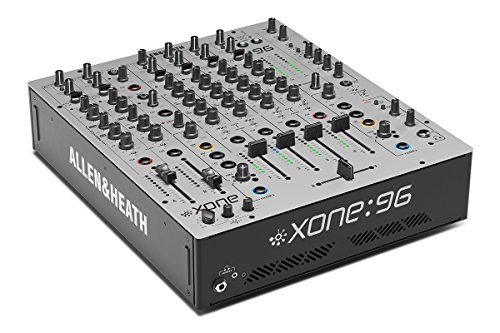
Allen & Heath Xone:96 — Best for Audiophile Rigs
The Xone:96 is included in a four-channel guide with its counting explained up front: four main channels for decks, plus additional return and microphone channels that bring the maker total to six. For DJs whose rig includes external effects sends, drum machines or elaborate hybrid setups, those extra paths are not padding — they are the reason this mixer exists.
It suits audiophile home rigs, hybrid live-DJ setups and DJs who use external effects as core parts of their sound. Buyers who simply need four deck channels will find the 92 Mk2 or the A9 simpler and cheaper to live with.
Strengths
- Four main channels plus returns suit effects-heavy and hybrid rigs better than any rival here
- Dual interface design supports recording and computer-based sources simultaneously
- Analogue flagship sound and build, with the headroom dense hybrid setups demand
Trade-offs
- The most complex mixer in this guide, with routing that takes time to master
- Its extra channels are wasted on a simple two or four deck setup
- Flagship tier pricing puts it beyond casual upgrades
| Main channels | 4 deck channels, plus return and microphone channels |
| Signal path | Analog (per Amazon listing title) |
| Listing note | Amazon title lists the model as 6-Channel, counting all input paths |
Think of the 96 as the mixer for DJs whose sets involve more than records: a delay pedal woven into transitions, a drum machine playing along, a second computer feeding stems. The return channels and routing depth turn those tricks from cable hacks into a proper workflow, and the analogue summing keeps the result cohesive.
That depth is also the warning label. A 96 bought for a plain four-deck rig is money spent on capacity that never gets used, and its next owner will thank you while you wonder why you paid for it. Buy it for the rig you actually perform with, and it has no real rival in this list.
Best for: Hybrid performers and audiophile rigs using external effects, returns and multiple sources / Not suited for: Straightforward four-deck DJs, who are better served by the 92 Mk2 or the DJM-A9
Check on Amazon to see the current listing for the Allen & Heath Xone:96.

Numark M6 USB — Best Budget
The M6 USB is how many DJs first afford four channels, and it earns that role honestly. Instead of stripping the format to a toy, Numark kept the essentials: four real channels, USB audio for a computer source or recording, per-channel three-band EQ, a mic input for hosting, and a crossfader you can replace when it wears — the single most important longevity feature on any DJ mixer.
It suits beginners stepping up, home DJs, mobile DJs who need a dependable backup, and anyone building a first four-channel rig on a budget tier. DJs playing out weekly will eventually want the build and sound of the models above it.
Strengths
- Built-in USB interface at a budget tier covers laptop sources and basic recording
- Replaceable, slope-adjustable crossfader extends working life and suits different styles
- Four full channels with mic input cover most real-world small-rig needs
Trade-offs
- Sound quality and component feel are a clear step below the premium picks
- No built-in effects section for creative transitions
- Heavy long-term gigging will outgrow its durability faster than a flagship
| Channels | 4 |
| Verified features | Built-in USB audio interface, 3-band EQ, mic input, replaceable slope-adjustable crossfader (per Amazon listing title) |
The M6 USB understands its job: be the mixer that gets a new four-channel DJ through their first years without embarrassing them. The layout teaches proper habits — gain staging per channel, EQ blending, cue discipline — and the USB connection means a laptop can be a source, a recorder or both while the rig grows around it.
Its limits appear exactly where you would expect: refinement. The EQ is effective rather than musical, the faders are serviceable rather than silky, and there are no effects to hide behind. For learning and for backup duty those are the right compromises, and the replaceable crossfader shows a respect for the buyer that many budget mixers skip.
Best for: Beginners, home DJs and mobile DJs who need four channels and USB on a budget tier / Not suited for: Professional booth use and DJs who prioritize sound refinement
Check on Amazon to see the current listing for the Numark M6 USB.
Pioneer DJ DJM-750MK2 — Best Mid-Range Pioneer
The DJM-750MK2 has long been the thinking buyer Pioneer: most of the club layout and workflow of the flagship line, four channels, its own effects character, and a tier that leaves budget for players or speakers. For DJs committed to the Pioneer ecosystem who cannot justify the A9, it has historically been the sweet spot.
It appears here in prose for a practical reason. When we verified listings for this guide, the listed a Decksaver cover and other Pioneer models for this search, but no confirmed listing for the mixer itself. Linking you to an accessory would be a worse service than describing the mixer honestly and pointing you to specialist retailers.
Strengths
- Club-style Pioneer layout at a mid-range tier below the flagship
- Four channels with effects cover the full working DJ workflow
- Strong ecosystem fit with Pioneer players and rekordbox-based rigs
Trade-offs
- Current Amazon availability could not be verified for this guide
- An older generation, so interface and effects refinements trail the A9
- Specialist-retailer pricing varies, so comparison shopping matters
If you find the 750MK2 through a DJ retailer at a sensible tier, the buying logic remains sound: it is the mixer for Pioneer-loyal DJs who play real sets and want the booth workflow at home without flagship money. Check whether the unit is new old stock or a current listing, confirm the warranty path in your region, and compare its total cost against a discounted A9 before deciding, because the gap between the two tiers narrows during promotions.
Within this guide it stands as the mid-range Pioneer answer, with the A9 above it for buyers who want the current standard and the M6 USB far below it for buyers whose budget simply will not stretch. That spread is the healthiest way to read the whole four-channel market.
Best for: Pioneer-ecosystem DJs who want club workflow at a mid-range tier and are comfortable buying through specialist retailers / Not suited for: Buyers who want a confirmed Amazon listing and the newest generation
Buying note: Look for the DJM-750MK2 at specialist DJ retailers. Confirm whether the unit is new or new old stock, check the regional warranty, and compare the total against current DJM-A9 offers before buying.
Comparison Table
Side by side, the six picks divide cleanly: one digital flagship, three shades of analogue Xone, one budget USB workhorse and one unlinked mid-range Pioneer. The right choice depends on whether your priority is the universal booth standard, analogue sound, hybrid flexibility or value.
| Pick | Badge | Key spec | Best for |
|---|---|---|---|
| Pioneer DJ DJM-A9 | Best Overall | Professional 4-channel mixer with audio interface for recording and performance | Working DJs, venues and serious home rigs that want the current professional standard |
| Allen & Heath Xone:92 Mk2 | Best Analog Sound | Analog 4-channel DJ mixer, Mk2 generation | House, techno and vinyl DJs who mix long blends and value analogue sound above features |
| Allen & Heath Xone:PX5 | Best Hybrid Performance Mixer | 4+1 channel analog performance mixer | Hybrid DJs who want analogue sound with digital recording and effects |
| Allen & Heath Xone:96 | Best for Audiophile Rigs | Analog flagship with four main channels plus return and mic channels | Hybrid performers and audiophile rigs using external effects, returns and multiple sources |
| Numark M6 USB | Best Budget | 4-channel mixer with built-in USB audio interface and replaceable crossfader | Beginners, home DJs and mobile DJs who need four channels and USB on a budget tier |
| Pioneer DJ DJM-750MK2 | Best Mid-Range Pioneer | Four-channel club-style mixer below the flagship tier | Pioneer-ecosystem DJs who want club workflow at a mid-range tier and are comfortable buying through specialist retailers |
How to Choose Among the Best 4 Channel DJ Mixers
Begin with ecosystem, because four-channel mixers do not live alone. If your players, software and the venues you play all speak Pioneer, the DJM-A9 removes every compatibility question and your skills transfer everywhere. If your rig is built around vinyl, external effects and long blends, the Xone family will feel like home in a way no effects library can imitate. Choosing the family first makes the model choice almost automatic.
Next, decide how your computer participates. A mixer with a strong built-in interface can be your DVS brain, your recorder and your streaming source at once. Analogue models deliberately leave that job to a separate interface, which some DJs prefer because each box does one thing well. There is no wrong answer, but there is a wrong purchase: paying flagship money for an interface you will bypass, or saving money on an analogue mixer and then spending the difference on the interface you actually needed.
Then interrogate the channel count honestly. Four channels earn their keep when a third or fourth source is genuinely wired in: a second pair of players for back-to-back sets, a sampler, a drum machine, a guest laptop. If channels three and four would sit empty for years, a great two-channel mixer plus better speakers is the smarter rig. The M6 USB exists for buyers who want the four-channel layout as insurance at a low tier, and that is a legitimate strategy as long as expectations about refinement match the tier.
Finally, think in terms of total cost of the booth. A four-channel mixer invites four channels of sources, cables, stands and eventually speakers that can do it justice. Budget the mixer as the anchor of that system, prioritize fader quality and outputs over novelty features, and remember that a replaceable crossfader and a supported manufacturer are worth real money over a five-year ownership span.
Do not overlook outputs while comparing channel counts. A dedicated booth output, a record output and balanced master connections decide whether the mixer works in a loud room, captures your sets cleanly and connects to serious speakers without adapters. Budget models trim outputs first, which is invisible in a bedroom and painful in a venue, so buyers who play out should rank outputs alongside EQ and effects when comparing the picks above.
Digital vs Analog 4-Channel Mixers: The Real Differences
The digital flagship approach, represented here by the DJM-A9, treats the mixer as a computer-adjacent hub: pristine conversion, deep effects, per-channel processing and an interface that ties players and software together. Its strengths are consistency and integration. Every night sounds the same, every feature is one button away, and recording is trivial. Its weakness is character: digital EQ and effects are precise tools, and some DJs find precision less inspiring than the imperfections they grew up mixing on.
The analogue approach, represented by the three Xone models, keeps the signal electrical from input to output. The practical consequences are the famous ones: EQ that feels like it is shaping music rather than editing data, filters with resonance you can play, and a tolerance for being driven hard that flatters dense mixes. The costs are equally practical: no recording without extra hardware, no presets, and effects limited to what the filters and your external units provide.
The PX5 and the Xone:96 show the middle path the market has settled into: analogue channels for the sound, digital additions where they remove friction. For most buyers in this decade, the decision is not ideology but inventory — list the external boxes you own or would need under each approach, price the complete rig both ways, and the better value usually reveals itself.
What Four Channels Unlock: Setups That Justify the Upgrade
The classic justification is the back-to-back set. Two DJs, each with their own players on their own channels, mixing off each other without cable swaps, is simply not possible on two channels. If you play with a partner or host guest DJs, four channels stop being a luxury the first time a handover happens mid-track instead of between tracks.
The second justification is the hybrid rig. A pair of decks on channels one and two, a sampler or drum machine on three, and a laptop or effects return on four turns a DJ set into something closer to a live performance. The Xone:96 layout exists for exactly this, and even on simpler mixers the spare channel is where creativity physically plugs in.
The third justification is resilience. A spare channel is a backup path when a player misbehaves, a channel for the ceremony laptop at a wedding, or the input a venue engineer asks for at the worst possible moment. Working DJs do not buy four channels for the nights everything goes right; they buy them for the nights it does not.
Used and Refurbished Flagships: When the Smart Money Buys Second-Hand
Four-channel mixers hold their value and their usefulness unusually well, which makes the used market a real option in this category. Previous-generation flagships and retired venue mixers regularly change hands at tiers far below their original position, and a well-kept analogue model in particular loses almost nothing with age because there is no software inside it to abandon. For a home rig, a serviced used Xone or a previous Pioneer flagship can deliver ninety percent of the experience for a fraction of the commitment.
The risks are specific and checkable. Faders and knobs carry the wear, so test every channel for crackle, check the crossfader for bleed at both extremes, and work every switch and encoder through its full range. Ask whether the unit lived in a venue, where smoke, spills and nightly transport age a mixer quickly, or in a home studio, where a decade can pass gently. Factor a professional service into the price of any venue-worn unit and the bargain often survives the math.
What the used route should never skip is the verification discipline this guide applied to new listings: confirm the exact model and generation, confirm the power supply matches your region, and confirm that replacement faders exist for the model you are buying. A four-channel mixer is a five-to-ten-year purchase in either market, and the buyers who treat it that way are the ones still happy in year six.
How to Set Up a 4-Channel DJ Mixer for Decks, Sampler and Laptop
This setup covers the rig most four-channel buyers are building: two main decks, a third source such as a sampler or drum machine, and a laptop on the fourth channel, with recording where the mixer supports it.
Step 1: Plan the channel map before plugging anything in
Decide which source owns which channel and write it down. A common map is deck one, deck two, sampler or third deck, then laptop. A fixed map builds muscle memory, and muscle memory is what lets you grab the right fader in the dark during a mix. Changing the map every session is how experienced DJs make beginner mistakes.
Step 2: Connect decks and set phono or line correctly
Wire turntables to phono inputs with ground wires attached, and media players to line inputs. The phono/line distinction is the most common cause of a channel that sounds distorted or whisper-quiet, so verify the selector on every channel before concluding anything is broken.
Step 3: Wire the third and fourth sources
Connect the sampler, drum machine or third deck to channel three, and the laptop to channel four, using the interface routing if your mixer provides one. Keep these cables a different color or labeled: auxiliary sources are the ones that get re-plugged most often, and labeled cables turn a five-minute hunt into a five-second fix.
Step 4: Set gains across all four channels
Play the loudest part of a representative track on each channel and trim each gain so all four sources peak at a consistent level below the red. Sources like drum machines and laptop outputs vary wildly in level, and balancing them now prevents the volume lurches that make hybrid sets sound amateur.
Step 5: Configure cueing and the booth output
Confirm every channel can be cued in headphones independently and in combination, then set the booth monitor level so you can hear your mix clearly without relying on the main room sound. In home rigs, the booth output feeding a nearfield speaker is the closest simulation of a real booth you can build.
Step 6: Test recording and a full transition run
If the mixer has an interface, record a practice run that uses all four channels: a deck blend, a sampler drop, a laptop source. Listen back for level jumps, noise on the auxiliary channels and any hum. Ten minutes of testing at home is cheaper than one flawed recording of a real set.
Once the map works, label the channel strips with the source names. It looks unglamorous and it is the single most professional habit in booth craft, because every guest DJ and every tired late-night version of yourself will navigate by those labels.
Revisit the channel map after your first month. Most DJs discover that one auxiliary source gets used weekly and another almost never, and reassigning channels to match reality — most-used sources on the most comfortable strips — is a small optimization that pays off every single session.
Store the channel map with the mixer, not in your memory. A photo of the rear panel and a one-line note per channel will save you, a bandmate or a guest DJ a full troubleshooting session the first time anything gets unplugged for transport.
Common Buying Mistakes
Buying four channels for a two-source life
If two decks are genuinely all you will ever connect, the extra channels buy you nothing but size and cost. The honest version of this mistake is buying for an imagined future rig; the fix is to price the rig you will build this year and let a future upgrade be a future decision.
Ignoring the interface question until after purchase
DVS players, streamers and recording DJs all depend on how the mixer talks to a computer. Choosing an analogue mixer and then discovering your workflow needs an interface is an expensive sequence. Decide the computer role first, then choose the mixer family that serves it.
Treating all four-band and three-band EQs as the same skill
Four-band EQ, as on the Xone:92, splits the midrange and changes how blends are built. DJs moving from three-band mixers need practice time to stop over-cutting. Budget that learning curve instead of concluding the mixer sounds wrong during your first weekend with it.
Running a flagship mixer into budget speakers
A top-tier mixer reveals everything downstream, including the limits of cheap speakers and tired cables. If the budget is fixed, a mid-tier mixer plus better monitoring usually produces better-sounding nights than a flagship feeding the weakest link in the chain.
Neglecting crossfader replacement and servicing
Four-channel mixers are long-term purchases, and their highest-wear part is the crossfader. Confirm the fader is replaceable and that spares exist for your model before buying, especially on budget models where a worn fader can otherwise end the mixer useful life.
Assuming the channel count on the box tells the whole story
As the Xone:96 shows, makers count channels differently: main channels, returns and microphone paths may all be included in the headline number. Read how the count is composed and match it to your sources, rather than comparing headline numbers between brands.
Final Recommendation
If you want one answer, take the Pioneer DJ DJM-A9: it is the current professional standard, and it will never be the reason a gig, a recording or a guest DJ does not work. If your heart is analogue, the Xone:92 Mk2 is the purist choice, the PX5 is the hybrid answer, and the Xone:96 is the deep rig instrument. On a budget tier, the Numark M6 USB delivers the full four-channel layout with USB and a replaceable crossfader, which is everything a first four-channel rig needs.
The DJM-750MK2 remains a sensible mid-range Pioneer through specialist retailers if its tier undercuts the A9 meaningfully when you shop. Whichever model you choose, choose the family first — Pioneer integration or Xone analogue character — because that decision shapes every session you will ever play on the mixer.
One closing consideration for buyers torn between the A9 and a Xone: rent or borrow time on both layouts if you possibly can. Thirty minutes of real mixing reveals more about your hands than thirty reviews, because EQ philosophy and fader feel are personal in a way specifications never capture. The mixer you stop noticing is the mixer you should buy.
Keep exploring the cluster: Best 3 Channel Dj Mixers Best 4 Channel Mixers For Djing Best 4 Channel Mixers Best 5 Channel Mixers Best 40 Channel Digital Mixers For Live Outdoor Sound
Frequently Asked Questions
Why do clubs standardize on four-channel mixers?
Four channels let a booth handle two playing decks, a third source ready to go, and a fourth for guests, samplers or backup, without re-plugging during a night. That flexibility, plus standardized layouts that any visiting DJ can play, is why venues converged on the format.
Is the DJM-A9 worth it for a home setup?
It is worth it if you play seriously, record or stream, or want your home rig to mirror professional booths exactly. If you mix casually on two decks, the same money spread across a mid-tier mixer and better speakers will usually produce more enjoyment.
What does 4+1 channel mean on the Xone:PX5?
It means four full main channels plus one additional channel, typically used for a microphone, a sampler or an effects return. The extra channel is simpler than the main four, which is why it is written as +1 rather than counted as a fifth full channel.
Can I use a 4-channel mixer with just two decks?
Yes. Many DJs run two decks on a four-channel mixer and keep the other channels for a microphone, a laptop or future expansion. The mixer works perfectly with channels unused; you are simply carrying capacity you may grow into.
Do analogue mixers like the Xone:92 work with DJ software?
They work as mixers for any audio source, including a laptop output, but they do not provide the USB interface that DVS timecode workflows require. For DVS on an analogue mixer, add a separate audio interface designed for that purpose.
How long should a 4-channel mixer last?
A well-kept four-channel mixer should serve for many years. The parts that wear are faders and knobs, which is why replaceable crossfaders and manufacturer support matter. Budget models wear faster under heavy gigging; flagship and analogue models are built and priced for long service.


