Disclosure: airfryerkitchensupply.com is reader-supported. When you buy through links on our site, we may earn an affiliate commission at no extra cost to you.
Where to buy
The best 20qt dough mixers are commercial machines, and they should be bought like commercial machines: from a listing you can verify, with the model number exact, the voltage confirmed and the warranty terms read before checkout. Every pick in this guide was verified against its manufacturer’s Amazon listing through current catalogue data. Start with the Hobart HL200 Legacy if budget allows and uptime is money, or the Globe SP20 if you want the bakery-standard planetary at a working bakery’s tier. We print no fixed prices — commercial equipment pricing shifts with configuration and freight — so each pick links to Amazon for you to check the current price on Amazon. Two honest notes before the list. First, “20 quart” describes the bowl, not the dough: the safe flour load is always smaller than the bowl suggests, and stiff doughs shrink it further; every review below treats capacity honestly. Second, two famous names could not be linked: the classic Hobart A200 returned only attachments and parts in Amazon’s catalogue (no verifiable standalone listing), and the Avantco MX20 returned no listing at all — both are discussed in prose where relevant rather than linked on a guess.
Introduction: planetary vs spiral, and why 20 quarts is the professional threshold
Twenty quarts is where dough mixing becomes a business decision. Below this size, bakeries and pizzerias batch small and often, burning labour on repetition; at 20 quarts, one mix covers a service’s bread, a morning’s pastry or a pizzeria’s dinner rush, and the machine’s reliability starts appearing directly in the accounts. The best 20qt dough mixers divide into two mechanical philosophies, and choosing between them matters more than choosing between brands. Planetary mixers — the Hobart, Globe, Centerline and Omcan here — spin a beater, whip or dough hook around a stationary bowl, exactly like a giant stand mixer. They do everything: dough, batter, whipped cream, mashed potatoes. Spiral mixers — the Eurodib LM20T — rotate the bowl itself while a fixed spiral hook kneads, a design built for one job: dough, developed gently and efficiently, with less friction heat and better gluten development for bread and pizza.
The six picks below therefore split by workload, not by rank. A bakery-café that mixes croissant dough at dawn, cake batter at ten and brioche at noon needs a planetary. A pizzeria or artisan bread operation whose day is dough, dough and dough should look hard at the spiral. Around those poles sit the value questions: Hobart’s two lines (the flagship Legacy and the Centerline value brand) against Globe’s bakery standard, Omcan’s timer-equipped workhorse, and VEVOR’s budget disruption. Every pick is a real, current, verifiable product; where the market’s most famous name (the A200) could not be verified as a purchasable listing, we say so rather than sending you to a parts page dressed as a mixer.
A final framing before the picks: at this size, the mixer is rarely the bakery’s bottleneck for long — the oven, the proofer and the team’s hands all take their turns — but it is the bottleneck whose failure stops everything upstream of it. Flour cannot become product without the mix, and no other station can improvise the mix at production scale. That is why experienced operators buy this category with a seriousness they do not bring to any other single appliance, why they keep the service number on the wall, and why the cheapest correct machine beats the cheapest machine every time. The six below are the correct machines at their respective tiers; the rest of this guide exists to help you find which tier is yours.
In this guide
Quick Picks
- Best Overall — Hobart HL200 Legacy: The 20-quart benchmark: Hobart build, three fixed speeds plus stir, and a service network that treats downtime as an emergency.
- Best for Bakeries — Globe SP20: The countertop planetary bakeries actually run: gear-driven, NSF-listed, with the attachments and support a pastry programme needs.
- Best for Bread and Pizza Dough — Eurodib LM20T Spiral Mixer: A true spiral design at 20 quarts: rotating bowl, gentle kneading, better dough development for bread-focused operations.
- Best Budget — VEVOR 20Qt Commercial Food Mixer (1100W): A full-size 20-quart planetary with a lever-operated lift at a fraction of the legacy brands’ tier.
- Best Value Hobart — Centerline by Hobart HMM20: Hobart’s value line: a 20-quart bench planetary with three fixed speeds and a 1/2 HP motor, backed by the Hobart name.
- Best with Timer — Omcan SP200AT: A 20-quart planetary with a built-in timer, safety guard and three attachments included — built for consistent, repeatable batches.
How These Picks Were Chosen
We filtered the 20-quart commercial mixer market on Amazon with five tests. First, verifiability: the machine had to be a current model with a confirmable listing from the brand or an authorised seller — which is why the legendary Hobart A200, represented in the catalogue only by bowls, hooks and whips, is a prose discussion rather than a pick. Second, duty honesty: we favoured gear-driven or proven commercial transmissions over belt-driven light-duty designs, because dough is the heaviest load a mixer ever sees. Third, capacity realism: manufacturers publish flour-capacity guidance for a reason, and we weighted machines whose ratings suit genuine dough work, not just batter. Fourth, safety and compliance: bowl guards, safety interlocks and NSF/ETL listings matter in inspected kitchens, and the picks reflect that. Fifth, service reality: a commercial mixer is a ten-year asset, so parts availability and brand support networks counted heavily — the one dimension where the budget pick knowingly trades depth for price, flagged in its review.
Spec boxes contain only facts confirmed from each manufacturer’s listing for the exact model — bowl size, speeds, motor and included attachments as listed. Where a number could not be verified, it was left out and the discussion kept qualitative. No prices, no review counts, no invented capacities.
The exclusions are as instructive as the picks. Alongside the A200’s parts-only presence, the catalogue is full of domestic stand mixers whose capacities are described in quarts of bowl but whose motors and transmissions are kitchen-grade; a home machine wearing a commercial number is the category’s most expensive illusion, and none appears here. Several no-name 20-quart listings also failed the verification standard — specifications that contradicted themselves between title and description, or brands with no traceable support presence at all. In a category where the product is a decade of production, a listing that cannot keep its own story straight is data, and we treated it that way. What survived is six machines whose claims check out and whose makers can be found again after the sale — the minimum definition of commercial equipment.
The 6 Best 20Qt Dough Mixers
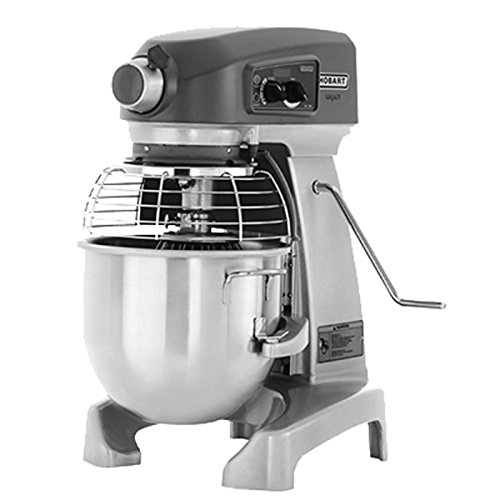
Hobart HL200 Legacy — Best Overall
The HL200 is what the phrase “commercial mixer” means when a health inspector, a bakery owner and a repair technician say it. Hobart’s Legacy series is the modern descendant of the A200 lineage that defined the category: a 20-quart bench planetary with three fixed speeds plus a stir setting, a gear-driven transmission, a stainless bowl and the standard Hobart attachment set, wrapped in the build quality that keeps these machines running for decades. The standard accessory kit in this listing means the machine arrives ready to work — bowl, beater, whip and hook — rather than ready to order accessories.
Strengths
- The benchmark build: gear-driven, serviceable, and designed for daily commercial duty.
- Hobart’s service and parts network — the strongest in this guide by a wide margin.
- Three speeds plus stir cover dough, batter and delicate work in one machine.
Trade-offs
- The premium tier of this class by a distance — the badge is a real cost line.
- Planetary action works dough harder than a spiral; bread purists should compare the Eurodib.
- Bench footprint and weight demand a serious, permanent station.
| Spec | Detail |
|---|---|
| Bowl | 20 qt, tabletop/bench |
| Type | Planetary, Legacy series |
| Kit | Standard accessory kit included |
| Brand | Hobart |
The HL200’s case is economic, not sentimental: downtime on a mixer stops production, and Hobart’s combination of durability and service coverage minimises both the frequency and the duration of stops. High-volume bakeries, institutions and any operation where the mixer runs all day will recover the premium in avoided disruption. Smaller operations should run the same arithmetic honestly — if the mixer works two hours a day, the Globe or Centerline may carry the smarter money — but nobody who buys the HL200 has ever bought the wrong machine, only occasionally a more expensive one than they needed.
Best for: high-volume bakeries, institutions, uptime-critical operations. / Not suited for: tight capital budgets or bread-only specialists (see the spiral).
Check the current price on Amazon
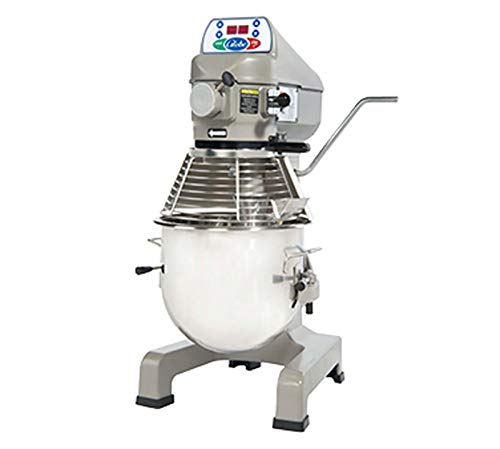
Globe SP20 — Best for Bakeries
Globe’s SP20 is the planetary the working bakery world settled on: a 20-quart countertop mixer, gear-driven, NSF-listed, with a #12 attachment hub that opens the door to Globe’s ecosystem of slicers, grinders and graters. Its three speeds and rigid cast construction suit the bakery day precisely — stiff doughs in the morning, batters and fillings after — and its controls are the simple, gloved-hand-friendly kind a production kitchen actually wants.
Strengths
- Gear-driven transmission built for dough loads, not just mixing.
- NSF listing and commercial safety features suit inspected kitchens.
- #12 hub expands the machine into a prep station with Globe attachments.
Trade-offs
- Still a planetary for dough — spiral converts will find dough development slower.
- Attachments beyond the standard set are separate purchases.
- Sits in the professional tier; casual or home users should look at the VEVOR honestly.
| Spec | Detail |
|---|---|
| Bowl | 20 qt, countertop |
| Type | Planetary |
| Certification | NSF |
| Brand | Globe |
The SP20 is the pick for the bakery that does a bit of everything and does it daily: its combination of dough capability, attachment versatility and commercial certification covers more real bakery programmes than any rival here except the Hobart it undercuts. Globe’s dealer and parts network is genuinely national, which matters when a gear or a switch is the difference between a production day and a lost one. If your menu is bread-only, read the Eurodib review twice; if your menu is a bakery, this is your machine.
Best for: bakeries, cafés and pastry programmes with mixed daily production. / Not suited for: dough-only operations or the strictest budgets.
Check the current price on Amazon

Eurodib LM20T Spiral Mixer — Best for Bread and Pizza Dough
The LM20T is the only true spiral mixer in this guide, and for dough-focused operations it is not a niche pick — it is the correct technology. The bowl rotates while a stationary spiral hook and breaker bar work the dough, producing the gentle, efficient kneading that develops gluten without tearing it and without the friction heat a planetary hook generates. Bread bakers taste the difference in the crumb; pizzerias feel it in dough that stretches instead of fighting. The T in the name signals the timer, which makes batch timing repeatable across staff and shifts.
Strengths
- True spiral action: superior dough development with less heat and oxidation.
- Timer-equipped for repeatable batches across different operators.
- ETL-listed commercial build sized for bakeries and pizzerias.
Trade-offs
- Dough only: no whipping cream, no batter, no mashed potatoes — it is a specialist.
- Spiral capacity is rated by dough weight; new users must learn its loading discipline.
- Eurodib’s support network is thinner than Hobart’s or Globe’s in some regions.
| Spec | Detail |
|---|---|
| Bowl | 20 qt |
| Type | Spiral dough mixer |
| Certification | ETL |
| Timer | Yes |
Choose the LM20T when dough is the business: artisan bread, pizza, bagels, laminated dough bases. Its efficiency shows up as shorter mix times, cooler dough and consistency that a planetary cannot match on bread — and consistency is what a dough business sells. The honest limitation is the mirror image: the café that also needs batter and whipped toppings must pair it with a planetary or choose one from the other five. Eurodib also offers the M20 planetary in this size for buyers who want the brand with all-purpose action; the LM20T remains the dough specialist’s pick.
Best for: pizzerias, artisan bread bakeries, dough-first operations. / Not suited for: mixed pastry programmes needing one machine for everything.
Check the current price on Amazon

VEVOR 20Qt Commercial Food Mixer (1100W) — Best Budget
VEVOR’s 20-quart entry is the budget disruption of this class: a full-size commercial-format planetary with a lever-operated bowl lift, a safety-conscious design and an 1100W motor, at a tier the legacy brands do not attempt. For food trucks, startup bakeries, church kitchens, test kitchens and serious home-production setups, it puts genuine 20-quart capacity within reach years earlier than the traditional buying path allows.
Strengths
- Full 20-quart planetary format at the lowest tier in this guide.
- Lever-operated bowl lift — easier handling of heavy dough batches.
- 1100W motor and commercial-style layout for bakery, pizzeria and restaurant use.
Trade-offs
- Long-term parts and service depth cannot match Hobart or Globe — the tier’s real trade.
- Respect the flour limits: budget motors suffer most from chronic overloading.
- Fit, finish and documentation are a step below the professional brands.
| Spec | Detail |
|---|---|
| Bowl | 20 qt |
| Type | Planetary, lever-operated lift |
| Motor | 1100W (as listed) |
| Brand | VEVOR |
The VEVOR’s buyer should be clear-eyed: this is a capacity purchase, not a heritage purchase. Run it within its ratings, keep batches honest, and it will mix a startup’s dough for years; overload it daily like a Hobart and the arithmetic of the tier will collect its debt. For operations whose alternative is hand-kneading or a domestic stand mixer dying in slow motion, the VEVOR is not a compromise — it is the machine that makes the business possible. Test every speed and safety switch during the return window, and register everything.
Best for: startups, food trucks, church and community kitchens, test production. / Not suited for: maximum-duty daily production or buyers needing deep service networks.
Check the current price on Amazon
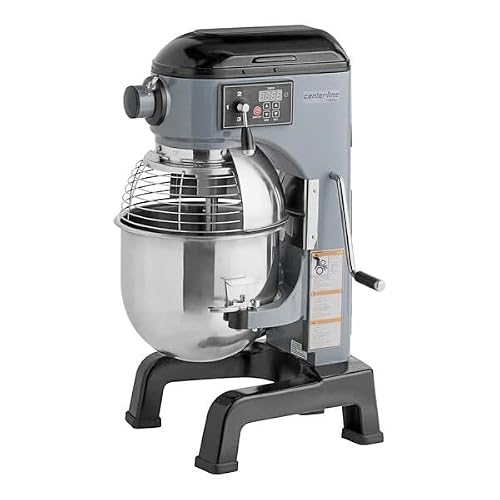
Centerline by Hobart HMM20 — Best Value Hobart
Centerline is Hobart’s value brand, and the HMM20 is its 20-quart statement: a bench-type planetary with three fixed speeds, a 1/2 HP motor and a 120V supply that fits ordinary commercial circuits. It exists for the buyer who wants Hobart’s engineering culture and dealer network without the Legacy series’ full premium — schools, cafés, delis and mid-volume bakeries are its natural home.
Strengths
- Hobart lineage and support at a materially lower tier than the HL200.
- Three fixed speeds and a straightforward control scheme suit multi-operator kitchens.
- 120V operation simplifies installation in existing spaces.
Trade-offs
- Value-line specification: fewer refinements than the Legacy series it echoes.
- 1/2 HP class output means batch discipline matters with stiff doughs.
- Still a planetary — bread specialists should weigh the Eurodib spiral.
| Spec | Detail |
|---|---|
| Bowl | 20 qt, bench type |
| Speeds | 3 fixed speeds |
| Motor | 1/2 HP, 120V |
| Brand | Centerline by Hobart |
The HMM20 is the rational middle of this guide: most of Hobart’s ownership experience — the dealer who answers, the parts that exist, the resale that holds — at a tier a school or café can approve without a capital campaign. Pair it with honest batch sizes and it covers the same menu breadth as any planetary here. Buyers choosing between it and the Globe SP20 are choosing between two good networks and two good machines; let local service coverage cast the deciding vote.
Best for: schools, cafés, delis and mid-volume bakeries wanting Hobart support. / Not suited for: heaviest daily dough production or spiral-dough specialists.
Check the current price on Amazon
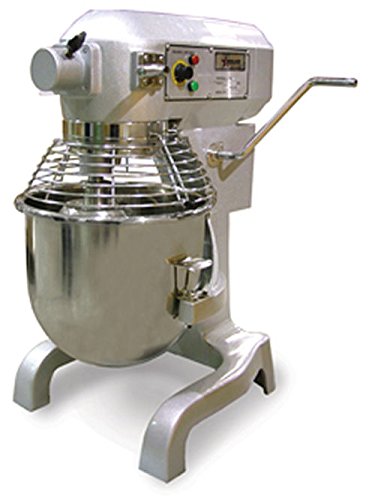
Omcan SP200AT — Best with Timer
Omcan’s SP200AT builds its case on repeatability: a 20-quart planetary with a built-in timer, a safety guard and all three working attachments (hook, beater, whip) in the box. In production kitchens, the timer is not a convenience — it is how the morning baker and the evening baker produce the same dough, and how a recipe survives staff turnover. Omcan, a long-standing food-equipment supplier to the restaurant trade, rounds out the package with the guard-and-interlock safety set inspected kitchens expect.
Strengths
- Built-in timer standardises batches across operators and shifts.
- Safety guard and three attachments included from the start.
- Restaurant-trade brand with an equipment catalogue behind the mixer.
Trade-offs
- Less prestigious badge than Hobart or Globe — resale and network depth follow.
- Planetary dough action, with the usual spiral comparison applying.
- Buyers should confirm local service arrangements before committing.
| Spec | Detail |
|---|---|
| Bowl | 20 qt |
| Type | Planetary with timer and guard |
| Attachments | 3 included (as listed) |
| Brand | Omcan |
The SP200AT suits the operation whose problem is consistency rather than capacity: commissaries, multi-staff bakeries, training kitchens and franchises where the recipe must survive the roster. Its timer disciplines the mix, its guard disciplines the safety audit, and its price tier disciplines the budget. It will not out-prestige the Hobart and it will not out-knead the Eurodib, but as a production tool judged on repeatability per dollar, it earns its badge outright.
Best for: commissaries, multi-staff kitchens, consistency-driven production. / Not suited for: badge-driven buyers or bread-only spiral converts.
Check the current price on Amazon
A note on the two unlinked names, since informed buyers will ask. The Hobart A200 remains, in the used and dealer market, a perfectly rational purchase — its absence here is a verification fact (Amazon’s catalogue offered us its bowls and hooks, not a machine we could responsibly link), not a judgement on the mixer. The Avantco MX20 is a popular value planetary in the restaurant-supply channel; it simply did not appear in the catalogue data available to this guide, so it earns this sentence instead of a badge. If you buy either through a dealer, apply this guide’s tests — capacity chart, guard, service — exactly as written; they were designed for machines we could not link as much as for machines we could.
Comparison Table
| Pick | Badge | Key spec | Best for |
|---|---|---|---|
| Hobart HL200 Legacy | Best Overall | 20 qt planetary, accessory kit | Uptime-critical bakeries |
| Globe SP20 | Best for Bakeries | 20 qt planetary, NSF, #12 hub | Mixed bakery production |
| Eurodib LM20T | Best for Bread and Pizza Dough | 20 qt spiral, timer, ETL | Dough-first operations |
| VEVOR 20Qt 1100W | Best Budget | 20 qt planetary, lever lift | Startups, food trucks |
| Centerline by Hobart HMM20 | Best Value Hobart | 20 qt bench, 3 speeds, 1/2 HP | Schools, cafés, delis |
| Omcan SP200AT | Best with Timer | 20 qt planetary, timer, guard | Consistency-driven kitchens |
How to Choose a 20Qt Dough Mixer
Choose the mechanism before the brand. Dough-only production (bread, pizza, bagels) points to the spiral LM20T. Everything-else production points to a planetary. This decision shapes dough quality more than any badge on the machine, and it cannot be changed later with an attachment.
Respect flour capacity, not bowl volume. A 20-quart bowl does not hold 20 quarts of dough. Manufacturers publish flour-capacity guidance per model and dough type; stiff, low-hydration doughs sit at the bottom of every range. Chronic overloading is the number-one killer of commercial mixers at every tier — size your batches to the chart, not to optimism.
Match the electrical reality. Check the voltage and circuit your space actually offers before ordering; most picks here run on standard commercial 120V service, but confirming beats rewiring. Leave the machine a dedicated, reachable station with room to lift a full bowl safely.
Budget in tiers, including service. The VEVOR tier buys capacity now. The Centerline and Omcan tier buys balanced capability. The Globe tier buys bakery-standard versatility. The Hobart tier buys the strongest service network in the industry. All four are rational — for four different operations. Add freight, a spare bowl and a second hook to any tier’s real total.
Dough Science in a 20-Quart Bowl: Hydration, Heat and Batch Discipline
Three variables decide whether a 20-quart mixer produces great dough or expensive regret. Hydration — the water-to-flour ratio — sets the load: a wet ciabatta dough is gentle work, while a stiff bagel dough at low hydration is the heaviest load the transmission will ever see, which is why the same machine can be rated generously for bread and conservatively for bagels. Friction heat is the silent variable: mixing warms dough, planetary hooks warm it faster, and warm dough ferments faster and behaves differently — production bakers calculate the water temperature backwards from a target dough temperature, and the spiral’s cooler action is a genuine quality advantage, not a marketing line. Batch discipline ties them together: consistent batch sizes, mixed to time or temperature rather than to mood, are what separate a bakery whose bread is the same on Friday as on Monday. The timer on the LM20T and SP200AT, and the fixed speeds on the Hobarts, exist to serve exactly this discipline. Buy the machine whose controls help your team repeat a great batch, not just achieve one.
Scaling is the companion discipline. A recipe proven in a home mixer does not simply multiply by ten into a 20-quart bowl: mixing efficiency changes with batch size, a fuller bowl develops dough faster, and a small test batch in a big bowl may under-mix because the hook cannot engage it properly — every machine here has a practical minimum as well as a maximum. Production bakers therefore scale in steps, note the mix times and dough temperatures at each proven size, and treat the recipe card as a per-batch-size document. Preferments complicate the arithmetic pleasantly: a poolish or biga made the night before occupies bowl capacity and changes the main mix’s timing, which is another argument for the second bowl recommended elsewhere in this guide. None of this requires genius; it requires the notebook habit, and it is the difference between a 20-quart mixer that merely replaces hand-kneading and one that becomes the bakery’s quality system.
How to Set Up and Run a 20Qt Mixer Station
1. Place it like infrastructure. A level, load-rated bench or floor position with clearance to raise, lower and remove a full 20-quart bowl without twisting. Full bowls are heavy and awkward; the station’s ergonomics are a safety feature.
2. Confirm power and guard function before the first batch. Run the machine empty through every speed, test the bowl guard and lift interlocks, and verify the emergency stop. A mixer that runs with the guard open is a mixer that gets unplugged until serviced.
3. Load in the right order. Water and liquid first, flour on top, yeast kept from direct contact with salt and sugar at loading. Add flour gradually for stiff doughs rather than dumping the full charge into a dry bowl.
4. Mix in stages. Start on the lowest speed until the dough comes together — flour clouds and splashing are a loading error, not a personality trait — then shift to the working speed for development. Use the timer once your recipe is proven, and record the times on the recipe itself.
5. Watch temperature, not just the clock. Check finished dough temperature until your team’s instincts calibrate. Adjust the next batch’s water temperature, not just its mix time.
6. Clean like a food plant. Bowl, hook and guard washed and sanitised after service; flour dust kept out of vents and switches; the area under the machine on the cleaning schedule. Dough residue is both a sanitation finding and a mechanical abrasive.
Common Buying Mistakes
Reading “20 quart” as dough capacity. Bowl volume is the container, not the workload. Flour capacity per the maker’s chart — adjusted down for stiff doughs — is the number that decides whether the machine lives or dies.
Buying a planetary for a bread-only business. It will work, and it will work harder, hotter and slower than the spiral built for the job. Mechanism first, brand second.
Ignoring the service network. A mixer down in December costs more than the price difference between tiers. Know who services your machine locally before you need them.
Forgetting installation. Doorway widths, bench ratings, circuit capacity and bowl-lift clearance have all ambushed real purchases. Measure the machine’s whole journey from truck to station.
Skipping the spare bowl. Production stops while the only bowl is in the wash. A second bowl (and a second hook) is the cheapest uptime in this entire guide.
Attachments, Bowls and the Ecosystem Around the Machine
A 20-quart planetary is not one tool but a platform, and the platform’s value compounds over years. The working set — dough hook, flat beater, wire whip — covers dough, batter and aeration, and every planetary pick here includes or supports it. Beyond the bowl, the #12 attachment hub (a Globe strength, present across much of this class) accepts meat grinders, vegetable slicers, graters and pasta equipment, turning the mixer’s motor into the kitchen’s shared power unit. For a small restaurant, that hub can retire two countertop appliances; for a bakery, it is how one machine grates the cheese, grinds the filling and mixes the dough in a single morning. When comparing purchases, price the ecosystem, not just the machine: the cost of a second bowl, a spare hook, a bowl dolly for moving full bowls safely and any hub attachments your menu will actually use.
Bowls deserve their own sentence, because production lives and dies on them. A second 20-quart bowl converts the mixer from a batch machine into a flow machine — one bowl mixing, one bowl resting or being filled, none waiting on the dish pit. Bowl material matters too: stainless is the sanitary and durability standard in this class, and any listing substituting lighter materials is telling you its tier. Finally, the humble accessories — a bowl scraper that fits the profile, an ingredient chute for adding flour without the cloud, a splash cover for thin batters — are the difference between a machine the team loves and a machine the team works around. None appears in a headline specification, and all of them appear in a well-run bakery’s daily reality.
Maintenance, Sanitation and the Long Life of a Commercial Mixer
Commercial mixers fail in predictable ways, and nearly all of them are postponed by habits rather than money. The daily habit is cleaning as sanitation and as inspection at once: bowl, attachments and guard washed and sanitised; the bowl seat and hub wiped; flour dust vacuumed — never blown — out of vents and switchgear, because flour dust is abrasive, hygroscopic and, in quantity, a genuine hazard. The weekly habit is mechanical sympathy: listen to the machine. A gear-driven mixer has a voice, and a change in that voice — a new whine at working speed, a knock at startup — is the earliest service warning you will ever get, weeks before the failure it predicts. Log it, report it, and schedule the visit while the machine still runs on your terms.
The monthly habit is fastener and guard discipline: check the bowl lift’s smoothness, the guard’s interlock, the attachment hub’s cap and every visible bolt for the loosening that vibration guarantees. The annual habit is professional: a service visit that inspects the transmission, replaces wear items on schedule rather than on failure, and keeps the machine’s documentation — model, serial, service history — in the file an inspector or a buyer will someday ask for. Operations that keep these habits get the decades the brochures promise; operations that treat a commercial mixer like a big home appliance get the repair bills that fund the service industry. At the budget tier, the same habits matter more, not less: the VEVOR’s value case assumes an owner who maintains, because there is less margin engineered in to forgive the one who does not.
Four Operations, Four Right Answers
Abstract advice sharpens when it meets real kitchens. The neighbourhood bakery-café — croissants and cakes, sandwich loaves and seasonal specials, one machine doing everything from 5 a.m. — is the Globe SP20’s portrait, with the Centerline HMM20 as the same answer where Hobart service is stronger locally. The artisan bread studio selling at markets and by subscription lives and dies on dough quality and batch rhythm; the Eurodib LM20T is its machine, and its owners will forgive the spiral’s single-purpose nature every time a loaf’s crumb photographs well. The pizzeria scaling from one shop to two needs dough consistency across sites and staff more than it needs versatility: the LM20T again for dough purity, or the Omcan SP200AT where a planetary must also cover prep, with the timer enforcing the recipe at both addresses. The startup and the institution split the last pair: the food truck, the church kitchen and the test bakery take the VEVOR and its capacity-per-dollar, while the school district and the hospital take the HL200, because their purchasing departments are really buying the service contract’s peace of mind and pricing downtime in risk, not dollars.
Notice what none of these profiles did: none chose by bowl size, headline wattage or the colour of the machine. They chose by mechanism, by menu, by who services the machine within driving distance and by what a stopped mixer costs them per day. That is the correct order of operations for this entire category, and it is why this guide spends more words on operations than on specifications. A 20-quart mixer is a decade of mornings. Buy the morning you actually live.
Safety in the Commercial Mixing Station
A 20-quart mixer concentrates real hazards in a friendly shape, and commercial kitchens are audited on how they manage them. The bowl guard and its interlock exist because a planetary hook can injure a hand faster than a shout can stop it: never defeat an interlock, never reach into a moving bowl, and treat any guard fault as a stop-work fault. Jewellery, loose sleeves and untied hair are mixing-station prohibitions, not suggestions. The full bowl is the second hazard — twenty quarts of dough is a serious lift with an awkward centre of gravity — which is why bowl dollies and two-person lifts for full bowls belong in the station’s design, and why the lever-lift on the VEVOR and the lift ergonomics of every pick deserve a test with water before the first dough. The third hazard is electrical and environmental: mixers live near water and flour, so circuits, cords and cleaning methods (never hose a mixer) are part of the safety case. None of this is exotic; all of it is the difference between a machine that anchors a business and an incident that defines one. Train every operator, post the rules at the station, and let the timer — not a reaching hand — be how batches end.
Total Cost of Ownership: The Price Is the First Line, Not the Total
Commercial mixers punish sticker-price thinking, because the purchase is the smallest cheque the machine will ever inspire. Freight for a crated commercial unit, installation and electrical confirmation, the second bowl and spare hook, the first year’s wear items, and the service relationship all belong in the real budget — and on the professional tiers they routinely add a meaningful fraction to the headline. Against those costs, weigh the machine’s earning pattern: a mixer that runs six days a week for ten years amortises even a Hobart premium into a trivial daily figure, while the same premium on a machine used twice a week never earns its keep. This is why this guide refuses to declare the VEVOR “cheap” or the Hobart “expensive” in the abstract: each is correctly priced for a different duty cycle, and incorrectly priced for the other’s.
Resale tells the same story from the other end. Professional-brand 20-quart mixers hold value stubbornly in the used market — a clean, documented HL200 or SP20 is a liquid asset a growing business can sell when it steps up to 30 or 40 quarts — while budget-tier machines are worth roughly their remaining usefulness to their current owner. Leasing and financing, common in this category, change the cash-flow shape but not the logic: match the machine’s tier to the duty it will actually perform, document its maintenance, and the mixer will be what it should be — the least dramatic line in the business’s accounts, producing the most dramatic line in its kitchen.
Final Recommendation
Buy the Hobart HL200 Legacy if uptime is revenue and the budget can carry the benchmark. Buy the Globe SP20 for a mixed bakery programme, the Eurodib LM20T if dough is the whole business, the Centerline HMM20 for Hobart support at a school-and-café tier, the Omcan SP200AT when batch consistency across staff is the problem, and the VEVOR 20Qt when the alternative is not having a 20-quart machine at all. Also verified and worth a look for planetary buyers: Eurodib’s M20 ETL bench planetary, which shares the LM20T’s commercial listing pedigree with all-purpose planetary action for cafés that knead, whip and beat in equal measure across a long and varied production day. Sizing neighbours live in Best 10 Quart Mixers and Best 6 Qt Standing Mixers, with the wider commercial field in Best Affordable Commercial Drink Mixers for beverage-side equipment.
Frequently Asked Questions
How much dough can a 20 quart mixer actually make?
Less than the bowl suggests, and it depends on the dough. Manufacturers publish flour-capacity charts per model: soft, hydrated doughs allow the largest batches; stiff bagel or pasta doughs the smallest. As a discipline, plan batches from the maker’s chart for your dough type, start conservatively, and never judge by whether the bowl physically closes — the transmission’s opinion is the one that counts.
Is a spiral mixer better than a planetary for bread?
For bread and pizza dough specifically, yes: the spiral’s rotating bowl and fixed hook develop gluten efficiently with less friction heat and less oxidation, producing dough that handles and tastes better. The planetary’s counter-argument is versatility — it also whips, beats and creams. Dough-only businesses should buy the spiral; mixed businesses should buy the planetary and accept very good, not ultimate, dough.
Can a 20qt mixer replace a stand mixer for a home baker?
It is the wrong tool for home use: these are heavy, bench-or-floor commercial machines sized for production batches, with minimum loads that dwarf a home loaf. Serious home-production sellers (farmers’ market and cottage businesses) are the exception — for them, a 20-quart machine like the VEVOR can be a business asset. Everyone else should look at the 6-quart class.
What is the difference between the Hobart HL200 and the classic A200?
The HL200 Legacy is Hobart’s modern successor in the 20-quart class, with updated controls and the current accessory standard. The A200 is the beloved classic — still running in countless bakeries — but in Amazon’s current catalogue it appears as attachments and parts rather than a verifiable standalone machine listing, which is why this guide recommends the HL200 for purchase and discusses the A200 with respect in prose.
Do these mixers need special electrical work?
Most 20-quart bench models in this guide run on standard 120V commercial service, but always confirm the exact model’s requirement against your space before ordering, and give the machine a properly rated circuit. Floor models and larger capacities move into higher-voltage territory quickly; the time to discover your panel’s limits is before the freight truck arrives.
How long should a commercial 20qt mixer last?
With rated loads and basic maintenance, the professional brands here are decade-plus machines — Hobarts routinely outlive the businesses’ first leases, their second sets of owners and, not infrequently, the buildings they were first installed in, which is why the used market for them never seems to cool down for long. Budget-tier machines trade some of that horizon for their price. The two habits that decide lifespan more than brand: never chronically overload, and keep flour dust and water out of the mechanical spaces. Both are free, both are teachable in a single short staff meeting, and both will do considerably more for the machine’s second decade than any extended warranty paperwork filed away and forgotten in a drawer somewhere.


