Disclosure: airfryerkitchensupply.com is reader-supported. When you buy through links on our site, we may earn an affiliate commission at no extra cost to you.
Where to buy
Let us save you some time and tell you the truth about the best 20 doller mixers that provide phantom power before you spend anything: at the twenty-dollar tier, a true mixer with real 48V phantom power is one of the rarest objects in audio. Most products at that level are either single-channel phantom power supplies (a box that powers one condenser microphone but mixes nothing) or mini line mixers with no phantom power at all. The six products below are the closest genuine mixers we could verify on Amazon — real multi-channel mixers whose own listings confirm 48V phantom power, sitting in the lowest price tiers this category offers. Start with the Maker hart Just Mic 4 if you want the smallest honest answer, or the BOMGE 4 Channel if you want effects and Bluetooth in the same breath. We do not print fixed prices anywhere in this guide — at this end of the market prices swing constantly — so each pick links to its Amazon listing for you to check the current price on Amazon. Read the intro before buying anything: knowing what twenty dollars can and cannot buy in this category is worth more than any single pick.
Introduction: the honest state of the $20 phantom power market
Here is the reality behind the search for the best 20 doller mixers that provide phantom power. Phantom power — the 48 volts a condenser microphone needs to work — used to be a feature that separated real mixers from toys. Condenser microphones have since become the default choice for podcasting, streaming and home recording, which created enormous demand for the cheapest possible way to power them. The market answered in three ways, and only one of them is a mixer. The first answer is the standalone phantom power supply: a small box with one XLR in and one XLR out that does nothing but deliver 48V. Useful, honest, and absolutely not a mixer — it cannot balance two sources, record anything, or drive speakers by itself. The second answer is the mini line mixer: genuinely a mixer, genuinely cheap, and almost never equipped with phantom power, because its channels expect keyboards and phones, not microphones. The third answer — a small mixer with mic preamps and phantom power at the lowest possible tier — is what this guide hunts down.
What we found, after verifying the field against Amazon’s catalogue, is a short and specific list. A handful of compact mixers from value-focused brands genuinely include 48V phantom power at budget tiers: the Maker hart Just Mic 4, built as a miniature microphone mixer with phantom power as its headline feature; a pair of BOMGE four-channel units and a two-channel BOMGE interface that put 48V on small sound boards with USB recording; two Aveek sound boards whose listings confirm phantom power alongside Bluetooth and DSP effects; and a Pyle eight-channel board that carries phantom power into small-PA territory. None of these is a famous-name mixer, and this guide will not pretend otherwise — at this tier you are trading brand heritage and long-term support for a feature set that would cost far more from the big names. What you are not trading away, if you choose from this list, is the one thing you came for: verified phantom power on a real mixer, at the lowest tiers where that combination exists.
One more piece of framing before the picks: a budget phantom mixer is a starter tool, and it should be bought like one. Its job is to get a condenser microphone working, a small system running and a creator recording — this month, at a tier that leaves money for the microphone, the cables and the headphones that matter just as much. The buyers who regret budget mixers are almost never the ones who outgrew them; outgrowing a tool you used hard is a success story. The regretful ones bought the wrong substitute — the supply that does not mix, the line mixer that does not power — and discovered it on the day of the recording. This guide exists so that your twenty-dollar-tier story is the first kind.
In this guide
Quick Picks
- Best True Phantom Mini Mixer — Maker hart Just Mic 4: A four-channel mini microphone mixer with portable phantom power and an audio interface path — the most literal answer to this search.
- Best Budget All-Rounder — BOMGE 4 Channel Mini Mixer: Four channels, 48V phantom power, USB, Bluetooth and stereo recording in the classic budget sound-board format.
- Best with DSP Effects — Aveek 4 Channel Audio Mixer: 48V phantom power plus a deep bank of DSP effects, Bluetooth and USB PC recording for streamers who want polish built in.
- Best Extra Input — Aveek 5 Channel Audio Mixer: Five channels with 48V phantom power and a PC recording interface — one more source than the four-channel crowd.
- Best 2-Channel Interface — BOMGE M12: A two-channel USB interface mixer with 48V phantom power for a pair of condensers and a computer, nothing more, nothing wasted.
- Best for Small PA — Pyle 8 Channel Bluetooth Studio Mixer: Eight channels, 48V phantom power, Bluetooth and USB recording — the budget door into small live setups.
How These Picks Were Chosen
The method for this guide was stricter than usual, because the category is full of traps. First, the phantom test: a pick only qualified if its own Amazon listing — verified through the manufacturer’s catalogue data — explicitly confirmed 48V phantom power or phantom power as a feature. Products whose titles and listings stayed silent on phantom power were excluded no matter how cheap they were, because a mixer that might power your condenser is a mixer that might not. Second, the mixer test: the product had to actually mix — at least two channels with level control — which removed the many standalone phantom supplies that flood this price tier. Third, the reality test: we excluded no-name listings whose feature claims could not be corroborated at all, and we have flagged the value-brand nature of every pick in its review rather than dressing them up as something they are not.
Fourth, honesty about the tier itself. The search’s twenty-dollar frame is treated in this guide the way it deserves: as the budget boundary shoppers are aiming at, not as a promise we can keep for every pick. Some of these mixers sit at or near that tier when promotions run; others sit in the next budget tier up, and they are included because the alternative — recommending a phantom supply and calling it a mixer — would be a lie. Where a pick costs more than the headline tier, its review says what the extra money buys. Spec boxes contain only facts confirmed from each product’s own listing; if a detail could not be verified, it does not appear in a box.
For the record, the excluded majority deserves a description, because readers will meet them in search results and wonder. The typical near-miss is a handsome mini mixer — four to eight channels, Bluetooth, a colour screen of promises — whose listing never once mentions phantom power or 48V, because it has none: it is a line mixer for music sources wearing a microphone mixer’s clothes. Others claim “phantom power” for a single shared low-voltage rail that browns out under a real condenser. Our rule protected you from both: if the manufacturer’s own catalogue data for the exact model did not confirm phantom power, the product is not in this guide, whatever its price or popularity. That rule shrank the field to six — and a short, verified list is worth more than a long, hopeful one in a category built on almost-true listings.
The 6 Best $20-Tier Mixers That Provide Phantom Power
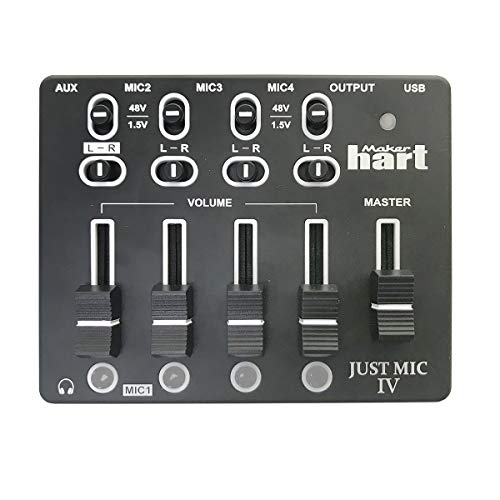
Maker hart Just Mic 4 — Best True Phantom Mini Mixer
The Just Mic 4 is the product this search seems to have been written for: a mini microphone mixer — four channels, designed for microphones first — with portable phantom power and an audio interface function for recording to a computer or phone. Maker hart specialises in exactly these miniature mixers, and the Just Mic 4’s whole reason to exist is giving small condenser and dynamic microphone setups a powered, mixable home without a full-size board. For a podcaster with two to four mics, a small choir or classroom setup, or a streamer whose desk cannot fit a standard mixer, it is the most focused tool in this guide.
Strengths
- Phantom power is the headline feature, not a footnote — built for condenser microphones.
- Four microphone-oriented channels in a genuinely miniature footprint.
- Audio interface function records the mix to a computer without extra hardware.
Trade-offs
- Mini format means mini controls — no channel EQ sculpting of a full board’s depth.
- Maker hart is a niche brand; support runs through the seller rather than a global network.
- Power and headroom are sized for small setups, not for driving a live venue.
| Spec | Detail |
|---|---|
| Channels | 4 (microphone mixer) |
| Phantom power | Yes — portable phantom power |
| USB audio | Audio interface function |
| Format | Mini / portable |
In practice the Just Mic 4 suits the exact situations the big boards handle worst: a podcast recorded at a kitchen table and packed away afterwards, a small worship or classroom setup where the “sound desk” is a shelf, a video creator whose microphones outnumber their desk space. Its phantom power means a pair of affordable condensers — the microphones most beginners actually buy — simply work, and its interface path means the recording is one cable away. It will not grow with a band and it will not impress a studio engineer, but within its brief it is the most honest product in this entire guide.
Best for: small podcast setups, classrooms, compact condenser rigs. / Not suited for: live bands, buyers wanting full-size controls and EQ.
Check the current price on Amazon
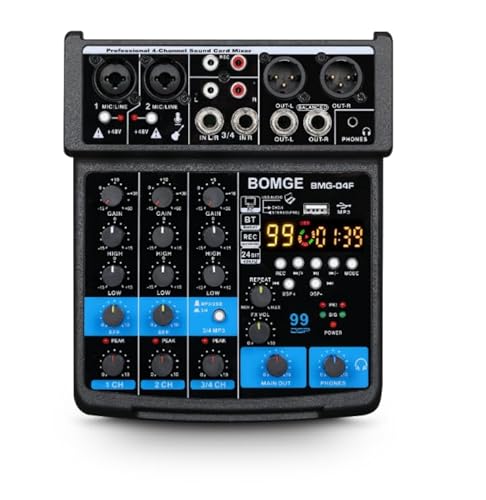
BOMGE 4 Channel Mini Mixer — Best Budget All-Rounder
BOMGE’s four-channel sound board is the archetype of the budget phantom mixer: a compact DJ-style console with microphone inputs backed by confirmed 48V phantom power, a USB interface for stereo recording to a computer, Bluetooth for music playback, and MP3 playback from USB media. It is the format sold under a dozen names at this tier, and this BOMGE model earns its place because its listing verifies the two things that matter here — real mixing channels and real phantom power — in one box.
Strengths
- 48V phantom power confirmed in the listing — condensers welcome.
- USB stereo recording plus Bluetooth covers podcasting and playback in one unit.
- Four channels handle a mic or two plus music sources without swapping cables.
Trade-offs
- Budget sound-board build: knobs and faders are functional, not luxurious.
- Phantom power is typically switched globally — plan mic combinations accordingly.
- Brand support is seller-based; test every function during the return window.
| Spec | Detail |
|---|---|
| Channels | 4 |
| Phantom power | 48V |
| USB audio | Yes — stereo recording interface |
| Wireless | Bluetooth playback |
Who should buy it: the beginner podcaster with a condenser mic and a laptop, the karaoke host who needs a mic channel with power and a Bluetooth music channel, the small event organiser assembling a first PA kit. The BOMGE formula works because it refuses to specialise — everything a small setup needs is present at a basic level, and the phantom power is genuinely there for the microphone that needs it. Buy it with realistic expectations, verify every input in week one, and it returns exactly the value its tier promises.
Best for: beginner podcasters, karaoke hosts, first PA kits. / Not suited for: professional daily use or buyers wanting established-brand support.
Check the current price on Amazon

Aveek 4 Channel Audio Mixer — Best with DSP Effects
The Aveek four-channel board takes the same budget formula and leans into effects: its listing confirms 48V phantom power, USB PC recording and Bluetooth — and adds a deep bank of DSP effects (the 99-effect library common to this class) for echo, reverb and novelty processing on the microphone channels. For streamers and karaoke performers, built-in effects are not a luxury; they are the difference between a dry, flat voice and a produced sound with zero software involved.
Strengths
- 48V phantom power plus a large DSP effects library in one budget board.
- USB recording to PC and Bluetooth playback cover the streamer workflow.
- Effects are hardware-based — no plug-ins, no latency, no software setup.
Trade-offs
- Most of the 99 effects are variations; a handful of reverbs and echoes do the real work.
- Value-brand build and documentation — expect to learn by experimenting.
- Not the tool for pristine, unprocessed recording; its personality is “produced.”
| Spec | Detail |
|---|---|
| Channels | 4 |
| Phantom power | 48V |
| Effects | 99 DSP effects |
| USB audio | Yes — PC recording |
The Aveek makes sense wherever a voice needs to sound finished live: a streamer entertaining chat, a singer at a family event, a host whose charisma includes a little echo on the punchlines. Its phantom power handles the condenser microphones streamers favour, and its recording path captures the processed result directly. Purist recordists should pass — the BOMGE M12 or the Just Mic 4 keep the signal cleaner — but as a budget performance board with verified phantom power, the Aveek is the most entertaining pick in this guide.
Best for: streamers, karaoke performers, live hosts who want built-in effects. / Not suited for: clean, unprocessed studio recording.
Check the current price on Amazon

Aveek 5 Channel Audio Mixer — Best Extra Input
The five-channel Aveek is the four-channel formula with one more input and the same verified foundations: 48V phantom power, a built-in PC recording interface, Bluetooth and the sound-board layout this tier has standardised. That extra channel is not a rounding error — it is the difference between unplugging the music source to add a second microphone and simply turning up channel five. For small setups that flex between one mic and two, or a mic plus instruments plus playback, the headroom is the product.
Strengths
- Five channels with 48V phantom power — the most inputs at this budget tier.
- PC recording interface built in for podcast and stream capture.
- Bluetooth playback keeps the phone-as-music-source workflow cable-free.
Trade-offs
- Same value-brand caveats as its sibling: test everything early, keep expectations tiered.
- Extra channel is a line-level convenience; the mic preamp count is what limits microphones.
- No established-brand resale or support ecosystem behind it.
| Spec | Detail |
|---|---|
| Channels | 5 |
| Phantom power | 48V |
| USB audio | Yes — PC recording interface |
| Wireless | Bluetooth |
Choose the five-channel Aveek when your setup’s guest list changes weekly: a podcast that sometimes adds a third voice’s instrument, a small church music corner, a party rig where the host mic, a singer’s mic and two music sources all appear in the same evening. The phantom power covers the condensers, the interface covers the recording, and the fifth channel covers the improvisation. It is a budget board and behaves like one under close inspection, but its verified feature set is precisely the one this search’s shoppers are hunting.
Best for: flexible small setups, small music corners, hosts with changing sources. / Not suited for: buyers prioritising build quality over channel count.
Check the current price on Amazon

BOMGE M12 — Best 2-Channel Interface
The M12 strips the formula to its essence: a two-channel USB audio interface and mixer with XLR and 3.5mm inputs and a 48V phantom power supply for the microphones. There are no effects banks and no Bluetooth — just two channels, honest power for condensers, and a sound-card path into a computer. For a solo podcaster with a condenser, a duo recording on a desk the size of a placemat, or a voiceover artist who needs their one good microphone powered and captured, it is the leanest verified route in this guide.
Strengths
- 48V phantom power in a true two-channel interface format — no wasted features.
- XLR plus 3.5mm inputs cover studio mics and small lav/phone sources.
- The simplest setup in this guide: plug in, power the mic, record.
Trade-offs
- Two channels is the whole story — no growth path within the box.
- No effects, no Bluetooth, no live-PA ambitions.
- Budget-brand preamps; the quietest condensers in bad rooms will expose them.
| Spec | Detail |
|---|---|
| Channels | 2 |
| Phantom power | 48V |
| USB audio | Yes — interface |
| Inputs | XLR / 3.5mm |
The M12 is the pick we would hand a beginner who owns exactly one or two condenser microphones and a laptop: it solves the actual problem — power and capture — at the lowest verified tier, and it teaches clean habits (gain set once, monitored properly) that transfer to any bigger rig later. It is also the natural spare: a backup interface that lives in a drawer costs little and saves a recording day when the main rig fails. Modest, verified, and honest about its limits.
Best for: solo condenser podcasters, voiceover beginners, backup-interface duty. / Not suited for: multi-source setups or live sound.
Check the current price on Amazon

Pyle 8 Channel Bluetooth Studio Mixer — Best for Small PA
Pyle is the one long-established budget name in this guide, and its eight-channel board stretches the format furthest: eight channels with 48V phantom power, Bluetooth streaming, USB computer recording and an MP3 player path, in a console layout meant for small live rigs as much as desks. It sits a tier above the twenty-dollar frame — we include it deliberately, because for buyers whose “small mixer with phantom power” actually means “run a small event,” this is where the budget road realistically leads, and pretending otherwise would send them to a four-channel board that cannot do the job.
Strengths
- Eight channels with 48V phantom power — small-PA capability, not just desktop duty.
- Bluetooth, USB recording and MP3 playback cover every small-event music source.
- Pyle is an established budget brand with a real retail footprint behind it.
Trade-offs
- Above the headline budget tier — included for capability, flagged honestly.
- Eight channels of budget build means eight channels to test in week one.
- Overkill in size and features for a one-mic desktop podcast.
| Spec | Detail |
|---|---|
| Channels | 8 |
| Phantom power | 48V |
| USB audio | Yes — computer recording |
| Wireless | Bluetooth |
For a community hall, a school event kit, a small band’s rehearsal PA or a venue corner that needs microphones powered and music playing from one modest console, the Pyle is the pragmatic end of this guide’s road. It is also the pick most likely to still be working, unglamorously and adequately, five years from now in a cupboard that smells of dust and good intentions — which, at this end of the market, is a genuine compliment. Its phantom power is verified in its own listing, its brand has sold budget audio for decades, and its channel count means the setup survives the evening’s improvisations. Desktop purists should stay with the smaller picks; event organisers should start here and save themselves the upgrade.
Best for: small events, halls, rehearsal PAs and school kits. / Not suited for: minimal desktop podcast setups or the strictest $20 budgets.
Check the current price on Amazon
Comparison Table
| Pick | Badge | Key spec | Best for |
|---|---|---|---|
| Maker hart Just Mic 4 | Best True Phantom Mini Mixer | 4ch mic mixer, portable phantom power | Compact condenser setups |
| BOMGE 4 Channel | Best Budget All-Rounder | 48V, USB, Bluetooth | Beginner podcasts, karaoke |
| Aveek 4 Channel | Best with DSP Effects | 48V, 99 DSP effects | Streamers, performers |
| Aveek 5 Channel | Best Extra Input | 48V, 5 channels, PC interface | Flexible small setups |
| BOMGE M12 | Best 2-Channel Interface | 48V, XLR/3.5mm, USB | Solo condenser recordists |
| Pyle 8 Channel | Best for Small PA | 48V, 8 channels, Bluetooth | Events and halls |
How to Choose a Budget Mixer with Phantom Power
Verify phantom power in the listing, not in your hopes. This is the whole game at this tier. If the product page does not say 48V or phantom power plainly, assume it is absent. Every pick in this guide passed that test through its verified listing; the dozens of similar-looking boards that failed it are why this category burns so many first-time buyers.
Count mic inputs, not channels. A “5 channel” budget board may offer two microphone inputs and three line inputs. If you own two condensers, you need two mic preamps with phantom power reaching both — check the layout, not the headline.
Decide whether effects matter. Live and streaming voices benefit from built-in reverb and echo (Aveek 4 Channel). Clean recording does not — effects printed at capture cannot be removed, so recordists should choose the BOMGE M12 or Just Mic 4 and add polish in software.
Budget honestly around the tier. The twenty-dollar frame buys a phantom supply or a toy. The picks here occupy the lowest tiers where a real mixer with phantom power exists; the Pyle shows where the road leads when the job outgrows the desk. Spending one tier up, once, is cheaper than buying the wrong box twice — the most repeated sentence in budget audio, because it keeps being true.
Phantom Power Explained: What It Is and What Can Go Wrong
Phantom power is a 48-volt DC supply that a mixer sends down the same balanced XLR cable that carries the microphone’s audio back. Condenser microphones need it to charge their capsule and run their internal electronics; without it, most condensers produce silence or a faint, distorted whisper. Dynamic microphones ignore it entirely — a properly wired dynamic on a phantom-powered channel is perfectly safe, which is why mixers can switch phantom globally without drama. The exceptions to handle with care: ribbon microphones (a few vintage designs can be damaged by phantom through a faulty cable), unbalanced sources wired with adapters, and any cable with a short — phantom power plus a damaged cable is how small problems become dead channels.
At the budget tier, two practical wrinkles matter. First, some ultra-cheap units advertise phantom power but deliver reduced voltage or current under load; a single modern condenser will usually still work, while several power-hungry mics at once can expose the limit — one more reason the verified listings in this guide matter. Second, USB-powered mixers draw their phantom supply from the computer’s port; a weak port or an unpowered hub can starve it. If a condenser sounds thin or intermittent on a USB-powered board, try a direct port or a powered hub before blaming the microphone. None of this should scare a beginner — phantom power is a solved, standard technology — but at twenty-dollar tiers, verifying it exists and feeding it properly is the difference between a rig that works and a return label.
Finally, a note on vocabulary, because listings exploit it: “phantom power,” “+48V” and “48V” all describe the same standard supply, and any of the three phrases in a listing is a pass on this guide’s test. Vague phrases — “mic power,” “plug-in power,” “power for microphones” — are not the same claim; plug-in power is a different, much lower voltage system used by small lavalier and camera microphones, and it will not run a studio condenser. When a listing is vague, treat the feature as absent. Precision in the listing correlates with precision in the product more often than any other signal at this tier.
How to Set Up a Budget Phantom-Power Mixer for a Condenser Microphone
1. Connect with a real XLR cable. Phantom power only travels on balanced XLR-to-XLR cables. An XLR-to-3.5mm adapter cable cannot carry it, no matter what the listing photos imply.
2. Connect before powering. Plug the microphone in with phantom power off, then switch phantom on. Hot-plugging a condenser under power sends a thump through the system and stresses both devices.
3. Set gain with the loudest real sound. Speak, sing or play at performance level and set the channel gain so peaks stay clear of distortion. Budget preamps have less headroom — leave more margin than feels necessary.
4. Add effects last, if at all. If your board has DSP effects, record a dry test first. Effects are seasoning; the dry signal is the meal, and you cannot un-season a recording.
5. Test every input in week one. Budget boards earn trust by inspection: every channel, the USB path, Bluetooth, and the phantom switch with each microphone you own. Ten minutes now beats a dead channel on recording day.
Common Buying Mistakes
Buying a phantom power supply and calling it a mixer. The single most common error behind this search. A phantom supply powers one microphone; it does not mix, record or amplify. If the product has one XLR in and one XLR out and nothing else, it is not in this guide’s category at all.
Assuming every mini mixer has phantom power. Most mini line mixers do not — they are built for keyboards and phones. Phantom power must be printed in the listing; if it is not printed, it is not there.
Feeding a condenser through the wrong cable. Adapters that convert XLR to unbalanced plugs break the phantom path. One proper XLR cable costs little and is the entire fix.
Judging by the effect count. “99 DSP effects” means a handful of usable reverbs and echoes wearing many hats. Judge a budget board by its inputs, its phantom power and its recording path; effects are the garnish.
Skipping the return-window test. Value-brand audio is a lottery with good odds, not a guarantee. The buyers who test everything immediately almost always end up with a working rig; the ones who unbox on recording day sometimes do not.
The Alternatives Shoppers Find at This Tier (and When They Are Actually Right)
Because the strict twenty-dollar shelf holds substitutes rather than true phantom mixers, it is worth understanding each substitute — because for some buyers, the substitute is genuinely the correct purchase. The standalone phantom power supply is a one-channel box that sits between a condenser microphone and any mixer or interface that lacks phantom. If you already own a mixer you like that simply cannot power your new condenser, this twenty-dollar-class box is the rational fix, and it is better built for its single job than the phantom stage of many budget boards. The inline microphone booster is a different animal: it uses phantom power rather than providing it, amplifying a quiet dynamic microphone’s signal before a weak preamp can add hiss. Confusing the two is a classic beginner error — a booster will not wake a silent condenser, and a phantom supply will not make a quiet dynamic louder.
The USB condenser microphone is the third substitute, and the most seductive: it skips mixers entirely by building the interface into the microphone. For a solo creator with one voice and no live ambitions, it is honestly the simplest path — but it forecloses the second microphone, the live event and the hardware control that every pick in this guide provides. The mini line mixer is the fourth: a real mixer for keyboards, phones and media players that cannot power microphones at all. It is the right tool for summing music sources and the wrong tool for every condenser ever made. The pattern to remember is that this tier is a shelf of single-purpose answers, and the six picks above are the rare generalists on it. Choose the specialist when your problem is truly single; choose a pick from this guide when your problem is, as most people’s is, a small system rather than a single gap.
Use Cases: Who Actually Buys a Budget Phantom Mixer
The first-time podcaster is the archetypal buyer: one condenser microphone bought on enthusiasm, a laptop, and the discovery that the microphone needs power and a home. Any pick here solves them, and the BOMGE M12 or Just Mic 4 solves them most directly. The karaoke and party host needs the opposite emphasis — a mic that always works, music from a phone, and effects that forgive enthusiastic singing — which is the BOMGE 4 Channel and Aveek 4 Channel’s home ground. The small church, school or hall needs phantom for the one good condenser that captures a choir or a speaker, plus channels for everything else, which is the Pyle’s brief and the Aveek 5 Channel’s opportunity. The streamer needs the condenser powered, the voice polished live and the game audio blended, which is why the DSP-equipped Aveek and the interface-lean M12 split that audience between them.
Two more buyers deserve naming. The home recordist — a singer or instrumentalist capturing demos — needs phantom and cleanliness above features, and should weight the Just Mic 4 and M12 accordingly, recording dry and adding polish in software where it can be undone. And the pragmatic upgrader: someone whose no-phantom mixer still works and whose band just bought condensers. For them this whole guide is a fork in the road — a twenty-dollar-class phantom supply keeps the old rig alive, while a budget phantom mixer replaces it with USB and Bluetooth included. Either can be right; the deciding question is whether the old mixer does anything else well enough to keep. Sentiment is not a spec, and at these tiers the new box often wins on features alone.
Troubleshooting Budget Phantom Power Setups
Problem: the condenser mic is completely silent. → Work the chain in order: is phantom switched on? Is the cable a true balanced XLR-to-XLR (adapters break the power path)? Is the channel gain up and the channel not muted? Is the mixer’s USB power adequate — try a direct port? In our experience the cable is the culprit in most silent-condenser stories at this tier.
Problem: the mic works but sounds thin, quiet or distorted. → The phantom supply may be sagging under load, or the gain is in the preamp’s harsh zone. Test the mic alone (unplug other phantom-powered mics), lower the gain and move closer to the microphone, and power the mixer from its strongest available source. A condenser that sounds right alone but wrong in company is telling you the power budget is shared and thin.
Problem: a loud pop or thump when switching phantom on. → Normal physics, bad habit. Mute the channel or turn the master down before toggling phantom, and connect microphones before powering, never after. Your speakers and your audience’s ears will notice the difference even if the mixer does not care.
Problem: Bluetooth music plays but the recording misses it. → On many budget boards, Bluetooth feeds the main mix but not always the USB recording path. If the recording must include the music, feed the phone by cable into a line channel instead — unglamorous, and it works every time.
Problem: one channel hisses noticeably more than the others. → Budget boards vary channel to channel. Swap the microphone and cable to the quiet channel for your main voice, and relegate the hissy channel to a line source where its noise hides under music. If every channel hisses at the gain your microphone needs, the pairing — not the channel — is the problem, and a louder microphone or an inline booster is the fix.
A Word on Microphone Pairings at This Tier
The happiest budget phantom setups pair these mixers with microphones that forgive them. Affordable large-diaphragm condensers with healthy output levels are the natural match: they need the phantom these boards provide, they do not demand extreme gain, and their sound flatters the simple EQ these boards offer. Very low-output condensers and quiet dynamic broadcast microphones are the stress test — they expose thin phantom supplies and noisy preamps, and at this tier the honest advice is to choose a louder microphone rather than a different twenty-dollar board, because the boards all share the same physics. Buyers with one demanding microphone and professional ambitions should treat this guide as a starting map and the established-brand small mixers as the destination; buyers with typical microphones and typical rooms will find these picks genuinely sufficient, which is precisely why the category exists and why it sells in the volumes it does.
Final Recommendation
If you want the smallest honest answer to this search, buy the Maker hart Just Mic 4 — a real microphone mixer with phantom power at its heart, built for exactly the job described in this search and nothing else at all. For a general beginner rig, the BOMGE 4 Channel covers podcast, karaoke and playback in one budget box; performers who want effects should take the Aveek 4 Channel instead, every time, flexible setups the versatile Aveek 5 Channel, solo condenser recordists the lean BOMGE M12, and small-event organisers everywhere the Pyle 8 Channel above all. And if your budget can stretch beyond this tier entirely, the established-brand small mixers in our guides to Best 2 Channel Mixers and Best 2 Mic Mixers For Podcasting are where long-term support lives — with Best 4 Channel Mixers and Best 5 Channel Mixers covering the next sizes up.
Frequently Asked Questions
Can you really buy a mixer with phantom power for around $20?
Almost — and the “almost” matters. At the strict twenty-dollar line, the market mostly offers standalone phantom power supplies (not mixers) and mini line mixers (no phantom). Genuine small mixers with verified 48V phantom power begin in the lowest budget tiers just above that line, which is where this guide’s picks live. Anyone promising a full-featured phantom mixer at exactly twenty dollars is usually selling one of the two substitutes above.
What is the difference between a phantom power supply and a mixer with phantom power?
A phantom power supply is a single-purpose box: microphone in, powered microphone signal out, nothing else. It must feed a mixer or interface to be useful. A mixer with phantom power does that job on each mic channel and also balances multiple sources, controls levels and EQ, and routes the result to speakers or a computer. If you already own a mixer without phantom, a supply is a smart fix; if you own nothing, buy the mixer with phantom built in.
Will phantom power damage my dynamic microphone?
With a properly wired balanced XLR cable, no — dynamic microphones simply ignore phantom power, and mixed setups (a condenser and a dynamic on the same phantom-powered mixer) are routine. The cautions are damaged cables, unbalanced adapters, and a small number of vintage ribbon microphones. Modern gear in good condition coexists with phantom power safely.
Why does my condenser microphone sound quiet or distorted on a budget mixer?
Usually one of three causes: phantom power is not actually reaching the mic (wrong cable type or the switch is off), the mixer’s USB power is starved (try a direct USB port or powered hub), or the gain is set into the preamp’s uncomfortable zone. Work through them in that order — cable, power, gain — and most budget rigs come right.
Is a budget phantom mixer good enough for podcasting?
For starting, yes. A verified budget board powering a decent condenser, in a reasonably quiet room, with the gain set carefully, produces podcast audio most listeners cannot distinguish from far pricier rigs. What budget boards give up is headroom, build quality and support — things that matter over years, not over your first season. Prove the show on a budget pick, then upgrade with evidence.
Do these mixers work with USB microphones?
No — and nothing does, because a USB microphone already contains its own interface and expects to plug directly into a computer. Phantom power mixers serve XLR microphones. If your microphone has only a USB plug, it cannot use any mixer in this guide; if it offers both XLR and USB outputs (a common hybrid design), the XLR output is the one that connects here, with phantom power if it is a condenser.


