Disclosure: airfryerkitchensupply.com is reader-supported. When you buy through links on our site, we may earn an affiliate commission at no extra cost to you.
Where to buy
Every faucet in this guide is sold through Amazon, where you can confirm the finish, the hole configuration and the current configuration options before ordering. Start with our top pick, the Moen Adler 87233SRS on Amazon, or check the rest of the shortlist: the FORIOUS pull-down, the Delta Essa 9113-AR-DST, the Moen Arbor 7594SRS, the WEWE pull-down and the Moen Essie 87014SRS. Prices move constantly, so use the listings to check the current price on Amazon rather than relying on any number printed in a review.
Introduction: the honest truth about 14 inch kitchen faucets
If you are shopping for the best 14 inch kitchen faucets, here is the market reality you need to hear first: almost no major manufacturer sells a kitchen faucet that measures exactly 14.0 inches tall. Overall height is not a size category the brands design around the way they design around hole counts or flow rates. What actually exists is a band of compact high-arc faucets measuring roughly 14.5 to 15.75 inches overall, and then a much larger band of standard faucets at 16 to 18 inches and beyond. The six faucets in this guide are the shortest quality pull-downs we could verify through Amazon’s own product data, measured from the countertop to the top of the arc, and every height printed below comes from the manufacturer’s own listing data rather than from a retailer’s rounded marketing copy.
Why does an inch or two matter? Because overall height decides whether a faucet fits under a shallow wall cabinet, a window sill that sits low over the sink, or a shelf built into a pass-through. It also decides how the faucet looks: on a small single-bowl sink, a 20-inch commercial spring faucet towers over everything and splashes more, because the spray head sits higher above the basin. A faucet in the 14 to 16 inch band keeps the arc proportional to a standard 33-inch sink, still clears a stockpot, and keeps the spray closer to the dishes where it belongs. If your constraint is a cabinet or a window, measure from the countertop to the underside of the obstruction, then leave at least an inch of clearance for the lever swing on top-handle models.
One more measurement warning before the picks: brands report two different heights. Overall height is countertop to the top of the spout arc. Spout height is countertop to the underside of the spout outlet, and it is always several inches lower. A faucet advertised around a 14-inch spout height can be an 18-inch faucet overall. Every number in this guide is overall height unless we say otherwise, because overall height is the number that decides cabinet clearance.
In this guide
Quick Picks
- Best Overall: Moen Adler 87233SRS — the shortest verified big-brand pull-down at 14.56 inches overall, with Power Clean spray and Reflex docking. Check the current price on Amazon
- Best Budget: FORIOUS Pull-Down — 14.76 inches overall, three spray modes, 1 or 3 hole mounting, budget-tier pricing. Check the current price on Amazon
- Best Compact Modern Design: Delta Essa 9113-AR-DST — 15.25 inches overall, minimalist single-hole styling, Arctic Stainless finish. Check the current price on Amazon
- Best for Heavy Rinsing: Moen Arbor 7594SRS — 15.5 inches overall, Power Boost spray for stuck-on food, Reflex docking. Check the current price on Amazon
- Best True Single-Hole Fit: WEWE Pull-Down — 15.7 inches overall, purpose-built for 1-hole sinks with no deck plate compromises. Check the current price on Amazon
- Best for Unusual Hole Layouts: Moen Essie 87014SRS — 15.75 inches overall, verified for 1, 2, 3 or 4-hole decks with the plate included. Check the current price on Amazon
How These Picks Were Chosen
We started with a simple filter: the faucet’s overall height, taken from the manufacturer’s product data on Amazon, had to fall in the compact band — under 16 inches. That single filter eliminated most of the best-selling pull-downs on the market, which cluster between 16 and 18 inches. We then verified each surviving model against Amazon data for this site: the model number, finish, hole configuration and included hardware all had to match the product we intended to describe. Any faucet whose dimensions we could not verify was dropped rather than guessed at, which is why this list leans on Moen and Delta plus a small number of direct-to-consumer brands whose listings publish full measurements.
Beyond height, we weighed spray performance (a compact faucet still has to rinse a sheet pan), docking reliability, cartridge quality, finish durability and the realism of the warranty and support behind the brand. We also considered who should not buy each faucet, because a 14-inch-class faucet is a compromise by design: you give up some pot-filling clearance and some visual drama in exchange for fit. The trade-offs section under each pick states that compromise plainly.
A note on the faucets that did not make it. Several well-known pull-downs advertise a compact look but measure 16.5 inches or more overall once you read the specification data rather than the lifestyle photos — they belong in a standard-height guide, not this one. A few budget listings publish dimension strings that describe the shipping box rather than the faucet, which you can spot because the “height” is the smallest of the three numbers; we excluded any model whose true overall height we could not establish from the manufacturer’s own feature data. And a handful of genuinely short faucets turned out to be bar faucets with short spout reaches that would leave the stream landing at the back of a standard kitchen sink — a different product for a different sink, covered in its own section below. What remains is a short list in the literal sense: six faucets whose heights we can stand behind, spanning the budget, mid-range and big-brand tiers, each with a defined job.
The 6 Best 14 Inch Kitchen Faucets

Moen Adler 87233SRS — Best Overall
The Adler is the faucet we would hand to most people who ask for a 14-inch-class faucet, because at 14.56 inches overall it is the shortest full-size pull-down from a major brand that we could verify, and it gives up almost nothing to get there. It suits standard 33-inch sinks, kitchens with a low window or cabinet over the sink, and anyone who finds tall faucets visually overwhelming. It does not suit cooks who regularly fill very tall stockpots under the spout without pulling the spray head down, or anyone set on a touch or touchless faucet.
Strengths
- Shortest verified overall height in this guide at 14.56 inches, so it clears obstructions that rule out standard pull-downs.
- Power Clean spray technology delivers a concentrated, higher-force rinse for baked-on food, per Moen’s product data.
- Reflex docking system keeps the pull-down wand seated smoothly instead of drooping over time.
Trade-offs
- The Spot Resist Stainless finish is the safe choice, but the design is conservative — it will not be the visual centerpiece of a designer kitchen.
- Two spray functions (stream and rinse) rather than the three modes some rivals offer.
- The compact arc means slightly less clearance for the tallest pots when the wand is docked.
Spec snapshot (verified): Overall height 14.56 in · Dimensions 7.5 x 10.25 x 14.5625 in · Install: 1 or 3 hole with included deckplate · Finish: Spot Resist Stainless · Spray: Power Clean, dual function
What makes the Adler work is that Moen shrank the arc without shrinking the engineering. The Reflex hose system uses a hose that genuinely retracts rather than relying only on a counterweight, so the wand pulls out with light effort and seats with a positive dock. The Duralock quick-connect fittings underneath make installation a push-fit job instead of a compression-fitting wrestling match, which matters in the tight cabinet under a sink. In daily use, the single lever has the smooth, damped feel of Moen’s better cartridges, and the Spot Resist finish really does shrug off the fingerprint smearing that makes polished chrome look dirty by Tuesday. For a rental upgrade, a first home, or a kitchen where the faucet has to fit under something, this is the default answer.
Best for: buyers who need the shortest quality pull-down that still behaves like a full-size faucet / Not suited for: cooks who need maximum docked clearance for very tall stockpots

FORIOUS Pull-Down — Best Budget
FORIOUS is a direct-to-consumer brand, and this faucet is the budget-tier way into the 14-inch class: 14.76 inches overall, a proper three-mode spray head, and a 10-inch deck plate in the box for 1 or 3 hole sinks. It suits first-time faucet buyers, landlords, laundry and utility sinks, and RV or camper kitchens where the cabinet above the sink is genuinely low. It does not suit buyers who want a decades-long brand warranty infrastructure or all-brass construction.
Strengths
- Verified overall height of 14.76 inches with a published spout height of 6.69 inches, so you know exactly what clearance you are getting.
- Three spray modes — stream, spray and pause — which several big-brand rivals at higher tiers do not offer.
- SUS304 stainless steel body with a ceramic cartridge, cUPC and NSF/ANSI/CAN 61 certified per the manufacturer’s data.
Trade-offs
- Long-term parts availability depends on the brand’s continued support rather than a national service network.
- The 1.8 GPM flow is standard, not generous; filling a large pot takes a little longer than with a high-flow model.
- Finish options are limited compared with the big brands’ catalogs.
Spec snapshot (verified): Overall height 14.76 in · Spout height 6.69 in · Flow 1.8 GPM · Install: 1 or 3 hole, 10-inch deck plate included · Hose: 18-inch pull-down · Max deck thickness 1.5 in
The honest way to judge this faucet is against its tier. Within the budget tier, the published specifications are unusually complete — the manufacturer states the mounting hole range, the deck thickness limit and the cartridge cycle testing, which is more than many no-name listings provide. The pause mode on the spray head is genuinely useful when you are moving the wand between a pot on the counter and the sink, because it stops the water without reaching back for the lever. The five-layer finish resists the spotting that plagues cheap chrome. What you give up versus the Moen is refinement: the lever action and wand dock feel a step less damped, and if you need a replacement cartridge in eight years you will be contacting the brand rather than walking into any plumbing supplier. For the price tier, that is a fair trade.
Best for: budget-conscious buyers and low-clearance utility or RV sinks / Not suited for: buyers who prioritize a national brand’s lifetime parts network

Delta Essa 9113-AR-DST — Best Compact Modern Design
The Essa is Delta’s minimalist single-lever design, and at 15.25 inches overall it sits at the taller edge of this compact class while looking smaller than it is, thanks to a slim, angled silhouette. It suits modern and Scandinavian-leaning kitchens, single-hole sinks, and buyers who want the faucet to visually disappear. It does not suit traditional kitchens, buyers who want a deck plate included for a 3-hole sink without checking the configuration, or anyone who needs a sprayer with multiple patterns.
Strengths
- Clean, architectural design that reads as a premium fixture despite the compact footprint.
- Delta’s DIAMOND Seal valve technology reduces leak points inside the faucet body.
- Arctic Stainless finish has a cooler, softer tone that pairs well with stainless appliances.
Trade-offs
- At 15.25 inches it is the pick to double-check against a hard 15-inch clearance limit.
- Single-hole design focus means 3-hole installations need the optional escutcheon arrangement confirmed before ordering.
- The minimalist lever is small; wet, soapy hands get less grip than on a larger handle.
Spec snapshot (verified): Overall height 15.25 in · Dimensions 1.25 x 11 x 15.25 in · Install: single hole · Finish: Arctic Stainless · Handle: single lever
Delta built the Essa around a simple idea: remove every visual seam and let the arc do the styling. In a compact kitchen that restraint pays off, because the faucet does not fight the cabinets or the backsplash for attention. The pull-down wand docks magnetically on this design family, which produces a crisp seat every time, and the spray head toggles between stream and spray with a positive button feel. Under the sink, Delta’s integrated supply lines simplify the hookup. If your clearance limit is a true 15 inches or less, pick the Adler instead; if you have 15.5 inches to work with and want the best-looking faucet in this class, the Essa is the one.
Best for: modern kitchens with a single-hole sink and at least 15.5 inches of clearance / Not suited for: strict sub-15-inch clearances or traditional kitchen styling

Moen Arbor 7594SRS — Best for Heavy Rinsing
The Arbor is the traditional-styled member of this class: a curved, almost gooseneck arc at 15.5 inches overall, with Moen’s Power Boost button that temporarily increases spray force for blasting casserole dishes. It suits buyers with classic or transitional kitchens, households that cook (and therefore wash up) heavily, and anyone who wants the strongest rinse in a compact body. It does not suit ultra-modern kitchens or buyers working with the tightest clearances.
Strengths
- Power Boost spray gives a temporary force increase for stuck-on food, per Moen’s verified product data.
- Reflex docking keeps the wand seated through years of daily pulls.
- Spot Resist Stainless finish hides fingerprints and water spots between cleanings.
Trade-offs
- The traditional styling looks out of place in a flat-panel, handleless modern kitchen.
- At 15.5 inches overall, it needs a real clearance check under low cabinets.
- Premium brand tier pricing relative to the direct-to-consumer picks in this guide.
Spec snapshot (verified): Overall height 15.5 in · Dimensions 7.88 x 10.25 x 15.5 in · Finish: Spot Resist Stainless · Spray: Power Boost with Reflex docking
The Arbor has been in Moen’s catalog for years, which is a quiet advantage: cartridges, wands and hoses for it are stocked everywhere, and any plumber in the country has installed one. The Power Boost feature is not a gimmick — it is a separate, more forceful spray pattern engaged by a button on the wand, and it genuinely shortens the rinse phase on roasting pans. The trade for the compact height is minimal here because the Arbor’s arc is shaped to keep usable spout clearance high even though the overall number is modest. If your kitchen style leans classic and your sink sees real cooking traffic, this is the compact faucet that behaves least like a compromise.
Best for: traditional kitchens and heavy daily cooking with a mid-level clearance limit / Not suited for: ultra-modern styling or the very tightest sub-15-inch spaces

WEWE Pull-Down — Best True Single-Hole Fit
Most “single-hole” faucets are really 1-or-3-hole faucets with a plate you can leave off. This WEWE model is built the other way: it is a dedicated 1-hole faucet, 15.7 inches overall, with no deck plate in the box and a mounting design meant for a single clean hole. It suits modern single-hole sinks, stone countertops drilled for one hole, and buyers who hate the look of an escutcheon plate. It does not suit 3-hole sinks (there is no plate to cover the extra holes) or buyers who want a sprayer with a pause-only economy mode set.
Strengths
- Purpose-built 1-hole installation with a clean, plate-free look and tool-free mounting hardware.
- Three spray modes — stream, spray and pause — with easy-clean silicone nozzles that resist limescale.
- SUS 304 stainless body, ceramic cartridge tested to 500,000 cycles, CEC-listed 1.8 GPM flow per the manufacturer’s data.
Trade-offs
- No deck plate included, so it cannot adapt to a 3-hole sink without buying a plate separately.
- Brand support is online-only, unlike the national brands in this guide.
- The 15.7-inch height is at the top of the compact band.
Spec snapshot (verified): Overall height 15.7 in · Dimensions 8.5 x 10 x 15.7 in · Flow 1.8 GPM (CEC listed) · Install: 1 hole only, fits 1.30–1.50 in mounting holes, decks up to 1.76 in thick · Certifications: cUPC, NSF/ANSI 61 and 372 per manufacturer data
The detail that sells this faucet is the mounting system: the manufacturer specifies the exact hole diameter range and a generous maximum deck thickness, which makes it a realistic fit for thick stone counters where budget faucets often run out of thread on the mounting shank. The braided supply hoses use a PEX core with a stainless sleeve, a construction detail usually found a tier up. In use, the wand’s three modes cover the daily range — a calm stream for filling, a wide spray for rinsing, and pause for moving between vessels. Just be certain your sink is truly single-hole before ordering, because this faucet makes no attempt to be anything else.
Best for: true single-hole sinks and thick stone counters that need a longer mounting shank / Not suited for: 3-hole sinks or buyers who want an included deck plate
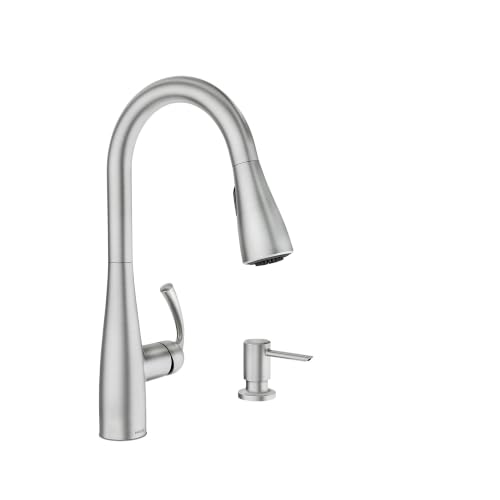
Moen Essie 87014SRS — Best for Unusual Hole Layouts
The Essie is the problem-solver of this group. At 15.75 inches overall it is the tallest faucet here, but its verified installation range — 1, 2, 3 or 4-hole configurations with the deck plate included, per Moen’s product data — makes it the compact pick for oddball sinks, especially genuine 2-hole decks and 4-hole decks where one hole takes the included soap or lotion dispenser. It suits remodels where the sink stays but the faucet changes, and anyone whose hole count does not match the standard patterns. It does not suit the strictest clearance limits.
Strengths
- Verified for 1, 2, 3 or 4-hole installations with the deck plate in the box — the widest compatibility in this guide.
- Included dispenser can be filled with soap or lotion, putting a spare deck hole to work.
- Power Clean spray and Reflex docking, the same core technology as Moen’s taller flagships.
Trade-offs
- At 15.75 inches overall, it fails a hard 15-inch clearance limit — measure first.
- The transitional styling is pleasant but not distinctive.
- More configuration parts in the box means a slightly longer install than a dedicated 1-hole model.
Spec snapshot (verified): Overall height 15.75 in · Dimensions 8.78 x 2.31 x 15.75 in · Install: 1, 2, 3 or 4 hole, deck plate included · Finish: Spot Resist Stainless · Spray: Power Clean with Reflex system
Think of the Essie as the compact faucet for kitchens that were not designed around modern faucet standards. Older sinks with two holes, four-hole decks from a previous two-handle faucet, cast-iron sinks with nonstandard spacing — the Essie’s kit covers them without a trip for adapter parts. The Duralock quick-connect system keeps the under-sink work simple, and every Moen residential faucet is certified to NSF 61 drinking-water standards per the brand’s data. If your clearance is 16 inches or better and your sink is the complication, this is the pick; if clearance is the complication, go back to the Adler.
Best for: 2-hole and 4-hole decks and remodels keeping an existing sink / Not suited for: clearances under 16 inches
Comparison Table
| Pick | Badge | Key spec | Best for |
|---|---|---|---|
| Moen Adler 87233SRS | Best Overall | 14.56 in overall height | Shortest quality pull-down |
| FORIOUS Pull-Down | Best Budget | 14.76 in, 1.8 GPM, 3 modes | Budget and utility sinks |
| Delta Essa 9113-AR-DST | Best Compact Modern Design | 15.25 in, single hole | Modern minimalist kitchens |
| Moen Arbor 7594SRS | Best for Heavy Rinsing | 15.5 in, Power Boost spray | Traditional kitchens, heavy cooking |
| WEWE Pull-Down | Best True Single-Hole Fit | 15.7 in, 1-hole only | Single-hole stone counters |
| Moen Essie 87014SRS | Best for Unusual Hole Layouts | 15.75 in, 1–4 hole | 2-hole and 4-hole decks |
How to Choose a 14 Inch Kitchen Faucet
Start with the tape measure, not the catalog. Measure from the countertop surface to the lowest obstruction above the sink — cabinet underside, window frame, or shelf. Subtract one inch for safety and lever clearance. That number is your maximum overall height, and it is a hard limit: a faucet that is half an inch too tall does not install “a little bit wrong,” it does not install at all, or it installs and the lever hits the backsplash or window every time you reach for hot water. Also check the lever style: top-mounted levers need vertical room through their whole arc, while side levers swing horizontally and are kinder to tight vertical spaces.
Next, separate overall height from spout height in every listing you read. Overall height decides fit. Spout height decides how tall a pot you can slide under the docked spout — for most households, a spout height around 7 to 9 inches handles everyday cookware, and the pull-down wand covers everything taller. If a listing only publishes one height and does not say which, treat it as marketing until you find the specification sheet.
Clearance, Splash and Sink Size: the Physics of a Shorter Faucet
A shorter faucet changes how water behaves in the sink. The spray head sits closer to the basin, so the spray pattern has less distance to spread and splash — one reason compact faucets feel calmer in small, shallow sinks. The trade-off appears with deep double-bowl sinks: a shorter arc with a shorter spout reach may not center the stream over both bowls, so check spout reach against your sink’s front-to-back depth. For a standard 22-inch-deep sink, a reach around 8 to 9 inches centers the water well. Compact faucets pair best with single-bowl sinks and standard doubles; oversized farmhouse sinks usually want a taller, longer-reach faucet.
Budget Tiers in the Compact Class
Compact faucets span the same tiers as the wider market. The budget tier (where the FORIOUS and WEWE picks sit) buys you stainless construction, ceramic cartridges and multi-mode spray heads, with the compromise in brand support and finish range. The mid tier (Moen Adler, Delta Essa) adds national parts networks, better docking systems and finish engineering that resists spots and fingerprints. The premium end of this height class is thin — most premium lines are tall — so if you want touch activation or designer finishes under 16 inches, expect to shop carefully and verify heights model by model rather than trusting a collection name.
How to Measure Your Sink and Install a Compact Faucet
Measuring takes five minutes and prevents every common failure. First, count the holes in your sink deck and measure the spread between the outer holes in inches. Second, measure countertop-to-obstruction clearance as described above. Third, check under the sink: note the supply stop valves (usually 3/8-inch compression), the deck thickness if you can see the sink’s underside edge, and whether a garbage disposal or water filter will crowd the faucet’s hose weight — the pull-down hose needs a clear loop to retract, so plan to move stored bottles to one side.
Installation follows the same sequence for every pick in this guide. Shut off both supply valves and open the old faucet to drain pressure. Disconnect the supply lines and the old mounting hardware — this is usually the slowest step on an old faucet, so penetrating oil and patience help. Remove the old faucet and clean the deck completely; old plumber’s putty and silicone cause new gaskets to leak. Set the new faucet with its gasket or deck plate, thread the mounting hardware up from below and snug it evenly. Connect the supply lines to the stops, hand-tight plus a quarter turn. Attach the pull-down hose, clip on the counterweight at the marked position, then flush the lines with the aerator removed for a minute to clear debris before the first real use. Check every joint with a dry paper towel after ten minutes of intermittent use — a slow weep shows up on paper long before it shows up as a drip.
Materials, Cartridges and What Actually Wears Out
Height gets a faucet onto your shortlist; construction decides whether it is still drip-free in year seven. The component that wears first is almost always the cartridge — the valve that mixes hot and cold and shuts the water off. Ceramic disc cartridges, used by every pick in this guide, are the current standard because the discs are harder than the mineral deposits that score older rubber-seal designs. The FORIOUS and WEWE listings both cite 500,000-cycle cartridge testing, which is the kind of number worth looking for in the budget tier; a cheap faucet with an unrated cartridge is where the savings usually hide. Body material matters next. SUS304 stainless steel bodies, used by the FORIOUS, WEWE and VAPSINT-class faucets, resist internal corrosion well. Brass bodies, traditional in the premium tier, are heavier and equally durable. The thing to avoid at any height is a faucet whose body material is not stated at all.
The second wear point is the pull-down hose and its docking system. Hoses flex thousands of times a year, and the wand either docks magnetically, by a shaped seat with a counterweight (Moen’s Reflex approach combines hose design with a weight), or by friction alone — friction-only docks are the ones that droop within a year. In a compact faucet the hose loop is shorter, which slightly reduces snagging but also means the counterweight position matters more: clip it exactly where the manufacturer marks, because a weight placed too low will bang the cabinet floor and one placed too high will not pull the wand home. Finally, finishes: physical vapor deposition (PVD) and branded spot-resistant finishes genuinely outlast thin electroplated chrome in a hard-water kitchen, and on a short faucet — which sits closer to the splash zone of the sink — that difference shows up faster than it does on a tall model.
Compact Faucets Beyond the Main Kitchen: RVs, Laundry Rooms and Small Apartments
The 14-inch class earns much of its living outside the main kitchen. In an RV or camper, the galley sink often sits under a cabinet that would foul a standard faucet, and the FORIOUS pick in this guide is explicitly marketed for camper and RV use with a mounting range that suits thinner decks. Weight matters there too — a lighter faucet stresses a thin RV countertop less over thousands of road miles. In laundry and utility rooms, a compact pull-down is arguably better than the basic utility faucet it replaces: the wand reaches across a deep utility tub, the pause mode stops splashing when you swing between a bucket and the tub, and the shorter arc clears the wall cabinets that utility rooms always seem to have directly over the sink.
Small apartments are the third case. A galley kitchen with a 24-inch sink and wall cabinets at standard height leaves roughly the same clearance problem as an RV, and a compact faucet restores a feeling of proportion that a 17-inch faucet destroys — the tall faucet makes the whole counter feel like it belongs to the sink. If you rent, keep the old faucet and its hardware in a labeled bag; every pick in this guide installs with standard connections, so the swap is reversible in under an hour when you move out. One caution for all three settings: measure the deck thickness. RV and utility sinks can have decks at the extremes — very thin stainless or unusually thick composite — and the mounting ranges in our spec snapshots (the WEWE fits decks up to 1.76 inches, the FORIOUS up to 1.5 inches) are the numbers to compare against yours.
Spray Modes, Flow Rate and Docking: Features That Matter More Than Height
Once a faucet fits, three features decide daily satisfaction. The first is spray pattern design. A two-function head (aerated stream plus a rinse spray) covers most kitchens; a third pause mode, offered by the FORIOUS and WEWE picks, is worth more than it sounds because it lets you stop water at the wand while moving between a pot and the sink. Moen’s Power Clean and Power Boost patterns take the opposite approach — fewer modes, but a deliberately forceful one for rinsing. Choose based on your dishes: households that roast and bake benefit from force; households that hand-wash delicate items benefit from pause and a gentle stream.
The second feature is flow rate, and in this class it is uniform: every pick here is a standard-flow residential faucet, with the verified listings stating 1.8 GPM where a figure is published. That is the right flow for a compact faucet — enough to fill and rinse briskly, and compliant in states that cap kitchen flow at 1.8 GPM. The third feature is docking, covered above, but worth repeating as a buying rule: if a listing does not explain how the wand stays docked, assume it relies on the counterweight alone and budget your expectations accordingly. Height gets the faucet into your kitchen; these three features decide whether you still like it in year three.
The Even-Shorter Alternative: Bar and Prep Faucets
If even 14.5 inches is too tall, the next step down is not another kitchen faucet — it is a bar or prep faucet. These are scaled-down faucets designed for small secondary sinks, typically with lower arcs and shorter reaches than anything in this guide. As a main-kitchen faucet, a bar faucet involves real sacrifices: the spout reach is shorter, so the stream lands closer to the back of a deep sink; the flow path and spray options are simpler; and most lack a pull-down wand entirely, which removes the feature that makes compact faucets practical for pot filling. We do not recommend one as a primary faucet unless your clearance is truly under 14 inches and a sink replacement is off the table.
There is also a middle path worth knowing about: low-arc and mid-arc kitchen faucets from the major brands, which keep a kitchen faucet’s reach and flow but bend the spout in a gentler curve. They are harder to shop for because listings emphasize style names over measurements, which is exactly why this guide insists on verified overall height for every pick. If you are between classes, the practical rule is simple: buy the tallest faucet your clearance honestly allows, because height buys spout clearance and presence, and only go shorter when the tape measure forces you. The picks above are ordered so that the first two are the true short options and the rest trade a little height for features — use that gradient rather than treating all six as interchangeable.
A Word on Aerators, Pressure and Perceived Flow
One question compact-faucet buyers ask is whether a shorter faucet can be made to “feel” stronger. The honest answer is that perceived force comes from the spray head design and your home’s static pressure, and the aerator is the one part you can legitimately change. Most of these faucets ship with a 1.8 GPM aerated stream; if your home has strong pressure and you want a softer, splash-free fill for delicate produce, a laminar-flow aerator of the same rating is a legitimate swap. Going the other direction — fitting a higher-flow aerator than the faucet is rated for — can breach local water codes in states that cap kitchen flow, and on a compact faucet it mostly buys you more splash, because the head sits closer to the basin. The better fix for a weak-feeling faucet is maintenance: unscrew the aerator or spray face, soak it in vinegar overnight to dissolve mineral scale, and rinse the debris screen. On a pull-down, also check the hose’s inlet screen where it meets the supply — a clogged screen there is the most common cause of a faucet that “lost pressure” two years in.
Common Buying Mistakes
- Confusing spout height with overall height. The number that hits your cabinet is the overall height. Always find both figures.
- Forgetting the lever swing. A faucet body that fits can still have a top lever that strikes a window frame. Side-lever models avoid this.
- Buying a 1-hole-only faucet for a 3-hole sink. Without a deck plate, the extra holes stay open. The WEWE pick is excellent — for the right sink.
- Ignoring the hose loop. If the under-sink cabinet is packed, the pull-down hose snags and the wand stops docking. Clear the loop path.
- Assuming shorter means weaker. Flow rate, not height, decides fill speed; every pick here is a standard-flow faucet.
Final Recommendation
For most kitchens, buy the Moen Adler 87233SRS: it is the shortest verified faucet here and the least compromised of the six we compared against manufacturer data. On a tight budget or in a utility space, the FORIOUS does the job honestly. If your sink has an unusual hole layout, the Moen Essie’s 1-to-4-hole kit saves the remodel. Comparing heights across classes? See our guides to Best 16 Inch Kitchen Faucets for the next size up, Best 3 Hole Kitchen Faucets and Best 2 Hole Kitchen Faucets for hole-specific shortlists, and Best Affordable Kitchen Faucets if the budget matters more than the tape measure.
Related guides
- Best Aged Brass Kitchen Faucets
- Best European White Kitchen Faucets
- Best 2.2 Gpm Kitchen Faucets
- Best Extendable Kitchen Faucets
Frequently Asked Questions
Is a 14 inch kitchen faucet tall enough for filling stockpots?
With a pull-down wand, yes. The docked spout height on compact faucets is typically 6.5 to 9 inches, which handles everyday pots; for a very tall stockpot, pull the wand out and fill the pot in the sink or on the counter beside it. Overall height does not limit you once the spray head is in your hand.
Why are there so few true 14 inch faucets?
Because brands design around hole configuration and style first, and the high-arc shape that buyers want naturally lands between 15 and 18 inches. The compact band in this guide — roughly 14.5 to 15.75 inches — is what the market actually offers, which is why we verified every height from manufacturer data instead of trusting category labels.
Will a shorter faucet splash less?
Generally yes. The spray head sits closer to the basin, so droplets travel a shorter distance and the spray pattern stays tighter. In a shallow sink, a compact faucet is noticeably calmer than a tall commercial-style model.
Can I install a compact faucet on a 3-hole sink?
Yes, if the faucet includes a deck plate (escutcheon) sized to cover the outer holes — the Adler, FORIOUS and Essie in this guide all include one. Dedicated 1-hole models like the WEWE pick do not, so match the faucet to your deck before ordering.
What clearance do I need above the faucet?
Plan for the faucet’s overall height plus about an inch. If the lever is on top of the faucet body, add the lever’s swing height as well, or choose a side-lever model. Measure to the lowest point of any cabinet, shelf or window frame over the sink.
Does a shorter faucet mean lower water pressure?
No. Flow is set by the faucet’s rated flow rate and your home’s water pressure, not by the arc height. All six picks here are standard-flow residential faucets; the compact shape changes clearance and splash behavior, not pressure.
Can I replace just the faucet if my sink is an odd size?
Usually yes. Faucets mount to the deck or countertop, not to the sink bowl itself, so an undersized or oversized sink does not block a swap as long as the hole count, hole spread and deck thickness fall within the faucet’s stated ranges. The spec snapshots in this guide list those ranges where the manufacturer publishes them; when a range is not published, measure your deck thickness and hole diameter and compare them against the listing’s installation diagram before ordering. If the new faucet’s footprint is smaller than the old one’s, expect to spend a few minutes removing the outline of old sealant and mineral deposits the previous escutcheon was hiding.

