Disclosure: airfryerkitchensupply.com is reader-supported. When you buy through links on our site, we may earn an affiliate commission at no extra cost to you.
Where to buy
The fastest way to buy any pick in this guide is through Amazon, where stock and configurations change often, so check the current price on Amazon on the product page rather than relying on any number printed elsewhere. These are the six verified picks for best 5 qt stoneware slow cookers:
- Blue Diamond 5QT Hinged-Lid Slow Cooker — Check on Amazon
- Crock-Pot Manual Slow Cooker, 4.5-Quart (Purple Potato) — Check on Amazon
- Crock-Pot Design Series Slow Cooker, 4.5-Quart (Light Blue Macaroon) — Check on Amazon
- Kenmore 5 Quart Slow Cooker — Check on Amazon
- bella 6.0 Qt Manual Slow Cooker (Oatmilk) — Check on Amazon
- GreenLife 6 Quart Programmable Slow Cooker (Turquoise) — Check on Amazon
Availability in this category moves quickly, especially for seasonal colours and smaller brands. If a first choice is out of stock, the alternatives in this guide are ranked so that the next pick down is a sensible substitute, not a compromise.
The search for the best 5 qt stoneware slow cookers runs into an honest market fact, and this guide will state it up front: true 5-quart cookers with classic glazed stoneware crocks are rare. The industry has largely moved this size to ceramic-coated inserts, while traditional stoneware concentrates at 4.5 quarts just below and 6 quarts just above. Rather than pretend otherwise, this guide gives you the one true 5-quart ceramic pick, the best just-under stoneware options, and the best step-up stoneware and ceramic models — every size flagged in the open, so you can choose your compromise with your eyes open.
Why do buyers ask for stoneware by name? Because the material cooks the way slow cooking wants to be cooked: thick walls that smooth the heat into a steady gentleness, a glaze that releases food and resists staining, and a crock that serves at the table and keeps dinner warm while it sits there. Ceramic-coated inserts answer with easier release and lighter weight, at the cost of coating-care rules. The reviews below name each pick’s construction precisely, because at this search the material is the decision.
This guide suits families of three to five who cook in the stoneware tradition and meal-preppers working at family scale. If your loyalty is to the size rather than the material, the general 5-quart guide in this series covers the full field including non-stick and programmable picks. If your loyalty is to stoneware itself, read on — the flagged near-sizes here are closer to your intent than a nominal 5-quart cooker with the wrong crock would be.
In this guide
Quick Picks
If you only read one section, read this one. These are the six best 5 qt stoneware slow cookers worth your money, each with a distinct badge so you can match the pick to your situation in seconds:
- Blue Diamond 5QT Hinged-Lid Slow Cooker — Best True 5-Quart. A genuine 5 qt with a hinged lid and delay start. Check price on Amazon
- Crock-Pot Manual Slow Cooker, 4.5-Quart (Purple Potato) — Best Classic Stoneware Just Under. Oven-safe stoneware at a flagged 4.5 quarts. Check price on Amazon
- Crock-Pot Design Series Slow Cooker, 4.5-Quart (Light Blue Macaroon) — Best Looking Stoneware. The Design Series finish at a flagged 4.5 quarts. Check price on Amazon
- Kenmore 5 Quart Slow Cooker — Best True 5-Quart Ceramic Insert. Stainless body, non-stick ceramic insert, family size. Check price on Amazon
- bella 6.0 Qt Manual Slow Cooker (Oatmilk) — Best Stoneware Step-Up. Stoneware pot with ceramic nonstick at a flagged 6 quarts. Check price on Amazon
- GreenLife 6 Quart Programmable Slow Cooker (Turquoise) — Best Programmable Step-Up. PFAS-free ceramic crock with delay start at a flagged 6 quarts. Check price on Amazon
How These Picks Were Chosen
Every product in this guide was verified against Amazon’s own catalogue data for this site before it was written about: the model name, capacity and headline features in each review come from the maker’s verified listing, not from memory or third-party summaries. Products that could not be verified were left out or written about without a purchase link, and this guide says so where that happened.
The criteria, in order, were: honest capacity for the 5-quart class named in the search; the features that decide daily satisfaction in this category, as set out in the buying guide below; build and care practicality, including whether the parts you wash are dishwasher safe; and a spread of badges so that different households — not just the average one — can find their pick. Where this size class is thin or confusing in the real market, the reviews say that plainly rather than padding the list with products that do not belong.
The 6 Best 5 Qt Stoneware Slow Cookers
Blue Diamond 5QT Hinged-Lid Slow Cooker — Best True 5-Quart
The Blue Diamond 5QT is the moderniser in this guide: a true 5-quart cooker with a hinged lid, four presets including a delay start, and a ceramic nonstick crock marketed as PFAS-free. The hinged lid sounds like a gimmick until the first serving, when every other cooker’s dripping loose lid has to find a home on your counter and this one simply stands open. The crock’s ceramic coating releases food easily and cleans fast, with the honest note that it is a coated insert rather than traditional stoneware — the buying guide below explains exactly what that trade means.
Strengths
- The hinged lid stays attached and upright when you serve — no wet lid hunting for counter space
- Delay start plus keep warm brings programmable convenience to a true 5-quart size
- Ceramic nonstick crock is marketed PFAS-free and goes in the dishwasher
Trade-offs
- The crock is ceramic-coated rather than classic glazed stoneware — a different care profile (see the stoneware guide)
- Hinged lids add a mechanism that a lift-off lid does not have
- Presets are convenient but less flexible than a full programmable timer grid
| Capacity | 5 quarts |
| Crock | Ceramic nonstick, PFAS-free per listing; removable, dishwasher safe |
| Controls | 4 presets including delay start and keep warm |
| Lid | Hinged lid (per listing) |
Day-to-day, the Blue Diamond 5QT Hinged-Lid Slow Cooker earns its keep in the unglamorous details. The lid seats flat and stays put, which matters more than any setting: slow cooking is trapped-steam cooking, and a lid that rocks quietly leaks the heat and moisture the method depends on. The crock lifts out without drama, carries to the table without sloshing when filled sensibly, and the handles stay cool enough to move the base while a cook finishes. None of that photographs well, and all of it decides whether a 5-quart cooker gets used three times a week or three times a year.
Consider the recipes this size serves best and the Blue Diamond 5QT Hinged-Lid Slow Cooker slots in naturally. A 5-quart crock is the right vessel for a pot of chili built for a small household with one leftover lunch, a chicken stew that starts with thighs rather than a whole bird, a batch of steel-cut oats that feeds two people for two mornings, or a pork shoulder in the two-to-three-pound range cut to fit. Scale a family recipe down by a third, keep the liquid a little shy of the original proportion — slow cookers lose almost nothing to evaporation — and seasoning concentrated at the end, and the results are reliably better than a big crock half-empty ever manages.
Think, too, about who else cooks with the Blue Diamond 5QT Hinged-Lid Slow Cooker. A simple cooker is a shared cooker: partners, teenagers, grandparents and guests can all operate it without a briefing, and that social simplicity is a genuine feature in a busy house. The more a cooker’s interface explains itself at a glance, the more cooking gets distributed — and the more the appliance earns its counter space across the whole household rather than in one person’s routine.
Best for: Families who want the exact size with modern convenience / Not suited for: Glazed-stoneware purists — its crock is ceramic-coated

Crock-Pot Manual Slow Cooker, 4.5-Quart (Purple Potato) — Best Classic Stoneware Just Under
Full disclosure, stated in the open: this Crock-Pot is a 4.5-quart cooker appearing in a 4-quart guide, because it is too good a fit for most 4-quart shoppers to omit — and because the half-quart difference is headroom, not a shortfall. The stoneware bowl is oven safe, the three manual settings are the class standard, and the Purple Potato pattern gives a countertop appliance more character than anything else in this roundup. If your shelf space and your recipes are built strictly around 4 quarts, choose a true 4-quart pick above; if a little extra room sounds like a feature, this is the one.
Strengths
- The original slow cooker brand’s stoneware, with an oven-safe bowl for finishing dishes
- The extra half quart over a true 4-quart is genuinely useful headroom for bone-in cuts
- A patterned finish with actual personality in a sea of stainless sameness
Trade-offs
- It is a 4.5-quart cooker in a 4-quart guide — flagged here and in the table; check it fits your shelf and your recipes
- Manual settings only, with no timer
- The bold pattern is a love-it-or-not choice; there is no quiet version of this design
| Capacity | 4.5 quarts — half a quart over this guide’s headline size, flagged openly |
| Crock | Stoneware bowl, oven safe (per listing) |
| Controls | 3 manual cook settings |
| Design | Purple Potato pattern |
Expect a short learning curve with the Crock-Pot Manual Slow Cooker, 4.5-Quart (Purple Potato): two or three cooks to learn how its Low and High map onto your recipes, and how full you like the crock for your household’s dishes. Fill between half and two-thirds for the most even results — an under-filled crock cooks hot and fast at the edges, an over-filled one risks bubbling over and cooks unevenly in the middle. After that calibration, the cooker disappears into routine, which is the highest compliment a slow cooker can earn.
There is also a budget argument that rarely gets made for this class: a 5-quart cooker right-sizes expensive ingredients. Braising cuts, dried beans and whole spices go further in small batches because nothing is cooked ‘just to fill the pot’. Households cooking for one or two routinely find that moving down a size cuts both the grocery bill and the leftover fatigue that makes people abandon slow cooking altogether. The cooker pays for itself in avoided waste faster than in energy savings, though it sips electricity compared with heating a whole oven for one small dish.
The Crock-Pot Manual Slow Cooker, 4.5-Quart (Purple Potato) also rewards a small amount of system around it: a freezer stock of portioned proteins, a shelf of dried beans and grains, and two or three sauce bases you trust. With those in place, the cooker turns a morning’s five minutes into an evening’s dinner with almost no decision fatigue. Without them, even the best cooker waits idle for inspiration. This is why this guide keeps returning to fit: the right cooker in a small system outperforms the perfect cooker in no system at all.
Best for: Stoneware loyalists whose batches run moderate / Not suited for: Cooks who fill a true 5-quart to the brim
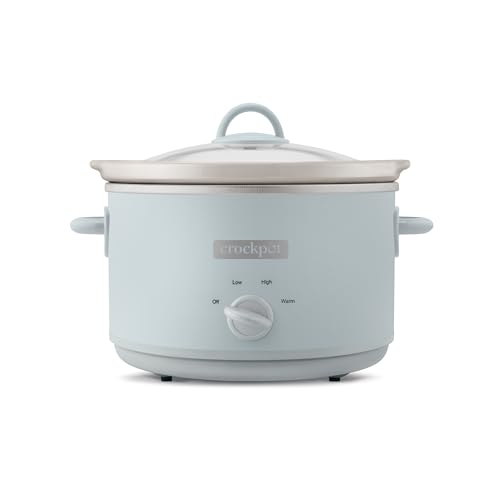
Crock-Pot Design Series Slow Cooker, 4.5-Quart (Light Blue Macaroon) — Best Looking Stoneware
The Design Series Crock-Pot is the style pick of the stoneware class: a 4.5-quart manual cooker in Light Blue Macaroon with a modern-vintage shape, included here with its size flagged in the open. Half a quart under the headline buys the best-looking cooker in this roundup, and in practice 4.5 quarts cooks the same family stews and soups that most 5-quart owners actually make. If your batches routinely fill a true 5-quart crock to the brim, size up to the step-up picks; if they do not, this is the one that will make you smile on the counter.
Strengths
- Crock-Pot’s Design Series finish is the prettiest in this guide — a genuine countertop object
- Three manual settings and dishwasher-safe parts keep the ownership story simple
- At 4.5 quarts it serves the same small-family meals as most nominal 5-quart cookers
Trade-offs
- It is a 4.5-quart cooker in a 5-quart guide — flagged; batch cooks who fill to the line should size up
- Manual only, no timer or delay start
- The pastel finish is a commitment, and a coloured crock shows chips more honestly
| Capacity | 4.5 quarts — just under this guide’s 5-quart headline, flagged openly |
| Controls | 3 manual cook settings |
| Design | Light Blue Macaroon, modern-vintage aesthetic (per listing) |
| Care | Dishwasher safe (per listing) |
Versatility in this category is easy to oversell, but a cooker like the Crock-Pot Design Series Slow Cooker, 4.5-Quart (Light Blue Macaroon) covers more than stews. Steel-cut oatmeal overnight, a batch of stock from a chicken carcass, mulled cider held at serving temperature, warm dips for a gathering, pulled chicken for a week of sandwiches — all sit comfortably in a 5-quart crock. What it will never do is brown, crisp or sear, and no slow cooker will. Judge it as a gentle-heat specialist and it is one of the highest-use appliances a kitchen this size can own.
Consider the recipes this size serves best and the Crock-Pot Design Series Slow Cooker, 4.5-Quart (Light Blue Macaroon) slots in naturally. A 5-quart crock is the right vessel for a pot of chili built for a small household with one leftover lunch, a chicken stew that starts with thighs rather than a whole bird, a batch of steel-cut oats that feeds two people for two mornings, or a pork shoulder in the two-to-three-pound range cut to fit. Scale a family recipe down by a third, keep the liquid a little shy of the original proportion — slow cookers lose almost nothing to evaporation — and seasoning concentrated at the end, and the results are reliably better than a big crock half-empty ever manages.
There is a sensory detail worth naming with the Crock-Pot Design Series Slow Cooker, 4.5-Quart (Light Blue Macaroon): a house that has had a slow cooker running all afternoon smells like someone competent is in charge of dinner. That is not a spec, but it is a real part of why this category endures — the cook comes home to food that is already an atmosphere. At 5-quart, that effect arrives in exactly the quantity a small household can eat, rather than in leftovers that outstay their welcome by Thursday.
Best for: Style-led kitchens serving from the crock / Not suited for: Brim-filling batch cooks

Kenmore 5 Quart Slow Cooker — Best True 5-Quart Ceramic Insert
Kenmore’s 5-quart cooker is the department-store classic updated: stainless steel outside, a non-stick insert inside, a glass lid, and a true family-of-four capacity. It is aimed squarely at the household that wants one cooker for weeknight stews, soups and rice-warming duty without paying for programmability it will never open the manual for. The non-stick insert is the practical heart of it — sauces release, cleanup is a rinse and a cycle — balanced against the usual coating care rules, which the guide below sets out plainly.
Strengths
- A true 5-quart capacity in a stainless steel body at the accessible end of the market
- Non-stick insert releases sauces and cleans with minimal soaking
- The Kenmore name carries a long appliance heritage behind a modern listing
Trade-offs
- Non-stick inserts ask for gentle utensils and no metal scouring
- The listing’s feature language is broad — judge it as a straightforward family cooker, not a sous vide instrument
- Controls are simple rather than programmable
| Capacity | 5 quarts — fits a 5 lb chicken / 3 lb roast (per listing) |
| Body | Stainless steel (per listing) |
| Insert | Non-stick ceramic insert, dishwasher safe (per listing) |
| Lid | Glass |
Cleaning is where slow cookers quietly win or lose owners, and the Kenmore 5 Quart Slow Cooker is on the right side of that line when its crock and lid go in the dishwasher as its listing promises. Dried-on sauce still rewards a ten-minute soak before the machine does the rest. The glaze is the long-term story: a smooth, intact surface releases food and resists staining for years, while a crazed or chipped crock is the signal to retire it. This guide weighs those care details as heavily as settings when it hands out badges.
There is also a budget argument that rarely gets made for this class: a 5-quart cooker right-sizes expensive ingredients. Braising cuts, dried beans and whole spices go further in small batches because nothing is cooked ‘just to fill the pot’. Households cooking for one or two routinely find that moving down a size cuts both the grocery bill and the leftover fatigue that makes people abandon slow cooking altogether. The cooker pays for itself in avoided waste faster than in energy savings, though it sips electricity compared with heating a whole oven for one small dish.
Finally, consider the exit costs of the Kenmore 5 Quart Slow Cooker, because good buying includes them. If your household grows, this size becomes the second cooker — for sides, dips and drinks — rather than a mistake to sell. If your household shrinks, it becomes the main cooker and the big one leaves. Versatility across life stages is built into this size class, and it is part of why the guide rates the honest middle sizes so highly against both extremes.
Best for: Practical families who prioritise easy release / Not suited for: Buyers set on traditional glazed stoneware

bella 6.0 Qt Manual Slow Cooker (Oatmilk) — Best Stoneware Step-Up
bella’s 6-quart is the design-conscious step-up: a stoneware pot wearing a ceramic nonstick coating, cool-touch handles, a tangle-free cord wrap, and an Oatmilk finish that looks considered rather than appliance-grey. It is flagged here as a quart over this guide’s headline, included because its pot construction — stoneware underneath, modern coating on top — is exactly the hybrid the stoneware shopper should know exists. Buy it if your batches run large and your kitchen runs visual; the true-5 pick above remains the right size for ordinary family batches.
Strengths
- The listing pairs a stoneware pot with a ceramic nonstick coating — traditional body, easy-release surface
- Cool-touch handles and a cord wrap are small design wins you feel every time you move or store it
- A full 6 quarts for whole chickens and doubled batches, in a soft Oatmilk finish
Trade-offs
- A step-up size: bigger footprint, and small batches cook unevenly in it
- Ceramic nonstick surface wants gentle utensils, unlike classic glazed stoneware
- Manual settings only — no timer at this size and tier
| Capacity | 6.0 quarts — a flagged step-up from this guide’s 5-quart headline |
| Pot | Stoneware pot with ceramic nonstick coating, dishwasher safe (per listing) |
| Controls | 3 temperature settings |
| Details | Cool-touch handles, tangle-free cord wrap, tempered glass lid (per listing) |
One honest note on temperature behaviour: manual slow cookers are simple machines, and their Low and High are wattage settings, not precise thermostats. The bella 6.0 Qt Manual Slow Cooker (Oatmilk) will hold a gentle simmer on High and a slower climb on Low, which is all a stew asks for. If your cooking life depends on a cooker that switches itself to Warm at a set hour while you are out, a programmable pick elsewhere in this guide is the right tool; if you cook while you are home or nearby, this simpler design has fewer parts to fail and nothing to reprogram after a power cut.
Consider the recipes this size serves best and the bella 6.0 Qt Manual Slow Cooker (Oatmilk) slots in naturally. A 5-quart crock is the right vessel for a pot of chili built for a small household with one leftover lunch, a chicken stew that starts with thighs rather than a whole bird, a batch of steel-cut oats that feeds two people for two mornings, or a pork shoulder in the two-to-three-pound range cut to fit. Scale a family recipe down by a third, keep the liquid a little shy of the original proportion — slow cookers lose almost nothing to evaporation — and seasoning concentrated at the end, and the results are reliably better than a big crock half-empty ever manages.
Ownership, month three and beyond, is where the bella 6.0 Qt Manual Slow Cooker (Oatmilk) either becomes furniture or becomes a favourite. The pattern owners report across this category is consistent: the cooker gets used heavily for the first fortnight, then settles into the two or three dishes it does best for that household — and that settling is success, not failure. A 5-quart cooker with three signature dishes in rotation is doing more real work than a feature-stacked appliance still waiting for its occasion. Judge this pick by whether its badge matches the dishes your household actually repeats.
Best for: Large-batch cooks who want the hybrid pot / Not suited for: Small kitchens and small batches

GreenLife 6 Quart Programmable Slow Cooker (Turquoise) — Best Programmable Step-Up
GreenLife’s 6-quart programmable is the feature step-up of this guide: five modes, a delay start and keep warm, wrapped around a PFAS-free ceramic crock in turquoise. It is included, flagged as a size up, because it is the pick for the stoneware-curious buyer who also wants the cooker to run itself while they are out. The crock is a coated ceramic rather than classic glazed stoneware — the guide’s material section explains that distinction in full — and for many households the easy release and programmability will outweigh purist construction.
Strengths
- Programmability — five modes, delay start, keep warm — at a full family size
- The ceramic crock is marketed PFAS-free and goes in the dishwasher
- The turquoise finish gives a big cooker genuine counter presence
Trade-offs
- A step-up from 5 quarts in both footprint and batch logic
- Ceramic nonstick care rules apply — gentle utensils, no thermal shock
- Programmable electronics carry the usual extra complexity over a manual dial
| Capacity | 6 quarts — a flagged step-up from this guide’s 5-quart headline |
| Crock | PFAS-free nonstick ceramic removable crock, dishwasher safe (per listing) |
| Controls | Programmable, 5 modes, delay start, keep warm (per listing) |
| Finish | Turquoise |
Storage and counter life deserve a thought at the 5-quart size. The cooker is light enough to move in and out of a cupboard weekly without becoming a chore, yet substantial enough to live on the counter without looking lost. Measure your shelf height with the lid on before you buy — lids and handles add more height than the headline dimensions suggest — and keep the cord’s short reach in mind when you picture where it will sit relative to your outlets.
There is also a budget argument that rarely gets made for this class: a 5-quart cooker right-sizes expensive ingredients. Braising cuts, dried beans and whole spices go further in small batches because nothing is cooked ‘just to fill the pot’. Households cooking for one or two routinely find that moving down a size cuts both the grocery bill and the leftover fatigue that makes people abandon slow cooking altogether. The cooker pays for itself in avoided waste faster than in energy savings, though it sips electricity compared with heating a whole oven for one small dish.
A word on longevity with the GreenLife 6 Quart Programmable Slow Cooker (Turquoise): slow cookers fail in boring ways — a cracked crock from a drop or thermal shock, a lid handle loosened, an element that fades after years of service. The design choices in this pick lean against those failures rather than towards novelty, and replacement crocks for established lines remain the cheapest insurance in the category. Treat the crock kindly, keep the base dry, and there is no scheduled end to this appliance’s working life.
Best for: Busy families wanting automation and size / Not suited for: Manual-dial traditionalists
Comparison Table
All six picks side by side. Capacity and feature claims are taken from each maker’s verified listing, and where a pick sits deliberately outside the headline size, the table says so rather than hiding it.
| Pick | Badge | Key spec | Best for |
|---|---|---|---|
| Blue Diamond 5QT Hinged-Lid Slow Cooker (Check on Amazon) | Best True 5-Quart | 5 qt ceramic nonstick crock, hinged lid, 4 presets with delay | A genuine 5 qt with a hinged lid and delay start |
| Crock-Pot Manual Slow Cooker, 4.5-Quart (Purple Potato) (Check on Amazon) | Best Classic Stoneware Just Under | 4.5 qt (flagged: half-quart over), oven-safe stoneware | Oven-safe stoneware at a flagged 4.5 quarts |
| Crock-Pot Design Series Slow Cooker, 4.5-Quart (Light Blue Macaroon) (Check on Amazon) | Best Looking Stoneware | 4.5 qt (flagged: just under 5), Design Series finish, 3 manual settings | The Design Series finish at a flagged 4.5 quarts |
| Kenmore 5 Quart Slow Cooker (Check on Amazon) | Best True 5-Quart Ceramic Insert | 5 qt, stainless body, non-stick ceramic insert, glass lid | Stainless body, non-stick ceramic insert, family size |
| bella 6.0 Qt Manual Slow Cooker (Oatmilk) (Check on Amazon) | Best Stoneware Step-Up | 6 qt (flagged step-up), stoneware pot with ceramic nonstick, cord wrap | Stoneware pot with ceramic nonstick at a flagged 6 quarts |
| GreenLife 6 Quart Programmable Slow Cooker (Turquoise) (Check on Amazon) | Best Programmable Step-Up | 6 qt (flagged step-up), programmable, PFAS-free ceramic crock | PFAS-free ceramic crock with delay start at a flagged 6 quarts |
How to Choose the Right 5-Quart Stoneware Slow Cooker
Start with capacity, because it is the decision you cannot undo. A slow cooker’s stated quarts are brim capacity; the working capacity is roughly two-thirds of that once you respect the fill line. A 4-quart cooker serves two to four people honestly, a 5-quart stretches to a small family with leftovers, and 6 to 7 quarts is gathering and batch-cooking territory. Choose for the meals you cook monthly, not the feast you host yearly.
Next, crock material. Stoneware and ceramic crocks distribute gentle heat evenly, hold it well, and usually go from cooker to table to dishwasher; they are also heavy and can chip. Coated metal inserts are lighter and sometimes stovetop-safe for searing, which saves a pan and builds flavour, but coatings demand gentler utensils. The finish on the base — stainless steel, coloured enamel-look, or plain — matters for kitchens where the cooker lives on the counter in plain sight.
Controls come in two philosophies. Manual dials (Low, High, Warm) are cheap, repairable and immune to power-cut amnesia, but they will not switch themselves off or drop to Warm when time expires. Programmable models add timers, delayed starts and automatic keep-warm, which suit cooks who load the pot in the morning and leave. Neither philosophy cooks better; they differ in who has to be home.
Finally, judge the details: a glass lid you can see through without lifting, handles that stay cool and give a secure grip on a full crock, a cord length that reaches your outlet without crossing the sink, and dishwasher-safe parts if hand-washing a heavy crock would quietly end your slow-cooking habit within a month.
How to Use and Care for a Stoneware Crock at Family Size
Step 1 — Load in the right order. Root vegetables and aromatics go in first, closest to the heat; meat sits on top of them; liquid comes last and should rarely cover the ingredients completely — slow cookers trap moisture, so a stew needs far less added liquid than the same dish on the stove.
Step 2 — Respect the fill band. Fill the crock between half and two-thirds full. Less and the edges scorch before the centre cooks; more and you risk bubbling over the rim and uneven cooking. At this size, that band is the difference between a recipe working and mysteriously failing.
Step 3 — Choose Low for time, High for speed. Low and High reach the same final simmer; they differ in how fast they get there. As a working rule, a dish that takes three hours on High wants seven to eight on Low. Dairy, fresh herbs and delicate vegetables go in during the last half hour either way.
Step 4 — Leave the lid on. Every lift dumps the trapped heat and adds meaningful time to the cook. Look through the glass, trust the plan, and check tenderness near the end of the window rather than throughout it.
Step 5 — Finish actively. Taste and season at the end, when flavours have settled. A splash of vinegar or citrus, fresh herbs, or a knob of butter stirred through a finished stew does more for it than any extra hour of cooking would.
Step 6 — Cool and store safely. Do not leave finished food sitting in the crock at room temperature or on Warm for many hours. Move leftovers to shallow containers, refrigerate promptly, and let the crock cool before washing to protect the glaze from thermal shock.
Common Buying Mistakes
- Buying the headline size for the wrong household. Quarts are brim capacity. A cooker that is too big cooks small meals badly — edges scorching, centres lagging — and a cooker that is too small simply overflows. Match working capacity to your two or three most common meals.
- Treating Warm as a cooking setting. Warm holds finished food at serving temperature; it does not cook raw food safely or finish a stew. Start on Low or High, and use Warm for the last stretch of serving, not the whole afternoon.
- Drowning the dish. Slow cookers lose almost no liquid. Recipes written for the stove need their liquid cut back, often by a third or more, or dinner arrives as soup wearing a stew’s name.
- Lifting the lid to check. Every peek dumps trapped heat and stretches the cooking time. The glass lid exists so you do not have to open it; trust the recipe window and check once, near the end.
- Adding dairy and fresh herbs at the start. Hours of heat split cream and mute fresh herbs to a shadow. Both belong in the final half hour, where they survive to be tasted.
- Washing a hot crock in cold water. Thermal shock is how stoneware crazes and cracks. Let the crock cool on the counter first, soak if needed, and the glaze will serve for years.
Before You Buy: A Final Checklist
- Confirm the size basis. Check the exact capacity statement in the pick’s spec box above, because this category’s headline numbers are not all measured the same way.
- Measure your space. Check the footprint against your counter and the storage spot you actually have, including room for the lid to open or lift clear.
- Match the pick to your three most common meals. Not the most ambitious meal you can imagine — the ordinary ones you cook every week.
- Plan the cleanup. Confirm which parts are dishwasher safe in the verified listing, and be honest about whether you will hand-wash a heavy pot every time.
- Check the current price on Amazon on the product page. Prices and stock in this category move often, and the listing is the only number that counts.
Run through those five checks and the right pick in this guide usually identifies itself. If two picks still tie, choose the one whose trade-offs you mind least — you will live with the trade-offs daily, while the strengths quickly become invisible.
Searing first: when it is worth the extra pan
A slow cooker cannot brown anything, and browning is flavour — so the question is when the extra pan earns its washing. For beef stews and pork shoulders, a hard sear on the meat and a deglazed pan tipped into the crock add a depth that hours of gentle heat cannot create on their own. For chicken soups, bean dishes and most weeknight braises, the difference is smaller and the skip is forgivable. A practical middle path: sear when the dish is the event, skip when it is Tuesday. If searing matters to you often, a cooker with a stovetop-safe insert — or a separate heavy pan you already own — closes the gap without changing the rest of your routine.
Adapting stove and oven recipes to this size
Most braises and stews convert gracefully: cut the liquid back, because the crock loses almost nothing to evaporation; keep the aromatics and seasoning at full strength; and scale the solids to sit inside the half-to-two-thirds fill band. Oven braises at low temperatures map to Low on the cooker, with time extended; stovetop simmers map to High for shorter cooks. Dairy, quick vegetables and fresh herbs shift to the end. Write the conversion on the recipe the first time you make it — your future self, standing in the kitchen at 8 a.m. with the crock in hand, will be grateful for the notes.
What actually fits in a 5-quart slow cooker
Capacity numbers become real when you translate them into food. A 5-quart crock holds a stew built on a modest cut of meat plus vegetables and liquid, a family pot of soup with room to stir, or a batch of pulled meat with sauce to spare. It will not hold the largest whole chicken plus vegetables, a double party batch of chili, or a big bone-in roast with all the trimmings — and pretending otherwise is how buyers end up disappointed in week two. Match the cooker to the meals you make monthly, and let the rare feast be the job of a borrowed roasting pan or a second, larger cooker you own cheaply. The cookers that stay in weekly rotation for a decade are the ones sized for ordinary Tuesdays, and this size class exists precisely because ordinary Tuesdays are most of cooking.
Batch cooking and leftovers at this size
A 5-quart cooker is a natural meal-prep tool: cook once, eat twice, and freeze a third portion flat in a bag for a future weeknight. Soups, braises and shredded meats freeze and reheat better than almost anything else you can make, and they are precisely the dishes this size handles best. Label portions with the date and the dish, rotate the freezer stock monthly, and the cooker quietly becomes the reason weeknight dinners stop being a daily negotiation. The other half of the system is containers: a set of identical, stackable, freezer-safe boxes turns a Sunday batch into a shelf of ready meals, and the cooker earns its counter space every time one of them comes back out.
Energy and running costs in perspective
Slow cookers sip electricity compared with heating a whole oven for one dish, and a 5-quart model sits at the frugal end of even that frugal category. The practical consequence is that long, gentle cooking is cheap enough to be an everyday habit rather than a weekend project. It also means the cooker earns its place in small homes, rentals and RVs where running a full oven heats the whole living space — a hidden cost in summer that a countertop cooker avoids entirely. Over a year of weekly use, the energy difference between this and oven braising is one of the few appliance savings that is real rather than marketing.
Getting the seasoning right in long, gentle cooking
Slow cooking mutes herbs and spices over hours, so season in layers rather than all at once. Dried herbs, whole spices and aromatics go in at the start for depth; salt is best judged at the end, when the liquid has settled into its final concentration. Fresh herbs, citrus zest and juice, vinegar and heat — chilli, black pepper, hot sauce — belong in the last half hour, where they survive to be tasted. A splash of acid at serving wakes up a long-cooked stew more reliably than any extra hour of cooking, and a small pinch of sugar balances tomato-heavy dishes that taste harsh after a full day in the crock. Taste at the end, adjust once, and write down what you did: small batches concentrate both mistakes and triumphs.
Final Recommendation
Start with the Blue Diamond 5QT Hinged-Lid Slow Cooker, our Best True 5-Quart pick: it is the model we would buy for the widest range of households searching for best 5 qt stoneware slow cookers. If its particular strengths do not match your situation, the Crock-Pot Manual Slow Cooker, 4.5-Quart (Purple Potato) (Best Classic Stoneware Just Under) is the alternative we would choose next, and every other pick in this guide exists because it serves a specific household better than either of those two. Check on Amazon / Check on Amazon
Still deciding between neighbouring sizes or formats? Compare the related guides in this series: Best 5 Quart Slow Cookers, Best 5 Quart Slow Cookers At Penneys, Best 6 7 Quart Slow Cookers With Stainless Steel Finish, Best 6 Cup Rice Cookers, Best 6 Qt Pressure Cookers. Sizes in this category sit close together, and ten minutes with the comparison tables in those guides is the cheapest way to avoid buying the wrong capacity.
Frequently Asked Questions
How many people does this size of slow cooker actually feed?
Count working capacity, not headline quarts: plan on roughly two-thirds of the stated size as usable volume. In practice the sizes in this guide serve small households through to gathering-sized batches as the comparison table lays out, with the badge on each pick naming the household it suits best.
Can I leave a slow cooker on while I am out of the house?
Slow cookers are designed for unattended cooking on a stable, heat-safe surface away from clutter, and programmable models that drop to Warm add a further margin. Use sensible precautions — nothing flammable nearby, a sound outlet, and a cooker in good condition — and follow the manufacturer’s guidance for your model.
Why is my stew watery when the same recipe works on the stove?
A slow cooker traps nearly all its moisture, while a stove pot evaporates steadily. Cut the recipe’s liquid back — often by a third — and thicken at the end if needed, rather than adding the full stovetop quantity at the start.
Is Low just a slower version of High?
Essentially yes: both settings settle at the same gentle simmer, and differ in how quickly they get there. That is why recipes convert — a dish done in three hours on High generally wants seven to eight on Low.
Can I put a frozen roast straight into a slow cooker?
Food-safety guidance is to thaw meat before slow cooking, because a large frozen piece spends too long in the temperature range where bacteria multiply. Thaw in the refrigerator overnight and the cooker can do the rest.
How do I stop the crock from staining or crazing?
Let it cool before washing, soak dried-on food instead of scouring, and avoid sudden temperature swings. Light staining is cosmetic; a network of fine cracks in the glaze means the crock has done its service and should be retired.


