Disclosure: airfryerkitchensupply.com is reader-supported. When you buy through links on our site, we may earn an affiliate commission at no extra cost to you.
Where to buy
The machines in this guide to the best 4 cup coffee makers are all sold through Amazon, where you can check the current price on Amazon for each model, confirm the exact variant, and read the manufacturer’s full listing before you buy. Prices and availability in this category move often, so this guide never prints a fixed price — use the links below to see today’s figure for the pick you choose.
- Elite Gourmet EHC4128 Automatic 4-Cup Drip Coffee Maker — Check the current price on Amazon
- Capresso 5-Cup Mini Drip Coffee Maker — Check the current price on Amazon
- Mr. Coffee 5-Cup Mini Brew Switch Coffee Maker — Check the current price on Amazon
- KRUPS Simply Brew Compact 5 Cup Coffee Maker — Check the current price on Amazon
- Cuisinart 5-Cup Coffee Maker with Stainless Steel Carafe (DCC-5570) — Check the current price on Amazon
- Zojirushi ZUTTO EC-DAC50 Coffee Maker, 5 Cups — Check the current price on Amazon
The best 4 cup coffee makers solve a problem the rest of the industry keeps oversizing: two mugs, brewed fresh, with nothing left to stale. A 4-cup machine makes about 20 ounces — and because the class is small, the differences between a good one and a disappointing one come down to honest capacity, basket design, and whether anyone sells a replacement carafe.
This guide leads with the genuine 4-cup machines, then includes the 5-cup models a 4-cup shopper should consider with eyes open — each labelled for exactly what it is. Every pick was verified against its manufacturer’s listing, and the reviews are blunt about the class’s universal weakness: almost nothing at this size has a timer or auto shut-off, so the guide flags the exceptions.
In this guide
Quick Picks: The Best 4-Cup Coffee Makers
- Best Overall — Elite Gourmet EHC4128 Automatic 4-Cup Drip Coffee Maker: True 4-cup size, reusable filter, keep-warm plate. Check price on Amazon
- Best for Long-Term Ownership — Capresso 5-Cup Mini Drip Coffee Maker: Mini drip format, black and stainless finish. Check price on Amazon
- Best 5-Cup Alternative — Mr. Coffee 5-Cup Mini Brew Switch Coffee Maker: One-switch brew, compact footprint. Check price on Amazon
- Best Looking — KRUPS Simply Brew Compact 5 Cup Coffee Maker: Stainless design, drip-free carafe, reusable filter. Check price on Amazon
- Best Upgrade — Cuisinart 5-Cup Coffee Maker with Stainless Steel Carafe (DCC-5570): Stainless thermal-style carafe, charcoal filter, removable reservoir. Check price on Amazon
- Best for Serious Coffee Drinkers — Zojirushi ZUTTO EC-DAC50 Coffee Maker, 5 Cups: Japanese-engineered 5-cup brewer, PFAS-free listing. Check price on Amazon
How These Picks Were Chosen
Every machine in this guide to the best 4-cup coffee makers was checked against the manufacturer’s own listing through Amazon’s catalogue data before it earned a place. That verification step matters more in this corner of the market than in most, because small brewers are sold under shifting model names, colour variants get listed as separate products, and capacity claims are notoriously elastic. If a model’s identity or capacity could not be confirmed, it did not get a link — full stop.
From the verified shortlist, machines were shortlisted on five criteria. First, honest capacity: the carafe or brew size had to match the size class in the search, using the coffee industry’s small ‘cup’ measure rather than mug marketing. Second, the features people actually use weekly — pause-and-pour, reusable filters, readable water windows, auto shut-off — counted for more than novelty extras. Third, parts and carafe availability were weighed, because a small brewer with an unreplaceable glass pot is a disposable product. Fourth, footprint and loading style were matched to the kitchens these machines live in: under cabinets, in dorms, on desks. Fifth, each pick had to own a distinct job. Six near-identical black boxes would be a worse guide than six machines that each win for a different household.
Selection for the 4-cup class applied the strictest capacity audit in this series of guides. Models whose listings blurred their true carafe size were excluded or demoted, and preference went to machines with reusable filters — at 20 ounces a pot, a household brewing daily goes through paper filters at a rate that makes the reusable option a financial feature, not an eco garnish.
One more rule governed the final list: nothing with a known safety recall was eligible, and no machine was included on the strength of a headline feature its listing could not support. Where a size tier turned out to be thin or effectively empty in today’s market, this guide says so in plain language rather than padding the list with oversized machines relabelled as small ones.
The Best 4-Cup Coffee Makers Reviewed

Elite Gourmet EHC4128 Automatic 4-Cup Drip Coffee Maker — Best Overall
The EHC4128 is one of the few machines in this roundup that is honestly a 4-cup brewer rather than a 5-cup model rounded down. That smaller carafe is the whole argument: two people, two mugs, no half-pot going stale on a warmer. It includes a reusable filter, Pause N Serve for an early pour, and a water level indicator — a fuller feature set than the bare-bones reputation of this size class suggests, in a body small enough to live in a cabinet between uses.
The EHC4128 is the class benchmark: a true 4-cup carafe, a reusable filter in the box, Pause N Serve, and a water window you can read. It does the two-mug job completely, costs little to run, and takes up less counter than a toaster. Most 4-cup shoppers can stop reading here — the rest of the list is for specific needs.
Strengths
- A genuine 4-cup carafe — the right size for two standard mugs with no stale leftovers
- Reusable filter and Pause N Serve are features many 4-cup rivals still treat as extras
- Small, light body is easy to move, store in a cabinet, or pack for a work site office
Trade-offs
- Keep-warm function is manual — switch it off or the last cup bakes
- Four cups is four 5-ounce coffee cups, so big-mug households will brew twice
- No programmability and no auto shut-off
| Capacity | 4-cup glass carafe |
| Filter | Reusable filter included |
| Features | Pause N Serve, keep warm, water level indicator (manufacturer listing) |
Expectations should match the format. It brews a small, hot pot quickly and cleans up fast, but there is no timer, no auto shut-off, and no thermal carafe to protect a second hour of drinking. The keep-warm plate does its job for the first 30 to 45 minutes; after that the coffee declines the way all plate-warmed coffee declines. Bought for what it is — a two-mug machine for a small household, a camper kitchen, or a desk — it is one of the most sensibly specced 4-cup options currently sold.
This is a machine you maintain with a sink and thirty seconds: rinse the basket, rinse the carafe, done. The reusable filter removes the only recurring purchase. Its small scale makes descaling quick — a half reservoir of solution is a full treatment — and its light weight makes it the easiest pick here to store in a cupboard between uses.
Best for: Two-mug households that never finish a bigger pot / Not suited for: Anyone whose ‘cup’ is a 16-ounce travel tumbler
Check the current price on Amazon
Capresso 5-Cup Mini Drip Coffee Maker — Best for Long-Term Ownership
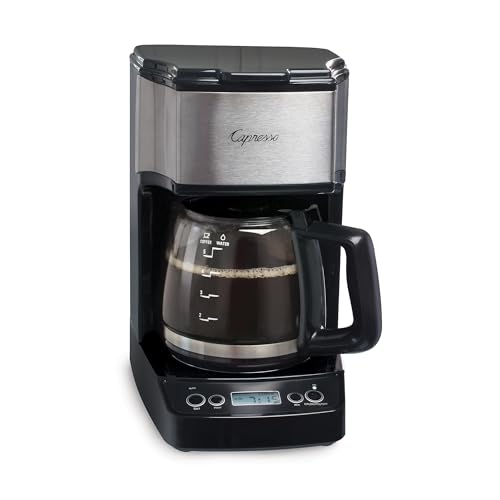
Capresso’s 5-Cup Mini Drip is the quiet veteran of this category: a coffee-specialist brand’s small machine that has stayed in the catalogue while flashier rivals came and went. That longevity has a practical benefit buyers overlook — replacement carafes and parts for a long-running model are far easier to source than for a one-season novelty. The black-and-stainless finish also helps it disappear into a modern kitchen rather than announcing itself as a budget appliance.
Capresso’s Mini Drip wins the ownership argument: a coffee-focused brand, a model with a long production history, and a replacement carafe sold as a normal spare part. If you keep appliances until they die of old age, this is the 4-cup-adjacent machine whose support story matches your habits.
Strengths
- Long-running model from a coffee-focused brand, with replacement carafes sold separately
- Black-and-stainless finish blends into modern kitchens better than plain black plastic
- Mini footprint suits galley kitchens, RVs, and office nooks
Trade-offs
- Feature set is minimal next to newer rivals — no timer and a basic control layout
- Brand support is solid but the model’s age shows in small ergonomic details
- Glass carafe fragility applies here as with all glass-pot machines
| Capacity | 5-cup glass carafe |
| Design | Black and stainless steel finish (manufacturer listing) |
| Format | Mini drip countertop brewer (manufacturer listing) |
As a brewer it is a conventional, competent drip machine: fill, switch, wait a few minutes, pour. It does not chase the timer crowd or the thermal-carafe crowd, and its control layout will feel dated next to the newest models. Where it wins is trust and footprint — it is small, it is proven, and its maker actually sells the carafe separately (the listing for the 426-series replacement carafe exists precisely because the installed base is large). For a buyer who values a known quantity over new features, that is a rational trade.
The Capresso’s ownership advantage is documentation and spares: a coffee-specialist brand that sells the replacement carafe for this exact model as a normal catalogue item. Daily care is standard drip fare — rinse, dry, descale — and the model’s long production run means community knowledge for every quirk is a quick search away.
Best for: Buyers who value a proven model with available spare parts / Not suited for: Anyone who wants the newest feature set at this size
Check the current price on Amazon

Mr. Coffee 5-Cup Mini Brew Switch Coffee Maker — Best 5-Cup Alternative
The Mr. Coffee 5-Cup Mini Brew Switch is the small brewer reduced to its essentials: fill the reservoir, add grounds to the basket, set the glass carafe on the plate, and flip one switch. There is no timer, no strength selector, and no digital display, and for a certain kind of household that restraint is exactly the point. It suits one or two drinkers who brew a small pot in the morning, drink it within the hour, and want a machine that a guest, a teenager, or a half-awake partner can operate without instructions.
Label honesty: this is a 5-cup machine, included because it is the one most 4-cup shoppers should cross-shop. It brews a clean measured half batch for two-mug days and a full pot for guests, with the simplest controls in the business. If your mug count ever fluctuates, this flexibility beats a strict 4-cup carafe.
Strengths
- Dead-simple one-switch operation — no menus, no clock to set, nothing to misconfigure on a groggy morning
- Compact body fits under low cabinets and in corners where a full-size brewer will not
- Replacement glass carafes for this long-running design are widely available, which extends the machine’s working life
Trade-offs
- No programmable auto-start, so coffee cannot be waiting when you wake up
- No auto shut-off beyond the warming plate switch — you have to remember to turn it off
- Basic showerhead coverage can under-extract if you overload the basket with fine grounds
| Capacity | 5 cups / 25 oz glass carafe |
| Controls | Single brew switch with indicator light |
| Design | Compact countertop footprint (manufacturer listing) |
In daily use the appeal is predictability. The brew cycle is short because the water volume is small, the carafe pours cleanly for its class, and the whole machine wipes down in seconds. The trade-off for that simplicity shows up in the cup: with no bloom phase and a basic spray pattern, very fresh light-roast beans will taste a little flatter here than in a brewer with better water distribution. Use a medium grind, keep the dose consistent, and descale on schedule, and it produces a honest, hot, repeatable small pot — which is all most buyers in this size class are actually asking for.
Ownership is as simple as the machine: the carafe and basket tolerate daily dishwashing, the plate wipes clean, and the only recurring task is descaling when the brew slows. Because the design has been sold for years, a replacement carafe is a commodity purchase rather than a treasure hunt — the single biggest predictor of a small brewer’s total lifespan.
Best for: Solo drinkers and couples who want a small pot with zero learning curve / Not suited for: Anyone who wants coffee brewed automatically before they wake up
Check the current price on Amazon

KRUPS Simply Brew Compact 5 Cup Coffee Maker — Best Looking
KRUPS built its reputation on tidy European design, and the Simply Brew Compact is what that philosophy looks like at 5 cups. The stainless-accented body sits more handsomely on the counter than the all-plastic competition, and the drip-free carafe is a small daily mercy — the spout geometry genuinely pours without the trailing dribble that plagues cheap glass pots. Pause & Brew, a keep-warm plate, and an included reusable filter complete a spec with no obvious holes.
The KRUPS Simply Brew is the 5-cup machine for kitchens where the brewer is on permanent display: stainless accents, the best drip-free pour in the class, and a reusable filter. You pay a design premium over the basic boxes; on an open-plan counter, it is a premium with a daily return.
Strengths
- Drip-free carafe spout is the best pourer in this class — no counter-wiping after every pot
- Stainless-accented body looks and feels a class above the all-plastic budget machines
- Reusable filter, keep warm, and Pause & Brew cover the full small-brewer checklist
Trade-offs
- Costs more than the basic switch models while brewing a similar-strength cup
- Keep warm is plate-based, so the last cup still stales if it sits too long
- Compact reservoir opening can be awkward to fill from a large jug
| Capacity | 5-cup carafe |
| Design | Stainless steel accents (manufacturer listing) |
| Features | Pause & Brew, keep warm, reusable filter, drip-free carafe (manufacturer listing) |
Blindfolded, its coffee is close to the other good 5-cup drip machines; you are paying for design, pour quality, and finish rather than a transformation in the cup. That is a legitimate reason to buy — this is an appliance that lives on your counter in plain sight — as long as you go in knowing the premium is cosmetic and ergonomic. The reservoir mouth is the one ergonomic miss: fill it from a small jug or the carafe itself rather than a wide kettle spout.
KRUPS ownership is about keeping the finish: the stainless accents reward a wipe with a soft cloth and punish abrasive pads. The drip-free carafe is not just a pour pleasure — fewer drips mean a cleaner plate and less baked-on coffee to scrub. The reusable filter and standard sizing keep consumables at zero and spares straightforward.
Best for: Design-conscious small kitchens that keep the brewer on display / Not suited for: Strict budget buyers — simpler models brew a comparable cup for less
Check the current price on Amazon

Cuisinart 5-Cup Coffee Maker with Stainless Steel Carafe (DCC-5570) — Best Upgrade
The Cuisinart DCC-5570 is the machine for people who have already broken one glass carafe — or know they eventually will. Its stainless steel carafe removes the most fragile part of every other brewer in this list, and because steel holds heat without a hot plate cooking the coffee, a pot brewed at seven still tastes respectable at eight. Add a removable water reservoir you can fill at the tap and a charcoal filter for the water itself, and nearly every small daily friction of the category has been thought about.
Also a 5-cup machine — and the upgrade path when a 4-cup shopper’s real problem is breakage or staling rather than size. The steel carafe cannot shatter and does not cook the coffee, the reservoir removes for sink filling, and the charcoal filter improves hard-tap-water towns’ cups noticeably.
Strengths
- Stainless steel carafe cannot shatter on a tile floor and keeps coffee hotter without a scorching plate
- Removable reservoir fills at the sink — no more aiming a carafe into a cramped machine top
- Charcoal water filter noticeably softens the taste of chlorinated tap water in small batches
Trade-offs
- Keep warm runs about 30 minutes, shorter than plate models that stay on indefinitely
- Stainless carafe hides the coffee level, so you cannot see how much is left at a glance
- The premium pick of this roundup — budget shoppers get similar brew volume for much less
| Capacity | 5-cup stainless steel carafe |
| Water | Removable reservoir with charcoal water filter (manufacturer listing) |
| Features | Brew Pause, 30-minute keep warm (manufacturer listing) |
The design choices cut both ways, and honesty matters here: you cannot see the coffee level through steel, and the roughly 30-minute keep-warm window is a nudge to drink promptly rather than graze all morning. The brew itself benefits from the filtered water more than from any exotic extraction tech — with hard, chlorinated tap water the difference over an unfiltered budget machine is real. For a household that values durability and drinks its pot within the hour, this is the most complete small brewer in the roundup.
The steel carafe changes maintenance for the better: no glass to baby, no plate scale ring, and it can take a bottle brush without anxiety. The charcoal filter is the one recurring consumable — replacements are a standard Cuisinart part. The removable reservoir also makes descaling honest work: you can see the solution, and the scale, at the sink.
Best for: Households tired of replacing broken glass carafes / Not suited for: Slow all-morning grazers who want a plate keeping coffee hot for hours
Check the current price on Amazon
Zojirushi ZUTTO EC-DAC50 Coffee Maker, 5 Cups — Best for Serious Coffee Drinkers
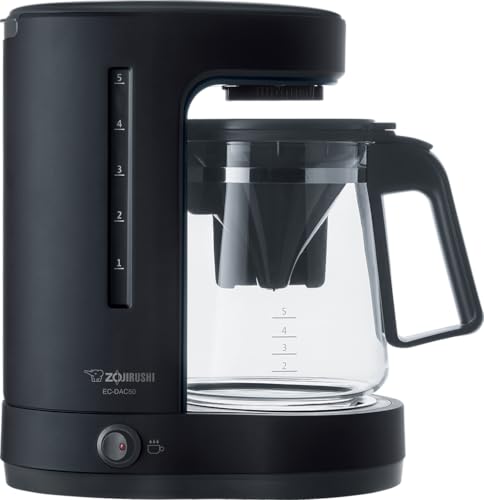
Zojirushi is the brand rice-cooker devotees swear by, and the ZUTTO EC-DAC50 applies the same philosophy to a 5-cup pot: do a simple thing with unusual care. The machine is compact and spare — no sprawling control panel — but the tolerances, the carafe fit, and the consistency from pot to pot are where the money goes. For drinkers who use good beans and have been disappointed by tepid, uneven small brewers, this is the upgrade candidate in the category.
The ZUTTO, again 5 cups, is where 4-cup shoppers land when brew quality outranks strict capacity: the most consistent extraction in this guide and build quality measured in decades. If you buy excellent beans and drink two mugs slowly, this is the machine that respects the beans.
Strengths
- Zojirushi’s build quality and fit-and-finish are a clear step above the budget tier
- Brew temperature consistency is this brand’s calling card, and small pots benefit most
- Compact, tidy industrial design that suits minimalist and Japanese-style kitchens
Trade-offs
- Premium pricing for a machine with a deliberately simple feature set
- No programmable timer — convenience seekers should look at the Mr. Coffee Programmable
- Replacement carafes are brand-specific and pricier than the generic glass pots
| Capacity | 5 cups |
| Design | ZUTTO series compact brewer (manufacturer listing) |
| Listing note | Marketed as PFAS-free (manufacturer listing) |
What you do not get is theatre: no timer, no strength dial, no app. The ZUTTO’s case is that extraction fundamentals — water hot enough, distributed evenly, at a repeatable volume — matter more at 25 ounces than at 60, because there is less margin for error in a small batch. It is also the pick most likely to still be on the counter in a decade. Buy it as a long-term appliance, not as a gadget, and the premium makes sense; buy it expecting features and you will feel short-changed.
Zojirushi ownership is the long game: descale on schedule, treat the carafe as the precision part it is, and the machine simply continues. Spare carafes and parts are brand-channel purchases — pricier than generic glass, but they exist, which is the entire point. Owners tend to measure this machine’s life in decades and hand it down rather than upgrade it.
Best for: Quality-first buyers who keep appliances for years / Not suited for: Feature hunters who want timers and strength settings
Check the current price on Amazon
Comparison Table
| Pick | Badge | Key spec | Best for |
|---|---|---|---|
| Elite Gourmet EHC4128 Automatic 4-Cup Drip Coffee Maker | Best Overall | True 4-cup size, reusable filter, keep-warm plate | Two-mug households that never finish a bigger pot |
| Capresso 5-Cup Mini Drip Coffee Maker | Best for Long-Term Ownership | Mini drip format, black and stainless finish | Buyers who value a proven model with available spare parts |
| Mr. Coffee 5-Cup Mini Brew Switch Coffee Maker | Best 5-Cup Alternative | One-switch brew, compact footprint | Solo drinkers and couples who want a small pot with zero learning curve |
| KRUPS Simply Brew Compact 5 Cup Coffee Maker | Best Looking | Stainless design, drip-free carafe, reusable filter | Design-conscious small kitchens that keep the brewer on display |
| Cuisinart 5-Cup Coffee Maker with Stainless Steel Carafe (DCC-5570) | Best Upgrade | Stainless thermal-style carafe, charcoal filter, removable reservoir | Households tired of replacing broken glass carafes |
| Zojirushi ZUTTO EC-DAC50 Coffee Maker, 5 Cups | Best for Serious Coffee Drinkers | Japanese-engineered 5-cup brewer, PFAS-free listing | Quality-first buyers who keep appliances for years |
How to Choose the Right Small Coffee Maker
Start with the only number that decides satisfaction in this category: how much coffee your household actually drinks in one sitting, measured honestly. Coffee makers do not measure cups the way your mug does. A coffee-maker ‘cup’ is roughly five ounces, so a 5-cup carafe holds about 25 ounces — two generous mugs, or one mug plus a refill. A 4-cup machine holds about 20 ounces. Buyers who skip this conversion are the ones leaving disappointed reviews on perfectly good machines, so do the mug maths first: count your household’s mugs, multiply by their real size, and let that total choose the carafe.
Glass Carafe, Steel Carafe, or No Carafe at All
Glass is the default because it is cheap, light, and lets you see the coffee level — but it is also the part of the machine most likely to end its life against a sink edge or a tile floor. A stainless steel carafe, like the Cuisinart’s in this guide, removes the breakage risk and holds heat without a warming plate cooking the coffee, at the cost of hiding how much is left. The third option is no carafe: a single-serve machine brews straight into your mug, which eliminates staling entirely but commits you to brewing one cup at a time. None of these is objectively best; the right answer depends on whether your household drinks together or one mug at a time.
The Features That Matter at This Size — and the Ones That Do Not
At 4 and 5 cups, four features earn their keep. Pause-and-pour stops the ‘first cup can’t wait’ drip disaster. A reusable filter quietly saves money every single week. A readable water window is the difference between a consistent pot and a daily guess, because at this scale being off by half a cup of water is being off by a fifth of the recipe. And auto shut-off is a genuine safety feature in any home that rushes out the door. Features that matter far less than marketing suggests: strength selectors on basic drip machines (dose and grind do that job better), built-in grinders (hard to clean at this size), and app connectivity on a machine with one job.
Budget Tiers, Explained Without the Hype
Small brewers fall into three honest tiers. The budget tier is the simple switch machines: they brew a decent pot, they ask you to manage the warmer, and their carafes are the fragile kind. The mid tier adds the conveniences — timers, front-loading baskets, better carafes, branded build quality. The premium tier at this size is small: a steel-carafe machine like the Cuisinart, or a Japanese-engineered brewer like the Zojirushi, where the money buys durability and consistency rather than features. Spend according to how long you intend to keep the machine. A dorm machine and a decade-long counter resident should not be the same purchase, and pretending otherwise wastes money in both directions.
What the Listings Do Not Tell You
Manufacturer listings for small drip machines share a blind spot: they photograph the machine empty, on an empty counter, in a kitchen with no cabinets. Reality adds a cabinet underside at exactly lid height, a mug that does not fit the marketing photo’s scale, and a second person trying to make toast in the same square metre. Before buying, act out your morning with a tape measure: where the machine stands, how the lid or basket opens, where the carafe travels to the sink. Ten minutes of this pantomime prevents the most common return reason in the category — not bad coffee, but bad fit.
Listings also stay silent about sound and steam. A small drip machine vents a surprising amount of steam for its size, which matters under wooden cabinet fronts; a machine placed permanently under a low cabinet should be pulled forward while brewing, or chosen in a front-loading design. And the last unlisted truth is the kindest: these machines improve noticeably in their second week, not because they change, but because you do — dose, grind, and timing settle into a routine, and the routine is where good small-pot coffee actually comes from.
Small Pots and Sustainability, Briefly
A right-sized brewer is quietly the greener choice in coffee: less water heated, less coffee brewed and discarded, and less energy holding a large plate warm. The reusable-filter machines in this guide remove the daily paper filter from the waste stream entirely, while the single-serve format in the wider series trades that away for per-cup packaging. None of this should override fit and flavour — a machine you replace in a year because it was wrong is the least sustainable outcome of all — but it is worth knowing that the frugal choice and the sustainable choice in this category are usually the same machine.
How to Set Up and Use Your Small Drip Coffee Maker
Step 1 — Wash before the first pot. Rinse the carafe, lid, and filter basket in warm soapy water, then run one full cycle of plain water through the machine. New small brewers carry factory dust and plastic notes that will otherwise season your first pot.
Step 2 — Measure water by the carafe, not the reservoir marks. Fill the carafe to the line for the batch you want, pour it into the machine, and you will never overfill or underfill. This one habit also teaches you your machine’s true capacity in mugs within two days.
Step 3 — Dose, level, and start. Add medium-ground coffee — start with one level tablespoon per coffee-maker cup and adjust — shake the basket gently to level the bed, seat the carafe fully so the pause-and-serve valve opens, and switch on.
Step 4 — Give it a minute. Let the full cycle finish and rest for about a minute before pouring; the last drips are the strongest part of the pot and the first pour is the weakest. Stirring the carafe once with a spoon evens out a small pot noticeably.
Step 5 — Rinse now, descale monthly. Dump grounds and rinse the basket and carafe immediately; coffee oils go rancid on plastic and glass alike. Descale every one to three months depending on your water — white vinegar solution or a descaler, followed by two plain-water cycles — because scale is the silent killer of brew temperature in small machines.
The 4-Cup Label Problem, Explained Once and For All
Two different deceptions hide under the 4-cup label. The first is innocent: the coffee industry’s cup is about five ounces, so a ‘4-cup’ machine makes 20 ounces and a buyer expecting four mugs feels cheated by arithmetic, not by fraud. The second is less innocent: some listings blur 4-cup and 5-cup models in the same product family, photograph them identically, and let shoppers discover the difference when the box arrives. The defence is boring and total — find the carafe capacity in ounces in the manufacturer’s own listing, and buy the ounces, not the headline.
There is also a genuine shortage to acknowledge: true 4-cup machines are a shrinking class, because the 5-cup format serves nearly the same households with one tooling line. That is why this guide includes clearly labelled 5-cup alternatives rather than pretending the 4-cup shelf is deeper than it is. A shopper who understands the label game will always beat a shopper who merely reads it.
The Glass Carafe Survival Guide
Since nearly every true 4-cup machine ships with a glass carafe, and since that carafe is statistically the part that ends the machine’s life, a short survival protocol is worth more than another feature comparison. Rule one: never set a hot carafe on a cold or wet surface — thermal shock cracks more small carafes than drops do, and the crack often appears an hour later, mid-brew, as a leak. Rule two: wash it warm, not scalding, and let it cool before cold water touches it, for the same reason. Rule three: the sink is the danger zone, not the counter — most breaks happen against taps and other dishes during washing, so wash the carafe alone, first, and put it somewhere safe before the rest of the dishes join it.
If the worst happens anyway, your options were decided at purchase time. Owners of the Capresso and the Mr. Coffee designs can order a replacement carafe as a routine part. Owners of obscure models discover that a ‘universal’ carafe rarely seals against their machine’s pause-and-serve valve, and the machine becomes a spare-parts donor. This asymmetry is why this guide weights carafe availability like a feature — because over a five-year life, it is one.
And if your household has already broken two carafes in two years, accept the verdict your kitchen is delivering: your next machine is the steel-carafe Cuisinart from the 5-cup shelf, and the size you give up is the price of a pot that bounces.
Repair, Replace, or Upgrade: Reading a Small Machine’s End of Life
Small brewers rarely die dramatically; they fade — slower cycles, cooler pots, a drip-stop that weeps, a switch that needs two presses. Before replacing one, run the honest triage. Descale first, always: a third of ‘dead’ small machines are scaled ones, and the cure costs pennies. Check the carafe and its lid seal next, since a warped lid defeats the pause-and-serve valve and mimics a machine fault. Inspect the basket for cracks around the hinge or rim, the most common plastic fatigue at this size, and the power cord at the machine’s entry point, where years of being dragged forward have flexed it.
If the heater itself has failed, replacement is the answer — small machines are not built for element surgery, and the economics never close. When you replace, replace with the diagnosis in hand: a machine killed by scale argues for a filtered-water model or a descaling calendar; a machine killed by its third carafe argues for steel; a machine simply outgrown argues for the 5-cup shelf. The end of one small brewer, read properly, is the buying guide for its successor.
The 4-Cup Machine as a First Appliance
There is a reason this size class is the traditional first coffee maker: it forgives beginners. The dose is four spoons, the water is one carafe, the cycle is minutes, and the cleanup is a rinse — a complete coffee education in an appliance that costs less than the beans it will brew in its first month. First-appliance buyers should resist only one temptation, which is buying the machine for the household they plan to become. Buy for the two mugs you drink now; the machine is inexpensive enough that outgrowing it is a celebration, not a loss, and its second life at a desk or in a guest room is already mapped out in this guide.
One Last Thing: Small Is a Strategy, Not a Compromise
It is worth ending where the category itself ends: a 4-cup machine is not a large coffee maker with something missing. It is a deliberate strategy — fresher pots, less waste, a smaller footprint, a lower price — chosen by households that measured their mornings and believed the result. The machines in this guide execute that strategy at every tier from the value shelf to the premium counter. Choose the tier that matches how long you keep appliances, run the two-mug test to confirm the size, and let the small machine do its small job perfectly.
Common Buying Mistakes
Trusting the cup number on the box. The single most expensive misunderstanding in this category. A coffee-maker cup is about five ounces; your mug is probably ten to sixteen. Always convert the carafe to ounces and compare it with your real mugs before buying.
Buying the size you wish you drank. People buy the 12-cup machine ‘for guests’ and then brew four cups in it daily, badly, because big machines under-extract small batches. Buy for the daily pot; guests can wait four minutes for a second brew.
Ignoring the carafe’s afterlife. Glass breaks. Before choosing any glass-carafe model, check that a replacement carafe exists and is easy to order. If it is not, price the machine as a disposable.
Leaving the warmer to do the thinking. Machines without auto shut-off will happily cook coffee — and eventually themselves — all day. If your household is forgetful, make auto shut-off a hard filter, not a nice-to-have.
Judging the machine before fixing the ratio. Weak or bitter first pots are usually dose and grind problems. Give any new small brewer a week of consistent ratios before concluding the machine is at fault.
Final Recommendation
Buy the Elite Gourmet EHC4128 if two mugs is truly your pot. Buy the Capresso if you keep machines for a decade. And if your mug count wavers or your glass carafes keep dying, the labelled 5-cup alternatives — Mr. Coffee for simplicity, Cuisinart for the steel carafe, Zojirushi for the cup quality — are upgrades, not compromises.
Start with Elite Gourmet EHC4128 Automatic 4-Cup Drip Coffee Maker, Capresso 5-Cup Mini Drip Coffee Maker, Mr. Coffee 5-Cup Mini Brew Switch Coffee Maker — the three picks most readers of this guide end up choosing between.
Related guides in this series: Best 4 Coffee Makers; Best 4 Cup Drip Coffee Makers; Best 4 Or 5 Cup Coffee Makers; Best 5 Cup Coffee Makers; Best 2 4 Cup Drip Coffee Makers.
Frequently Asked Questions
What is the best true 4-cup coffee maker?
The Elite Gourmet EHC4128 — it is a genuine 4-cup machine with a reusable filter and Pause N Serve, the two features that matter most at this size, in a compact and inexpensive format.
Are 4-cup and 5-cup coffee makers the same size?
Close, but not identical: about 20 ounces versus about 25 ounces of carafe capacity — roughly half a mug of difference. The machines’ footprints are similar, which is why many households cross-shop them; the choice should be made on mug count, not counter space.
Do any 4-cup coffee makers have a timer?
Programmable true 4-cup machines are rare to the point of absence in the current market. The practical routes are a programmable 5-cup model, or a simple machine paired with a smart plug — the Hamilton Beach FrontFill in the wider guides is designed for exactly that trick.
How much ground coffee goes in a 4-cup pot?
Start with four level tablespoons for a full pot — one per coffee-maker cup — of medium-ground coffee, then adjust by taste. Consistency matters more than the exact number: measure the same way every day for a week before changing anything.
Can a 4-cup coffee maker keep coffee hot for a second hour?
Not well, and neither can a 12-cup one — warming plates stale coffee after about 45 minutes in every size. Brew the 4-cup pot, drink it, and brew again if needed; the small pot’s speed is the feature.
Is a 4-cup machine a good gift?
For the right recipient, one of the best in small appliances: a student, a new apartment, a grandparent brewing for one or two. Pair it with a bag of good medium-ground coffee and it is a complete, immediately usable present.


