Disclosure: airfryerkitchensupply.com is reader-supported. When you buy through links on our site, we may earn an affiliate commission at no extra cost to you.
Where to buy
All six machines below are sold on Amazon, and each pick links to its verified listing so you can check the current price on Amazon. We do not print prices — they change too often to stay accurate — and every model was matched against Amazon’s product data feed for this site before it earned a link.
- Ninja CE251 Programmable Brewer — check the current price on Amazon
- Cuisinart PerfecTemp Thermal DCC-3400 — check the current price on Amazon
- KRUPS 12-Cup Programmable Thermal — check the current price on Amazon
- KitchenAid KCM1208 Drip Coffee Maker — check the current price on Amazon
- Cuisinart Brew Central DCC-1200 — check the current price on Amazon
- Mr. Coffee Easy Measure 12-Cup — check the current price on Amazon
The best 12 cup programmable drip coffee makers share one defining feature — a clock that brews — and differ in almost everything that determines whether that feature delights or disappoints: the quality of the brew underneath the timer, the intelligence of the strength and small-batch settings that can join the program, and the carafe that receives a pot nobody is awake to drink. This guide takes the programming itself seriously, feature by feature, and then grades the six machines that implement it best.
A word of framing that will save some readers money: ‘programmable’ has become a loose word. At its minimum it means a delay-start timer. At its best it means a small system — a brew time, a strength profile, a small-pot adjustment, a warming or holding strategy, and an auto-off — all set once and executed daily without supervision. The machines in this guide were chosen from the serious end of that spectrum, and the buying guide below explains how to tell the difference on any listing, including the ones we did not pick.
Every machine here was verified product feed attached to this site, matched brand-and-model against live Amazon listings. The six cover the category’s real range: Ninja’s family system, two Cuisinart philosophies (thermal temperature-first and the glass classic), KRUPS’ strength-focused thermal, KitchenAid’s design-led programmer, and Mr. Coffee’s beginner-proof dosing system.
In this guide
Quick Picks
Six programmable machines, graded on the program as much as the pot. Start with the badge that matches your mornings.
- Ninja CE251 Programmable Brewer — Best Overall Programmable: The complete household program: 24-hour delay brew with Classic or Rich profiles, a mid-size batch function, an easy-load removable reservoir, and a clean-cycle prompt that protects the schedule. — Check on Amazon
- Cuisinart PerfecTemp Thermal DCC-3400 — Best Thermal Programmable: Program the brew, protect the result: full auto-start and strength control, a temperature-focused heater, and a double-wall thermal carafe that holds the pot without a plate. — Check on Amazon
- KRUPS 12-Cup Programmable Thermal — Best Strength Programming: Three programmable strengths into a thermal carafe: the machine for households that disagree about strength but agree on a schedule. — Check on Amazon
- KitchenAid KCM1208 Drip Coffee Maker — Best Design Programmable: Programming with a design conscience: auto-start, a programmable warming plate, and a 29-hole spiral showerhead that makes the unattended pot extract evenly. — Check on Amazon
- Cuisinart Brew Central DCC-1200 — Best Classic Programmable: The original template: 24-hour programmability, a benchmark 1–4 cup setting, brew pause and the best-pouring carafe in the business — proven across years of production. — Check on Amazon
- Mr. Coffee Easy Measure 12-Cup — Best Programmable for Beginners: A timer plus a teacher: full auto-start, and a color-coded measuring system that makes the loaded pot match the intended pot, whoever loads it. — Check on Amazon
How These Picks Were Chosen
We shortlisted the programmable 12-cup drip machines that lead this category on Amazon and verified each feed, linking only on a certain brand-and-model match.
Criteria: (1) the programmability itself — delay-start range, how strength and small-batch settings integrate with the timer, clock legibility, behavior after power interruptions; (2) brew quality with the timer ignored — temperature and distribution; (3) holding strategy, because a programmed pot is a waiting pot; (4) setup friction — the number of steps and the clarity of state (can a tired owner confirm the program is armed?); and (5) the underlying ownership basics: descaling, parts, carafe quality. Badges name the programming job each machine does best.
The 6 Best 12 Cup Programmable Drip Coffee Makers

Ninja CE251 Programmable Brewer — Best Overall Programmable
The CE251 is the programmable for households that will actually use every part of the program: timed weekday pots, a Rich profile for the strong drinker, smaller untimed pots on weekends. Its setup is the least frictional here. It does not suit thermal-carafe households, and its glass pot should be drunk within the hour it was programmed for.
Strengths
- Delay brew plus two extraction profiles in one program
- Removable reservoir makes the nightly load genuinely easy
- Clean-cycle prompt keeps brew time (and punctuality) stable
Trade-offs
- Glass carafe and plate: the programmed pot has a one-hour prime
- No thermal sibling in this exact line
- Full-size counter footprint
| Capacity | 12-cup glass carafe |
| Programming | 24-hour delay brew |
| Profiles | Classic and Rich |
| Reservoir | Removable |
What elevates the CE251 above timer-with-a-brewer rivals is that its programmability is integrated rather than bolted on. The delay brew does not just start the machine; it starts it in the profile you chose, so the household’s strong-drinker mornings and mild mornings are both programmable facts. The mid-size batch function extends the logic to partial pots, which is where most real programming happens — not every scheduled brew is a full twelve cups. And the unglamorous details compound: the removable reservoir turns the nightly load into a sink trip instead of a jug-balancing act, and the clean-cycle prompt appears before scale has slowed the brew enough to make the machine late for its own appointment. Brew quality under the timer is the brand’s solid mainstream-plus standard. The honest limit is the glass carafe: this is a program for households that drink on schedule, not for pots that must wait until mid-morning — those households should read the two thermal reviews that follow.
A programming habit worth stealing: set the delay for the household’s second alarm, not its first. The pot finishes as people actually reach the kitchen, and the coffee spends its peak minutes being drunk rather than waiting for its audience to assemble.
Best for: households that will use profiles, batches and timer as one system / Not suited for: staggered households needing a long, patient hold

Cuisinart PerfecTemp Thermal DCC-3400 — Best Thermal Programmable
The DCC-3400 is the programmable for households whose drinking lags their waking — the pot is ready at the alarm and still tastes brewed when the last drinker arrives an hour or two later. Its PerfecTemp heater also suits quality-first buyers. It does not suit glass-carafe traditionalists, and the thermal carafe requires hand care and hides the coffee level.
Strengths
- Thermal holding makes the program forgiving of real life
- PerfecTemp system targets proper extraction temperature
- Complete Cuisinart programmability: auto-start, strength, small-pot logic
Trade-offs
- Premium tier in this category
- Steel carafe: no visible level, hand washing
- Lid channels need a rinse-after-every-pot habit
| Capacity | 12-cup |
| Carafe | Double-wall stainless thermal |
| Programming | Fully programmable |
| Heating | PerfecTemp |
Programming creates a pot with a past: by the time the household drinks it, the coffee has already lived a while. The DCC-3400 is engineered for that biography. Its thermal carafe removes the plate from the story entirely — no slow cooking while the household showers, dresses and negotiates the morning — and its PerfecTemp heating attacks the other programmed-pot weakness, extraction quality, by brewing at a properly hot temperature that lesser programmables never reach. The program itself is Cuisinart’s mature pattern: set the time, set the strength, let the small-pot adjustment handle the early riser’s half pot. Owners should build two habits: preheat the carafe in cold months (a hot-water rinse at loading time), and rinse the brew-through lid after every pot, because its channels are where yesterday hides. Against the KRUPS below, the Cuisinart argues temperature and brand ecosystem; against its glass sibling, it argues patience. For the household whose schedule is real but whose drinking is leisurely, it is the most complete programmable here.
The 1–4 cup adjustment deserves its reputation in this machine: programmed small pots are where most programmables quietly fail, washing hot water through a shallow bed at full-pot speed. Engaging the small-pot logic makes the early riser’s pot taste like the household pot — a detail that decides whether the first person up bothers with the machine at all.
Best for: scheduled households whose drinking window stretches for hours / Not suited for: glass-carafe fans or strict budgets

KRUPS 12-Cup Programmable Thermal — Best Strength Programming
The KRUPS suits the mixed-strength household on a timetable — program the pot at the strength the day’s drinkers need, and let the thermal carafe hold it patiently. It is also a strong value route into programmable thermal. It does not suit buyers wanting the deepest brand ecosystem, and its interface is workmanlike rather than elegant.
Strengths
- Three strength settings that can be part of the program
- Thermal carafe holding without a plate
- Straightforward 24-hour programming
Trade-offs
- Interface and finish are functional, not premium
- Thermal carafe care: hand wash, hidden level
- Smaller owner community than Cuisinart or Ninja
| Capacity | 12-cup |
| Carafe | Thermal, double-wall stainless |
| Programming | 24-hour programmable |
| Strengths | 3 settings |
Strength is the variable scheduled households argue about, because a programmed pot is a single decision imposed on every drinker. KRUPS answers with the guide’s most useful strength implementation: three distinct settings, selectable as part of the program, so Tuesday’s mild pot for the whole family and Saturday’s strong pot for the early risers are both just settings, not negotiations. The thermal carafe completes the thought — a strong pot held on a plate becomes harsh as it cooks, while the same pot in insulation merely stays strong. Brew character leans clean and European, and the machine’s programming is refreshingly plain: set time, set strength, done. Where it concedes to the Cuisinart is heating-system emphasis and aftermarket depth; where it beats most of the guide is the combination-per-dollar of programmable, thermal and strength-flexible. Households whose only real fights are about how strong the coffee is should start here and may not need to look further.
Use the middle strength as the household default and reserve the strongest for pots destined for milk or for a thermos — dilution is strength’s natural enemy, and programming a pot for its actual destination is the kind of small sophistication this machine rewards.
Best for: mixed-strength households on a shared schedule / Not suited for: buyers wanting a flagship interface or glass carafe

KitchenAid KCM1208 Drip Coffee Maker — Best Design Programmable
The KCM1208 is for the household that wants its programmable to look like furniture and brew like engineering: the showerhead’s even saturation matters most precisely when nobody is watching the brew. It suits design-led kitchens on schedules. It does not suit thermal households, and its plate and strength settings reward one deliberate setup session.
Strengths
- Spiral showerhead: the unattended pot still extracts evenly
- Programmable warming plate tailored to your window
- Design and materials above the category norm
Trade-offs
- Plate holding still ages coffee past the hour
- Premium-for-mainstream pricing
- Most considered setup in this guide
| Capacity | 12-cup |
| Showerhead | Spiral, 29-hole |
| Programming | Auto-start; programmable plate |
| Design | KitchenAid line |
There is an underappreciated link between programmability and distribution: a supervised brewer can be nudged, but a programmed pot brews alone, so the showerhead’s pattern is the whole quality story. KitchenAid’s 29-hole spiral head is the best unsupervised distribution in this guide, raining evenly across the wide basket so the 6 a.m. pot tastes like the Saturday pot you watched. The programming around it is complete — auto-start, strength selection, and a warming plate whose temperature and duration can be set to the household’s window rather than accepted as factory defaults. That plate programmability is the sleeper feature: a lower, shorter hold measurably slows the flavor decay that makes programmed coffee taste tired. The machine asks a premium and a careful first setup in exchange, and it remains a glass-plate design with that design’s hour limit. For the kitchen where the brewer is visible all day and used every morning, it is the programmable that respects both facts.
Spend the setup session on the plate, not the clock: most owners need one experiment — a pot held at the lower setting for the household’s real window — to find the configuration they will keep for years. The clock takes thirty seconds; the plate is the craft.
Best for: design-led scheduled households wanting even unattended extraction / Not suited for: thermal households or set-it-and-never-touch-it minimalists

Cuisinart Brew Central DCC-1200 — Best Classic Programmable
The DCC-1200 suits the buyer who wants the programmable that defined the category and never stopped being made: complete features, endless parts availability, controls any guest can run. It fits prompt-drinking scheduled households. It does not suit thermal seekers or anyone chasing a modern interface.
Strengths
- The category’s benchmark small-pot programming (1–4 cup)
- Dripless, ergonomic carafe — daily quality of life
- Years of production: parts and knowledge everywhere
Trade-offs
- Glass and plate: programmed pots should be drunk promptly
- Dial-era interface feels dated
- Styling is traditional
| Capacity | 12-cup glass carafe |
| Programming | 24-hour, auto-off |
| Small batch | 1–4 cup setting |
| Carafe | Dripless spout, knuckle guard |
Some products are recommendations; the DCC-1200 is closer to a default setting. Its programmability is the complete classic pattern — 24-hour auto-start, auto-off, a small-pot setting that remains the benchmark for programmed half pots — executed on a brewer with properly hot, even mainstream drip performance and the best carafe ergonomics in this guide. The ownership case compounds: because the model has been produced for years, carafes, filters and fixes are universally available, and every quirk it has is documented by a generation of owners. In a guide that also contains its own thermal sibling, the DCC-1200’s role is the glass-carafe classic done right: program it, drink the pot within the hour, and enjoy the most understood appliance relationship in home coffee. Households whose pots wait should buy the DCC-3400; households whose pots are events — brewed, poured, finished — will find this the easiest machine in the guide to live with for a decade.
The knuckle guard and dripless spout sound like trivia until the first 6 a.m. pour in the dark: this is the carafe least likely to dribble down the counter or scald a knuckle on the plate. Programmable machines are operated by the half-awake; ergonomics are a safety feature here.
Best for: prompt-drinking households wanting the proven classic program / Not suited for: long-hold households or modern-interface seekers
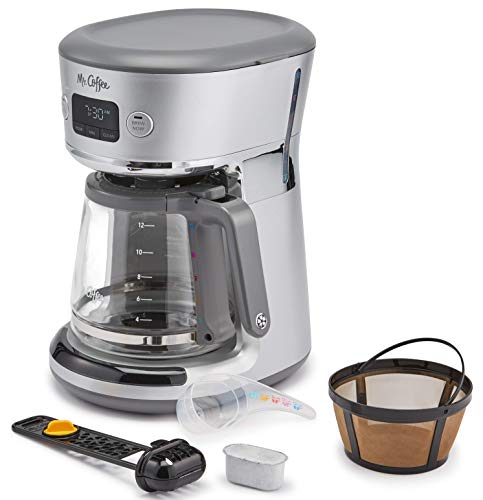
Mr. Coffee Easy Measure 12-Cup — Best Programmable for Beginners
The Easy Measure is the programmable for households whose results vary by loader — which is most households starting out. Its dosing system disciplines the one variable the timer cannot. It suits first-time programmable buyers and shared homes. It does not suit experienced brewers with a scale habit, and its performance ceiling is the honest mainstream middle.
Strengths
- Color-coded dose system: consistent programmed pots
- Full programmability at a mainstream tier
- Reusable filter simplifies the nightly load
Trade-offs
- Guidance redundant for veterans
- Mainstream materials and brew ceiling
- Filter rinsing joins the nightly routine
| Capacity | 12-cup |
| Programming | Programmable auto-start |
| Dosing | Easy Measure color-coded |
| Filter | Gold-tone reusable |
Every programmable machine automates the same thing — the start — and leaves the most error-prone step, the loading, entirely human. The Easy Measure is the only design here that attacks the loading itself: reservoir lines and scoop counts share colors, so the tired person loading at night reproduces the rested person’s calibration exactly. In shared households this is the difference between a programmable that produces the household’s coffee and one that produces a lottery. The machine around the system is a fair mainstream programmable — auto-start, a reusable filter that removes the paper variable from the nightly ritual, and brew performance that will satisfy any household still learning what it likes. Its ceiling is lower than the Ninja’s or Cuisinarts’; its floor — the worst pot it will ever make in careless hands — is higher than all of theirs. For beginners, floor beats ceiling. Buy it, learn your household’s taste on its rails, and graduate later if the hobby takes hold.
Label the lid with the household’s color once the dose is settled (‘blue line, blue scoops’). Guests and new housemates become competent loaders in one sentence, and the programmed pot survives every change of personnel.
Best for: beginners and shared households needing loader-proof consistency / Not suited for: experienced brewers chasing the category’s ceiling
Comparison Table
| Pick | Badge | Key spec | Best for |
|---|---|---|---|
| Ninja CE251 Programmable Brewer | Best Overall Programmable | 24h delay brew, Classic/Rich profiles | households that will use profiles, batches and timer as one system |
| Cuisinart PerfecTemp Thermal DCC-3400 | Best Thermal Programmable | Programmable thermal, PerfecTemp heat | scheduled households whose drinking window stretches for hours |
| KRUPS 12-Cup Programmable Thermal | Best Strength Programming | 3 strengths, programmable thermal | mixed-strength households on a shared schedule |
| KitchenAid KCM1208 Drip Coffee Maker | Best Design Programmable | Programmable, spiral showerhead | design-led scheduled households wanting even unattended extraction |
| Cuisinart Brew Central DCC-1200 | Best Classic Programmable | 12-cup programmable classic, 1–4 cup | prompt-drinking households wanting the proven classic program |
| Mr. Coffee Easy Measure 12-Cup | Best Programmable for Beginners | Programmable, color-coded dosing | beginners and shared households needing loader-proof consistency |
Use the table to compare roles at a glance, then read the full review of any pick you are seriously considering — the trade-offs matter more than the headline spec.
How to Choose a 12 Cup Programmable Drip Coffee Maker
Programmable is a system, not a switch. Evaluate the system in four parts: what can be programmed, how the pot waits, how the small brews behave, and how the machine fails.
What Can Be Programmed (More Than the Clock)
The entry-level program is a start time. The serious program — the kind this guide rewards — lets strength and batch size ride along: the pot that starts itself should also be the strength the day requires and the size the morning needs. When reading any listing, ask three questions: Can the strength setting be part of the timed brew? Can a small-pot mode be timed? Does the warming or holding behavior have its own settings? Machines that answer yes are programmable; machines that answer no have a timer. The distinction is the whole category.
How the Pot Waits
A programmed pot’s life begins before its first drinker arrives, so holding is a first-order feature here. Glass and plate: fine for under an hour, degrading steadily after. Thermal: patient for two to three hours, at a higher purchase price and with hand-wash care. Programmable plates (KitchenAid) split the difference by letting you soften the hold. Choose by the true gap between your brew time and your last drinker — measure it for a week before buying, because households routinely misjudge it by an hour in the optimistic direction.
How the Small Brews Behave
The second most common programmed brew is not the full pot; it is the small early pot for the first riser. Machines handle it with a dedicated mode (Cuisinart’s 1–4 cup pattern) that slows flow for a shallow bed, or they ignore it and brew weak coffee on time. If your household has an early riser, treat small-pot programming as a headline feature, not a footnote — it decides whether that person uses the machine or defects to a pod brewer on the side.
How the Machine Fails
All programmables share failure modes worth planning for: power flickers erase clocks and appointments on most models; a mis-seated carafe defeats the pause valve and floods; scale slows the brew until the ‘6:30 pot’ finishes at 6:50. The defenses are habits — check the clock after outages, seat the carafe like you mean it, descale quarterly — plus one buying preference: machines whose program state is visible at a glance, so a tired owner can confirm at night that tomorrow is armed. Buy the machine whose failures you can prevent.
Delay Brew, Explained: What Actually Happens Overnight
Nothing brews overnight. The grounds and water simply wait — the grounds in the basket’s ambient air, the water in the reservoir — until the clock closes the circuit and the ordinary brew cycle runs. Two implications follow. First, freshness: the overnight wait is short enough that the coffee difference versus loading at dawn is small for most palates, which is why the feature survives; loading a full day ahead is where staleness becomes real. Second, water: the reservoir wait is why we insist on fresh water at loading and a washed tank — the machine will faithfully brew with whatever it was given, including yesterday’s forgotten fill. Understand delay brew as a starting gun, not a slow cooker, and its results will match its promise.
Programmable Drip vs Pod Timers and Smart Plugs
Two workarounds circulate and deserve honest verdicts. Pod machines with timers exist, but a pod brewed at 6:30 and drunk at 7:00 has the same waiting problem with a smaller, more expensive cup — pods are at their best brewed on demand, which is why our dual-brewer guide treats the carafe side as the programmed side. Smart plugs on dumb brewers are the classic hack: a brewer with a mechanical switch left ‘on’ can indeed be started by a plug’s schedule, and for a beloved old machine it works — but you lose the machine’s own auto-off logic and add a failure point, and modern electronic brewers will not wake on restored power at all. For a household committed to programmed pots, a true programmable drip machine remains the reliable, integrated answer; the workarounds are for the households in between.
The Anatomy of a Program: A Worked Example
Abstract features become clear in a single household day. Consider a house with a 5:40 riser, a couple leaving at 7:15, and a work-from-home parent drinking until 10. The naive program — one full pot at 5:30 on a plate — serves the first riser perfectly, the couple adequately, and the parent a cup of cooked coffee. The system program looks different: a thermal machine (or a timed small batch) covers the first riser with a right-sized pot; the main full pot is timed for 7:00 in the carafe that will travel to the home office; strength is set a notch up because two of the four drinkers take milk. Nothing about that morning requires exotic equipment — it requires a machine whose strength, batch and holding choices can all be set the night before, which is precisely the definition of programmability this guide has been arguing for. When you evaluate any machine, run your household’s hardest morning through it on paper. The machine that survives the exercise without a compromise you can taste is the machine to buy.
Two Clocks in the Kitchen: Coordination With Real Life
A programmable coffee maker introduces a second schedule-keeper into a household that already runs on alarms, school runs and shift rotas, and the coordination is worth a deliberate minute. Put the coffee’s finish time on the household’s shared calendar rhythm — not the wake time, the pour time, which is usually ten to twenty minutes later and drifts later on weekends. Households with variable weekday starts (a rota worker) should treat the program as a nightly decision rather than a permanent setting: the ninety-second load includes setting tomorrow’s actual time, which is why interfaces with fast time-setting earn their keep. And in households where the first riser changes by the day, the thermal carafe is again the peacemaker — the pot can be programmed for the earliest plausible riser and still greet the latest one gracefully. The machine’s clock is dumb; the household’s system around it is where the intelligence lives.
Daylight-saving weekends deserve their own sentence in this section, because they are the two mornings a year when the entire category is an hour wrong together. The fix is embarrassingly simple — change the brewer’s clock when you change the others, and add it to the household’s little list of clocks that includes the oven and the microwave. The households that do this are the ones whose Monday coffee arrives, as ever, exactly when it should.
There is a softer coordination too: the smell. A programmed pot announces itself before it is seen, and in many households that aroma is the real alarm — the gentle one that says the day has started and something good is waiting downstairs. It is not a spec, it cannot be measured, and owners mention it constantly. When a machine is doing its job perfectly, that is what it produces: not just coffee ready on time, but a whole quiet house that slowly wakes to the smell of fresh coffee, brewed and ready right on time — the small daily miracle that a well-programmed machine performs without fail, every ordinary weekday morning, for years on end without ever asking for thanks.
What Programmable Owners Know After a Year
Ask long-term owners what surprised them and the answers cluster. First, that they use the timer more and the other features less than expected — except the small-batch mode, which they use constantly. Second, that the nightly load became a genuine ritual rather than a chore: the last calm minute of the day, traded for the first calm minute of the next. Third, that the machine’s failures were almost never electronic — they were a forgotten load, a missed descale, a carafe left unseated, all human and all preventable. Fourth, that guests benefit disproportionately: a house that wakes to coffee feels hosted before the host is vertical. None of this appears in a feature list, and all of it predicts satisfaction better than the feature list does. Buy the machine whose daily pattern you can picture your household actually living — that picture, not the spec sheet, is the product.
Reading Programmable Spec Sheets: A Field Guide
Programmable listings reward translation. ’24-hour programmable’ means the delay can be set up to a day ahead — standard, and sufficient. ‘Brew strength control’ is only meaningful if it changes the brew’s flow or temperature rather than a light on the panel; reviews and manuals reveal which, and this guide’s picks were chosen among the honest implementations. ‘Auto-off’ should state or imply a window; a plate that stays on indefinitely is a generation behind. ‘1–4 cup’ is a flow adjustment, not a separate small machine hiding inside. And ‘thermal’ must be interrogated: a double-wall stainless carafe is insulation; a ‘thermal’ label on a glass carafe with a warmer is marketing weather. Armed with those five translations, a shopper can grade any listing in this category in two minutes — including the many machines this guide did not pick, most of which fail on exactly one of the five.
The Second Pot Problem
Households plan for the first pot and improvise the second — the mid-morning top-up, the weekend refill, the guests-arriving pot — and programmable machines serve the second pot worse than the first, because it is unprogrammed by definition. The machines here handle it with varying grace: quick manual starts, batch modes that right-size it, and — in the thermal picks — a first pot that lasts long enough to make the second pot unnecessary. When you choose, simulate the second pot: it is the brew that reveals whether the machine’s controls make sense awake as well as asleep, whether the reservoir refills gracefully mid-morning, and whether the carafe system punishes a household that drinks past the plan. The first pot sells programmable machines; the second pot is where owners live with them.
When Not to Buy Programmable at All
The candid closing section: some households should skip this entire category. If your mornings have no schedule — retirement rhythms, night-shift rotations that scramble weekly, households that rise when they rise — a timer is a feature you will use on the mornings you least need help and ignore on the rest; buy a better manual brewer instead, like the Moccamaster in our 10–12 cup guide, and let the first riser press a button. If your household is one person, a programmable 12-cup machine is capacity and complexity pointed at the wrong problem; single-serve is your category. Programmability pays when a fixed wake time meets a multi-person pot — a specific, common, honorable pattern. Outside that pattern, the honest recommendation is a simpler machine and better coffee to put in it.
Programmable and the Environment: A Brief Honest Note
Two environmental facts belong in a complete guide. The standby draw of a clock-equipped brewer is small but continuous; households minimizing phantom loads can use a switched outlet — accepting that the clock must be reset, which most find defeats the purpose, which is itself informative about how small the draw is. The larger footprint is behavioral: a programmed machine brews exactly when needed, and households that program honestly waste less coffee than households that brew defensively ‘in case’ — while households that program a full pot for a two-cup morning waste more. As with the energy section of our companion guide, the machine is not the variable; the household’s honesty about its own mornings is. Program the pot you will drink, drink the pot you programmed, and the category is as green as coffee at home gets.
How to Program a Drip Coffee Maker for Perfect Timing
Programming is a one-time setup and a nightly ninety-second ritual. Both halves matter:
- Set the clock accurately, once, in daylight. The entire system inherits the clock’s errors. Re-check after outages and at daylight-saving changes, when half the category’s owners are an hour wrong for a day.
- Calibrate before you automate. Three manual pots across a weekend: settle the dose, the strength setting and the batch size for your household’s standard morning. Automate the recipe you have proven, not the one you hope for.
- Set the brew to finish at pour time. Work backward from the first cup, not forward from the alarm. A full pot takes roughly ten minutes; set the start accordingly and let the machine’s own timing become familiar.
- Load nightly: fresh water, measured grounds, carafe seated. In that order, every night, by whoever finishes the day’s last pot. Confirm the program indicator is lit before you leave the kitchen — the glance that prevents the only unforgivable morning.
- Program the small pot for the first riser. If your machine allows a timed small batch, give the earliest person their own right-sized, right-strength pot instead of a share of a big one brewed too early.
- Review monthly. Schedules drift; programs should drift with them. A one-minute monthly review — times, strengths, who is actually drinking — keeps the system fitted to the household it serves.
Keeping a Programmable Brewer on Schedule
A programmable machine has two health metrics: how the coffee tastes, and whether it is ready on time. Both are maintenance outcomes. Scale attacks both — it cools the brew and slows it, so a scaled machine is simultaneously worse and later; quarterly descaling defends the whole value proposition. The pause valve defends the counter: rinse the basket area weekly so grounds cannot hold it open. The clock defends the appointment: after any outage, reset it before bed, not after the missed morning. The carafe defends the flavor: wash it weekly with soap, soak thermals monthly, and rinse thermal lids after every pot. Troubleshooting: Problem: pot ready but half-brewed → carafe seating or a clogged valve. Problem: pot ready but weak → the load, not the program; check the dose system. Problem: pot late → scale, almost always. Problem: program ‘forgot’ → power flicker; reset and glance nightly. None of these requires a technician — they require the ninety-second nightly ritual this guide keeps recommending.
Common Buying Mistakes
The programmable category’s mistakes are specific and avoidable:
- Buying a timer instead of a programmable system. If strength and batch size cannot join the program, you bought half the feature. Check what the timer actually controls.
- Programming the full pot for a two-cup morning. A timed small batch tastes better and wastes nothing. Use the modes you paid for.
- Letting the programmed pot wait on the plate. The schedule got the coffee made; the plate will unmake it. Thermal or prompt drinking — pick one.
- Loading a day ahead to ‘save time’. The saving is zero and the staleness is real. Nightly loading is the rhythm the feature was designed around.
- Never verifying the program is armed. One glance at the indicator each night prevents the category’s only truly bad morning.
- Blaming the clock for scale. Late, weak pots from a programmable are a descaling overdue notice. The clock keeps perfect time; the heating path does not.
Program the system, load nightly, descale quarterly — and a programmable drip machine becomes the most dependable member of the household staff.
Final Recommendation
The Ninja CE251 is our best overall programmable: integrated profiles, easy loading, honest brewing. The Cuisinart DCC-3400 is the thermal quality pick; the KRUPS is the strength-flexible thermal value; the KitchenAid KCM1208 is the design-and-distribution choice; the Cuisinart DCC-1200 remains the classic default; and the Mr. Coffee Easy Measure guarantees beginners a consistent pot.
The wider 12-cup field — including non-programmable and thermal specialists — is covered in the companion guides:
- Best Overall Programmable: Ninja CE251 Programmable Brewer
- Best Thermal Programmable: Cuisinart PerfecTemp Thermal DCC-3400
- Best Strength Programming: KRUPS 12-Cup Programmable Thermal
- Best Design Programmable: KitchenAid KCM1208 Drip Coffee Maker
- Best Classic Programmable: Cuisinart Brew Central DCC-1200
- Best Programmable for Beginners: Mr. Coffee Easy Measure 12-Cup
Best 12 Cup Programable Drip Coffee Makers Best 12 Cup Coffee Makers Best 12 Cup Thermal Coffee Makers Best 12 Cup Electric Coffee Makers Best 10 Cup Coffee Makers
Frequently Asked Questions
What does programmable mean on a coffee maker?
At minimum, a delay-start timer: you load the machine in advance and it brews at a set time. Better machines let strength settings and small-batch modes be part of the timed program, and add auto-off and holding controls. The word covers a spectrum — this guide picks from its serious end.
Can I program a coffee maker to brew a small pot?
Yes, on machines whose small-batch mode can join the timer — the Cuisinart 1–4 cup pattern is the classic example. It matters because small pots need slower flow to extract properly; a timed small pot without the mode brews weak.
How long can programmed coffee sit before it tastes bad?
On a warming plate, quality holds for roughly 45 minutes. In a thermal carafe, two to three hours. Program the brew to finish near your first pour, and choose the carafe type that matches how long your household actually takes to drink the pot.
Will a programmable coffee maker remember its settings after a power outage?
Usually not — most models lose the clock and the program when power drops and blink until reset. Make clock-checking part of your after-outage routine, and glance at the program indicator each night when you load.
Is it safe to leave a programmed coffee maker plugged in?
Yes — these are appliances designed for exactly that, and auto-off features add a further layer. Use a sound outlet, keep the cord clear of water and heat, and consider a surge protector for models with electronic controls.
Why is my programmed coffee ready late?
Almost always scale in the heating path slowing the brew. Descale the machine; if the timing returns to normal, you have confirmed the diagnosis. Late and weak together are the classic scale signature in a programmable machine.


