Disclosure: airfryerkitchensupply.com is reader-supported. When you buy through links on our site, we may earn an affiliate commission at no extra cost to you.
Where to buy
Every machine in this roundup is sold on Amazon, and each verified pick links to its listing so you can check the current price on Amazon before buying. We never print prices — they change too often to stay accurate — and every model here was matched against Amazon’s product data feed for this site before earning its link.
- Technivorm Moccamaster KBGV Select — check the current price on Amazon
- Zojirushi EC-YTC100 Fresh Brew Plus — check the current price on Amazon
- Cuisinart 10-Cup Thermal Classic DCC-1170 — check the current price on Amazon
- Mr. Coffee 10-Cup Programmable Thermal — check the current price on Amazon
- Ninja Specialty Coffee Maker CM401 — check the current price on Amazon
- Breville Precision Brewer Glass BDC400 — check the current price on Amazon
The best 10 cup coffee makers are the quiet sweet spot of home brewing: a full pot for a household of coffee drinkers, without the counter bulk and stale leftovers that come with oversized machines. Ten cups in manufacturer language means about 50 ounces — four generous mugs — which matches the real morning demand of most two-to-four-person households far better than the headline numbers suggest. This guide rounds up the six 10-cup machines we recommend, from a hand-built Dutch precision brewer to a budget thermal workhorse.
Why do so many households land on 10 cups? Because it is the largest size that still brews well at half capacity. A 12-cup machine asked to make two mugs often under-extracts through a shallow bed; a good 10-cup machine handles both the weekday half pot and the weekend full pot gracefully. If your household regularly serves five or more mugs at once, step up to our 12 cup guide instead — but be honest about how often that happens before giving it counter space.
Every pick below was verified product feed attached to this site, with brand and model matched to live Amazon listings. The selection deliberately spans the category’s real range: precision drip, thermal carafes, a grind-free programmable classic, a specialty-drink hybrid and a precision brewer for people who like to tune.
In this guide
Quick Picks
Six 10-cup machines with distinct personalities. The badges tell you the job; the reviews tell you the compromises.
- Technivorm Moccamaster KBGV Select — Best Overall: The reference 10-cup brewer: copper heating element, nine-hole spray arm, a full 40 oz pot in about six minutes — and a design built to be repaired, not replaced. — Check on Amazon
- Zojirushi EC-YTC100 Fresh Brew Plus — Best Thermal Carafe: Ten cups brewed into a stainless thermal carafe that keeps coffee hot and fresh-tasting for hours — no warming plate, no cooked flavor, from the insulation specialists. — Check on Amazon
- Cuisinart 10-Cup Thermal Classic DCC-1170 — Best Programmable Thermal: The mainstream answer: a fully programmable 10-cup machine with a thermal carafe — wake-up coffee that does not sit on a plate cooking while you get ready. — Check on Amazon
- Mr. Coffee 10-Cup Programmable Thermal — Best Budget: A programmable 10-cup machine with an insulated thermal carafe and a Strong Brew selector at a budget tier — the cheapest route here to wake-up coffee that is not plate-cooked. — Check on Amazon
- Ninja Specialty Coffee Maker CM401 — Best for Specialty Drinks: A 10-cup drip brewer with a second life: concentrated specialty brews and a fold-away frother turn it into the household’s latte and iced-coffee station. — Check on Amazon
- Breville Precision Brewer Glass BDC400 — Best for Precision Tuning: A 10-cup-class precision brewer with multiple brewing modes — including a Gold setting tuned to specialty standards — plus pour over and cold brew adapters in its ecosystem. — Check on Amazon
How These Picks Were Chosen
We shortlisted the 10-cup machines that lead this category on Amazon and verified each one feed — a pick only carries an Amazon link where brand and model matched a live listing with certainty.
Criteria, in order: (1) brew fundamentals — water temperature and showerhead distribution, the two things that decide whether any of this matters; (2) half-pot performance, because a 10-cup machine lives half its life brewing four or five cups; (3) carafe strategy — thermal versus glass and what each does to coffee across a morning; (4) footprint, since many 10-cup buyers are downsizing from a 12; and (5) ownership — parts, descaling, and whether the design has proven itself over years. Badges were assigned after scoring, to name the role each machine fills best.
The 6 Best 10 Cup Coffee Makers

Technivorm Moccamaster KBGV Select — Best Overall
The Moccamaster is the 10-cup machine for buyers who intend to stop buying coffee makers. It suits daily pot brewers who taste the difference temperature makes and who brew mostly for two to four people. It does not suit feature shoppers — there is no timer, no clock, no menu — and its 40 oz carafe is the smallest ’10 cups’ in this guide, so mug-counters should do the math in the intro before falling in love.
Strengths
- Copper element holds brewing water in the ideal temperature window
- KBGV Select switch optimizes flow for half or full pots
- Repairable, hand-built construction with long parts support
Trade-offs
- Premium pricing — the top tier in this roundup by a distance
- Fully manual: no auto-start or programmability
- Glass carafe and warming plate, with the usual sit-time flavor cost
| Capacity | 10 cups / 40 oz (1.25 L) |
| Heating element | Copper |
| Brew control | Half/full pot selector |
| Carafe | Glass, warming plate |
The Moccamaster’s reputation rests on one unglamorous fact: it gets the water properly hot and keeps it there, pot after pot, year after year. The copper heating element brings water to a vigorous boil-point brew temperature that budget machines never reach, and the spray arm pulses it over the basket so the whole bed extracts evenly. The Select model’s half/full switch is not a gimmick at this size — it changes the flow rate so a 20 oz weekday pot extracts like a full one, which is precisely where lesser 10-cup machines disappoint. The ownership proposition is the other half of the appeal: switches, carafes, spray arms and baskets are all replaceable parts on a machine assembled by hand in the Netherlands, and owners routinely report decade-plus service. You give up every electronic convenience to get it. There is no waking up to brewed coffee unless a household member plays that role. For drinkers whose priority is the cup itself and a machine that outlasts trends, that trade has made the Moccamaster the default recommendation in this class for years.
A word on the warming plate, since it is the one place this machine can betray you: it keeps coffee hot at the cost of slowly cooking it, exactly like every other plate. Discerning owners brew, serve, and switch the plate off, or decant the remainder into a preheated thermal carafe. The machine gives you a great pot; what happens to that pot over the following two hours is, as with all glass-carafe brewers, your department.
Best for: daily brewers who prioritize cup quality and decade-long ownership / Not suited for: auto-start devotees or buyers wanting the largest 10-cup carafe

Zojirushi EC-YTC100 Fresh Brew Plus — Best Thermal Carafe
Choose the Zojirushi if your household brews once and drinks slowly: remote workers topping up across the morning, couples on different schedules, weekend readers. Its thermal carafe is the point of the machine. It does not suit anyone who wants to watch the coffee level through glass, and its control set is deliberately plain — the engineering budget went into heat retention and build, not menus.
Strengths
- Thermal carafe holds temperature and flavor for hours without power
- No hot plate means no stewed, bitter second-hour coffee
- Dense, high-quality build typical of the brand
Trade-offs
- Steel carafe hides the coffee level — you judge by weight
- Carafe wants hand washing to protect finish and seal
- Plain feature set: brewing excellence over electronics
| Capacity | 10-cup |
| Carafe | Stainless steel thermal |
| Warming | Insulation only, no plate |
| Brand specialty | Vacuum insulation |
Every coffee drinker knows the taste of a pot that sat on a warmer too long. The Zojirushi’s answer is to delete the warmer: coffee lands in a double-wall stainless carafe and stays hot by insulation alone, so the mug you pour at ten o’clock tastes like the pot brewed at seven, not like a compromise. Zojirushi’s decades of vacuum-bottle engineering show in the carafe’s heat retention and in small details like a lid that seals properly and pours without glugging. The brewer side is a competent, well-temperatured drip machine with the conveniences a household needs and nothing theatrical. Living with it means two adjustments: you cannot see how much coffee remains, and the carafe should be hand-washed — a bottle brush and hot soapy water after each use keeps stainless from developing the invisible residue film that eventually flavors coffee. Preheat the carafe with hot water before brewing in winter and the last cup stays properly hot. For slow-morning households, this is the 10-cup machine that respects the whole pot, not just the first cup.
One small ritual separates satisfied owners from the rest: learn the carafe’s weight. A full pot and an empty carafe feel distinctly different in the hand, and within a week you will judge remaining coffee by heft without thinking — the steel carafe’s one real inconvenience quietly disappears. The other is to register the machine and keep the manual’s descaling schedule; Zojirushi’s support and parts culture rewards owners who do.
Best for: households that brew once and drink across the morning / Not suited for: glass-carafe traditionalists or feature collectors

Cuisinart 10-Cup Thermal Classic DCC-1170 — Best Programmable Thermal
The DCC-1170 is for households that want two things at once: a timer that has coffee ready at wake-up, and a thermal carafe that treats the coffee kindly afterward. It suits scheduled families and commuters. It does not suit precision purists chasing certified brew temperatures, and — like all thermal carafes — it asks for hand washing and hides the coffee level.
Strengths
- Full programmability with a thermal carafe — a rarer combination than it should be
- Brew Pause lets you pour a cup mid-brew without a mess
- Mainstream brand with easy parts and support
Trade-offs
- Thermal carafe performance is good, not class-leading like the Zojirushi
- Control panel and clock add electronics that can age
- Thermal lid design needs a rinse routine to stay fresh
| Capacity | 10-cup |
| Carafe | Thermal |
| Programming | Fully programmable, auto-start |
| Extras | Brew Pause |
Cuisinart’s Thermal Classic occupies the sensible center of this category: it does the two jobs mainstream households actually ask for. The programming is the full, familiar Cuisinart pattern — set the clock, set the brew time, wake to a finished pot — and the thermal carafe means that pot waits gracefully instead of stewing on a plate while the household showers and dresses. Brew Pause covers the impatient first cup mid-cycle. In the cup, it is a solid, mainstream drip performance: properly hot, even enough, and forgiving of supermarket coffee and eyeballed doses, which describes most real kitchens. Against the Zojirushi it trades a measure of insulation excellence and build density for the timer and a friendlier tier; against budget programmables it justifies itself with the carafe and Cuisinart’s support network. The honest maintenance note: thermal carafe lids have channels that trap coffee — rinse the lid assembly after every pot and soak it weekly, or the freshest brew will pick up yesterday’s flavor on the way through.
The DCC-1170 also earns quiet points for its charcoal water filter, which genuinely helps households whose tap water tastes of the treatment plant — coffee is mostly water, and chlorinated water makes chlorinated coffee. Keep spare filters on the replacement rhythm or the benefit lapses silently. It is the kind of unglamorous, practical feature that mainstream brands include and boutique brands skip, and for many kitchens it matters more than a degree of brew temperature.
Best for: scheduled households wanting wake-up coffee in a thermal carafe / Not suited for: temperature purists or anyone who hates hand-washing a carafe
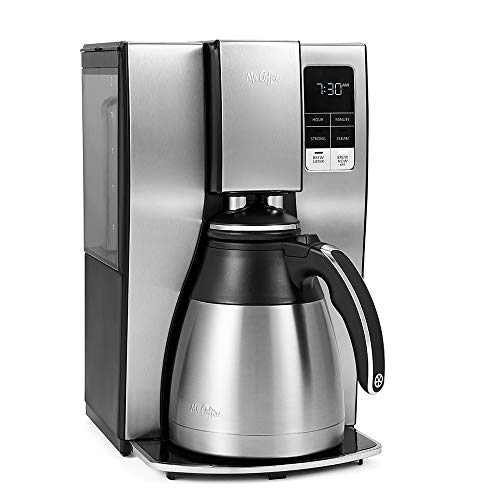
Mr. Coffee 10-Cup Programmable Thermal — Best Budget
This is the value pick: households that want the thermal-plus-timer combination without paying mid-tier money. It suits first apartments, offices and anyone replacing a dead machine on a budget. It does not suit buyers expecting premium materials — the build is honest budget plastic — and heavy users should expect a shorter service life than the premium picks, which is the real price of the tier.
Strengths
- Thermal carafe and programmability at a budget-tier price point
- Strong Brew selector for a bolder pot
- Simple controls that need no manual to speak of
Trade-offs
- Budget build materials; fit and finish trail Cuisinart and Zojirushi
- Thermal performance is adequate rather than excellent
- Long-term durability is the known compromise of the tier
| Capacity | 10-cup |
| Carafe | Insulated thermal |
| Programming | Programmable with auto-start |
| Extras | Strong Brew selector |
Mr. Coffee’s play here is feature arbitrage: the two upgrades households actually feel — a thermal carafe instead of a plate, and a Strong Brew option — delivered at the tier where rivals still ship glass and a warmer. The result is a machine that punches above its price in daily satisfaction. The coffee it makes is mainstream drip, hot and consistent enough, and the Strong setting genuinely helps when the pot must carry milk or a full house’s worth of dilution. The compromises live where budget compromises always live: plastics feel lighter, the carafe’s insulation is good for a couple of hours rather than a morning, and the control buttons are basic. None of that prevents it from doing its job well for years if it is descaled and not abused — budget machines die of scale and neglect more often than of their price tag. For a first home, a rental, an office kitchen or a household that would rather spend the difference on good coffee beans, this is the rational buy in the guide.
Set expectations for the carafe correctly and you will be happy: it keeps coffee properly hot through a normal morning’s first half, not through a long brunch. For the price tier, that is a fair trade, and households that drink the pot within a couple of hours will never notice the gap to premium insulation. Where owners do notice the tier is the reservoir and lid plastics — treat them gently, especially when hot, and the machine returns the courtesy.
Best for: budget buyers wanting thermal plus timer without mid-tier pricing / Not suited for: buyers prioritizing premium build and longest service life

Ninja Specialty Coffee Maker CM401 — Best for Specialty Drinks
The CM401 suits the 10-cup household whose members split between straight drip and milk drinks. Weekday mornings run the carafe; weekends run the specialty setting and the frother. It does not suit espresso purists — the specialty brew is concentrated coffee, not pressure-extracted espresso — and it does not suit anyone who wants the simplest possible machine, because breadth brings buttons.
Strengths
- Four brew styles including a concentrated specialty mode for milk drinks
- Fold-away frother built in — no separate gadget to store
- Size range from a single mug to the full 10-cup carafe
Trade-offs
- Not true espresso: no pump, no crema — set expectations accordingly
- Most controls and modes in this guide; a learning curve week one
- Glass carafe with warming plate, so sitting coffee still stews
| Capacity | 10-cup carafe |
| Brew styles | Classic, Rich, Over Ice, Specialty |
| Frother | Built-in fold-away |
| Filter | Permanent filter included |
Judge the CM401 as two machines sharing a counter footprint and it makes sense. As a drip brewer it is a competent 10-cup programmable with size flexibility — genuinely useful in households that alternate between a travel mug and a full pot. As a drinks station, its specialty mode brews a small, concentrated coffee designed to stand up to frothed milk, and the fold-away frother heats and whisks milk without a separate appliance hogging the counter. The drinks are café-style rather than café-identical; latte drinkers at home are usually delighted, espresso nerds are referred to actual espresso machines. The permanent filter saves paper costs and the removable parts are dishwasher friendly, which keeps the broader feature set from becoming a cleaning burden. Where it loses to the specialists in this guide is focus: the Moccamaster brews a purer pot, the Zojirushi holds coffee better, the Cuisinart programs more simply. Where it wins is households — the mixed-drink reality of most homes is exactly its design brief.
The permanent filter deserves a practical note: it saves paper money and adds a rinse to every brew, and it lets a whisper more sediment and oil into the cup than paper does. Some households love the fuller cup; others run paper filters in it anyway for a cleaner result. Both are legitimate — the machine tolerates either habit, which is more flexibility than the filter debate usually allows.
Best for: mixed households splitting between drip pots and milk drinks / Not suited for: espresso purists or minimalists
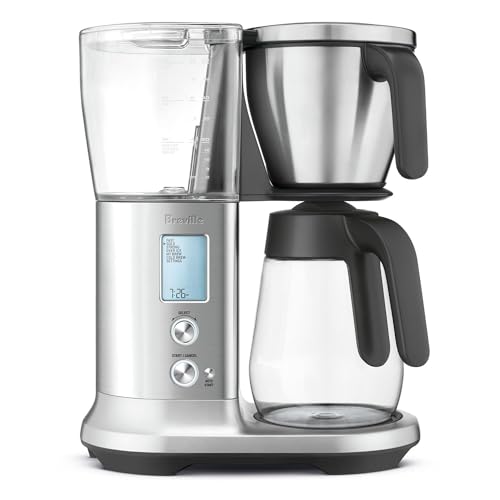
Breville Precision Brewer Glass BDC400 — Best for Precision Tuning
The Precision Brewer is for the drip drinker who likes control: brew temperature, bloom time and flow rate are adjustable in its custom mode, and presets cover everything from Gold-standard drip to strong and iced. It suits tinkerers and multi-style households. It does not suit set-and-forget shoppers — the menu rewards engagement — and its glass carafe version here pairs with a warming plate rather than insulation.
Strengths
- Adjustable temperature, bloom and flow in My Brew custom mode
- Gold preset brews to specialty-coffee standard parameters
- Ecosystem supports pour over adapter and cold brew styles
Trade-offs
- Most complex machine in this guide — menus within menus
- Glass carafe version stews coffee left sitting
- Premium tier pricing for a drip machine
| Capacity | 10-cup class (60 oz max brew) |
| Modes | Multiple presets incl. Gold, Strong, My Brew custom |
| Control | Adjustable temp, bloom time, flow rate |
| Carafe | Glass (this version) |
Breville built the Precision Brewer for the drinker who reads about extraction and wants the knobs. Its Gold mode automates specialty-standard parameters; its My Brew mode hands over temperature, bloom time and flow rate for genuine experimentation; and its adapter ecosystem extends it to pour over dripper use and cold brew. For a certain kind of coffee household this is not complexity for its own sake — it is the machine that grows with your curiosity, brewing an unimpeachable standard pot on autopilot while letting you chase a new bean’s potential on weekends. The costs are real: the interface takes study, the machine is physically imposing, and this glass-carafe version leaves brewed coffee on a plate like any other. Breville also sells a thermal-carafe sibling for households that prefer insulation. Set against the Moccamaster, the philosophical split is clean — Technivorm fixed the variables at the factory after decades of refinement; Breville hands them to you. Neither is wrong; know which kind of owner you are.
Cold brew through the Precision Brewer’s ecosystem is the sleeper feature: households that buy it for drip often find summer afternoons colonized by its cold brew output. It reframes the value math — a machine bought for one job doing a second job seasonally is easier to justify than a single-purpose premium. If your household drinks cold coffee half the year, weight this pick above its drip-only rivals.
Best for: tinkerers who want temperature and flow control over their drip / Not suited for: set-and-forget households or thermal-carafe devotees (in this version)
Comparison Table
| Pick | Badge | Key spec | Best for |
|---|---|---|---|
| Technivorm Moccamaster KBGV Select | Best Overall | 40 oz, copper element, half-pot mode | daily brewers who prioritize cup quality and decade-long ownership |
| Zojirushi EC-YTC100 Fresh Brew Plus | Best Thermal Carafe | 10-cup stainless thermal carafe | households that brew once and drink across the morning |
| Cuisinart 10-Cup Thermal Classic DCC-1170 | Best Programmable Thermal | 10-cup programmable thermal | scheduled households wanting wake-up coffee in a thermal carafe |
| Mr. Coffee 10-Cup Programmable Thermal | Best Budget | 10-cup thermal, Strong Brew, budget tier | budget buyers wanting thermal plus timer without mid-tier pricing |
| Ninja Specialty Coffee Maker CM401 | Best for Specialty Drinks | 10-cup, 4 styles, built-in frother | mixed households splitting between drip pots and milk drinks |
| Breville Precision Brewer Glass BDC400 | Best for Precision Tuning | Adjustable temp/bloom/flow, Gold mode | tinkerers who want temperature and flow control over their drip |
Use the table to compare roles at a glance, then read the full review of any pick you are seriously considering — the trade-offs matter more than the headline spec.
How to Choose the Best 10 Cup Coffee Maker
Ten-cup shoppers are usually choosing between three philosophies, not six machines. Decide which household you are, and the shortlist collapses to one or two names.
The Quality-First Household
If the pot is a daily ritual and taste outranks convenience, your candidates are the Moccamaster and the Breville — one fixed the variables for you, the other hands them over. Both cost premium money; both repay it in the cup and in years of service. The tiebreaker is temperament: buy the Technivorm if you want to think about coffee less, the Breville if you want to think about it more.
The Slow-Morning Household
If coffee is brewed once and sipped for hours, carafe insulation matters more than any other spec, and your candidates are the Zojirushi and the two programmable thermals. Choose the Zojirushi for pure holding performance, the Cuisinart for the wake-up timer, and the Mr. Coffee if the budget insists. All three beat any glass-and-plate machine at the two-hour mark by a margin you can taste.
The Mixed-Drink Household
If lattes, iced coffee and specialty drinks circulate alongside drip, the Ninja CM401 is the only pick here designed for you. Everyone else in this guide brews drip coffee well and nothing else; the Ninja brews drip well and moonlights credibly. The mistake is buying it for a household that never touches the specialty side — that is money spent on theater.
Half-Pot Performance: The 10-Cup Machine’s Real Test
A 10-cup machine spends much of its life brewing five cups, and half pots are where extraction goes to die: the water races through a shallow bed, the showerhead pattern sized for a full basket overshoots, and the cup comes out thin. Machines handle this differently — the Moccamaster Select slows flow mechanically, good programmables offer a 1–4 cup or small-batch mode that does the same electronically, and naive machines do nothing. When you read any 10-cup machine’s marketing, hunt for its small-batch story. If there is none, plan to brew full pots or accept weaker weekday coffee — or choose a machine in this guide that took the problem seriously.
Footprint and Fit: Downsizing Done Right
Many 10-cup buyers are escaping a 12-cup machine that dominated the counter. Protect the win: measure the new machine’s height with the lid open, check whether the reservoir removes (sink-filling beats jug-pouring under cabinets), and confirm the carafe pours without needing two hands and a prayer. Thermal carafe models run slightly bulkier than glass equivalents; specialty machines like the Ninja run deepest. The machine that fits your counter and your cabinets is the one that stays out and gets used — the one that does not becomes a garage resident with a cord.
What Separates a Good 10-Cup Machine From a Mediocre One
Strip away the marketing and three components decide everything. The heater determines whether extraction is even possible at the right temperature — this is where budget machines quietly fail. The showerhead determines whether the whole bed of grounds works or only the middle does — narrow spray patterns leave a ring of dry, wasted coffee around the basket’s edge. And the carafe system determines what time does to the finished pot — a plate cooks it, insulation preserves it, glass shows it. Every pick in this guide was chosen because it gets at least two of the three genuinely right, and the top picks get all three. When you compare any machine not listed here, interrogate those three components in that order and ignore the rest of the spec sheet until they pass.
The fourth factor is you. Dose consistency, fresh water and descaling discipline move cup quality more than the gap between most adjacent machines. This is liberating news for budget buyers: a modest machine used well beats a premium machine used carelessly, every single morning. Buy the best machine your budget allows from this list, then invest your attention in the routine — that is where the remaining quality lives.
Grind, Dose and Water: The Variables You Control
A 10-cup machine automates heat and distribution; the remaining quality levers are yours. Grind for drip should resemble coarse sand — fine enough to extract in the brew window, coarse enough to never stall the basket. Dose is the lever beginners underuse: most disappointing pots are simply under-dosed, brewed at ratios that would make weak coffee in any machine on earth. If your coffee tastes thin, add coffee before you blame the brewer; if it tastes harsh, check that you are not compensating for a dirty machine with a bigger dose. Water is the third lever and the most ignored: coffee is over 98 percent water, so heavily chlorinated or very hard tap water caps what any machine can do. A simple filter pitcher — or the charcoal filter built into machines like the Cuisinart — removes the chlorine note, and filtered water also slows the scale that drags brew temperatures down between descalings. None of this requires new equipment beyond a scale for dosing; it requires only the decision to treat the machine as half of the system and yourself as the other half.
When to Replace Rather Than Repair
Drip machines rarely die dramatically; they fade, and owners replace them in a fog of dissatisfaction without knowing what failed. The diagnosable failures are worth knowing. If coffee has turned sour and weak and a full descale does not restore it, the heating element is losing its output — on a budget machine that is a replacement decision, on a Moccamaster it is a parts order. If the machine leaks from the base, seals or the reservoir valve have gone; again, repairable on premium brands, terminal on sealed budget ones. If the clock and programming die but brewing works, decide whether you actually used them — many owners happily run a ‘broken’ programmable as a manual brewer for years. And if the carafe breaks, check the replacement price before replacing the machine: carafes for major brands are stocked for years, and a new carafe plus a descale often returns a machine to service for a fraction of a new purchase. The wasteful pattern is replacing a machine for a dirty showerhead — clean first, diagnose second, buy third.
There is an environmental footnote worth one sentence: a drip brewer is mostly metal, glass and simple electronics, and every year of service you extract from one is a year a replacement is not manufactured, shipped and landfilled — maintenance is not just frugal, it is the sustainable choice in this category. Keep the manual, oddly enough: model numbers and part names live in it, and it turns a repair search from guesswork into a five-minute errand years from now.
A Note on Brewing for Guests With a 10-Cup Machine
The scenario 10-cup owners dread — a table full of guests — is easier than feared with a little choreography. Brew the full pot first and decant it into a preheated thermal carafe or the machine’s own thermal carafe if it has one; then immediately brew a second pot while the first circulates. Guests experience an endless supply, the machine experiences two ordinary cycles, and nobody drinks coffee that sat cooking on a plate for an hour. If your machine is glass-and-plate, the decanting step is the whole trick — a large thermal carafe is the best accessory a 10-cup household can own, useful on guest days and slow Sundays alike. This is also the honest ceiling of the size class: if guest mornings are a weekly event rather than a monthly one, that is the signal to shop the 12-cup guide instead, and to keep the 10-cup machine’s virtues in perspective rather than pretending capacity does not matter.
One more guest-day tip that costs nothing: brew the guest pot slightly stronger than your everyday dose. Coffee served to a table is usually served with milk, sugar and conversation diluting attention if not the cup itself, and a marginally bolder pot reads as generous rather than strong. Your everyday drinkers will not notice the difference; your guests will simply think your coffee is good, which is the entire point of serving it.
Ten Cups vs Twelve: The Downsizer’s Dilemma
Many readers arrive here from a 12-cup machine, wondering if 10 will feel like a loss. The honest answer: for households of two to four coffee drinkers, almost never. The 12-cup machine’s extra capacity is used on a handful of mornings a year, while its costs — counter space, a bigger carafe to wash, worse half-pot extraction — are paid daily. The 10-cup machine’s smaller basket is also its advantage: the bed depth at everyday volumes sits in the range where showerheads distribute well. The households that should stay at 12 are the ones whose ordinary Tuesday already empties a 10-cup pot and asks for more; everyone else is buying insurance they will rarely claim. Our 10–12 cup guide covers the overlap zone if you are torn between the sizes.
How to Set Up and Use a 10 Cup Coffee Maker Well
The difference between a good 10-cup machine used well and the same machine used carelessly is larger than the difference between most machines. The routine:
- Run two water-only cycles before the first pot. New machines carry manufacturing residues; flush them before they flavor your coffee.
- Find your dose once, then keep it. Start around 1–2 tablespoons of grounds per 6 ounces of water, brew a full pot, taste, adjust by one step, and write the winning dose on a note inside the cabinet door.
- Use the small-batch mode for small pots. If your machine has a 1–4 cup, half-pot or slow-flow setting, it exists for extraction physics, not marketing. Weekday pots will taste like weekend pots.
- Preheat thermal carafes. A rinse of hot water before brewing buys real holding time, especially for the last cup.
- Program the timer with fresh water and grounds the night before — and no earlier. Grounds loaded in the morning for an evening program stale noticeably; overnight is the practical limit.
- Descale on a calendar, not on symptoms. Quarterly descaling keeps brew temperature where the machine was designed to run. By the time coffee tastes sour from scale, the build-up is heavy.
Maintenance Schedule for a 10-Cup Brewer
Put four recurring tasks on autopilot and a 10-cup machine will perform in year five like it did in month one. After every pot: dump grounds promptly (they mold in a warm basket faster than you would like to know), rinse the carafe and lid, and leave the basket area open to dry. Weekly: wash carafe, lid and basket with hot soapy water; wipe the showerhead with a damp cloth to clear oil and fines. Monthly: soak thermal carafes with a cleaning tablet if coffee films are building; check the spray pattern by running water through an empty basket and watching for blocked holes. Quarterly: descale, replace the charcoal water filter if your machine uses one, and wipe the warming plate before residue bakes on. Troubleshooting: Problem: coffee tastes progressively worse over weeks → it is almost always residue or scale, in that order; clean first, descale second. Problem: brew overflows when the pot is full → too-fine grind or a doubled filter; fix the filter stack before blaming the machine.
Common Buying Mistakes
Ten-cup regrets cluster around sizing and habits rather than defects:
- Buying 10 cups for a six-mug household. Count mugs honestly — five regular mugs is a 12-cup machine’s job, and brewing twice helps nobody.
- Judging a machine by its full-pot coffee only. Most of its life is half pots. Small-batch performance is the real test in this size class.
- Letting the timer do stale work. Grounds loaded a full day ahead, or water sitting in the reservoir all week, quietly ruin a programmable machine’s output.
- Skipping carafe lid hygiene. Thermal lids trap old coffee in their channels; rinse after every pot or every pot tastes faintly of the last one.
- Storing beans above the brewer. Heat and steam from daily brewing is the worst storage environment in the kitchen. Airtight, cool and dark wins.
- Ignoring the showerhead. Mineral and oil build-up narrows the spray pattern month by month. Wipe it when you descale.
With those handled, every machine here will do its job — the choice between them is about which job your household actually has.
Final Recommendation
The Technivorm Moccamaster KBGV Select is our top pick for households that brew daily and keep appliances for years. The Zojirushi EC-YTC100 wins slow mornings, the Cuisinart DCC-1170 wins scheduled ones, and the Mr. Coffee 10-Cup Thermal wins the budget argument outright. Mixed-drink households get the Ninja CM401; tinkerers get the Breville Precision Brewer.
Need a different size or format? The neighboring guides pick up where this one stops:
- Best Overall: Technivorm Moccamaster KBGV Select
- Best Thermal Carafe: Zojirushi EC-YTC100 Fresh Brew Plus
- Best Programmable Thermal: Cuisinart 10-Cup Thermal Classic DCC-1170
- Best Budget: Mr. Coffee 10-Cup Programmable Thermal
- Best for Specialty Drinks: Ninja Specialty Coffee Maker CM401
- Best for Precision Tuning: Breville Precision Brewer Glass BDC400
Best 10 12 Cup Coffee Makers Best 12 Cup Coffee Makers Best 12 Cup Thermal Coffee Makers Best 1 Cup Coffee Makers Best 12 Cup Programmable Drip Coffee Makers
Related guides
Frequently Asked Questions
How many mugs does a 10-cup coffee maker fill?
About four generous mugs. Manufacturers count a cup as roughly 5 ounces, so a 10-cup carafe holds around 50 ounces — though European models like the Moccamaster hold 40 ounces, closer to three large mugs. Check carafe ounces, not the cup number.
Is 10 cups enough for a family?
For two adults drinking two mugs each, yes — that is exactly one pot. Add teenagers, guests or a third round and you will brew twice or want a 12-cup machine. Be honest about your biggest regular morning, not your average one.
Do 10-cup coffee makers brew well at half capacity?
The good ones do, using a small-batch or half-pot mode that slows water flow so a shallow bed still extracts evenly. Machines without such a mode tend to brew weak half pots. It is the first feature to check in this size class.
Thermal or glass carafe for a 10-cup machine?
Thermal if coffee sits for more than about 45 minutes — it holds flavor without a cooking plate. Glass if the pot is drunk quickly, you want to see the level, and you prefer dishwasher-easy care.
Can a 10-cup coffee maker make good coffee for one person?
It can, with a small-batch mode and the right dose — but a household of one will usually be happier with a single-serve machine or a compact brewer. See our 1 cup coffee makers guide for the solo options.
How often should I descale a 10-cup coffee maker?
About every three months with typical tap water; monthly if your water is very hard. Scale lowers brew temperature gradually, so coffee drifts sour long before the machine complains — descale by the calendar, not by taste.


