Disclosure: airfryerkitchensupply.com is reader-supported. When you buy through links on our site, we may earn an affiliate commission at no extra cost to you.
Where to buy
Every machine in this guide to the 10 best bread machines is sold through Amazon, and that is where we recommend buying: stock turns over quickly on popular models, listings show the current configuration and included accessories, and returns are straightforward if a pan, paddle, or lid arrives damaged. Start with our top pick, the Zojirushi Home Bakery Virtuoso Plus, or jump to the pick that matches your kitchen: the Breville Custom Loaf for maximum control, the Cuisinart Convection CBK-210 for crust, the Panasonic SD-R2550 for preset variety, the West Bend Hi-Rise for big horizontal loaves, and the Hamilton Beach Digital if you want to spend as little as possible. Check the current price on Amazon for the model you choose, because configurations and bundle contents change more often than model names do.
One honest note before the list: the phrase “10 best bread machines” gets attached to a lot of roundups, but when we verified the current market through Amazon’s own product data, the field narrowed fast. Several once-popular models are discontinued, sold only by third-party sellers at inflated markups, or listed under confusing bundles. Rather than pad this guide to ten names, we kept the six machines we could verify as current, genuinely distinct, and worth recommending — and we explain below exactly how the other contenders fell away.
Introduction: What Actually Separates a Good Bread Machine From a Dust Collector
If you are comparing the 10 best bread machines hoping one of them will quietly take over your weekly baking, here is the truth up front: the difference between a machine you use twice a week and one you give away in a year is rarely the number of programs printed on the box. It is whether the loaf comes out evenly baked top and bottom, whether the pan shape gives you slices that fit a sandwich, whether the paddle leaves a small hole or a crater, and whether cleanup takes two minutes or twenty. Every pick below was chosen against those everyday tests, not against a spec-sheet beauty contest.
A bread machine does four jobs — mixing, kneading, proofing, and baking — inside one insulated box. That sounds simple, and the basic versions genuinely are simple. Where machines diverge is in how carefully they manage heat and timing across those four jobs. A single heating element in the base tends to produce a pale top crust and an over-browned bottom. Dual heaters, convection fans, and temperature sensors exist specifically to fix that imbalance, and you will see those features drive most of the price ladder in this guide. Paying more is rational when it buys more even baking; it is not rational when it only buys more programs you will never select.
The other dividing line is loaf geometry. Vertical pans bake tall, narrow loaves that slice awkwardly. Horizontal pans bake a loaf shaped more like a bakery loaf, which most households prefer for toast and sandwiches. Two of our picks bake horizontally, and if you have never owned a bread machine before, pan shape is the single decision most likely to determine whether you love the result.
Finally, a word about expectations. A bread machine will not reproduce a crusty artisan boule from a Dutch oven, and no preset changes that. What it does brilliantly is repeatable everyday bread — sandwich loaves, whole wheat, enriched doughs, pizza dough, jam — with about ten minutes of your attention. Buy it for that job and it earns its counter space. Buy it expecting a bakery and it will disappoint you no matter which model you choose.
In this guide
Quick Picks
- Best Overall: Zojirushi Home Bakery Virtuoso Plus BB-PDC20BA — Dual heaters for an evenly browned 2 lb loaf, dedicated gluten-free and whole-wheat programs, and a 13-hour timer. The machine we would buy with our own money.
- Best for Custom Control: Breville Custom Loaf BBM800XL — A collapsible kneading paddle that folds down before baking, custom crust settings, and an automatic fruit and nut dispenser for bakers who like to tinker.
- Best for Crust Lovers: Cuisinart Convection Bread Maker CBK-210 — A convection fan circulates hot air for a more artisan-style crust, with 16 programs including a sourdough starter cycle and an automatic mix-in dispenser.
- Best for Preset Variety: Panasonic SD-R2550 — 20 presets, an advanced temperature sensor that adjusts for your kitchen, gluten-free baking, and a raisin and nut dispenser.
- Best for Large, Traditional Loaves: West Bend Hi-Rise — A traditionally shaped horizontal pan with dual knead blades and three loaf sizes up to 3 lb, for families who bake big.
- Best Budget: Hamilton Beach Digital Bread Maker — 12 settings plus a gluten-free cycle, a PFAS-free nonstick pan, and 2 lb capacity at a budget-tier price. Check price on Amazon.
How These Picks Were Chosen
We started with the full field of bread machines currently listed for the US market and verified every candidate against Amazon’s product data, confirming that each model is a real, current listing sold in the configuration described. That step alone removed several famous names: some are discontinued and only available used or through resellers, and we do not recommend machines you cannot buy new with a warranty and a return window.
From the verified field, we scored machines on six criteria. First, baking evenness: dual heaters, convection, or temperature sensing all count, because pale tops and scorched bottoms are the most common owner complaint. Second, loaf shape and size range: horizontal pans and multiple loaf sizes score higher because they fit how people actually eat bread. Third, kneading hardware: dual blades handle stiff whole-grain doughs better, and paddles that collapse or can be removed before baking leave a smaller hole in the finished loaf. Fourth, program relevance: a dedicated gluten-free cycle and a real dough cycle matter; a cake program is a bonus, not a reason to buy. Fifth, everyday usability: delay timers for morning bread, a mix-in dispenser if you bake raisin or seeded loaves, and a pan that releases cleanly. Sixth, value for the tier: each pick had to be the strongest option at its quality tier, not merely an expensive one.
We also applied two honesty filters. Machines with a safety recall were excluded outright. What survived those filters is the list below: six machines, each the right answer for a different kitchen, and none of them chosen because a manufacturer asked.
A note on how to read the reviews: each one opens with who the machine suits, then gives three strengths and three trade-offs — the teardown format we use across this site, because a bread machine review that lists only positives is an advertisement, not a review. Each review closes with a blunt verdict line. If you read nothing else, read the verdicts and the comparison table; they contain the whole decision in miniature.
The 6 Best Bread Machines to Buy Now

Zojirushi Home Bakery Virtuoso Plus BB-PDC20BA — Best Overall
The Virtuoso Plus is the machine for the household that will bake two or three loaves a week for years and wants each one to come out right without supervision. Zojirushi has refined this platform over multiple generations, and the current Virtuoso Plus pairs a heating element in the lid with the main element in the base, so the top of the loaf browns at the same rate as the bottom — the single most visible quality gap between premium machines and everything else. If you bake one loaf a week and mostly white sandwich bread, you can spend less and be happy. If you bake often, bake whole grains, or bake gluten-free, this is where the money shows.
Strengths
- Dual heaters — one in the lid, one in the base — produce the most evenly colored crust in this guide, top and bottom.
- Dedicated gluten-free and whole-wheat programs adjust kneading and rise times for doughs that generic cycles handle badly.
- The 13-hour delay timer makes overnight baking reliable: load the pan after dinner, wake to a finished 2 lb loaf.
Trade-offs
- It sits in the premium tier; casual bakers will not use enough of its capability to justify the step up.
- The footprint is substantial, and the lid needs clearance to open fully under low cabinets.
- Two kneading blades mean two small holes in the bottom of the loaf instead of one — a cosmetic issue some bakers dislike.
Key specs (verified)
- Loaf size: 2 lb
- Programs include: gluten-free, whole-wheat
- Heating: dual heaters
- Delay timer: 13 hours
The deeper story with the Virtuoso Plus is consistency across dough types. Whole-wheat dough is stiffer and rises slower than white dough; a machine with one generic cycle tends to under-proof it, and the loaf comes out dense. The dedicated whole-wheat program lengthens the rise, and the dual heaters keep the crust from staying pale while the dense crumb finishes baking through. Gluten-free dough is the opposite problem — it is a batter, not a dough, and over-kneading ruins its structure. A purpose-built gluten-free cycle that mixes gently and bakes once, without a punch-down, is the difference between a sliceable loaf and a gummy brick. Most budget machines offer a gluten-free label on a barely modified basic cycle; this machine’s program is genuinely re-thought, and for gluten-free households that alone can justify the tier.
Day to day, the details are well judged. The pan releases loaves cleanly, the lid heater means you stop rotating or tenting loaves, and the machine runs its cycles quietly enough for overnight use in most homes. Replacement pans and paddles are sold as standard parts, which matters on a machine you plan to keep for a decade. Check the current price on Amazon — and check whether the listing is the standalone machine or a bundle, since both circulate.
Best for: frequent bakers, whole-grain and gluten-free households, anyone who wants one machine for years / Not suited for: occasional bakers, tiny kitchens with no counter clearance, buyers who only want the cheapest route to a white loaf

Breville Custom Loaf BBM800XL — Best for Custom Control
The Custom Loaf is the enthusiast’s machine: it assumes you have opinions about your bread and gives you the controls to act on them. Its signature trick is a kneading paddle that collapses flat before the bake cycle begins, so the finished loaf has a far smaller paddle hole than any fixed-paddle machine leaves. Around that trick, Breville builds manual and custom program options, custom crust settings, and an automatic fruit and nut dispenser that drops mix-ins at the right point in the cycle. If you are the kind of baker who keeps notes on recipes, this is your machine. If you want to press one button and walk away, the Zojirushi above is the calmer choice.
Strengths
- The collapsible paddle folds down before baking, dramatically reducing the hole torn in the bottom of the loaf.
- Custom and manual settings let experienced bakers adjust knead, rise, and bake phases instead of accepting factory timing.
- The automatic fruit and nut dispenser times mix-ins correctly, so raisins and seeds distribute instead of shredding.
Trade-offs
- The collapsible paddle is a moving part with a hinge; it needs a proper clean after sticky doughs or it can stick in one position.
- The control set has a learning curve — expect your first loaves to involve the manual, not just the quick-start card.
- Premium-tier pricing, and its size is among the largest in this guide.
Key specs (verified)
- Kneading paddle: collapsible, folds before baking
- Mix-ins: automatic fruit and nut dispenser
- Crust: custom crust settings
- Finish: brushed stainless steel
What the customization actually buys you shows up in edge cases. A high-hydration dough that a fixed program under-kneads can be given a longer first knead. A sweet enriched dough that browns too fast can be pulled to a lighter crust setting without shortening the bake and leaving the center gummy. Seeded loaves come out with intact seeds because the dispenser adds them after the violent early mixing is done. These are real capabilities, and no other machine in this guide matches the paddle design — the difference between a neat slice and a slice with a torn tunnel at the base is visible at every breakfast.
The honest caveat is maintenance. Any mechanism that folds will eventually collect dough in its hinge if you bake sticky, sugary doughs and only rinse the pan. Budget two extra minutes with a soft brush after those bakes and the paddle behaves for years; skip it and the feature quietly stops working. Treat that as the ownership contract for the most capable machine here. Check the current price on Amazon.
Best for: experienced bakers who tweak recipes, seeded and fruit loaves, anyone who hates the paddle hole / Not suited for: set-and-forget beginners, bakers who dislike cleaning mechanisms, the budget-minded

Cuisinart Convection Bread Maker CBK-210 — Best for Crust Lovers
Most bread machines bake in still air, which is why most bread-machine loaves have a soft, pale, steamed-looking crust. The CBK-210 attacks that directly with a convection fan that circulates hot air around the pan, pushing the crust closer to what an oven produces: deeper color, a firmer bite, a loaf that looks baked rather than poached. It layers that fan on a full-featured platform — 16 programs including a sourdough starter cycle, an automatic mix-in dispenser, and a full 2 lb capacity. Choose it if crust is the thing you have always disliked about machine bread. Choose the Zojirushi if you value set-and-forget consistency over crust character.
Strengths
- The convection fan produces the most oven-like crust in this guide — better color and a crisper bite than still-air machines.
- 16 programs include a sourdough starter cycle, letting the machine maintain starter even if you finish the loaf in an oven.
- An automatic mix-in dispenser handles nuts, seeds, and dried fruit at the correct point in the cycle.
Trade-offs
- A fan is a moving part and a faint source of noise during the bake phase that still-air machines do not have.
- Convection browns faster, so the darkest crust setting can overshoot on sweet doughs until you learn its habits.
- It is a full-size machine; measure your counter depth and cabinet clearance before ordering.
Key specs (verified)
- Loaf size: 2 lb
- Programs: 16, including sourdough starter
- Baking: convection fan
- Mix-ins: automatic dispenser
The sourdough starter program deserves a clarification, because it is easy to misread. This machine will not turn out a bakery sourdough loaf on its own — true sourdough needs a long, slow fermentation and a fiercely hot bake that no countertop bread machine delivers. What the program does is hold starter at a controlled temperature and handle dough cycles for sourdough-style breads, which is genuinely useful if you keep a starter and want the machine to manage the messy middle stages. Buy it for the convection crust and treat the starter cycle as a helpful extra, and you will be pleased. Buy it expecting artisan sourdough from a button press and you will not — that warning applies to every machine in this guide, not just this one.
In daily use the CBK-210 behaves like the premium Cuisinart it is: clear controls, a pan that releases well, and crust settings with real range between them. It is the pick we steer toward buyers who have owned a basic machine, liked the convenience, and want the one upgrade that changes what is on the plate. Check the current price on Amazon.
Best for: bakers who prioritize crust, upgraders from a basic machine, households that keep sourdough starter / Not suited for: buyers expecting true artisan sourdough from a preset, noise-sensitive overnight bakers, small counters
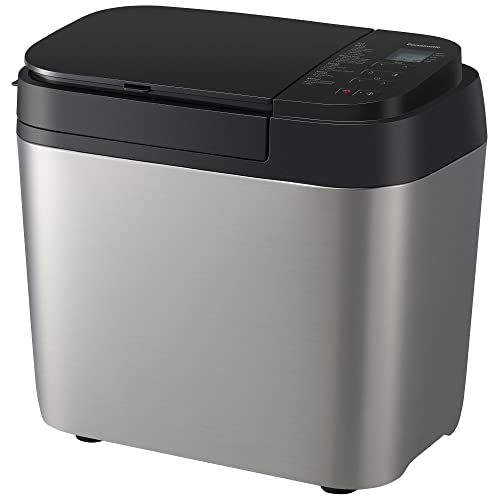
Panasonic SD-R2550 — Best for Preset Variety
Panasonic’s angle is intelligence rather than brute features: the SD-R2550 carries 20 presets and an advanced temperature sensor that reads the temperature of your kitchen and adjusts the program, because dough rises faster in a warm summer kitchen than in a cold winter one and most machines pretend otherwise. Add a raisin and nut dispenser, gluten-free baking, and programs that run from bread to cake to pizza dough, and you have the most versatile preset library in this guide. It suits the household that bakes a bit of everything and wants the machine to adapt. It is less suited to bakers who want manual control — for that, the Breville above is the pick.
Strengths
- 20 presets cover bread, cake, and pizza dough with the broadest out-of-the-box variety here.
- The temperature sensor compensates for warm or cold kitchens, reducing the seasonal inconsistency that plagues fixed-timing machines.
- A raisin and nut dispenser plus a gluten-free program cover the two most common special-diet and mix-in needs.
Trade-offs
- Preset-led design means less manual phase-by-phase control than the Breville offers.
- With 20 programs, the interface takes a few bakes to learn; keep the manual nearby at first.
- Mid-to-premium tier pricing for what is, at heart, a convenience advantage.
Key specs (verified)
- Programs: 20 presets
- Sensing: advanced temperature sensor
- Mix-ins: raisin and nut dispenser
- Includes: gluten-free baking, cake and pizza programs
The temperature sensor is not a gimmick, and here is the concrete scenario where it earns its keep. You set a loaf on the delay timer in a kitchen that cools overnight. A fixed-timing machine proofs the dough for the same duration it would on a warm afternoon, and in the cold kitchen the loaf under-rises and bakes up dense. The Panasonic measures the ambient temperature and stretches the rise to compensate. Owners in older houses, cold climates, or hot kitchens without air conditioning feel this difference regularly; owners in climate-controlled homes may rarely notice it. Judge the feature against your kitchen, not against a spec sheet.
Beyond the sensor, this is a well-rounded family machine: the dispenser means raisin bread does not require you to hover for the add-in beep, and the breadth of presets means one appliance covers the Friday pizza dough and the Sunday cake as well as the weekday loaf. Check the current price on Amazon.
Best for: varied baking households, kitchens with big temperature swings, families wanting one machine for bread, dough, and cake / Not suited for: manual-control enthusiasts, minimalists who use two programs, strict budgets

West Bend Hi-Rise — Best for Large, Traditional Loaves
The West Bend Hi-Rise exists for one reason: loaf shape. Its pan is horizontal and traditionally shaped, with dual knead blades, so the bread that comes out looks like bread — a wide loaf that slices into sandwich-sized pieces instead of the tall tower a vertical pan produces. It offers three loaf sizes up to a full 3 lb, 12 programs including gluten-free, and a choice of crust colors. Big families, sandwich households, and anyone who has ever been annoyed by tower-loaf geometry should start here. Solo bakers and couples will find its capacity more than they need, and its counter footprint matches its ambition.
Strengths
- The horizontal, traditionally shaped pan produces proper sandwich slices — the best loaf geometry in this guide.
- Dual knead blades work the full length of the long pan, so big doughs mix evenly without dry corners.
- Three loaf sizes up to 3 lb let you scale from a small loaf to a family-size bake in the same machine.
Trade-offs
- The long pan makes this one of the widest machines here; it needs real counter width.
- Two blades mean two paddle holes in the base of the loaf.
- A 3 lb loaf is a lot of bread — households that bake big must also store or freeze big.
Key specs (verified)
- Loaf sizes: 3 sizes, up to 3 lb
- Programs: 12, including gluten-free
- Pan: horizontal, traditional shape, dual knead blades
- Crust: multiple crust colors
There is a practical rhythm to owning a machine like this. A 3 lb loaf covers school lunches and toast for most of a week, and because you choose the ingredients, the loaf keeps the way homemade bread keeps — best within days, frozen in slices after that. The dual blades matter more at this size than at any other: a single paddle in a long pan leaves the far corners of the dough under-worked, and you taste it as streaks of dense, under-mixed crumb. West Bend’s two-blade layout is the correct engineering answer, and it is why this machine, rather than a cheaper big-pan rival, holds the large-loaf slot in this guide.
One caution: respect the size settings. Loading a 3 lb recipe and selecting a smaller loaf size under-bakes the center. The machine gives you the range; matching recipe weight to the selected size is your part of the bargain, and the how-to section below walks through it. Check the current price on Amazon.
Best for: families, sandwich and toast households, bakers who want a bakery-shaped loaf / Not suited for: one- or two-person households, narrow counters, bakers bothered by paddle holes
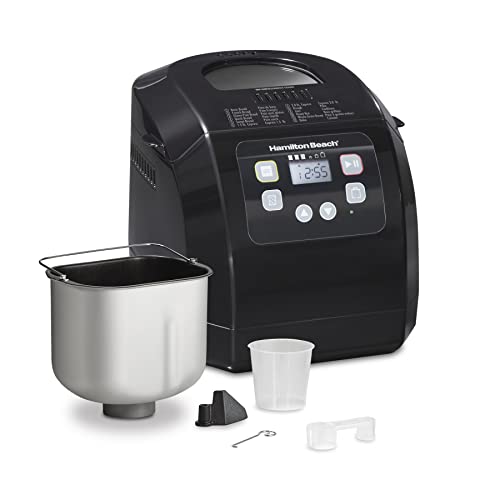
Hamilton Beach Digital Bread Maker — Best Budget
Every guide needs an honest budget pick, and this Hamilton Beach is it: 12 settings including a gluten-free cycle, a 2 lb capacity, and — a detail we did not expect at this tier — a PFAS-free nonstick pan and kneading paddle, for buyers who are actively avoiding conventional nonstick coatings. It does not have dual heaters, a convection fan, or a dispenser, and we will not pretend otherwise. What it has is the complete core job — mix, knead, proof, bake, on a timer — at a budget-tier price from a mainstream brand with real support. For a first machine, that is exactly the right trade.
Strengths
- The PFAS-free nonstick pan and paddle answer a concern many buyers have and few budget machines address.
- 12 settings plus gluten-free cover the everyday repertoire: basic, whole wheat, dough, and more.
- Full 2 lb capacity at a budget tier — no capacity penalty for spending less.
Trade-offs
- A single heating arrangement means a paler top crust than the dual-heater or convection picks deliver.
- No mix-in dispenser: raisin and seeded loaves need you to add ingredients at the beep.
- Fit, finish, and control feel are a clear step below the premium machines in this guide.
Key specs (verified)
- Loaf size: 2 lb capacity
- Programs: 12 settings plus gluten-free
- Pan and paddle: PFAS-free nonstick
- Controls: digital, programmable
Here is how we suggest thinking about the budget tier. If you are unsure whether bread-machine baking fits your life, this machine answers the question at the lowest sensible cost: bake with it for a season, and you will know whether you are a twice-a-week baker who should have bought the Zojirushi, or a twice-a-month baker for whom this was the correct purchase all along. The loaves will be good — slightly paler on top, with a standard paddle hole — and for toast, sandwiches, and dough duty, good is usually enough. The dough cycle alone justifies the machine for many households: pizza night with machine-made dough is a genuine weekly upgrade.
What you should not do is buy this tier expecting the premium results described at the top of this guide, then blame the category. The gap between this machine and the Virtuoso Plus is real and visible on the plate; it is also entirely optional. Check the current price on Amazon.
Best for: first-time buyers, budget-conscious households, PFAS-averse buyers, dough-cycle users / Not suited for: crust perfectionists, heavy whole-grain bakers, anyone who wants a dispenser
Comparison Table
| Pick | Badge | Key spec | Best for |
|---|---|---|---|
| Zojirushi Virtuoso Plus BB-PDC20BA | Best Overall | Dual heaters, 2 lb, 13-hour timer | Frequent and gluten-free bakers |
| Breville Custom Loaf BBM800XL | Best for Custom Control | Collapsible paddle, automatic dispenser | Enthusiasts who tweak recipes |
| Cuisinart Convection CBK-210 | Best for Crust Lovers | Convection fan, 16 programs | Bakers who prioritize crust |
| Panasonic SD-R2550 | Best for Preset Variety | 20 presets, temperature sensor | Varied family baking |
| West Bend Hi-Rise | Best for Large, Traditional Loaves | Horizontal pan, up to 3 lb, dual blades | Families and sandwich loaves |
| Hamilton Beach Digital | Best Budget | 12 settings, PFAS-free pan, 2 lb | First-time and budget buyers |
How to Choose the Right Machine From the 10 Best Bread Machines
Start with how much bread you actually eat, because loaf size is the least forgiving decision. A household of one or two that bakes for toast will waste the top of a 3 lb loaf; a family of five will run a 1 lb machine twice a day and resent it. Match the machine’s largest loaf to your biggest normal bake, and prefer a machine with smaller size settings — most of our picks offer them — for the days you want less. Remember that loaf weight refers to the finished loaf, roughly the combined weight of flour, water, and extras in the recipe.
Next, be honest about your flour. If most of your baking will be white sandwich bread, almost any machine here will serve you, and budget is a fair deciding factor. If whole wheat and seeded loaves are the point, weight your choice toward strong kneading (dual blades or a proven single paddle), a dedicated whole-wheat program with a longer rise, and heating that can finish a dense crumb — the Zojirushi and West Bend profiles. If gluten-free baking is the point, a purpose-built gluten-free program is non-negotiable, and it should be a true single-rise cycle, not a relabeled basic program.
Pan Shape, Paddles, and the Hole in Your Loaf
Vertical pans are compact and common; horizontal pans bake the shape most people picture when they picture bread. Neither is wrong, but they produce different slices, and slices are what you eat. Paddles are the second geometry question. Every machine kneads with at least one paddle that stays in the pan during baking, and the paddle leaves a hole where it sat. Your options for minimizing it: choose a collapsible paddle (the Breville), choose a machine that alerts you to remove the paddle before baking, or accept the hole and slice around it, as most owners cheerfully do. What you cannot do is buy a fixed-paddle machine and be surprised by the hole — it is physics, not a defect.
Programs That Matter and Programs That Pad the Box
Programs worth paying for: a real dough cycle (for pizza, rolls, and oven-finished loaves), a whole-wheat cycle with extended rise, a genuine gluten-free cycle if you need it, a quick or express cycle for same-afternoon bread, and a bake-only cycle for rescuing an under-baked loaf or baking dough prepared elsewhere. Programs that should not sway you: cake, jam, and yogurt settings are pleasant extras, but a cake from a bread pan is a compromise cake, and jam is a stovetop job in most kitchens. Count the programs you will use monthly, not the programs on the box, and let the heaters, pan, and paddle — the hardware you use every bake — carry the decision.
Budget Tiers, Honestly Framed
Bread machines sort into three quality tiers, and the tiers buy different things. The budget tier buys the core job done competently: one heater, a standard pan, a dozen programs — our Hamilton Beach pick lives here, and for first-time buyers it is the rational entry point. The mid-range tier buys evenness and convenience: better heating, dispensers, more thoughtful programs, quieter operation. The premium tier buys the last measure of consistency — dual heaters, temperature sensing, collapsible paddles, custom programming — the features that separate a good loaf from the same good loaf every single time, across whole grains and gluten-free doughs. None of the tiers buys artisan crust; if that is your goal, use any of these machines on the dough cycle and bake in a hot oven or Dutch oven, which is what experienced machine owners quietly do.
How to Use a Bread Machine for a Perfect First Loaf
Step 1: Measure by weight if you can. Flour is the biggest variable in machine baking. A scale removes the guesswork; if you must use cups, spoon flour into the cup and level it rather than scooping, which compacts it.
Step 2: Load in order — liquids first, flour second, yeast last. Add water and other liquids to the pan, then flour so it covers the liquid, then make a small well in the flour for the yeast, keeping yeast away from direct contact with salt and liquid until the cycle starts. This order matters most on the delay timer, where early yeast contact can start fermentation hours too soon.
Step 3: Match the recipe weight to the loaf-size setting. Select the size that matches your recipe’s total weight, choose the program for your flour type, and pick a crust setting one shade lighter than you think you want on your first bake — you can go darker next time, but you cannot un-brown a loaf.
Step 4: Watch the first knead, once. Five to ten minutes into the first mix, open the lid and look. The dough should form a smooth, slightly tacky ball that cleans the sides of the pan. A shaggy, dry mass needs water a tablespoon at a time; a slack puddle needs flour the same way. This single check, done on your first few bakes, teaches you more than any manual.
Step 5: Cool before slicing, and store honestly. Remove the loaf promptly, shake it from the pan, fish the paddle out of the base if it came away with the loaf, and cool on a rack for at least half an hour — slicing hot bread gums the crumb. Store in a bread bag or box at room temperature and freeze extra slices rather than refrigerating, which stales bread fastest.
Cleaning, Care, and Making the Machine Last
A bread machine is one of the easiest appliances to maintain, and the owners who get a decade from one share the same few habits. The pan and paddle do almost all the work and take almost all the wear, so they get almost all the care. After each bake, let the pan cool, fill it with warm water, and let it soak for ten minutes; baked-on dough softens and lifts away without scrubbing, which protects the nonstick coating far better than any amount of careful scouring. Wash the pan and paddle by hand with a soft sponge — most nonstick pans are technically dishwasher tolerant and practically dishwasher shortened — and dry them fully before storing, because the paddle shaft and the pan’s drive socket are the two places moisture likes to linger.
The paddle deserves one specific check. Dough works its way under the paddle and around the shaft as it kneads, and if that residue bakes on repeatedly, the paddle starts to seize or wobble. Wiggle it after every few bakes; if it feels gritty or stiff, soak longer and work a soft brush around the shaft. On the Breville’s collapsible paddle, this same check keeps the hinge folding freely. Once a month, wipe the inside of the baking chamber and around the heating element with a barely damp cloth once the machine is cool and unplugged — flour dust accumulates there, and a heavy buildup can smoke faintly on a hot bake. Never immerse the machine body, and never run a cycle with water in the pan to “steam clean” it; that is hard on the element and the electronics.
Two ownership habits matter more than any cleaning ritual. First, keep the manual and one proven basic recipe together, because the recipe ratios a manufacturer prints are tuned to that machine’s pan volume and program timing, and they are your baseline when a new flour brand misbehaves. Second, know your replacement parts before you need them: pans and paddles are wear items sold separately for every machine in this guide, and replacing a worn pan in year six is far cheaper than replacing a machine whose coating has failed. A machine that is cleaned gently, stored dry, and fed the right recipe weights is not a five-year appliance — it is a ten-year one, and at two loaves a week that is over a thousand bakes from a single purchase.
Common Buying Mistakes
Buying by program count. Twenty programs you never touch are worth less than the dough cycle you use weekly. Buy hardware first, programs second.
Ignoring the footprint. Bread machines are tall, and lids swing up. Measure the space between your counter and cabinets before ordering any full-size model, or your new machine will live in a closet — which is to say, it will not be used.
Expecting artisan sourdough. No preset in any machine reproduces a Dutch-oven boule. Use the dough cycle and finish in the oven if that loaf is your goal.
Mismatching recipe and size setting. A 3 lb recipe on a 2 lb setting overflows; a big recipe on a small setting under-bakes. This causes more failed loaves than any machine fault.
Skipping the first-knead check. Flour absorbs water differently by brand, season, and storage. Thirty seconds of looking during the first knead prevents most dense-loaf disappointments.
Chasing a discontinued bargain. A famous model sold used or by a reseller at a markup is worse value than a current model with a warranty. If a listing looks too good for a discontinued name, it usually is.
Final Recommendation
For most households, the answer is the Zojirushi Virtuoso Plus: it bakes the most even loaf, handles the hardest doughs, and is built for years of weekly use. Buy the Breville Custom Loaf if you tinker and hate the paddle hole, the Cuisinart CBK-210 if crust is your complaint, the Panasonic SD-R2550 if your kitchen swings hot and cold and your baking ranges wide, the West Bend Hi-Rise if you bake big, traditionally shaped loaves for a family, and the Hamilton Beach Digital if you are buying your first machine on a budget. Check the current price on Amazon for whichever you choose.
Still deciding? These guides in the same series go deeper on specific needs: Best 2 Lb Bread Machines, Best Bread Machines Under $100, Best Affordable Bread Machines, Best Bread Machines For Sourdough, Best Bread Machines For Home Use, and Best Bread Flour For Bread Machines.
Related guides
Frequently Asked Questions
Is a bread machine worth it if I already own a stand mixer and an oven?
For crusty artisan loaves, your oven setup wins and the machine adds little. For everyday sandwich bread, whole wheat, and dough on a timer — bread that is ready when you wake up or come home, with ten minutes of effort — the machine earns its space. Many owners use both: the machine for the weekly loaf and dough duty, the oven for weekend projects.
Why does my bread machine loaf have a hole in the bottom?
The kneading paddle sits in the pan through the bake, and the hole is where it was. It is normal on every machine. A collapsible paddle shrinks it, removing the paddle before the bake eliminates it, and slicing from the other end hides it — but no fixed-paddle machine avoids it entirely.
Can a bread machine make real sourdough?
It can manage starter and dough cycles for sourdough-style bread, and some models include a dedicated starter program. It cannot reproduce the long fermentation control and fierce, humid heat that produce a true artisan sourdough crust. For that loaf, use the machine’s dough cycle and bake in a Dutch oven.
What size bread machine should a family buy?
Match the machine’s largest loaf to your largest normal bake. Families of four or more who eat bread daily usually land on a 2 lb machine as the minimum, and households baking for lunches all week should look at the 3 lb West Bend in this guide. Smaller households do better with a 2 lb machine that offers smaller size settings.
Why did my loaf collapse or come out dense?
The usual causes are measurement, not machinery: too much liquid, old yeast, yeast that touched salt or liquid early on a delayed cycle, or a recipe weight that did not match the size setting. Weigh flour, check the dough ball during the first knead, and keep yeast dry in its flour well until the cycle starts.
How long does a loaf stay fresh, and how should I store it?
Homemade bread without preservatives is best within two to three days at room temperature in a bread bag or box. Do not refrigerate it — cold accelerates staling. For longer keeping, slice the loaf, freeze the slices, and toast them straight from the freezer.


