Disclosure: airfryerkitchensupply.com is reader-supported. When you buy through links on our site, we may earn an affiliate commission at no extra cost to you.
Where to buy
Every blender in this guide was verified against Amazon’s live catalog data — brand, model, configuration, and ASIN confirmed — so the review and the link describe the same machine. Check the current price on Amazon and confirm the model number on the listing before ordering.
- NutriBullet Pro 900 — Check on Amazon
- Ninja Professional Plus DUO Blender BN751 — Check on Amazon
- nutribullet Full-Size Blender Combo NBF50500 — Check on Amazon
- Ninja Nutri-Blender Pro BN401 — Check on Amazon
- Vitamix Propel Series 510 — Check on Amazon
- Hamilton Beach Power Elite Blender 58148AG — Check on Amazon
Introduction
The best affordable blenders for green smoothies are decided by the hardest ingredient in the smoothie world: fiber. Fruit is easy, yogurt is easy, ice is a solved problem — but kale stems, celery, ginger, and frozen mango together will expose any blender that lacks the power or the circulation to keep a thick, leafy load moving. A weak machine leaves the evidence in the glass: strings, flecks, and a layer of pulp that separates while you watch. The good news is that green smoothies are where the affordable tier’s progress shows most. Personal blenders now concentrate 900 watts into a single cup, Ninja’s pitchers pull leafy loads down with stacked blades, nutribullet builds a combo that covers both formats, and even the premium step-up — a Vitamix — has an entry model that belongs in an honest conversation about value over years. This guide reviews six verified machines for the green-smoothie job specifically, explains the technique that makes greens disappear in any of them, and keeps the health framing where it belongs: on taste, texture, and the habit of actually drinking your greens.
One promise about scope: nothing in this guide makes medical claims for green smoothies or for any blender. What a good machine does is make a green smoothie taste like a drink instead of a chore — smooth, cold, and consistent — and that, in practice, is what decides whether the habit survives February.
A second promise about honesty in the picks: the word “affordable” stretches in this guide from a budget Hamilton Beach to a Vitamix, and that stretch is deliberate. Green smoothies are the category where the premium machine’s advantage is most visible, so a guide that hid the Propel would be protecting a price point at the cost of the reader’s information. It is badged as the step-up it is; the five picks around it are the affordable class proper, and for most readers one of those five is the correct destination.
In this guide
Quick Picks
- Best Overall: NutriBullet Pro 900 — 900 watts concentrated in a personal cup, the most reliable affordable route to a genuinely smooth green smoothie. Check on Amazon
- Best for Families: Ninja Professional Plus DUO BN751 — a 72-ounce pitcher for family green smoothies plus single-serve cups, with Auto-iQ doing the work. Check on Amazon
- Best Combo: nutribullet Full-Size Blender Combo NBF50500 — a 1,200-watt pitcher and cups in one system, for households split between batch and personal blending. Check on Amazon
- Best Personal Power: Ninja Nutri-Blender Pro BN401 — 1,100 peak watts with Auto-iQ programs and 24-ounce cups, the strongest personal green-smoothie tool here. Check on Amazon
- Best Premium Step-Up: Vitamix Propel Series 510 — the professional class’s entry point, with a 48-ounce container and three programs, for greens without compromise. Check on Amazon
- Best Budget: Hamilton Beach Power Elite 58148AG — a 700-watt circulation-jar blender that handles leafy greens respectably at the friendliest point in the class. Check on Amazon
How These Picks Were Chosen
Green-smoothie competence was the entry test, judged on the three things that decide it: power density (watts working on the actual volume in the vessel), circulation (whether fibrous material keeps returning to the blades), and cycle discipline (whether the machine — or its programs — runs long enough to finish the job, because most under-blended greens are simply under-blended in time). Verification followed this series’ standing rule: exact model and ASIN confirmed against live Amazon catalog data before a link was earned.
The list deliberately spans formats, because green-smoothie households divide by routine, not by taste: solo drinkers with a morning cup, families blending a pitcher, and devotees ready to buy the professional step-up. Each pick leads one of those lives. Excluded were the light personal blenders under roughly 600 watts that make green smoothies an exercise in chewing — charming machines for shakes, wrong tools for kale.
Also weighed, and worth recording: noise and morning diplomacy. Green smoothies are a dawn ritual in many homes, and the powerful picks here are not quiet. The guide’s position is that a 60-second cycle is a fair trade for a smooth result, and that readers in thin-walled homes should blend the night before — a sealed cup of green smoothie keeps its quality overnight in the refrigerator — rather than buy a weaker machine for the sake of silence and chew their greens at noon instead.
The 6 Best Affordable Blenders for Green Smoothies

NutriBullet Pro 900 — Best Overall
The Pro 900 is the green smoothie, solved at personal scale. Its 900 watts work on a single cup’s volume, and that concentration is the whole story: spinach vanishes, kale blends smooth with a full cycle, and frozen fruit stops being an obstacle and becomes the texture. The workflow is the fastest in this guide — fill, twist, blend, drink from the same cup — which matters because green smoothies are a habit food, and habits live or die on friction. The verified listing here is the Special Edition in white. It suits one-to-two-person households with a daily green routine. It does not suit families blending for a table, and fibrous extremes like thick celery-and-ginger loads come out a touch smoother in the BN401 or the Vitamix.
Strengths
- 900 watts in a personal cup — power density that makes greens genuinely smooth.
- The two-minute routine is the easiest daily habit in this guide to keep.
- Deep parts ecosystem: cups, blades, and gaskets are available everywhere.
Trade-offs
- One serving at a time, by design.
- The most fibrous loads still show a hint of texture.
- Press-and-twist control means timing is yours to learn.
| Spec | Detail |
|---|---|
| Motor | 900 watts |
| Format | Personal blender, Special Edition |
| Finish | White |
| Operation | Twist-on cup, press to blend |
The Pro 900’s green-smoothie authority comes from a physical truth this guide keeps returning to: what matters is watts per ounce of smoothie, and a personal cup wins that ratio against almost any pitcher. Add the greens-first technique from the how-to section — greens and liquid given a head start — and its results embarrass machines with twice the headline power and four times the volume. For the solo green drinker, it is not the budget version of the right blender. It is the right blender.
Best for: daily solo green smoothies with minimal fuss. / Not suited for: family batches.
Check the current price on Amazon

Ninja Professional Plus DUO BN751 — Best for Families
Family green smoothies are a volume problem wearing a health halo: four servings, one of them suspicious of anything green, all of them needing the texture to be beyond argument. The BN751 answers with a 72-ounce pitcher, 1,400 peak watts, and Auto-iQ programs that run the long, pulsing cycle greens need while the cook makes breakfast. The two included 24-ounce cups cover the solo weekday version of the same habit. Frozen fruit and leafy greens come out smooth at pitcher scale — the stacked blades keep the big load circulating where lesser pitchers stratify into a smooth bottom and a leafy top. It suits families and batch makers. It does not suit solo drinkers, who will wash a big pitcher for one cup, or the noise-sensitive.
Strengths
- Auto-iQ runs the full green-smoothie cycle hands-free and consistently.
- 72-ounce pitcher makes a family round in one blend.
- Cups included for the personal version of the routine.
Trade-offs
- Peak-watt rating — headroom rather than a sustained figure.
- Loud at full load, as strong pitchers are.
- Big footprint for a daily solo habit.
| Spec | Detail |
|---|---|
| Motor | 1,400 peak watts |
| Pitcher | 72 oz pitcher |
| Cups | (2) 24 oz single-serve cups |
| Programs | 3 Auto-iQ programs |
The family case for the DUO is really a texture-diplomacy case. A green smoothie that a skeptical kid or partner finds smooth gets drunk; one with strings becomes a story told against the whole category. The BN751’s combination of pitcher circulation and programmed cycle length is the affordable tier’s most reliable way to win that argument at volume — and winning it once a morning, for years, is the entire point of the purchase.
Best for: families making green smoothies at pitcher scale. / Not suited for: solo drinkers or quiet kitchens.
Check the current price on Amazon

nutribullet Full-Size Blender Combo NBF50500 — Best Combo
The Combo is the hedge against format regret: one 1,200-watt base, a 64-ounce pitcher for shared green smoothies, and single-serve cups for personal ones. nutribullet’s extractor heritage shows in the cup work — greens come out smooth at personal scale — and the pitcher handles family loads with more authority than most budget jars, because the same motor class drives it. Households whose green routine splits between a weekday solo cup and a weekend family pitcher get both from one base, one footprint, and one parts ecosystem. It suits couples and small families with split routines. It does not suit glass loyalists, and its pitcher finesse with the most fibrous loads trails the Vitamix below.
Strengths
- One 1,200-watt system covers personal and family green smoothies.
- Cup performance inherits nutribullet’s extractor strengths.
- Strong frozen-fruit handling in both formats.
Trade-offs
- Plastic vessels throughout.
- More parts to store than a single-format machine.
- Pitcher texture ceiling sits below the professional step-up.
| Spec | Detail |
|---|---|
| Motor | 1,200 watts |
| Pitcher | 64 oz full-size pitcher |
| Formats | Pitcher plus single-serve cups |
| Model | NBF50500, dark gray |
Combos are often compromises wearing a costume; this one is an architecture. Green smoothies are the job where the two formats genuinely alternate in real households — the solo health routine and the family breakfast are different events — and the Combo is the only pick here that refuses to make you choose between them. If your green life is honestly both, it is the most rational purchase in the guide.
Best for: households split between solo cups and family pitchers. / Not suited for: glass loyalists or single-format purists.
Check the current price on Amazon
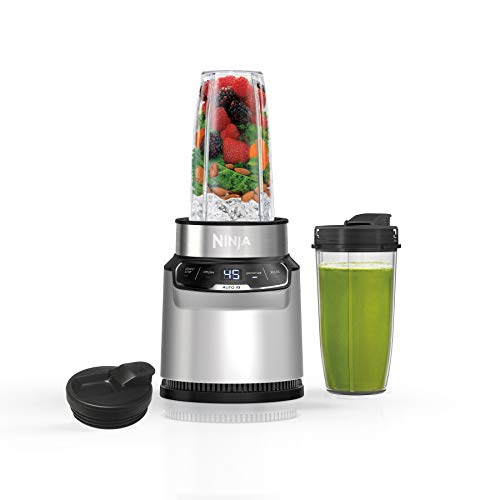
Ninja Nutri-Blender Pro BN401 — Best Personal Power
The BN401 is the personal format with its limits removed: 1,100 peak watts, Auto-iQ programs that choreograph the pulse-rest-blend pattern greens respond to, and two 24-ounce cups that hold a serious smoothie. Where the Pro 900 asks you to learn timing, the BN401’s programs simply execute — press the button and the machine runs the cycle that turns kale, frozen mango, and ginger into a uniform drink while you get dressed. It is the strongest answer in this guide for the solo drinker whose smoothies lean fibrous. It suits green devotees blending for one or two. It does not suit the tightest budgets, and its base is the largest of the personal picks.
Strengths
- 1,100 peak watts is the most personal power in this guide.
- Auto-iQ programs automate the exact cycle greens need.
- 24-ounce cups hold full, meal-sized green smoothies.
Trade-offs
- Peak-watt rating, and the top of the personal format’s pricing.
- Larger, louder base than other personal picks.
- Still one serving per cycle.
| Spec | Detail |
|---|---|
| Motor | 1,100 peak watts |
| Cups | (2) 24 oz cups |
| Programs | Auto-iQ programs |
| Model | BN401 |
Green smoothies are where personal blenders earn or lose their reputation, and the BN401 earns it at the fibrous frontier: celery and kale stems, the loads that leave strings in lesser cups, come out clean. If your smoothie formula is fruit-forward, the Pro 900 serves you for less commitment. If your formula reads like a garden — and you drink it daily — the BN401 is the personal machine that will never make you chew your breakfast.
Best for: solo green-smoothie devotees with fibrous recipes. / Not suited for: tight budgets or batch blending.
Check the current price on Amazon

Vitamix Propel Series 510 — Best Premium Step-Up
The Propel 510 is the professional class’s front door, and in a green-smoothie guide it earns its place on results: Vitamix’s circulation and sustained power produce the smoothest green texture in this guide — the kind where kale stems simply cease to exist as a category — in a 48-ounce container sized for one to three servings, with three programs including the smoothie cycle and a self-cleaning habit that makes daily use painless. It is positioned, honestly, above the affordable core; it is here because green smoothies are the job where the professional difference is most visible in the glass, and because bought once and used daily for years, its cost-per-smoothie argument is real. It suits devoted green drinkers ready to end the upgrade ladder. It does not suit bargain hunters or occasional smoothie makers, for whom it is magnificent surplus.
Strengths
- The finest green-smoothie texture in this guide — fibrous loads vanish.
- Three programs plus variable control cover smoothies to soups.
- Self-cleaning design sustains the daily habit effortlessly.
Trade-offs
- It is the premium step-up, priced accordingly.
- 48-ounce container is mid-sized for large families.
- Professional power is professional volume — it is not quiet.
| Spec | Detail |
|---|---|
| Container | 48 oz |
| Programs | 3 programs |
| Controls | Variable speed with pulse |
| Cleaning | Self-cleaning |
The honest framing for the Propel is trajectory. A reader who has already replaced one affordable blender with another, chasing a smoother green result, is on a path whose total cost approaches this machine — with worse smoothies along the way. Readers at the start of that path should buy from the five picks around this one and be happy. Readers partway down it should recognize their destination when they see it.
Best for: devoted green-smoothie drinkers ready to buy the destination. / Not suited for: occasional users or strict budgets.
Check the current price on Amazon

Hamilton Beach Power Elite Blender 58148AG — Best Budget
The Power Elite is the budget green-smoothie answer, and its weapon is circulation rather than force. The Wave Action jar keeps a leafy load folding into the blades, so spinach and soft kale blend evenly without the stop-and-stir ritual, and the 700-watt motor handles frozen fruit in reasonable portions. Its honest limits are the fibrous frontier — celery and thick kale stems will leave their signature — and its 40-ounce glass jar sizes it for one to three servings. With the greens-first technique, its results satisfy most green drinkers at the friendliest positioning in this guide. It suits budget buyers, beginners, and leaf-forward (rather than stem-forward) recipes. It does not suit fibrous devotees or family volume.
Strengths
- Wave Action circulation makes leafy greens blend evenly without technique.
- Glass jar, simple controls, and the easiest cleanup routine here.
- The most affordable legitimate green-smoothie machine in the guide.
Trade-offs
- Fibrous stems and celery leave texture behind.
- 700 watts wants reasonable frozen portions.
- 40-ounce capacity caps family ambitions.
| Spec | Detail |
|---|---|
| Motor | 700 watts |
| Jar | 40 oz glass |
| Functions | 12 functions including puree and crush ice |
| System | Wave Action circulation |
Most green smoothies in the real world are spinach, banana, and frozen fruit — and for that recipe, the Power Elite is not a compromise at all. It earns the budget badge by covering the common case completely and by being honest about the frontier beyond it. Beginners especially should note the pattern: start with the machine that handles your actual recipe, learn the technique in this guide, and let your recipes — not marketing — tell you if you ever need more.
Best for: budget buyers and leaf-forward green smoothie recipes. / Not suited for: fibrous-stem devotees or big families.
Check the current price on Amazon
The Texture Ladder: From Flecks to Silk
Green smoothies live on a texture ladder, and knowing your rung is the fastest way to buy the right machine. The bottom rung is flecked: visible green pieces, a drink you chew slightly, made by light machines or short cycles. The middle rung is smooth-with-body: no strings, a slight pulp presence, the result most home drinkers happily live with — every pick in this guide reaches at least here with proper technique. The top rung is silk: greens fully dissolved into the drink, the professional texture, reached by the BN401 at personal scale and the Propel at any scale, and approached by the Pro 900 and the DUO on their best cycles.
Two forces move you up the ladder, and only one of them costs money. Technique — greens first, correct ratios, full cycles, sensible prep — moves any machine up a full rung for free. Hardware moves you up when technique has done its work and the texture still stops short of your standard. The buying mistake this ladder exists to prevent is purchasing the top rung before learning whether your palate even lives there. Most green drinkers discover that the middle rung, reached by a mid-tier machine and good method, is where they happily stay for years. The devotees who climb higher know exactly why, and this guide has a pick waiting for them at the top.
One more subtlety: the ladder is recipe-dependent. The same machine produces a middle-rung spinach smoothie and a bottom-rung celery smoothie, because fiber is the variable. When you read any green-smoothie claim — including the ones in this guide — ask which greens it was earned on. This guide’s badges were assigned against kale-and-frozen-fruit as the standard load, with the fibrous frontier called out wherever a pick’s story changes there.
Building the Habit: A Green Smoothie Pantry
The blender is only half of a green-smoothie practice; the pantry is the other half, and it is cheaper than any machine here. Keep a freezer rotation of portioned greens — washed spinach and kale in smoothie-sized bags — beside frozen mango, pineapple, and banana, portioned to your vessel. Keep lemons or limes for brightness, ginger for bite, and your protein or nut butter beside the machine rather than across the kitchen. The goal is a morning with no decisions and no shopping: greens, fruit, liquid, blend. Habits fail at friction points, and every item staged in advance removes one.
Rotate flavors on a simple rhythm so the habit does not stale: a tropical build (mango, pineapple, spinach) for bright days, a green-apple and ginger build when you want bite, a banana-and-peanut-butter build when the smoothie is breakfast. The machines in this guide handle all three without adjustment — what changes is only the bag you pull from the freezer. And keep one honest rule: if a combination tastes bad, change the combination, not the habit. Green smoothies survive on enjoyment; virtue alone has a notoriously short shelf life.
Finally, measure the practice in weeks, not days. The first week of green smoothies is experimentation — ratios, textures, the machine’s personality. By the third week, most drinkers have a house recipe and a two-minute routine, and the blender has become what the best appliances become: invisible infrastructure for a life that runs slightly better with it than without it. Every pick in this guide is capable of carrying a reader to that third week. The rest is groceries.
Comparison Table
| Pick | Badge | Key spec | Best for |
|---|---|---|---|
| NutriBullet Pro 900 | Best Overall | 900W personal cup format | Daily solo green smoothies |
| Ninja BN751 DUO | Best for Families | 1,400 peak W, 72 oz + cups | Family green smoothies |
| nutribullet Combo NBF50500 | Best Combo | 1,200W, 64 oz pitcher plus cups | Split personal and batch routines |
| Ninja BN401 | Best Personal Power | 1,100 peak W, Auto-iQ, 24 oz cups | Fibrous solo recipes |
| Vitamix Propel 510 | Best Premium Step-Up | 48 oz, 3 programs, self-cleaning | Finest green texture |
| Hamilton Beach Power Elite | Best Budget | 700W, 40 oz glass, Wave Action | Leaf-forward recipes on a budget |
How to Choose a Blender for Green Smoothies
Power density beats headline power
The number that predicts your green smoothie is watts per ounce. A 900-watt personal blender working on 20 ounces concentrates its effort far beyond a 900-watt pitcher spread across 60 — which is why the personal picks in this guide punch so far above their format. When you compare machines, divide honestly: your serving size is the denominator that matters, and it explains results that confuse buyers who shop by the headline figure alone. It also explains the family trap: a pitcher run for a single serving is a low-density blend no matter how strong the motor, which is why the DUO’s included cups matter — they restore the density that makes its weekday solo smoothie match its weekend family one.
Circulation is the second engine
Fibrous material floats, mats, and rides above blades. Designs that defeat this — stacked blades cutting at height, extractor cups keeping everything in a tight vortex, circulation jars folding the load down, Vitamix’s professional vortex — are the ones whose green smoothies come out uniform. A powerful motor in a lazy jar makes a loud, chunky smoothie. Read for the circulation story in every review above. You can test circulation in the first week with any machine: blend a smoothie with a handful of spinach added last, on top, and watch whether the leaves are pulled down within seconds or ride the surface until you intervene. That one observation predicts your entire ownership experience with greens.
Cycle length is a feature
Greens need time: most smooth results in this guide come from cycles of 45 to 90 seconds, and programs that enforce that length (Auto-iQ, the Vitamix smoothie program) remove the human tendency to stop early. If you buy a manual machine, buy a timer habit with it. The difference between a flecked smoothie and a smooth one is often twenty seconds, not two hundred watts. There is a ceiling, though: beyond the point of smoothness, extra blending only adds air and warmth, both of which flatten flavor and loosen texture. Learn your machine’s finishing time — the moment the sound evens out and the surface turns glossy — and stop there, however round the number on the clock is not.
Match the machine to your greens
Spinach and leaf lettuce forgive everything. Kale leaves ask for the mid-tier. Kale stems, celery, and raw ginger — the fibrous frontier — ask for the BN401, the DUO at volume, or the Propel. Be honest about your recipe: most green drinkers live happily in leaf territory, and the few who live at the frontier should buy for it directly rather than upgrading through disappointment. Chard and beet greens sit between the territories — softer than kale stems, sturdier than spinach — and herbs like parsley and mint, used by the handful, blend anywhere but flavor aggressively, so let the recipe rather than the machine ration them.
How to Make a Green Smoothie That Actually Tastes Good
- Greens and liquid first. Blend the greens with your liquid alone for 20 to 30 seconds before anything else goes in. This single step does more for texture than any upgrade in this guide.
- Frozen fruit is the sweetener and the chill. Frozen mango, pineapple, and banana mask green flavors while they thicken and chill — no ice needed, no dilution suffered.
- Respect the ratio. Start near sixty percent fruit to forty percent greens while your palate learns, and shift greener as the habit sets. A smoothie you enjoy beats a virtuous one you abandon.
- Add a fat or a protein for staying power. A spoon of nut butter, yogurt, or protein powder turns a drink into a breakfast and rounds the flavor.
- Acid brightens everything. A squeeze of lemon or lime wakes up a flat green smoothie the way it wakes up a salad.
- Blend the full cycle. Forty-five to ninety seconds, depending on the machine and the fibrousness. Taste, adjust once, and drink it cold and fresh.
A note on preparation: wash greens well, destem the thickest kale ribs if your machine is a mid-tier one, and cut celery and ginger small. Two minutes of knife work is worth several hundred watts, and it is the technique professionals use regardless of the machine in front of them.
The Green Lineup for Every Routine
The solo morning ritual: the Pro 900 for most, the BN401 for the fibrous faithful — two minutes, one cup, no negotiation.
The family breakfast: the BN751 DUO, whose pitcher and programs make four smoothies taste like one recipe instead of four compromises.
The split household: the nutribullet Combo, because weekday cups and weekend pitchers are both real, and one base should serve both.
The devoted daily drinker: the Propel 510, bought once, used for years, its texture never again a topic of thought.
The beginner on a budget: the Power Elite and a bag of spinach — the common green smoothie, covered completely, with room to grow.
Troubleshooting: Green Smoothie Problems, Solved
Problem: Strings and flecks in the glass. The greens did not get their head start, or the cycle was short. Blend greens with liquid first, run the full cycle, and cut stems smaller. If flecks persist in a strong machine, check the blade assembly for dullness — a worn blade tears greens instead of cutting them, and a replacement restores the original texture completely.
Problem: The smoothie separates in minutes. The emulsion never formed — usually too little frozen fruit or too short a blend. Add frozen banana or mango and blend longer; separation is a texture problem, not a freshness one.
Problem: It tastes like a salad, in a bad way. The ratio ran too green too fast, or the fruit was not sweet enough. Shift toward fruit, add citrus, and let your palate migrate over weeks rather than days.
Problem: The blender stalls on frozen mango. The load is packed or too dry. Add liquid, thaw the largest pieces for two minutes, and start on a lower setting to establish movement. Cut frozen fruit smaller at prep time — halved mango cheeks and strawberries blend like fresh produce — and the stall disappears from your routine permanently, whatever machine you own. Treat prep as part of the recipe rather than as a preliminary to it, and even the budget pick in this guide will feel like a considerably stronger machine than its modest little specification sheet promises on paper at first casual glance in the store aisle.
Problem: Foam on top, thin drink below. Over-aeration from a very long high-speed run with lots of headspace. Fill the vessel closer to its working line and stop at smooth rather than continuing to frothy. A short rest before pouring lets the foam settle back into the drink; a straw inserted and removed breaks the worst of it if you are in a hurry. Persistent foam usually means the recipe is very high in fresh fruit sugars and low in body — a spoon of yogurt or nut butter settles it.
Care and Cleaning for Green Machines
Green smoothies are kind to blenders in one way — the loads are wet and cool — and unkind in another: chlorophyll stains, and fibrous residue dries into the blade assembly’s crevices like green cement. The defense is the same minute-after rinse this series recommends everywhere, with one green-specific addition: a drop of dish soap and a full self-clean cycle matters more here than with fruit smoothies, because the pigment that makes the drink beautiful will tint a neglected jar permanently. Glass jars resist the tint best; plastic vessels forgive drops but keep a faint green memory if they sit unwashed.
Blade bases and personal cups deserve a weekly detail: remove the gasket, clear the groove, and check the seal, because green residue hides exactly there and a compromised gasket is next week’s leak. Motors, by contrast, ask for almost nothing in this category — green loads are the gentlest work in blending, cool and liquid, and a machine used for greens alone will outlast the same machine used for ice. If your blender’s whole career is green smoothies, expect a long one, and spend your maintenance attention on the small rubber ring rather than the motor.
Storage follows the habit: a green-smoothie machine earns a permanent counter spot beside the fruit bowl, because a practice measured in daily minutes cannot afford a cupboard retrieval. Keep the cups and lids together, the freezer portions visible, and the machine ready. The whole system — appliance, pantry, and two-minute routine — is the product you are really buying when you buy from this guide, and it is why the picks were judged as much on friction as on power.
Common Buying Mistakes
- Buying a shake machine for a kale habit. Light personal blenders are honest tools for protein shakes and wrong tools for fibrous greens. Match the motor to the stem.
- Judging by the first smoothie. Greens reward learned technique — order, ratio, cycle length. Give any machine here a week of proper method before judging it.
- Ignoring power density. A big pitcher’s headline watts spread thin. For solo green smoothies, the personal format is not the compromise; it is the advantage.
- Skipping the greens-first step and blaming the machine. The most common green-smoothie failure is procedural. Fix the order before you fix the appliance.
- Buying premium before knowing your recipe. If your greens are spinach and your fruit is banana, the budget pick covers you completely. Let recipes, not aspirations, set the budget.
- Expecting the blender to fix the flavor. Texture is the machine’s job; balance — sweet, acid, fat — is yours. Both halves are in this guide for a reason.
Green Smoothies for Kids and Skeptics: A Texture-First Strategy
Many green-smoothie purchases are really negotiations — one household member drinks greens happily, and another is unconvinced. The blender’s role in that negotiation is texture: skeptics reject strings, flecks, and swamp colors far more than they reject flavor. The strategy that works is to start where the skeptic is: a fruit-forward smoothie, vividly colored by mango or berries rather than by a deep green, blended to complete smoothness by a machine from the top half of this list, served cold in a cup that is not transparent. Spinach, the mildest green, hides invisibly behind mango and banana at ratios that would expose kale instantly.
From there, migrate gradually — a handful more greens each week, the color deepening as palates adjust — and let the machine’s consistency carry the argument. This is the practical reason the family pick in this guide is the automated DUO and the solo picks lead with power: in a household negotiation, an inconsistent smoothie is not a small flaw, it is the opposition’s best evidence. Buy the texture that wins the argument, keep the ratios kind, and the greens will take care of themselves.
And keep the framing honest at the table, as this guide has kept it on the page: a green smoothie is a tasty way to eat greens and fruit, full stop. Sold as a treat, it becomes one. Sold as a medicine, it becomes a chore with a straw — and no blender in this guide, at any price, can fix a chore.
Final Recommendation
The NutriBullet Pro 900 is the green-smoothie answer for most people: real power, personal scale, and a routine too fast to skip. Families should take the BN751 DUO, split households the nutribullet Combo, fibrous solo drinkers the BN401, devotees the Vitamix Propel 510, and budget beginners the Power Elite. Add the greens-first technique and a fruit-forward ratio, and any of them will turn a bag of greens into a drink you look forward to — which is the entire point. Judge your purchase a month from now, not on the first morning: by then the machine will have a house recipe, a two-minute routine, and a place in your kitchen’s geography, and the only question left will be why you spent so long drinking smoothies with strings in them.
More from this cluster: Best Affordable Blenders, Best Affodable Blenders, Best Afforadble Personal Blenders, Best Affordable Blenders For Smoothies, and Best 900 1000 Watt Blenders.
Related guides
Frequently Asked Questions
What is the most important feature for green smoothies?
Power density with circulation: enough watts working on your actual serving size, in a vessel that keeps fibrous material returning to the blades. After that, cycle length — greens need a full 45 to 90 seconds to truly smooth out. If you remember one sentence from this guide, make it that one; it explains why a 900-watt cup can out-blend a stronger pitcher for a solo smoothie, why programs that enforce cycle length are worth having, and why your first fix for a chunky result should always be more time and better loading order rather than a new machine.
Can a personal blender handle kale?
Leaves, yes, comfortably in the 900-watt class and above. Stems are the frontier: the BN401 and the Pro 900 with the greens-first technique handle them well, and the Vitamix erases them entirely. Lighter personal blenders should stick to leaves. A practical compromise for mid-tier machines: use the leaves in the smoothie and save the thickest stems for cooking, or destem the kale in the two minutes while the frozen fruit tempers. The smoothie loses nothing and the machine works a full class above its station.
Why does my green smoothie taste bitter?
Usually the ratio: too much green, not enough ripe fruit, or a bitter green like mature kale dominating. Sweeten with frozen mango or banana, add citrus for brightness, and build toward greener ratios gradually. Also check your greens themselves — older kale and the thickest stems carry the bitterness, while baby spinach is nearly flavorless in a smoothie. A reader who concludes they dislike green smoothies after one bitter, stem-heavy attempt has usually met a recipe problem wearing a category’s clothing; fix the recipe before you judge either the drink or the machine.
Should I use fresh or frozen greens?
Both work. Fresh greens blend fastest; frozen greens keep longer and chill the drink, but ask a little more of the motor. Many daily drinkers freeze their own washed spinach in portions, which keeps indefinitely and blends beautifully in the stronger picks here. One caution with frozen greens in lighter machines: add them after the liquid and let the greens-first stage run a few seconds longer, because a frozen block of spinach is effectively a green ice cube and deserves the same respect as the frozen fruit.
How do I stop my green smoothie from separating?
Blend longer with enough frozen fruit to form a stable texture, include a little fat or yogurt if your recipe allows, and drink it fresh. Separation after twenty minutes is normal physics; separation in two minutes means the blend was too short or too thin. If you routinely make a smoothie to drink later, blend it thick, store it filled to the brim in a sealed cup (less air, slower separation and oxidation), and give it a hard shake before drinking — the texture recovers most of the way, and the routine survives a commute.
Is a Vitamix worth it just for green smoothies?
If green smoothies are a daily, years-long habit with fibrous recipes, its texture advantage is real and its cost spreads across thousands of drinks. If your smoothies are occasional or leaf-based, the affordable picks in this guide will satisfy you completely for far less commitment. The honest test is your own history: if you have already worn out or outgrown one affordable blender chasing a smoother green result, the Propel is your destination and buying it now is the economical move. If this is your first green-smoothie machine, start with the Pro 900 or the Power Elite and let your recipes vote.


