Disclosure: airfryerkitchensupply.com is reader-supported. When you buy through links on our site, we may earn an affiliate commission at no extra cost to you.
Where to buy
Every pick in this best 10 quart air fryers guide is sold through Amazon. Check the exact listing for each model named: the Ninja DZ401 Foodi DualZone XL 10 Qt, the Instant Pot 10 Qt 7-in-1 Air Fryer, the Chefman Multifunctional Digital Air Fryer+ 10L, the Gourmia 10 Qt Dual Basket Air Fryer, the Ninja SL401 DoubleStack XL 10 Qt, and the DEIME Air Fryer 10.2 QT. Ten-quart machines come in three different architectures that share a capacity number and little else, so confirm the format — dual basket, stacked, or oven — matches the review before ordering.
The best 10 quart air fryers are not simply bigger air fryers; they are a different idea of what the appliance is for. At ten quarts the category splits into three architectures, and choosing among them matters more than choosing among brands. Dual-basket machines (the Ninja DZ401, the Gourmia) run two independent zones, so the protein and the side cook at different temperatures and finish together. Stacked designs (Ninja’s DoubleStack) keep a narrow footprint while cooking up to four foods at once across two levels. Oven-style machines (the Instant and Chefman) open like a small convection oven, with racks, a window and — in both cases here — a rotisserie, trading basket-shake simplicity for genuine multi-rack volume. What unites them: family-plus capacity, party capacity, holiday capacity — the ability to cook for six to ten people, or to cook two things at once for four. If your kitchen regularly feeds a crowd, or your weeknight dinners keep demanding two temperatures at once, this is your class, and the six verified machines below are its current honor roll.
Every pick was verified against live Amazon catalog data through the Amazon Creators API — ASIN, exact listing title, capacity and headline specifications confirmed before inclusion. Verification matters acutely here because “10 quart” is the most abused number in the category: some listings count both baskets, some count one cavity generously, and oven models quote liters that sellers round into quarts. We state each machine’s format and verified configuration plainly so the comparison is honest. We print no prices — they move too often to be useful in print — and each pick links to its live listing so you can check the current price on Amazon. We also ignore star ratings and review counts as selection criteria; in a class this expensive, fit matters and momentum does not.
Who should buy a 10-quart machine? Households of five or more, regular hosts, holiday cooks, meal-preppers working at scale, and two-dish dinner households tired of sequencing a single basket. Who should not? Anyone whose dinners fit a 5–6 qt layer — the bigger machines preheat slower, wash bigger, and claim serious counter territory — and small kitchens where the footprint simply does not exist. Within the class, your first decision is architecture (dual, stacked, or oven), your second is brand ecosystem, and your third is which special talent — sync cooking, rotisserie, vertical stacking, a window — matches your actual cooking. The reviews are ordered to walk that decision.
In this guide
Quick Picks
- Ninja DZ401 DualZone XL 10 Qt — Best Overall. Two independent 5 qt baskets, six functions, Match Cook and Smart Finish syncing — the dual-basket benchmark. Check the current price on Amazon.
- Instant Pot 10 Qt 7-in-1 — Best Oven-Style with Rotisserie. EvenCrisp airflow, seven functions and a rotisserie in a windowed oven format. Check the current price on Amazon.
- Chefman Multifunctional 10L — Best Multifunction Oven. Seventeen presets, rotisserie, dehydrator racks and a large easy-view window in a family-size oven body. Check the current price on Amazon.
- Gourmia 10 Qt Dual Basket — Best Dual Basket Value. Dual-basket sync cooking with seven presets and a 90–400°F range at a value-tier position. Check the current price on Amazon.
- Ninja DoubleStack XL SL401 10 Qt — Best Space-Saving 10 Qt. Ten quarts stacked vertically — cooks four foods at once and fits a 5 lb chicken in a narrow footprint. Check the current price on Amazon.
- DEIME 10.2 QT — Best with Viewing Window. A 1700W, 10-preset large-capacity basket fryer with a visual cooking window. Check the current price on Amazon.
How These Picks Were Chosen
We verified the class from live catalog data via the Creators API — ASIN, title, stated capacity and configuration for every candidate — then scored on the criteria that govern satisfaction at this scale. First, architecture honesty: is the 10-quart figure one cavity, two zones, or a stack, and does the format serve the cooking it promises? Second, synchronization: dual machines live or die on how well they finish two foods together (Ninja’s Smart Finish and Match Cook set the standard; every rival is measured against them). Third, real capacity per zone: a dual machine’s zones cook independently, so zone size — not the headline sum — decides whether a zone takes a family side. Fourth, oven-format utility where relevant: racks, window, rotisserie hardware actually included. Fifth, the ownership burden: footprint, wash load, and whether the machine earns permanent counter residence. Sixth, brand substance. We excluded unverifiable listings, anything under an open safety recall, and models whose capacity claims could not be reconciled with their own listings. The six survivors represent the class’s three architectures with a value and a premium expression where the market offers both.
The 6 Best 10 Quart Air Fryers

Ninja DZ401 Foodi DualZone XL 10 Qt — Best Overall
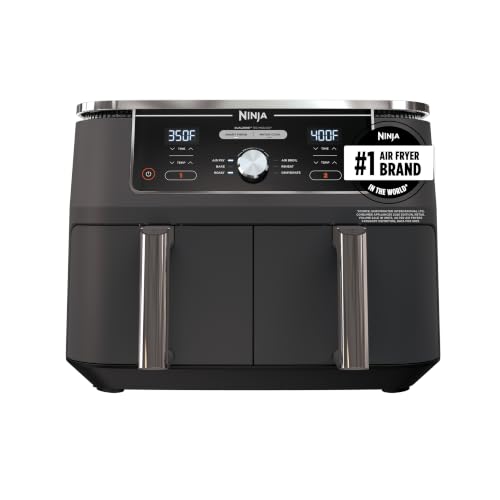
The DZ401 is the machine that made dual-basket cooking mainstream, and it remains the benchmark: two independent 5 qt baskets, six functions, IQ Boost power distribution, Match Cook to mirror settings across both zones, and Smart Finish to make two different foods land at the same moment. It suits the two-dish household — salmon in one zone, asparagus in the other; wings here, fries there — and families whose dinners refuse to share a temperature. It does not suit whole-bird cooks (a bird does not fit a 5 qt zone) or anyone whose counter cannot host a wide machine.
Strengths
- Smart Finish synchronization is the class-defining feature, executed best here.
- Two full 5 qt zones — each zone alone matches a family-class single basket.
- Six functions per zone with IQ Boost sharing power intelligently.
Trade-offs
- Wide footprint — measure with both baskets’ clearance in mind.
- No single 10 qt cavity: large single items belong to the oven models.
- Premium-tier positioning within the class.
| Spec | Value (verified from listing) |
|---|---|
| Capacity | 10 qt total — two independent 5 qt baskets |
| Functions | 6-in-1: air fry, roast, broil, bake, reheat, dehydrate |
| Sync features | Match Cook, Smart Finish, IQ Boost |
| Model | DZ401 |
The dual-basket idea succeeds or fails on choreography, and the DZ401’s choreography is the reference implementation. Smart Finish does the arithmetic a tired cook cannot: it staggers start times and adjusts zones so the 25-minute wings and the 12-minute fries arrive together, hot. Match Cook turns the pair into one 10-quart basket for a single big batch. IQ Boost borrows power for the zone that needs it when both run hard. Around those smarts sits honest hardware — two genuinely family-sized zones with dishwasher-safe parts — and the result is the machine that converted “air fryer” from a side-dish appliance into a full dinner system for thousands of households. If your dinners have two components, this is not one option among six; it is the answer the other five argue against.
Best for: two-dish households and families who cook protein plus side nightly. / Not suited for: whole-bird cooks or narrow counters.
Instant Pot 10 Qt 7-in-1 Air Fryer — Best Oven-Style with Rotisserie
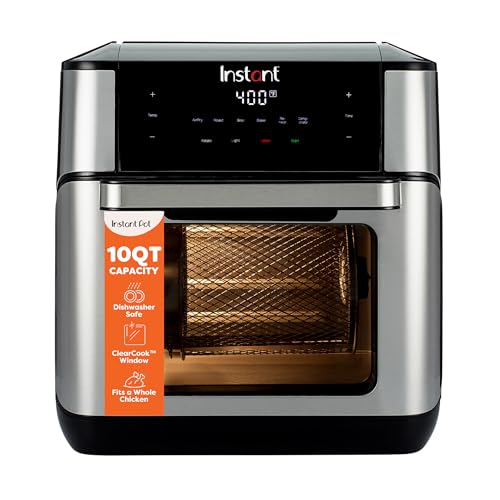
Instant’s 10-quart entry takes the oven road: a windowed, stainless cavity with the brand’s EvenCrisp airflow, seven functions, and rotisserie cooking for birds and roasts, supported by an app recipe library. It suits the cook who thinks in trays and racks — sheet-pan dinners, a rotisserie chicken, dehydrating across levels — and wants one cavity that behaves like a fast, small oven. It does not suit the dual-zone choreography crowd, and its oven format asks you to rotate trays the way ovens always have.
Strengths
- Rotisserie included — whole birds and roasts turn evenly in their own juices.
- EvenCrisp airflow is engineered for tray-level evenness in an oven cavity.
- Seven functions plus app guidance from the category’s most established ecosystem.
Trade-offs
- One cavity, one temperature — no dual-zone independence.
- Rack cooking needs tray rotation for perfect evenness on multi-level loads.
- Oven format preheats and cleans more like an oven than a basket fryer.
| Spec | Value (verified from listing) |
|---|---|
| Capacity | 10 qt oven cavity |
| Functions | 7-in-1 including rotisserie |
| Finish | Stainless steel |
| Airflow | EvenCrisp technology |
The rotisserie is the headline and it earns it: a chicken turning in hot air bastes itself, crisps on every side, and produces the kind of bird a basket cannot. But the deeper argument for the Instant is format honesty — some cooking is tray cooking, and a windowed cavity with racks handles sheet-pan vegetables, nachos, reheated pizza for a crowd and multi-level dehydrating in a way no basket pretends to. The window matters here, too: oven cooking is visual cooking. If your mental model of a big air fryer is “a faster, smaller oven that also crisps,” this is the class’s most coherent expression of it, from the brand whose name is on more counters than any other in the category.
Best for: tray cooks, rotisserie fans and oven-minded households. / Not suited for: dual-temperature dinners or basket minimalists.
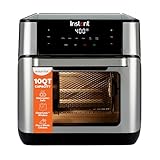

Chefman Multifunctional Digital Air Fryer+ 10L — Best Multifunction Oven
Chefman’s 10L oven is the maximalist’s machine: a multifunctional digital body with 17 touchscreen presets spanning fry, roast, dehydrate and bake, a rotisserie, dehydrator capacity, auto shut-off and a large easy-view window, in a family-size footprint. It suits the host who wants one appliance to run a party — rotisserie turning, trays crisping, snacks dehydrating — and preset lovers who want a program for everything. It does not suit small kitchens (it is unapologetically large) or cooks who find 17 presets to be 14 too many.
Strengths
- Seventeen presets — the broadest program library in this guide.
- Rotisserie plus dehydrator racks make it a genuine three-appliance consolidation.
- Large easy-view window suits the oven format’s visual cooking style.
Trade-offs
- Big body, big wash load — it earns a permanent counter home or none.
- Preset abundance means a learning curve before it feels simple.
- One cavity and one temperature, like all oven formats here.
| Spec | Value (verified from listing) |
|---|---|
| Capacity | 10L family size (sold as the 10-quart-class oven) |
| Presets | 17 touchscreen presets |
| Features | Rotisserie, dehydrator, convection oven, auto shut-off |
| Window | Large easy-view window |
Judge the Chefman as a consolidation play. The households it suits own, or were about to own, three appliances: an air fryer, a dehydrator, and a countertop oven with rotisserie ambitions. This machine is all three in one footprint, with presets that encode the settings for each role. The window is genuinely large, the cavity genuinely family-sized, and the preset library — whatever you think of presets — means a household’s various cooks all get consistent results without negotiating settings. Its compromises are the oven format’s compromises, worn openly: one temperature at a time, trays to rotate, a serious object to clean. For the right kitchen, it is not a compromise at all; it is three appliances’ worth of counter handed back.
Best for: hosts and consolidators who want fryer, oven, rotisserie and dehydrator in one. / Not suited for: small kitchens or dual-zone cooks.

Gourmia 10 Qt Dual Basket Air Fryer — Best Dual Basket Value
Gourmia brings the dual-basket concept to a value tier: 10 qt across two baskets in a stainless body, with digital touch controls, seven cooking presets, a 90–400°F adjustable range, and dishwasher-safe baskets and crisper trays. It suits families who want the DZ401’s two-zone idea at a friendlier tier, and first-time dual buyers testing whether the format fits their dinners. It does not suit sync perfectionists — Ninja’s Smart Finish remains the choreography benchmark — or 450°F extremists.
Strengths
- Dual-basket independence at a value-tier position — the format’s most accessible entry.
- Seven presets and a wide 90–400°F range cover the family repertoire.
- Stainless presentation and dishwasher-safe parts keep ownership easy.
Trade-offs
- Sync and power-sharing polish trail the Ninja benchmark.
- 400°F ceiling cedes the hardest crisping to 450°F rivals.
- Brand ecosystem and accessory depth are thinner than Ninja or Instant.
| Spec | Value (verified from listing) |
|---|---|
| Capacity | 10 qt dual basket |
| Presets | 7 |
| Temperature range | 90–400°F |
| Cleanup | Baskets and trays dishwasher-safe |
The Gourmia’s argument is arithmetic: the dual-basket format changes how a family cooks dinner, and this machine delivers that change at the class’s friendliest tier. Two zones at different temperatures, sides and mains landing together, dishwasher-safe everything — the daily experience is the dual experience, even if the synchronization smarts are a generation behind Ninja’s. Gourmia is a real appliance brand with broad retail presence, which steadies the value proposition. Buy it to find out whether dual cooking is your household’s future; if it is, you will either live happily with the Gourmia for years or graduate to the DZ401 knowing exactly why.
Best for: value shoppers who want the dual-basket format now. / Not suited for: sync perfectionists or 450°F seekers.


Ninja DoubleStack XL 10 Qt (SL401) — Best Space-Saving 10 Qt
The DoubleStack solves the dual format’s footprint problem by going vertical: two stacked baskets in a narrow body, six functions, the ability to cook four foods at once across two levels with racks, room for a 5 lb chicken, and Ninja’s Smart Finish and Match Cook syncing. It suits galley kitchens, apartment counters and anyone who needs 10-quart capability in a footprint closer to a 5-quart machine. It does not suit cooks who dislike managing stacked levels, and its zones are stacked, not side-by-side — tall items belong elsewhere.
Strengths
- Ten quarts in a dramatically narrower footprint than side-by-side duals.
- Cooks four foods at once with stacked racks — a party trick that is genuinely useful.
- Full Ninja sync ecosystem: Smart Finish and Match Cook included.
Trade-offs
- Stacked levels cook with some interaction — delicate items need level awareness.
- Per-zone height is limited; this is a wide-and-flat machine’s opposite.
- Premium-tier positioning, like its DZ401 sibling.
| Spec | Value (verified from listing) |
|---|---|
| Capacity | 10 qt, two stacked baskets |
| Functions | 6-in-1: air fry, broil, roast, bake, reheat, dehydrate |
| Capacity note | Cooks 4 foods at once; fits a 5 lb chicken |
| Sync features | Smart Finish, Match Cook |
| Model | SL401 |
Counter width is the scarcest resource in most kitchens, and the DoubleStack is the only machine in this guide designed around that scarcity. By stacking its zones, it delivers the dual format’s choreography — two temperatures, synchronized finishes, four foods with racks — in a body that slides into counters where the DZ401 simply cannot go. The stacked format asks one skill: level awareness, since the upper and lower zones interact thermally more than side-by-side baskets do, and racks want a mid-cook check. Master that and the DoubleStack is the class’s cleverest answer — proof that the 10-quart decision is about architecture first and brand second.
Best for: narrow counters that still need dual-zone, 10-quart cooking. / Not suited for: tall-item cooks or stack skeptics.

DEIME Air Fryer 10.2 QT — Best with Viewing Window
The DEIME takes the simplest route to ten quarts: one large basket, 1700W, ten presets, a non-stick basket and a visual cooking window, in a silver finish. It suits big-batch single-food cooking — a mountain of wings, fries for a crowd, a family frozen spread — with the ability to watch it brown. It does not suit two-temperature dinners (one basket, one setting) or brand-infrastructure prioritizers; DEIME is a smaller label than the giants sharing this guide.
Strengths
- A true single large cavity — the biggest undivided batch space in this guide.
- Viewing window brings supervision to large-batch crisping.
- 1700W and ten presets cover the party repertoire without menu overload.
Trade-offs
- No dual zones, no rotisserie, no stacking — one basket does everything.
- Smaller brand support footprint than Ninja, Instant or Chefman.
- A full 10-quart basket is a serious sink object, window or not.
| Spec | Value (verified from listing) |
|---|---|
| Capacity | 10.2 qt |
| Power | 1700W |
| Presets | 10 |
| Window | Visual cooking window |
| Basket | Non-stick |
There is a cook this machine was built for: the one whose air fryer jobs are singular and large. Game-day wings by the trayful, fries for six, a whole family’s worth of nuggets in one run — jobs where dual zones are irrelevant and a single deep cavity with a window is exactly right. The window earns its place at this scale because big loads brown unevenly by nature, and seeing the top layer’s progress tells you when to shake. Buy the DEIME with the brand caveat understood and it is the class’s straightforward value in single-cavity form; buy it expecting choreography and you have chosen the wrong architecture, not the wrong machine.
Best for: big single batches and party cooking with visual control. / Not suited for: two-temperature dinners or rotisserie cooking.
Comparison Table
| Pick | Badge | Key spec | Best for | Link |
|---|---|---|---|---|
| Ninja DZ401 | Best Overall | 2× 5 qt zones, Smart Finish | Two-dish families | Check on Amazon |
| Instant Pot 10 Qt | Best Oven-Style with Rotisserie | Oven cavity, 7-in-1, rotisserie | Tray and bird cooks | Check on Amazon |
| Chefman 10L Oven | Best Multifunction Oven | 17 presets, rotisserie, dehydrator | Hosts, consolidators | Check on Amazon |
| Gourmia 10 Qt Dual | Best Dual Basket Value | Dual basket, 7 presets, 90–400°F | Value dual shoppers | Check on Amazon |
| Ninja DoubleStack SL401 | Best Space-Saving 10 Qt | Stacked zones, 4 foods at once | Narrow counters | Check on Amazon |
| DEIME 10.2 QT | Best with Viewing Window | Single cavity, 1700W, window | Big single batches | Check on Amazon |
How to Choose the Best 10 Quart Air Fryers: Architecture First
Choose the architecture before the brand, because the architectures cook differently. Dual side-by-side (DZ401, Gourmia): two independent zones with synchronized finishes — the two-dish dinner machine. Choose it if your meals pair a protein and a side at different temperatures, or if different family members eat different things at the same time. Stacked (DoubleStack): the same independence folded vertically, plus multi-level racks for up to four foods — choose it when counter width is the binding constraint and your foods are wide rather than tall. Oven-style (Instant, Chefman): one windowed cavity with racks and rotisserie — choose it for birds, trays, sheet-pan cooking, dehydrating at scale, and any cooking that is fundamentally oven-shaped. Single large basket (DEIME): one cavity, maximum batch — choose it for party volumes of one food at a time. After architecture, weigh zone size (a dual’s zones, not its sum, decide portions), sync quality (Ninja leads), included hardware (rotisserie kits and racks should be in the box, not an accessory hunt), and the footprint measured honestly — with baskets open and exhaust clearance included. Budget spans a wide range in this class: the Gourmia and DEIME anchor the value end, the oven models and Ninjas occupy the premium tiers, and the honest summary is that you are paying for architecture and choreography, not for quarts.
How to Set Up and Run a 10-Quart Machine
Setup is a commitment in this class, so do it once and properly. Give the machine a permanent, heat-safe home with generous exhaust clearance — these are the largest countertop appliances most kitchens will host — on a circuit that can carry a high-draw heater without sharing with another. Run the first-use burn-off empty with ventilation. Learn your format’s core skill in the first week: dual owners should run the sync features on a simple two-food dinner until the choreography is instinct; stacked owners should map which level runs hotter with a batch of fries; oven owners should learn tray rotation on a sheet of vegetables; single-basket owners should calibrate shake timing on a full wing load. Universal rules still apply, amplified: preheat fully (big cavities punish impatience), keep layers honest even in huge baskets, dry food before it goes in, and verify big proteins with a thermometer at the thickest point. Build a small rotation of proven two-zone or two-rack dinners — five is enough — and the machine shifts from appliance to system within a month.
Two habits separate delighted big-format owners from frustrated ones, and both are learned in the first fortnight. The first is staging: at this scale, cooking is a sequence, not an event — dense and slow items start first, delicate items join later, finished components hold warm in their zone or on a low rack, and the cook who stages calmly serves everything hot without heroics. The second is the mid-cook audit: one deliberate check at the halfway point — a shake, a tray rotation, a level swap, a thermometer probe — catches nearly every big-format failure while it is still correctable. Build both habits into your first five cooks, on forgiving foods like fries, wings and roasted vegetables, and the machine’s learning curve is behind you before your first ambitious dinner depends on it.
What 10 Quarts Actually Cooks: Three Formats, Three Answers
Dual format (DZ401, Gourmia): each 5 qt zone holds a family side or a main — fries for four in one, a tray of wings in the other — so the honest unit is “a full two-component dinner for four to five, simultaneously.” Stacked format (DoubleStack): the same two-zone logic plus racks, stretching to four foods at once for parties, with a 5 lb chicken as its single-item headline. Oven format (Instant, Chefman): a rotisserie chicken with room to spare, two racks of vegetables, a crowd’s worth of reheated pizza, or dehydrating across levels — the unit is “a small oven’s worth, faster.” Single basket (DEIME): the biggest undivided layer here — party wings, fries for six-plus, a family frozen spread in one run. What none of them do: cook a large turkey, replace a full-size oven at the holidays, or make small jobs efficient — a 10-quart machine reheating one slice is a cathedral holding a meeting for one, and most owners keep or buy a compact second fryer for exactly those jobs. Size your purchase to your largest regular cooking, and let the holiday extremes rent the oven they have always used.
A Week of Big-Format Dinners
Monday, dual-style: salmon in zone one, asparagus in zone two, Smart Finish landing them together — the weeknight choreography that sells the format. Tuesday, oven-style: a rotisserie chicken turning in the Instant or Chefman, potatoes crisping on the rack below in the drippings’ heat. Wednesday, stacked: four foods at once in the DoubleStack — wings above, fries below, two temperatures, one finish time — for a family with opinions. Thursday, single-basket: the DEIME runs a full party tray of wings for a game night, window watched, shaken twice. Friday, dual again: two different kids’-menu dinners in the two zones, no negotiation, no sequencing. The weekend is the class’s showcase: dehydrating a garden’s worth of herbs or a batch of jerky in the oven models, a holiday side-dish relay in the duals. Read the week honestly and the class’s value clarifies — it is not about any single enormous cook; it is about parallelism, the end of “the side is waiting for the main” as a fact of family dinners.
Troubleshooting Big-Format Cooking
Problem: dual zones finish at different doneness despite sync. → Loads differ in density and starting temperature; sync assumes typical loads. Give the denser zone a head start manually the next time and note the offset — every dual household develops a house correction within a few weeks. Problem: stacked levels brown unevenly. → Swap levels at the halfway point on the first cooks to learn your machine’s gradient, then load deliberately — robust foods on the hotter level, delicate ones on the gentler. Problem: oven-format trays crisp on top, pale below. → Rotate trays and use the higher rack for finishing; oven physics rewards the same tray discipline as a conventional oven. Problem: smoke at scale. → Fat volume scales with load; wipe drawers and drip trays between batches, and never let a full drip tray meet a second fatty cook. Problem: the big basket steams a full load. → Even 10 quarts has a layer limit; two honest batches beat one mountain, and the re-crisp trick reunites them at serving. Big-format failures are almost always choreography failures, and choreography is learnable — which is why this class rewards its owners more with each passing month.
Care, Storage and the Long Haul at 10 Quarts
These machines are furniture-grade commitments, and their care scales accordingly. Baskets and racks across this guide are largely dishwasher-safe — at this size that is not a convenience, it is the difference between a sustainable routine and a sink standoff — but grease management is the real discipline: wipe drawers, drip trays and cavity floors while warm after fatty cooks, because ten-quart loads render ten-quart fat volumes, and baked-on accumulation is the class’s main aging mechanism. Rotisserie hardware (Instant, Chefman) wants a soak and a brush after birds; windows want a warm wipe to stay windows. Storage is rarely an option at this size — plan on permanent residence, which makes the footprint conversation in the buying guide a one-time decision with daily consequences. Longevity follows the usual law: the branded flagships here carry support ecosystems, replacement baskets and parts channels, which at this tier is a genuine component of value — a machine this central to a household’s dinners should be repairable in the small ways (a basket, a rack, a spit rod) rather than disposable. Expect, with basic grease discipline, years of service; expect, without it, a slow decline in both performance and enthusiasm that no feature list can reverse.
Energy, Circuits and Noise: The Big-Machine Footnotes
Ten-quart machines are among the highest-draw appliances in a kitchen while heating, and dual models run two zones at once. The per-meal energy story remains favorable — parallel cooking in compact cavities beats an oven’s long preheat for the same dinner — but the circuit story deserves respect: run the machine on a circuit that is not simultaneously carrying another heating appliance, and treat a tripped breaker as information about your wiring, not your fryer. In older homes, a dedicated kitchen circuit is the difference between a flagship that performs and one that negotiates. Noise scales with ambition: two fans and big airflow make a purposeful sound, present in open-plan spaces and irrelevant behind a kitchen door, and oven formats add the gentle theater of a rotisserie turning. Heat is the third footnote: exhaust volume is real, clearances in the buying guide are not decorative, and upper cabinets above a 10-quart machine should be checked for steam sensitivity before the first holiday cook, not after. None of these footnotes argues against the class — they argue for installing it thoughtfully, once, the way you would a range or a refrigerator, because functionally that is the tier of appliance you are adopting.
Accessories for Big Formats
Buy for scale. Extra racks for the oven models multiply dehydrating and reheating capacity — the one accessory that changes what the machine is. A second set of crisper trays for dual owners keeps a finished zone’s food crisp while its basket washes. Large-format parchment liners, sized honestly to big baskets, tame the fattiest party cooks. Long, sturdy tongs and a wide spatula sized to family portions protect coatings and hands alike. A roasting thermometer with a probe earns its place the first time a rotisserie bird or a stacked chicken needs certainty rather than hope. And a heat-safe landing surface — a large trivet or board beside the machine — gives two hot baskets somewhere to be during the nightly choreography. Skip small-class accessories entirely; in this class, undersized tools are not quaint, they are hazards.
Which Big-Format Buyer Are You? A Decision Walk-Through
The choreographer — the cook whose dinners are duets, protein and side landing together or not at all — belongs with the DZ401, and the only remaining question is whether the Gourmia’s value tier tempts more than Ninja’s polish reassures. The narrow-kitchen choreographer takes the same duet vertically with the DoubleStack, accepting level management as the price of the footprint. The oven traditionalist — sheet pans, birds, trays, the visual cook — chooses between the Instant’s ecosystem polish and the Chefman’s everything-included maximalism, a decision best made by counting dehydrator and rotisserie ambitions honestly. The party cook, whose loads are singular and enormous, takes the DEIME and its window and stops apologizing for owning a specialist. And the honest fifth buyer — the household of three that wandered into this guide on ambition — should hear the class’s kindest advice: a 5–6 qt machine will preheat faster, wash easier and cook your actual dinners identically, and the money and counter you save are real. Ten quarts is a magnificent answer to a specific set of questions; make sure your kitchen is asking one of them, and then buy the architecture that answers it, with the confidence that every machine above was verified to be exactly what its listing claims.
Common Buying Mistakes
Mistake one: buying the headline number without the architecture — a “10 quart” dual, stack, oven and single basket are four different appliances, and the wrong format disappoints no matter the brand. Mistake two: measuring the counter with the baskets closed; open baskets and doors define the real footprint, and this class has ended many purchases against a wall. Mistake three: assuming dual zones equal one giant cavity — a whole bird does not fit a 5 qt zone, and buyers who needed a cavity should have bought the oven format. Mistake four: the reverse — buying an oven for two-temperature dinners and spending a year sequencing trays. Mistake five: ignoring the wash load; ten quarts of baskets and racks is a dishwasher cycle or a serious sink session, and households should choose formats their cleanup routine can carry. Mistake six: electrifying the decision — these are high-draw machines, and a shared, tired circuit will announce itself at the worst moment; check your kitchen’s capacity before the machine arrives.
Final Recommendation
For most big households, the Ninja DZ401 is the class’s answer: the best choreography, two genuine family zones, and the format that changes weeknight dinners. Narrow kitchens should take the same idea vertically with the DoubleStack SL401, and value shoppers can enter the dual world with the Gourmia. Oven-minded cooks should choose between the Instant’s polish and the Chefman’s maximalism, and party-batch cooks should take the DEIME’s big windowed basket. If ten quarts turns out to be ambition rather than need, the Best 5 6 Qt Air Fryers class below is the honest family size for most homes; the full field is ranked in Best 10 Air Fryers, with compact options in Best 4 Qt Air Fryers and the high-heat shortlist at Best 5 Hot Air Fryers.
Frequently Asked Questions
Dual basket or oven-style — which 10-quart format is better?
Neither; they cook different dinners. Dual baskets win when meals pair two foods at two temperatures that must finish together. Oven styles win for whole birds, trays, rotisserie and multi-rack dehydrating. Audit your last ten big cooks and count which shape dominates. If the count splits evenly — many households find it does — prioritize the weeknight shape over the weekend shape, because weeknights are where the machine earns its residence fifty weeks a year, and a holiday bird can always borrow the conventional oven it has used all along. The format that serves your ordinary Tuesdays is the format you will still be glad about in year three.
Can a 10 qt air fryer cook for eight people?
For most menus, yes — dual zones or a big cavity handle mains and sides for eight with at most light batching on the largest items. For a single-item feast (wings for eight), expect two runs of any format, reunited with a two-minute re-crisp. The deeper truth is that cooking for eight is a logistics problem more than a capacity problem: the cooks who succeed at it prep in stages, hold finished components warm, and let the machine’s parallelism — two zones, two racks — do the sequencing. A 10-quart machine gives you that parallelism in one appliance, which is precisely what separates a manageable holiday side-dish relay from an evening of oven Tetris. Plan the menu around the format you own, and eight people is a pleasure rather than a stress test.
What does Smart Finish actually do?
On Ninja dual models, Smart Finish coordinates the two zones — staggering starts and adjusting power — so foods with different cooking times complete at the same moment. Match Cook instead mirrors one setting across both zones for a single large batch. In practice the feature removes the last piece of mental arithmetic from weeknight cooking: you load both zones when you start, season and set each food’s own program, and the machine handles the sequencing that used to require a timer, a notebook and a cook willing to hover. Households that cook two-component dinners nightly consistently name it the reason the dual format replaced their oven, which is the strongest endorsement any appliance feature can earn.
Is a rotisserie worth having in an air fryer?
If you cook whole chickens or roasts regularly, yes — self-basting rotation produces evenly crisped skin no basket matches. If birds are a monthly event, the feature is a pleasant extra rather than a deciding one. Consider also the secondary uses owners discover: rotisserie-style kebabs, whole cauliflower, and roasts that benefit from constant turning. The hardware on both oven picks here is included rather than sold separately, which matters — a rotisserie that requires an accessory hunt is a rotisserie that never turns. Judge the feature by your last three months of cooking, not your holiday imagination, and the answer will be obvious in one direction or the other.
How much counter space does a 10-quart machine need?
Plan generously: the body footprint, full basket or door travel, and several inches of exhaust clearance behind and above. The DoubleStack is the exception that fits narrow counters by going vertical. Measure with the machine “open,” not closed. As a planning habit, tape the footprint on your counter for a day before ordering — live with the outline through a day of cooking and you will know, rather than guess, whether the machine’s residence works. More flagship returns trace to that skipped day of tape than to any cooking disappointment, because the cooking, in this verified class, rarely disappoints anyone who chose the right architecture.
Can I cook two different foods at different temperatures?
Yes — that is the dual-basket format’s entire purpose (DZ401, Gourmia, DoubleStack). Oven-style and single-basket models run one temperature at a time, so two-temperature dinners there are cooked in sequence. It is worth deciding before you buy how often your dinners truly need that simultaneity, because the answer sorts the entire class neatly into your shortlist and everyone else’s.
Comparing the whole market before committing to a flagship? Start with Best 5 Air Fryers for the cross-class shortlist, then return here with your architecture chosen. One final encouragement: owners of this class consistently report that the second month is better than the first — choreography becomes instinct, the house corrections get learned, and the machine stops being the big new appliance and becomes simply how dinner happens. Buy for the dinners you actually cook, install it thoughtfully, and give it that month.