Disclosure: As an Amazon Associate, airfryerkitchensupply.com earns from qualifying purchases. Links on this page are affiliate links; they cost you nothing extra. Prices and availability change often, so check the current Amazon listing before you buy.
Weighing up towel warmer pros and cons honestly means resisting both the showroom glow and the sceptic’s shrug. The towel warmer pros and cons in this article are the ones owners actually live with after the first month: the daily warmth and the drying on one side, the warm-up wait, the placement rules and the capacity ceiling on the other. Read them against your own bathroom and routine, because the same list produces a delighted owner in one house and a returned parcel in another.
Key Takeaways
- Biggest pro: a small comfort repeated every day, plus towels that dry properly between uses on a rail.
- Biggest con: no warmer is instant, so the habit needs a timer or a moment’s foresight, forever.
- Safety shapes the cons: hardwired means a licensed electrician, plug-in means GFCI protection and the maker’s clearances.
- Capacity bought too small is the one con that cannot be fixed later, so size for real mornings.
- The balance tips pro for daily-use bathrooms with a safe placement, and con for rarely used rooms.
Quick verdict: for a household that showers daily and has a sensible spot for one, the pros win comfortably. For a spare bathroom, a room with no safe placement, or a household expecting instant heat, the cons win just as comfortably. Everything below exists to help you tell which household is yours.
In this guide
The Pros
Warmth that repeats daily
A towel warmer’s first pro is not intensity but repetition. It improves an ordinary moment every single day, which is more than most comfort purchases manage, and it does so without skill or effort once the routine or the timer is set. Five better minutes each morning compounds into one of the most-used upgrades in the house.
Towels dry properly
On a rail, a used towel dries through instead of lingering damp in its fold, so towels smell fresher, feel better and survive longer between washes. In humid or windowless bathrooms this pro can outweigh the warming itself, because damp towels are a daily irritation that a warmer quietly abolishes.
A guest-room superpower
Few upgrades this simple impress guests as reliably. A warm towel or a robe from a bucket signals a host who thought about the stay, and guests mention it unprompted. For households that host often, this social return is a genuine pro, not a frivolous one.
Formats for every situation
Renters get buckets and freestanding rails, renovators get hardwired fixtures, families get wide rails, gift-buyers get an easy win. A category with a format for nearly every tenure and budget is a category whose pros are unusually accessible.
Simple, durable technology
A warmer has one job, few moving parts and a manual measured in pages rather than chapters. Simplicity is a pro in a bathroom full of appliances competing for attention: there is little to learn, little to configure and little to go wrong when the maker’s placement and loading guidance is followed.
Kind to towels and laundry rhythms
Towels that dry fully between uses need washing less desperately and wear more gently, and a household’s laundry rhythm smooths out when towels are not constantly in the damp-and-musty queue. The pro is modest per wash and meaningful per year.
The Cons
Nothing is instant
The headline con: a warmer needs a head start, always. Forget to start it and the shower ends with a cold towel and a small sense of betrayal. Timers soften this con to almost nothing, but they do not delete it, and households unwilling to plan even that far ahead will feel the con at full strength.
Placement is constrained
Safety clearances, outlet positions and reach decide where a warmer can live, and some bathrooms offer no good answer. A warmer forced into a bad spot is worse than none, so the con is real: this is a purchase some rooms simply cannot accept, and discovering that after ordering is the category’s most avoidable disappointment.
Capacity is finite
A bucket warms one towel at a time; a small rail crowds a family’s towels into poor contact and poor drying. Buying capacity by optimism or by showroom impression leads to queues and bunched towels, and unlike a timer, capacity cannot be retrofitted. The con is fixed at purchase, which is why the sizing step matters so much.
It is one more heated appliance to place responsibly
Rails get hot, buckets concentrate heat, and both live in the room with the most water in the house. The safety rules are simple, GFCI protection, clearances, supervision, suitable fabrics only, but they are permanent responsibilities, not one-time setup choices, and households with unsupervised small children must weigh them honestly.
It does not heat the room or fix the bathroom
Shoppers sometimes buy a warmer hoping it will cure a cold, damp bathroom, and it cannot. It warms towels and dries them; the room’s heating, ventilation and storage problems remain exactly as they were. Expecting more than the appliance promises manufactures a con out of a perfectly good product.
Running it thoughtlessly costs money and wear
Left on around the clock, a warmer spends electricity for hours nobody uses and ages faster for no benefit. The con is entirely behavioural and entirely avoidable with a timer, but it belongs on the list because always-on is the default mistake new owners make in the first month.
Safety First: The Non-Negotiables
Hardwired towel warmers are not a do-it-yourself wiring project. A hardwired model connects directly to your home’s electrical system, and that work belongs to a licensed electrician, no exceptions. The electrician confirms the circuit, the junction box position and local code requirements, and makes the connection safely inside the wall. If a listing describes hardwired installation as a quick weekend job, treat that as a warning sign about the listing, not as permission to improvise with household wiring.
Plug-in models are simpler, but the bathroom rules still apply. A plug-in warmer should run from a GFCI-protected bathroom outlet, the kind with test and reset buttons that cuts power quickly if current leaks toward water or a fault. Position the warmer exactly where the maker says it can go, respecting the clearances the manual specifies from the tub, the shower spray and standing water. A cord stretched across a wet floor to reach a distant outlet is the wrong answer; move the warmer or choose a different format instead.
Rail surfaces get hot in normal use, hot enough that you should treat them with the same respect you give a radiator or a heated appliance. Keep flammable items off the rails, never drape paper, aerosols or cleaning products over a running warmer, and supervise children around one until they understand it is a heater, not a climbing frame or a towel rack they can hang from. A warm towel is the goal; a crowded, overloaded rail works worse and is harder on everyone.
Some fabrics do not belong on a warmer. Delicate synthetics and garments with heat-sensitive prints, elastic or embellishments can be damaged by sustained heat, so check garment care labels and the warmer maker’s guidance before draping anything beyond ordinary towels and robes. When in doubt, warm the towel and leave the delicate item on a regular hook. The same caution applies to bucket warmers, which concentrate heat in an enclosed space around whatever you place inside them.
Towel Warmer Pros And Cons: What the Trade-Offs Mean for You
Daily showerers
If everyone in the house showers at home daily, the pros compound and the cons shrink to the timer habit. This is the profile the category was made for, and almost any format at a sensible tier will land on the pro side of the ledger within a month.
Occasional users and spare bathrooms
If the bathroom hosts a few showers a week, the maths invert: the warmer sits idle through its cons, placement, space, responsibility, while delivering its pros too rarely to notice. A portable bucket that also serves guests is the only version of the purchase that survives this profile’s scrutiny.
Families with young children
Families gain the drying pro at full strength and must manage the supervision con deliberately: rails placed and used with hot surfaces in mind, buckets kept stable and cords out of reach. Managed, the balance is pro; unmanaged, no comfort is worth the worry, and waiting a few years is a legitimate answer.
Renovators and renters
Renovators can erase the installation con by planning a rail into the build with their electrician. Renters can erase the permanence con entirely with a bucket or freestanding rail. Each tenure has a format whose cons it never has to feel, which is the category’s quiet strength.
Families use warmers differently from couples, and couples differently from people living alone. A household with children may warm towels for bath time in the evening rather than the morning, and needs capacity and supervision in equal measure. A person living alone can be perfectly served by the smallest bucket or a compact rail, because the queue is one person long. Matching the warmer to the household’s actual bathing pattern is worth more than any single feature a listing can boast about.
Finally, remember what a towel warmer is not. It is not a room heater, and it will not rescue a freezing bathroom on its own, though a rail takes the edge off a small space. It is not a medical device and makes no health promises. It is not a tumble dryer, and thick towels still need proper laundering. Bought with those boundaries clear, it is a simple, durable comfort appliance, and simple appliances that match expectations are the ones still in daily use years later.
The warm-towel habit sounds like a small luxury until you live with it through a cold month. Stepping out of a shower into a cool bathroom is the moment the warmer justifies itself, and it does so every single morning rather than on special occasions. That repetition is the real product here. You are not buying a heated rail or a heated bucket; you are buying a reliably better five minutes at the start of the day, and a towel that feels looked after rather than merely hung up.
How the Alternatives Compare
Against doing nothing, a warmer trades a modest purchase and a timer habit for warm, dry towels indefinitely. Against a heated bathroom floor, it is cheaper and more targeted, while doing nothing for cold tiles. Against warming towels in a tumble dryer, it is waiting for you rather than needing fetching, in short scheduled bursts. Against a plain towel rail, a rail warmer is the same object with two extra jobs. The alternatives clarify the trade: the warmer’s cons are mostly about commitment and patience, its pros about daily texture, and households know which currency they have more of.
Models in the Balance
Amba Radiant Towel Warmer
Amba’s Radiant line is the name many shoppers meet first in wall-mounted rails, offered in a range of widths and bar counts in polished and matte finishes. The appeal is choice: a narrow model for a small ensuite, a wider one for a family bathroom, in plug-in or hardwired versions depending on how permanent you want the installation to be. In prose terms it sits in the mid-to-premium tier of rails, and it suits buyers who want a fixture that looks deliberate rather than added on. Remember that the hardwired versions belong to a licensed electrician, and the plug-in versions belong on a GFCI-protected outlet placed per the maker’s clearances.
proscons
Brookstone Towel Warmer Bucket
Brookstone’s towel warmer bucket is the friendly face of the bucket format: a lidded countertop bucket sized for a bath towel or a robe, with simple controls aimed at people who want warmth without any installation at all. It suits guest bathrooms, gifts and anyone renting, because it arrives, plugs into a GFCI-protected outlet and works the same day. Load only fabrics the maker lists as suitable, do not leave it running unattended for long stretches, and unplug it when the cycle is done. In tier terms it is an accessible entry point to the whole category.
proscons
WarmlyYours Towel Warmer
WarmlyYours builds towel warmers as part of a wider home-heating range, and its rails tend to suit buyers who like the idea of the warmer as part of the bathroom’s heating picture rather than a standalone gadget. Designs run from compact rails for a single towel to larger formats for shared bathrooms, with plug-in and hardwired options across the range. It positions in the mid-to-premium tier. As with any rail, judge it on bar spacing for your towel size, the timer story, and whether its finish sits well with the rest of your fittings.
proscons

Zadro Towel Warmer
Zadro’s towel warmer bucket leans into capacity, with a roomy interior intended to take oversized bath sheets and robes that smaller buckets struggle with. For households whose towels are genuinely large, that interior volume is the whole argument, and the timer-style controls on the range suit a set-it-before-your-shower routine. It stands on the counter or floor, so measure that footprint honestly. Treat it like every bucket: suitable fabrics only, supervised use, unplugged when finished, and positioned away from tub and shower water per the maker’s guidance.
proscons
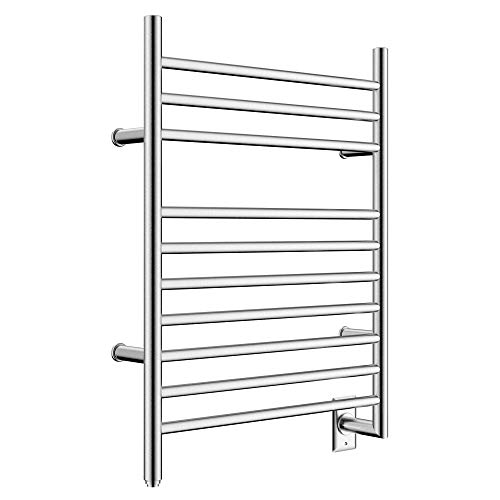
HEATGENE Towel Warmer
HEATGENE sells wall-mounted and freestanding rail warmers that appeal to value-minded buyers who still want the ladder-rail format and a choice of finishes. The freestanding options are worth a look for renters, while the wall-mounted versions follow the usual rule: plug-in models on a GFCI-protected outlet with the maker’s clearances respected, and anything hardwired handed to a licensed electrician. In tier terms HEATGENE generally sits at the accessible end of rails, which makes it a sensible first rail for a household deciding whether the warm-towel habit will stick.
proscons
Brandon Basics Towel Warmer
Brandon Basics offers a bucket warmer that has become a common gift and first-bucket choice, sized for towels and small blankets with straightforward operation. It is the kind of unit that ends up in a guest room before a visit or in a nursery-adjacent bathroom for warming a robe, and its simplicity is the point: load, close the lid, wait, enjoy. It sits in the entry tier of buckets. The same bucket discipline applies: follow the maker’s fabric guidance, never leave it running unattended for long periods, and unplug it when you are done.
proscons
How to Buy Smart
The Criteria That Actually Decide It
Capacity: how many towels, and how big are they?
Capacity decides whether a warmer fits your household or becomes a bottleneck everyone queues for. Count the towels that need warming on a normal morning, not a holiday morning, and be honest about towel size: oversized bath sheets need wider rails or a larger bucket than standard bath towels. A rail with more bars holds more towels with fabric spread out to warm evenly, while a bucket’s capacity is fixed by its interior, so a household of four sharing one bucket will run it in shifts or not at all.
Warm-up behaviour and timers
Warmers are not instant. Rails and buckets both need a head start before the shower ends, so the controls matter as much as the heating itself. A built-in timer or a plug-in timer switch lets the warmer start before you wake and stop after the morning rush, which is how the habit becomes effortless instead of one more thing to remember. Models with simple on-off switches work fine for deliberate users; households that run on routine should treat a timer as close to essential.
Installation: plug-in, hardwired or freestanding
Installation shapes the whole ownership experience. Plug-in models go up with basic fixings or simply stand on the floor, and they can move when you do. Hardwired models look seamless and free up the outlet, but they require a licensed electrician and a permanent decision about placement. Freestanding models ask for nothing but floor space and an outlet within cord reach. Decide which commitment your bathroom and your tenure in the home actually justify before you fall for a finish or a shape.
Size, placement and clearances
Measure the wall or floor space before choosing, and measure it the way the maker measures, including the space towels need to drape without bunching. A warmer squeezed beside the shower door may sit inside the spray zone, which the manual’s clearances exist to prevent. Think about who reaches the warmer, too: rails mounted for adults may put hot bars at face height for small children, and a bucket on the floor needs a spot where it will not be kicked, splashed or tripped over in the dark.
Build, finish and bathroom humidity
A bathroom is a humid room, and a warmer lives in that humidity every day. Look for finishes and construction the maker explicitly rates for bathroom use, tidy welds or joints on rails, a lid that seals sensibly on a bucket and a cord and plug in good order. Finishes should match or at least sit comfortably with your taps and other fittings, because a warmer is a visible fixture you will look at daily, not an appliance that hides in a cupboard.
Running costs and everyday efficiency
A warmer uses electricity in short, predictable bursts, and how you run it matters more than small differences between models. Warming towels for the morning window on a timer costs far less than leaving a unit on around the clock, and drying towels on the rail can reduce how often towels need laundering, which is its own saving. Check the maker’s stated power draw on the listing, run the warmer on a schedule, and the running cost stays a minor line in the household budget rather than a surprise.
Setup and Care That Reduce the Cons
Care starts with the towel, not the warmer. Towels washed with too much detergent or fabric softener build up residue that makes them less absorbent and slower to dry, and no warmer can fix a towel that repels water. Wash towels hot enough for the fabric, skip the softener habit, and the warmer’s drying job gets easier. A warmer paired with tired, coated towels underperforms for reasons that have nothing to do with the appliance itself.
Wipe rails and bucket interiors down regularly once they have cooled completely. Bathroom dust, lint and the fine spray of toiletries settle on warm surfaces, and a soft cloth keeps finishes looking right and heat transfer clean. Never spray cleaner onto a warm or running unit, and never use abrasive pads on polished or coated finishes. The maker’s care notes for your specific finish override any general advice, including this paragraph.
Check the cord, plug and fixings as part of a seasonal bathroom once-over. A plug that sits loose in the outlet, a cord pinched behind furniture, or a wall fixing that has worked slightly loose are all small things caught early. Hardwired models need none of the cord checks, but if a hardwired warmer ever behaves oddly, the answer is an electrician, not experimentation. Appliances that heat and live in humid rooms deserve this modest, regular attention.
When a warmer will sit unused for a long stretch, such as in a holiday home or a guest bathroom between visits, switch it off at the outlet or unplug it rather than leaving it in standby indefinitely. Buckets should be left clean, dry and with the lid ajar so the interior airs. Rails simply need the towels taken off them. These small shutdown habits keep the appliance ready for the season when it earns its keep again.
The most common mistake is buying capacity by optimism. Shoppers picture weekend guests and holiday mornings, then live with a warmer sized for a crowd in a bathroom used by two. The everyday morning is the design case. Size for the towels you warm on a normal day, and let rare occasions involve a second load or a tumble in the dryer, rather than paying in space and money for capacity that sits idle fifty weeks a year.
The second mistake is placing the warmer by looks alone. A rail centred beautifully on the wrong wall, out of comfortable reach of the shower, or inside the spray zone its manual warns against, will annoy daily and may be unsafe. Placement is a safety and routine decision first and a styling decision second. Live with the tape outline on the wall for a day, mime the reach from the shower door, and only then commit to fixings or wiring.
A third mistake is expecting instant heat. Every warmer needs a head start, and shoppers who judge one by switching it on and touching it a minute later conclude wrongly that it does not work. Judge a warmer by the towel it hands you at the end of a shower it was started before, on a timer, the way it will actually be used. Set the routine first, then decide whether the appliance performs.
Ignoring the manual’s fabric and loading guidance is the fourth mistake, and the one most likely to damage something. Overloading a bucket, cramming towels between rails so air cannot circulate, or warming fabrics the maker excludes all produce poor results and unnecessary risk. The manual is short. Read it once, fully, before the first use, and keep it with the household papers rather than in the recycling with the box.
Safety First: The Non-Negotiables
Bucket warmers ask for a few habits of their own. Load only fabrics the maker lists as suitable, never leave a bucket warmer running unattended for long periods, and unplug it when the warming cycle is done, following the maker’s instructions rather than treating it as an always-on appliance. Give the bucket counter space with ventilation around it, keep the lid and cord in good condition, and stop using any warmer, bucket or rail, if the cord frays, the plug runs unusually hot or the unit behaves erratically.
A towel warmer also earns its keep as a dryer. A towel that dries fully between uses stays fresher for longer, and hanging a damp towel over a warm rail after your shower helps it dry instead of sitting in a damp fold on a hook. That is a comfort and laundry point, not a health claim: a warmer is a bathroom comfort appliance, and it should be bought, installed and used as one, with the maker’s manual as the final word on placement, loading and care.
Bottom Line
The pros and cons of a towel warmer are unusually predictable, which is a compliment to the category. Nothing on either list is a surprise after purchase if you read it before. Daily routine, safe placement, honest capacity: households with those three get the pros at full strength and the cons at their mildest, and that is the whole calculation.
More Depth: Living With a Towel Warmer
Think about the towel itself as part of the system. A warmer cannot rescue a towel that has lost its absorbency to years of softener build-up, and it flatters a good towel enormously. Thick cotton with a bit of loft holds warmth in its fibres and feels generous; thin, tired towels warm fast and cool fast. If a new warmer disappoints in week one, wash the towels without softener and try again before blaming the appliance, because the fix is often already in your laundry cupboard.
Sound and light are small but real ownership details. A good warmer is effectively silent and asks for no attention; a simple indicator light that confirms it is on prevents the two classic errors, leaving it running all day and showering while it sits cold. When comparing models, these humble details, a clear switch, a visible indicator, a timer that keeps its setting, predict daily satisfaction better than any headline feature, because they are the parts you interact with every single morning.
Resale and moving house deserve a sentence in any honest guide. Plug-in rails, freestanding models and buckets move with you, which quietly raises their value for anyone not in a forever home. Hardwired rails stay with the house, where they read as a finished-bathroom feature that estate agents are happy to list. Neither is a reason to buy or avoid on its own, but households that move often should weight portability, and households renovating for the long term can treat a hardwired rail as part of the room’s fabric.
Finally, buy from the listing details, not the lifestyle photograph. The photograph shows a spa bathroom with perfect light; the details show dimensions, installation type, control type and the maker’s own clearance and fabric instructions, which are the things that decide whether the warmer works in your room. Read the manual before the first use, keep it, and let it settle any question this guide has raised generally, because the maker’s word for your model outranks every general guide, including this one.
Consider the morning from the towel’s point of view for a moment. It hangs in a cool, steamy room, it is asked to dry a person and then dry itself in air that is already full of moisture, and in many bathrooms it is folded while damp and left that way until tomorrow. A warmer changes every term of that arrangement. The towel starts warm, works once, and then dries in moving, warmed air instead of stagnating in a fold. When owners say the category changed their bathroom, this unglamorous cycle, repeated daily, is most of what they mean.
There is a hotel lesson hiding in this category. Hotels did not adopt warm towels as theatre; they adopted them because guests reliably rate the bathroom higher when one small moment feels considered. Homes work the same way on a longer timescale. You stop noticing the warmer consciously within a month, in the same way you stop noticing good water pressure, but the bathroom’s overall feeling keeps the benefit. Judging a warmer by whether you still exclaim over it in month three is judging it by the wrong standard entirely.
Energy questions deserve a calm answer. A warmer is a modest electrical load run in short, deliberate windows, and its footprint in a household budget is governed almost entirely by the schedule you give it. Timer discipline is therefore both an economic and a practical virtue: the warmer works when the household bathes and rests when it does not. Owners who master that one habit stop thinking about running costs altogether, because there is so little left to think about.
Think, too, about who else uses the bathroom. A partner on an earlier shift, a teenager before school, an elderly parent staying for the month: each has a bathing time, and a timer schedule can be shaped around the household’s real sequence rather than a single person’s. Warmers reward households that treat them as shared infrastructure, set for everyone’s mornings, instead of as one person’s gadget that everyone else encounters cold and switched off.
The aesthetics question is worth settling plainly. A rail warmer in a finish that matches the taps looks like part of the bathroom’s design, because it is one: a fixture, chosen like the mirror and the lighting. A bucket looks like an appliance, because it is one, and in a guest room or a rental that honesty is fine. Neither look is superior; they belong to different kinds of rooms, and choosing between them is partly choosing what kind of object you want living in your bathroom.
Noise, or the absence of it, is an underrated virtue in a bathroom appliance. A warmer asks for no attention while it works: no fan, no cycle sounds, no beeps demanding a response at dawn. In a house where the morning already contains alarms, kettles and plumbing, an appliance that simply waits, warm and silent, fits the hour it serves. It is one reason owners describe the category as calming rather than merely convenient.
Durability expectations should be set like a fixture’s, not a gadget’s. A warmer has no software to abandon, no subscription to lapse and no consumables to reorder. Treated according to its manual, kept clean, loaded sensibly and run on a schedule, it should serve for years with the same indifference as the towel rail it may have replaced. That longevity is part of the value case: the purchase is amortised across a very large number of ordinary mornings.
A word about towels themselves, since the warmer and the towel are a system. Cotton towels with decent loft hold warmth generously and dry predictably; very dense luxury towels take longer to warm through and reward a longer head start; quick-dry travel towels warm fast and cool fast. None of this requires a special purchase, but if you replace towels in the same season as the warmer, choose with the system in mind and the pairing will feel designed rather than accidental.
Placement has a social dimension as well as a safety one. The warmer should be reachable without a negotiation: not behind the door’s swing, not across the room from the shower, not in the one spot where laundry baskets and bath toys accumulate. A warmer that requires a small expedition at the wettest moment of the morning will be used less, then resented, then ignored. Reach, tested with a mime from the shower door, is a specification as real as any dimension in the manual.
Seasons change the routine, and good owners adjust without thinking about it. Winter schedules run longer and earlier; summer schedules shrink or shift to drying duty after evening showers. A warmer on a timer invites that seasonal tuning, and households that do it find the appliance feels correctly sized all year. Households that set one schedule in January and never revisit it sometimes conclude the warmer is too much in July, when in fact only the timetable is.
The gift angle deserves respect rather than embarrassment. A bucket warmer is one of the rare household gifts that is used the week it is given, requires nothing of the recipient’s home, and suits people who are otherwise impossible to buy for. New parents warming a robe for night feeds, hosts upgrading a guest room, anyone in a cold house with a cold bathroom: the category keeps appearing in gift guides because the use case is universal and the commitment is zero.
Renovation timing is the strategic version of the same point. The cheapest day to add a hardwired rail is the day the walls are already open and an electrician is already in the house; the most expensive day is the one after the tiles set. If a bathroom renovation is anywhere in your two-year plans, the warmer decision belongs in that plan even if the purchase waits, because the placement and wiring decisions are the renovation’s to make, not the appliance’s.
Water quality and laundry habits echo quietly through ownership. Towels in hard-water homes stiffen over time and warm less pleasantly until they are washed with that in mind; towels in any home benefit from a wash routine that keeps them absorbent. The warmer exposes towel condition mercilessly, which owners initially read as the appliance underperforming. More often it is the appliance reporting, accurately, that the towels themselves need attention.
Finally, there is the question of enough. One warmer, correctly placed and correctly sized, serves a bathroom completely; a second warmer in the same room adds nothing but redundancy. The category rewards restraint: buy the format that fits, size it honestly, and stop. Households chasing the perfect bathroom sometimes stack upgrades until the room feels like a showroom, and the warm towel, the simplest pleasure in it, gets lost among the features competing to impress.
Bathroom routines are among the most stable habits in a house, which is why appliances that attach to them age so well. People change sofas, phones and even kitchens, but the morning shower happens in the same room, at roughly the same time, in roughly the same order, for years. A warmer plugged into that stability inherits it. When you evaluate any claim in this article, test it against your own routine’s stability: the more fixed the routine, the more completely the appliance’s advantages apply to you.
Humidity is the silent character in every towel story. A bathroom after a shower holds warm, wet air that condenses on cool surfaces and soaks into anything fibrous left folded or bunched. Towels live in that air twice a day. Anything that moves a towel from damp to dry between uses is fighting the room’s basic physics on the towel’s behalf, and that fight, more than the moment of warmth, is what keeps towels pleasant across a week of use instead of turning by day three.
There is a modest choreography to a well-run warm-towel morning. The timer starts the warmer, the first person showers while the towels come up to warmth, the rail or bucket hands over its towel, and the used towel goes back spread out to dry while the next person showers. Nobody directs this; the schedule does. Articles about appliances rarely say it plainly, but the schedule is the product, and the hardware is merely what the schedule switches on.
Children read a warmer differently from adults, and households should plan for the reading. To a child, a warm towel after a bath is pure ceremony, one of the small luxuries they will describe decades later, and bath time resistance often softens around it. The same household must hold the other truth at the same time: hot rails are not for climbing, buckets are not toys, and supervision is part of the ceremony until the lesson is thoroughly learned.
Older relatives are the other audience worth planning for. A warm towel is kind to someone who feels the cold after a bath, and a rail at the right height doubles as a reassuringly warm thing to steady against, though it should never be treated or loaded as a grab rail, which it is not designed to be. Guest rooms and family bathrooms that host older visitors get disproportionate gratitude from this category, a fact hosts discover in thank-you messages rather than in specification tables.
The Trade-Offs in Daily Life: Where a Towel Warmer Earns Its Place and Where It Does Not
Most advice about a towel warmer focuses on the day you buy it, yet satisfaction is decided later, at the bathroom, near the bath or shower exit, during warming towels so stepping out feels finished rather than rushed. So work backwards from daily life: fix the routine, the space and the people in your mind first, and only then weigh the features that looked persuasive on a product page. Before anything else, settle the rail or bucket capacity against the number of towels your household uses; it is the unglamorous detail that quietly decides whether the rest of the specification ever gets a chance to matter. Think about what the towel warmer has to live alongside. The neighbouring furniture, fittings and appliances in your home are fixed facts, and the newcomer is the one that has to fit in.
The second check is whether the mounting, power point and clearances work in the bathroom as built, a point shoppers skip because it is hard to judge from photographs, yet it is painfully obvious within the first week of ownership. Flexibility is worth paying for only if you will use it. A towel warmer that folds, moves or converts impresses in the listing and matters only if your routine actually asks it to. Keep a brief note of when any problem started and what changed around then, because that record turns a vague complaint into a solvable question if you ever need parts, repair or a replacement decision. The honest verdict on a towel warmer is usually conditional, excellent for one household pattern and mediocre for another, and locating your own pattern is the real work of this section.
- Give daily annoyances more weight than twice-a-year inconveniences.
- Mark each disadvantage with whether a simple habit can manage it.
- Mark each advantage with how often it will actually matter.
- Test the verdict against your busiest week rather than your easiest.
- Decide which trade-off your household tolerates most easily.
Before ordering, list everything the first week of use requires and confirm, item by item, whether it arrives with the towel warmer or has to be found separately. Attention is a budget too. A towel warmer that needs remembering, scheduling, monitoring or special handling spends it, so count that cost alongside the physical ones. Long-term performance usually comes down to whether you keep up with one routine: wiping rails down, keeping vents clear and following the maker’s guidance for your model. Decide honestly whether your household will do it before you rely on it. Other people in the household get a vote too, since the person who cleans, moves, stores or shares the towel warmer will find friction that the buyer, focused on the main job, can easily miss.
The opposite mistake is just as costly over time: a towel warmer that is slightly too small, too light or too basic for a daily routine will be resented long after the saving is forgotten. Get the tape measure out before you get the shortlist out. Written measurements settle arguments that photographs start, especially around clearances that only matter when the towel warmer is actually in use. Anything heavy, hot, sharp, load-bearing or electrically powered deserves a respectful pause in the decision, and the maker’s own guidance, read before purchase, is part of the specification. Try this decision exercise: write down three non-negotiable jobs, one acceptable compromise and one walk-away flaw. If a candidate survives that list, it deserves its place on the shortlist.
Most disappointment with a towel warmer traces back to towels staying on too long, and units placed where ventilation cannot clear the steam. It is a slow, predictable process, which is good news, because predictable problems can be designed out before you buy. Shortlisted models, perhaps the Amba Radiant Towel Warmer and the Brookstone Towel Warmer Bucket, should each be put through the same checks in the same order, using the current listing details rather than an older screenshot or a remembered specification. Add up the minutes honestly: the washing, wiping, descaling, emptying, airing or reassembly a towel warmer demands each week is part of its real specification. Do not test your decision against a calm day. Test it against the rushed morning, the crowded evening or the week everything happens at once, because that is when a towel warmer earns or loses its place.
Frequently Asked Questions
What is the single biggest pro of a towel warmer?
Daily reliability. A towel warmer does its one job every morning without skill, effort or attention once a timer runs it, and it adds towel drying as a second, quieter benefit. Most comfort appliances promise an experience; this one delivers a routine. Owners consistently describe the pro in past tense after a month, as in they cannot imagine the bathroom without it, which is the strongest form the advantage takes in practice.
What is the single biggest con?
The warm-up wait, because it cannot be engineered away. A warmer must start before the shower, so the appliance demands a tiny bit of foresight or a timer, forever. Households that will not give it either will experience the con at full strength and the pros barely at all. The second con, placement constraint, follows from safety: clearances, outlets and reach decide where the warmer can live, and some bathrooms simply offer no good home for one.
Do the pros outweigh the cons for families?
Usually yes, provided capacity and supervision are solved together. A wide rail gives every family member a warm, properly dried towel and removes the damp-towel pile from the bathroom’s life. The cons that bite families are a warmer sized too small, which creates queues, and hot rails placed where small children can grab them. Solve size and placement at purchase, supervise as you would around any heater, and the balance lands clearly on the pro side for most households.
Are towel warmers a waste of money?
They are a waste only in the specific cases this article names: bathrooms used rarely, placements that break the maker’s clearances, and households expecting instant heat or room heating. In a daily-use bathroom with a safe spot and a timer, the cost spreads over years of mornings and the drying benefit reduces laundry wear as well. Waste is a mismatch between appliance and household, not a property of the category, and the mismatch is visible before purchase if you look for it.
Which format has the fewest cons?
Each format trades cons rather than removing them. Buckets have no installation con but carry capacity and counter-space cons. Rails have no capacity con but carry installation and permanence cons. Freestanding rails sit between, with stability and cord cons. The format with the fewest cons is the one whose particular cons your household will never notice: a renter never feels a bucket’s permanence problem because there is none, and a renovator never feels a hardwired rail’s installation con twice.
Can the cons be reduced after buying?
Several can. A plug-in timer fixes the foresight con. Better towels, washed without softener build-up, fix the disappointing-warmth con that was never the warmer’s fault. Re-placing a freestanding unit or re-routing a cord within the maker’s rules can fix a placement niggle. The cons that cannot be fixed afterwards are capacity bought too small and a hardwired position chosen badly, which is why those two decisions deserve the most care before money changes hands.
Related Reading
For more on this topic, see our towel warmer review and our towel warmer reviews roundup.
Go deeper with the towel warmer buying guide and is a towel warmer worth it.
Also useful: how to choose a towel warmer and how to use a towel warmer.
For the guest-room side of bathroom comfort, browse best blankets for Airbnb hosting and best blankets for couples.
You may also like guest room bed sheet sets and guest room closet organizers.

