Disclosure: As an Amazon Associate, airfryerkitchensupply.com earns from qualifying purchases. Links on this page are affiliate links; they cost you nothing extra. Prices and availability change often, so check the current Amazon listing before you buy.
This oven thermometer buying guide exists because the cheapest instrument in the kitchen is also the one most often bought badly — grabbed on dial colour, then abandoned when the glass fogs or the hook will not fit the rack. A good oven thermometer buying guide starts from what the instrument must reveal: an oven that cycles above and below its set point, develops hot spots, and drifts out of calibration as it ages. Below: the types, a picks table, the criteria that matter, and five real models matched to real kitchens. Deep-dives live in our oven thermometer review.
Key Takeaways
- Buy legibility first: a large, bold dial you can read through your own oven window.
- Match mounting to your racks — hanging for air-stream readings, standing where bars are awkward.
- Cover your real cooking range, from low-and-slow to your oven’s maximum setting.
- Established temperature brands and clear stated intended use beat feature-stuffed listings.
- Plan the habit, not just the purchase: seasonal checks are what convert a dial into knowledge.
In this guide
What an Oven Thermometer Does and the Main Types
Dial thermometers that live in the oven
There is a quiet virtue in an instrument with no battery and no software. A dial oven thermometer works during a power flicker, never asks for pairing, never needs charging the night before a big bake, and presents its information as a needle you can interpret at a glance from across the room. That simplicity is also its limitation: it cannot record, alert or graph, and it asks you to come and look. For many home cooks that trade is exactly right. The tool’s job is to tell the truth about the cavity, and a needle over a clear scale does that with nothing to go wrong.
Cabled probe thermometers with external displays
Most oven thermometers for home use are simple dial instruments that live inside the cavity, with a bimetallic element moving a needle across a printed scale. They need no battery, no cable and no app, and they tolerate being left in the oven permanently. The alternative approach is a probe on a heat-resistant cable connected to a display outside the door, which adds alerts and easier reading but also adds a cable to route and electronics to protect. Neither approach is automatically better. The dial suits set-and-forget checking; the cabled probe suits cooks who want to be called when a target is reached.
Why your oven needs checking at all
No home oven holds one steady temperature, and understanding that single fact explains almost everything an oven thermometer reveals. The heating element or burner switches on, the cavity overshoots the set point, the heat switches off, and the temperature drifts down until the control calls for heat again. The dial on the front panel reports the average the manufacturer chose to display, smoothed and rounded, not the swinging reality around your food. An independent thermometer sitting beside the tray shows the swing itself: the peaks that can scorch the top of a cake and the troughs that can leave the centre underdone, even though the recipe time has fully elapsed.
Calibration drift is the slow, quiet problem. Ovens age, sensors tire, door seals compress, and a control that was honest when the appliance was new can gradually settle into running consistently hotter or cooler than the number on the dial. Nothing dramatic breaks, so nothing gets repaired; instead, everything you bake is mysteriously a little off, a little pale or a little dark, for years. A thermometer exposes drift in one preheat. If the offset is consistent, many ovens allow a calibration adjustment, and even when they do not, you can simply set the dial to compensate once you know the truth.
Top Picks at a Glance — Oven Thermometer Buying Guide Shortlist
| Model | Tier | Best for | Watch out for |
|---|---|---|---|
| Taylor Classic Oven Thermometer | Entry | A simple always-in dial for everyday baking | Small dials reward a close look through the window |
| Rubbermaid Commercial Oven Thermometer | Entry-to-mid | Kitchens that want a sturdier commercial-style build | Confirm it fits smaller cavities before relying on it |
| CDN DOT2 ProAccurate Oven Thermometer | Mid | Bakers who read the dial often and value clarity | Treat the lens gently when cleaning |
| Cooper-Atkins 24HP Oven Thermometer | Mid | Cooks who like a professional-kitchen instrument style | Check hanging fit on your own rack bars |
| KT THERMO Oven Thermometer | Entry | A second unit for mapping two zones at once | Entry instruments reward an occasional cross-check |
Check the current Amazon listing before you buy. The head-to-head detail is in our oven thermometer reviews.
How Big and Legible Does the Dial Need to Be?
Readability deserves honest treatment, because it is where cheap oven thermometers most often disappoint. Steam, splatter and the slow bake-on of cooking vapours cloud the glass over time, and a dial that was crisp in the box can become a guessing game through a fogged lens and a closed oven door. Larger dials with bold markings age more gracefully than small, finely divided ones. Wiping the glass clean while the thermometer is cold, before a bake rather than after, preserves clarity, and choosing a model whose markings you can read at arm’s length through your own oven window is a legitimate, practical buying test.
Every door opening costs heat, and a thermometer makes that cost visible. Crack the door to peek and you can watch the needle fall, then watch how long the oven takes to recover after you close it. That simple observation cures two bad habits: constant peeking, which destabilises everything, and loading food slowly with the door wide open. It also argues for reading the dial through the oven window with the interior light on whenever your model and window allow it, reserving door openings for moments when you genuinely need to act on what you see.
Hang or Stand: Which Mounting Suits Your Oven?
Placement starts with a choice between hanging and standing. Many dial models offer both: a hook that slips over a rack bar and a flat base or feet that let the instrument stand on the rack itself. Hanging keeps the thermometer up in the air stream at the height of the food and keeps it clear of trays being slid in and out. Standing is simpler and works when rack bars are awkwardly spaced, but a standing unit can be knocked by a tray and can read the rack’s own conducted heat if it sits touching hot metal rather than standing in open air.
Repositioning a thermometer in a hot oven is a job for oven mitts and patience, never for bare fingers or a hurried tea towel. The instrument, the rack and the surrounding air are all at baking temperature, and the natural instinct to nudge it quickly with a fingertip is exactly how small burns happen. The safe routine is to open the door fully, let the first rush of heat pass, grip the thermometer’s edge or hook with a mitt, move it deliberately, and close the door and wait for the reading to settle again before trusting it. Better still, decide placement before preheating whenever you can.
What Temperature Range and Placement Do You Need?
Rack position changes what the thermometer should tell you. The reading that matters is the temperature at the height where the food actually sits, not at the oven’s own sensor, which may live near the top or back wall. When you test, place the thermometer on the middle rack first for a baseline, then repeat at the rack you use for bread and at the one you use for trays of vegetables. Note the differences in a notebook or on a card kept with your recipes. That small record becomes your personal translation table between recipe instructions and your oven’s real behaviour.
Hot spots are the second revelation. Heat does not arrive evenly in most ovens: the back corners often run hotter than the front, the top rack behaves differently from the middle, and the side near the element can brown food noticeably faster than the opposite side. A thermometer moved methodically from zone to zone, with the oven fully preheated and left to settle between moves, turns that vague suspicion into a map. Once you know your oven’s map, you stop blaming recipes. You rotate trays on purpose, you choose the honest rack for delicate bakes, and you avoid the corner that always catches.
High-heat cooking pushes an oven thermometer to its limits, so match the instrument to the job. Pizza and flatbread sessions run an oven at its maximum for a long preheat, and any thermometer left inside must be rated by its maker for that environment; check the listing rather than assuming. Many cooks use the thermometer to verify the long preheat has truly saturated the stone or steel, then remove it with mitts before launching the pizza. Used that way, the dial is a preheat referee rather than a permanent resident, and it still settles arguments about whether the oven was really ready.
Low-and-slow cooking is the opposite test: holding a modest temperature steadily for hours. Here the thermometer’s value is in the troughs of the cycle, because an oven whose average looks right can dip low enough, often enough, to stretch cooking times and dry food at the surface. Checking the reading periodically through a long braise or a slow roast, and noting how far it wanders, tells you whether your oven can be trusted unattended at low settings. If it wanders badly, you learn to set the dial a touch differently and to check in more often, which is still useful knowledge.
How to Prioritise by Use Case
The weekly baker should spend on dial clarity and a stable hang at the middle rack, because that instrument will be read hundreds of times.
Bakers feel oven error first and worst. A cake in an oven running hot domes, cracks and browns at the edges while the centre stays heavy; the same cake in a cool oven rises weakly and can sink as it cools. Bread needs a genuinely hot start for oven spring, cookies spread differently with every shift in real temperature, and meringues and custards punish overshoot without mercy. None of these failures is a mystery once you can see the actual temperature. The thermometer converts a string of disappointing bakes into one measurable explanation, and one adjustment you can repeat.
The roast-and-braise cook should value a wide range and easy two-zone checks.
Roasting and everyday cooking benefit just as much, if less dramatically. A joint timed by the book assumes the oven is what it claims to be; if the cavity runs cool, the centre lags and the cook, seeing pale skin, extends the time and dries the meat. If it runs hot, the outside races ahead of the middle. Knowing the true cavity temperature lets you set the dial to deliver the heat the recipe actually intended. Pair that knowledge with a meat thermometer in the food itself and the two instruments divide the work cleanly: one verifies the oven, the other verifies the dish.
The troubleshooter with an oven under suspicion should buy two entry units and map before judging, as oven thermometer pros and cons explains.
Serious bakers sometimes run two thermometers at once, one at each end of the rack, and the practice is worth copying for a single diagnostic session even if you never do it again. Two readings expose the gradient across the cavity in a way one moved thermometer cannot, because the oven is in the same state for both. If the difference is small, you can relax and rotate out of habit rather than necessity. If it is large, you have found the reason one side of every tray browns first, and you can plan tray position and rotation around a measured fact.
The Picks in Detail
Tiers are qualitative and no model is credited with invented specifications.

Taylor Classic Oven Thermometer
Taylor Classic Oven Thermometer. It is the archetypal hang-it-and-forget-it dial: a familiar round face, a hook for the rack and a base for standing, presented without fuss. It sits in the entry tier, so judge it on dial clarity, how securely it hangs or stands, and how honestly it keeps reading after months of heat cycles rather than on extras it never promised. Treat the listing as a starting point: check the current Amazon listing for the exact configuration, confirm the dial markings suit the way you cook, and remember that placement in your own oven will matter more than any small difference between honest dial models. Best for: cooks who want a simple, always-present reference in the oven they use most. Not suited for: anyone who needs an alert from another room, because a dial inside a closed oven can only be read when you open the door and look.

Rubbermaid Commercial Oven Thermometer
Rubbermaid Commercial Oven Thermometer. It borrows its manner from commercial kitchens, where instruments are handled constantly and are expected to shrug off daily heat cycles without complaint. It sits in the entry-to-mid tier, so judge it on dial clarity, how securely it hangs or stands, and how honestly it keeps reading after months of heat cycles rather than on extras it never promised. Treat the listing as a starting point: check the current Amazon listing for the exact configuration, confirm the dial markings suit the way you cook, and remember that placement in your own oven will matter more than any small difference between honest dial models. Best for: cooks who want a simple, always-present reference in the oven they use most. Not suited for: anyone who needs an alert from another room, because a dial inside a closed oven can only be read when you open the door and look.

CDN DOT2 ProAccurate Oven Thermometer
CDN DOT2 ProAccurate Oven Thermometer. It comes from a maker whose name is built on temperature instruments, and the emphasis falls on a clear, purposeful dial rather than decoration. It sits in the mid tier, so judge it on dial clarity, how securely it hangs or stands, and how honestly it keeps reading after months of heat cycles rather than on extras it never promised. Treat the listing as a starting point: check the current Amazon listing for the exact configuration, confirm the dial markings suit the way you cook, and remember that placement in your own oven will matter more than any small difference between honest dial models. Best for: cooks who want a simple, always-present reference in the oven they use most. Not suited for: anyone who needs an alert from another room, because a dial inside a closed oven can only be read when you open the door and look.

Cooper-Atkins 24HP Oven Thermometer
Cooper-Atkins 24HP Oven Thermometer. It carries a professional-kitchen heritage, the kind of instrument bought by people who measure things for a living and dislike ambiguity. It sits in the mid tier, so judge it on dial clarity, how securely it hangs or stands, and how honestly it keeps reading after months of heat cycles rather than on extras it never promised. Treat the listing as a starting point: check the current Amazon listing for the exact configuration, confirm the dial markings suit the way you cook, and remember that placement in your own oven will matter more than any small difference between honest dial models. Best for: cooks who want a simple, always-present reference in the oven they use most. Not suited for: anyone who needs an alert from another room, because a dial inside a closed oven can only be read when you open the door and look.
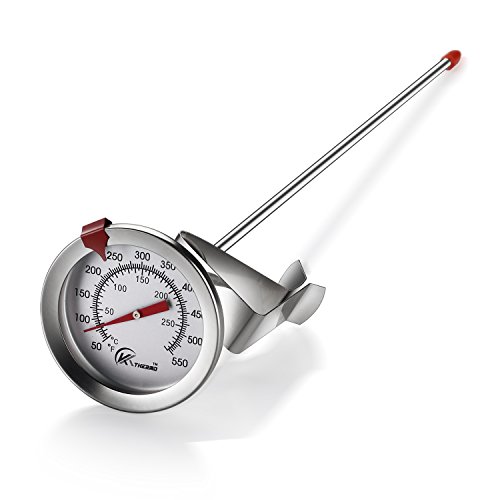
KT THERMO Oven Thermometer
KT THERMO Oven Thermometer. It is a straightforward large-dial design of the sort many bakers buy in pairs, so two zones of the same oven can be watched at once. It sits in the entry tier, so judge it on dial clarity, how securely it hangs or stands, and how honestly it keeps reading after months of heat cycles rather than on extras it never promised. Treat the listing as a starting point: check the current Amazon listing for the exact configuration, confirm the dial markings suit the way you cook, and remember that placement in your own oven will matter more than any small difference between honest dial models. Best for: cooks who want a simple, always-present reference in the oven they use most. Not suited for: anyone who needs an alert from another room, because a dial inside a closed oven can only be read when you open the door and look.
First Setup and Care Essentials
Preheating is where a thermometer first earns its place. Most ovens signal ready far too early, when the air near the sensor has reached temperature but the walls, racks and baking stone are still soaking up heat and the cavity has not stabilised. Food loaded at the beep enters an oven that is still climbing and swinging, which is why the first batch so often bakes differently from the second. Watching an independent dial teaches patience with evidence: you see the reading settle near the set point and stay there through a full cycle, and only then do you load the tray.
Care is simple but not optional. An oven thermometer should be wiped down while cold with a damp cloth when splatter builds up, and it should never be plunged into water or left soaking, because moisture inside the case clouds the glass and can corrode the movement. Avoid harsh scouring on the printed dial, which is the part you most need to preserve. Store a spare unit in a drawer rather than loose among heavy pans. Treated gently, a dial thermometer is one of the longest-lived tools in the kitchen, asking for nothing but an occasional clean lens and a safe place to hang.
You can sanity-check an oven thermometer without laboratory equipment. The point is not to certify it but to catch a unit that has become wildly dishonest after a drop or years of service. Compare it against a second thermometer you trust, side by side in the same preheated oven, and expect agreement within a reasonable margin for home instruments rather than perfection. If a dial has a reset or calibration feature, follow the maker’s instructions carefully and only adjust when you are confident in the reference. A thermometer you have checked is a tool; one you have never questioned is an opinion.
Mistakes to Avoid
The common mistakes are predictable. Placing the thermometer against a wall or touching the rack so it reads conducted heat instead of air. Reading it too soon, before the cavity has stabilised after preheating or a door opening. Leaving it in one forgotten corner and treating that corner’s story as the whole oven’s truth. Never cleaning the lens, then complaining the dial is unreadable. And the deepest mistake: buying the thermometer, confirming the oven runs hot, and then changing nothing, neither the dial setting nor the rack nor the rotation habit. Measurement only pays when it changes behaviour.
Your oven’s behaviour is not fixed for life. Readings taken in a cool kitchen in winter and in a hot kitchen in summer can differ, a new door seal changes the picture, and moving house or replacing an element resets everything you thought you knew. Treat thermometer checks as a seasonal habit rather than a one-time investigation: a quick verification before the heavy baking season, after any repair, and whenever results mysteriously change. The habit takes minutes, costs nothing beyond the instrument itself, and prevents the slow slide back into guessing that made the thermometer necessary in the first place.
Still deciding whether the category earns its hook at all? Our verdict piece, is an oven thermometer worth it, makes the case both ways, and the selection method in how to choose an oven thermometer turns this guide into steps. For the food side, add meat thermometer buying guide and suitable ovens from best wall ovens for home bakers.
Related Guides
Keep exploring: oven thermometer review, oven thermometer reviews, oven thermometer pros and cons, is an oven thermometer worth it, how to choose an oven thermometer, meat thermometer buying guide, meat thermometer pros and cons, best wall ovens for baking, best wall ovens for home bakers.
More From the Test Kitchen
Teaching new cooks is easier with a thermometer on the rack. Beginners are often told to learn their oven, which is sound advice with no method attached. A dial gives the method: preheat together, watch the swing, note where the needle settles, and compare it with the dial’s claim. That single supervised session teaches more about heat than a month of unexplained successes and failures. It also builds the habit of verifying rather than assuming, which transfers to meat thermometers, pan temperatures and every other measurement a confident cook eventually makes.
Dual markings deserve a practical mention for households that cook from international recipes. Many dials print both major scales, which saves mental arithmetic mid-recipe, but crowded dual scales can be harder to read at a glance than a single bold one. Decide which scale you will actually use weekly and prioritise its legibility when choosing. Converting a recipe’s temperature once, in pencil, on the recipe itself, is still the most reliable method; the thermometer’s job is to confirm the cavity, not to serve as a conversion chart under pressure.
A second oven, a range’s smaller cavity, or a much-used countertop oven each needs its own audit. Behaviour does not transfer between cavities, even in the same appliance: the small oven that seems fierce for toast may be honest for baking, or the reverse. Run the same simple protocol in each — preheat, settle, read at the working rack, note the offset — and label the notes clearly by cavity. Cooks who skip this step often compensate the wrong oven for months, applying the main oven’s correction to a cavity that never needed it.
Frozen and convenience foods are an honest everyday test. Their instructions assume a standard oven, and their results — crisp base or soggy one, browned top or pale — are sensitive to real cavity temperature in ways busy cooks blame on the product. Verifying your oven once improves every packet instruction you will ever follow, because the gap between your oven and the assumed standard is finally known. It is not glamorous, but for many households this, rather than celebration baking, is where the thermometer quietly pays its way week after week.
Storage between uses is rarely discussed and often done badly. A thermometer left loose in a drawer of heavy utensils gets knocked, and a knocked dial is a suspect dial. Hang it in the oven it serves, or keep it in a small box or on a hook where it will not be crushed. If you own two, store the spare with its lens protected. The instrument’s whole value rests on being believed, and belief is preserved by boring, gentle handling far more than by anything purchased alongside it.
Glass is not the only readability factor; lighting matters too. Many ovens have an interior light that makes a dial genuinely readable through the window, and using it for a quick check is better than opening the door and dumping heat. If your oven’s window is small or darkened with age, position the thermometer where the light reaches it best, which may mean the front of the middle rack rather than the back. Experiment while the oven is cold, sighting through the closed door, until the dial’s usual home is somewhere you can actually see.
There is a difference between checking an oven and chasing it. New owners sometimes adjust the set point after every small needle movement, fighting the natural cycle and never letting a bake settle. The cycle is normal; what matters is where the swing is centred and how wide it runs at your working rack. Watch a full cycle or two before judging, note the approximate high and low, and make one calm correction if the centre is off. Thermometers reward patience and punish fiddling, like most measuring instruments in most crafts.
Finally, know what a thermometer cannot settle. It cannot tell you whether a cake is baked through, whether a roast is safe, or whether bread has finished — those judgements belong to probes in the food, skewers, colour, sound and experience. What it settles, completely, is the environment those judgements happen in. Cooks who keep that boundary clear get the best from both instruments and blame neither for the other’s job. Cooks who blur it end up distrusting a good dial for failing at work it never claimed to do.
Parallax is a small reading error with a simple cure. A dial needle sits slightly above the printed scale, so viewing it from an angle shifts the apparent reading. Read the dial as squarely as you can through the window, at eye level with the instrument, rather than from above while standing back. It takes two seconds and removes a source of disagreement between cooks in the same kitchen, where one person swears the oven runs hot and the other, reading from a different angle, swears it does not. Consistent reading position is part of consistent baking.
Holiday cooking is the stress test that converts sceptics. A large bird, trays rotating on two racks, a door opening far more often than usual — every weakness in an oven’s behaviour is amplified at exactly the moment failure costs most. A thermometer earns unusual trust on those days because it separates the oven’s contribution from the cook’s: when the reading is right and stable, attention can go to basting, timing and guests. Many owners report that the instrument they bought for curiosity becomes, by the second holiday season, the first thing they check when the oven goes on.
There is a repair decision a thermometer informs better than any other cheap test. If readings show a consistent, stable offset, compensation or a calibration adjustment may be all the oven needs. If readings swing wildly, lag far behind setting changes, or differ chaotically between sessions, the instrument has documented a symptom worth showing a technician. Arriving at a service visit with written readings — dates, settings, racks and observed temperatures — changes the conversation from vague complaint to evidence, and can save a second visit. Keep those notes with the appliance paperwork.
Renters benefit in a particular way. You may not be authorised to adjust or repair a landlord’s oven, but you are entirely free to measure it. A thermometer tells you how to compensate with the dial you have, which rack to trust, and how long a true preheat takes in that specific kitchen. If the readings reveal something extreme, they also give you a factual, unemotional basis for a conversation with the landlord. When you move, the instrument moves with you, ready to audit the next oven on its first weekend.
Recipe development and careful recipe following both depend on the same quiet assumption: that the temperature in the recipe is the temperature in your oven. Cookbook authors test in ovens they know, and their timings inherit those ovens’ habits. Your thermometer is the translation layer between their kitchen and yours. Once you know your offset, you can even annotate favourite recipes in pencil — set higher, set lower, rotate halfway — so the translation survives your memory. Over a year, those small annotations become one of the most valuable documents in the kitchen.
Energy use is an underappreciated angle. An oven running hotter than its dial claims wastes energy on every session, and long compensating bakes in a cool-running oven waste time and fuel in the other direction. Cooking at the temperature the recipe actually intends, for the time it actually needs, is the efficient pattern, and it is unreachable while the cavity’s true temperature is unknown. The thermometer will not transform a household energy bill, but it removes a steady, invisible inefficiency from one of the most power-hungry appliances in the home.
A Pre-Purchase Fit Audit for Oven thermometer: Space, Habits and the Constraints Listings Skip
Specifications and shortlists only get a buyer so far. What decides whether an oven thermometer works out is the fit between the product and the oven and the dishes whose results it will help you judge, and that fit can be audited before any money moves. Work through the checks below in order, because each one eliminates a different kind of disappointment: the wrong size, the wrong format for the routine, and the right product undermined by one ignored constraint in the room or the household.
Treat this first check as a gate, not a preference. Start with fit, because fit failures cannot be fixed by enthusiasm later. In practice that means three things: look at the temperature range against the hottest and coolest jobs you do; decide whether a simple dial suits you or you want the clarity of a larger face; and check the dial or display size so it reads easily through your oven door. Write the answers down rather than holding them in your head, because an oven thermometer is usually chosen over several browsing sessions, and the constraint you checked on Monday is the one forgotten by Friday. If any of the three checks produces an awkward answer, treat it as information about format, not as a problem to wave away — a different format of oven thermometer often removes the conflict entirely, while a compromise on fit tends to be re-litigated every time the product is used.
On a shortlist, this is where weak candidates quietly fall away. Then picture the product in its real situations rather than its best one. The routine cases are easy to imagine: a new oven whose true behaviour you are still learning, or slow cooking and meringue drying that punish temperature drift. The more useful exercise is the harder day: a thermometer coated in roast splatter that becomes unreadable over time; and comparing readings between two ovens with different cycling patterns. An oven thermometer does not need to be perfect in those moments, but it does need a workable answer to them — a way to be moved, covered, adjusted, cleaned or simply tolerated until conditions improve. If the honest answer is that the hard day would make you stop using it altogether, that is a decision-grade fact, and it is far cheaper to learn it now than after delivery.
Reviewers rarely mention this point, yet owners raise it constantly. Most disappointments trace back to a short list of avoidable errors. The common ones here are: assuming the dial is wrong forever rather than learning your oven’s consistent offset; leaving the thermometer in during self-cleaning cycles it is not rated for; and hanging the thermometer where it touches a rack or wall and reads that surface instead. Notice that none of them is really about build quality. They are sequencing errors — deciding before measuring, assuming instead of checking, or copying someone else’s setup whose space and habits differ from yours. Reading any listing for an oven thermometer with those three errors in mind is a fast filter: if the page in front of you encourages one of them, slow down and return to your own measurements and routine.
Budget for this in time, not just money, before you commit. Ownership also has a rhythm, and it is worth pricing that rhythm in before you commit. For an oven thermometer, the upkeep that keeps it pleasant is modest but specific: check its hanging clip or stand for distortion from heat cycles; handle it with oven gloves when repositioning mid-bake; and wipe the face and body once cool so splatter does not bake on. None of that is onerous on its own. The question is whether it attaches to a routine you already have — a weekly clean, a seasonal tidy, a habit of putting things away properly — or whether it requires a new routine invented from scratch, which is the kind that quietly lapses by the second month.
Sellers describe features; this paragraph is about verification instead. When a listing is open in front of you, use the examples named in this guide as a checking exercise rather than a ranking. Take the Taylor Classic Oven Thermometer, the Rubbermaid Commercial Oven Thermometer and the CDN DOT2 ProAccurate Oven Thermometer: for each one, ask how it answers the fit checks above, what its format assumes about your space, and which of the edge cases its design handles gracefully. Listings answer those questions unevenly — dimensions and format are usually stated, while behaviour on the hard days has to be inferred from design details — but even an incomplete answer is useful, because it shows you which questions to carry to the next listing instead of buying the first plausible option.
Frequently Asked Questions
Should an oven thermometer hang or stand?
Both work when done properly. Hanging from a rack bar keeps the instrument in the air stream at food height and clear of sliding trays, while standing on a flat base suits racks whose bars are awkwardly spaced. What matters is that it sits in open air, not touching walls, racks or elements, because contact measures conducted heat instead of the cavity air your food cooks in. Choose the arrangement that stays stable in your oven.
How do I move an oven thermometer when the oven is hot?
Use proper oven mitts, open the door fully, let the first rush of heat escape, and grip the edge or hook of the instrument deliberately rather than nudging it with fingertips. Move it once, close the door, and allow time for the reading to settle before trusting the new position. Whenever possible, decide placement before preheating, while everything is cold and unhurried. Burns in the kitchen most often come from small, hurried adjustments exactly like this one.
Can an oven thermometer help with a convection oven?
Yes. A fan evens some hot spots but creates its own patterns, and makers often advise reducing the set temperature for fan cooking, which raises the question of what the cavity truly reaches. Testing with the fan on and off, at the racks you use most, shows whether the suggested reduction matches your appliance. The readings turn generic advice into settings you have verified in your own oven, for both fan and conventional modes.
How often should I check my oven against a thermometer?
Make it a seasonal habit: before the heavy baking season, after any repair or new door seal, and whenever results mysteriously change. Ovens drift slowly as sensors age and seals compress, so a check once or twice a year catches the slide early. Each check takes a single preheat with the thermometer at your usual rack. Record the offset where you keep recipes, and you will never have to rediscover it from a failed bake.
Do I leave an oven thermometer in the oven all the time?
Most dial models are designed to live in the oven, hanging from a rack or standing where they will not collide with trays. Leaving it in place means the truth is available at every preheat without a special test session. Just keep it clear of elements and walls, wipe the lens while it is cold when splatter builds up, and check occasionally that its hook or base still holds it steady after months of trays sliding past.
Why does my oven thermometer disagree with the oven dial?
Because the two instruments measure different things in different places. The oven’s own sensor sits where the manufacturer placed it and its display is smoothed and rounded; your thermometer reads the air where the food actually sits, through the full swing of the heating cycle. A consistent difference usually means calibration drift in the oven, while a difference that changes by rack points to hot spots. Either way, the reading beside the food is the one your baking experiences.
Notes From Real Kitchens
Think of a roast chicken that is always ready later than the recipe promises, with skin that pales while the cook waits. A thermometer placed beside the bird shows a cavity running cool through every cycle, so the bird is effectively roasting at a gentler heat than intended. Raising the set point to deliver the intended temperature restores the recipe’s timing and browning in one step. The thermometer did not cook anything; it simply removed a translation error between the recipe writer’s oven and yours that had been taxing every meal.
Imagine testing a new baking steel for pizza night. The manufacturer urges a long preheat, the oven dial claims maximum, and yet the first pizza emerges pale underneath. A thermometer session the next day, with readings taken as the steel soaks, shows how slowly the cavity truly stabilises at its top setting. Armed with a real preheat time instead of a hopeful one, the second pizza night delivers the crisp base the steel promised. The instrument’s contribution was patience, measured in degrees rather than guessed in minutes.
Imagine testing a new baking steel for pizza night. The manufacturer urges a long preheat, the oven dial claims maximum, and yet the first pizza emerges pale underneath. A thermometer session the next day, with readings taken as the steel soaks, shows how slowly the cavity truly stabilises at its top setting. Armed with a real preheat time instead of a hopeful one, the second pizza night delivers the crisp base the steel promised. The instrument’s contribution was patience, measured in degrees rather than guessed in minutes.
Consider a familiar scene: a sponge cake that has baked perfectly a dozen times suddenly sinks. The recipe has not changed and the ingredients came from the same shelf, so suspicion falls on technique. A thermometer tells a different story — the oven, accurate last year, now runs cool enough to matter, perhaps after a repair or a tired seal. One reading replaces weeks of self-doubt, and the fix is a small turn of the dial rather than a new recipe. Scenes like this, repeated across bread, roasts and cookies, are why experienced cooks treat the dial as a witness rather than an accessory.
Picture two trays of cookies baked back to back. The first tray, loaded the moment the oven beeped, spreads unevenly and browns at the back edge; the second, loaded twenty minutes later into a stabilised cavity, bakes evenly. Without a thermometer the difference looks like inconsistency in the dough. With one, the explanation is plain: the oven was still climbing during the first tray. The practical lesson changes shopping and scheduling alike — preheat earlier, load once, and let the instrument, not the beep, declare the oven ready.
Think of a roast chicken that is always ready later than the recipe promises, with skin that pales while the cook waits. A thermometer placed beside the bird shows a cavity running cool through every cycle, so the bird is effectively roasting at a gentler heat than intended. Raising the set point to deliver the intended temperature restores the recipe’s timing and browning in one step. The thermometer did not cook anything; it simply removed a translation error between the recipe writer’s oven and yours that had been taxing every meal.
Imagine testing a new baking steel for pizza night. The manufacturer urges a long preheat, the oven dial claims maximum, and yet the first pizza emerges pale underneath. A thermometer session the next day, with readings taken as the steel soaks, shows how slowly the cavity truly stabilises at its top setting. Armed with a real preheat time instead of a hopeful one, the second pizza night delivers the crisp base the steel promised. The instrument’s contribution was patience, measured in degrees rather than guessed in minutes.
Consider a familiar scene: a sponge cake that has baked perfectly a dozen times suddenly sinks. The recipe has not changed and the ingredients came from the same shelf, so suspicion falls on technique. A thermometer tells a different story — the oven, accurate last year, now runs cool enough to matter, perhaps after a repair or a tired seal. One reading replaces weeks of self-doubt, and the fix is a small turn of the dial rather than a new recipe. Scenes like this, repeated across bread, roasts and cookies, are why experienced cooks treat the dial as a witness rather than an accessory.
Picture two trays of cookies baked back to back. The first tray, loaded the moment the oven beeped, spreads unevenly and browns at the back edge; the second, loaded twenty minutes later into a stabilised cavity, bakes evenly. Without a thermometer the difference looks like inconsistency in the dough. With one, the explanation is plain: the oven was still climbing during the first tray. The practical lesson changes shopping and scheduling alike — preheat earlier, load once, and let the instrument, not the beep, declare the oven ready.

