Disclosure: As an Amazon Associate, airfryerkitchensupply.com earns from qualifying purchases. Links on this page are affiliate links; they cost you nothing extra. Prices and availability change often, so check the current Amazon listing before you buy.
Asking is a measuring spoon set worth it feels like asking whether a doorknob is worth it — until you price the question properly, in failed cakes, hijacked spice blends and recipes you quietly stopped trusting. This article answers is a measuring spoon set worth it the way the question deserves: by what you actually get, what it really costs beyond money, who it pays off for, who should skip it, and what to do instead if the answer for your kitchen is no.
Short answer: worth it if you bake, blend, scale or follow recipes with fractional measures — the set pays for itself in rescued recipes and repeatable results. Not worth it — at least not beyond an honest entry set — if your cooking is genuinely measure-free, or if your current set is already complete, legible and true. The long answer, with its profiles and checklist, follows.
Key Takeaways
- Worth it for: bakers, spice blenders, recipe followers, scalers and anyone whose dishes fail mysteriously.
- Not worth it beyond entry tier for: pure improvisers and kitchens with an already-complete, legible set.
- The real return is repeatability — recipes that work stay working, and failures become diagnosable.
- The real costs are tiny but real: a drawer slot, a washing habit and two seconds of leveling per measure.
- A scale complements a spoon set; it does not replace the potent small end where spoons are exact.
Is a Measuring Spoon Set Worth It: What You Actually Get
What you get is not five spoons. You get the removal of an entire category of doubt. Every recipe’s small measures — the leavener that decides the rise, the salt that decides the balance, the spice that decides the character — become constants instead of variables. That constancy is worth more than precision in the abstract, because it changes how you cook: you attempt the ambitious recipe, you trust the trusted one, and when something fails you can find the real reason instead of blaming the teaspoon-shaped fog. Cooks underestimate this purchase because its unit is small; its jurisdiction is every recipe they own.
Sticky ingredients reward a small piece of technique. Honey, molasses, golden syrup and thick pastes cling to the bowl, so a brim-full spoon delivers noticeably less than its measure to the bowl and keeps the rest as a coating you rinse away. The classic fix is to measure a neutral oil or a quick spray of oil in the spoon first when the recipe allows it, empty it into the mix, and then measure the sticky ingredient in the filmed bowl — it slides out almost completely. Warm spoons help with very thick syrups too. None of this requires special equipment; it requires remembering that the spoon is a system of bowl, surface and technique, and that the recipe only receives what actually leaves the spoon.
Scaling recipes is where a complete size range proves itself. Halving a recipe turns tablespoons into teaspoons and teaspoons into fractions, and doubling turns fractions into whole spoons again. Sets that include the small fractional sizes — the quarter and eighth measures, and the in-between sizes some lines add — let you scale without arithmetic gymnastics or resorting to pinches and dashes that no one can repeat. If you regularly cook for two from recipes written for six, or bake test batches before committing to a full tray, range matters more than finish. A cook who always cooks recipes as written can live happily with the standard sizes; a cook who scales constantly should buy range first and everything else second.
You also get range and jurisdiction that no other tool covers. Cups cannot read the small end; scales strain at it; cutlery invents it. The set is the only instrument in the kitchen that is exact by construction from a pinch-adjacent fraction up to a tablespoon, and that range happens to contain the highest-consequence ingredients in cooking. Owning it completes your measuring system the way a roof completes a house — unglamorously, and in a way you notice most when it is missing.
In this guide
The Real Costs Beyond Money
Money is the smallest cost, and this article keeps it qualitative on purpose: entry sets are modest, mid-tier sets are the sweet spot, premium sets buy finish. The real costs are elsewhere. Space: one shallow-drawer slot or one hook — among the cheapest real estate in the kitchen. Maintenance: washing between raw and ready-to-eat work, drying fully, keeping the set together — seconds per week. Learning curve: one habit, leveling with a straight edge, learned in a single baking session and kept for life. Attention: the discipline of reaching for the proper spoon instead of the nearest cutlery, which is a habit of weeks, not a talent. Totalled honestly, the non-money costs are close to the minimum any tool can ask.
Dual markings — the familiar spoon sizes alongside their metric equivalents — look like a small thing until you cook from international recipes. Modern cookbooks and websites cross the Atlantic constantly, and a set that carries both systems on the bowl saves the phone-with-floury-hands conversion dance. The deeper point is confidence: when a recipe says five millilitres, a marked spoon answers directly instead of inviting a guess dressed as a conversion. If your recipe sources are mixed, dual markings belong on your shortlist. If you cook from one tradition only, they are harmless clutter. Either way, legibility beats quantity: a few sizes you can read at a glance are worth more than a crowded bowl of tiny print you have to squint at.
Dishwasher care is where good sets quietly outlast cheap ones. Stainless spoons are broadly dishwasher safe, but the details decide how they age: dry them promptly rather than leaving them damp in a crowded basket, because prolonged contact with salty or acidic residue can spot even decent steel, and separate them from reactive metals during the wash. Plastic sets face the opposite risk — heat. A plastic spoon that lands near a heating element can warp just enough to change its volume while looking perfectly fine, which is the worst kind of damage because it is invisible. Whatever the material, the end-of-wash habit that protects accuracy is simple: dry, check the bowls are unbent, and store the set together so sizes are not lost one by one into the utensil drawer diaspora.
Who It Pays Off For
The baker is the clearest case: leaveners and salt are dosed in spoon fractions, and the difference between a leveled and a heaped measure is the difference between the recipe and a rumour of it. If you bake monthly, the set pays off in the first season, in cakes that rise and biscuits that balance. The spice-led cook is the second case: blends and rubs are nothing but spoon measures in sequence, and jar-friendly bowls turn a spilled production into a two-minute routine. The scaler and tester is the third: halving, doubling and trialling recipes lives in the fractional sizes, where estimation cannot follow. All three profiles share one trait — their cooking has consequences at the small end — and that trait, not enthusiasm, is what makes the set worth it.
A bent spoon is an inaccurate spoon, and bending is the most common way sets die. Thin bowls flex when they are used as pry tools — levering lids, chiselling frozen juice concentrate, scraping hardened sugar — and once a bowl’s shape changes, its volume changes with it, silently. Protect the set with a division of labour: spoons measure, other tools pry. The second killer is loss. Ring sets lose members when the ring opens in a drawer; nested sets lose members to the backs of drawers. A set missing its teaspoon is a set that forces estimation exactly where estimation hurts most. Storing the set as a unit — on its ring, in its stack, in one known place — is not tidiness for its own sake; it is how the tool remains a measuring system instead of a handful of approximations.
There is a genuine partnership between measuring spoons and a kitchen scale, and understanding it makes both tools better. A scale is superb for flour, sugar and anything bulky, because weight removes the packing variable entirely. But below a certain threshold, scales lose resolution: a few grams of baking soda or salt sits at the edge of what many home scales register reliably, and by the time the display settles you have overshot. Spoons own that small end of the recipe. The mature workflow is both tools together — scale for the bulk, spoons for the potent — and cooks who adopt it stop seeing them as rivals. If you are building a measuring kit from scratch, the spoon set usually comes first, because every recipe assumes you own one.
Who Should Skip It
The pure improviser — the cook who seasons by eye, bakes by feel and treats recipes as suggestions — will use a premium set as drawer jewellery. An honest entry set for the occasional measured recipe is the right ceiling for that kitchen, and there is no shame in it. The second skip case is the already-equipped: if your current set is complete, its markings legible, its bowls true, a new set buys you nothing but novelty, and your money belongs to a gap elsewhere. The third case is the scale-only minimalist who genuinely never bakes or blends; even there, an entry set is cheap insurance for the day a recipe arrives with a quarter teaspoon in it. Skipping, in this category, usually means skipping the upgrade — not the tool.
Strengths and Trade-Offs of Owning One
Strengths
- Repeatability: identical small measures make recipes trustworthy and failures diagnosable.
- Coverage: exact measurement across the highest-consequence range in cooking.
- Economy of everything: minimal space, minimal care, minimal learning curve.
Trade-offs
- Volume’s limits: packing still varies results until technique and consistency tame it.
- Small-part risk: the set must be stored whole or it decays into estimation.
- Habit dependency: the value only arrives if you actually reach for it and level honestly.
Alternatives to Consider
The kitchen scale is the strongest alternative and the better partner: superb for flour and bulk, weak at the potent small end where spoons rule — most serious kitchens end up owning both, in sequence. Measuring cups cover the range above spoons and are worthless below a tablespoon. Cutlery is the free alternative and the false economy: its volumes vary by pattern, and every mysteriously failed recipe carries its fingerprints. Estimation itself is a legitimate technique for the experienced improviser — for seasoning to taste, not for leavening to chemistry. Judge the alternatives by jurisdiction and the spoon set’s worth usually clarifies itself.

OXO Good Grips Stainless Steel Measuring Spoons
The OXO Good Grips line approaches measuring spoons the way the brand approaches most hand tools: start with the grip, then worry about the bowl. The handles are shaped to sit flat and steady in the hand, with the soft, grippy feel the Good Grips name promises, which matters more than it sounds when your fingers are dusted with flour or wet from rinsing produce. The bowls are stainless steel with a profile that pours cleanly rather than dribbling down the side, and the markings are the permanent kind rather than a surface print that fades. In daily use this is the set that feels calm and predictable: it levels neatly, it rinses clean, and it goes back on its ring or into the drawer without drama. It sits in the mid tier of the category, priced by feel and finish rather than by novelty features. Best for: everyday bakers and cooks who want one dependable set that disappears into the routine. Not suited for: cooks who specifically want magnetic nesting or dual-ended bowls, which are different design philosophies covered by other picks in this cluster.
Cuisinart Stainless Steel Measuring Spoons
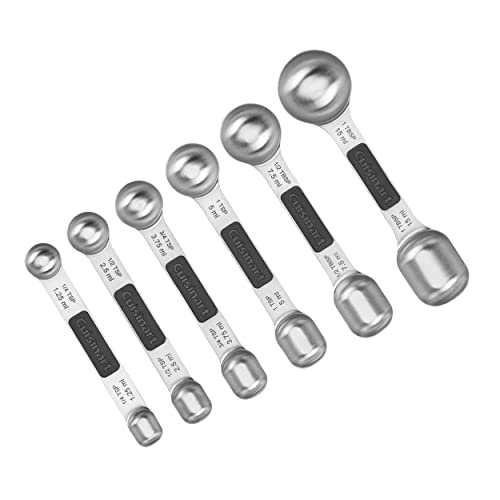
Cuisinart’s stainless steel measuring spoons are the classic, no-nonsense entry in this group: a traditional ring-connected set in brushed metal, shaped along the lines measuring spoons have followed for decades. There is a quiet virtue in that familiarity. The bowls are the conventional round-to-oval shape that fits most jars and tins, the handles are plain and easy to wipe, and the whole set reads instantly if you grew up cooking with a ring of spoons hanging by the stove. Cuisinart positions this line as an entry-to-mid tier staple, the kind of set that arrives with a first apartment kitchen and is still there years later. It does not chase magnetic storage or dual-ended tricks; its argument is durability and clarity at a modest tier. If your cooking is recipe-led and your drawers are already organised, that argument is enough. Best for: traditional cooks, first kitchens and anyone replacing a worn plastic set with metal. Not suited for: cooks with very narrow spice jars who need the slimmest possible bowl profile, or anyone who hates ring-connected storage.

Spring Chef Magnetic Measuring Spoons Set
The Spring Chef magnetic measuring spoons take the storage problem as the design brief. Instead of a ring, the spoons nest together with magnets, so the set sits in a drawer as one tidy stack and each spoon lifts away cleanly when you need it — no unthreading, no ring to open with floury hands. The line is also known for dual-ended thinking: one end shaped for dry goods and reaching into containers, the other suited to small amounts of liquid, which reduces the mid-recipe washing that interrupts baking. The bowls are stainless steel and the overall feel is modern and deliberate, a mid-tier set aimed at organised, space-conscious kitchens. Magnets are not magic, though: the stack still needs a drawer home, and cooks who hang their tools will find nesting less useful than a ring. Best for: small kitchens, tidy-drawer cooks and anyone who measures both dry and liquid ingredients in the same recipe. Not suited for: cooks who prefer to hang tools on hooks, or who want the absolute simplest traditional ring set.
U-Taste Stainless Steel Measuring Spoons Set
U-Taste has built its measuring spoon line around precision-minded home bakers, and the design shows it: slim bowls shaped to slip into spice jars, clear permanent markings, and a dual-ended approach on sets in this style that gives you a narrow end for jars and a rounder end for general measuring. The handles tend to be flat and businesslike rather than cushioned, which precision bakers often prefer because a flat handle doubles as a rest that keeps the spoon level on the counter between measures. This is a mid-tier line with a technical personality — less about kitchen decor, more about repeatable results when a quarter teaspoon has to be a quarter teaspoon. It suits the cook who weighs flour on a scale but still reaches for spoons for leaveners, salt and spices, where small errors change outcomes. Best for: bakers who scale recipes, blend spices and measure small amounts often. Not suited for: cooks who want soft, cushioned grips or a decorative set that lives on display.
How to Get the Most Value If You Buy
Value is extracted through habits, not features. Level dry ingredients with a straight edge rather than heaping — that single habit is worth more than any tier step. Stage small measures in resting spoons before mixing begins, so recipes flow instead of lurching. Wash between raw ingredients and ready-to-eat foods as a fixed principle, and dry the set fully before it goes away. Keep the set complete in one home, near where measuring happens. And annotate your recipes when a small measure proves decisive, so your collection calibrates itself to your tools. Do these things and even an entry set performs like a premium decision.
Homemade spice blends and rubs are a hidden heavy use case for measuring spoons. A barbecue rub, a taco seasoning, a garam masala or a pumpkin spice mix is nothing but spoon measures in sequence, and the balance of the blend lives in fractions of teaspoons. This is where a set’s small sizes, narrow jar-friendly bowls and neutral material pay off in a single session: you move jar to jar, measuring, leveling and washing rarely, because dry spices in sequence do not demand the washing that raw-to-ready-to-eat transitions do. Cooks who blend regularly often end up keeping a dedicated set in the spice drawer, and it becomes the most-used set in the house — a useful prediction when you are deciding how much quality to buy.
Coffee and drinks give measuring spoons a second career outside baking. Ground coffee for a pour-over, loose tea, matcha, cocktail bitters and syrups, hot chocolate mixes — all live in the spoon range, and all reward consistency, because the difference between a level and a heaped spoon of coffee is a different cup, not a slightly different one. The same leveling habit applies, with one adjustment: coffee drinkers often standardise on a single spoon and a single routine rather than chasing the full set, because repeatability beats theoretical precision when the goal is the same cup every morning. A sturdy metal spoon also doubles as a gentle stirrer and a jar scoop, which is why the set by the coffee station tends to be the one that disappears from the baking drawer.
The Decision Checklist
Answer honestly, then follow the rule. Do you bake at least monthly? Do your recipes use fractional small measures? Have you had a dish fail for reasons you could not name? Do you blend spices, rubs or drinks? Do you scale recipes up or down? Is your current measuring situation cutlery, or a set with missing sizes or faded markings? The rule: three or more yeses — buy, at the tier your frequency justifies. One or two — buy an honest entry set with etched markings and stop thinking about it. Zero — skip with a clear conscience, and revisit the question if your cooking changes.
Final Verdict
Is a measuring spoon set worth it? For the overwhelming majority of kitchens that ever open a recipe, yes — decisively, and at almost any tier, because what it sells is not spoons but certainty at the exact point where cooking is least forgiving. The costs are a drawer slot, a washing habit and two seconds of leveling; the return is every recipe you own working the way it promised. Buy the tier your frequency earns, keep the set whole, and let the question retire itself the first time a cake rises exactly on schedule.
More Detail Worth Knowing
Recipes written for professional kitchens sometimes assume spoon measures are weighed or that a spoon means a specific regional standard, and home cooks inherit the ambiguity. The defence is not anxiety but annotation: when a recipe works beautifully, note which set and which spoon you used for the critical small measures; when it fails, the note tells you whether the measure is a suspect. Over a year, a handful of such notes turns your recipe collection into a calibrated system matched to your tools. This is how experienced bakers seem to have intuition — much of it is recorded consistency. A dependable set makes those records meaningful, because the instrument does not change between attempts.
Magnetic nesting is the other modern answer, this time to storage rather than washing. Ring-connected sets hang beautifully but tangle in drawers, and the ring itself must be opened or the whole set carried to the counter for one spoon. Magnetic sets stack into a single flat bundle that lifts apart spoon by spoon, which suits shallow drawers and tidy personalities. The magnets are a convenience, not a performance feature — they change nothing about accuracy — so judge them as storage design. Ask whether your kitchen actually has the drawer space and the habit of restacking, because a magnetic set scattered loose in a deep utensil crock delivers none of its promise. Storage systems only work when they match the way you already move around your kitchen.
Storage location quietly shapes accuracy habits. A set kept in the baking drawer, next to the flour and the mixing bowls, gets used properly; a set exiled to a cluttered utensil crock gets substituted — by a dinner spoon, by an estimate, by optimism. Wherever the set lives, it should live complete and reachable at the moment of measuring, which is usually mid-recipe with something already in the bowl. Hooks near the stove suit ring sets; shallow drawers suit nested ones; a small crock suits neither unless the set stays together inside it. Audit your own kitchen honestly: the best storage system is the one positioned where your hands already go when a recipe says teaspoon.
Gifting is a surprisingly large part of this category, and it clarifies the tiers. A spoon set is a classic component of a new-home or wedding kitchen gift because it is useful daily, lasts for years and carries a small ceremonial weight — the beginning of cooking seriously. Gift sets justify the premium tier’s finish and presentation in a way that self-purchases often do not. If you are buying for someone else, favour the classic shapes and the most legible markings over the cleverest design, because the recipient’s habits are unknown; cleverness is a personal preference, but clarity is a universal one. And if you are registering or hinting, a mid-tier steel set with etched markings is the request that future-you will thank present-you for, every single week.
Dual-ended spoons answer a real mid-recipe annoyance. You are halfway through a batter and need a teaspoon of vanilla after measuring baking powder; with a single-ended set, that means washing and drying a spoon before the liquid measure, or contaminating the extract with dry residue. A dual-ended design puts a second bowl on the other end of the handle — often a narrower, deeper shape suited to liquids and jar work — so one tool covers both measures and the washing waits until the baking is done. The trade-off is handling: a bowl at each end means one end always points at your palm or the counter, and the sets can feel busier in the hand. Cooks who bake layered recipes tend to love them; cooks who measure one thing at a time rarely notice the benefit.
Finally, consider what a spoon set replaces. Without one, small measures come from cutlery — and cutlery spoons vary enormously in volume from pattern to pattern, so a teaspoon from the drawer is a lottery ticket printed with your flatware’s design choices. Every recipe that ever failed mysteriously in a kitchen without measuring spoons carries that suspicion. The set’s deepest value is not precision in the abstract; it is the removal of an entire category of doubt. Once the small measures are trustworthy, failures point where they should — at oven temperature, ingredient freshness, mixing and timing — and cooking becomes diagnosable, improvable and far more fun.
Tiers in this category are best understood qualitatively. Entry-tier sets cover the standard sizes in basic materials and are entirely adequate for occasional baking; their usual compromises are printed markings, thinner bowls and basic storage. Mid-tier sets — where most of the well-known kitchen brands sit — add etched markings, sturdier steel, better shapes and smarter storage, and they are the sweet spot for weekly cooks. Premium sets sell finish, heft, design and completeness: unusual sizes, beautiful materials, gift-worthy presentation. None of the tiers changes the fundamental job, which is why the honest advice is to buy for your frequency. Daily use justifies mid-tier comfort; monthly use does not require it; and no tier excuses a set whose markings you cannot read.
Travel and small-space cooking compress the virtues of a set into their essentials. A nested or ring set takes almost no room in a camping kit, a holiday rental drawer or a tiny studio kitchen, and it instantly upgrades cooking away from home, where the alternative is estimating baking powder with a dinner spoon and hoping. The sets that travel best are the ones that stay together as a unit and tolerate rough washing. Back home, the same compactness serves small kitchens permanently: a spoon set is one of the few complete measuring systems that fits in the shallowest drawer in the house, which is part of why it survives every kitchen declutter while bulkier tools get exiled to high shelves.
There is a small ritual worth adopting when a new set arrives: the water test. Fill each spoon with water, level your expectations instead — for liquids, fill to the brim — and pour the measures into each other to check the relationships: the fractional spoons should compose the larger ones sensibly, and the tablespoon should accept its teaspoons without spilling over or falling obviously short. This is not laboratory calibration, and home cooking does not need it to be. It is a sanity check that catches a mis-stamped or bent spoon on day one rather than after a season of mysteriously flat cakes, and it takes five minutes at the sink. Sets that pass earn trust; trust is what makes you reach for them without hesitation.
Accuracy has a ceiling worth understanding, because it stops you overspending. A measuring spoon is a volumetric tool, and even a perfectly made one delivers volume, not weight — and volume varies with how an ingredient is packed, sifted or settled. The practical differences between a well-made entry-tier set and a premium set are therefore mostly about durability, legibility, comfort and shape, not about one being dramatically more accurate in a home kitchen. Your technique — leveling, consistency, using the same set for the same recipe — contributes more to repeatable results than the last increment of manufacturing tolerance. Buy the set you will keep, read and enjoy using for years; that is where the money actually goes, and it is a perfectly good place for it to go.
Think about the order you measure in, because it decides how much washing a recipe demands. Dry before wet is the classic sequence: measure the flour-adjacent dry ingredients first — the leaveners, salt and spices — and the same spoons can proceed through them with only a tap to clear residue between jars. Save oils, extracts and syrups for last, since a spoon filmed with oil changes how dry goods behave in the bowl and a spoon wet with vanilla will cake the next spice it touches. When a recipe interleaves wet and dry small measures, stage them: level the dry measures into resting spoons or small dishes first, then work through the wet ones. Two minutes of staging removes nearly all mid-recipe washing and nearly all cross-flavour accidents.
Stainless steel is the default material recommendation for a simple reason: it does not hold flavours or colours. A plastic spoon that measured smoked paprika on Monday can carry a faint echo of it into Tuesday’s baking powder, and turmeric will sign its name permanently on pale plastic. Steel rinses neutral, resists staining, shrugs off the dishwasher and does not flex when you press it into a firm jar of brown sugar or a cold block of shortening. Plastic sets still have a place — they are light, quiet in the drawer and gentle on nonstick interiors — but for a primary set that measures everything from vanilla to curry powder, steel’s neutrality and stiffness win on points that show up in real cooking, week after week.
A second set is not an indulgence in many kitchens; it is a workflow. One set lives with the baking supplies, one with the spices, or one stays pristine for dry goods while the other handles oils, extracts and sticky work. The case strengthens in households with allergen separation, where a dedicated set for nut-free baking removes a whole category of washing anxiety, and in homes where two people cook at once and the teaspoon is somehow always in the other person’s hand. Because spoon sets are compact and tiered across a wide qualitative range, the second set can be a simpler one. What matters is that each set stays complete and in its place — two half sets help no one.
Markings decide whether a set stays accurate for a decade or quietly becomes guesswork. Printed markings sit on the surface of the metal or plastic, and years of dishwashing, scrubbing and drawer friction wear them away until the sizes are a memory. Etched or stamped markings are cut into the material itself, so they remain legible for the life of the spoon; you can feel them with a fingertip even in poor light or with wet hands. When you shop, run a thumbnail across the size marking. If your nail catches an edge, the marking is part of the spoon. If the surface feels perfectly smooth and glossy, the size is a print with an expiration date, and the set should be priced and judged accordingly.
Care routines differ subtly by finish. Brushed steel hides water spots and fine scratches, ageing gracefully in a working kitchen. Polished and mirrored finishes look beautiful out of the box and show every spot, which some owners enjoy maintaining and others quietly resent. Dark or coated finishes add another consideration: coatings can chip at bowl edges over years of leveling with metal straight edges, so if you choose a coated set, level with a wooden or plastic edge instead. None of these finishes changes accuracy on day one; they change how the set looks on day seven hundred, and how you feel about reaching for it. Choose the finish your future self will still enjoy maintaining, not the one that photographs best today.
Handle length matters in two opposite directions. Long handles reach to the bottom of tall spice jars, deep canisters and narrow bottles, and they keep your knuckles out of the flour bin. Short handles are quicker to manoeuvre in small bowls and feel more precise for tiny measures. Most home sets compromise in the middle, which is right for most kitchens, but if you buy in bulk and decant into tall jars, or if your spice collection lives in deep tins, reach becomes a genuine selection criterion rather than a spec-sheet footnote. Try the mental test before buying: picture the deepest container you measure from weekly, and ask whether the spoon you are considering can get in, scoop and come out level without a fight.
The reason small measures deserve this care is that baking is chemistry at kitchen scale. Leaveners are dosed in fractions of a teaspoon because their effect is powerful: too little baking soda and a cake stays dense and pale; too much and it tastes soapy and metallic, with a coarse, yellowed crumb. Salt behaves the same way — a heaped teaspoon can push a balanced dough into harsh territory, while a scant one leaves it flat and dull. Spices concentrate the lesson further, because a heaped spoon of cayenne or cloves does not politely intensify a dish, it hijacks it. Measuring spoons exist precisely for the ingredients where small absolute errors become large relative ones, and that is why their accuracy and your leveling habit matter more than the accuracy of a big measuring cup ever will.
Flat-bottomed spoons and spoons with flat handles share an underrated virtue: they rest. Set a rounded, tippy spoon down mid-recipe and it rolls, spills its measure or lands bowl-down in the flour. A spoon designed to sit level on the counter becomes a staging tool — you can measure out baking powder, salt and spices into resting spoons before the mixing starts, line them up in recipe order, and then add them one by one without re-measuring under pressure. Cooks who bake with children, or who simply like a calm counter, feel this benefit immediately. It costs nothing in accuracy and it changes the rhythm of a recipe from frantic to deliberate, which is where good results usually come from.
The tablespoon boundary is where spoon sets hand over to cups, and knowing the handover keeps recipes smooth. Spoons are the right tool from a pinch up to a tablespoon or so; beyond that, counting spoons becomes slow and error-prone — three teaspoons to a tablespoon is manageable, but nobody should measure a quarter cup of oil four tablespoons at a time if a cup is hanging nearby. Good cooks move fluidly: spoons for the potent and the small, cups for the bulk dry and liquid, a scale for the heavy and the critical. A spoon set should therefore be judged partly by how it sits in that system — whether its tablespoon is comfortable for repeated measures of oil or milk when a recipe lives right at the boundary, and whether its handle rests flat while you pour.
Leveling is the single technique that separates accurate spoon measuring from approximate spoon measuring. Fill the spoon so the ingredient mounds above the rim, then draw a straight edge — the back of a table knife, a chopstick, the flat handle of another spoon — across the top in one steady pass. What falls away was never part of the measure. A heaped spoon of flour or cocoa can hold dramatically more than a leveled one, and with potent ingredients such as baking soda, salt or ground spices, that surplus is not a rounding error; it is a different recipe. Build the habit until it is automatic: scoop, mound, level, then add. It takes two seconds and it is worth more than any premium finish or clever storage system a set can offer.
When a Measuring Spoon Set Earns Its Place: The Long-Term Ownership Test
Whether a measuring spoon set is worth it is rarely decided on the day it arrives. The answer builds over months of small moments: the days it quietly does its job, the days it frustrates, and the day you realise you would replace it without hesitation, or would not. This section works through that longer test in practical terms.
The value case for a measuring spoon set rests on repetition. It exists for accurate baking and seasoning measurements, so multiply a small daily convenience by the number of times your household actually does that job in a year, and the purchase usually justifies itself on arithmetic alone. The case collapses just as quickly for households where the job is monthly or seasonal, because an excellent tool used rarely is still mostly storage.
Running costs here are mostly attention. Ownership asks that you accept washing promptly after oily or strongly coloured spices and drying the ring joint, and accept the occasional frustration when measurements drifting because markings have worn or heaped spoons replace level ones. Households that treat that upkeep as part of the routine report the measuring spoon set as an easy yes years later; households that resent every minute of maintenance experience the same product as a burden, which is why identical items earn opposite verdicts in different homes.
So run the replacement test. Imagine the measuring spoon set vanished tomorrow: would you reorder the same thing within the month, borrow one in the meantime, or quietly enjoy the cleared space? Add the edge case, sticky ingredients like honey, which need a different technique than dry spices, and ask whether it handled yours well enough to matter. If you would replace it quickly and it passed your hardest regular test, it was worth it by the only definition that counts, your own revealed behaviour.
A Final Decision Checklist
- Count the weekly uses honestly, since value here comes from accurate baking and seasoning measurements repeated, not occasional.
- Subtract the attention cost, because washing promptly after oily or strongly coloured spices and drying the ring joint is part of the price you pay forever.
- Forgive rare frustrations, but not weekly ones, and the recurring one is measurements drifting because markings have worn or heaped spoons replace level ones.
- Ask the replacement question: if it vanished, would you reorder before the month ends.
- Check it still fits your life as routines change, since whether the spoons fit into your narrowest spice jars and how the markings are applied.
- Test the moment that justifies ownership, because sticky ingredients like honey, which need a different technique than dry spices.
- Keep packaging and paperwork until the first full week, while the decision is still reversible.
- Photograph the setup once it works well, a small record of the version you would replace like for like.
- Track for a month whether the upkeep into an existing routine, because washing promptly after oily or strongly coloured spices and drying the ring joint only happens reliably when it rides on a habit.
- Notice how often sound, weight and effort during normal use, the everyday qualities that decide long-term satisfaction.
- Ask whether you would miss seasonal differences, since heat, guests and holiday loads test a measuring spoon set differently from ordinary weeks.
- Be honest about whether the shortlist against your written criteria, not against whichever listing photographs best.
- Ask whether you would miss instructions photographed on your phone, so troubleshooting never starts with a search through drawers.
- Notice how often the edge case on a quiet day first, since sticky ingredients like honey is a poor thing to meet unprepared.
- Count the weeks when the storage spot honestly: if putting it away is awkward, the measuring spoon set will slowly stop being used.
Frequently Asked Questions
Is a measuring spoon set worth it if I already own a kitchen scale?
Yes, because the tools split the recipe between them. A scale excels at flour, sugar and bulk ingredients, where weight removes packing error, but the potent small amounts — baking soda, salt, yeast, spices — sit near the reliable resolution limit of many home scales, and recipes dose them in spoon fractions. Spoons are exact by construction in that range. Most cooks who buy a scale first end up adding spoons for the small end; most who buy spoons first add a scale for the bulk. Worth it is not either-or here; the set completes the system.
How much should I spend on a measuring spoon set?
Think in tiers rather than amounts. Entry-tier sets with etched markings and stiff bowls deliver the core value — repeatability — in full, and suit occasional cooks honestly. Mid-tier sets add comfort, better shapes, smarter storage and fuller fractional range, and they are the sweet spot for weekly cooking because you feel those comforts constantly. Premium sets buy finish, heft and presentation, which are pleasures rather than performance. The waste to avoid is paying premium money for printed markings, or entry money for a set you will use daily for a decade.
Can I just use regular spoons from my cutlery drawer?
You can, and many cooks do — it is the main reason recipes fail mysteriously. Cutlery teaspoons and tablespoons are designed for eating, not measuring, and their volumes vary widely from one flatware pattern to another, sometimes dramatically. A recipe written against standard measures becomes a lottery when your spoon holds a different amount. For seasoning to taste, cutlery is fine. For leaveners, salt in baking, and spice blends — anywhere the amount itself is the recipe — a proper set is the difference between cooking and gambling, and it is among the cheapest upgrades in the kitchen.
Is a premium measuring spoon set worth it over a basic one?
For accuracy, no; for experience, sometimes. A well-made basic set with etched markings measures as honestly as a premium one, because your leveling technique contributes more than manufacturing tolerance. Premium tiers repay daily cooks in heft, finish that ages beautifully, extended fractional sizes and presentation — real pleasures if you handle the set every day, invisible if you bake twice a year. Match the tier to your frequency and be honest about it. The category’s trap is not overspending; it is buying premium finish with printed markings, which inverts every priority that matters.
When is a measuring spoon set not worth it?
Three situations qualify. Your cooking is genuinely measure-free — you season by eye, never bake, and treat recipes as inspiration — in which case even the modest cost buys drawer decoration. Your current set is already complete, legible and unbending, in which case an upgrade buys novelty only. Or your kitchen’s real gap is elsewhere — no scale for serious baking, no cups for bulk liquids — and the spoon money serves better there first. Notice that even the strongest case usually argues for an entry set eventually, because one quarter-teaspoon recipe is all it takes to miss owning one.
How long does a good measuring spoon set last?
A stainless steel set with etched markings, used only for measuring and stored complete, can last for many years — effectively a buy-once tool. Its enemies are specific and avoidable: bowls bent by prying or levering, printed markings fading (choose etched and this enemy never exists), damp storage causing spots and odours, and slow loss of individual sizes into drawers and lunchboxes. None of these requires money to prevent, only habits. That longevity is central to the worth-it case: the cost, however you tier it, is divided by a decade or more of weekly use.
Related Measuring Guides
our measuring spoon set review
our measuring spoon set reviews
the measuring spoon set buying guide


