Disclosure: airfryerkitchensupply.com is reader-supported. When you buy through links on our site, we may earn an affiliate commission at no extra cost to you.
Where to buy
Shopping for the best liquid measuring spoons means filtering a category that mostly sells dry-goods tools with a liquid claim in the title. Every set below was verified against live catalog data, and we only included sets whose listings genuinely support liquid use — dual-sided liquid ends, rectangular corner-pour bowls, or an explicit dry-and-liquid rating with the fractional sizes liquids need.
One scoping note before you buy: spoons own the sub-tablespoon world. Once a recipe asks for two tablespoons or more of a liquid, a small liquid measuring cup or mini beaker is faster and more accurate. The smart kitchen buys the spoon set for teaspoons and tablespoons, and a mini measure for everything above — this guide covers the spoon half of that system.
- Spring Chef Stainless Steel Magnetic Measuring Spoons Set of 8, Black — Best Overall for Liquids: check price on Amazon.
- Smithcraft Copper Measuring Spoons Set 10 with Leveler — Best for Bottles and Jars: check price on Amazon.
- U-Taste 18/8 Stainless Steel Measuring Spoons Set of 9 — Best Fractional Range: check price on Amazon.
- Styled Settings Copper Measuring Spoons Set with Leveler, 8-Piece — Best Double-Sided Alternative: check price on Amazon.
- Spring Chef Stackable Stainless Steel Measuring Spoons Set of 6 with Leveler — Best Space-Saving: check price on Amazon.
- YUNNKEEY Stainless Steel Measuring Spoons Set of 14 with Leveler — Best Complete Range: check price on Amazon.
The best liquid measuring spoons solve a problem most cooks do not notice until a sauce breaks or a cake tastes faintly of almond-extract regret: ordinary measuring spoons are shaped for flour, not for fluids. A shallow, wide bowl that levels beautifully with a knife will sheet olive oil over its rim, dribble vanilla down its handle, and turn ‘one teaspoon’ into a range rather than a quantity.
Liquids behave differently from dry goods, and spoon design has quietly adapted. Dual-sided spoons add a deeper, narrower liquid end. Rectangular spoons pour from a corner in a controlled stream. Long handles reach into oil bottles and honey jars. Extended fractional ranges exist because potent liquids — extracts, bitters, fish sauce, chili oil — are dosed in eighths and quarters of a teaspoon, where a guess is a seasoning decision you did not mean to make.
There is also a quiet hygiene argument for taking liquid spoons seriously. Spoon measures move between raw marinades, tasting, and finished sauces all through a cooking session, and a set that rinses clean in seconds — smooth stainless, no seams, no coatings to baby — gets rinsed. A fussy set gets ‘wiped’, and the difference shows up in the next dish’s flavor before it shows up anywhere else. Ease of cleaning is an accuracy feature too: a spoon you clean properly between measures is a spoon that measures only what you put in it.
The six sets below were chosen for liquid work first and dry work second, and each was verified against live catalog data before being linked. Between them they cover all the realistic ways home cooks measure small amounts of liquid at home — and the guide sections that follow explain the physics, the technique, and the common mistakes that matter far more in daily cooking than which brand name happens to be stamped on the handle.
In this guide
Quick Picks
Six sets, each with a distinct and genuinely useful liquid-measuring talent:
- Best Overall for Liquids — Spring Chef Stainless Steel Magnetic Measuring Spoons Set of 8, Black. The dual-sided design gives every size a dedicated liquid end — deeper and narrower, so oils and extracts dome at the rim instead of sheeting over it.
- Best for Bottles and Jars — Smithcraft Copper Measuring Spoons Set 10 with Leveler. Ten sizes with US and metric markings and long handles made to reach into bottles and jars — the liquid cook’s reach problem, solved.
- Best Fractional Range — U-Taste 18/8 Stainless Steel Measuring Spoons Set of 9. Nine sizes down to 1/16 tsp — the set for liquid fractions, where a few drops of extract either season the dish or hijack it.
- Best Double-Sided Alternative — Styled Settings Copper Measuring Spoons Set with Leveler, 8-Piece. Double-sided, magnetic, and stackable in a copper finish, with a leveler — the stylish twin of the dual-sided idea, sized to fit spice jars too.
- Best Space-Saving — Spring Chef Stackable Stainless Steel Measuring Spoons Set of 6 with Leveler. Rectangular spoons that stack flat, carry metric measures, fit spice jars, and pour liquids from a corner — a genuinely different geometry for tight kitchens.
- Best Complete Range — YUNNKEEY Stainless Steel Measuring Spoons Set of 14 with Leveler. Fourteen rectangular sizes in a slim, jar-fitting design with a leveler — the maximalist set for cooks who never want to estimate a fraction again.
How These Picks Were Chosen
We screened the measuring spoon market specifically for liquid competence: a set had to offer a design feature that genuinely helps with fluids — a dedicated liquid bowl, a corner-pouring rectangular shape, long bottle-reaching handles, or a fractional range deep enough for extracts — and its listing had to confirm the details against live catalog data. Sets that merely added the word ‘liquid’ to a generic dry set were cut.
Judging weighted pour control and meniscus readability first, then size range at the small end, then reach (handles versus bottle necks), then the usual virtues of material and storage. Because liquids stain, corrode, and linger as odors, stainless steel dominates this list; the one thing no pick here does is ask you to trust a printed claim we could not verify.
- Pour control: a bowl shape — deep, narrow, or cornered — that releases liquid in a stream, not a sheet.
- Honest fill line: a bowl deep enough for surface tension to dome at the rim, so ‘full’ is visible and repeatable.
- Small-size range: fractions down to at least 1/8 tsp, because potent liquids are dosed in fractions.
- Reach: handles long enough for oil bottles, honey jars, and extract necks.
- Material discipline: stainless that ignores acids, salts, pigments, and the dishwasher.
The 6 Best Liquid Measuring Spoons

Spring Chef Stainless Steel Magnetic Measuring Spoons Set of 8, Black — Best Overall for Liquids
Most measuring spoons treat liquids as an afterthought: the same flat bowl that levels flour is expected to hold a tablespoon of olive oil without spilling. The Spring Chef set of 8 refuses that compromise. Each spoon is dual-sided, with one end shaped for dry ingredients and the other — narrower and deeper — shaped for liquids, and the set is explicitly made for dry and liquid ingredients alike.
For liquid work specifically, that second end is the whole story. A deeper bowl lets surface tension form the slight dome that means ‘exactly full’, and the narrower profile pours in a controlled stream into a mixing bowl or a narrow pan. The set nests magnetically, includes a leveler for the dry end, and goes in the dishwasher.
Strengths
- A dedicated liquid end on every spoon: deeper bowl, cleaner meniscus, fewer spills with oils and extracts.
- Magnetic nesting keeps all eight spoons together — and a set you can find is a set you will use.
- Stainless construction shrugs off the dishwasher and does not hold onto garlic oil or vanilla odors.
Trade-offs
- The black coating is a finish over steel; cooks who abuse utensils may prefer a bare-steel set.
- Dual-sided spoons are double-ended in the drawer too — slightly bulkier than single-ended designs.
- No in-bowl measurement markings; you measure by the spoon size, as with most sets.
| Material | Stainless steel |
| Pieces | Set of 8, dual-sided |
| Design | Magnetic nesting, leveler included |
| Use | Dry and liquid ingredients (manufacturer listing) |
| Care | Dishwasher safe |
Think about the liquids a spoon actually measures: vanilla and almond extract, lemon juice, soy sauce, Worcestershire, olive oil, melted butter, honey, maple syrup. They range from water-thin to spoon-coatingly thick, and the failure mode is the same — a shallow bowl plus a shaky pour equals an approximate measure and a sticky counter. The Spring Chef’s liquid end attacks both halves: depth for the fill, narrowness for the pour.
The magnetic nesting earns a specific mention for liquid cooks, because extracts and oils live in bottles that get opened mid-recipe with wet hands. Grabbing the whole nested block one-handed, flicking off the teaspoon, and returning the block to the fridge door is a workflow a ring set simply does not offer.
Best for: cooks who measure extracts, oils, and sauces by the spoon daily and want one set that treats liquids as a first-class job / Not suited for: buyers who want in-bowl gradations or an uncoated finish
Check the current price on Amazon

Smithcraft Copper Measuring Spoons Set 10 with Leveler — Best for Bottles and Jars
Half the battle of measuring liquids is geography: the oil is at the bottom of a tall bottle, the honey is in a deep jar, the extract bottle’s neck is narrower than your spoon. Smithcraft’s set of 10 answers with long handles designed for jars and bottles, in stainless steel with both metric and US markings across ten sizes.
The copper finish makes it the handsome set in this roundup, but the substance is the range and the reach. Ten sizes cover the fractional world of liquid measures — the quarter-teaspoon of almond extract, the half-tablespoon of lemon juice — and a leveler is included for the dry side of its dry-and-liquid brief.
Strengths
- Long handles reach into oil bottles, honey jars, and deep canisters where standard spoons cannot go.
- Ten sizes with US and metric markings — the widest dual-unit range in this roundup.
- Copper-finished stainless with a leveler included, so it covers dry measures credibly too.
Trade-offs
- Copper finishes reward hand-washing; daily dishwasher cycles will age the look faster than bare steel.
- Ten pieces is a lot of spoons to store; no magnetic system is included.
- Long handles are slightly awkward in shallow drawers and small jars.
| Material | Stainless steel, copper finish |
| Pieces | Set of 10 |
| Markings | Metric and US |
| Design | Long handles for spice jars and bottles; leveler included |
| Use | Dry and liquid |
The dual-unit markings matter more for liquids than for dry goods, because liquid recipes cross borders constantly: a European sauce wants 15 ml of cream (a tablespoon), a cocktail wants 5 ml of bitters (a teaspoon), a marinade wants both systems in one paragraph. Spoons stamped in both units remove the phone-with-wet-hands conversion step where errors breed.
On the finish: copper-toned coatings on steel are a style choice with a maintenance price, and buyers should make it knowingly. Hand-wash and the set stays a showpiece; dishwasher it daily and it becomes a working set with a fading tan. Either way the steel underneath measures the same — which is the right order of priorities.
Best for: cooks who measure from tall bottles and deep jars and cook from both US and metric recipes / Not suited for: dishwasher-only households who want a finish that never changes
Check the current price on Amazon
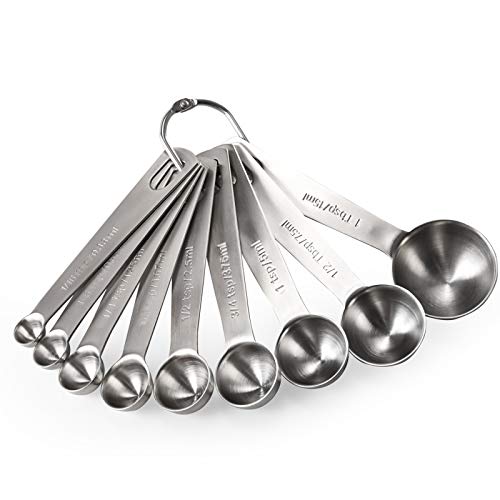
U-Taste 18/8 Stainless Steel Measuring Spoons Set of 9 — Best Fractional Range
Liquid measures live at small sizes: a quarter teaspoon of sesame oil finishes a soup, an eighth of a teaspoon of almond extract perfumes a cake, and doubling either by accident is a ruined dish. The U-Taste set of 9 is built for that world, running from 1/16 tsp to 1 tbsp in 18/8 stainless, rated by its maker for dry and liquid ingredients.
The tiny end of the range is the point. A 1/16 tsp spoon is the difference between measuring a potent liquid and free-pouring it hopefully. Bakers scaling recipes, cocktail makers, and anyone who cooks with concentrated flavors — fish sauce, chili oil, bitters, extracts — will feel the value of the small sizes weekly.
Strengths
- The fractional range (1/16, 1/8, 1/3, 3/4 tsp) that potent liquids actually demand.
- 18/8 stainless: no rust at the stampings, no lingering odor from fish sauce or garlic oil.
- One set honestly covers dry and liquid, so it can be a kitchen’s only set.
Trade-offs
- Single-shape bowls: the liquid pour is good, not as specialized as the Spring Chef’s dual-sided liquid end.
- No leveler or magnetic storage included.
- The smallest spoons are easy to lose; the set demands a ring or clip habit.
| Material | 18/8 stainless steel |
| Pieces | Set of 9 |
| Sizes | 1/16 tsp to 1 tbsp, incl. 1/3 and 3/4 tsp |
| Use | Dry and liquid ingredients |
There is a quiet precision argument for bare 18/8 steel in liquid work: coatings and pigments are irrelevant, but corrosion is not. Liquid measures sit in acidic juices, salty sauces, and the dishwasher’s steam for years. The chromium-nickel alloy in this set is the food-industry default precisely because it ignores that treatment.
Use the small sizes with the respect they deserve: fill potent liquids over the bowl or pan, never over the whole dish, so an over-pour ruins a spoonful rather than a meal. And rinse the spoon immediately after chili oil or turmeric-heavy liquids — steel will not stain, but the next measure of vanilla will thank you.
Best for: cooks who work with potent liquids in fractional amounts — extracts, bitters, chili oils, fish sauce / Not suited for: cooks who only ever measure water-like liquids in whole teaspoons
Check the current price on Amazon

Styled Settings Copper Measuring Spoons Set with Leveler, 8-Piece — Best Double-Sided Alternative
Styled Settings takes the same engineering as our top pick — double-sided spoons, magnetic nesting, a leveler in the box — and dresses it in copper. The spoons are described as stackable and spice-jar friendly, which makes this the set for cooks who want the liquid-friendly dual-ended design and a kitchen that looks considered.
Eight pieces cover the standard range. The liquid case is identical in structure to the Spring Chef: a second, narrower end that holds and pours liquids more honestly than a flour bowl can. The difference is presentation — and for many kitchens, presentation is a legitimate feature, because tools that please the eye get kept in reach and used.
Strengths
- Double-sided liquid/dry design with magnetic nesting and a leveler — the full modern feature set.
- Spice-jar-friendly sizing, so the dry end is as practical as the liquid end.
- Copper finish makes it the giftable, display-worthy option in this roundup.
Trade-offs
- Copper finish needs gentle care to stay bright; it is the highest-maintenance surface here.
- Standard eight-piece range — no 1/16 or 3/4 tsp fractions for precision work.
- Style-forward pricing tier relative to plain-steel equivalents.
| Material | Stainless steel, copper finish |
| Pieces | 8-piece set, double-sided |
| Design | Nesting magnetic, stackable, spice-jar friendly |
| Included | Leveler |
It is worth saying plainly: between this set and the Spring Chef, the measuring performance is a near tie, and the choice is about finish and feel. Buyers who cook daily and dishwasher everything should take the plainer tool; buyers furnishing a kitchen they love looking at — or giving a gift that will actually be used — can choose the copper with a clear conscience.
The spice-jar-friendly note is not filler. Liquid cooks are usually spice cooks too, and a set whose dry end enters the jar while its liquid end handles the extract bottle covers a whole recipe’s small measures with one tool. That versatility is why double-sided sets dominate the top of this list.
Best for: style-conscious cooks who still want the functional dual-sided, magnetic design / Not suited for: buyers who want fractional micro-sizes or a zero-maintenance finish
Check the current price on Amazon

Spring Chef Stackable Stainless Steel Measuring Spoons Set of 6 with Leveler — Best Space-Saving
Spring Chef’s second entry here changes the shape entirely: rectangular spoons that stack flat into a compact block, with metric measures, long handles, and a profile made to fit in spice jars. For liquid measuring, the rectangle has a hidden talent — it pours from a corner, in a thin controlled stream, which is exactly what you want when adding a teaspoon of lemon juice to a sauce that is already nearly right.
The set of 6 covers the core sizes and includes a leveler for dry work. It suits small kitchens, metric-recipe cooks, and anyone whose drawer has no patience left for round spoons rolling around loose.
Strengths
- Rectangular bowls pour liquids from the corner in a controlled stream — a real advantage with sauces and dressings.
- Stackable flat design stores in a fraction of the space of ring sets.
- Metric measures and long, jar-fitting handles broaden the recipes and containers it serves.
Trade-offs
- Six core sizes only; fractional specialists should look at the U-Taste or YUNNKEEY sets.
- Rectangular bowls feel unfamiliar at first, and the meniscus reads differently than in a round bowl.
- Stacking requires the set to be nested to save space — leave them scattered and the benefit evaporates.
| Material | Stainless steel |
| Pieces | Set of 6, with leveler |
| Design | Rectangular, stackable, long handle, fits spice jars |
| Markings | Metric measures |
| Use | Dry and liquid ingredients |
The corner-pour effect deserves a moment, because it is the rare case of a shape being better for a physical reason: liquid leaving a corner is guided into a narrow stream by the two meeting edges, where a round rim releases liquid across a wide, unpredictable lip. Anyone who has tried to add ‘just a little’ oil from a round spoon and added rather more will recognize the problem this solves.
The metric orientation also fits how liquids are actually specified worldwide — milliliters, not spoon fractions. A cook working from a European cookbook with these spoons measures natively instead of converting, and conversions skipped are errors avoided.
Best for: small kitchens and metric-recipe cooks who value a controlled pour and flat storage / Not suited for: cooks who need extended fractional sizes in US units
Check the current price on Amazon

YUNNKEEY Stainless Steel Measuring Spoons Set of 14 with Leveler — Best Complete Range
If the U-Taste is the fractional argument in round form, the YUNNKEEY set of 14 is the same argument taken further: fourteen rectangular stainless spoons covering the range from pinches to tablespoons, in a slim design that fits in spice jars, with a leveler included. For liquid work, that range means the exact small measure — not a halved guess — for extracts, acids, and oils.
Rectangular bowls bring the corner-pour benefit described above, and fourteen sizes bring a completeness no other set here matches. The trade is drawer management: this is a set for an organized cook with a divider, a hook, or a magnetic strip, not for the junk drawer.
Strengths
- Fourteen sizes — the most complete range in this roundup, dry and liquid alike.
- Rectangular bowls pour liquids from the corner and fit into spice jars.
- Leveler included and stainless construction for daily dishwasher life.
Trade-offs
- Fourteen pieces demand a storage system; loose, they are a drawer incident waiting to happen.
- Rectangular meniscus reading takes a recipe or two of practice.
- Overkill for cooks who measure two liquids a week.
| Material | Stainless steel |
| Pieces | Set of 14, with leveler |
| Design | Rectangular, slim, fits in spice jars |
| Use | Dry and liquid ingredients |
Completeness changes behavior. With fourteen sizes in the drawer, the cook stops translating recipes into the spoons they happen to own — no more ‘a scant half teaspoon’ arithmetic — and simply takes the measure the recipe names. For liquids, where the potent ones are dosed in fractions, that directness is accuracy you can taste.
The honest caveat is organizational. Fourteen rectangular spoons stack and store well if you give them a system, and become clutter if you do not. Buy this set with a drawer divider or a wall strip in the same order, and it will repay you for a decade.
Best for: organized, recipe-driven cooks who want every fractional size for liquids and dry goods in one set / Not suited for: minimalists or anyone whose utensil drawer is already at war
Check the current price on Amazon
Comparison Table
| Pick | Badge | Key spec | Best for |
|---|---|---|---|
| Spring Chef Stainless Steel Magnetic Measuring Spoons Set of 8, Black | Best Overall for Liquids | 8 dual-sided stainless spoons with dedicated liquid ends, magnetic nesting | cooks who measure extracts, oils, and sauces by the spoon daily and want one set that treats liquids as a first-class job |
| Smithcraft Copper Measuring Spoons Set 10 with Leveler | Best for Bottles and Jars | 10 sizes, US + metric, long handles, copper-finished stainless | cooks who measure from tall bottles and deep jars and cook from both US and metric recipes |
| U-Taste 18/8 Stainless Steel Measuring Spoons Set of 9 | Best Fractional Range | 9 sizes from 1/16 tsp, 18/8 stainless, dry and liquid rated | cooks who work with potent liquids in fractional amounts — extracts, bitters, chili oils, fish sauce |
| Styled Settings Copper Measuring Spoons Set with Leveler, 8-Piece | Best Double-Sided Alternative | 8 double-sided magnetic spoons, copper finish, leveler included | style-conscious cooks who still want the functional dual-sided, magnetic design |
| Spring Chef Stackable Stainless Steel Measuring Spoons Set of 6 with Leveler | Best Space-Saving | 6 rectangular stackable spoons, metric, corner-pour bowls | small kitchens and metric-recipe cooks who value a controlled pour and flat storage |
| YUNNKEEY Stainless Steel Measuring Spoons Set of 14 with Leveler | Best Complete Range | 14 rectangular stainless spoons, slim jar-fit design, leveler included | organized, recipe-driven cooks who want every fractional size for liquids and dry goods in one set |
Choose by the liquid you measure most. Extracts and bitters argue for fractional range (U-Taste, YUNNKEEY). Oils and sauces argue for bowl shape (Spring Chef dual-sided, rectangular corner-pour sets). Bottles and jars argue for handle length (Smithcraft). The table makes the talents plain; your pantry should make the decision.
How to Choose Liquid Measuring Spoons
Begin with the physics, because it explains every design in this roundup. A liquid in a spoon is held by surface tension: filled correctly, it domes very slightly above the rim — that dome is the true measure. A shallow bowl cannot hold the dome without spilling at the slightest tilt, so shallow spoons systematically under-measure in real hands. Depth is accuracy. That is why the liquid ends of dual-sided spoons are deeper, and why rectangular spoons — whose corners channel the pour — beat round bowls when the liquid is precious.
Next, inventory your liquids. Thin and watery (vinegar, citrus juice, soy sauce) mainly demand the dome and a steady hand. Viscous liquids (honey, syrups, thick sauces) cling: they need a bowl they release from cleanly — smooth stainless — and they reward a light film of oil in the spoon first, a trick covered in the how-to below. Potent liquids (extracts, bitters, sesame and chili oils) demand fractional sizes above all; with these, the difference between 1/8 and 1/4 tsp is the dish.
Then check the supporting specs:
- Markings: US-only is fine for US recipes; metric or dual markings pay off the first time a recipe specifies milliliters.
- Handles: long handles for bottles and deep jars; standard handles for countertop work.
- Storage: magnetic or stackable systems matter because liquid cooks reach for spoons mid-recipe, one-handed, with wet hands.
- Material: stainless steel, full stop, for a primary liquid set — acids, salts, and pigments are its home turf.
Finally, know the boundary of the category. Spoons measure teaspoons and tablespoons. For a quarter cup of stock or two ounces of lemon juice, a mini liquid measuring cup or beaker is the right tool and every set here would be the wrong one. Buy the spoon set for the small end and a mini measure for the rest, and the whole liquid range is covered honestly.
Teaspoons, Tablespoons, and Milliliters: The Liquid Conversions That Matter
Liquid recipes speak three dialects. US spoons: 1 tablespoon = 3 teaspoons ≈ 15 ml; 1 teaspoon ≈ 5 ml. Metric recipes skip spoons and speak in milliliters directly — 5, 10, 15 ml for the classic spoon sizes. Australian recipes hide a trap: the Australian tablespoon is 20 ml, a third larger than the US one, which is enough to unbalance a sauce or a cake. Dual-marked sets like the Smithcraft above exist precisely to defuse that trap.
The fractional ladder is where liquid cooks live: 1/2 tbsp = 1 1/2 tsp; 1/4 tsp ≈ 1.25 ml; 1/8 tsp — the ‘dash’ of older recipes — ≈ 0.6 ml; a ‘pinch’ is roughly 1/16 tsp. When a recipe from another era calls for a dash of bitters or a pinch of something liquid-adjacent, the small spoons in the U-Taste and YUNNKEEY sets are the translation made physical.
A practical habit: if you cook internationally, write the three anchor conversions — 5, 15, 20 ml — inside a cupboard door. Between that note and a dual-marked spoon set, no recipe’s liquid quantities will ever slow you down or quietly betray you.
Sticky, Oily, and Potent: Measuring Difficult Liquids Well
Honey, syrups, and molasses defeat naive measuring twice: they pour slowly, so the spoon is under-filled, and they cling, so part of the measure stays in the spoon. The professional fix is to film the spoon first — a whisper of neutral oil or a hot-water dip — so the sticky liquid releases completely. Measure oil before honey in the same spoon and the honey slides out on the oil film; recipe writers sequence ingredients with exactly this in mind.
Oils bring the opposite problem: they are thin enough to sheet over a shallow rim but viscous enough to coat, so a measured tablespoon leaves a film behind. With costly oils, pour the spoon’s contents, then give it a second over the bowl to drain. The film is a small percentage — but with truffle oil or good sesame oil, small percentages are flavor.
Potent liquids deserve a protocol of their own: always measure them over a small prep bowl, never directly over the dish. An over-pour into the prep bowl costs a spoonful; an over-pour into the soup costs the soup. Extracts, bitters, fish sauce, and chili oil all graduate from ‘ingredient’ to ‘incident’ at about double the intended dose, and the prep bowl is the cheapest insurance in cooking.
Adjustable Spoons, Mini Beakers, and Other Ways to Measure Small Liquids
Two alternative tools deserve an honest hearing, because liquid cooks meet them constantly. The first is the adjustable measuring spoon: a single spoon with a sliding cover that sets the bowl to any volume in its range. For liquids it has one genuine virtue — a single tool replaces the small sizes — and two real weaknesses: the sliding seal is a leak path for thin liquids, and the mechanism traps syrups and oils in seams that are tedious to clean. As a backup or a travel tool it is defensible; as a primary liquid instrument, a fixed set measures more honestly.
The second is the mini liquid measuring cup or beaker — a small graduated vessel, typically covering from a few milliliters up to a quarter or half cup, read at eye level at the meniscus. This is the correct tool from two tablespoons upward, and it overlaps the spoon range at exactly the sizes where cooks hesitate. Owning both is not duplication: spoons win below a tablespoon because a beaker’s gradations are too coarse at 5 ml, and the beaker wins above two tablespoons because spoon-counting stacks errors. The boundary is functional, not commercial.
A third option, the kitchen scale, deserves mention for liquids measured by weight in modern recipes: water, milk, and most thin liquids convert at roughly 1 ml to 1 g, so a recipe that specifies grams is quietly inviting you to weigh. Oils run slightly lighter than water per volume, which is why serious baking weighs fat rather than spooning it. None of this replaces the spoon for a teaspoon of vanilla — it completes the system around it.
The takeaway for buyers: spend on the spoon set first, because the sub-tablespoon world has no substitute, then add a mini beaker when your cooking regularly crosses the two-tablespoon line. That order of purchase covers the whole liquid range with two honest tools instead of one compromised one.
How to Measure Liquids With a Spoon Accurately
Technique is half the instrument. This is the method test kitchens use for spoon-measured liquids — extracts, oils, acids, and syrups — and it takes no longer than the sloppy version once it is habit.
- Set the spoon down. Rest the spoon on a flat surface and pour into it there. A spoon filled in mid-air is a spoon filled approximately, and approximation is what you are trying to leave behind.
- Fill to the dome. Pour slowly until the liquid domes just at the rim — surface tension holding it fractionally proud. That dome is the true measure; a flat surface is slightly under, a trembling overflow is over.
- For sticky liquids, film the spoon first. Dip the spoon in hot water, or measure an oily ingredient first, so honey and syrups release fully instead of leaving a third of the measure behind as a coating.
- Carry level, pour from the corner or the narrow end. Move the spoon level over the bowl, then tip it so the liquid leaves in one controlled stream — from the corner of a rectangular spoon or the narrow end of a dual-sided one — rather than sheeting over a wide rim.
- Measure potent liquids over a prep bowl. Extracts, bitters, and chili oils get measured over a small bowl first, then added. The prep bowl catches the mistake that would otherwise season the whole dish.
- Rinse between strong flavors. A quick rinse and shake-dry between fish sauce and vanilla keeps yesterday’s measure out of today’s recipe. Stainless makes this a five-second habit instead of a washing-up event.
Keep the set where the liquids are. It sounds obvious, yet most kitchens store spoons with the cutlery across the room from the oils and extracts. A magnetic set on the fridge door beside the stove, or a stackable set in the shallow drawer under the prep counter, gets used at the moment of measuring — which is the only moment that truly counts in the whole measuring process. Tools stored inconveniently are tools replaced by estimation.
Verify your spoons once with water and a scale if you own one: a level tablespoon of water is about 15 grams, a teaspoon about 5. It is a ten-second check that tells you whether your set’s small sizes — the ones that matter most for liquids — deserve your trust.
Common Buying Mistakes
Measuring liquids in a dry-shaped spoon
The category error this whole guide exists to fix. A flat flour bowl sheets oil over its rim and dribbles extract down the handle. If your set has a liquid end or a corner-pour shape, use it; if it does not, that is the upgrade to make.
Filling the spoon in mid-air
A spoon filled while held over the pot is filled by hope. Set it on the counter, pour to the dome, then carry it level. The two seconds saved by the aerial method are paid for in accuracy every time.
Free-pouring potent liquids ‘about a teaspoon’
Extracts, bitters, sesame oil, and fish sauce are dosed in fractions for a reason. ‘About’ a teaspoon of almond extract is a different dessert. Use the small spoons — 1/8 and 1/4 tsp exist for exactly these bottles.
Measuring honey in a dry, cold spoon
A third of the honey stays in the spoon, so the recipe is under-sweetened and the spoon is a sticky problem. Film the spoon with oil or hot water first and the full measure lands where it belongs.
Reading the meniscus from above at an angle
Liquid measures are read at the rim, with the spoon level and your eye in line with it. Judging the fill from a standing cook’s height, at an angle, invites parallax error — the dome looks different from every viewpoint except the right one. Set the spoon down, glance level, then carry it carefully.
Using spoons for cup-scale liquids
Once a recipe wants a quarter cup of anything, spoons become slow and error-stacking — eight tablespoons is eight chances to lose count. Switch to a mini liquid measure above two tablespoons and let spoons rule the small end, where they are unbeatable.
Final Recommendation
The Spring Chef dual-sided set is the liquid spoon set to buy first: a genuine liquid end on every spoon, magnetic storage for wet-handed mid-recipe grabs, and honest stainless throughout. It fixes the core problem — dry-shaped bowls — in a single purchase.
Build around it by need. Fractional dosers should take the U-Taste’s nine sizes or go all-in on the YUNNKEEY fourteen. Bottle-and-jar cooks will feel the Smithcraft’s long handles daily, and metric cooks its dual markings. The rectangular Spring Chef stackable set is the small-kitchen and corner-pour specialist, and the Styled Settings copper set is the same dual-sided idea dressed for display.
Whichever set lands in your drawer, adopt the counter-resting, dome-filling technique from the how-to section. With liquids, the spoon is only ever half the instrument — the hand — its steadiness, its patience, its willingness to set the spoon down and fill it properly — is the other half of the instrument.
Keep researching the cluster: Best Kitchen Measuring Spoons Best Measuring Cups Best Liquid Measuring Cups Best Stainless Steel Measuring Spoons Best Measuring Spoons For Spice Jars
Frequently Asked Questions
What makes a measuring spoon good for liquids?
Depth, pour geometry, and small sizes. A deeper bowl holds the surface-tension dome that marks a true fill; a narrow end or a corner releases the liquid in a controlled stream instead of a sheet; and fractional sizes down to 1/8 tsp let you dose potent liquids — extracts, bitters, chili oil — precisely instead of approximately.
Can I use regular measuring spoons for liquids?
You can, and cooks do daily — but a dry-shaped shallow bowl will under-measure and spill more often, especially with oils. Dual-sided sets with a dedicated liquid end, or rectangular spoons that pour from a corner, measurably improve both the fill and the pour. For water-like liquids in whole teaspoons, the difference is small; for oils and extracts, it is not.
How do I measure honey or syrup without losing half of it in the spoon?
Film the spoon first: dip it in hot water, or measure an oily ingredient in it before the honey. The film breaks the honey’s grip on the metal, so the full measure slides out. Measuring over the bowl and giving the spoon a moment to drain completes the job.
What size is a dash or a pinch in liquid terms?
In older recipes, a dash is about 1/8 teaspoon and a pinch about 1/16 teaspoon. Those are exactly the smallest sizes in extended sets like the U-Taste and YUNNKEEY — one more reason liquid cooks, who meet dashes of bitters and pinches of potent flavorings constantly, benefit from the fractional range.
When should I stop using spoons and use a liquid measuring cup instead?
Above about two tablespoons. Spoons are the precision tool for teaspoons and tablespoons; beyond that, repeated spoonfuls stack errors and lose count. A mini liquid measuring cup or beaker takes over cleanly from two tablespoons to a cup.
Are copper-finished spoons okay for acidic liquids like lemon juice and vinegar?
Yes for measuring — contact is brief and the underlying metal is stainless steel. The care note is about the finish, not the function: acidic residues left sitting, and daily dishwasher cycles, will age a copper finish faster. Rinse after use and hand-wash if you want the look to last.

