Disclosure: As an Amazon Associate, airfryerkitchensupply.com earns from qualifying purchases. Links on this page are affiliate links; they cost you nothing extra. Prices and availability change often, so check the current Amazon listing before you buy.
How to Use a Portable Washing Machine: Key Takeaways
Knowing how to use a portable washing machine well is mostly knowing a short routine and respecting two of its stages: the water connections and the spin. This guide on how to use a portable washing machine takes you from the kit you need, through safety, through every step of a wash day, to troubleshooting and maintenance. Follow it for your first supervised loads and the routine will become automatic — connect, check, wash, balance the spin, drain, dry the tub — in a few weeks of ordinary use.
In this guide
What You Need
Required: the machine’s inlet hose and tap adaptor, the drain hose, a nearby sink or tub, a level working position, detergent suited to small loads, and a laundry basket for sorting. Optional but wise: a shallow tray and towel kept beside the machine, spare hose washers, a small mesh bag for delicates, and an anti-vibration mat if your floor is lively. Gather the required kit before your first wash; improvising connections mid-fill is how small floods begin.
With kit ready, Detergent behaviour changes at this scale, and getting it right prevents most of the complaints new owners report. A portable tub needs far less detergent than a full-size load; too much produces a foam surplus that the rinse cannot clear, leaving fabric stiff and sometimes triggering extra rinses that waste the water saving the machine was bought for. Liquid detergent disperses fastest in small volumes of water, pods designed for large loads can overdose a small tub, and a modest amount of powder works if it is dissolved before clothes go in. Treat the first few washes as calibration: if you see lingering suds in the final rinse, cut the dose before you blame the machine.
With kit ready, Sorting still matters, even when every load is small. Mixing heavy denim with light synthetics in a compact tub unbalances the spin and shortens the life of the suspension, while washing dark dyes beside pale cottons risks the same colour transfer you would get in any machine. Portable owners develop a quick rhythm: a lights load, a darks load, and a separate pass for the grimy category — work clothes, pet blankets, cleaning cloths — so soil never migrates onto everyday garments. Because loads are small, sorting rarely means waiting days for a full basket; each category reaches washable size within a few days in most households, which keeps the whole system moving without effort.
Safety and Before-You-Start
Safety First: Water, Electricity and a Spinning Tub
Every portable washing machine brings water and electricity into the same small space, so a few habits matter more than any feature list. Seat the drain hose firmly in the sink or tub before you start, and clip or weight it so pump pressure cannot push it loose mid-cycle. Never leave the machine unattended while it is filling or draining; a hose that slips can empty a full tub across a floor in minutes, and floors under and around the machine should be able to tolerate water, because small splashes are a normal part of portable laundry life.
Keep the electrical side just as disciplined. Plug into a ground-fault protected outlet where one is available, as general good practice for any appliance used near water, and always handle the plug with dry hands when you connect or disconnect it. Keep cords out of puddles and away from the drain stream. When the spin cycle runs, the machine must stand level and balanced: if it starts to vibrate hard, walk across the floor or thump against a wall, stop it, open the lid and redistribute the load evenly before restarting. Finally, treat the tub as strictly off-limits for children — a child must never climb into the tub or sit on top of the machine, and the lid stays closed whenever the machine is not being loaded or unloaded.
The Wash, Step by Step
Step 1: Position and Level the Machine
Move the machine to its working position near the sink and check it stands level and stable on all feet. A rocking machine now becomes a walking machine during the spin, so adjust position or feet until it sits solidly. Keep the power cord dry and routed away from where water will flow, and give yourself standing room to work comfortably.
Step 2: Connect the Water Inlet
Fit the adaptor to the tap if it is not already in place, attach the inlet hose snugly, and check the joint with a dry hand. Turn the tap on slowly for the first fill and watch the connection for a full minute — a weep found now is a drip; the same weep found later is a puddle. Never start a fill and immediately leave the room.
Step 3: Seat the Drain Hose Firmly
Place the drain hose deep into the sink or tub and secure it so pump pressure cannot push it out — this is the single most important physical action in portable laundry. Confirm the hose has no kinks and that the sink is clear enough to accept the full drain volume. Picture the worst moment — full tub draining while the hose slips — and arrange things so that moment cannot happen.
Step 4: Sort and Load Without Stuffing
Sort by colour and soil as you would in any machine, then load loosely to the level the maker indicates, distributing weight evenly as you go. Pair heavy items with similar weights and never load one sodden heavy piece alone. Close zips, empty pockets, and put delicates in a mesh bag. An honestly loaded tub washes better and spins calmer than a stuffed one.
Step 5: Dose Detergent for a Small Tub
Add a small amount of detergent — far less than a full-size load — and let it disperse in the water where the design allows. If previous loads left suds in the final rinse, reduce the dose further. Keep the detergent beside the machine measured and ready, so dosing stays consistent instead of becoming a guess each time.
Step 6: Choose the Cycle and Start, Then Stay Nearby
Select the programme or timer setting that matches the load, start the machine, and remain within earshot for the whole cycle. Use the first minutes to confirm the fill connection is dry and the machine sounds normal. This supervision is the standing rule of portable laundry: short cycles, attended water.
Step 7: Manage the Spin Like It Matters
When the spin begins, watch the first seconds. Smooth acceleration means a balanced load; thumping or travelling means stop, redistribute the clothes evenly, and restart. Never lean or sit on the machine to calm it, and never let a child near it while it spins. A well-balanced spin leaves clothes ready for the rack and the machine exactly where you placed it.
Step 8: Drain Fully, Disconnect and Dry the Tub
At the end, confirm drainage is complete, turn off the tap, and disconnect hoses in an order that keeps drips inside the sink. Wipe the tub and leave the lid open so everything dries. Coil hoses without sharp kinks, return the machine to its storage spot if it moves, and note anything — a weeping washer, a fraying hose — while you still remember it.
In routine use, Renters face a paperwork question alongside the practical ones, and it is worth answering before the machine arrives. Most leases care about permanent plumbing changes, and a portable washer that connects to a tap with a removable adaptor and drains into a sink usually makes none — but some buildings restrict in-unit laundry outright, and a quick check of the lease or a message to the landlord protects you. Because the connection is temporary, the machine also leaves with you when you move, which changes the value calculation versus paying for a plumbed installation you would abandon. Keep the original tap fittings in a labelled bag so the sink can be restored exactly as you found it.
In routine use, Water and energy use are where portables quietly shine for the right household. Filling a small tub for a small load uses a fraction of the water a full-size machine draws for the same few garments, and most portable cycles finish quickly, so the motor runs for less time. The saving disappears if you run half-empty loads back to back all day, so the honest pattern is full-but-not-stuffed small loads, washed as they accumulate. Owners who switched from laundromat routines notice a different saving: no travel, no waiting, and no carrying baskets in bad weather. The machine pays in convenience first and in utilities second, and both are real.
Troubleshooting and Common Mistakes
When problems appear, Dorm and first-apartment living is where the category earns much of its reputation. Shared laundry rooms mean queues, costs per load, machines that eat coins or cards, and the low-grade anxiety of leaving clothes unattended. A portable washer in your own room removes the queue entirely for everyday items, provided house rules allow it and the sink connection behaves. Students typically wash uniforms, gym kit and weekly basics in the machine and still use shared facilities for duvets and big towel loads. Check dorm rules first — some residences prohibit in-room washers — and keep a waterproof mat under the working position as cheap insurance for the floor and for your deposit.
When problems appear, Baby and toddler laundry is a use case owners mention with genuine feeling. Small clothes arrive in relentless volume, often need washing the same day, and benefit from being kept separate from adult workwear and pet items. A portable machine handles the rhythm perfectly: a quick small load each evening, gentle cycles for soft fabrics, and no waiting for a full-size basket to accumulate. The same logic serves anyone caring for a family member whose laundry needs to stay separate and frequent. Hygiene habits still apply — hot washes where fabrics allow, thorough drying, and regular tub cleaning — but the machine turns a daily chore into a ten-minute routine.
When problems appear, Pet owners form another loyal group. Hair-covered blankets, washable pads, soft toys and the towels used after muddy walks are exactly the loads nobody wants in the main household wash rotation more than necessary, and exactly the loads a small machine handles without complaint. Shake items outside first, clean the lint filter diligently, and run an empty rinse after heavily soiled loads so hair does not migrate. The spin balance lesson applies doubly here, because a single sodden pet blanket is the classic unbalanced load; pair it with towels of similar weight. For multi-pet households the machine often becomes the dedicated pet-laundry station and earns its floor space on that job alone.
Gear That Helps
If you are still choosing the machine itself, these four representative models cover the main styles this routine applies to. All; check price on Amazon before deciding.
BLACK+DECKER Portable Washer
A familiar laundry name in a compact, single-tub format aimed at apartment and rv owners who want push-button cycles rather than manual timing. Treat this as a entry-level option in qualitative terms and check price on Amazon before deciding, since listings and availability change often. In daily use, judge it on the things that decide portable laundry happiness: how confidently the inlet connection seats on your tap, how securely the drain hose stays put, how balanced the spin feels with a realistic mixed load, and how easily the tub and lint filter clean afterwards. Owners with similar small-space routines value machines that start without fuss, drain completely, and store without dominating the room. Before you commit, measure your working position and storage spot, picture the hose route, and read the safety notes in this guide again — the best portable is the one whose routine fits your rooms, your tap and your week, not the one with the longest feature list.
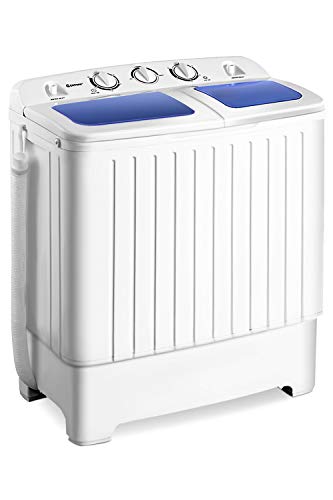
Giantex Portable Twin Tub Washer
A twin-tub design with a separate wash tub and spin tub, built for hands-on users who like controlling each stage themselves. Treat this as a mid-range option in qualitative terms and check price on Amazon before deciding, since listings and availability change often. In daily use, judge it on the things that decide portable laundry happiness: how confidently the inlet connection seats on your tap, how securely the drain hose stays put, how balanced the spin feels with a realistic mixed load, and how easily the tub and lint filter clean afterwards. Owners with similar small-space routines value machines that start without fuss, drain completely, and store without dominating the room. Before you commit, measure your working position and storage spot, picture the hose route, and read the safety notes in this guide again — the best portable is the one whose routine fits your rooms, your tap and your week, not the one with the longest feature list.
Panda Portable Washing Machine
A compact automatic-style portable known for small footprints that suit dorm rooms, tiny bathrooms and tight utility corners. Treat this as a premium-leaning option in qualitative terms and check price on Amazon before deciding, since listings and availability change often. In daily use, judge it on the things that decide portable laundry happiness: how confidently the inlet connection seats on your tap, how securely the drain hose stays put, how balanced the spin feels with a realistic mixed load, and how easily the tub and lint filter clean afterwards. Owners with similar small-space routines value machines that start without fuss, drain completely, and store without dominating the room. Before you commit, measure your working position and storage spot, picture the hose route, and read the safety notes in this guide again — the best portable is the one whose routine fits your rooms, your tap and your week, not the one with the longest feature list.

Costway Portable Washer
A value-minded portable line spanning manual twin-tub and more automatic styles for budget-conscious small households. Treat this as a value-focused option in qualitative terms and check price on Amazon before deciding, since listings and availability change often. In daily use, judge it on the things that decide portable laundry happiness: how confidently the inlet connection seats on your tap, how securely the drain hose stays put, how balanced the spin feels with a realistic mixed load, and how easily the tub and lint filter clean afterwards. Owners with similar small-space routines value machines that start without fuss, drain completely, and store without dominating the room. Before you commit, measure your working position and storage spot, picture the hose route, and read the safety notes in this guide again — the best portable is the one whose routine fits your rooms, your tap and your week, not the one with the longest feature list.
Maintenance and Keeping It Working
For maintenance, Drying deserves its own plan, because a portable washer only does half the laundry job. The spin cycle — especially a twin-tub spinner, which owners consistently praise for how dry it leaves fabric — removes enough water that most items dry on a rack within hours rather than days. In humid climates or winter, pair the machine with a small fan or a heated airer, and avoid drying loads faster than your space can absorb the moisture. Never treat the washer tub as a drying cabinet; leaving damp clothes sitting in it breeds odour and undoes the wash. Households that plan drying space at the same time as washing space report the smoothest routines.
For maintenance, When something does go wrong mid-cycle, a calm sequence protects both floor and machine. Switch off, unplug with dry hands if you need to move anything electrical, close the tap, and only then investigate hoses and connections. Keep a towel and a shallow tray within reach of the working position as standard kit, the way you would keep a mat under a pet bowl. Most incidents trace back to the same trio: a drain hose that was not seated firmly, an inlet connection finger-tight instead of snug, or a load so unbalanced the machine walked and pulled a hose loose. Each is preventable, and after the first near-miss most owners become quietly rigorous about the thirty-second setup check.
More Practical Detail Worth Knowing
In this context, Sorting still matters, even when every load is small. Mixing heavy denim with light synthetics in a compact tub unbalances the spin and shortens the life of the suspension, while washing dark dyes beside pale cottons risks the same colour transfer you would get in any machine. Portable owners develop a quick rhythm: a lights load, a darks load, and a separate pass for the grimy category — work clothes, pet blankets, cleaning cloths — so soil never migrates onto everyday garments. Because loads are small, sorting rarely means waiting days for a full basket; each category reaches washable size within a few days in most households, which keeps the whole system moving without effort.
In this context, The spin cycle deserves respect because it is where a light machine meets real physics. As the tub accelerates, any uneven pocket of wet fabric becomes a swinging weight, and a portable washer — far lighter than a plumbed-in machine — will tell you about it immediately with noise, vibration and walking across the floor. The fix is almost always load craft rather than machinery: distribute items evenly around the tub, avoid washing one heavy item alone, and pair similar weights together. Twin-tub owners get a manual version of the same lesson when they pack the spinner basket; automatic owners meet it as an out-of-balance pause. Either way, a balanced load spins drier, quieter and kinder to the machine.
In this context, Noise is relative, and setting expectations honestly helps. A portable washer is not silent: pumps hum, water sloshes, and the spin cycle announces itself through floors and thin walls. In a house with a utility corner this barely registers, but in a studio apartment the spin can interrupt a call or wake a light sleeper in the same room. Timing becomes the practical tool — wash while you are out on errands nearby, or during hours when the household is awake and active, rather than late at night. Rubber feet, a level floor and a folded mat rated for appliance use can soften vibration transfer, though none of them turn a spinning tub into a silent one.
More Practical Detail Worth Knowing
In this context, Renters face a paperwork question alongside the practical ones, and it is worth answering before the machine arrives. Most leases care about permanent plumbing changes, and a portable washer that connects to a tap with a removable adaptor and drains into a sink usually makes none — but some buildings restrict in-unit laundry outright, and a quick check of the lease or a message to the landlord protects you. Because the connection is temporary, the machine also leaves with you when you move, which changes the value calculation versus paying for a plumbed installation you would abandon. Keep the original tap fittings in a labelled bag so the sink can be restored exactly as you found it.
In this context, Water and energy use are where portables quietly shine for the right household. Filling a small tub for a small load uses a fraction of the water a full-size machine draws for the same few garments, and most portable cycles finish quickly, so the motor runs for less time. The saving disappears if you run half-empty loads back to back all day, so the honest pattern is full-but-not-stuffed small loads, washed as they accumulate. Owners who switched from laundromat routines notice a different saving: no travel, no waiting, and no carrying baskets in bad weather. The machine pays in convenience first and in utilities second, and both are real.
In this context, Maintenance is simple but not optional, and five unglamorous habits decide whether a portable washer stays fresh for years. Leave the lid open after washing so the tub dries; wipe the lint filter after every few loads, because a clogged filter redeposits fluff on dark clothes; run an empty hot wash occasionally to clear detergent residue; check the inlet hose washers for drips before they become leaks; and keep the drain hose unkinked in storage so it does not crack along a fold. None of this takes more than minutes a month, yet skipped maintenance is behind most odour complaints, most drainage complaints and most premature pump problems owners report.
More Practical Detail Worth Knowing
In this context, For RV and boat life, the portable format solves a specific geography problem: laundry facilities are irregular, sometimes distant, and often busy exactly when you need them. A compact washer in a wet bay or bathroom corner turns a half-day laundromat expedition into background chores done while you cook or plan the next leg. The constraints are real — fresh water supply, grey-water disposal rules and power draw all need thought, and marina or campsite rules vary — but within those limits the machine earns its space. Many travellers wash small loads more often, keep a minimal wardrobe rotating, and arrive at paid facilities only for bedding and bulky items.
In this context, Dorm and first-apartment living is where the category earns much of its reputation. Shared laundry rooms mean queues, costs per load, machines that eat coins or cards, and the low-grade anxiety of leaving clothes unattended. A portable washer in your own room removes the queue entirely for everyday items, provided house rules allow it and the sink connection behaves. Students typically wash uniforms, gym kit and weekly basics in the machine and still use shared facilities for duvets and big towel loads. Check dorm rules first — some residences prohibit in-room washers — and keep a waterproof mat under the working position as cheap insurance for the floor and for your deposit.
In this context, Baby and toddler laundry is a use case owners mention with genuine feeling. Small clothes arrive in relentless volume, often need washing the same day, and benefit from being kept separate from adult workwear and pet items. A portable machine handles the rhythm perfectly: a quick small load each evening, gentle cycles for soft fabrics, and no waiting for a full-size basket to accumulate. The same logic serves anyone caring for a family member whose laundry needs to stay separate and frequent. Hygiene habits still apply — hot washes where fabrics allow, thorough drying, and regular tub cleaning — but the machine turns a daily chore into a ten-minute routine.
More Practical Detail Worth Knowing
In this context, The environmental ledger of a portable washer is mostly about matching machine size to load size. Right-sized loads mean less water per garment, less energy heating and moving that water, and fewer emergency laundromat trips by car. Against that, a second appliance is another manufactured object, and a household that already owns an efficient full-size machine gains little by adding one. The strongest case belongs to households whose alternative is genuinely worse: long drives to shared facilities, oversized machines washing tiny loads, or disposable workarounds. Buy the machine to solve a real pattern in your week, keep it for years, maintain it simply, and the footprint argument mostly takes care of itself.
In this context, A realistic weekly rhythm helps more than any single feature. Many owners land on a pattern like this: darks on one evening, lights on another, a small delicates or gym-wear load whenever the basket fills, and household cloths with the weekend clean. Each load is short, the machine is never left holding wet laundry, and drying — on a rack near the machine — keeps pace because small loads dry fast. The routine collapses the psychological size of laundry: there is no laundry day, just a background task that takes less attention than cooking dinner. Households that try to replicate the old weekly mountain in miniature, by contrast, spend a whole evening feeding a small tub and blame the machine for a scheduling choice.
In this context, Drying deserves its own plan, because a portable washer only does half the laundry job. The spin cycle — especially a twin-tub spinner, which owners consistently praise for how dry it leaves fabric — removes enough water that most items dry on a rack within hours rather than days. In humid climates or winter, pair the machine with a small fan or a heated airer, and avoid drying loads faster than your space can absorb the moisture. Never treat the washer tub as a drying cabinet; leaving damp clothes sitting in it breeds odour and undoes the wash. Households that plan drying space at the same time as washing space report the smoothest routines.
More Practical Detail Worth Knowing
In this context, Controls on portables range from a single timer dial to modest electronic panels, and simpler is often better at this scale. A timer dial cannot crash, rarely confuses guests or family members, and makes the machine easy to share in a rental or multi-generational home. Electronic models add preset cycles and gentler fabric programmes, which help if you wash varied fabrics often. Whichever style you choose, test your understanding on the first supervised loads: know how to pause, how to drain manually if a cycle is interrupted, and how to run a rinse-and-spin to rescue an over-soaped load. That small fluency turns the machine from a gadget into a household tool.
In this context, Floors and neighbours both notice a portable washer, so placement is a courtesy decision as well as a practical one. A machine on a solid ground floor behaves very differently from the same machine on a sprung upper floor, where spin vibration travels. If you live above someone, wash at sociable hours, keep the machine level, and consider a dense anti-vibration mat. Inside your own rooms, keep the working position away from sleeping areas if the household includes light sleepers. None of this is complicated, but it is the difference between a machine the whole building ignores and one that becomes a topic of conversation in the stairwell.
In this context, Think about where the water actually goes before you think about any cycle or control. A portable washer fills from a tap, usually through an inlet hose with a quick-connect adaptor, and it drains by pump or by gravity into a sink, a bathtub or a floor drain. That simple loop decides almost everything about daily life with the machine: how close it must live to the sink, how long the hoses need to be, whether you can walk away during a cycle, and how much of your bathroom or kitchen the laundry routine temporarily takes over. Households that plan the water path first — measuring the distance, checking the tap thread, and picturing the drain hose route — almost never regret the purchase, while households that start with capacity charts often discover the real constraint was plumbing all along.
More Practical Detail Worth Knowing
In this context, Sorting still matters, even when every load is small. Mixing heavy denim with light synthetics in a compact tub unbalances the spin and shortens the life of the suspension, while washing dark dyes beside pale cottons risks the same colour transfer you would get in any machine. Portable owners develop a quick rhythm: a lights load, a darks load, and a separate pass for the grimy category — work clothes, pet blankets, cleaning cloths — so soil never migrates onto everyday garments. Because loads are small, sorting rarely means waiting days for a full basket; each category reaches washable size within a few days in most households, which keeps the whole system moving without effort.
In this context, The spin cycle deserves respect because it is where a light machine meets real physics. As the tub accelerates, any uneven pocket of wet fabric becomes a swinging weight, and a portable washer — far lighter than a plumbed-in machine — will tell you about it immediately with noise, vibration and walking across the floor. The fix is almost always load craft rather than machinery: distribute items evenly around the tub, avoid washing one heavy item alone, and pair similar weights together. Twin-tub owners get a manual version of the same lesson when they pack the spinner basket; automatic owners meet it as an out-of-balance pause. Either way, a balanced load spins drier, quieter and kinder to the machine.
In this context, Noise is relative, and setting expectations honestly helps. A portable washer is not silent: pumps hum, water sloshes, and the spin cycle announces itself through floors and thin walls. In a house with a utility corner this barely registers, but in a studio apartment the spin can interrupt a call or wake a light sleeper in the same room. Timing becomes the practical tool — wash while you are out on errands nearby, or during hours when the household is awake and active, rather than late at night. Rubber feet, a level floor and a folded mat rated for appliance use can soften vibration transfer, though none of them turn a spinning tub into a silent one.
More Practical Detail Worth Knowing
In this context, Renters face a paperwork question alongside the practical ones, and it is worth answering before the machine arrives. Most leases care about permanent plumbing changes, and a portable washer that connects to a tap with a removable adaptor and drains into a sink usually makes none — but some buildings restrict in-unit laundry outright, and a quick check of the lease or a message to the landlord protects you. Because the connection is temporary, the machine also leaves with you when you move, which changes the value calculation versus paying for a plumbed installation you would abandon. Keep the original tap fittings in a labelled bag so the sink can be restored exactly as you found it.
In this context, Water and energy use are where portables quietly shine for the right household. Filling a small tub for a small load uses a fraction of the water a full-size machine draws for the same few garments, and most portable cycles finish quickly, so the motor runs for less time. The saving disappears if you run half-empty loads back to back all day, so the honest pattern is full-but-not-stuffed small loads, washed as they accumulate. Owners who switched from laundromat routines notice a different saving: no travel, no waiting, and no carrying baskets in bad weather. The machine pays in convenience first and in utilities second, and both are real.
In this context, Maintenance is simple but not optional, and five unglamorous habits decide whether a portable washer stays fresh for years. Leave the lid open after washing so the tub dries; wipe the lint filter after every few loads, because a clogged filter redeposits fluff on dark clothes; run an empty hot wash occasionally to clear detergent residue; check the inlet hose washers for drips before they become leaks; and keep the drain hose unkinked in storage so it does not crack along a fold. None of this takes more than minutes a month, yet skipped maintenance is behind most odour complaints, most drainage complaints and most premature pump problems owners report.
More Practical Detail Worth Knowing
In this context, For RV and boat life, the portable format solves a specific geography problem: laundry facilities are irregular, sometimes distant, and often busy exactly when you need them. A compact washer in a wet bay or bathroom corner turns a half-day laundromat expedition into background chores done while you cook or plan the next leg. The constraints are real — fresh water supply, grey-water disposal rules and power draw all need thought, and marina or campsite rules vary — but within those limits the machine earns its space. Many travellers wash small loads more often, keep a minimal wardrobe rotating, and arrive at paid facilities only for bedding and bulky items.
In this context, Dorm and first-apartment living is where the category earns much of its reputation. Shared laundry rooms mean queues, costs per load, machines that eat coins or cards, and the low-grade anxiety of leaving clothes unattended. A portable washer in your own room removes the queue entirely for everyday items, provided house rules allow it and the sink connection behaves. Students typically wash uniforms, gym kit and weekly basics in the machine and still use shared facilities for duvets and big towel loads. Check dorm rules first — some residences prohibit in-room washers — and keep a waterproof mat under the working position as cheap insurance for the floor and for your deposit.
In this context, Baby and toddler laundry is a use case owners mention with genuine feeling. Small clothes arrive in relentless volume, often need washing the same day, and benefit from being kept separate from adult workwear and pet items. A portable machine handles the rhythm perfectly: a quick small load each evening, gentle cycles for soft fabrics, and no waiting for a full-size basket to accumulate. The same logic serves anyone caring for a family member whose laundry needs to stay separate and frequent. Hygiene habits still apply — hot washes where fabrics allow, thorough drying, and regular tub cleaning — but the machine turns a daily chore into a ten-minute routine.
Building a Reliable Routine With a Portable washing machine: Practice Runs, Edge Cases and Small Fixes
Using a portable washing machine well is mostly routine design. The first attempts teach the basics; a deliberate routine, built around the space, water access and laundry load it must serve, is what makes results repeatable. This section covers the practice runs worth doing, the edge cases that interrupt a smooth session, and the small fixes that experienced users apply without thinking.
Build this into the routine from the second session onward. Start with fit, because fit failures cannot be fixed by enthusiasm later. In practice that means three things: match capacity to your realistic load size rather than your largest bedding; check how the machine fills and drains, and whether your sink fittings suit it; and confirm the floor can take vibration during the spin cycle without the machine walking. Write the answers down rather than holding them in your head, because a portable washing machine is usually chosen over several browsing sessions, and the constraint you checked on Monday is the one forgotten by Friday. If any of the three checks produces an awkward answer, treat it as information about format, not as a problem to wave away — a different format of portable washing machine often removes the conflict entirely, while a compromise on fit tends to be re-litigated every time the product is used.
Technique matters more than effort at this point. Then picture the product in its real situations rather than its best one. The routine cases are easy to imagine: a dorm or shared space where trips to a laundry room are the alternative, or an RV or cabin routine with limited water and drainage options. The more useful exercise is the harder day: draining into a shallow sink that fills faster than it empties; and washing bulky items that soak up water and exceed sensible capacity. A portable washing machine does not need to be perfect in those moments, but it does need a workable answer to them — a way to be moved, covered, adjusted, cleaned or simply tolerated until conditions improve. If the honest answer is that the hard day would make you stop using it altogether, that is a decision-grade fact, and it is far cheaper to learn it now than after delivery.
This is the edge case that interrupts an otherwise smooth session. Most disappointments trace back to a short list of avoidable errors. The common ones here are: leaving the machine unattended while filling, then dealing with an overflow; using too much detergent for the small water volume, leaving residue in clothes; and dragging it by its hoses when moving it between rooms. Notice that none of them is really about build quality. They are sequencing errors — deciding before measuring, assuming instead of checking, or copying someone else’s setup whose space and habits differ from yours. Reading any listing for a portable washing machine with those three errors in mind is a fast filter: if the page in front of you encourages one of them, slow down and return to your own measurements and routine.
Experienced users handle this automatically; it is worth copying them. Ownership also has a rhythm, and it is worth pricing that rhythm in before you commit. For a portable washing machine, the upkeep that keeps it pleasant is modest but specific: clean lint filters and drain screens on a regular rhythm; flush hoses occasionally and store them drained and loosely coiled; and check feet and the base for trapped moisture or early wear. None of that is onerous on its own. The question is whether it attaches to a routine you already have — a weekly clean, a seasonal tidy, a habit of putting things away properly — or whether it requires a new routine invented from scratch, which is the kind that quietly lapses by the second month.
Frequently Asked Questions
Can a portable washing machine handle a full week of laundry for one person?
Yes, provided you spread it out rather than saving it all for one session. One person typically produces several small loads a week — clothes, towels and bedding separated — and a portable tub handles each comfortably. Wash two or three times a week in short sessions and the machine keeps pace easily. The pattern fails only when a week of laundry is forced through in a single evening, which is a scheduling problem rather than a machine problem. Bedding and the bulkiest items may still suit a larger machine occasionally.
Where does the water come from and where does it go?
The machine fills from a nearby tap, usually a sink or bathtub faucet, through an inlet hose with a quick-connect adaptor that screws or clips on for the wash and comes off afterwards. Drainage goes back into the same sink or tub through a drain hose, either pumped or by gravity depending on the model. That is why placement near a sink matters so much, why the drain hose must be seated firmly before every cycle, and why you should stay nearby while the machine fills and drains.
Do portable washing machines clean as well as full-size machines?
For everyday soil — body oils, light food splashes, gym wear, dust — yes, the cleaning is genuinely comparable, because the chemistry of detergent, water and agitation is the same. Where full-size machines pull ahead is heavily soiled workwear, very large items, and high-temperature sanitising washes. In a portable, good results depend on not overloading, dosing detergent for the small water volume, and sorting so heavy soil stays with heavy soil. Owners who follow those basics rarely report a cleaning gap on normal laundry.
How much detergent should I use in a portable washer?
Much less than in a full-size load — the small tub holds a fraction of the water, so a full-size dose creates foam the rinse cannot clear. Start with a small amount of liquid detergent, watch the final rinse for lingering suds, and adjust downward until the rinse water runs clear. Avoid large pods designed for big machines unless the maker explicitly supports splitting or small-load use. Overdosing is the single most common beginner mistake, and it causes stiff fabric, residue and extra rinses rather than cleaner clothes.
Can I leave a portable washing machine running while I go out?
It is strongly discouraged. The temporary hose connections that make the machine portable are also its weak point: a drain hose that slips or an inlet joint that weeps can put a tub of water on the floor while nobody is watching. Stay within earshot, check the connections in the first minutes of the cycle, and treat filling and draining as attended stages. The cycles are short, so supervision costs little — most owners simply fold the previous load or tidy the kitchen while the machine works.
What should I do if the machine vibrates or walks during the spin?
Stop the cycle, let the tub come to rest, then open the lid and redistribute the clothes evenly around the drum before restarting. Check that the machine stands level on a firm floor and that you have not loaded one heavy item alone — pair it with similar-weight pieces. Persistent violent vibration on a level floor with a balanced load is a reason to stop using the machine and have it looked at. Never try to hold a walking machine still by sitting or leaning on it, and never let a child sit on the machine at any time.
Related Reading and Next Steps
Keep exploring with the guides below. They cover the same small-space laundry questions from different angles, so you can compare verdicts, check the trade-offs again, or move straight to setup and daily use once you have chosen a machine.
our portable washing machine review
our portable washing machine reviews roundup
the portable washing machine buying guide
portable washing machine pros and cons in full
whether a portable washing machine is worth it
how to choose a portable washing machine step by step
washing machine vs portable washing machine compared
closet organisers that help small apartments stay tidy
