
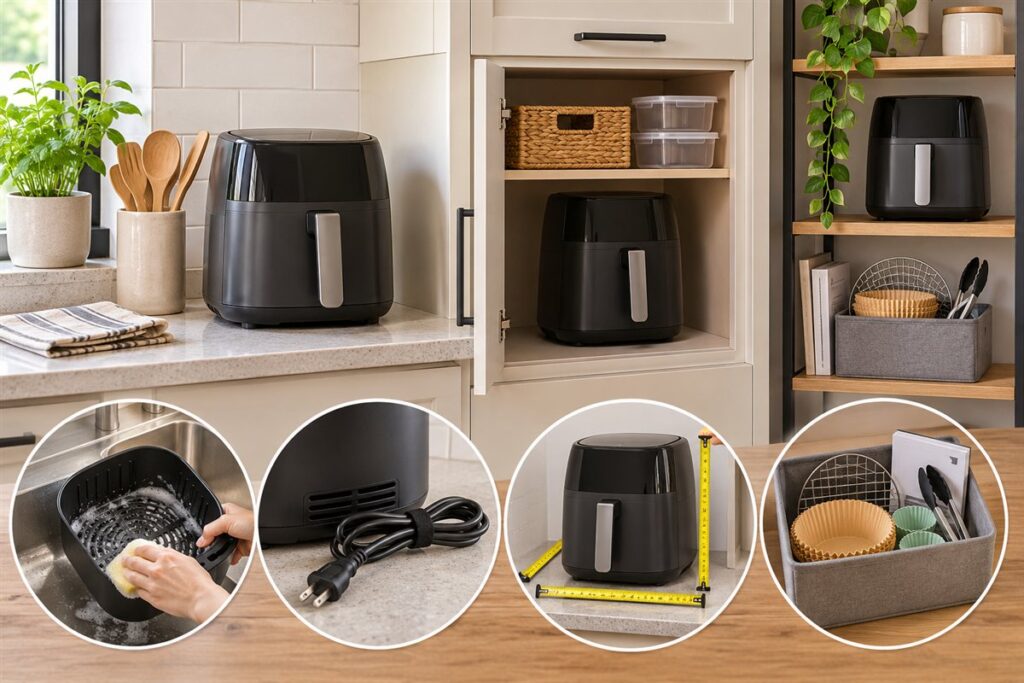
Store an air fryer only after it has cooled, been cleaned, and dried completely. Keep it on a flat, stable surface with free space around it, whether that is a counter or a cabinet shelf. Here is a simple routine and some placement ideas.
Before You Put It Away
- Switch off and unplug the unit, then wait until it is fully cool.
- Remove the basket and tray, and wash and dry them.
- Wipe the inside of the cooking chamber and the outer shell with a soft, slightly damp cloth.
- Let everything air dry so no moisture is trapped inside.
- Loosely coil the cord, without wrapping it tight around the body.
- Put the basket back in place, or store it alongside as the manual suggests.
Counter or Cabinet?
| Option | Good for | Watch out for |
|---|---|---|
| Counter | Frequent use and quick access | Splatter, dust, and heat-sensitive surfaces nearby |
| Low cabinet | Occasional use | Lifting a heavy unit and keeping it level |
| Shelf in a pantry | Saving counter space | Making sure the shelf can bear the weight |
Placement Habits
- Do not stack other items on top of the unit.
- Keep it away from the stove, kettle, or other heat sources.
- Leave space around the vents when it is in use, as the manual advises.
- Keep it away from the sink edge, where splashes could reach it.
- Store accessories in the basket or a nearby box so they stay together.
Long-Term Storage
If you will not use the unit for a while, clean it well and cover it with a breathable cloth or its original box, if you still have it. Choose a dry spot away from damp walls or garage floors. Before using it again, give it a quick wipe and check the cord and plug for damage.
Check on Weight and Lifting
Air fryers can be heavy and awkward. Lift with both hands, bend your knees, and clear your path first. If you struggle to move yours, keep it on the counter in a tidy spot instead.
Think about ease of use, too. A unit that is hard to reach tends to be used less, so if you cook with it weekly, a spot on the counter or a low shelf close to an outlet is often most practical. Never run it while it sits inside a cabinet or under a low shelf, since heat and steam need room to escape. Pull it fully out and place it on a clear surface before you switch it on.
Measuring the Space Before You Commit
Many storage problems begin with a spot that looked large enough but was not. Before you decide where the air fryer lives, measure the unit at its widest, deepest, and tallest points, including the handle, any protruding knob, and the cord loop. Then measure the space, and remember to include clearance. Under a cabinet, a unit with a top vent needs room above it, and the manual will state a minimum distance from walls and ceilings when the appliance is in use.
It helps to think about two positions: where the unit sits when stored, and where it sits when running. They can be different. A shelf might fit a stored unit but be too tight for use, so you will need a plan to bring it to a clearer surface each time. If you will have to lift it, consider the weight and the height, and keep heavy items between waist and shoulder level.
- Measure width, depth, and height with the handle and cord included.
- Check door swing, so a cabinet door does not hit the basket handle.
- Allow room for your hands, not just the unit.
- Look at the shelf rating or material, since thin shelves can sag under a heavy appliance.
- Note outlet position for the moment you plug it in.
Write the measurements on your phone so that you can compare them when you shop for shelving or a new unit.
Small Kitchen and Shared Space Ideas
In a compact kitchen, an air fryer competes with the kettle, toaster, and coffee maker for counter space. A few approaches can help. A deep drawer or lower cabinet works well if the unit is used a few times a week and you do not mind lifting it. A sturdy rolling cart or trolley can serve as a mobile station that moves to the cooking area when needed. Open shelving can be convenient, but the unit will gather dust and grease from the room unless it is covered.
Think about how the air fryer relates to the other things you do in the kitchen. Putting it beside the prep area makes it easier to move food in and out, but it should stay away from the sink, the stove, and any surface that can be damaged by heat and steam. In shared homes or small flats, agree on a spot where everyone can find it, so it is not shoved into a tight space where the vents could be blocked.
- Choose a spot you can reach without climbing or crouching.
- Check that the surface is flat, firm, and heat-tolerant.
- Keep the unit away from curtains, paper towels, and other flammable items.
- Avoid placing it where a child could pull it down by the cord.
If you do not have a heat-safe surface, use a trivet or board that is rated for the appliance, never anything that blocks the air intake underneath.
Organizing Accessories and the Power Cord
An air fryer tends to attract accessories: liners, racks, skewers, silicone molds, baking dishes, tongs, and a manual. Without a plan these end up scattered in drawers, and you find yourself hunting for the right piece. A single container or labeled box that lives next to the unit keeps everything together. Smaller items can be kept in a bag or tin inside the box, so they do not rattle or get lost.
Think about what you reach for most often. Tongs and a silicone-tipped spatula belong within arm’s length. Rarely used items, such as a specialty tray, can go on a higher shelf. If any accessory has sharp edges or points, store it so that it cannot rub against the basket, since that is a common cause of coating damage.
The cord needs attention as well. A long cord left hanging can catch on drawer handles, trail across a worktop, or get pinched in a cabinet door. Use a loose loop and a soft tie, or a cord holder if the unit has one. Do not wrap it tightly around the body, as repeated bending at the same point can damage the insulation over time.
- Use one container for liners, mats, and small tools.
- Keep paper liners flat and dry, away from damp.
- Store the manual in a folder or taped inside the cabinet door.
- Keep the cord clear of hot surfaces and sharp edges.
Household Safety Around a Stored Appliance
Where you keep the air fryer should account for the people and pets in the home. The unit stays hot for a while after use, and its outer shell and basket can cause burns, so it should never be put away or covered while still warm. Children can reach for cords, and a pulled cord may bring the appliance down. Keep the cord short and out of reach, and place the unit towards the back of the surface, away from the edge.
Think about fire safety too. Do not keep the unit near the cooker hob, under a curtain, or beside paper and plastic bags. After using it, check that it is switched off and unplugged if the manual advises it, and that nothing has been left inside. Grease and crumbs left in a unit can attract pests, so food residue is also a household concern, even though cleaning itself is a separate topic.
- Place the unit well back from counter edges.
- Leave open space around the vents whenever it is in use.
- Keep the cord out of reach of small children and pets.
- Do not put anything on top of the unit, particularly cloth or paper.
If your household includes people with limited strength or mobility, choose a storage spot at a comfortable height so no one has to lift a heavy, hot-prone appliance from awkward positions.
Deciding When a Unit Has Outgrown Its Space
Sometimes the difficulty is not how you store it but whether the size suits your home. If you have to rearrange half the kitchen each time you cook, you might use the air fryer less, even if you like what it makes. Ask yourself how often it comes out, whether the capacity suits your household, and whether a smaller or more compact design would suit you better.
When shopping for a replacement or a first unit, check the exterior dimensions on the product listing and not just the stated capacity. Two units with the same capacity can have different footprints and heights. Compare the depth in particular, because a deep unit can stick out past the counter edge. Look at the position of the vents, since rear exhausts need more space behind the unit, while top vents need clearance above.
- Frequent cooks are usually happier with a counter spot, even if it takes space.
- Occasional cooks may prefer a compact unit that tucks into a cabinet.
- Large households may need greater capacity, which affects the footprint.
- Shared kitchens benefit from a standard, easy-to-lift design.
Be honest about habits. The best storage plan is the one that matches how you really cook.
FAQ
Should I keep the packaging?
If you have space, it is handy for moves or long storage, but it is not essential.
Can I leave it plugged in?
Many people do while it sits on the counter. Check your manual, and unplug it if you are away for a long time.
Can I store the air fryer in a garage or shed?
It is better to keep it indoors in a dry, temperature-stable place. Damp, dust, pests, and temperature swings can affect the electrics and finish, so check your manual for storage guidance.
Should I keep the basket inside the unit?
Many people do, which keeps parts together. Make sure everything is completely dry first, and follow the manual if it suggests storing the basket separately.
Is it safe to leave it on the counter next to the kettle?
Leave space between them. Steam from a kettle can reach the vents, and both appliances produce heat. Keep clearance as your manual describes.
How can I protect the unit from dust on an open shelf?
Use a breathable cover or place it in its original box. Avoid plastic bags that can trap moisture, and do not cover the unit while it is warm.
Can I stack a microwave or other appliance on top?
No. Stacking blocks vents and puts weight on the casing. Give the air fryer its own surface.
What is the best shelf height?
A level between waist and shoulder height is easiest, because you can slide it out without lifting overhead or bending far. Avoid storing it above head height.
Does a heavy air fryer need special shelving?
Check the shelf rating or material. Thin or weak shelves can sag under the weight, so a sturdy shelf or the floor of a base cabinet is safer.
The Short Version
Cool, clean, dry, then store flat with space around it. Follow the manual for your model.









