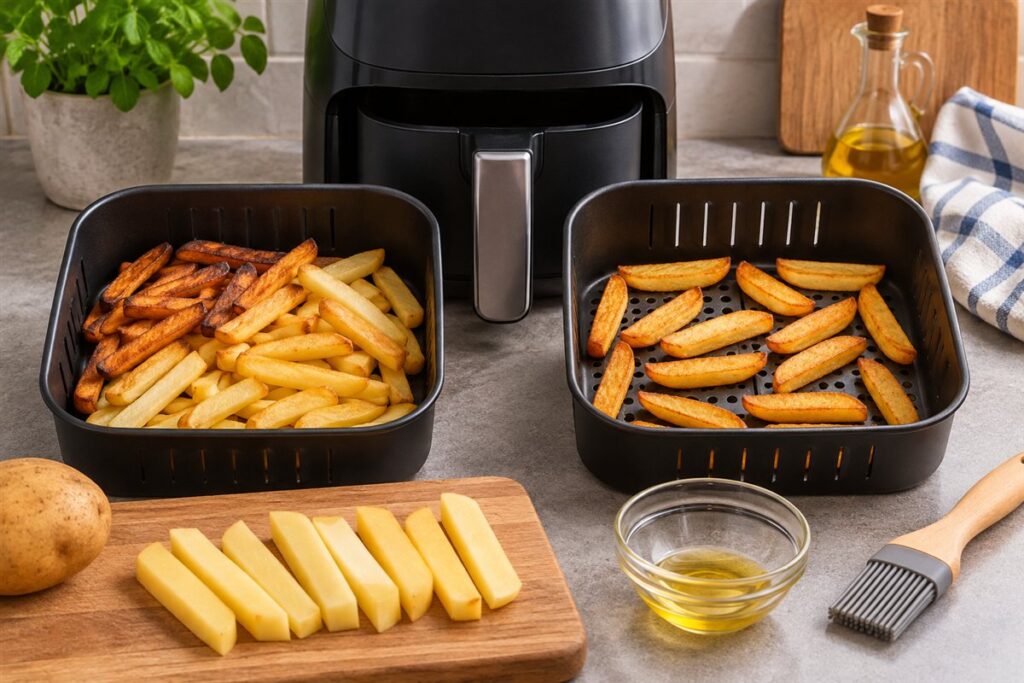
Uneven cooking in an air fryer usually comes from crowding, mixed sizes, or food that was never turned. Work through a few simple checks on how you load the basket and the results often improve right away. If the problem stays no matter what you try, the manual and the maker are the next stop.
Why Food Cooks Unevenly
An air fryer works by moving hot air around the food. Anything that blocks that air, such as a packed basket or pieces stacked on each other, leaves cooler pockets. Pieces of different thickness also finish at different times, even when the airflow is fine.
Step-by-Step Checks
- Cut food into pieces of similar size and thickness so they finish together.
- Spread the food in a single layer where you can, with small gaps between pieces.
- Pat the food dry and coat it lightly with oil so browning is more even.
- Pause partway through the cook, then shake the basket or turn the pieces over.
- Rotate or rearrange items so the ones near the edge swap places with those in the middle.
- Give the machine a short warm-up if your manual suggests one.
Common Causes and Quick Fixes
| What you see | Likely cause | Try this |
|---|---|---|
| Pale bottom, dark top | Food was not turned | Flip pieces halfway through |
| Burnt edges, raw centre | Pieces too thick or cooked too hot | Cut smaller or lower the setting a little |
| Soggy middle of the pile | Overfilled basket | Cook in two smaller batches |
| One side always darker | Uneven airflow in the cooking space | Rotate the basket or tray |
Loose Ballpark Ranges
Many foods land somewhere in the range of 160 to 200 degrees Celsius for roughly 10 to 25 minutes, but this varies a lot by food and by machine. Treat these numbers as a loose guide only, and use the chart in your own manual. Look at the food early and adjust, rather than trusting a single number.
When It Is Not Your Technique
If every batch cooks badly even with small, well-spaced loads, the cause may be the appliance itself. Do not try to open the housing or adjust any electrical parts. Read the troubleshooting section of the manual, then contact the maker for help with a possible fault.
It also helps to keep notes. After each cook, jot down the amount, the setting, and how the food looked, so the next batch can be adjusted with confidence. Small changes made one at a time are easier to judge than several at once.
How Air Moves Through the Cooking Space
Knowing the basic airflow pattern in your air fryer explains most uneven results. In a typical basket-style unit, a heating element and a fan sit above the food. The fan pushes hot air down over the food and around the sides, and the air then circulates back up. The top surface of the food and the pieces near the center get the strongest blast, while the underside and the corners get less.
Drawer-style and oven-style units differ. A drawer model has one compartment and a fan above, so pieces closest to the fan brown first. An oven-style unit with trays usually has a fan at the back, so the back of each tray can run hotter than the front, and upper racks often cook faster than lower ones. Your manual may describe the airflow, and it is worth reading before you decide how to arrange food.
- Top-down units: expect the upper surface to color first and plan to turn food over.
- Rear-fan units: rotate trays front to back partway through.
- Multiple racks: swap the position of racks halfway so each gets time in the stronger air.
- Raised bases: a rack or grid under the food lets air reach the bottom, which reduces a pale underside.
Once you see where your machine tends to run hot, you can put thicker pieces in that zone and delicate ones elsewhere.
Sorting Food into Matching Groups
Even a well-run air fryer cannot make a thick cut and a thin slice finish together. The simplest fix is to sort what you are cooking into groups that behave alike, and cook those groups together or in sequence. Cutting everything to a similar size is the first step, but different foods also need different times, and a mixed load usually means that something is under or overdone.
When you want a whole meal from one load, stagger the additions. Start with whatever takes longest, such as potato wedges or chicken pieces with bones, and then add quick-cooking items such as asparagus, thin sausages, or fish a few minutes before the end. Check your manual for whether the unit allows mixed loads, and keep every item in a single layer where you can.
- List each item and estimate which will take longest.
- Start the slowest item alone for part of the time.
- Add the faster items, placing them where airflow is best.
- Pull out any item that finishes early rather than waiting for the rest.
Dividers made for air fryers, if your model supports them, can separate foods that release different amounts of juices or fat, and they stop flavors drifting between items. Use only the accessories your maker approves, because homemade foil barriers can block airflow or touch hot parts.
Shaking, Turning, and Rotating Technique
Small loose foods respond well to shaking, while larger pieces need to be turned by hand. The aim is the same in both cases: give each face of the food a fair share of the strongest airflow. Without turning, the face that sits against the base of the basket can stay pale and sometimes steams in its own juices.
When to turn depends on the food. Turn too early and a coating can tear or crumbs fall away before they have set. Turn too late and one side may already be dark. A fair guide is to wait until the food has taken some color and releases easily from the basket, then flip. For long cooks, a second turn near the end helps.
- Chips and florets: shake the basket firmly once or twice, using oven gloves, with the unit switched off if your manual advises so.
- Chops, fillets, and nuggets: turn with tongs, taking care not to drag them.
- Layered foods: if you must stack pieces, swap top and bottom layers midway.
- Trays: rotate the tray and also swap shelves if the unit has more than one.
Always use caution when opening or removing a hot basket. Steam and hot oil can cause burns, so keep your face and arms clear and place the basket on a heatproof surface.
Liners, Dishes, and Accessories That Disturb Airflow
Add-ons can quietly cause uneven results. A paper liner that covers the whole base blocks the holes that let air rise through the food. A foil sheet that is larger than the food can lift in the airflow and shade parts of the basket. A baking dish with tall sides shelters the food from the stream of hot air so the edges brown and the middle lags.
That does not make accessories a bad idea. They are useful for sticky, juicy, or messy foods. What matters is choosing ones sized for your model and shaped to leave airflow around them. Look for liners with perforations, dishes with low sides, and silicone items made specifically for air fryers. Check the maker’s guidance on what may be used and what must be avoided.
- Choose accessories that leave a clear gap around all edges.
- Weigh liners down with food before the cycle starts, so they cannot flutter into the fan.
- Pick shallow dishes where possible, and cook a little longer to compensate.
- Remove a liner partway through if its presence leaves the underside pale.
If results improve without the accessory, keep it for the foods that truly need it and cook everything else directly on the basket or rack.
Separating User Error from an Equipment Problem
When results stay uneven, run a simple check before blaming the appliance. Use a food that is easy to compare, such as same-size frozen chips or plain potato cubes, spread in a single layer. Cook for the time shown on the pack and note where the browning is heavier. If one side is always darker no matter how you arrange the food, that points to the way that unit moves air. If the pattern changes when you rotate the basket, it is more likely about your loading.
Also check the basics. Make sure the basket or tray is seated fully, that the vents are clear of the wall or cupboard, and that the unit stands level. A unit pushed up against a wall can recirculate its own exhaust. Make sure that dust, grease, or residue is not blocking the grille, cleaning it as the manual describes.
- Consistent pattern, no matter what: likely a design trait, so adapt by rotating food.
- Sudden change from past use: look for a loose part, blocked vent, or a new accessory.
- Strange smells, noises, or a unit that seems far hotter or cooler than set: stop using it and contact the maker.
Keep your purchase details and model number handy when you contact support, and describe what you tried. That helps the maker decide whether it is a fault covered under the warranty.
FAQ
Should I always shake the basket?
For small loose items like chips or florets, yes, once or twice. For delicate items, turn them gently with tongs instead.
Does preheating help with uneven results?
It can, especially for foods that need a quick sear. Follow the guidance for your model, since not every maker recommends it.
Why is the food at the back of my tray always darker?
Many oven-style models have the fan at the back, so that area gets the strongest air. Rotate the tray halfway through and place thinner pieces toward the back.
Can I cook different foods together in one load?
Often yes, if you stagger the start times and keep each item in a single layer. Start the slower item first, then add quick-cooking food later.
Is a bigger basket better for even results?
A larger basket gives you more space to spread food out, which helps. It does not fix poor airflow by itself, so loading and turning still matter.
Should I preheat to get more even cooking?
It can help because food starts in steady heat from the first minute. Not all makers recommend it, so check your manual and see whether your results improve.
Why is my food pale on the bottom?
The bottom gets less direct airflow and may sit in its own moisture. Use a rack or perforated surface, flip the food, and avoid liners that cover the base.
Do thicker pieces need a lower temperature?
Often, yes. A slightly lower setting lets the center cook before the outside darkens. You can finish with a short hot burst for color.
How can I tell whether my air fryer has a fault?
If it behaves differently from before, runs far off its settings, or shows signs such as odd smells or noises, stop using it and contact the maker. Do not open the housing yourself.
The Short Version
Cut food evenly, leave space for air, and turn it partway through. If poor results continue with good habits, follow the manual and contact the maker.