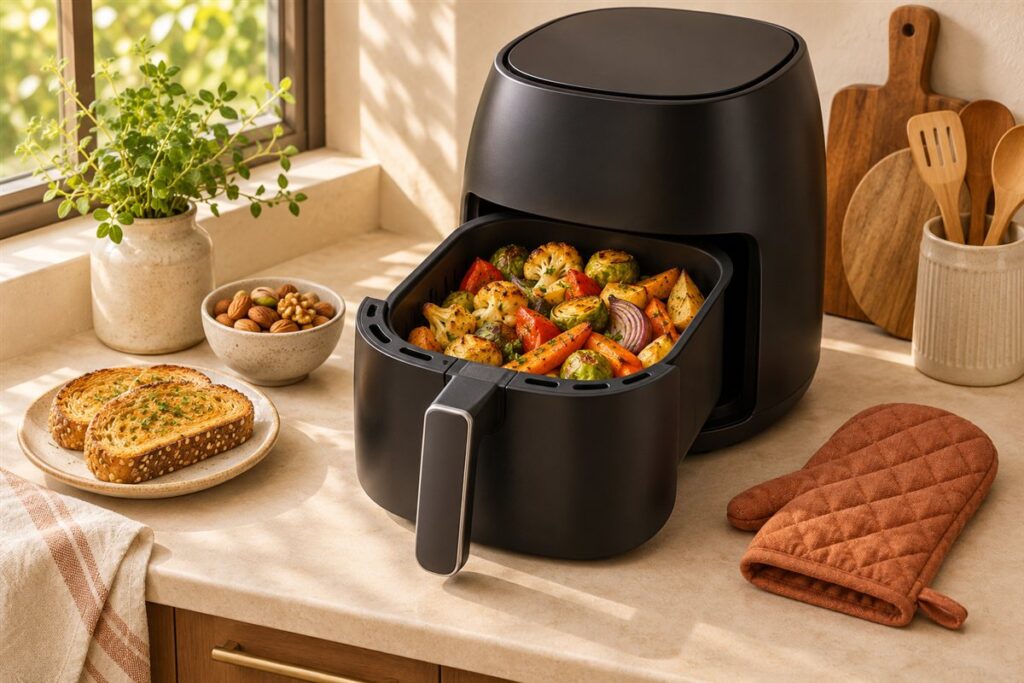
For most households, the answer is found by matching quarts to the number of people you feed and the foods you cook. Smaller capacities suit one or two people, middle sizes suit small families, and larger ones suit big groups or batch cooking. Exact fit varies by maker, so use the ranges below as a guide only.
What a Quart Number Tells You
A quart is a measure of volume, the space inside the cooking container. It does not tell you the shape or the usable floor area. A deep, narrow container can have the same number as a wide, shallow one but hold less food in a single layer.
Some makers also use liters, and some list capacity in pounds of food. Compare in one unit and read the maker’s description.
General Ranges by Household
| Household | Typical capacity range | Notes |
|---|---|---|
| One person | Compact, around 2 to 3 quarts | Good for snacks and small sides |
| Two people | Around 3 to 5 quarts | Handles a main and side |
| Three to four people | Around 5 to 7 quarts | May still need two batches |
| Five or more | Larger or dual-drawer | Helps cut down on batches |
These ranges are rough. Check how much food your model is meant to hold.
Think About What You Cook
- Frozen snacks and vegetables: floor space matters more than depth.
- Whole chicken or roasts: you need height and width to fit them.
- Baking: check that your pans fit.
- Meal prep: a larger unit or a second drawer saves time.
Practical Limits
Bigger units need more counter room and are heavier to move. They may also use more electricity while heating, so check the wattage in the manual. If your kitchen is small, a mid-size model that you can store easily may get more use than a large one that stays in a cabinet.
Whatever size you choose, avoid packing food to the top, as crowding blocks airflow and leads to uneven results.
A Simple Way to Check Your Choice
Think of the last three meals you would have cooked in an air fryer. Picture the food laid out in one layer on a flat tray. If it would fit with small gaps between pieces, the capacity is probably right. If you would need to stack it, you may want a larger size or be ready to cook in two rounds. Planning for how you really cook beats planning for a rare big gathering.
Comparing Quarts, Liters, and Other Capacity Labels
Capacity labels are not standardized, so comparing two models can be confusing. A quart is a volume of about 0.95 liters, so a rough conversion is to treat one quart as slightly under one liter. Some listings use liters, some use quarts, and some give a weight of food the basket is meant to hold. These figures are not directly interchangeable, because food does not fill a basket evenly.
The way a maker measures volume also varies. Some measure the full interior to the brim, others measure the usable space below a fill line. A listing might state capacity for the basket alone or for the entire cooking chamber. To compare fairly, find the same measurement type in each listing, and look at the interior dimensions in addition to the headline number.
Helpful habits:
- Convert everything to one unit before comparing.
- Check whether the listed number includes the space above a fill line.
- Look for basket width, depth, and height in the product details.
- Read the manual’s guidance on maximum fill, which often matters more than capacity.
A weight-based capacity is the least precise for planning, since a pound of fries and a pound of chicken wings occupy different amounts of space. Use it as a hint, then picture the foods you cook and decide whether they would fit in a single layer.
Dual-Zone and Multi-Rack Models
Capacity gets more complicated when a unit has two drawers or multiple racks. A dual-drawer model might list a combined number, but each drawer holds only a part of that total. A large single dish will need to fit in one drawer, not split between both. Check the size of each drawer individually.
The benefit of a dual setup is cooking two foods at once, sometimes with different settings, and some models offer a feature to finish both at the same time. Check the manual for how the drawers share power, since running both at once can change heating or timing. Rack-style units spread food over several levels, which increases total surface area but can lead to uneven results if airflow is limited.
When comparing multi-zone models:
- Look at the capacity of each drawer or rack, not only the total.
- Check whether both zones can run different temperatures.
- Consider the footprint, as these units are larger.
- Think about whether you really cook two foods at once.
For many households, a single mid-size basket is simpler and takes less room. A dual model makes more sense if you often cook a main and side that need different timing, or if you feed several people regularly.
Oven-Style Units and Their Capacity
Some air fryers are shaped like small ovens with a door and trays, and they measure capacity differently. They often list a larger volume than basket models, and they can hold a tray of food at once. This makes them handy for baking, toast, and big batches, but they take more counter space and often a longer time to preheat.
The cooking pattern differs from a basket. Trays create layers, so food on different levels may cook at different rates, and you may need to rotate trays. Racks can also catch drips, so cleaning is a bit more involved. Check how many racks are included and what positions are available.
Questions to ask about oven-style models:
- Does the interior fit the pans and trays I already own?
- How much clearance is needed above and around the unit?
- How easy is it to clean the interior and racks?
- Is the door safe to open at higher temperatures?
Oven-style units suit those who bake or cook for several people. If you cook mostly small portions, a basket model may be simpler. Read the manual for guidance on maximum loads and tray placement, because overloading can reduce performance.
Sizing for Batch Cooking and Guests
If you meal prep or host, capacity matters more. Think about the largest regular batch you cook, such as a week of chicken or a plate of appetizers for a few guests. A larger basket reduces the number of rounds, which saves time and avoids letting early batches cool.
Plan realistically. A basket that can hold a lot by volume might still need several rounds because food must stay in a single layer. In many cases, two rounds in a mid-size unit are acceptable, and holding finished food in a warm oven or covered dish keeps it warm. Remember that crowding reduces crispness, so a bigger basket is useful only if you fill it sensibly.
Consider these planning tips:
- Start with the longest-cooking item and add shorter items later.
- Use a rack to add a second level only if your manual allows.
- Keep finished batches warm in a safe way and serve promptly.
- Combine the air fryer with other appliances for large gatherings.
If you host only once or twice a year, cooking in rounds is usually fine. If you meal prep each week, a larger unit or dual-drawer model may save a noticeable amount of time and be worth the space.
Signs You Bought Too Big or Too Small
After a few weeks of use, you will know whether the capacity fits. If you often cook three rounds for one meal, or food comes out soft because you crowd the basket, you probably need more space. If you regularly cook one small portion in a big basket, or the unit sits unused because it is hard to store, you may have too much.
Other clues come from the kitchen. A large unit that takes over the counter and forces you to move other items might not be worth it. A small unit that never fits your pans may limit what you can make. The right size is one that you reach for naturally.
Watch for these signs:
- Constant batch cooking for ordinary meals.
- Large gaps in the basket on most uses.
- Difficulty finding a spot to use or store it.
- Accessories that do not fit or fill the space oddly.
If you notice these, check the return window and manual guidance before deciding. Sometimes a small change in habits, such as cutting food smaller or using two rounds, fixes the issue. A persistent mismatch is a fair reason to switch to a different size.
FAQ
Is a bigger quart number always better?
No. It only helps if you regularly cook enough food to use the space.
Can a small air fryer feed a family?
It can with batches, though that takes more time. If you often cook for several people, a larger or dual-drawer model may suit you better.
How many liters is a quart?
One quart is a little under one liter, about 0.95 liters. Use this for rough comparison, and check each listing for how the maker measures capacity.
Is a 5-quart air fryer enough for a family?
It depends on the household and the foods. It may handle a main and a side in a couple of rounds. Check the basket dimensions and your usual meals.
Does a bigger quart number mean food cooks faster?
Not necessarily. Cooking speed depends on power, airflow, and how full the basket is. A bigger basket may take longer to heat.
Can I cook two foods at once in a single large basket?
Sometimes with a divider, but timing and flavors may mix. A dual-drawer model is built for this.
What capacity do I need for baking?
Focus on whether your pan fits with room around it, not only the quart number. Measure the basket and the pan.
Should I buy larger than I need just in case?
Usually not. A larger unit takes more space and energy to heat. Choose for your typical use, and cook in rounds for rare larger meals.
The Short Version
Match the quart size to the number of people and the foods you cook, and remember that floor space matters. Treat the ranges here as rough guidance and read the maker’s guide.