Disclosure: airfryerkitchensupply.com is reader-supported. When you buy through links on our site, we may earn an affiliate commission at no extra cost to you.
Where to buy
Weber’s range runs from a fourteen-inch charcoal kettle that fits in a car boot to a stainless flagship gas grill center, and this guide’s job is to place the right Weber in the right backyard. Every linked model below was verified against Amazon’s catalog data connection; check price on Amazon from each link, because Weber pricing and bundle configurations change through the year.
- Weber Spirit E-325 Gas Grill (Propane) — check price on Amazon
- Weber Master-Touch Charcoal Grill, 22-Inch — check price on Amazon
- Weber Genesis E-415 Gas Grill (Propane) — check price on Amazon
- Weber Original Kettle Charcoal Grill, 22-Inch — check price on Amazon
- Weber Traveler Portable Gas Grill — check price on Amazon
- Weber Summit FS38 Premium Gas Grill (Stainless, Propane) — check price on Amazon
Ask ten grill owners to name the best weber grills and you will get ten answers that are really autobiographies: the kettle they learned on, the gas grill that feeds their street, the portable that goes camping. They are all correct, because ‘best Weber’ is not a model — it is a match between a grill’s fuel, format and temperament and the way a particular household cooks. This guide therefore refuses to crown one grill. It gives you the six Webers that, between them, cover nearly every honest use case, and says plainly who each one is not for.
Weber’s dominance rests on three unglamorous pillars. The designs change slowly, so skills transfer between models and decades. The parts ecosystem is unmatched — grates, flavorizer bars, igniters and covers for older grills remain findable long after rival brands orphan their owners. And the cooking geometry, from the kettle’s airflow to the gas lines’ burner spacing, has been refined by more backyard hours than any competitor can claim. You are not buying the cheapest route to hot food; you are buying into the deepest support system in grilling.
The six picks below span charcoal and gas, portable and flagship, because a guide to the best Weber grills that only listed premium gas models would fail the camper, the apartment dweller and the charcoal romantic in a single stroke. Read the verdicts as routing instructions: each one sends a specific kind of cook to a specific grill, and sends everyone else honestly elsewhere in the list.
In this guide
Quick Picks
Weber Spirit E-325 Gas Grill (Propane) — Best Overall. The gas grill most households should actually buy — compact, plumbed-free propane freedom, cast-iron grates and a Boost sear zone for steak night. — Check on Amazon
Weber Master-Touch Charcoal Grill, 22-Inch — Best Charcoal. The charcoal benchmark fully grown: hinged cooking, a lid that parks itself, ash management that respects your patio, and the deepest accessory ecosystem in grilling. — Check on Amazon
Weber Genesis E-415 Gas Grill (Propane) — Best for Crowds. The crowd machine: four burners and Genesis structure for households whose grill is a neighborhood institution. — Check on Amazon
Weber Original Kettle Charcoal Grill, 22-Inch — Best Value. The original, still undefeated on value: a 22-inch kettle that grills, roasts and smokes with nothing but charcoal, air and your growing skill. — Check on Amazon
Weber Traveler Portable Gas Grill — Best Portable. The folding portable that behaves like a real grill — full-size cooking for campsites, tailgates and small patios, then it folds and rolls away. — Check on Amazon
Weber Summit FS38 Premium Gas Grill (Stainless, Propane) — Best Flagship. The flagship statement: stainless construction, rotisserie, infrared broiler and smoker box in Weber’s most complete freestanding gas grill. — Check on Amazon
How These Picks Were Chosen
Because this is the flagship guide for the whole Weber cluster on this site, its selection bar was the highest of the series. Each pick had to be verified in Amazon’s catalog data connection — model, fuel and headline features matching — and each had to be the strongest representative of a distinct grilling life: charcoal purist, gas family cook, crowd feeder, budget traditionalist, traveler and flagship buyer. A model that merely duplicated another pick’s life, however good, did not make the six.
We also weighed what ownership feels like in year five. Weber grills are long relationships: the kettle’s one moving system is a vent, the gas models’ wear parts are standardized and widely stocked, and even the flagship’s electronics sit on a platform with real dealer support. Every pick here can be kept cooking with parts you can actually obtain — a criterion that quietly eliminates many impressive-looking grills from other brands, and some short-lived experiments from Weber itself.
Finally, we protected the budget spread on purpose. The cheapest pick here costs a small fraction of the flagship, and we would defend it in a blind cook-off against grills three times its price for a simple burger night. Best, in this guide, always carries its context with it.
The 6 Best Weber Grills

Weber Spirit E-325 Gas Grill (Propane) — Best Overall
Most households asking for the best Weber should land here. The E-325 gives you the complete modern gas experience — cast-iron grates, three-burner zoning for indirect cooking, a Boost sear zone for steaks — in a compact propane format that fits ordinary patios and ordinary routines. It is the grill that gets used on Tuesdays, which is the highest praise in this category.
Strengths
- Sear Zone with Boost burners handles the one job plain gas grills do worst
- Three burners give a true indirect zone for roasts and whole chickens
- Compact footprint and propane freedom suit the widest range of homes
Trade-offs
- Party capacity tops out around a dozen burgers cooked in waves
- No side burner for pan and sauce work
- Boost zone needs watching — it is genuinely hot
- Key spec (verified): 3 burners; Sear Zone with Boost burners; cast-iron grates
- Fuel/format: Liquid propane, standard 20 lb tank
What makes the E-325 the overall pick is the absence of a wrong note for its audience. It preheats quickly enough for weeknights, sears hard enough for weekends, roasts indirectly well enough for holidays, and stores on patios where a Genesis would dominate the furniture plan. Owners upgrade from it for capacity or permanence — almost never because it failed at a cooking task. In a range full of specialists, the E-325 is the generalist at the top of its game.
Best for: most households wanting one Weber that does everything well / Not suited for: very large gatherings or plumbed-gas converts
Check on Amazon — check the current price on Amazon before you decide.
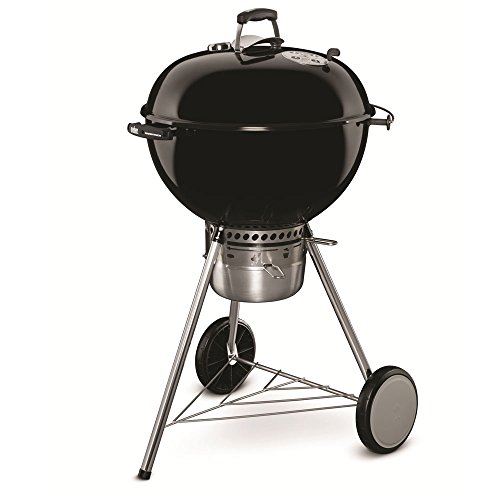
Weber Master-Touch Charcoal Grill, 22-Inch — Best Charcoal
The Master-Touch is what the kettle becomes when Weber fixes every small annoyance of the original: the lid parks in a Tuck-Away holder instead of hunting for a hook, ash sweeps into a proper catcher, and the platform welcomes the Gourmet BBQ System world of inserts. If charcoal is your fuel and one grill must do everything, this is the charcoal Weber to own.
Strengths
- The most versatile charcoal platform Weber makes, with a vast insert and accessory ecosystem
- Tuck-Away lid holder and ash management make it a civilized daily cooker
- Porcelain-enameled kettle shrugs off weather and heat cycles for years
Trade-offs
- Charcoal always costs more time than gas — lighting, ash, patience
- No gas convenience for a spontaneous ten-minute cook
- The accessory ecosystem is a delightful money pit if you let it be
- Key spec (verified): 22-inch; Tuck-Away lid holder; One-Touch cleaning
- Fuel/format: Charcoal (briquettes or lump)
Cooking on a Master-Touch is a skill that compounds. The two-zone fire, the vent dance, the lid thermometer’s personality — within a season you are managing temperature by instinct, and food cooked over real fire carries a flavor gas cannot counterfeit. The Master-Touch’s refinements matter because they remove friction from that learning curve: you adjust vents instead of juggling a hot lid, you sweep ash instead of scooping it. It is the kettle for people who intend to become good at this, and it will keep teaching for a decade.
Best for: charcoal cooks who want one kettle to master completely / Not suited for: weeknight speed seekers or gas-only households
Check on Amazon — check the current price on Amazon before you decide.

Weber Genesis E-415 Gas Grill (Propane) — Best for Crowds
When the grill is a social institution — team parties, family reunions, the Fourth of July — the E-415’s four PureBlu burners and broad cast-iron field turn hosting from batch management into cooking. Everything lands at once, zones hold their temperatures, and the cook gets to attend the party.
Strengths
- Four-burner capacity cooks for a crowd in a single wave
- Genesis structure stays rigid and calm with a full, heavy load
- Cast-iron grates even out the temperature across a big surface
Trade-offs
- Substantial footprint and propane appetite
- More grill than a small household will ever light fully
- Heavier grates to lift for deep cleaning days
- Key spec (verified): 4 PureBlu burners; cast-iron grates
- Fuel/format: Liquid propane, standard 20 lb tank
Big grills fail parties in a specific way: the center races, the edges lag, and the cook becomes a traffic controller. The E-415’s combination of burner spacing and cast-iron mass is engineered against exactly that failure — the surface cooks evenly enough that a full load of chicken finishes together. If your calendar has a dozen big cooks a year, this is the Weber that pays for itself in evenings not spent apologizing for the second batch.
Best for: hosts and big families cooking for eight-plus regularly / Not suited for: couples, small patios or occasional grillers
Check on Amazon — check the current price on Amazon before you decide.

Weber Original Kettle Charcoal Grill, 22-Inch — Best Value
The Original Kettle is the most proven cooking device in this entire guide: a porcelain-enameled bowl, a lid, two vents and seventy years of accumulated technique. It grills beautifully, roasts convincingly and, with a banked fire and patience, smokes respectably. Nothing at its level of simplicity cooks this well, which is why it remains the value pick against competitors with apps.
Strengths
- Unmatched value — decades of service from the simplest possible design
- Grills, roasts and smokes with technique instead of features
- Replacement parts and accessories available everywhere, forever
Trade-offs
- Lid must be hooked or set down — no parking system
- Ash handling is basic compared with the Premium and Master-Touch
- Temperature control is entirely your skill, for better and worse
- Key spec (verified): 22-inch kettle; One-Touch cleaning
- Fuel/format: Charcoal (briquettes or lump)
Every grilling culture on earth has a version of the kettle lesson: fire management is cooking. The Original Kettle teaches it at the lowest possible tuition, and its alumni run most of the backyard barbecue world. Buy it as a first grill and it may be your only grill; buy it as a second grill beside gas and it will steal more Sundays than you expect. Its limitations are real but they are the honest kind — the kind that make you better.
Best for: beginners, traditionalists and anyone buying a lifetime grill on a budget / Not suited for: cooks who want convenience features or hands-off operation
Check on Amazon — check the current price on Amazon before you decide.

Weber Traveler Portable Gas Grill — Best Portable
The Traveler solves the portable problem the Weber way: instead of shrinking a grill until it barely cooks, it puts a real cooking surface on a folding cart with wheels, so it grills like a patio grill at the campsite and then folds flat against the garage wall at home. For apartment patios it doubles as a space-saving main grill.
Strengths
- Full, useful cooking area in a grill that folds and rolls away
- Cart design makes transport and setup genuinely one-person work
- Weber build quality in a category full of disposable camping grills
Trade-offs
- Portable capacity still means batches for a big group
- Heavier than minimalist tabletop portables — it is a cart, not a backpack grill
- Runs best on small canisters for travel; tank use needs an adapter plan
- Key spec (verified): folding cart with wheels; portable propane
- Fuel/format: Liquid propane — canisters for travel, tank via adapter at home
The Traveler’s cleverness is ergonomic rather than thermal: the one-handed fold, the wheelbase that handles gravel, the height that cooks like a real grill instead of a camp toy. Owners consistently report using it more than expected at home, because a grill that sets up in a minute gets lit on evenings a full-size grill feels like a project. If your life splits between a small patio and the outdoors, it may be the only grill you need.
Best for: campers, tailgaters, RV travelers and small-patio households / Not suited for: backpackers or hosts feeding a crowd away from home
Check on Amazon — check the current price on Amazon before you decide.

Weber Summit FS38 Premium Gas Grill (Stainless, Propane) — Best Flagship
The Summit FS38 Premium is Weber’s argument that a freestanding gas grill can be a complete outdoor kitchen: stainless construction, an infrared broiler for steakhouse tops, an integrated rotisserie, a smoker box, a side burner and WEBER CRAFTED grates that accept a system of cooking inserts. It is for the buyer who has priced built-in outdoor kitchens and prefers Weber’s platform in a rolling cabinet.
Strengths
- The most complete cooking toolkit Weber sells in a freestanding grill
- Infrared broiler and rotisserie open techniques other picks here cannot do
- Stainless construction and flagship fit and finish throughout
Trade-offs
- Premium tier pricing that buys a whole second grill elsewhere in this list
- Feature-rich means more components to clean and keep up
- Its talents are wasted on households that grill burgers twice a month
- Key spec (verified): stainless; side burner; infrared broiler; integrated rotisserie; smoker box
- Fuel/format: Liquid propane, standard 20 lb tank
Judge the Summit by technique expansion: the rotisserie produces self-basting roasts no grate can match, the infrared broiler finishes and crusts at temperatures ordinary burners wave at, and the smoker box lets a gas grill flirt honestly with smoke. A cook who will use those tools monthly owns a different category of machine. A cook who will not is buying sculpture. This guide recommends it warmly to the first cook and steers the second, without judgment, to the E-325.
Best for: serious outdoor cooks who will use rotisserie, broiler and smoker tools / Not suited for: occasional grillers or value-first buyers
Check on Amazon — check the current price on Amazon before you decide.
Comparison Table
| Pick | Badge | Key spec | Best for |
|---|---|---|---|
| Weber Spirit E-325 Gas Grill (Propane) | Best Overall | 3 burners; Sear Zone with Boost burners; cast-iron grates | most households wanting one Weber that does everything well |
| Weber Master-Touch Charcoal Grill, 22-Inch | Best Charcoal | 22-inch; Tuck-Away lid holder; One-Touch cleaning | charcoal cooks who want one kettle to master completely |
| Weber Genesis E-415 Gas Grill (Propane) | Best for Crowds | 4 PureBlu burners; cast-iron grates | hosts and big families cooking for eight-plus regularly |
| Weber Original Kettle Charcoal Grill, 22-Inch | Best Value | 22-inch kettle; One-Touch cleaning | beginners, traditionalists and anyone buying a lifetime grill on a budget |
| Weber Traveler Portable Gas Grill | Best Portable | folding cart with wheels; portable propane | campers, tailgaters, RV travelers and small-patio households |
| Weber Summit FS38 Premium Gas Grill (Stainless, Propane) | Best Flagship | stainless; side burner; infrared broiler; integrated rotisserie; smoker box | serious outdoor cooks who will use rotisserie, broiler and smoker tools |
The honest summary of this table is that Weber’s range is a ladder of commitments, not of quality. The kettle at the bottom cooks with the same fundamental competence as the Summit at the top; what climbs is convenience, capacity and technique range. Choose the rung your actual cooking life occupies — most people are one rung lower than their first instinct, and the money saved buys a decade of charcoal, propane and very good meat.
How to Choose the Right Weber for Your Cooking Life
Begin with fuel honesty. Charcoal asks for time and gives flavor and ritual; gas asks for almost nothing and gives speed and repeatability. Neither answer is more serious — competition champions and weeknight parents both exist on each side — but a grill whose fuel fights your schedule becomes patio furniture. If your household grills twice a week in twenty-minute windows, buy gas. If grilling is your weekend craft, buy charcoal and enjoy the apprenticeship.
Next, size by your eighty-percent cook. The grill that fits your normal Tuesday and stretches for your biggest Saturday beats the grill sized for a party you host twice a year. Capacity mistakes are the most common in this category because showroom logic rewards bigness; backyard logic rewards the grill that preheats fast, cleans easily and fits the patio with room for people. Measure the footprint, measure the grate against your real menu, and let the party problem be solved by batches or a borrowed kettle.
Finally, think in decades and parts. A Weber is one of the few appliances where a fifteen-year ownership plan is realistic, which changes the math: features you use weekly are worth paying for, and availability of grates, bars and igniters matters more than launch-year novelty. Buy the Weber whose parts you can still picture ordering in ten years — which, in this range, is refreshingly close to all of them.
Charcoal vs Gas: The Weber Version of the Old Argument
Weber is the rare brand that argues both sides well. Its kettles define charcoal grilling: simple airflow physics, live-fire flavor and a technique culture with generations of written knowledge. Its gas lines define the modern patio: push-button ignition, zoned control and a preheat measured in minutes. The flavor gap is real but narrower than folklore claims — a gas grill with a smoker box and a hard sear produces food most guests cannot distinguish, while charcoal’s edge shows most in long cooks and high-heat searing.
The operational gap is wider. Charcoal costs twenty minutes and an ash bucket per session; gas costs a tank discipline and a slightly larger cleaning surface. Households that grill most often should weight operations over flavor romance, because the best grill is the one that gets lit. Many of the happiest Weber owners eventually run one of each — a kettle for Sundays, a Spirit for Tuesdays — and this guide’s picks are chosen to pair as happily as they stand alone.
What Weber Ownership Actually Costs Over Time
The purchase is the down payment. Charcoal owners spend steadily on fuel and the occasional grate; gas owners spend on propane, flavorizer bars every few seasons, igniters rarely and covers as they weather. None of it is punishing, and Weber’s parts pricing is sane by appliance standards, but the flagship tier does carry flagship parts prices — a Summit grate set is not a kettle grate set. Budget a modest annual ownership line and the grill will never surprise you.
The hidden saving is replacement avoidance. Cheap grills are a subscription: a new one every three or four years as burners rot and frames wobble. A Weber bought once, maintained lightly and fed with standard parts undercuts that subscription within two cycles while cooking better the entire time. That arithmetic, more than any single feature, is the brand’s real value proposition — and why this guide treats even the premium picks as defensible for the right household.
How to Set Up Your First Weber Cook, Whatever You Bought
Every Weber in this guide rewards the same first-session discipline: verify the machine, learn its heat map, and cook something forgiving while you take notes. One careful first cook teaches more than a month of guessing.
- Assemble and position the grill on level ground with working clearance, then inspect it empty: grates seated, drip systems in place, no packing materials anywhere near a burner or a firebox.
- For gas, leak-test connections with soapy water; for charcoal, test the vent movement and ash system dry. Then run a full empty burn-off — gas on high with the lid down, charcoal with a full chimney burned through — to clear manufacturing residues.
- Map the heat: on gas, lay slices of white bread across the grate on medium for two minutes and photograph the browning pattern; on charcoal, hold your hand at grate height across the surface and note where the fire runs hot. Every grill has a personality — learn yours deliberately.
- Season cast-iron or steel grates with the thin-oil ritual while warm, as described in this guide’s care guidance.
- Cook a forgiving first meal — burgers, sausages or chicken thighs — using the heat map: sear over the hot zone, finish over the calm zone, and note times and settings.
- Close down correctly: gas off at the tank after burners, charcoal vents shut to starve the fire. Record what you learned in the notes app you will actually check.
- Clean while warm, oil the grates lightly, empty ash or grease once cool, and cover the grill only when it is dry.
Repeat the bread test once a year. Burners age, vents stiffen and fires change character; a two-minute map refresh keeps your instincts calibrated to the grill you actually own today, not the one you bought.
The Weber Lineup, Mapped: Where Every Family Fits
New shoppers often meet Weber as a wall of similar-looking grills, so here is the map this guide’s picks were drawn from. At the foundation sit the kettles: charcoal, in diameters from travel size to party size, with convenience tiers from the Original through the Performer workstation. Above them in price and complexity, the Q line handles portable gas cooking, and the Traveler folds the portable idea into a cart. The Spirit line is compact family gas, the Genesis line is the heavier family-and-host platform, and the Summit line is the flagship, adding technique tools and installation formats. Every family shares parts philosophy and design language, which is why skills and even accessories migrate with you as you move through the range.
Two cross-cutting decisions overlay that map. The first is grate material: cast iron for searing mass and a small care contract, stainless for forgiveness and coastal durability — available as near-twin models in the gas lines, so the choice must be made deliberately rather than inherited from a listing photo. The second is fuel configuration in gas: propane for freedom, natural gas for permanence, sold as distinct factory builds under similar names. Most ‘wrong Weber’ stories are actually right-model, wrong-overlay stories, which is why this series of guides separates those decisions into their own articles.
The map also explains Weber’s pricing calm. You are rarely paying for cooking ability as you climb — a kettle sears a steak as fiercely as a Summit — you are paying for capacity, convenience, structure and technique range. That is a refreshingly honest ladder, and it means the correct shopping question is never ‘how much Weber can I afford’ but ‘which of my cooking habits am I paying to serve’. The six picks in this guide were chosen as the clearest answer to that question at six different altitudes.
A Weber for a Decade: The Ownership Habits That Matter
The difference between a Weber that serves five years and one that serves twenty is almost never the model — it is four habits. The first is heat discipline: brush the grates while hot, every time, because residue removed hot is a two-minute task and residue removed cold is a project. The second is water discipline: the grill cools before the cover goes on, the cover breathes rather than seals in damp, and charcoal ash never sits wet in the bowl. Rust in this category is a scheduling error, not a material flaw.
The third habit is wear-part honesty. Flavorizer bars, igniters, grates and kettle ash tools are consumables by design — Weber’s genius is making them standard, available and replaceable rather than pretending they are eternal. Replacing a set of bars in year four is not a failure of the grill; it is the system working, and it costs a small fraction of the replacement grill a sealed-design competitor would demand. Owners who internalize this stop fearing wear and start enjoying the machine.
The fourth habit is the annual hour: one full inspection per year — burners and ports on gas models, vents and enamel on kettles, fasteners, wheels and hoses everywhere. That hour, plus the habits above, is the entire secret behind the twenty-year Weber stories you hear from neighbors. There is no product you can buy that substitutes for it, and no Weber in this guide that does not richly repay it.
How Weber Grills Hold Their Value — and When to Buy Used
A used Weber is one of the safest secondhand purchases in the appliance world, for structural reasons: the designs are stable, the wear parts are catalogued, and the failure modes are visible. A kettle can be assessed in two minutes — enamel sound, vents moving, grate honest. A gas grill takes ten: firebox free of rust-through, burners lighting evenly, flavorizer bars intact or priced into the deal, igniter clicking. Anything else the platform needs is a standard part at a standard price, which is why used Webers price by condition rather than by fear.
The used market also clarifies the new market. Models that hold value share the traits this guide selected for: parts availability, design stability and a cooking reputation independent of features. When you buy a new Weber from this list, you are buying into that same afterlife — the grill is an asset with a floor under it, not a consumable with a countdown. That is a rare property in outdoor appliances and a legitimate part of the purchase case.
Two used-buying warnings complete the picture. First, verify fuel configuration on gas models in person — a natural gas grill is a paperweight to a propane household without professional attention, and listings blur the distinction constantly. Second, price the consumables before the handshake: a grill needing grates, bars and an igniter can still be a bargain, but only if the arithmetic was done before money moved. The platform forgives many things; it does not forgive arithmetic skipped.
First Weber, Right Weber: A Decision in Four Questions
Strip away the catalog and four questions choose your Weber. One: which fuel fits your schedule — charcoal for ritual and flavor, gas for speed and frequency? Two: how many mouths, simultaneously, on your biggest normal cook — not your biggest imaginable one? Three: where does the grill live — patio throne, garage corner, car trunk, balcony? Four: how long is this home — a decade justifies permanence and premium structure; a transition argues for propane and portability. Answer those honestly and the range collapses to one or two models, which is why this guide’s six picks map so cleanly onto six answers.
A fifth question, asked last, protects the first four: what will you actually maintain? Every Weber rewards the same light rhythm, but cast iron wants its oil, charcoal wants its ash removed, and flagship features want their components included in the routine. The buyer who answers the fifth question honestly buys a grill that still delights in year five; the buyer who skips it buys a first summer. The range contains no wrong answers — only mismatches, and mismatches are a failure of questions, not of grills.
If you are still torn between two finalists after all five, choose the one that gets lit more often in your imagination’s ordinary week — not the holiday, not the party, the Tuesday. Frequency is the multiplier on every other virtue a grill has. The best Weber, in the end, is the one whose cover is off when dinner is being decided.
The Two-Grill Household: Weber’s Quiet Endgame
Spend time in serious grilling neighborhoods and a pattern emerges: the happiest households run two Webers. A gas grill for the week’s velocity and a kettle for the weekend’s ceremony is the classic pairing, but the variations are personal — a Summit and a Q for the traveling serious cook, a Genesis and a Jumbo Joe for the host who camps. The pattern works because Weber’s ecosystem is shared: skills transfer, tools transfer, fuel habits simplify, and each grill covers the other’s honest weaknesses without either pretending to be universal.
This guide’s six picks were chosen to stand alone, but they were also chosen to pair. If your first Weber leaves a specific hunger — speed, or smoke, or portability — the second Weber is usually already in this list, wearing a different badge. Buy the first one well, cook on it for a season, and let experience, not a bundle deal, choose the second. That is how the great patios are actually built: one honest grill at a time.
The Invitation at the End of the Guide
Guides end; grilling begins. Whichever of these six Webers is currently being unboxed in your imagination, the important next step is not another comparison — it is a first cook, this week, with forgiving food and the setup ritual in this guide performed slowly and completely. Every expert habit in this category was once a beginner’s careful afternoon. Choose your grill, light it properly, take your notes, and welcome to the longest-running cooking club in the backyard world.
One Last Routing Table in Words
If the six picks blur together after this much reading, here is the guide as a single decision flow. Answer fuel first: charcoal sends you to the Master-Touch for refinement or the Original Kettle for value; gas sends you onward. Gas households then answer size: family-standard goes to the Spirit E-325, crowd-standard to the Genesis E-415. Movement answers next: if the grill must fold, roll to storage or travel, the Traveler interrupts every other plan and wins. Finally, technique ambition: the cook who names rotisserie and broiler as monthly habits has exactly one destination left, the Summit. Every path through that flow ends at a grill this guide would defend in a decade — which is the only promise a flagship guide should make.
Common Buying Mistakes
Buying the flagship to ‘grow into it’. Growth in grilling comes from cooking often, and a simpler grill that gets lit twice a week teaches faster than a flagship that feels like an occasion. Buy for this year’s cooking; Weber resale values protect you if you truly outgrow it.
Treating charcoal and gas as rivals instead of tools. The households happiest with their setup usually matched fuel to schedule, not to ideology. Some own both. The wrong fuel, loyally defended, is still the wrong fuel.
Ignoring the parts test. Before buying any grill, search for its replacement grates and wear parts. If they are scarce now, they will be extinct later. Weber passes this test better than anyone — verify it anyway and buy with confidence.
Sizing for the party instead of the week. Oversized grills preheat slowly, eat fuel and discourage weeknight use. Rent, borrow or batch-cook for the annual crowd; live happily with the right-sized grill the other fifty weeks.
Skipping the cover-and-clean routine in year one. Every longevity story in this category is written in the first season’s habits. Ten minutes of care per cook is the difference between a five-year grill and a twenty-year grill.
Final Recommendation
The routing, in one breath: most households should buy the Spirit E-325 and start cooking tonight. Charcoal devotees should buy the Master-Touch, traditionalists and beginners the Original Kettle. Hosts belong on the Genesis E-415, travelers and small patios on the Traveler, and the cook who will genuinely use a rotisserie and infrared broiler has exactly one destination — the Summit FS38 Premium. Every one of these is a defensible ‘best Weber’; the only wrong answer is the one matched to somebody else’s life.
Whichever arrives at your home, give it the careful first cook described above and then use it relentlessly for a month. Familiarity is the feature no specification sheet can sell you, and it is the one that makes any of these six the best grill you have ever owned.
Best Weber 3 Burner Gas Grills Best Weber Grills Charcoal Best Weber Propane Grills Best Weber Natural Gas Grills Best Weber Cast Iron Grills Best Weber Summit Gas Grills
Frequently Asked Questions
What is the single best Weber grill?
For most households, the Spirit E-325 in this guide — it balances size, searing, zoning and price for ordinary family cooking. But the honest answer is conditional: the best Weber is the one matched to your fuel preference, headcount and patio, which is why this guide routes six different buyers to six different grills.
Are Weber grills worth the money over cheaper brands?
Over a long ownership, generally yes. The value is not magic cooking — it is build consistency, a parts ecosystem that keeps the grill repairable for years, and resale value if you upgrade. Cheap grills replaced every few years usually cost more per cooked meal.
Should a beginner start with charcoal or gas?
Gas forgives scheduling and teaches temperature control fastest; charcoal teaches fire craft and delivers live-fire flavor. Beginners who want to grill on weeknights should start with gas; beginners who want a hobby should start with a kettle.
How long do Weber grills last?
Kettles routinely serve for decades with nothing but grate replacements. Gas models serve for many years with flavorizer bars, igniters and grates replaced as wear parts. Longevity tracks cleaning habits more than purchase price.
Can one Weber really grill, roast and smoke?
Yes. A kettle with a two-zone fire roasts and smokes convincingly; a multi-burner gas grill roasts indirectly and can add smoke with a smoker box. Dedicated smokers do long cooks more effortlessly, but a Weber covers the full menu credibly.
Which Weber is best for a small patio or balcony?
The Traveler, for its folding footprint and real cooking area, or a compact Spirit for a fixed patio. Always check your building and local rules first — some balconies restrict fuel types regardless of grill size.
Which Weber should I buy as my only grill for the next decade?
The one matched to your fuel life and household size today, from a family with full parts support — which in this guide means the Spirit E-325 for most gas households and the Master-Touch for most charcoal households. Decade grills are bought on fit and support, not on maximum features.
Are Weber grills hard to assemble?
The kettles assemble in minutes; the gas models take a relaxed hour or two with clear instructions and mostly hand-friendly hardware. Nothing in this guide requires more than household tools and patience, and the larger models repay a second pair of hands.
Does Weber make a grill for an apartment balcony?
Where local rules and building policies permit, the Traveler and the compact Q-class grills are the usual answers for their footprints — but always verify your building’s and municipality’s fuel rules first, since they override any product’s suitability.
What is the best Weber for a complete beginner?
A Spirit gas model for schedule-forgiving control, or an Original Kettle for the fire-craft education — both are in this guide. Beginners succeed fastest on the platform that matches their household’s tempo; there is no prerequisite grill you must suffer through first.
Do Weber grills go on sale?
Pricing moves seasonally and by retailer, and bundles change through the year — which is one reason this guide links you to check the current price rather than printing numbers that would age badly. The model decision should be made on fit; the timing can follow the calendar.
Which Weber holds up best outdoors year-round?
All of the guide’s picks are built for outdoor life with a cover, but stainless-bodied models and kettles shrug off harsh climates most gracefully, while any grill stored under shelter ages slower. Climate should influence format and storage more than brand choice within this range.
Where should I buy my Weber?
From a channel that gives you the verified model and configuration you chose — as the links in this guide do — with the paperwork kept. At purchase, confirm fuel, grate material and model number against your decision one final time; two minutes of verification protects a decade of cooking.


