Disclosure: airfryerkitchensupply.com is reader-supported. When you buy through links on our site, we may earn an affiliate commission at no extra cost to you.
Where to buy
Every grill below was confirmed on Amazon before it earned a link, and Amazon is where you can check the current price on Amazon for each model in the fuel configuration you need. The shortlist: the Weber Spirit E-325 Gas Grill for the best all-round weather-resistant value, the Napoleon Prestige 500 RSIB for premium stainless construction, the Napoleon Rogue PRO 625 for the largest weather-ready cooking area, the Monument Grills Mesa II 410BZ for stainless steel at a mid tier, the Monument Grills Denali 605Pro for big families who leave the grill out year-round, and the Weber Spirit E-210 for compact patios.
The best weather resistant outdoor gas grills are not the ones with the most burners or the shiniest showroom finish — they are the ones still cooking evenly in year five, after five winters of rain, snow, freeze-thaw cycles, and patio neglect. Weather resistance in a gas grill is a materials and design story: what the cookbox, lid, grates, burners, and cart are made of; how water is kept out of the places it destroys; and whether the manufacturer sells the covers, burners, and ignition parts that turn a corroding grill back into a working one. This guide compares six verified gas grills through that lens — porcelain-enameled cast iron, stainless steel grades, enclosed carts, and the honest limits of every material — and it is frank about the other half of the equation: no grill is weatherproof, covers and habits matter, and the most weather-resistant purchase is a well-built grill plus a decent cover plus ten minutes of seasonal care. If your grill lives outside uncovered — as most do — this is the guide written for your actual life.
One more piece of honesty before the reviews, aimed at the reader whose current grill is a rusted lesson in this exact subject. The failure you experienced was probably not one bad part but a sequence: a painted surface breached, corrosion started invisibly, a burner followed, the igniter gave up in the damp, and by the time the grill looked finished it had been failing for two seasons. Every pick below was chosen to break that sequence at its first link — surfaces that do not breach easily — and its last, with parts that can be replaced when time eventually wins a round. Read the trade-offs in each review as the specific places where that grill’s sequence could still begin, because knowing your grill’s weak point in advance is what turns maintenance from guesswork into a short, targeted routine.
In this guide
Quick Picks
- Best Overall — Weber Spirit E-325: Three burners with a sear zone and boost burners, porcelain-enameled cast-iron grates, and Weber’s parts ecosystem — the balanced weather-resistant buy. Check the current price on Amazon
- Best Premium Stainless — Napoleon Prestige 500 RSIB: A stainless steel body with infrared side and rear burners, built as a long-service outdoor fixture. Check the current price on Amazon
- Best Large — Napoleon Rogue PRO 625: Five burners, 74,000 BTUs, 988 square inches, stainless grates, and locking casters for big, exposed patios. Check the current price on Amazon
- Best Stainless Value — Monument Grills Mesa II 410BZ: Four stainless burners, 525 sq in, a broil zone, and foldable shelves at a mid tier. Check the current price on Amazon
- Best for Big Families — Monument Grills Denali 605Pro: A 6+1 burner smart stainless grill with side burner, cover included in the package, and rotisserie capability. Check the current price on Amazon
- Best Compact — Weber Spirit E-210: Two burners and porcelain-enameled cast-iron grates in the smallest footprint here, for balconies and small patios. Check the current price on Amazon
How These Picks Were Chosen
Every grill in this guide was verified: brand and model searched, the returned title matched — burners, fuel, materials, cooking area — and only then linked. Gas grill listings are notorious for configuration sprawl, with the same model name spanning propane and natural gas versions and multiple model years; verification is how we ensure the E-325 linked here is the propane model described, and the Prestige is the stainless RSIB configuration, not a lesser trim wearing the same name.
Selection criteria were weather-first. Materials led: porcelain-enameled cast iron grates and enameled or stainless cookboxes resist corrosion best in this class; stainless steel was judged by role — stainless burners and grates are genuine durability features, while thin stainless decorative panels are not — and each review distinguishes the two. Design came second: enclosed or shielded cart areas, grease management that keeps corrosive drippings contained, ignition systems known for surviving damp storage, and caster and leg construction that tolerates wet ground. Third came the ownership ecosystem: a grill is a decade-long purchase, and the availability of replacement burners, grates, igniters, and fitted covers — Weber and Napoleon are the benchmarks — is a weather-resistance feature in itself, because the grill that can be repaired does not become scrap at the first failed part. Fourth, cooking performance still mattered: even heat, a working sear capability, and burner counts matched to real household sizes, because a durable grill that cooks badly is just a long-lasting disappointment. Price was excluded from scoring; tiers are described in words, and you can check price on Amazon when you shop.
The 6 Best Weather Resistant Outdoor Gas Grills

Weber Spirit E-325 Gas Grill — Best Overall
The Spirit E-325 is the balanced answer to the weather question: a three-burner propane grill with a sear zone and boost burners, porcelain-enameled cast-iron cooking grates, and the build discipline of the line that defines this category. The materials are chosen for outdoor life. Porcelain enamel over cast iron is the grate material that best resists rust while delivering real sear marks, provided the enamel is not chipped by abuse; the enameled cookbox shrugs off rain that would start corrosion on painted steel; and Weber’s decade-deep parts availability means a burner or igniter that eventually succumbs is a replacement, not a funeral. The current generation’s Weber Works rails add a prep ecosystem without changing the durability fundamentals.
Strengths
- Porcelain-enameled cast-iron grates: the best rust-resistance-to-sear ratio in this class.
- Sear zone with boost burners gives genuine high-heat performance in a mid-size grill.
- Weber’s parts and cover ecosystem is the strongest long-term ownership story here.
Trade-offs
- Porcelain enamel chips if struck hard; chipped spots need oil and care to stay rust-free.
- Three burners suit most households but not the largest gatherings.
- The fitted cover is a separate purchase — budget for it; this guide insists.
Key specs (from verified listing): 3 burners, propane, sear zone with boost burners, porcelain-enameled cast-iron grates, Weber Works rails.
The E-325 is the grill we would hand to the median reader of this guide: a household grilling two to five times a week in season, on a patio, in a real climate, expecting the grill to work for many years. Its weather resistance is not one feature but a system — materials, design, parts, covers — and systems are what survive winters. Buy it, cover it, oil the grates a few times a season, and it will outlast most of the patio furniture around it.
Best for: most households wanting a durable, mid-size grill for year-round outdoor storage. / Not suited for: very large gatherings, or owners who will never use a cover. Check the current price on Amazon

Napoleon Prestige 500 RSIB — Best Premium Stainless
The Prestige 500 RSIB is the premium expression of the weather-resistant idea: a stainless steel propane grill with an infrared side burner for true high-heat searing and an infrared rear burner for rotisserie work. Stainless construction, done at this level, is the connoisseur’s weather answer — the cookbox, lid, and components resist the corrosion that ends lesser grills, and the material ages by dulling gracefully rather than by rusting through. The infrared side burner doubles as a weather-independent feature: its intense, wind-resistant heat sears in conditions where a conventional open burner struggles, a practical virtue on exposed patios. This is a grill bought as a fixture, the way you would buy a fixture for the house itself.
Strengths
- Stainless steel construction at a premium level for maximum corrosion resistance.
- Infrared side and rear burners add searing and rotisserie range no standard burner matches.
- Napoleon’s build quality and support suit a decade-plus service expectation.
Trade-offs
- Premium tier in every sense; the value calculation only works across many years.
- Stainless shows fingerprints and weather film; it resists rust, not cleaning.
- Large and heavy — a permanent patio resident, not a movable convenience.
Key specs (from verified listing): Propane, stainless steel, infrared side and rear burner (RSIB configuration).
Choose the Prestige when the grill is a permanent part of an outdoor kitchen or a serious patio, in a climate that punishes equipment — coastal air, hard winters, relentless sun. Its premium is not cosmetic: it is concentrated in materials and burners that determine whether a grill is cooking in year ten. For buyers who grill year-round and regard the appliance as infrastructure, this is the guide’s most defensible large purchase.
Best for: serious grillers in harsh climates wanting a fixture-grade stainless grill. / Not suited for: budget shoppers, small patios, or anyone who moves house often. Check the current price on Amazon
Napoleon Rogue PRO 625 — Best Large
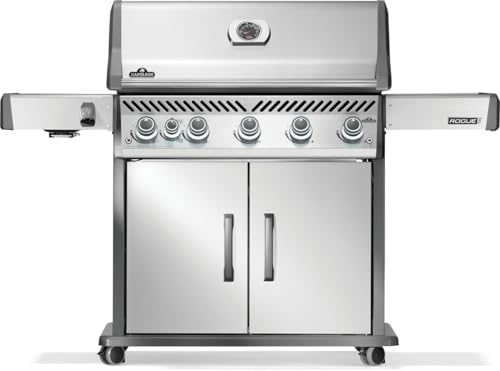
The Rogue PRO 625 scales the weather-resistant formula up: five burners, 74,000 BTUs, 988 square inches of cooking area, stainless steel grates, an infrared side burner, backlit knobs, a folding shelf, and locking caster wheels, per the verified listing. The stainless grates deserve the headline for this guide’s purposes — at this cooking volume, grates are the highest-wear, most corrosion-exposed component, and stainless removes the enamel-chipping concern entirely while tolerating aggressive scraping and weather. The locking casters matter more than they look: a grill this size that can be rolled under an eave for the worst weather, then locked in place for cooking, gets the best of both worlds.
Strengths
- 988 sq in and five burners handle the largest residential gatherings.
- Stainless steel grates maximize durability at the highest-wear surface.
- Infrared side burner and locking casters add searing power and repositioning practicality.
Trade-offs
- Its size demands a large patio and a large cover; measure both.
- More burners and parts mean more eventual maintenance, however good the materials.
- Overkill for households under six; the E-325 serves them better.
Key specs (from verified listing): 5 burners, propane, 74,000 BTUs, 988 sq in, infrared side burner, stainless steel grates, backlit knobs, folding shelf, locking casters.
The Rogue PRO 625 is for the household that hosts: the big family, the neighborhood barbecue anchor, the patio that feeds fifteen on a holiday weekend — in a climate where the grill cannot come inside. Its weather design is honest about scale: durable materials where wear concentrates, mobility for shelter-seeking, and a size that justifies the cover-and-care routine this guide prescribes.
Best for: large families and hosts on exposed patios. / Not suited for: small households or small spaces. Check the current price on Amazon
Monument Grills Mesa II 410BZ — Best Stainless Value
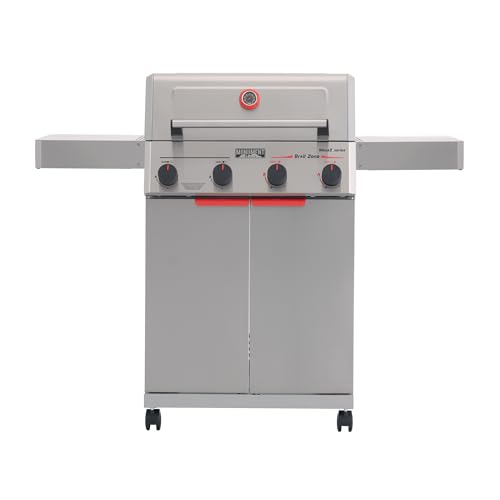
Monument’s Mesa II makes the stainless case at a mid tier: four burners in a stainless steel body, 525 square inches of cooking area, 37,000 BTUs, a broil zone for fast high heat, foldable side shelves, knob controls, and a built-in thermometer. The value argument is material-per-dollar: stainless where the weather hits, in a four-burner format that suits most families, without the premium brands’ price structure. The listing’s claim of reaching 500°F in five minutes speaks to the broil zone’s recovery speed — useful when weather windows are short and dinner cannot wait for a slow preheat.
Strengths
- Stainless steel construction and four burners at a mid tier.
- 525 sq in suits family cooking without the largest footprint.
- Broil zone for fast preheat and searing; foldable shelves save patio space.
Trade-offs
- Stainless grade and gauge at this tier are good, not Prestige-class; covers matter more, not less.
- Monument’s parts ecosystem is younger than Weber’s or Napoleon’s.
- 37,000 BTU total is adequate, not generous, across all four burners at once.
Key specs (from verified listing): 4 burners, propane, stainless steel, 525 sq in, 37,000 BTU, broil zone, foldable side shelves, built-in thermometer (Model: Mesa II 410BZ).
The Mesa II is the rationalist’s pick: it spends on the material this guide cares about and trims the brand premium. Paired with a quality cover — treat the cover as part of this purchase, not an accessory — it delivers the weather-resistant ownership experience at the tier most households can justify. Buyers in severe coastal climates should still weigh stepping up to the Napoleon; everyone else should weigh how many years of grilling the savings represent.
Best for: value-focused families wanting stainless construction. / Not suited for: severe coastal exposure without a cover discipline, or parts-ecosystem purists. Check the current price on Amazon

Monument Grills Denali 605Pro — Best for Big Families
The Denali 605Pro is Monument’s flagship format: a 6+1 burner smart propane grill in stainless steel, 78,000 BTUs, with a side burner, and a package that per the verified listing includes a pizza stone, round cooking plate and grid, a cover, and rotisserie capability. Two details matter for this guide. First, the included cover: the manufacturer bundling the single most important weather accessory signals the intended ownership style — this grill is meant to live outside, protected. Second, the smart features and sheer burner count suit the household that grills constantly and in volume, where the grill is effectively an outdoor range. Six main burners across a big family patio is not excess; it is zones — searing here, holding there, vegetables at a gentler corner.
Strengths
- 6+1 burners and 78,000 BTUs for true multi-zone, high-volume cooking.
- Stainless construction with a cover included in the package.
- Side burner, rotisserie, and included cooking accessories broaden it into an outdoor kitchen.
Trade-offs
- The largest maintenance surface here: more burners, more parts, more cover to manage.
- Smart features add convenience and a failure mode analog grills do not have.
- Its footprint and appetite for propane suit committed grillers, not occasional ones.
Key specs (from verified listing): 6+1 burners, propane, stainless steel, 78,000 BTU, side burner, smart features, cover and rotisserie included in package (Model: Denali 605Pro).
Choose the Denali when the grill is the patio’s main appliance and the household cooks like it — big families, frequent hosting, year-round outdoor cooking in a climate that requires the grill to be genuinely weather-capable. Its included cover and stainless build acknowledge the assignment. Smaller households should take the same philosophy at the Mesa II’s scale instead.
Best for: big families and outdoor-kitchen households grilling year-round. / Not suited for: occasional grillers or compact patios. Check the current price on Amazon

Weber Spirit E-210 — Best Compact
The E-210 shrinks the Spirit formula to two burners for balconies, small patios, and households of one to three — and smallness is itself a weather feature. A compact grill fits under eaves, into a storage corner, or beneath a cover that actually gets used because it takes ten seconds to fit. It keeps the family’s important materials: porcelain-enameled cast-iron grates that resist rust and sear properly, Snap-Jet ignition, and Weber Works rails for the current generation’s accessories. For a single person or a couple, this is the weather-resistant pick most likely to be maintained well, because every care task — covering, cleaning, moving — is easier at this size.
Strengths
- Spirit materials and parts support in the smallest, most manageable footprint.
- Porcelain-enameled cast-iron grates for rust resistance and real sear marks.
- Easy to cover, move, and shelter — the habits that create weather resistance.
Trade-offs
- Two burners and a small grid cap the gathering size hard.
- No dedicated sear zone like the E-325’s.
- Households that grow will outgrow it.
Key specs (from verified listing): 2 burners, propane, porcelain-enameled cast-iron grates, Snap-Jet ignition, Weber Works rails.
The E-210 is the honest compact: it does not pretend to feed a party, and in exchange it gives a small household the full Weber durability system at a scale their space can hold. In apartments with grill-friendly balconies and in small homes where the grill winters against the house wall, it is the pick most likely to still be cooking beautifully in a decade — because its owners can actually perform the care that weather resistance requires.
Best for: singles, couples, balconies, and small patios. / Not suited for: gatherings beyond four to six people. Check the current price on Amazon
Comparison Table
| Pick | Badge | Key spec | Best for |
|---|---|---|---|
| Weber Spirit E-325 | Best Overall | 3 burners, sear zone, porcelain-enameled cast-iron grates | Most households |
| Napoleon Prestige 500 RSIB | Best Premium Stainless | Stainless body, infrared side + rear burners | Harsh climates, fixture installs |
| Napoleon Rogue PRO 625 | Best Large | 5 burners, 988 sq in, stainless grates | Big gatherings |
| Monument Mesa II 410BZ | Best Stainless Value | 4 burners, stainless, 525 sq in, broil zone | Value-focused families |
| Monument Denali 605Pro | Best for Big Families | 6+1 burners, 78,000 BTU, cover included | Year-round outdoor kitchens |
| Weber Spirit E-210 | Best Compact | 2 burners, porcelain-enameled cast-iron grates | Balconies, small patios |
How to Choose a Weather Resistant Outdoor Gas Grill
Start with your climate, honestly classified — not the climate of the region in general, but the microclimate of the specific corner where the grill will stand, which can differ from the street’s weather more than the street’s differs from the next town’s. Mild and dry climates forgive almost any grill; wet climates punish painted steel and reward enamel and stainless; coastal climates are the harshest test in residential life, because salt air attacks everything, all the time, and only genuinely corrosion-resistant materials plus rinsing habits survive it; freeze-thaw climates crack trapped water and heave at seams, rewarding designs that shed water rather than pool it. Match the material to the climate before you match the grill to your menu: in a coastal or very wet setting, the stainless Napoleons and the enameled Webers are not upsells but the actual requirement, while in a mild climate the Mesa II’s tier gives years of service.
Second, read materials by component, not by brochure headline — the word “stainless” in a title tells you almost nothing until you know which parts it describes and which it pointedly does not. The hierarchy of weather exposure runs: grates first (hottest, wettest, most abused — porcelain-enameled cast iron or stainless are the durable answers), burners second (stainless tube burners outlast aluminized steel by years and are replaceable on the good brands), cookbox and lid third (enamel or stainless over painted steel), and cart and panels last (largely cosmetic, though enclosed carts keep tanks and lines drier). A grill advertising “stainless steel” only in its trim panels while hiding aluminized burners has the hierarchy exactly backwards; the picks in this guide were screened against that trick. Third, size for your real gatherings — burners and area you use weekly — because an oversized grill is harder to cover, slower to preheat, and no more durable for its size. Fourth, plan the cover and the spot before the grill arrives: a fitted, vented cover in a breathable weather fabric, on a surface that drains, ideally with an eave or wall breaking the worst of the weather. The grill, the cover, and the spot are one purchase decision, and the cheapest of the three — the cover — protects the most expensive.
Materials, Honestly: Stainless, Enamel, and Cast Iron in the Weather
Stainless steel is not one material but a family of alloys, and its weather performance depends on grade and gauge more than on the word itself appearing in a listing. Higher-grade stainless resists corrosion superbly and is what premium grill bodies are built from; lower grades can develop surface tea-staining in coastal air — cosmetic, cleanable, but a surprise to buyers promised invincibility. Thick gauges also resist the warping and oil-canning that thin panels show after heat cycles. Porcelain enamel is glass fused to metal: on cast-iron grates and steel cookboxes it is essentially rust-proof until chipped, and chips — from dropped tools and thermal shock — are its one vulnerability, managed by handling grates with reasonable care and seasoning exposed spots with oil. Cast iron beneath enamel delivers the heat retention that makes sear marks; bare cast iron, by contrast, is a maintenance commitment that outdoor storage punishes, which is why no pick in this guide uses uncoated grates. Painted steel is the budget material and the honest loser outdoors: once the paint film is breached — a scratch, a hot spot — corrosion starts beneath it. Every pick here avoids painted primary surfaces for exactly that reason. The summary worth remembering: enamel and quality stainless fail slowly and visibly, giving you years of warning; cheap painted steel and thin aluminized parts fail suddenly. Weather resistance is mostly the art of choosing the slow failures.
A word, too, about the components nobody photographs. Ignition systems live in the dampest neighborhood of the grill and are the most common first failure outdoors; designs that shield the igniter and route its wiring away from drips and condensation earn their keep silently, and on the major brands the part is cheap and replaceable when it eventually loses. Grease management is similarly unglamorous and similarly decisive: a system that channels drippings into a removable tray keeps corrosive, salt-laden grease out of the cookbox’s seams and off the cart, while a design that lets grease pool internally is quietly rusting from the inside regardless of how noble its exterior materials are. When you compare grills in a showroom or in listing photos, spend a minute on these two systems — where does the grease go, and how protected is the spark — because they predict the ownership experience better than a fourth burner ever will. The picks in this guide were screened on exactly these unphotogenic merits, which is why some famous names with weaker grease and ignition designs did not make the cut for a weather-specific guide despite being perfectly good fair-weather grills.
How to Set Up and Maintain a Gas Grill for Year-Round Outdoor Life
Setup begins with placement: a level, drained surface, out of the prevailing wind where possible — wind is a cooking problem as much as a weather one, stealing heat and making burners uneven — with the clearances from structures and combustibles the manufacturer specifies treated as law rather than as a suggestion written for other people’s houses. Assemble with the weather in mind: a drop of thread protection on fasteners in coastal homes, the tank stored upright and connected properly, and a leak test with soapy water on every connection before the first cook and at every tank change. Fit the cover from day one, not from the first autumn: covers work by habit, and the habit forms when the grill is new. The maintenance rhythm that produces decade-long grills is short. After cooks, burn off residue at high heat for a few minutes, brush the grates while warm, and let the grill cool before covering — covering a hot, steaming grill traps the moisture you are trying to exclude. Monthly in season, empty the grease tray, because accumulated grease is both a fire risk and a corrosive, pest-attracting mess. Seasonally, inspect burners for blocked ports and corrosion, check igniter function, oil enameled grates lightly if any chips show bare iron, and wash the cover itself so it does not become a mold blanket. In winter in hard climates, either keep grilling — these grills are built for it, with longer preheats — or winterize deliberately: clean thoroughly, dry completely, disconnect and store the tank per local guidance, and cover snugly. A grill maintained on this rhythm does not merely resist weather; it makes weather mostly irrelevant.
Common Buying Mistakes
The first mistake is buying “stainless” by the label rather than by component, ending with shiny trim over rust-prone internals that fail while the brochure surface still gleams. The second is skipping the cover to save a small sum, then watching a large sum corrode — the cover is the highest-return purchase in this entire category, and financing the grill by deleting it is the category’s classic false economy. The third is oversizing: a six-burner grill for a couple is harder to cover, slower to heat, and no more weather-resistant than its two-burner sibling. The fourth is ignoring the parts ecosystem, discovering in year four that a failed burner is unobtainable and the grill is scrap despite a sound body. The fifth is placing the grill in the yard’s worst microclimate — the drip line of a roof, a wind tunnel between houses, a spot that puddles — when a few feet away would have halved its weather exposure. The sixth is treating winter as storage by default and neglecting the cleaning that winterizing requires; a dirty grill under a cover corrodes faster than a clean grill in the open. A seventh mistake is buying for the climate you wish you had: the inland specification purchased for a coastal home, the mild-climate cover chosen for a snow belt. Weather resistance is a local specification, and the buyers who get a decade from their grills are the ones who described their actual yard — its salt, its sun, its wind, its winters — before they described their menu.
Final Recommendation
For most households, the Weber Spirit E-325 is the weather-resistant buy: the right materials, the right size, and the strongest ownership ecosystem. Harsh climates and fixture installs justify the Napoleon Prestige 500 RSIB; big gatherings the Napoleon Rogue PRO 625. Value shoppers should take the Monument Mesa II 410BZ plus a quality cover, big outdoor-kitchen families the Monument Denali 605Pro, and small spaces the Weber Spirit E-210. Continue in the cluster with our live guides to Best Gas Grills That Don’t Rust and Best Selling Gas Grills, and for indoor grilling days, Best Waffle Grills covers the countertop side of the family.
Covers: The Accessory That Decides Everything
Because the cover carries so much of the weather-resistance outcome, it deserves specification-level attention. Fit first: a cover made for your grill’s shape sheds water at the seams and stays on in wind, while a generic rectangle pools water on top — and a pooled cover can hold moisture against the lid for weeks, which is worse than no cover at all. Ventilation second: a good cover has vents or a breathable panel, because a sealed cover over a grill that went to bed damp creates a private greenhouse of condensation; the goal is to block weather from above while letting humidity escape. Material third: heavy, UV-stable fabrics with sealed seams outlast thin vinyl, which cracks in cold and welds itself to hot grills in summer. Fastening fourth: straps or drawcords at the base matter on any patio that sees wind, since a cover in the neighbor’s yard protects nothing. Finally, the human factor, which outweighs all specifications: the best cover is the one light and easy enough that you actually replace it after every cook. If your household’s honest pattern is that a heavy, fiddly cover gets left off “just for tonight” three nights a week, choose the lighter, simpler fitted cover and accept a shorter cover lifespan in exchange for a longer grill lifespan. Replace the cover when it cracks or tears — a failed cover is a moisture trap wearing a costume — and treat its cost as part of the grill’s price from the beginning, because in every honest accounting of outdoor grill ownership, it is.
The Coastal Playbook: Grilling Where the Air Is Salt
Coastal ownership deserves its own protocol, because salt air is not merely “more weather” — it is a different, continuous chemistry experiment conducted on your grill. The rules that emerge from it: favor the highest-grade stainless and enamel in this guide, and treat the mid-tier picks as cover-mandatory rather than cover-optional. Rinse the grill’s exterior with fresh water periodically — a gentle hose-down of the closed, cool grill removes the salt film that otherwise works on the metal daily — and dry it before covering. Keep the grill out of direct sprinkler paths, since irrigation water is often mineral-laden and relentless. Lubricate hinges, caster axles, and fasteners seasonally, because moving parts fail first in salt air. Inspect burners and ignition more often than inland owners do; salt accelerates the port corrosion that makes flames uneven. And store the tank connection capped and clean, because a corroded regulator fitting is the coastal failure that arrives without warning. None of this is burdensome — it is perhaps twenty minutes a season beyond the standard rhythm — but it is the difference between a premium grill lasting a premium lifespan by the sea and merely matching an inland budget grill. The ocean gives coastal grillers the best setting in the world for outdoor cooking; this protocol is simply the rent.
Budget Tiers: Where Durability Money Goes
Without printing prices, the tiers in this category divide by how much of the grill is built from the slow-failing materials. The value tier — the Mesa II’s ground — buys stainless presence and full family size, with the understanding that gauge, grade, and parts depth are a step behind the leaders; paired with a good cover, it is a rational purchase for most climates. The mainstream tier, where the Spirit E-325 lives, buys the complete system: proven materials in every high-wear component, the deepest parts ecosystem in the business, and design refined over generations; for most households this is the tier where durability-per-dollar peaks. The premium tier — the Napoleons — buys fixture-grade construction, infrared capability, and the longest realistic service life, justified when the grill is permanent infrastructure or the climate is severe. Two cross-tier truths complete the picture. First, a mainstream grill with a cover outlasts a premium grill without one in the same yard, so never let the grill’s price consume the cover’s budget. Second, longevity is where premium pricing gets repaid: a grill that serves twelve years instead of five is the cheaper grill across its life, however the stickers compare on day one — provided, always, that the household actually grills enough to use those years.
Wind, Sun, and the Forgotten Weather
Rain gets the blame, but two other elements do quieter damage. Wind is the cook’s enemy first: it strips heat from the cookbox, bends flames away from the food, and makes temperature control a negotiation — which is why placement out of the prevailing wind, or a grill with infrared burners that resist wind by design, matters in exposed yards. Wind is also the cover’s enemy and the light grill’s stability problem, another argument for locking casters and covers that strap down. Sun is the slow enemy: ultraviolet degrades plastic knobs, side shelves, cover fabrics, and ignition buttons over seasons, and it bakes the south-facing side of a grill through thermal cycles that stress finishes. A grill parked in full southern sun ages its polymers years faster than the same grill under an eave, even in identical rain. The practical synthesis is a placement doctrine: out of the roof’s drip line, out of the wind tunnel, out of the harshest sun where the yard allows, on a surface that drains, close enough to the house that covering it is a ten-second habit rather than a trek. More weather resistance is bought by that free decision than by any single feature in this guide — and it explains why two identical grills in two different yards can have entirely different lifespans, a fact worth remembering before blaming or crediting a manufacturer for yours.
Frequently Asked Questions
What makes a gas grill weather resistant?
Materials and design: porcelain-enameled or stainless cookboxes and grates, stainless burners, water-shedding design, protected ignition, and a manufacturer that sells replacement parts and fitted covers. No grill is fully weatherproof — resistance means it survives years of outdoor life with basic care, not that it can be neglected indefinitely. Think of it as the difference between a raincoat and a submarine: the grills in this guide are excellent raincoats, and they still expect you to hang them up properly.
Is stainless steel or porcelain enamel better outdoors?
Both are excellent when done well, and the strongest grills usually combine them across components. Quality stainless resists corrosion and tolerates abuse but can show surface staining in coastal air that needs cleaning rather than indicating failure; porcelain enamel is rust-proof until chipped, after which the exposed spot needs oil and attention. Many of the most durable grills combine them — enameled cookboxes with stainless burners, or stainless bodies with enameled or stainless grates — so judge the whole materials system, component by component, rather than crowning one material in the abstract.
Do I really need a grill cover?
Yes — it is the single highest-value accessory in this category, worth more than a burner upgrade or a tier step in the grill itself. A fitted, vented cover keeps rain, snow, pollen, and debris off the grill while allowing moisture to escape. Even the most weather-resistant grill in this guide will last measurably longer covered, and mid-tier grills depend on one. The only bad cover is a torn, water-pooling, or never-used one; choose fit and ease of use over exotic fabric claims, and replace it when it fails.
Can I leave my gas grill outside all winter?
With the grills in this guide, yes, provided you clean it, dry it, manage the tank safely, and cover it — or keep cooking on it, which many owners in cold climates do with longer preheats and a certain amount of pride. What destroys grills is not winter itself but a dirty, wet grill sealed under a cover for months, quietly corroding in its own moisture. A clean, dry, covered grill experiences winter as a pause; a neglected one experiences it as an accelerator.
How long should a weather resistant gas grill last?
A well-built grill from this guide, maintained on a light rhythm, should serve for many years — a decade is a reasonable expectation for the premium picks, with burners, igniters, and grates replaceable along the way rather than fatal when they wear. Longevity depends more on materials and parts availability than on any single feature, which is why this guide weights them so heavily. The honest variable is the household: a covered, cleaned grill in a mild climate can double the service of the same grill neglected in a coastal yard, so treat lifespan claims — including ours — as statements about a maintained grill.
What is the first thing to fail on an outdoor grill?
Usually the ignition system or a burner, both accelerated by moisture — which is why this guide treats protected ignition, stainless burners, and parts availability as weather features. Grates follow if their coating is breached. The encouraging news is that on the brands featured here, each of those is a replaceable part rather than a death sentence, provided you address it in the season it appears instead of letting corrosion recruit neighboring components.
Is natural gas or propane better for an outdoor grill?
For weather resistance, they are equivalent — the grill’s materials and your cover habits do that work, not the fuel. Propane offers placement freedom and is what most picks here use; natural gas offers unlimited fuel if your home has an outdoor line, at the cost of fixing the grill’s location permanently — which, for weather purposes, can be an advantage if that location is a sheltered one. Choose by your home’s infrastructure, and buy the exact fuel configuration you need, since conversions are model-specific and not every grill offers one.


