Disclosure: airfryerkitchensupply.com is reader-supported. When you buy through links on our site, we may earn an affiliate commission at no extra cost to you.
Where to buy
Every machine in this guide is a complete, standalone washing machine sold on Amazon — no parts, no accessories, no washer-dryer pair bundles. Full-size washers are freight-class purchases, so use the Check on Amazon link under each review to confirm delivery and installation terms for your address before ordering, and measure your laundry space and doorways first. Portable models ship as normal parcels and connect to a sink faucet with the adapters their listings describe.
Introduction
Choosing the best washing machine for pillows is a more specific problem than it sounds. A pillow is the awkward load of the laundry world: bulky but light, absorbent enough to become waterlogged and heavy mid-cycle, and prone to unbalancing a drum when it migrates to one side. Machines that wash clothes beautifully can thump, walk, and error-out on a single pillow — or, at the other extreme, agitate so harshly that they tear ticking and clump the fill. What a pillow actually needs from a washer is a roomy drum with space for the load to tumble, enough water and a soak-friendly cycle to flush detergent out of dense fill, a gentle or bulky-item wash action that cleans without shredding, and a spin strong enough to extract the surprising amount of water a pillow holds. The six machines below — four full-size top-loaders and two fully automatic portables, every one a complete washer verified against Amazon’s catalog data for this guide — were chosen against exactly those criteria. A note before the picks: solid memory-foam pillows should not be machine washed at all in any machine, a honesty point the how-to section covers in detail; shredded foam, down, down-alternative, and polyester pillows are the machine-washable majority this guide serves.
There is also a housekeeping truth behind this search: many people searching for it are not really shopping for an appliance — they are standing in front of a machine that just failed a pillow load, wondering whether the washer or the method is at fault. This guide answers both. The method sections will rescue many existing machines; the picks are for the households whose drums are genuinely too small, whose portables cannot fit a pillow at all, or whose laundry situation has changed. If your current washer is a roomy mainstream model, try the balanced-pair method in the how-to before spending anything. If it is a compact, an aging compact-capacity model, or a twin-tub, the machines below are the honest upgrade path.
Capacity is the headline number, but read it correctly. A 4.5 cu. ft. top-loader swallows two king pillows with room to tumble; a 3.5 cu. ft. machine handles two standard pillows comfortably; the portables in this guide wash one pillow at a time, which is a fair trade for apartment life. Wash action matters as much: impeller machines (a low-profile disc instead of a center post) leave maximum room for bulky items and treat fills gently, while traditional agitator machines scrub harder and can be rougher on ticking — both approaches appear below, matched to the right owners. Spin extraction is the sleeper spec: a pillow can hold several pounds of water, and a machine that spins it properly halves your drying time and prevents the mildew smell that haunts under-extracted pillows.
In this guide
Quick Picks
- Best Overall: Samsung WA50R5200AW 4.5 Cu. Ft. Top Load Washer — a roomy, mainstream full-size drum that takes two pillows in stride. Check the current price on Amazon
- Best for Bulky Pillows: Kenmore 4.5 Cu. Ft. Top Load Washer with Triple Action Impeller — no center post, maximum tumble room, gentle impeller action. Check the current price on Amazon
- Best Mid-Size Full-Feature: BLACK+DECKER 4.1 Cu. Ft. Top Load Washing Machine (BTLW41MW) — stainless tub, glass lid, 10 wash cycles in a full-size footprint. Check the current price on Amazon
- Best Budget Full-Size: Amana NTW4516FW 3.5 Cu. Ft. Top Load Washer — the simple, proven budget top-loader with room for a pair of standard pillows. Check the current price on Amazon
- Best Portable for Apartments: BLACK+DECKER 2.0 Cu. Ft. Portable Washer (BPWM20W) — 15.4 lb capacity, sink quick-connect, washes one pillow properly. Check the current price on Amazon
- Best Compact Automatic: COMFEE’ 1.6 Cu. Ft. Portable Washing Machine — fully automatic, wheeled, with drain pump; one standard pillow per load. Check the current price on Amazon
How These Picks Were Chosen
Every pick is a complete washing machine — that filter eliminated an entire class of misleading results, including laundry accessories, replacement parts, washer-dryer pair bundles, and stacked laundry centers that appear in catalog searches for this search. We then applied the pillow-specific tests. Drum room: at least enough capacity for a pair of standard pillows in the full-size class, or an honest one-pillow brief for portables. Wash action: impeller or gentle-capable cycles favored for fill safety, with agitator machines included where their scrub suits sturdy polyester pillows. Water and rinse behavior: machines suited to the extra-rinse, high-water washing that dense fills need to come out detergent-free. Extraction: spin performance adequate to leave pillows damp, not sodden. The result spans the real market — Samsung and Kenmore mainstream full-sizers, a BLACK+DECKER full-size alternative, Amana’s budget classic, and two fully automatic portables for homes without laundry hookups — because “best washing machine for pillows” is asked by apartment dwellers as often as by homeowners.
The 6 Best Washing Machines for Pillows
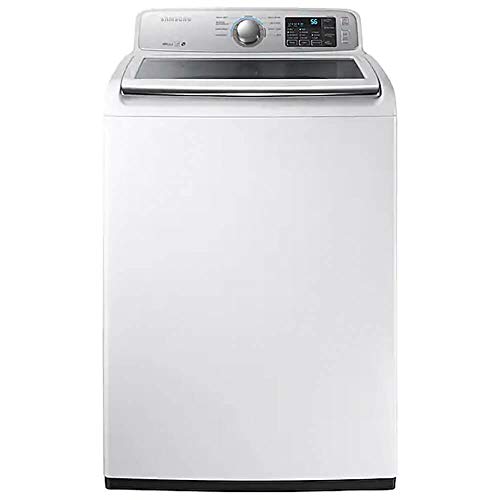
Samsung WA50R5200AW 4.5 Cu. Ft. Top Load Washer — Best Overall
The Samsung WA50R5200AW is the straightforward answer for most homes: a 4.5 cu. ft. white top-load washer from a mainstream maker, with a drum that takes two standard or queen pillows — or one king with room to spare — and lets them tumble instead of packing into a corner. That tumble room is the whole game with pillows: balanced, moving loads wash evenly, rinse clean, and spin without the drum banging that a cramped machine produces. It suits families who wash pillows seasonally in batches and want the same machine to handle the rest of the household laundry without drama. It is a full-size appliance with full-size delivery and installation considerations, and buyers in small apartments should look at the portables below instead. Within its class, it is the balanced default: capacity, availability, and parts support all where they should be.
Strengths
- 4.5 cu. ft. drum fits two pillows with genuine tumble room for even washing and rinsing.
- Mainstream Samsung model — parts, service, and documentation are easy to find for years.
- Full-size versatility: the pillow machine is also the family’s everyday machine.
Trade-offs
- Requires standard laundry hookups and a full-size footprint.
- Top-load format means reaching into a deep drum for small users.
- Delivery and installation logistics are appliance-class, not parcel-class.
Key specs: Top load washer; 4.5 cu. ft. capacity; white; model WA50R5200AW (per listing).
For pillow duty specifically, run this machine the way the how-to section describes: two pillows placed opposite each other, a bulky or heavy-duty cycle with extra rinse, and a full spin. The drum size does the rest — pillows emerge evenly washed and well extracted, ready for a thorough dry. Owners coming from a small or aging washer will notice the difference most in balance: loads that used to thump into an error simply complete. That reliability, repeated across years of laundry, is what best overall means for an appliance.
Best for: most homes washing pillows in pairs, plus everyday family laundry / Not suited for: apartments without hookups
Check the current price on Amazon

Kenmore 4.5 Cu. Ft. Top Load Washer with Triple Action Impeller — Best for Bulky Pillows
The Kenmore’s defining feature is in its name: a Triple Action Impeller instead of a center agitator post. Removing the post frees the drum’s center — exactly where a bulky pillow wants to be — and the impeller’s wash action moves loads with water currents and a rotating plate rather than a twisting post, which is gentler on pillow ticking and fill. The listing also names Express Wash and AccelaWash features and touch controls. It suits owners of king and body-adjacent pillows, down and down-alternative fills that resent rough handling, and anyone whose current agitator machine has ever torn a seam. Buyers who prefer the hard scrub of a traditional agitator for work clothes may find impeller action gentler than they like on that job — though for pillows, gentle is the point.
Strengths
- Impeller design maximizes usable drum room for bulky pillows — no center post to wrap around.
- Gentler wash action protects ticking seams and keeps fills from clumping.
- Full 4.5 cu. ft. capacity matches the largest mainstream pillow loads.
Trade-offs
- Impeller washing relies on proper loading; overfilling defeats the water-current action.
- Touch controls are a preference split — some users prefer physical dials.
- Full-size footprint and hookups required, like all machines in this class.
Key specs: Top load washer; 4.5 cu. ft.; Triple Action Impeller; Express Wash and AccelaWash named in listing; touch controls; white.
Load this machine the impeller way: pillows placed loosely, not stuffed, with water able to circulate — the wash action does its work through movement, and a pillow that can tumble end-over-end comes out uniformly clean. Down-alternative owners in particular will appreciate the combination of room and restraint: enough water and motion to flush detergent from dense fill, without the seam stress that shortens a pillow’s life. If your pillows are the priority load in your laundry room, this is the machine designed around them.
Best for: king and bulky pillows, delicate fills, seam-safe washing / Not suited for: buyers who want traditional agitator scrub for heavy workwear
Check the current price on Amazon

BLACK+DECKER 4.1 Cu. Ft. Top Load Washing Machine (BTLW41MW) — Best Mid-Size Full-Feature
BLACK+DECKER’s full-size entry offers a 4.1 cu. ft. top-load washer with an agitator, a stainless steel tub, a glass lid, an LED display, and 10 wash cycles on a standard 120V connection, per its listing. The capacity sits a step below the two 4.5 cu. ft. picks — still comfortably a two-standard-pillow machine — and the glass lid is a small, real pleasure when washing pillows, because you can see the load’s balance and water level without opening anything. It suits buyers who want a full-size machine with a traditional agitator’s scrub and modern controls, in homes where 4.1 cubic feet covers the family’s loads. Very bulky king pairs will be happier in the 4.5 cu. ft. drums above; for standard and queen pillows, this machine is entirely in its element.
Strengths
- Stainless steel tub and glass lid — durable drum, visible load balance.
- 10 wash cycles give a genuine gentle-to-heavy range for different fills.
- Agitator action suits sturdy polyester pillows that benefit from a firmer wash.
Trade-offs
- 4.1 cu. ft. is a step down in pillow room from the 4.5 cu. ft. picks.
- Agitator action is rougher on delicate ticking than impeller washing.
- BLACK+DECKER’s laundry line is newer to the category than the legacy brands.
Key specs: Top load washer with agitator; 4.1 cu. ft.; stainless steel tub; glass lid; LED display; 10 wash cycles; 120V; model BTLW41MW (per listing).
The honest way to place this machine: it is the traditionalist’s full-sizer. If your pillows are sturdy synthetics, your other laundry includes towels and bedding that like an agitator’s attention, and you value watching a load balance itself through a glass lid, it covers the brief completely. Choose cycle by fill — gentle for anything delicate, normal for polyester — and use the extra rinse the dense fill of a pillow always deserves.
Best for: sturdy synthetic pillows and traditional agitator washing at full size / Not suited for: the bulkiest king pairs or the most delicate fills
Check the current price on Amazon

Amana NTW4516FW 3.5 Cu. Ft. Top Load Washer — Best Budget Full-Size
The Amana NTW4516FW is the budget classic of American laundry rooms: a 3.5 cu. ft. white top-load washer with a simple, proven design and the no-drama control scheme that landlords, first-home buyers, and budget-focused families have relied on for years. For pillows, 3.5 cubic feet is the honest threshold of “full-size enough” — two standard pillows fit and wash properly, and a queen pair is feasible with care. It suits buyers who want a real, serviceable full-size machine at the budget tier and whose pillow loads are standard-size. King-pillow households should step up to the 4.5 cu. ft. picks, and feature hunters will find this machine deliberately basic. What it offers instead is the thing budget appliances should offer: a known model, a simple mechanism, and parts everywhere.
Strengths
- Budget-tier price for a genuine full-size top-loader from an established brand.
- 3.5 cu. ft. drum handles the standard two-pillow wash properly.
- Simple design and controls — easy to use, easy to service, parts widely available.
Trade-offs
- Smallest full-size drum here; king pillows are a squeeze.
- Basic feature set — no luxury cycles or smart functions.
- Traditional wash action needs the gentle cycle chosen deliberately for delicate fills.
Key specs: Top load washer; 3.5 cu. ft.; white; model NTW4516FW (per listing).
There is a particular satisfaction in an appliance that does its job without negotiation, and that is the Amana’s whole character. For pillow washing, that translates to predictable water levels, a spin that gets on with it, and a machine that a local technician can fix with parts from stock if it ever needs fixing. If your pillows are standard size and your budget is real, this is not the compromise pick — it is the correct one.
Best for: budget full-size washing of standard pillow pairs / Not suited for: king-pillow households or feature-focused buyers
Check the current price on Amazon

BLACK+DECKER 2.0 Cu. Ft. Portable Washer (BPWM20W) — Best Portable for Apartments
Not every home has hookups, and the BPWM20W is the portable answer with real pillow capacity: a 2.0 cu. ft., 15.4 lb capacity fully automatic portable washer with 6 cycles, a transparent lid, and the quick-connect sink adapter and drain hose its listing includes. In pillow terms, that capacity means one standard or queen pillow per load, washed properly with room to move — the difference between a portable that genuinely serves this search and the tiny twin-tubs that merely survive it. It suits apartment and dorm dwellers, RV users with space, and anyone adding laundry capability to a home without a laundry room. The trade-offs are the format’s own: one pillow at a time, sink connection setup for each session, and loads that are small by full-size standards. For the homes it targets, it converts an impossible chore into a routine one.
Strengths
- Largest portable capacity in this guide — one real pillow per load, washed with room to tumble.
- Fully automatic cycles with sink quick-connect and drain hose included per the listing.
- Transparent lid lets you watch load balance, which matters with a single bulky item.
Trade-offs
- One pillow per load; a household set takes several cycles.
- Sink-adapter setup each session is a small but real ritual.
- Not a substitute for full-size capacity in a family laundry room.
Key specs: Portable washer; 2.0 cu. ft. / 15.4 lb capacity; 6 cycles; quick-connect sink adapter and drain hose included; transparent lid; model BPWM20W (per listing).
The technique for a one-pillow load in any machine is balance: a single pillow wants a partner, so add a couple of towels to the drum to even the spin — the how-to section details this. With that habit, the BPWM20W washes pillows the way they should be washed: submerged, gently agitated, thoroughly rinsed, and spun dry enough to finish quickly on a rack or in a dryer. For apartment life, that is the entire brief, met.
Best for: apartments, dorms, and RVs washing one pillow at a time / Not suited for: batch washing a household’s full pillow set
Check the current price on Amazon

COMFEE’ 1.6 Cu. Ft. Portable Washing Machine — Best Compact Automatic
The COMFEE’ 1.6 cu. ft. portable is the compact end of the automatic spectrum: 11 lbs capacity, fully automatic operation with 6 wash programs, a drain pump, and built-in wheels, in a magnetic gray finish, per its listing. For pillows, its brief is one standard pillow per load — a down-alternative or polyester standard fits and washes well; oversized and king pillows belong in the bigger machines above. It suits small apartments, single households, and anyone whose pillow set is modest and whose space is tighter than the BLACK+DECKER portable allows. The drain pump and wheels matter more than they sound: they make the machine genuinely movable and genuinely self-draining, which is what separates a portable you use weekly from one that colonizes a closet. Capacity discipline is the price of admission — load it as directed and it performs; stuff it and no small machine can save the load.
Strengths
- Fully automatic programs with drain pump and wheels — the complete portable formula.
- Compact footprint suits the smallest laundry-less homes.
- One standard pillow per load, washed properly rather than crammed.
Trade-offs
- Smallest capacity here; standard pillows only, one at a time.
- Multiple cycles needed for a full household pillow refresh.
- Compact drums are unforgiving of overloading.
Key specs: Portable washer; 1.6 cu. ft. / 11 lb capacity; 6 wash programs; drain pump; built-in wheels; magnetic gray (per listing).
Judge this machine by the standard of its class: does it let a person in a small, hookup-less home wash a pillow correctly, at home, without a laundromat trip? It does — automatically, with a pump to empty itself and wheels to go back in its corner afterward. Keep the one-pillow discipline, balance the load with a towel or two, and it will keep a small household’s pillows on a proper washing rhythm indefinitely.
Best for: small apartments and single households with standard pillows / Not suited for: king pillows or batch washing
Check the current price on Amazon
Comparison Table
| Pick | Badge | Key spec | Best for |
|---|---|---|---|
| Samsung WA50R5200AW | Best Overall | Top load, 4.5 cu. ft. | Two-pillow loads, family laundry |
| Kenmore Triple Action Impeller | Best for Bulky Pillows | Top load, 4.5 cu. ft., impeller | King pillows, delicate fills |
| BLACK+DECKER BTLW41MW | Best Mid-Size Full-Feature | Top load, 4.1 cu. ft., 10 cycles | Sturdy synthetics, agitator wash |
| Amana NTW4516FW | Best Budget Full-Size | Top load, 3.5 cu. ft. | Standard pairs on a budget |
| BLACK+DECKER BPWM20W | Best Portable | Portable, 2.0 cu. ft., sink connect | Apartments, one pillow per load |
| COMFEE’ 1.6 Cu. Ft. Portable | Best Compact Automatic | Portable, 1.6 cu. ft., drain pump | Smallest homes, standard pillows |
Key Takeaways
- Pillows need drum room, water, a gentle-to-bulky cycle, an extra rinse, and a strong spin — in that order.
- Wash pillows in balanced pairs in full-size machines; in portables, wash one pillow with a couple of towels as ballast.
- Impeller machines give bulky pillows the most room and the gentlest ride; agitators scrub sturdier fills harder.
- Solid memory foam should not be machine washed in any machine — check your pillow’s care label first, always.
- Only complete washers appear in this guide — no pair bundles, parts, or accessories dressed up as machines.
- Fully automatic portables beat twin-tubs for pillows: a complete program and a real spin beat hand-transferring a waterlogged pillow.
- Between two machine sizes, pillows argue for the larger drum — they hold their shape and their water, and they grade a washer honestly.
- Protectors washed monthly let pillows be washed seasonally — the rhythm that keeps both pillows and machines in their best years.
How to Choose a Washing Machine for Pillows
Start with your pillow inventory, not with machines. Count the pillows, note their sizes (standard, queen, king, body) and fills (down, down-alternative, polyester, shredded foam — and solid memory foam, which exits the machine-washing conversation entirely). A household washing standard pairs seasonally is served by any full-size pick here; king and body pillows push you to the 4.5 cu. ft. impeller first; a one-person apartment with two standard pillows is the portable brief exactly. Then match format to housing: hookups and a laundry space mean full-size; anything else means portable, and portable capacity — 2.0 versus 1.6 cubic feet — decides whether your queen pillow fits.
Also weigh the unglamorous logistics while you still can: measure the laundry doorway, the stair turn, and the space’s depth with the lid open, because a top-loader you cannot fully open is a daily annoyance and a machine that cannot reach the room is a return. Confirm hookup type — the BLACK+DECKER full-sizer’s listing specifies a standard 120V connection — and plan for hoses and a drain path. None of this is pillow-specific, but pillow washing is a long-relationship task: you will do it seasonally for the life of the machine, and the machine that fits the room is the one still doing it in year ten.
Next, wash action. Impeller machines move loads on water currents and are the gentle, roomy choice for bulky and delicate fills. Agitator machines scrub with a post: sturdier fills tolerate and sometimes benefit from it, but the post eats drum room and can stress seams. Front-load machines — not represented in this verified roundup — are also gentle and roomy in principle; if you prefer that format, apply the same capacity and cycle criteria and confirm the specific model before buying rather than assuming. Finally, the pillow-specific features to value in any listing: a bulky/bedding or heavy-duty cycle, an extra-rinse option, a deep-fill or high-water setting for dense loads, and the strongest spin the machine offers. Brand support matters for a decade-long appliance — every pick here is a named model from a maker with a parts network, which is the correct risk profile for a machine you will ask to spin waterlogged pillows for years.
How to Wash Pillows Properly, Step by Step
- Step 1: Read the care label. Down, down-alternative, polyester, and shredded foam are usually machine washable; solid memory foam is not — spot-clean it instead and never submerge it.
- Step 2: Inspect seams and ticking; a small tear becomes a drum full of fill. Repair or retire damaged pillows before washing.
- Step 3: Load for balance: two pillows opposite each other in a full-size drum; one pillow plus two towels as ballast in a portable.
- Step 4: Use a small amount of liquid detergent — pillows trap detergent, and excess is the main cause of musty, clumpy results. Skip fabric softener.
- Step 5: Select a gentle or bulky/bedding cycle with warm water (per the label) and always add an extra rinse; dense fills need it to come out soap-free.
- Step 6: Run the highest suitable spin. A well-extracted pillow dries in hours; a sodden one mildews.
- Step 7: Dry completely — tumble dry on low with dryer balls or clean tennis balls to break up fill clumps, or air-dry in sun with frequent fluffing. A pillow is done only when the center is dry; surface-dry is how mildew starts.
- Step 8: Fluff, reshape, and let pillows rest a few hours before use; fill loft returns as the last moisture leaves.
One more capacity nuance deserves attention before you order: pillow size labels lie by omission. A “king” pillow is roughly twenty inches longer than a standard, and two of them in a 3.5 cu. ft. drum leave no room for the tumbling that does the cleaning — the load becomes a plug that rotates as one mass, washing its outside and rinsing nothing. The 4.5 cu. ft. class exists in this guide precisely for that geometry. Conversely, a standard pair in a 4.5 drum has room to spare, which is not wasted space: it is wash quality. When in doubt between two sizes of machine, the pillow load argues for the larger drum more strongly than almost any other laundry you own — sheets and towels compress, but pillows hold their shape and their water, and they grade your machine honestly.
Fill-by-Fill: What Each Pillow Type Asks of a Washer
Down pillows are the aristocrats: light, lofty, and intolerant of rough handling and detergent excess. They want the impeller’s room, warm water, a fraction of the normal detergent dose, two rinses, and a patient tumble dry with dryer balls until every cluster is separated and dry — under-dried down smells, and the fault is the drying, not the washing. Down-alternative (polyester microfiber clusters) is the forgiving middle class: machine washable in any pick here, tolerant of agitator or impeller, and mainly demanding an extra rinse and a complete dry. Hollow-fiber polyester pillows are the sturdy working class — the agitator machines suit them, they wash in pairs happily, and their main enemy is heat, so dry on low. Shredded foam pillows wash like down-alternative provided the inner liner is intact and zipped or sewn closed; check that liner twice, because a failed one turns a wash into a confetti incident. Buckwheat and other hull fills are never machine washed as a whole pillow — the hulls come out and are aired or sunned separately. And solid memory foam, to repeat the point that protects the most pillows: never machine wash, never submerge; spot-clean the foam, wash the removable cover, and air thoroughly.
Why Machines Thump on Pillows — and How the Right Machine Prevents It
The thumping, walking washer is a balance problem, and pillows are balance’s hardest exam. A waterlogged pillow is a dense, mobile mass; when it settles on one side of the drum, the spin cycle becomes a centrifuge with a brick in it. Three defenses exist, and this guide’s picks were chosen with all three in mind. The first is room: a drum large enough that the load can redistribute — the reason capacity leads every review above. The second is load discipline: pairs opposite each other, or ballast towels in a single-pillow portable load, so the mass starts balanced. The third is the machine’s own balance handling during spin-up, a behavior mainstream full-size machines have refined over generations. If your current machine thumps on pillows, the diagnosis is usually drum size or loading, not a broken appliance — and the cure is one of the roomier picks here plus the loading habits in the how-to. Persistent violent imbalance on balanced loads, by contrast, is a service call, not a shopping problem.
Top-Load vs. Front-Load for Pillow Duty
All six verified picks in this guide are top-loaders or portables, which invites a fair question about front-load machines. In principle, a front-loader is an excellent pillow washer: its tumbling action is gentle, its drum has no post, and its high spin speeds extract superbly. In practice, front-loaders ask two things of pillow loads — enough drum size that the pillow tumbles rather than plastering itself to the glass, and a bulky or bedding cycle that adds the water dense fills need, because front-loaders sip water by design and a thirsty pillow can otherwise wash in its own absorbed puddle. If you already own a roomy front-loader with a bedding cycle, you likely do not need this guide’s machines at all; use the how-to method and the extra rinse. If you are buying new for pillows first, the top-load format earns its sweep of this roundup honestly: deep-fill water levels, easy mid-cycle access to rebalance a load, and no door seal to keep clean. Buyers set on front-load should apply this guide’s criteria — usable drum room, bedding cycle, extra rinse, strong spin, verified model — and confirm the specific listing before purchasing, the same standard applied to every pick here.
Portables and Twin-Tubs: An Honest Word on the Smallest Machines
The portable category hides two very different species. The fully automatic portables in this guide — the BLACK+DECKER and COMFEE’ — work like real washers in miniature: fill, wash, rinse, and spin on a program, with a drain pump to empty themselves. The other species is the semi-automatic twin-tub, sold under many names, where you fill the wash tub by hand, transfer the load to a separate spin tub, and manage every stage yourself. Twin-tubs wash clothes adequately for their fans, but for pillows they are the weakest tool in the category: the wash tubs are small, the transfer of a waterlogged pillow is awkward, and the spin tubs are narrower than most pillows. That is why no twin-tub appears among the picks despite their prominence in catalog searches — this search deserves machines that wash a pillow completely and automatically. If budget absolutely forces the twin-tub route, treat it as a one-small-pillow, fully supervised process; if you can reach the automatic portables, they are the correct small-space answer and the ones this guide stands behind.
Common Buying Mistakes
- Buying by headline capacity alone. A cramped 4.5 with a tall agitator can hold less pillow than a roomy impeller design; usable room is the real spec.
- Washing one pillow alone in a full-size drum. The imbalance that follows is the load’s fault, not the machine’s — pair up or add ballast.
- Machine washing solid memory foam. It tears, waterlogs, and never dries properly; no machine in this guide changes that.
- Using full detergent doses. Dense fills trap soap; residue causes clumps and mustiness. Less detergent, extra rinse.
- Accepting a pair bundle or accessory as “a washing machine.” Catalog searches surface bundles, parts, and gadgets; this guide’s picks are all complete standalone washers.
- Under-drying. The wash gets blamed for mildew that the drying caused. Dry to the center, every time.
- Skipping the seam check. Five seconds inspecting ticking prevents the one laundry disaster nobody forgets: a drum full of loose fill.
- Washing pillows without protectors the rest of the year. The seasonal deep wash cannot undo eleven months of unprotected soiling; protectors are the system, the machine is the backup.
Protecting the Investment: Pillow Protectors and a Sane Washing Rhythm
The cheapest way to make any of these machines better at washing pillows is to wash pillows less often — by protecting them. A zippered pillow protector under the pillowcase intercepts the sweat, oils, and drool that soil a pillow, and protectors wash in any load, in any machine, without balance drama. With protectors on a monthly rhythm, the pillows themselves need their deep wash only two or three times a year, which is gentler on fills and seams and kinder to the machine. When a pillow does come due, batch the household’s pillows through the machine in balanced pairs on one laundry day, dry them completely in rotation, and let each rest before it returns to a bed. That system — protectors monthly, pillows seasonally, method every time — is what the right machine enables, and it is the actual product this guide is selling: not a washer, but a household where pillows are clean by routine rather than by crisis.
Final Recommendation
Most homes should buy the Samsung WA50R5200AW: its 4.5 cu. ft. drum, mainstream support, and balanced behavior make pillow washing a routine load instead of an event. If your pillows are king-size or delicate-filled, the Kenmore impeller is the specialist to choose; if you prefer an agitator’s scrub in a full-featured mid-size, the BLACK+DECKER BTLW41MW covers it; and the Amana is the correct budget answer for standard pairs. Apartment households should match the portable to the pillow: the BLACK+DECKER BPWM20W for queen capacity, the COMFEE’ for the smallest footprint. Whichever machine you choose, the method in the how-to section matters as much as the metal: balanced loads, little detergent, extra rinse, full extraction, complete drying. For the other half of the system, see Best Washable Bed Pillows, Best Down Pillows You Can Machine Wash, and Best Pillows That Can Be Washed. Outdoor cushions have their own version of the same problem — see Best Washable Outdoor Pillows.
Frequently Asked Questions
How many pillows can I wash at once?
In a full-size machine, two — placed opposite each other for balance. That holds for standard and queen sizes in the 3.5 cu. ft. Amana, and the 4.5 cu. ft. machines add king capability. In the portables here, wash one pillow per load, with a couple of towels as balancing ballast.
Can I machine wash a memory foam pillow?
Not if it is a solid foam pillow — submerging and agitating solid memory foam tears its structure and it dries extremely poorly. Spot-clean the foam, machine wash its removable cover, and air it thoroughly. Shredded foam pillows in a sealed inner liner are the exception and wash like down-alternative.
Which is better for pillows: agitator or impeller?
Impeller, for most pillow owners: no center post means more room and a gentler ride for seams and fills. Agitators scrub harder and suit sturdy polyester pillows, but they cost drum space and can stress delicate ticking. Both styles appear in this guide matched to those briefs.
Can I wash a body pillow in these machines?
A full-length body pillow is the extreme case: in the 4.5 cu. ft. machines it fits folded or coiled with modest room, and it should be washed alone with the bulky approach — extra water, extra rinse, and a patient spin, accepting that balance may require a mid-cycle reposition. In the 3.5 cu. ft. Amana it is a squeeze that most owners will find impractical, and in the portables it does not fit at all. If body pillows are central to your household, let that single fact choose the Kenmore or Samsung class for you.
Why do my pillows smell musty after washing?
Almost always incomplete drying or trapped detergent. Use less detergent, always select the extra rinse, spin on the highest suitable setting, and dry until the center of the pillow is fully dry — then a few hours more of airing before it goes back on the bed.
Do I need a machine with a dedicated bedding or bulky cycle?
It helps but it is not mandatory. A bulky or bedding program typically adds water, lengthens the wash, and moderates the spin-up to keep big items balanced — all pillow-friendly behaviors. Without one, you can assemble the same recipe manually on most machines: gentle or normal cycle, highest water level or deep-fill option, extra rinse, and a full spin. What is mandatory is the drum room and the loading method; cycles refine the result, geometry decides it.
How often should pillows be washed?
For most households, two to three times a year keeps pillows fresh, with protectors washed monthly in between. Allergy-managed homes often wash more frequently. A machine with genuine pillow capacity — the point of this guide — is what makes that rhythm realistic.
My current washer thumps and stops on pillows. Is it broken?
Probably not. Thumping and imbalance errors on pillow loads usually mean the drum is too small for the load to redistribute, or a single pillow was washed alone and settled on one side. Try the balanced-pair method — or one pillow with towel ballast in a small machine — on a bulky cycle with a full spin. If a properly balanced, reasonably sized load still triggers violent imbalance, then a service call is warranted; but in most homes the cure is room and loading, which is what the larger picks in this guide provide.
What cycle and water temperature should I use for pillows?
Follow the care label first. In general: a gentle or bulky/bedding cycle, warm water for synthetics and down-alternative, and the label’s guidance for down. Always add the extra rinse, use roughly a third of a normal detergent dose in liquid form, and finish with the strongest spin the fill tolerates. The cycle choice matters more than the machine tier — a budget washer on the right program washes a pillow better than a premium washer on a harsh, short one.
Will a portable washer really clean a pillow?
Yes, within its size brief: one standard or (in the 2.0 cu. ft. BLACK+DECKER) queen pillow per load, balanced with towels, on a full automatic cycle. What portables cannot do is batch work or king sizes — that is a capacity fact, not a cleaning-quality failing.

